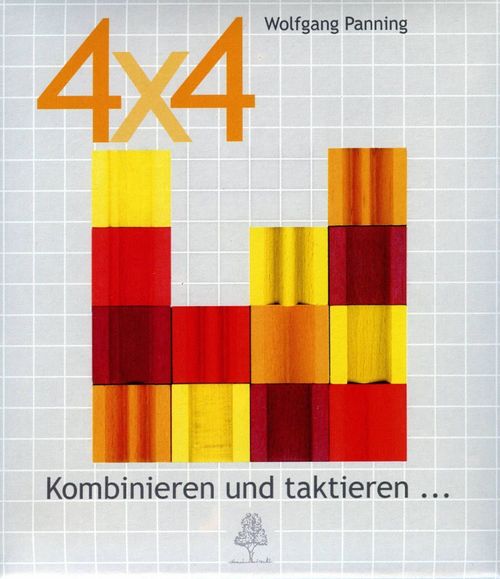
4 X 4
4 X 4 Rulebook
Table of Contents
Table of Contents
I. Components
- 16 different building blocks in four colours
- 4 boards
- 1 rules sheet
II. Object of the Game
Taking turns, the two players build a wall of four blocks across and four blocks high. Each of these blocks has one of four different shapes milled into each of two opposite sides.
The player who manages to form a row of four identical shapes, or a row of four different shapes, horizontally, vertically or diagonally wins the game.
III. Setup
Before the first game it is advisable to look at the blocks closely. Each block is unique, yet all of them follow a strict system. They are also designed so that from above one can see which shapes are on both sides. Since the game depends heavily on recognising the shapes, make sure the lighting is good.
Place the blocks on the spaces of the boards that match their shape and colour. (Fig. 1)
Fig. 1 caption: The different shapes are named T, U, V and W according to their design as seen from above.
The boards should give an overview of the blocks at all times. They must therefore be visible to both players. (See also the section "End of Game and Scoring.")
During play, blocks are taken down from the boards and built into the wall.
IV. Course of Play
A starting player is determined. This player takes a block from any board and places it in the middle, between themselves and their opponent. They orient the block so that they can see the chosen shape; the other shape automatically faces their opponent. (Fig. 2)
The opponent then takes a turn.
Each new block must be placed in the same orientation, directly next to or on top of an existing block. (Fig. 3) A player may decide whether to build upward or sideways.
In the bottom row the blocks must always be built as a closed row. From the second row upward this is no longer required.
Turn by turn, a wall takes shape between the two players, with up to four blocks side by side and at most four blocks on top of each other.
Colour Rule
When building the wall, the following COLOUR RULE applies:
In every horizontal and vertical row, only one block of each colour may be built into the wall. (Fig. 4)
The player who is not on turn watches to make sure the opponent observes the colour rule. A block placed incorrectly is returned to its board, and the same player is on turn again.
The colour rule can mean that, by the choice of a colour, the wall cannot be completed and blocks are left over:
Fig. 4 example: These blocks may not be placed.
Example 1 (Fig. 5): The dark red block is the last block that can be placed. Any further block violates the colour rule in every case. 5 blocks remain!
Example 2 (Fig. 6): In the second horizontal row, a yellow and an orange block are missing. If the yellow block is placed on the dark red block of the bottom level, no further block can be built on the orange block of the bottom row. The orange block missing horizontally is not allowed vertically. (The wall can then consist of at most 13 blocks.)
If, on the other hand, the yellow block is placed on the existing orange block, the second row can be completed in full.
Note: This example takes on a special significance in the professional rule (Profiregel).
Each player should be able to see only their own side. Information about the opposite side can be drawn from the upper faces of the visible blocks in the wall and from the boards.
V. End of Game and Scoring
V.1. The Row of Four
As soon as a row of four, consisting of four identical shapes or the four different shapes, has formed on one side of the wall, viewed horizontally, vertically or diagonally, the game ends immediately. Remaining blocks are no longer built.
- The player who placed the last block wins if a row of four has formed only on their side.
- Since every block also places a shape on the opposite side, the win condition can be met unintentionally by the opponent. In such a case, the opponent has won.
- The opponent also wins if, in a single turn, rows of four are formed on both sides.
Fig. 8 caption: ROW OF FOUR. Example of scoring: The orange block was placed last. Two rows of four have formed. (That the win condition is met twice is irrelevant!)
V.2. The Rows of Three
If the last possible block in the wall has been placed and no row of four has formed, the players score one point for each horizontal, vertical or diagonal row of three identical shapes. The player with the highest score wins. A draw is possible.
Fig. 9 caption: THREE-ROWS. Four rows with three identical shapes each result in four points in total.
Tip!
For players who want to determine an overall winner after a previously agreed number of games, the following point scoring may be tried:
- A win by row(s) of four earns a flat 7 points.
- The loser scores one point for each row of three. Each row of four of the loser is also scored with one point, but only if it consists of identical shapes.
- In games without a row of four, each player notes the points they received for rows of three.
- The player who reaches the highest score wins.
(The starting player should of course change with each new game.)
VI. The Professional Rule (Profiregel)
Note: The professional rule should only be tried by players who have gained enough experience with the basic rule.
The Intervention
If a player recognises that the block just placed by the opponent makes it impossible to complete the wall, they may raise an objection and demand that the last block be taken back.
The block is returned to its place on the board. The player who placed it remains on turn. They need neither take the same block nor build in the same place.
If, after their own move, a player recognises that the block they just placed makes it impossible to complete the wall, they may take it back only with their opponent's permission.
(The printed German reads "darr" here; this is evidently a typo for "darf", "may", and is translated accordingly.)
The period in which an intervention can be made ends immediately when the next player has placed a block. A move made before the previous one, or earlier, cannot be challenged.
The wall is not corrected, and in any case it will consist of fewer than 16 blocks.
If a player notices such a situation, they announce it to their opponent.
From then on, no intervention may be raised anymore.
Fig. 10 caption: The intervention. This situation is already known from Fig. 6. An intervention may be made!
Fig. 11 caption: In this example there are 6 possibilities for the choice of colour for a block.
VII. Final Word
For players who want it a little harder, leaving out the boards is recommended.