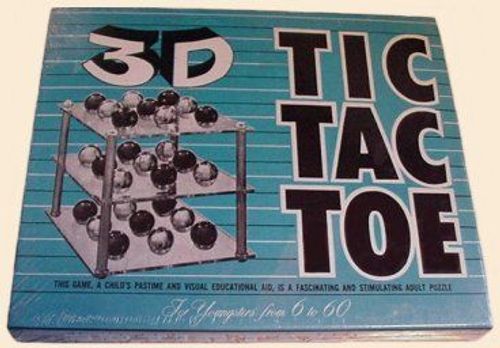
3D Tic Tac Toe
3D Tic Tac Toe Rulebook
Table of Contents
Table of Contents
Game Board
The number of holes and balls may, of course, be varied, the above description being given merely by way of example. The only essential is that the holes be arranged so that each will form an element of at least two lines in the same plane and at least one interplanar line.
Every hole of the game board forms an element of at least one such interplanar line, in addition to forming an element of at least two lines in the same plane.
Contestants and Markers
Any number of contestants from two to five makes an interesting game. Each contestant is provided with a set of markers, in this case balls, all of the markers of one contestant being distinguished from the others, for instance by color or shape. Fig. 4 shows five balls of different colors, beginning with a white ball 12 at the left and including a black ball 13, a red ball 14, a blue ball 15, and a green ball 16.
When only two contestants are playing, each will have two colors to be played alternately. If more than two contestants are playing, each will have only one color. There are enough balls of each color to provide a ball for each hole of the game board when any number of contestants are playing.
Play
The game may be placed according to the following rules:
Three or More Contestants
For three or more contestants, each takes a supply of balls of his chosen color, and after the order of play has been settled, the first player places a ball in any hole of the game board which he selects, for instance hole 11 in the shelf 2. The next player places a ball in another selected hole, and the third player places one in a third selected hole. The play proceeds until all of the holes of the game board have been filled with balls.
Each time a player, by placing a ball in a certain hole, completes a line of three balls of his color in any direction, he claims a score of five. For instance, three white balls, 17, 18, 19, would count five.
If the ball completes a line of three different colors, he claims a score of one. For instance, a red ball 20, a white ball 18, and a blue ball 21 would count one.
Any line having two balls of the same color and a third ball of a different color has no scoring value.
The player must call his points as he places his ball, or lose the score for them. Since the placing of a single ball may complete several different lines, close attention is needed to avoid overlooking points.
The score is totalled when the board has been filled, and the next game begins with a change of turn, to equalize the opportunities.
Two Contestants
If two contestants are playing, each selects two colors and plays them alternately, one ball at each turn. The same scoring rules are followed.
Rotating Rims Variant
The play with this game board proceeds in the same manner as with those previously described, but with the additional possibility of scoring by rotating the rims. After some balls have been placed on each of the shelves, a partial turn of one of the rims may establish new interplanar lines of markers which can be scored in the same way as lines formed by placing a new marker.