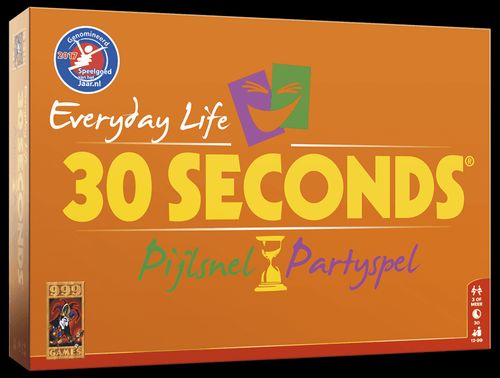
30 Seconds: Everyday Life
30 Seconds: Everyday Life Rulebook
Table of Contents
Table of Contents
Game Materials
240 cards with 2400 words, 1 card holder, 1 game board, 1 sand timer, 1 die, 4 pawns, and the rulebook.
Setup
- Place the game board on the table.
- Form different teams.
- The more players per team, the more fun the game becomes. For a game with 6 people, we recommend forming 2 teams of 3 players rather than 3 teams of 2 players. There must be at least 3 players to play 30 SECONDS® Everyday Life (see "Rules for Three Players").
- Each team chooses a pawn and places it on the "START" space.
- Each team decides the order in which its players will take turns describing. All players must describe an equal number of times. This order must stay the same for the rest of the game.
- Decide which team goes first.
How to Play
A team's turn consists of three phases:
- Roll the die
- Describe and guess words
- Move the pawn forward
1. Roll the Die
The die shows the numbers 0, 0, 1, 1, 2, and 2. The team whose turn it is must roll the die before a card is taken from the card holder. This roll determines how many spaces the team's pawn may move forward at the end of the turn (see "3. Move the Pawn Forward").
2. Describe and Guess Words
The player who describes first must take a card from the "OUT" side of the card holder. Each card has two coloured sides. The player must use the side whose colour matches the colour of the space their team's pawn is standing on.
Example: if the team's pawn is standing on a green space, the player must describe the words on the green side of the card.
Note: because the start space is purple, all teams begin with the purple side of their first card.
Each side of the card shows five words. The player may describe them in any order they choose.
A player from another team turns over the sand timer and calls out "START!". Now the player whose turn it is may turn over the card and start describing.
Important: the player may NOT look at the words to be described BEFORE the sand timer is turned over.
Rules for Describing and Guessing
The player who is describing must follow these rules:
They ARE allowed to:
- describe the word in any way they like, including singing, humming, and using gestures.
- use the words "and", "the", and "a"/"an" when these occur within a word.
They are NOT allowed to:
- say the words on the card.
- literally translate the words, or parts of the words.
- say words or word forms that are derived from the word on the card.
- use "sounds like" or "rhymes with" tactics.
- refer to a letter or letters of the alphabet.
- point at something.
The players who are guessing call out their guesses while the describing player is describing. They ARE allowed to use letters of the alphabet, especially if the word to be described is an abbreviation.
After 30 seconds, the team's turn is over. It is the responsibility of the other teams to watch the sand timer and call out "STOP" when the time is up.
3. Move the Pawn Forward
Subtract the number rolled at the start of the turn from the number of words guessed correctly. This is the number of spaces the team must move its pawn forward. If the result is 0 or lower, the team stays on the same space.
Examples:
- If a team rolled "1" at the start of its turn and correctly guessed 3 words, its pawn moves forward 2 spaces.
- If a team rolled "0" at the start of its turn and correctly guessed 4 words, its pawn moves forward 4 spaces.
- If a team rolled "2" at the start of its turn and correctly guessed 1 word, its pawn stays on the same space.
Afterwards, put the card back in the "IN" side of the card holder. It is now the next team's turn.
End of the Game
The game ends when one team's pawn reaches the FINISH space. That team has won.
Strictness
Decide at the start of the game how strictly the rules will be enforced.
Example 1: is it enough to guess "main road" when the word to describe is "main street"?
Example 2: is it acceptable if the guessing players say "main" before time is up and "street" after time is up?
Penalty Points
If a player or team breaks one or more rules, their team's turn ends immediately and the corresponding pawn is moved back one space.
Rules for Three Players
If you want to play 30 SECONDS® Everyday Life with three players, one player describes the words for the other players for the entire game. This player effectively acts as the game leader, has no pawn, and therefore cannot win the game. All other rules remain in effect.