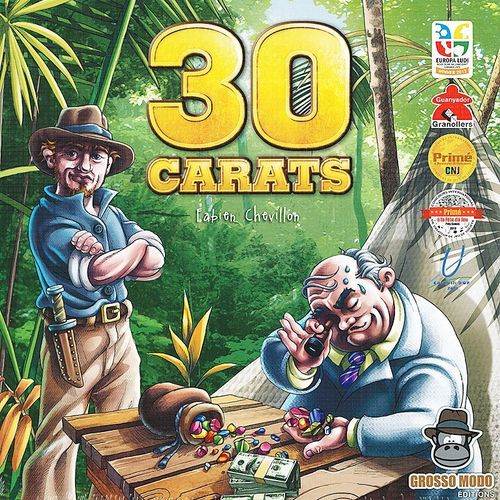
30 Carats
30 Carats Rulebook
Table of Contents
Table of Contents
Objective
To be the richest player at the end of the game.
Contents
- 6 Screens (blue, green, red, white, black and purple)
- 210 Gems (35 gems per colour, the colours corresponding to those of the Screens)
- 35 Gold Nuggets (yellow)
- 18 TRANSACTION cards
- 13 Secret Value cards (numbered from -30 to +30)
- 3 Day cards (Morning / Midday / Evening)
- 1 Bank bag
Set Up
A) Each player gets:
- 1 Screen in the colour of his choice
- 5 Gems of each one of the Screens' colours (only of the Screens being used in the current game)
- 5 Gold Nuggets
B) Bank bag
The players fill the Bank bag with 5 Gold Nuggets and 5 gems of each one of the colours in play.
Example: In a 3-player game, the Bank bag contains 15 gems (5 gems of each one of the Screens' colours, and 5 Gold Nuggets).
C) TRANSACTION cards
The players shuffle the 18 TRANSACTION cards. Three TRANSACTION cards are dealt to each player. After they have looked at them, the players hide them behind their Screens.
D) Secret Value cards
The players shuffle the 13 Secret Value cards. One Secret Value card is dealt to each player. The players look at it, and then hide it behind their Screens.
The Secret Value card determines the value, either positive or negative, of the gems of one colour (the colour of the player's Screen). Every Gold Nugget is always worth +10.
Example: The player with the red Screen draws the -20 Secret Value card, so every red gem is worth -20.
The players form a face down pile with the Secret Value cards that were not dealt. One card is drawn from this pile, and placed face up, next to the pile.
Example: The +15 Secret Value card is turned over. The players now know that no gem can be worth +15 since this Secret Value card cannot have been drawn by any player.
E) Day cards
The Morning Day card is placed face up on the table.
Rules
The player with the largest feet plays first. During his turn, he takes on the role of the "Seller".
5 steps then occur in succession:
1) Choosing a TRANSACTION card
The Seller chooses one of his TRANSACTION cards and places it face up in front of the players.
Information provided by the TRANSACTION card:
- Criteria that the Seller must meet to be able to offer a combination of his gems for sale.
- Whether the other players' offers will be "simultaneous", or "successive".
ONLY the Seller must respect the TRANSACTION card. Unless otherwise indicated, his opponents are free to do as they choose.
2) Proposing a combination
The Seller chooses a combination among his gems & nuggets. He then places it in front of his Screen so that all the other players can see it. The total number of gems & nuggets offered by a Seller can never be more than 5!
Example: The RED Seller chooses among his gems & nuggets: 2 red gems, 2 blue gems, and 1 Gold Nugget. He places them in front of his screen and they make up his combination.
Example (TRANSACTION card "The Seller proposes at least 2 gems of the Seller's colour", simultaneous): The Seller proposes at least 2 gems of the Seller's colour.
3) Bartering
The Bartering begins! To get the Seller's stones, the other players offer him their own combinations of gem & nuggets, either one by one (SUCCESSIVELY), or all at the same time (SIMULTANEOUSLY) according to what the Seller's TRANSACTION card reads.
An opponent's offer must be different from the Seller's and include at least 1 gem or 1 Gold Nugget.
When forming their combinations, the opponents have no other limitations, EXCEPT when the TRANSACTION card imposes certain constraints on every player.
Example (TRANSACTION card "The Seller proposes at least 1 gem of the Seller's colour + 2 gems of the colour of the player next to him", successively).
SIMULTANEOUSLY: The Seller's opponents' offers are all made at the same time. Each player holds his gems & nuggets in his hand, with his fist clenched and his arm stretched out in front of his screen. The players open their fists simultaneously.
SUCCESSIVELY: Moving clockwise, the opponents make their offers one by one. Each player places his gems & nuggets in front of his Screen.
4) Playing with an opponent or with the Bank
The Seller must choose one of the two following actions:
- To swap his combination for another player's. In this case, the two players exchange their gems & nuggets and place them behind their Screens.
- To swap his combination with the Bank; to do so, he must pay gold nuggets.
The Seller does as follows:
- He places the number of gold nuggets indicated behind his Screen in the Bank bag.
- He places his combination of gems & nuggets in the Bank bag.
- After having mixed the contents of the bag, he randomly draws as many gems & nuggets as he had in his combination.
The Bank swap costs, as printed on the Day cards:
- In the Morning, swap your combination with the Bank for 2 Gold Nuggets.
- At Midday, swap your combination with the Bank for 3 Gold Nuggets.
- In the Evening, swap your combination with the Bank for 4 Gold Nuggets.
Right of Inspection
NOT IN THREE-PLAYER GAMES!
"Right of inspection" allows the Seller to learn how much a gem colour is worth by paying gold nuggets. The cost of the "Right of inspection" is indicated on the Day card.
- In the Morning, Right of Inspection costs 4 Gold Nuggets.
- At Midday, Right of Inspection costs 3 Gold Nuggets.
- In the Evening, Right of Inspection costs 2 Gold Nuggets.
The Seller can use his "Right of inspection" at any time during his turn.
After having placed the number of gold nuggets indicated behind his Screen in the Bank bag, the Seller can discretely read the Secret Value card of the opponent of his choice.
5) End of Bartering
The TRANSACTION card that has just been played is discarded.
The following player (moving clockwise) becomes the Seller.
During the game, each player will be the Seller 3 times.
End of a Round
The first round ends when all the players have been the Seller once. The "Morning" Day card is discarded.
For each new Day:
- The next Day card ("Midday" and then "Evening") is placed, face up.
- A new Secret Value card is drawn from the pile and revealed to all the players. It is placed on the table, face up.
- A new player becomes the first player: The first player (who will be the Seller) is chosen by the player who played first during the previous Day card. The same player cannot play first twice.
Victory
The game ends once all the players have been the Seller three times (Morning, Midday, and Evening cards). The Secret Value cards are revealed. Players convert their gems & nuggets according to each Secret Value card. The player with the highest loot wins the game. He is the richest adventurer.
In Case of a Tie
The player with the most gold nuggets wins the game.
Details About the Final Count
Each player reveals his Secret Value card to the other players. The players now know the value of the gems of each colour. Gold nuggets are always worth +10. A player's final score can be either positive, or negative.
Example: A player has:
- 6 blue gems; 1 blue gem = +10; his loot of blue gems is therefore worth +60.
- 3 red gems; 1 red gem = -20; his loot of red gems is therefore worth -60.
- 2 Gold Nuggets; 1 Gold Nugget = +10; his loot of Gold Nuggets is therefore worth +20.
His loot is therefore worth a total of 20.
Tips: When calculating the value of each player's loot, the positive and negative gems can cancel each other out. Multiplication tables are available on the edges of the box.
Frequently Asked Questions
What happens when a player cannot meet any of the constraints in his TRANSACTION cards?
At the beginning of the game, all of the TRANSACTION cards can be applied. But during the game, when a player cannot follow his TRANSACTION card, he is penalised and must reveal to his opponents how many gems/nuggets he has by lifting up his Screen. Then he draws a new TRANSACTION card from the deck.
Can a player use his Right of Inspection several times during a same game or a same round?
Yes, when it is his turn to offer a combination, a player can ALWAYS use 1 or several Rights of Inspection as long as he has enough gold nuggets to pay the Bank.
What does the TRANSACTION card "Seller's offer consists of 5 gems randomly chosen from the Bank" mean?
In this particular case, the Seller does not offer gems & nuggets from behind his Screen, but instead randomly draws gem & nuggets to offer his opponents from the Bank.
Note: the printed FAQ reads "me an" at a line break in this question; it is corrected to "mean" here.