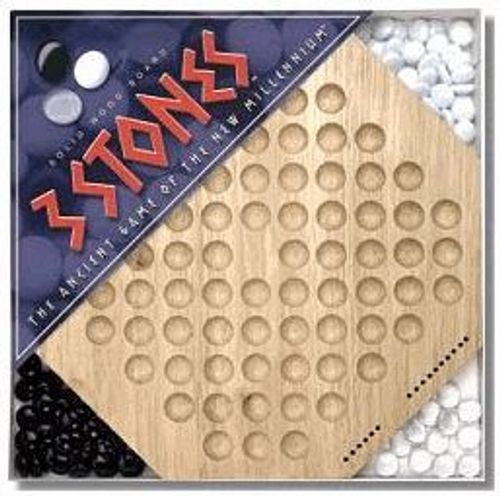
3 Stones
3 Stones Rulebook
Table of Contents
Table of Contents
Starting the Game
- Place the stones (30 black, 30 white, 12 clear) into the pouch and mix them up.
- IMPORTANT: We have included a few extra stones in case any get lost or broken. Place only the correct number of stones into the pouch.
- One player chooses "white" and the other player chooses "black". The players decide which of them will play first.
- Place your scoring pegs into the "zero points" position. (see picture to right)
Your Turn
- At your turn, draw a stone from the pouch and place it into an empty pocket on the board. You must play what you draw, even if it's your opponent's color.
- If this is the first play of the game, you may play the stone anywhere.
- Otherwise, you must play the stone into an empty pocket in the same row or the same column as your opponent's last play. If this is not possible, because none of those pockets are empty, you may play the stone into any empty pocket on the board.
- Once a stone is played, it is not moved for the remainder of the game.
Picture caption: "Always play in the same row or column as the last stone played. (Note the board is placed with the scoring pegs on a diagonal.)"
Center of the Board
Note the empty space at the center of the board. Think of this as a pocket that always remains empty. So, pockets on opposite sides of the center are considered part of the same row or column (see picture above), however you cannot score a 3-in-a-row through the center.
The Ring
The ring is used to keep track of the last stone played. (As the board fills up, it's easy to forget which stone was played last.) After playing a stone, place the ring over it.
Picture caption: "Using the Ring"
Scoring
- Each player scores 1 point for every 3-in-a-row made with their color stone, whether across, up-and-down, or diagonally.
- A stone may be part of more than one scoring row. For example, a line of 4 stones of one color contains two 3-in-a-rows, each of which scores a point, while a line of 5 contains three 3-in-a-rows, and so on.
- A clear stone counts for both players. So, a line of three stones containing both white and clear stones scores for white. A line of three stones containing both black and clear stones scores for black. A line of three clear stones does not score for either player.
- For scoring purposes, it does not matter which player played the stone. It is very common for you to score when your opponent plays a stone of your color, or for both players to score when one player plays a clear stone.
- Remember not to score the same 3-in-a-row more than once. When adding a stone to an existing 3-in-a-row, score only the newly created 3-in-a-rows.
Picture captions: "Clear stones count for both players" and "Every 3-in-a-row scores"
Scoring Pegs
Use your scoring pegs to keep track of your score. The shorter row counts 10's and the longer row counts 1's.
Picture captions: "Zero points" and "One point"
Winning the Game
- The game ends when the last stone is played.
- High score wins.
- If the score is tied, the game is a draw.
For a Game of Pure Skill
If you prefer a game of pure skill, the pouch is not used. After choosing colors, each player takes half of the white stones, half of the black stones, and half of the clear stones. At your turn, select and play one of the stones from your hand.
Timed Play
When playing in a more serious setting, such as a tournament, you may use a chess clock. When using a clock, you must draw from the pouch, make your play, move the ring, and update your scoring pegs before stopping your clock. A player who runs out of time loses the game. You may play using any agreed-upon time limit. Suggestion: 30 minutes per player for the standard game, 60 minutes per player for the pure skill game.
Handicapping
If a player is competing against a much stronger opponent, you may spot the weaker player a few points and/or give the weaker player additional time. Removing one or more of the stronger player's stones from play (as is sometimes done in chess) is not recommended.