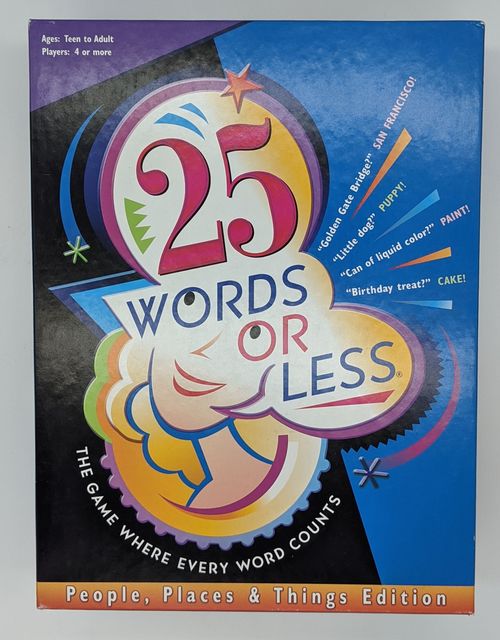
25 Words or Less: People, Places and Things Edition
25 Words or Less: People, Places and Things Edition Rulebook
Table of Contents
Table of Contents
The Game in Brief
You've got one minute to use and twenty-five words or less of clues to get your teammates to say the five words on your card. If you get your teammates to guess all five words in less than a minute AND in twenty-five words or less of clues, your team wins the card. If not, your opponents win the card. The first team to win ten cards wins the game!
Contents
288 cards, one-minute sand timer, countdown board
Set-Up
- Place the game board in the center of the table. Take nineteen cards, sight unseen, and put them in the middle of the game board, face down.
- Divide into two teams. Each team needs at least two [blank in source] players, although teams need not be of equal size.
- Each team elects one player to be the "clue-giver" for the first round.
- Decide if you will use the blue words on each card [blank in source] or the purple words. Both sets of words are of equal difficulty—there are no "easy" sets and "challenging" sets. Be consistent throughout the game with which color words you use. Select the top card from the [blank in source] deck. Two opposing clue-givers (one from each team) jointly study the card for a brief moment. The clue-givers now bid for control of the card. The oldest player bids first to begin the game. After [blank in source] that, teams alternate as to who starts the bidding.
Bidding always begins at twenty-five clue words. (Both clue-givers must bid for control of the card unless they decide jointly that they'd like to pass on [blank in source] the card and choose the next card to bid on.) The player who bids the lowest wins control of the card. The player who loses the bid serves as "judge."
Example of Bidding for a Card:
- Team A clue-giver says: "I can do this card in 25 words."
- Team B clue-giver says: "Well, I can do this card in 24 words."
- Team A clue-giver says: "Oh yeah? I can do this card in 19 words!"
- Team B clue-giver says: "Okay, go ahead—you've got 19 words to do it in!"
Team B clue-giver (who didn't win control of the card) is now the judge.
- The judge takes the sand timer and places it on the [blank in source] number on the game board that corresponds to the clue-giver's bid, in this case "19."
- You are now ready to play the first round.
Gameplay
The judge turns over the timer and the clue-giver begins to give word clues to his team. The judge moves the timer one space for each word the clue-giver says. The clue-giver should give concise clues to get his teammates to guess each word.
- Clue-givers can jump back and forth between the [blank in source] five words on the card—you do not have to do the [blank in source] words in order. Teammates who are guessing clues can shout out answers simultaneously—it is not necessary for teammates to "take turns" when [blank in source] guessing.
- Remember: The judge counts every word [blank in source] the clue-giver says, even if the clue-giver repeats [blank in source] words already spoken.
The round continues until:
- The clue-giver's team guesses all five words on the [blank in source] card before passing zero on the countdown board and before running out of time, or
- The clue-giver's team passes zero on the countdown board, or
- The clue-giver's team runs out of time.
No-No's
When giving clues, clue-givers are not allowed to say "rhymes with", "sounds like" nor are they allowed to use gestures that suggest the answer word. For example, you cannot point to your lips to convey the word "lipstick." Clue-givers are not allowed to use any part of the answer word as a clue. For example, you cannot say, "fights fires" to convey "fireman." If a "no-no" is committed the card is forfeited and "won" by the opposing team.
Scoring & Winning
If a team correctly guesses all five words in time they score by keeping the card. If a team fails to complete the card, the opposing team wins the card. The first team to accumulate ten cards wins the game.
Playing the Next Round
Play the next round as you did the first. However, choose a different player on each team to be clue-giver and make sure to alternate which team starts the bidding.
Helpful Hints
- Bid aggressively to win control of the card. You want it [blank in source] don't you? You want a chance to win this card! Your team wants to guess the words on the [blank in source] card based on your oh-so-clever clues. Go for it!
- Before bidding starts, clue-givers briefly look at the [blank in source] five words they are bidding on. Do not study the [blank in source] card and try to think of clues for each word—this [blank in source] slows down the game. Take a risk and bid quickly!
- At the beginning of a round, if both clue-givers [blank in source] jointly decide they don't like the words on the card, they can discard it and pick the next card to bid on. It's okay to trash a card, we understand.