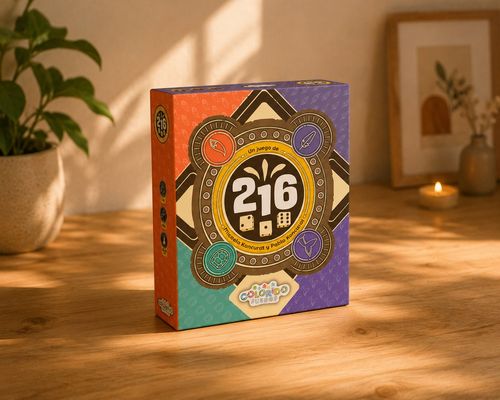
216
216 Rulebook
Table of Contents
Table of Contents
Components
- 70 Objective Cards.
- 30 Help Cards.
- 3 dice.
- 1 rulebook.
Setup
- Shuffle the deck of Objective Cards and place 4 cards face up in the center of the table. This will be the Offer.
- Shuffle the deck of Help Cards and place it face down near the Offer.
- Place the dice within reach of all players.
- Randomly designate a starting player.
- Find paper and a pencil to keep score.
Playing the Game
The game is played in turns, clockwise.
On your turn, you may roll the dice up to 2 times.
First Roll
Roll the 3 dice. Compare the results against the 4 cards of the Offer.
Served Game!
If your dice match exactly an Objective Card that is in the Offer on the first roll, WITHOUT using Help Cards, you have a Served Game:
- You win the General Score of that card.
- Choose your Bonus for a Served Game:
- Add extra points.
- Or take a Help Card from the deck.
- Discard the fulfilled Objective Card and replenish the Offer immediately.
Achieving an objective using Help Cards
If you do not achieve a Served Game, or if having achieved one you prefer to ignore it, you may use Help Cards. You may play as many Help Cards from your hand as you like to modify the dice and fulfill an objective.
If your dice match exactly an Objective Card that is in the Offer on the first roll, using Help Cards:
- You win ONLY the General Score of that card.
- Discard the Help Card(s) used.
- Discard the fulfilled Objective Card and replenish the Offer immediately.
Note: If you manage to fulfill an Objective Card, whether with a Served Game or by using Help Cards, but you would rather try for another objective in the Offer, you may ignore it and proceed to the Second Roll.
Second Roll (Reroll)
If you did not achieve (or did not want) to fulfill an objective on the first roll, you must reroll.
Choose 1, 2, or all 3 dice and roll them again.
After the second roll, you may use Help Cards.
If, after the second roll, your dice match exactly an Objective Card that is in the Offer, you may choose between:
- Add ONLY the General Score of that card.
- Discard the Help Card(s) used.
- Discard the fulfilled Objective Card and replenish the Offer immediately.
- Give up the General Score and take a Help Card from the deck.
- You do not add points this turn.
- The corresponding Objective Card remains in the Offer.
Note: If any roll happens to fulfill more than one Objective Card in the Offer, you may only take one, of your choice.
Failure and Compensation
If, after the second roll, you do not manage to fulfill any objective in the Offer:
- Your turn ends without adding points.
- Compensation: You take a Help Card from the deck.
Note: If the Objective Card deck or the Help Card deck runs out, shuffle the discards to form a new deck.
End of Turn
Record the points obtained, keep a running total (so you know how many points the players have), and pass the dice to the next player.
End of Game
The game ends when a player reaches or exceeds 100 points.
- The current round must be completed so that all players have had the same number of turns.
- The player with the most points at the end of the round wins the game.
- If two or more players reach the same score (100 or more), play continues until one of the players achieves a higher score at the end of a round and becomes the winner of the game.
Long Variant: Players must agree on a higher target score (e.g. 150 or 200 points) before starting.
Objective Cards
These cards show a combination of dice that you must achieve. They have two score values:
General Score: obtained on fulfilling the objective (1st Roll: Served, or using Help Cards; 2nd Roll: with or without Help Cards).
Served Game Bonus: obtained only if you fulfill the objective on the 1st roll and without using any Help Card.
There are 4 types, distinguished by their color and symbol:
- Gray Cards: show an exact combination of numbers that you must achieve.
- Orange Cards: show a combination of numbers to add up.
- Green Cards: show a combination where 2 or 3 dice must be equal.
- Purple Cards: show a combination of numbers that must NOT be present in the roll.
The xxx/216 numbers on the sides of the cards are a statistical guide to the probability of getting that roll on a single throw.
Dice symbols on the cards:
- Die showing a number: you must get that exact number.
- Die showing "?": represents any result.
- Opposite: the die's value is the opposite face of itself. Example: the opposite of 1 is 6, of 3 is 4, and of 2 is 5, and vice versa.
- Symbols: Equal, Different, Sum, Greater than or Equal to, Less than or Equal to.
Objective Card Reference
- Pair and Opposite: you must get any pair, and the third die must be the opposite of that pair. Example: 2-2-5 or 1-1-6.
- Straight: you must get three dice with consecutive numbers. Example: 1-2-3 or 4-5-6. The following straights are also valid: 5-6-1 and 6-1-2.
Help Cards
These cards modify the results of the dice, granting special advantages.
- Obtained as a bonus or as compensation.
- Their use is optional, and they can be used starting from the turn after the one in which they were obtained.
- There is no limit on the number of cards in hand.
- They are single-use (discarded after use).
- If you use a Help Card to fulfill an Objective Card, the game will never be considered Served.
| Effect | Description | Note / Detail |
|---|---|---|
| +1 / -1 | Adds or subtracts 1 from the value of a die | E.g. 4 becomes 5, or 6 becomes 1 (adding). 1 becomes 6 (subtracting). |
| +2 / -2 | Adds or subtracts 2 from the value of a die | E.g. 3 becomes 5, or 5 becomes 1 (adding). 4 becomes 2, or 1 becomes 5 (subtracting). |
| Opposite | Changes the result of a die to its opposite face | 1-6, 2-5, and 3-4, and vice versa. |
| Reroll 1 | Rerolls 1 specific die | Does NOT count as the "Second Roll" (reroll). It can be used before or after your normal reroll. |
| Reroll 3 | Rerolls all 3 dice | Does NOT count as the "Second Roll" (reroll). It can be used before or after your normal reroll. |
| Wild | Transforms the result of any die into a 1, 2, 3, 4, 5, or 6, as needed |
Clarification: If a die showing a result of 1 has 1 subtracted from it, its result becomes 6, and if a die showing a result of 6 has 1 added to it, the die's result becomes 1. The +2 and -2 cards work the same way — for example, going from 5 to 1 using +2, or from 1 to 5 using -2.
Solo Mode: "The AI Challenge"
In this variant you face off against the AI (Aleatory Imprevisibility). Turns alternate as follows:
- You play your turn normally.
- AI's turn:
- Take from the Offer the Objective Card that grants the lowest General Score. If there is a tie for the lowest value, you choose the Objective Card. That objective is considered "fulfilled" by the AI, so you must add the General Score to its score total and remove the card from the Offer.
- Replenish the Offer according to the normal rules, ending the AI's turn.
End of the game: the game ends when a player reaches 100 points. If you reach 100 points before the AI, you win the game. In case of a tie, resolve the ending as in a multiplayer game.
Dedicated to Ivo, father and grandfather, with whom we shared memorable playful afternoons with dice and who inspired us to create this game.
Published by: Coloridojuegos (2026) Coloridojuegos is a registered trademark. All rights reserved. www.coloridojuegos.com.ar