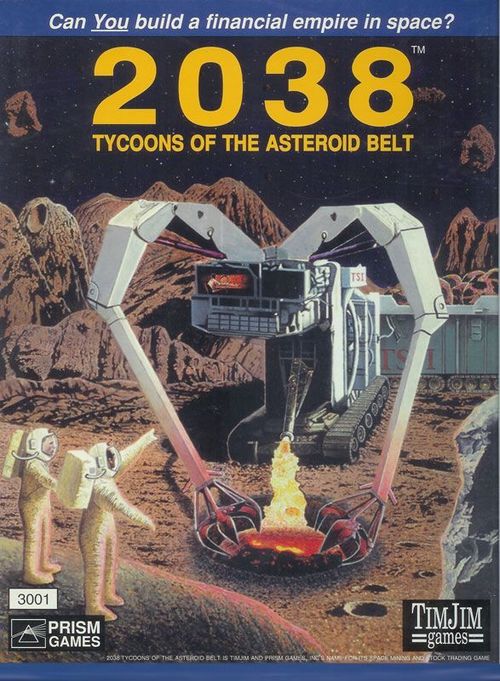
2038: Tycoons of the Asteroid Belt
2038: Tycoons of the Asteroid Belt Rulebook
Table of Contents
Table of Contents
Let's Play! (Read This First)
Rules Introduction for 2038: Tycoons of the Asteroid Belt
Learning to play 2038: If you learn best "by doing", read this sheet as you play out a Short Game. Refer to the full rules should problems arise. If you learn best by reading, skim this sheet and then read the full rules before starting play. The Short Game lasts 2-3 hours, once players are familiar with it. New players may find it takes 3-5 hours to play the very first time. The Full Game's length varies with a group's playing style. Experienced players complete it in 5-9 hours. Newer players should allow more time.
2038 is loosely derived from the railroad game 1829, with stock rounds surrounding company operations. Players familiar with it will find 2038 rather different. Companies explore, mine and deliver ores (see Figures 6, 8 & 9), instead of laying track to connect cities. Growth Corporations (see page 3) are also new. Page 4 lists many fine points to remember.
Setup. Perform the following steps (see Figures 1 and 2):
- Mix one bid counter per player and draw to determine First Player and seating order. Hand out the First Player card and bid counters.
- Unfold the board, placing the Round and Phase chits and spaceships on it. Nearby, place the stock mat, bank and 10% stock shares. Put the Asteroid League and 20% President certificates on the stock mat.
- Split $1,800 evenly among the players. If playing a Short Game, remove $6,000 and 2 Phase II ships from the game.
- Mix the asteroid tiles in the box lid asteroid side down. Set the lid, Company / Corporation mats and counters aside for later use.
- Lay out the 12 Private and Independent Company certificates in order ("0"-"11"), along with the associated TSI shares and Probe.
Overview. Players are investors. The goal is to be the player with the most money (in stock and cash) at the game end. Each turn consists of:
- A stock trading round (when investors act).
- Two operating rounds (when Companies / active Corporations act).
This cycle repeats until the bank runs out of money and the game ends.
Earnings are produced during operating rounds by spaceships picking up and delivering ores from asteroid mines to bases or transshipment points.
There are three types of business entities in the game:
- Private Companies. Until removed, Private COs pay income to their owners each operating round. They do not trade on the stock market and, except when Co. "10" runs the Probe, never operate spaceships.
- Independent Companies. These buy and operate spaceships but are not traded on the stock market. Instead, each Independent either retains all of its earnings or splits them evenly with its owner.
- Corporations. Each Corporation buys and operates spaceships but is jointly owned by shareholders, who buy and sell its shares, affecting its stock price. Each Corporation has a President, the player owning the most stock in it, who directs it during Operating Rounds and can increase its stock price by paying out its earnings as dividends.
§ Important: Each Independent Co. and Corporation has a treasury. Money in it is always kept separate from its owner's / President's cash.
Initial Auction. Play begins with players bidding for and buying the 12 Private and Independent Companies. Each player, starting with the First Player and proceeding clockwise, either places a bid, passes, or buys the lowest numbered certificate available (see Figure 2). A purchase may trigger auctions or purchases due to previously placed "pending" bids.
To place a bid, the player puts a bid marker on the desired certificate and sets aside the amount named. This must equal or exceed the certificate's printed bid value and be at least $5 greater than the last bid placed on it. Money set aside for a bid is allocated and cannot be spent until that certificate is either bought or has a higher bid placed on it.
When a certificate is bought, the next one becomes available. If it has only one bid marker on it, it is sold to that player for the amount bid. If several bid counters are present, an auction is held among those players. Proceeding clockwise from the player with the highest pending bid, each player must either bid at least $5 more than the previous bid or drop out. The last player remaining buys the certificate. Note that several certificates in succession might be sold in this manner (see Figure 3). Once a certificate with no pending bids becomes available, the next player (on the original buyer's left) then takes a turn (buy, bid or pass) normally.
As each Independent Co. is purchased, put $100 plus 1/2 of the amount, if any, over $100 for which it was bought (round down) into its treasury.
Figure 1: General Setup (takes up a 4' x 6' area). Shown are the board, the stock mat with tiles in its box lid, corporation mats, President certificates and Asteroid League shares, private and independent COs, 10% shares, spaceships, round and phase chits, the bank, and player money and bid markers.
Figure 2: Initial Company Layout and Opening Bids. Shown above is the layout of the 12 Private and Independent Companies. COs "7"-"10" come with TSI shares. Each of these is bid for and bought as a set; afterwards these certificates function completely separate from each other. Company "11", the Asteroid Export Co., forms the Asteroid League in either Phase III or IV, receiving its President's certificate then.
In a 4-player game, Player 1 bids $100 on Fast Buck. Player 2 bids $120 on Drill Hound (to put $10 extra into its treasury). Player 3 bids $100 on Lucky. Player 4 bids $110 on Fast Buck, putting pressure on Player 1...
§ Playing Tip: During the initial auction, make sure you get at least one Independent Company (unless, possibly, you're the TSI President in a six player game). When bidding on Independents, consider bidding $120 or so since an extra $10 in the Company treasury can often prove useful.
Figure 3: Resolving an Auction and Pending Bids. Later in the bidding, Player 1 buys Company "0" for $50. Players 1 and 4 then hold an auction for Fast Buck, Player 4 eventually buying it for $160 ($130 goes into Fast Buck's treasury). Ice Finder and Drill Hound have pending bids on them and are sold to players 4 and 2. Player 2 may then purchase Ore Crusher, pass or place a bid on another company.
TSI is a Public Corporation. TSI becomes active once 50% of its shares are held by players. This occurs when Private COs "7"-"10" have been bought. TSI's President takes its mat and counters, placing the Probe on the mat and TSI's stock price and par value markers in the appropriate boxes of the stock chart: either $100 (Full Game) or $67 (Short Game). Put 10 times the par value ($1,000 or $670) into TSI's treasury.
Once all 12 initial companies have been bought, the auction is over. The five remaining TSI shares become available at TSI's par value. (The RU President's certificate is also available but is rarely bought.) Each player either buys a TSI share or passes (no sales are allowed in the first stock round). If one player obtains more TSI shares than its President has, then that player becomes President and swaps two shares for the President's certificate. The stock round ends once all players pass in succession. Move TSI's stock price up one space if players own all of its shares.
If all players consecutively pass — thus ending the initial stock round — before the initial 12 companies are sold, resolve all pending bids as if those certificates, in order, had become available for purchase.
In either case, give the First Player card to the player on the left of the last player who made a non-pending purchase.
Operating Rounds. Perform the following steps in sequence twice (once for each operating round) before starting the next stock round:
- Pay each Private Co.'s owner (and Fast Buck's treasury) its income.
- Each Independent (in numerical order) followed by each active Corporation (in stock price order) operates, performing these steps: a. Fly spaceship routes, picking up and delivering ores. b. Determine withholdings / dividends. Adjust stock price. c. Purchases (including new spaceships and claims).
- Remove Used Mine markers placed earlier that round.
Spaceships. Earnings are produced by using spaceships to deliver ores. Each spaceship has two numbers: its movement points and number of cargo holds (see Figure 4). The first dictates how many hexes it may travel each round, starting from any of its bases; the second, how many cargo pickups / deliveries it may make. Initially, only Phase I spaceships are available; these must be bought from the bank. There are two types available: 5/1 Scouts and 3/2 Tugs. Once chosen, a spaceship's type is fixed. Note that both types have the same price only in Phase I.
Operations: Each spaceship is moved separately, spending a movement point to enter each hex. An unexplored hex may be explored by spending an extra movement point to draw and place an asteroid tile in it. For each hex explored, the "Survey Board" (the bank) pays $10 into its owning Company's or Corporation's treasury. Asteroids contain either one or two mines. Each mine produces a type of ore, either Nickel (N), Ice (I) or Rare (R), in a grade worth a given amount (see Figure 5).
During the first operating round, since the Independents don't begin play owning any spaceships, their first round action will be to purchase one. TSI then operates the Probe (collecting its exploration payments) moving its stock marker left one box since it has zero earnings. TSI then buys up to 3 more spaceships and 2 claims (see below), placing them on mines that the Probe found. Note: If TSI is not active, then the owner of the Space Transportation Co. ("10") flies the Probe from the TSI base, with the owner collecting the Probe's exploration payments.
Each round, only one pickup may be made at each unclaimed mine (by the first spaceship to do so). Place a Used Mine chit to mark this. The pickup is worth the lower of the mine's two values. If an Independent Co. or Corporation buys and places a claim on a mine, then only its spaceships may make pickups there. Furthermore, that ore is now worth the mine's higher value. Pickup values are earned by spaceships only if they end their route at any base or a red transshipment point (a ship that is only exploring may end its route in space). A spaceship ending its route at a transshipment point with an empty cargo hold earns the lower value listed there ($20 or $30). Note that some Companies and Corporations earn bonuses for delivering certain ores; bonuses can also be earned by any ship for delivering ore to certain bases (see Figure 6).
A Company or Corporation's earnings are the total of all its spaceships' routes (but not its exploration payments). An Independent may either keep all of its earnings or split them evenly with its owner. It may not choose to pay them all out. A Corporation may either retain its earnings or pay out dividends, either in the amount of 1/2 its earnings or in full. This decision affects its stock price, moving it one box left, one box right or two boxes right (see Figure 7). Treasury money may then be spent to buy more spaceships or claims (within certain limits, see charts).
During the next operating round, the remaining Phase I ships and a Phase II ship might be bought. This triggers the start of Phase II immediately.
STOP: Hold the initial auction and play through the first stock and operating rounds before reading on (unless Phase II begins).
Figure 4: Sample Spaceships (Phase I Scout and Tug). A spaceship card shows its movement / cargo holds (e.g. 5/1), its price (e.g. $100), and either "Obsolete: Phase III" with a box for the phase it is removed from the game, or, on ships permanently in play, the phase it entered play and the phase it was purchased.
Figure 5: Sample Asteroids. An asteroid tile shows one or two mines. Each mine shows its ore type (N, I or R) and two values: the unclaimed mine value and, after a claim is placed, the (higher) claimed mine value — e.g. an Ice mine showing 30/40 unclaimed, or an asteroid with two mines (R and N) showing 30/60 and 20/60 once claimed.
Figure 6: Operating an Independent. In the first operating round (OR 1), Ore Crusher buys a 5/1 Scout. In OR 2, the 5/1 moves to hex A and spends a second movement point to explore it, drawing the tile shown. Deciding not to make a pickup at either of these mines, the 5/1 moves to hex B and explores it, drawing a $20 Nickel mine and adding $20 to Ore Crusher's treasury for the two explorations. The 5/1 makes a pickup there, placing a Used Mine chit, before spending its fifth and final movement point to reach the Lunar Enterprises base for $40 ($20 ore plus the base and Ore Crusher bonuses for delivering Nickel ore). This $40 could be split $20-$20 between Ore Crusher's treasury and its owner or fully retained. The owner chooses to retain the $40 in treasury and spends it, plus the $20 exploration payments, to claim the $20 Nickel mine. In OR 3, after a stock round, the 5/1 will run again (from Ore Crusher's base), exploring hex C (+$10 treasury) before delivering ore from the claimed Nickel mine to the Lunar Enterprises base for $80.
Figure 7: Paying Dividends and Adjusting Stock Price. In OR 1 of the short game, TSI has no earnings (exploration payments don't count) and its stock price slides left one space to $59. In OR 2, TSI has $170 earnings and pays out $17 per share, moving its stock price right two spaces to $76. Had TSI instead paid out 1/2, it would have kept $80, paid $9 per share and moved its stock price right one space to $67.
Phase II begins immediately when a Phase II ship is purchased:
- The TSI Probe becomes obsolete and is removed from the game.
- Companies and Corporations may buy spaceships from one another for any mutually agreeable price, at least $1.
- Growth Corporations may now be launched during stock rounds.
- Private Companies "0" and "7"-"9" may be bought by Corporations from players for at least $1 and no more than their printed bid values. Once held by Corporations, Private Companies "7"-"9" may be used to each place one extra black-edged counter (see Figure 8).
- Corporations may buy Independent claims for $60 each, replacing them with their own claims and returning the Independents' claims for reuse.
- Corporations may buy and place bases and refueling stations.
A refueling station adds 3 movement points to each of its Corporation's ships that enters that hex (or refuels a ship back to its starting movement amount, whichever total is smaller). Only one refueling station may be placed per base; thus a base provides both an alternative starting point for routes and a single refueling station "slot" usable by any Corporation (whichever one places a station there first). Bases, refueling stations and claims must be placed within range of an existing base (see Rules 7.4).
Stock Rounds. During stock rounds, players may both sell and buy stock shares in Corporations, possibly launching new ones. Each player, starting with the First Player and proceeding clockwise, may sell as many shares as desired (within certain limits) into the Stock Market and then may purchase one certificate. Shares are bought from the Public or Growth boxes at their par value. They are sold to and bought from the Stock Market for their current stock price.
A Corporation's stock price moves down one square (if possible) when its shares are sold, even when several shares are sold at once. A Corporation's Presidency is transferred between players (swapping stock certificates) if one player acquires more shares in a Corporation than its President has. Shares in a Corporation which hasn't operated may only be sold by its President. Neither the President's certificate nor more than 50% of a Corporation's shares may enter the Stock Market. A player may not buy a stock he or she previously sold that stock round nor buy more than 60% of a Corporation's shares. A stock round ends once all players pass in succession. Give the First Player card to the player left of the last player who made a stock transaction. Move the stock price of any stock completely held by players up one square (if possible).
Corporations. Corporations become available in several groups, whose members may be launched in any order. Group "C" is not available in the Short Game. There are two Corporation types: Public and Growth. They differ in how they are launched, become active, their starting capital, initial stock price and whether they receive money for their unbought shares when they pay dividends (as they do for their shares in the Stock Market). Growth Corporations get this money; Public ones do not.
To launch a Public Corporation, a player sets its initial stock price and par value ($67, 77, 88 or 100) and buys an available President's certificate at twice this amount. Place its 10% shares in the Public share box.
To launch a Growth Corporation, the owner of an Independent swaps it for an available President's 20% certificate during a stock turn in Phases II or III, before the Asteroid League forms. This counts as that player's stock purchase that turn. Place its 10% shares in the Growth share box.
A Public Corporation becomes active once 50% of its stock has been bought; it then receives 10 times its par value as its starting capital, once 50% of its stock is bought. A Growth Corporation is active immediately. Its initial stock value is $10. It begins with its Independent's spaceship(s) and treasury but receives additional capital only as its 10% shares are bought at its $67 par value. Replace (for free) the Independent's base and placed claims with its GROWTH base and claims. Flip the Independent certificate to its pilot side; its bonuses now only apply to one spaceship. Move one Asteroid League share from the trade-in box to the Growth Corporation box.
STOP: Continue play until Phase III begins before reading further.
As spaceships are bought, the game will enter new phases with various effects (see charts). Phase I-III ships eventually become obsolete and are removed. Corporations without a ship must buy one. (After the Asteroid League forms, Independents without a ship must buy one or join the League.) If a Corporation doesn't have sufficient cash to buy a spaceship, its President must make up the difference with his or her own cash, possibly selling stock to obtain it (see 7.38). Thus, being President of a Corporation can become a liability (see Player Notes).
Also triggered by phase changes is the formation of the Asteroid League, a Corporation which eventually absorbs all Independents that don't form Growth Corporations. The Asteroid Export Co. owner may form the Asteroid League when Phase III begins (and must do so in Phase IV). Each Independent may then join it (and must join in Phase V). Its owner receives 1/2 its treasury if it joins when the League first forms (or, in the Full Game, if it owns a ship if it joins later), plus a 10% League share.
As players become wealthier, their ability to purchase more stock will be restricted by the certificate limit (see chart) which they may not exceed. Both Independent and Private Companies count towards this limit.
The game ends when a player goes bankrupt (by not being able to buy a required spaceship for a Corporation, see 7.38) or, more typically, at the end of the round sequence (stock plus two operating rounds) during which the Bank runs out of money. (For these final rounds, players may either "spreadsheet" payments (see Figure 10) or give an equal amount of money to the Bank so it can continue to pay out.) The player with the most money in stock plus cash-on-hand wins! Cash held in treasuries does not count towards this total; Private Companies still held by players (if the game ends before Phase V) are worth their printed bid values.
Figure 8: Purchases and Marker Placement. TSI buys Private Co. "7" for $120 and uses its special property to place its black-edged base marker in hex A (which was explored earlier), after flipping the asteroid tile there to its base side B. TSI then spends $50 to place a refueling station there. Later, its 3/2 spaceship can pickup Ice ores at C and D and deliver them for +$10 each to the OPC base.
Fig. 9: Running Multiple Routes & Using Ore Counters. TSI has 6 placed claims and is taking Rare to the VP base and Nickel to the LE base using 4 ships with 8 cargo holds, a 5/1, 3/2, 6/2 and 4/3. The 3/2 flies first (using the TSI refueling station to reach the LE base), placing 2 $60 Nickel ore counters on its card. The 5/1 flies next, picking up at C, refueling and exploring D, finding a RARE $30, before arriving at VP. The 6/2 picks up at E, explores F, refuels, picks up the $30 RARE at D and ends at VP. The 4/3 picks up at G, H and F, refuels and ends at LE. $20 for two explorations goes into TSI's treasury. TSI's earnings (with base bonuses) are $280 N + $40 I + $220 R = $540 (or $54 / share if TSI pays out full dividends).
§ Playing Tip: To find good routes quickly and speed play, assign your claims to holds and fly fully loaded ships first, conducting exploration. Then fly your other spaceships, again conducting any exploration first.
Short Game Rules Summary
The Short Game uses all the Full Game rules except the following:
- Remove $6,000 and 2 Phase II spaceships from the game.
- TSI's initial stock and par value is $67, not $100; TSI receives $670 initial capital, not $1,000.
- The two group "C" Corporations, the Outer Planet Consortium and the Ring Construction Corp., are not used.
- The certificate limits are reduced (see chart).
- Independent owners receive 1/2 of their cash-on-hand only if they join the Asteroid League when it first forms (regardless of whether they still possess a spaceship if they join later).
§ Playing Tip: The Short Game usually ends during Phase III. Note that Independents, as per the normal rules, are worth nothing towards a player's final value (unlike Private Companies). Thus, joining the Asteroid League when it first forms is usually wise.
Figure 10: Spreadsheeting the Final Operating Round. Track each Corporation's dividend per share on paper. Add them to its final stock value. Multiply this by each player's # of shares. Total these amounts, plus cash on hand, to determine each player's final standing.
| Corp | OR Div. 1 | OR Div. 2 | Stock | Sum | Player 1 #Shrs | Player 1 Amt | Player 2 #Shrs | Player 2 Amt | Player 3 #Shrs | Player 3 Amt |
|---|---|---|---|---|---|---|---|---|---|---|
| TSI | 53 | 53 | 440 | 546 | 5 | 2730 | 2 | 1092 | 2 | 1092 |
| RU | 77 | 79 | 243 | 396 | - | - | 3 | 1188 |
Points to Remember ("18xx" players take note)
Setup: All 13 bases printed on the map start the game in play.
Initial Auction:
- The minimum bid on a certificate is its printed bid value.
- Money bid is allocated and may not be spent or used for other bids until a higher bid is placed on that certificate.
- If all players consecutively pass to end the stock round before the first 12 Companies are bought, resolve any pending bids in order.
- The amount placed in an Independent's treasury is $100 plus 1/2 of the amount above $100 paid (round fractions down).
Stock Rounds:
- All sales are done before the one allowed purchase per turn.
- Neither the President's certificate nor more than 50% of a Corporation's stock may be sold into the Stock Market.
- Selling multiple shares of one Corporation's stock in a single player turn depresses its stock price only one box.
- Only the President may sell shares in a Corporation before it has operated during at least one operating round.
- A player may not buy a stock that he or she sold previously that round; nor buy (or hold) more than 60% of a Corporation's stock; nor buy (or hold) stock in excess of the certificate limit (see chart).
Forming Corporations:
- A Corporation is launched once its President's certificate (only) is acquired during a stock round. Another Corporation (whether the first one is active or not) may then be launched by the next player.
- Corporations become available for launching in groups. Once all of a group have been launched, the next group is immediately available.
- Launching a Growth Corporation (in Phases II and III before the Asteroid League forms) counts as that player's stock purchase.
- A Public Corp. becomes active, receiving 10 x its par value cash, once 50% of its stock is bought. A Growth Corp. is active at once.
Operations:
- There are two operating rounds per stock round.
- Fast Buck's income of $15 per round goes into its treasury.
- Independents operate in numeric order before active Corporations operate in stock price order.
- A spaceship's route always starts at one of its bases. It must end at any base (or transshipment point) for its pickups to earn money.
- It costs one extra movement point to explore a hex, placing a tile and adding $10 to the Company or Corporation's treasury.
- A refueling station may be used once per operating round by any ship belonging to that Corporation that enters its hex. Each ship gains three movement points (limited by its starting movement).
- One pickup may be made at a mine per round. Only the owning Company or Corporation may make a pickup at a claimed mine, earning its higher value. Making both pickups at an asteroid with two mines uses two cargo holds but no extra movement.
- Ore bonuses from a base may be earned by a spaceship of any Company or Corporation that ends its route there.
- The bonus for ending a route at a transshipment point requires an empty cargo hold. It may be earned once per ship per round.
- An Independent's earnings may either be split evenly between its owner and its treasury or retained completely within its treasury.
- Corporate earnings may be paid out in full, in half (round down the half retained by $10) or retained. Adjust its stock price marker right two spaces, right one space or left one space respectively.
Purchases:
- There are two types of Phase I-V spaceships. A spaceship's type may not be altered after being purchased from the bank.
- After the first Phase V ship is bought, Phase VI spaceships become available. In Phases V and VI, a Phase III-V spaceship may be upgraded to a Phase VI ship for $700, removing the old ship card.
- After Phase I, Corporations and Companies may buy spaceships from each other at any agreed upon price, $1 or higher.
- The Asteroid League's last spaceship may not be purchased.
- A Corporation (only) must buy a spaceship if it has none. If it doesn't have sufficient cash to do so, it must buy the earliest available (of either type) from the bank. Its President supplies the needed cash, raising it if necessary by selling shares normally, except that its sales may not transfer this Presidency (see 7.38).
- Corporations may buy Private Companies "0" and "7"-"9" from players (with their consent) after Phase I, paying at least $1 and no more than the printed bid value of each Company.
- Private Companies "7"-"9" each permit an owning Corporation to place one extra (black-edged) counter on the map. Doing so does not shut down the Private Company.
- After Phase I, a Corporation may buy an Independent's claims for $60 apiece (with its owner's consent).
- Each round, a Corporation may buy a base and a refueling station (after Phase I) and two claims (three if the Asteroid League), placing them within range of any of its bases (see 7.4), in addition to any Independent claims purchased or Private Co. counters placed.
- Bases may only be placed in explored tiles without claims, flipping the asteroid tile there to its gray base tile side. Claims may be placed on mines that were used earlier that round.
Game Phases / Asteroid League:
- There are six game phases. New phase effects occur immediately once a spaceship of that phase is purchased.
- The Asteroid League may be formed when Phase III begins. If the owner of the Asteroid Export Co. chooses not to form the League then, he or she may form it before the start of any Phase III Stock or Operating Round. It must be formed when Phase IV begins.
- Independents may choose to merge into the Asteroid League when it forms. The League gets its base, claims, spaceships and 1/2 its treasury (round down), with its owner getting the rest and a 10% Asteroid League share. Owners who don't merge at this point may alter their choice at the start of each Operating (but not Stock) Round. Independent Companies must merge upon failing to purchase a spaceship (see 7.39) or when Phase V begins.
- The Asteroid League starts with $250 initial capital, receiving extra capital as Independents join and as its shares are bought.
Ending the Game / Winning:
- The game ends either when a player goes bankrupt (due to not being able to purchase a required spaceship for a Corporation) or, more typically, at the end of the round sequence — stock plus two operating rounds — during which the Bank ran out of money.
- The winner is the player with the highest stock value (counting any Private Companies left at bid value), plus cash-on-hand.
Etiquette: All player and treasury monies are open for examination.
Rounding Rule: The treasury always gets the smaller amount.
Rules of Play and Reference
1. Introduction
2038 is a game of stock manipulation, space exploration and mining for 3-6 players, ages 14 to adult. Players invest in and direct companies to explore and mine the asteroid belt. Each turn consists of two parts: a stock trading round followed by two operating rounds, during which corporations conduct exploration and mining activities and possibly pay dividends to their shareholders. The game ends when the bank runs out of money. The winner is the player with the highest net worth as determined by stock portfolio value plus cash on hand.
§ Learning to play 2038: If you learn best "by doing", read the "Let's Play!" sheet as you play a Short Game. Refer to the full rules, below, should problems arise. If you learn best by reading first, skim the "Let's Play!" sheet before reading the full rules, referring back to its examples of play as needed.
2. Components and Concepts
A complete copy of 2038 includes:
- 16" by 22" game board
- 11" by 16" stock mat
- 236 die cut counters (1 sheet)
- 106 die cut hexagonal tiles (2 sheets)
- 72 Corporate Stock Certificates
- 12 Certificates representing Private and Independent Companies
- 41 Spaceship cards (Note: 2 Phase VI ships are printed on the reverse of other certificates: Private Co. "0" and the TSI Probe.)
- 8 Corporation mats
- 6 Independent Company mats
- 2 play summary cards
- 1 packet of play money containing $10,000 in denominations of: 8 x $500, 35 x $100, 28 x $50, 30 x $20, 30 x $10, 28 x $5, 60 x $1
- 1 card used to denote the First Player for stock rounds
- 1 four-page Let's Play! rules introduction sheet
- 1 four-page Player and Design Notes & Charts
- 1 four-page rules folder (what you're reading)
If any items are damaged or missing, please write:
Prism / TimJim Games Attn: 2038 P.O. Box 60141 Palo Alto, CA 94306-0141
2.1 Board
The board depicts part of the asteroid belt, viewed from above the solar plane. It is divided into hexes, each containing a transshipment point, base location or, after exploration, an asteroid with one or two mines. Important: All 13 bases printed on the map begin the game in play.
2.2 Tiles
The 106 tiles are used differently depending on which side is face up:
- As asteroids. When an empty map hex is explored, a tile is chosen randomly and placed asteroid side face up. Each asteroid contains either one or two mines. Each mine has an ore type, either N (nickel), I (ice) or R (rare), and two values representing the amounts earned for delivering ore from that mine. The first value is the mine's initial unclaimed value; the second, higher number is its improved value after being claimed.
- As base tiles. When placing a base marker, flip the asteroid tile over to its gray side. Each base tile may hold one Refueling Station marker.
2.3 Spaceships
Each spaceship has two numbers:
- Movement Points. The number of hexes a spaceship may enter while operating (its range). A spaceship exploring a hex expends an extra movement point to place an asteroid tile on the mapboard.
- Cargo Holds. The maximum number of mine pickups a spaceship may make when operating.
In addition, each spaceship has a price, a phase number showing when it enters play, and either an indication that is a permanent spaceship or the phase in which it becomes obsolete and is removed from the game.
2.4 Counters
Four types of counters, plus round and phase markers, are provided:
- Bid markers (22). These are used to mark pending bids by different players during the initial auction of Private and Independent Companies.
- Used Mine chits (22, backprinted on the bid markers). Use these to mark pickups at unclaimed mines during an operating round.
- Corporation counters (164). Stock markers, bases, refueling stations and mining claims for each Company or Corporation in the game. The black-edged Corporation bases, refueling stations and claims are used to exercise the special properties of Private Companies "7"-"9" or, if marked GROWTH, when launching Growth Corporations.
- Ore counters (48). These may be optionally used to mark ore and transshipment pickups by spaceships (see "Let's Play!" Figure 9).
2.5 Terms
Phase: The six phases represent the asteroid belt's economic development over time and are tied to the purchase of spaceships during play.
Spaceships: These are used to run routes, making pickups to earn money. Two types of spaceships are available during Phases I-V: fast scouts, for exploration, and slower tugs, which have more cargo holds.
Private Company: These six companies, until shut down, pay income to their owners each operating round. Private Companies don't operate spaceships (Space Transportation Co. flies the Probe if TSI is inactive). Companies "0" and "7"-"9" may be sold to Corporations; "7"-"9" each allow an owning Corporation to place one extra counter on the map.
Independent Company: The six Independent Companies operate spaceships, but do not have shares which are traded during stock rounds. Eventually, all Independents must either form Growth Corporations or be merged into the Asteroid League.
Corporation: The eight Corporations operate spaceships and are owned jointly by their current shareholders. Corporations (except the Asteroid League) enter play as either Public or Growth Corporations.
Public Corporation: A Public Corporation is launched by a player setting its par value and buying its President's certificate for twice this amount. A Public Corporation is inactive and does not operate until 50% of its shares have been bought. Once this occurs, it immediately receives 100% of its capitalization from the bank.
Growth Corporation: After Phase I (until the Asteroid League forms), a Growth Corporation is launched during a stock turn by transferring the assets of an Independent Company owned by the forming player into an available Corporation in exchange for its President's certificate. Growth Corporations are immediately active, have a $10 initial stock price, a $67 par value and receive additional capital only as their shares are bought.
Asteroid League: This Corporation comes into play differently from other Corporations and has different spaceship limits and capitalization.
President: The player owning the most stock in a Corporation. He or she runs it during operating rounds, making all decisions for it.
Stock Price: Each Corporation, once launched, has a stock price for which its shares can be sold into and bought from the Stock Market. This price, unlike the Corporation's par value, changes during the game, and is marked by the position of a stock price marker on the stock mat.
3. Setup
Unfold the board, placing the stock mat, bank and 10% shares near it and the 20% President and Asteroid League shares, spaceships and Phase and Round chits on it as indicated. Mix the tiles asteroid side down in the box lid. Draw bid chits to determine seating and First Player. Hand out bid chits and split $1800 evenly among players. Lay out the 12 Private and Independent Co. certificates, with their TSI shares and the Probe, in numerical order ("0"-"11"). Begin play by purchasing them (see 5.1).
Short Game: Remove $6,000 and 2 Phase II ships from the game.
4. Sequence of Play
Play proceeds by alternating Stock Rounds with two Operating Rounds.
Stock Round (see section 5)
Starting with the First Player, each player in turn either passes or may sell stock share(s) before possibly buying one stock certificate.
A stock round ends when all players pass in succession. Assign the First Player card and adjust stock prices as needed for "all shares held".
Operating Round (see sections 6-8)
- Private Companies (and Fast Buck) receive income.
- In numeric order, each active Independent Company operates.
- In stock price order, each active Corporation operates.
- Remove all Used Mine markers. Flip over all used Claim markers.
Operating an Independent Company or Corporation
- Run routes for each owned Spaceship.
- Determine withholdings / dividends. Adjust stock price.
- May buy 1 or more Spaceships (Corporations must own at least 1).
- May buy Private Companies and/or exercise their special properties.
- May buy 1 Base.
- May buy 1 Refueling Station.
- May buy 1-2 Claims (1-3 if the Asteroid League).
5. Stock Rounds
During a Stock Round each player in turn, starting with the First Player and proceeding clockwise, may sell any number of shares, including none, and then possibly buy one stock certificate or launch a Growth Corporation. A player who does nothing is deemed to pass. The round ends when all players consecutively pass. Then, reassign the First Player card and adjust stock prices, if necessary, to reflect "all shares held".
Notes: When placing or adjusting stock price markers, a marker entering a given box of the stock price chart is placed below any markers already in that box. Markers are never adjusted below the bottom or above the top rows of the stock price chart; they instead stay where they are.
5.1 Buying Private and Independent Companies
All 12 Private and Independent Companies must be purchased before any Corporation stock shares may be bought. Companies become available for purchase in ascending numerical order ("0"-"11"). Once bought, these Companies may not be sold to the Stock Market (unlike the TSI shares bought with COs "7"-"10"; these may be sold — but note 5.21). The player whose turn it is has three options: pass, buy the currently available Private or Independent Company (possibly paying more than the face price if desired (see 5.14)) or place a (supported) bid on any other Private or Independent Company not yet available for purchase.
5.11 The first bid on any given certificate must equal or exceed its printed bid price. Each subsequent bid on the certificate must exceed the previous bid on the certificate by at least $5. Use bid chits to mark players' pending bids.
5.12 A player must have sufficient unallocated cash to support a given bid. Cash previously allocated towards a bid becomes unallocated once a higher bid has been placed on that certificate.
When a certificate becomes available (once the previous one is sold), if it has only one pending bid on it, it is immediately sold to that player for the amount bid. If several players have pending bids on it, an auction is held to determine its buyer and sale price. Proceeding clockwise from the player with the highest pending bid, each involved player must either drop out or place a bid on it at least $5 higher than the last amount bid.
5.13 If all players consecutively pass, ending the Stock Round before all Independent and Private Companies are sold, resolve all pending bids as if those certificates, in order, had become available for purchase.
5.14 When an Independent Company is purchased, it receives as its starting capital $100 plus 1/2 of any amount above $100 for which it was purchased (round any fraction down). Place this cash in its treasury.
Important: Throughout the game, cash belonging to players must be kept separate from cash held by Companies and Corporations in their treasuries. Independent Company owners and Corporation Presidents may not mix the funds they control with their own cash on hand.
5.2 Selling Stock
A player may sell any number of stock shares on his or her turn, subject to the limits below. The player receives the current stock price for each share sold, places the stock certificates in the Stock Market and adjusts the stock price for each Corporation in which share(s) were sold downwards one box (even if the player sold more than one stock share of a given Corporation during that stock sale).
5.21 Only the current President may sell a Corporation's stock before it has operated during at least one operating round.
5.22 A player may both sell and buy stock in a single player turn but this must occur in this order — all sales take place before any purchase.
5.23 A sale by a Corporation President which reduces that player's holdings in the Corporation below another player (who holds at least 20% of its shares) results in a Presidency change. The player holding the highest percentage, resolving ties clockwise, receives the "President" certificate in exchange for two 10% shares of stock.
5.24 No more than 50% of a given Corporation's shares may be sold to the Stock Market. A President's certificate may never enter the Stock Market. A sale resulting in a Presidency change such that these rules are obeyed after the sale is complete is allowed.
Example: The President of TSI holds 20%, two other players each hold 20% and 40% is in the Stock Market. The President may sell one TSI share, even though the only TSI certificate held by that player is the 20% President's certificate. After the sale, the first player clockwise from the selling player will hold the President's certificate, five 10% TSI shares will be in the Stock Market and the previous TSI President will hold one 10% TSI share.
5.3 Buying Stock / Launching Corporations
A player may only buy one share certificate at a time, either from a share box or the Stock Market. Each certificate represents a 10% stock share, except for President certificates which represent 2 shares or 20%. The President's certificate of a given Corporation must be held before any of its 10% shares may be bought. Shares are bought from the share boxes at par value. Public Corporations' par values, except for TSI, are set by the player purchasing its President's certificate. TSI's par is $100 ($67 in the Short Game). Growth Corporations have a $67 par value. The Asteroid League has a $125 par value. Shares enter the Stock Market only when sold by players. A share in the Stock Market is bought by paying the stock price of that Corporation (which usually differs from its par value).
Only shares in available Corporations may be bought. Trans-Space, Inc. shares and the Resources Unlimited President certificate may not be bought until all the Private and Independent Companies have been purchased. Once Resources Unlimited has been launched, all three of Lunar Enterprises, Mars Mining, and Venus Prospectors are available. After these Corporations launch, then, in the Full Game only, Outer Planet Consortium and Ring Construction Corp. both become available.
5.31 No player may voluntarily own more than 60% of a Corporation's stock. A player who does so involuntarily (due to a forced merger into the Asteroid League) must comply on his or her next stock turn.
5.32 If, due to a purchase or merger, a player owns a greater stock percentage of a Corporation than its current President, then that player becomes President, swapping two shares of stock with the previous President to obtain the President's certificate.
5.33 Once a player sells a share in a given Corporation, he or she may not purchase shares in that Corporation until the next stock round.
Certificate Limit. Each player may only hold a fixed number of stock certificates depending on the number of players in the game (see chart). When computing how many certificates a player holds, each Private Company, Independent Company and 20% President certificate counts as one certificate. Any Private or Independent Company certificates owned by Corporations do not count against their Presidents' certificate limits.
5.34 A player may not buy stock in excess of this certificate limit (even if doing so would produce a Presidency change that would then result in that player not exceeding the certificate limit).
5.35 A player who involuntarily exceeds the certificate limit (due to a change in Presidency) must comply on his or her next Stock turn.
Launching a Public Corporation
A Public Corporation is launched by a player establishing its par value and purchasing an available President's Certificate at twice that amount, placing its par value marker in the appropriate box on the stock mat and its stock price marker in the matching box of the stock price track. Place its 10% shares in the Public Corporation share box.
5.36 A Public Corporation becomes active once 50% of its shares have been purchased. Its President then takes its counters and mat, receiving 10 times the Corporation's par value from the bank to put in its treasury.
Launching a Growth Corporation
Growth Corporations may only be launched in game Phases II and III, before the Asteroid League forms. A Growth Corporation is launched by a player who owns an Independent Company turning it in for the President's share of an available Corporation during that player's turn of a Stock Round. Doing so counts as that player's stock purchase that turn. Remove the Independent Company from the game, giving its cash, spaceships and certificate to the Corporation. Place its extra GROWTH base marker on the Independent's base and replace (for free) any placed claims with claims belonging to the Corporation. Mark its par value of $67 and place its stock price marker in the $10 box of the stock price chart. Move its 10% shares to the Growth Corporation share box, shifting one Asteroid League share from the trade-in box to the League share box. The new Corporation immediately becomes active, but receives no money from the bank. When its shares are purchased from the Growth Corporation share box, that money goes to its treasury, not to the bank.
5.4 Passing
A player may pass instead of selling and/or buying any stock. Unless all players consecutively pass to end the Stock Round, a player who passes may sell and buy stock on his or her next turn normally.
5.5 Ending a Stock Round
When all players consecutively pass, the First Player card is given to the player to the left of the last player to sell or buy a certificate on his or her turn (ignoring any purchases due to pending bids, see 5.13). That player will be the first player to take a turn in the next Stock Round.
All Shares Held: At the end of a Stock Round, all Corporations whose shares are 100% held by players adjust their stock markers in order up one box (unless already at the chart top). Note that the Asteroid League's price may not rise due to this if some of its shares are in the trade-in box.
6. Operating Rounds
The following four steps constitute an Operating Round and are performed in order twice before starting a new Stock Round:
Private Companies receive Income
The current owner (either a player or Corporation) of each active Private Company receives its printed income from the bank. In addition, Fast Buck's Company (or owning Corporation) adds $15 to its treasury.
Independent Companies Operate
Each Independent Company in order ("1"-"6") operates. Then, if TSI isn't active yet, the owner of the Space Transportation Private Company flies the TSI Probe from the TSI Base, receiving its exploration bonuses.
Corporations Operate
Each Growth and active Public Corporation operates once in stock price order (highest to lowest value, with Corporations whose stock markers are in the same box operating in top to bottom order). Note: This order may change during an operating round due to forced sales (see 7.38).
Remove all Used Mine chits and flip over all used Claim markers
A given mine may only be used once per Operating Round. This is marked with Used Mine chits or flipped over claim markers, which are removed or flipped face up at the end of each Operating Round.
7. Operations
7.1 Run Routes
Each spaceship owned by the operating Company or Corporation may run one route per operating round, expending movement points and making pickups sequentially hex by hex up to the limits of its movement allowance and cargo holds (see Let's Play! Figures 6 and 9).
A route is a series of adjacent hexes starting from a base belonging to the operating Company or Corporation. To earn money, a route's pickups must be delivered by ending that route at any base or a transshipment point. If not, the spaceship is simply exploring; its pickups are worth nothing and may not be kept for future rounds. Note: Where a ship ends its route has no effect on which base it may start from in the next round.
7.11 A route may both begin and end at the same base. More than one spaceship may begin or end its movement at a given base each round.
It costs one movement point to enter a hex. It costs one additional movement point to explore a hex to discover what's there. The owning Company or Corporation receives $10 directly into its treasury for each hex explored by its ships. Alternatively, an unexplored hex may be passed through without exploring it.
A spaceship's remaining movement points are increased either by 3 or up to its starting movement allowance, whichever total is smaller, each time it visits a different refueling station belonging to its Corporation.
7.12 A given refueling station may be visited once per operating round by each spaceship belonging to its Corporation that enters its hex.
A spaceship may make as many pickups along its movement path as it has cargo holds. Making pickups costs no movement points. Making both pickups at an asteroid with two mines takes two empty cargo holds. Only one pickup may be made at each mine per Operating Round. Mark ore pickups at unclaimed mines by placing Used Mine chits. Pickups may be made at unused and unclaimed mines, unused mines claimed by the operating Company or Corporation, or, if ending its route there, at a transshipment point (the last models "delivering the mail"). Note that a route may end at a transshipment point without making a pickup there.
7.13 Once a cargo hold has been assigned to a given pickup, its cargo may not be jettisoned to make a different pickup.
7.14 Transshipment points may be used multiple times for pickups during an Operating Round by different spaceships ending routes there.
A route's value is the total of each pickup delivered on the route plus any bonuses listed on its Corporation mat, assigned pilot or ending base hex. Exploration bonuses do not count towards this total. All delivery bonuses are cumulative. Note: Base hex bonuses for certain ore types are available to all Company or Corporation ships ending their routes there.
Pilots: The six Independents serve as pilots for all spaceships owned by their Companies. When an Independent launches a Growth Corporation or merges into the Asteroid League, its pilot certificate is placed in that Corporation (until removed in Phase V). In the case of Fast Buck, the owning Corporation receives $15 in its treasury when Private Companies are paid. The other Independents may each be assigned as a pilot to one (different) spaceship belonging to the owning Corporation each operating round. That spaceship, when moved, receives that Independent's bonus (extra movement, additional tile draw and/or route pickup bonus).
7.2 Earnings, Dividends and Stock Adjustments
A Company or Corporation's earnings in an Operating Round is the sum of its routes' values. Exploration payments and Private Company (and Fast Buck) income do not count towards this total.
Independent Company earnings may either be split evenly between the owner and the Independent Company's treasury or retained completely in the Independent Company's treasury as its owner wishes.
Corporate earnings may either be retained in its treasury or paid out or partially paid out as dividends to its shareholders as its President wishes:
- Retained earnings are placed in the Corporate treasury. The stock price is adjusted left one box (or down one box if it can't be moved left).
- Paid out earnings are divided by 10 and this amount is paid per share to each shareholder. The Corporation's treasury receives this amount for each of its shares in the Stock Market, Asteroid League trade-in box or Growth Corporation share box (but not for any of its shares in the Public Corporation share box). Adjust the stock price right two boxes (or up one box and right one box if it can't be moved right two boxes).
- To pay partial dividends, divide total earnings by two. Round this amount down to the nearest $10; retain it in the Corporation's treasury. Divide the remainder by 10 and pay it to shareholders as above. Adjust the stock price right one box (or up one box if it can't be moved right).
Example: A Corporation earns $250 in an operating round and its President elects to pay partial dividends. $120 is retained in the Corporation's treasury and $13 per share is paid to its shareholders.
7.21 An active Corporation (see 5.36) with zero earnings shifts its stock price left one box (or down one box if it can't be moved left).
7.3 Purchasing Spaceships
An Independent Company or Corporation may, using only its own funds, purchase spaceship(s) from the bank at list price or, after Phase I, from Companies or Corporations at any agreed upon price not less than $1.
In Phases V and VI, Phase III-V spaceships may be upgraded for $700 each into Phase VI ships, removing the old ship cards.
Each spaceship purchase / upgrade is performed separately, one at a time. Phase I-V spaceships are divided into two types, scouts and tugs, each printed on opposite sides of the same certificate and generally costing different amounts. Phase VI spaceships are all the same type: freighters.
7.31 When buying Phase I-V spaceships from the bank, either type may be bought. Once purchased, a ship's type may not be changed.
7.32 No spaceships of the next game phase may be purchased until all spaceships of the current phase have been bought. Exception: Phase VI ships may be bought once one Phase V spaceship has been bought.
Spaceship Limits: The number of spaceships which a Corporation or Company may own varies with the current game phase (see phase chart).
7.33 Spaceships may not be voluntarily turned in or sold to the bank.
7.34 Extra ships may not be bought even if this would trigger a change of game phase that would, by rendering some spaceships obsolete, result in that Company or Corporation complying with the spaceship limit.
7.35 If, due to a change in game phase, a Company or Corporation owns more spaceships than it is entitled to, it must immediately comply by turning in excess spaceships of its choice to the bank (for no money).
7.36 Returned ship certificates may be purchased again (as either ship type) and don't affect the current game phase or spaceship availability.
7.37 No Company or Corporation may purchase the Asteroid League's last spaceship (reducing its number of spaceships to zero).
Mandatory Spaceship Purchase
A Corporation must buy a spaceship if it has none when it operates. If it is unable to buy one from another Corporation, Company or the bank with its own funds, it must buy the earliest spaceship available (of either type) from the bank using all of its treasury with the remainder (only) coming from its President's cash on hand.
7.38 A President who doesn't have the needed cash must raise it by selling stock shares. The President may sell any shares, obeying all rules for doing so (including resolving Presidency changes), except for shares which would cause a Presidency change in the Corporation currently operating. (Note that these sales may also alter the order in which Corporations still to go operate that round.) Once the amount needed has been raised, no further sales may be made. If, after making all possible sales, the President hasn't raised the required amount, then that player is bankrupt and the game ends immediately (see section 9).
7.39 An Independent Company is not required to own a spaceship until the Asteroid League forms. Afterwards, an Independent Company operating without a spaceship must either purchase one, using only its own funds, or merge into the Asteroid League (without its owner receiving 1/2 of the Independent Company's treasury in the Full Game, see 8.11).
7.4 Other Purchases
In Phases II-IV a Corporation, using only its own funds, may purchase one or more of the Private Companies "0" or "7"-"9" from their owning players (with their consent) during an operating round. The amount paid for each must be at least $1 and no greater than its printed bid value.
Private Companies "7"-"9", if owned by a Corporation, may place one counter (a base, refueling station or claim, respectively) for free during the course of the game, using the extra black-edged markers supplied for this. Doing so does not result in the Private Company being shut down.
A Corporation, using only its own funds, may purchase and place up to one base, one refueling station and two claims per round (exception: the Asteroid League may place up to three claims per round). These are in addition to any markers placed due to using a Private Company's special property (see above) or bought from Independent Companies (see 7.45).
An Independent Company may not purchase Private Companies, bases or refueling stations. It may, using only its own funds, purchase and place either one or both of its two claims during a single round.
A given hex is within range for placing a base, refueling station or claim if at least one of that Company or Corporation's spaceships could move there (factoring in any movement bonuses from already placed refueling stations). A Company without spaceships can not place claims.
7.41 A base may be placed for $50 (exception: Mars Mining pays only $25) on any explored asteroid tile that doesn't already contain a claim within range of the placing Corporation. Flip the tile over before placing the base marker on it.
7.42 A refueling station may be placed for $50 (exceptions: Venus Prospectors pays only $25; Outer Planet Consortium places its first one (only) for free) on any base within range of the placing Corporation that doesn't already contain a refueling station (even if that base is not owned by the Corporation placing the refueling station).
7.43 Claims may be placed on any unclaimed mine (possibly with a Used Mine chit on it) within range of the placing Corporation or Company. Placing the first claim in a round costs $60 (exception: Resources Unlimited places its first claim each round for free). Placing a second claim in one round costs $100 (exception: the Asteroid League's second claim costs $75; its third one costs $100).
7.44 Corporations have a limited number of bases, refueling stations and claims. Once placed, they may not be transferred or removed.
7.45 After Phase I, a Corporation may buy Independent Company claims (with their owners' consent) for $60 each. They need not be within range of the purchasing Corporation. Return an Independent's claim marker to it for reuse after replacing it with one of the Corporation's claim markers.
8. Game Phases / Asteroid League
There are six game phases. A phase begins once a spaceship belonging to it has been bought. Its effects (see charts) take place immediately in the order listed and persist until altered by a later phase.
The Asteroid League is a special Corporation that comes into existence during either Phase III or IV. It is formed by the owner of Asteroid Export Company launching it, taking the President's certificate of the Asteroid League. The owner has the option to do this immediately when Phase III begins. If that player doesn't exercise this option then, he or she may choose to exercise it at the beginning of each Operating or Stock Round until Phase IV begins (when the League must be formed).
The Asteroid League has an initial capitalization of $250 and a $125 par value. The Asteroid Export Company is retained by its owner until the League acquires a spaceship (either by purchase or by an Independent merging into it); then it is removed. Place its stock price marker in the $125 box of the stock price chart and transfer its stock from the Asteroid League box to the Growth Corporation share box. Draw a base tile and place it and a base marker on its reserved map hex. Note that doing this prevents spaceships from using that hex for transshipment pickups.
Once the Asteroid League forms, each Independent, in clockwise order, may immediately join it, its owner starting with the Asteroid League President, receiving 1/2 of its treasury cash (round down the amount left in the treasury) and a 10% Asteroid League share from the trade-in box (this may produce a Presidency change as per 5.32). Owners who don't merge at this point may alter their choice at the start of each Operating (but not Stock) Round, again, in clockwise order starting with the current Asteroid League President. Independent Companies must merge upon failing to purchase a spaceship (see 7.39) or when Phase V begins.
8.11 An owner whose Independent merges after the Asteroid League's initial formation receives 1/2 of the Independent's cash only in the Full Game and only if it still has a spaceship when it joins. (Note: Phase II ships go obsolete before Independents must join the League in Phase V.)
When an Independent merges, remove it from the game. Give its pilot certificate, spaceship and treasury cash (after any final payment) to the Asteroid League and replace (at no cost) its base and any placed claims with a base marker and claims belonging to the Asteroid League.
8.12 The Asteroid League may not place and must reserve one base and two claims for each remaining Independent which hasn't merged into it.
8.13 After each merger, if the Asteroid League has more spaceships than allowed, it must return its excess ships to the bank; however, it may return any of its spaceships, not just the one(s) most recently received.
8.14 The Asteroid League operates the round it forms if no Corporation has begun to operate from a stock price of $124 or less when the League is formed. All spaceships, pilots or claims used earlier that round by Independents that joined the League may not be used a second time by it.
9. Ending the Game and Winning
The game may end in two ways, either immediately upon a player going bankrupt (extremely rare) or, more typically, at the conclusion of the round sequence (Stock Round plus two Operating Rounds) during which the bank ran out of money.
Total each player's cash on hand and stock portfolio value, based on the final stock prices. (Add the printed values of Private Companies (only) if the game ends before Phase V.) Ignore all assets held in Corporation (or Company) treasuries. The player with the highest total wins.
When playing out the final Operating Rounds, players may find it useful to "spreadsheet" them (see Let's Play! Figure 10) or to each give a fixed sum of money to the bank so that it can continue to make payments.
10. Etiquette
Players may make deals; however, any deals are not binding. No assets may be traded, given or sold among players, Companies or Corporations except as explicitly set forth in the rules. Players' current cash on hand and stock holdings are open for examination, as are Company and Corporations' treasuries, spaceships, certificates and available counters.
Rules questions and comments should be sent to the address listed in section 2 above. To expedite handling, supply a SASE and, if possible, submit your questions phrased to accept "Yes" or "No" answers.
Rules © 1992-1995 Tom Lehmann, Fun & Game Design; and Jim Hlavaty, Spectrum Game Design.
Player Notes
2038 constantly presents its players with decisions whose effects are both far-reaching and interact with other players' actions. This, plus its stock / operations "game-within-a-game" style, produces interesting repeated play (since a game can develop many ways), but may make 2038 hard to grasp initially. Here are some tips:
- Perceptions matter. If players decide that a given Corporation is a good investment and buy it, its price will rise due to being all sold out and won't drop due to sales. It then is a good investment. In contrast, if players sour on and sell a stock bought earlier, then its stock price will fall, regardless of the Corporation's true value.
- Group actions affect the game. For example, during the first two operating rounds, players may choose to buy all the Phase I ships plus a Phase II spaceship. This allows Growth Corporations to start in the second stock round. Similarly, if several Independents join the Asteroid League when it forms, their spaceships and claims will quickly make the League quite powerful; if they instead hold off merging until Phase V, it will be considerably weaker. Act in your best interests. Recognizing when you should "go along" with group actions — and when you shouldn't — is often overlooked.
- Remember your goals. You are an investor, seeking to hold the best stock portfolio and most cash when the game ends. Running a Corporation well is one means to this, it is not the end. Players who focus solely on preparing future routes for their Corporations usually lose. However, neglecting your company's routes is also wrong. Typically, the cost of not developing good routes is about $10-30 per share per round. Over six rounds, in a Corporation you hold 60% of, this can easily total $600. Thus, it may be worth losing a dividend payment and one or two squares of its final stock value to raise cash to develop its routes. You must strike a balance between short and long term gains.
- Manage your portfolio. Players' end-game wealth comes from two major sources: dividends and stock appreciation. Higher priced stocks yield the best appreciation once you're at the certificate limit. If not, you may do better with two lower priced shares even if they pay smaller dividends. You must also judge whether a Corporation is going to pay out its dividends in full. Full dividends from one with less developed routes are usually worth more than half dividends from another, even if the latter's routes are much better.
- Manage your portfolio mix. It is not enough to buy valuable stock and run your companies well if your opponents hold the same shares and more. Try to eventually own 60% in Corporations you control. Contrive to "share in the wealth" by buying shares in other well-run companies, subject to the safety considerations discussed below. Be wary of splitting a stock equally between you and its President, since that player may transfer its assets to another one (where he or she has a favorable stock split). By holding 30-40% in two profitable Corporations (whose Presidents each own 60%) as well as 60% in your own Corporation (assuming it is profitable), you will often win due to a superior overall mix of stock shares.
Spaceship Trouble. It is important to understand that being President of a Corporation is both an advantage (you control its decisions) and a potential liability. If a Corporation has no ships nor the cash to buy one from the Bank (and is unable to buy one from another Corporation or Independent), then its President must supply the cash needed to buy one. This liability remains until it acquires a permanent spaceship — and may reappear if it then allows another Corporation to buy its permanent ship.
Transfer of Corporations. Even though Presidencies may not change hands very often during a game, the threat of them changing hands does affect play. While many Corporate assets can't be transferred, two important ones — spaceships and cash — can be. Cash can be sent to investors by buying Private Companies "0" and "7"-"9" for list price. Among Corporations (and Independents), cash can be transferred via spaceship purchases. A Corporation could spend its cash either to purchase a soon-to-be-obsolete ship from another Corporation or to buy new ships from the Bank, which it then sells for $1 apiece. In either case, if its President later sells off the Presidency to another player, that player will have strengthened the Corporation receiving the cash or spaceships at the expense of the "looted" Corporation's new President (who will soon have to come up with the cash to acquire a spaceship).
Stripping a Corporation. Even when it isn't possible to dump a Corporation, a President can strip it by transferring out its cash and ships prior to selling all but 20% of its shares to the Stock Market to generate investment funds. If another player buys these shares, the first player then transfers the Presidency. If not, the player remains President (the "extra" certificate is valuable when the certificate limit becomes relevant), and pays full dividends. Since the Corporation has Stock Market shares, some of this money goes into its treasury. Once the Corporation's financial health is restored, its President then buys back shares to continue to control it.
A variation, if a President can't shift assets to a second Corporation or Independent, is to buy many spaceships and other assets before selling down to 20%. This removes cash needed for later ship purchases, creating a long-term liability. However, because the Corporation is left with good short-term prospects, this stratagem can fail if a player, perhaps President of a Corporation with extra cash, is willing to take it over. Or, several players might each buy one share (for short term gains without risk), thus removing stock from the Stock Market which was supposed to provide the Corporation with cash. However, this tactic in turn reduces the President's incentive to pay full dividends (even though not paying out hurts the President more in the short term), which makes that stock less attractive to buy... Note how player actions can interact.
Rolling Over Cash. Stripping Corporations is useful only if the investor doing so can use the cash generated to create profits larger than the liabilities incurred. One method is to launch a Public Corporation. This effectively leverages the cash pulled out of the stripped Corporation (since the new one is capitalized at twice this amount). This "extra" cash can then be transferred back to the stripped one, giving the player control of two, reasonably healthy Corporations. This tactic, however, presupposes that a Corporation is still available to launch. Since Growth Corporations can launch after Phase I — without requiring any funds — all Corporations might well be in play. If so, and no highly profitable shares remain to invest in, then stripping tactics become far less useful.
One way to avoid having a Corporation dumped on you is to never buy a second share in one you don't control. However, a player who correctly gauges when it isn't worthwhile for a President to dump a profitable Corporation and then buys additional shares in it will often beat players unwilling to take this risk. The decision to dump or strip a Corporation is complex and depends on many factors, including which player is currently in line to hold the First Player card (since a player who can sell shares next round before a President can do so is usually safe — but not always, due to forced sales — from having a Corporation dumped upon him or her).
Spaceship Management and Route Development. These are key to earning high dividends. When choosing between tugs and scouts, bear in mind that more cargo holds are better — once a route is developed — but that extra movement, particularly when augmented by strategically placed refueling stations, allows ships not only to explore but also to end their routes at bases paying ore bonuses. This suggests that one should buy a scout first, when building routes, followed by tugs in later game phases.
Plan for the future by deciding whether your Corporation is ultimately going to own one or two spaceships. If it will only own one, placing claims "aimed" at different bonus paying bases (attractive during the midgame when operating several ships) is usually wrong. Similarly, if you can foresee that your Corporation will end up running, say, a Phase IV 6/5, you should concentrate on getting claims on five high valued, well situated mines in order to be competitive with Corporations ending with Phase VI 9/7s. These points are particularly valid when your Corporation doesn't have many claims in its counter mix. If so, its potential final route value will be reduced by each claim placed solely for midgame use.
When building a route that ends at a base that pays ore bonuses, place a new base to start from if this forms a straight path instead of a less efficient circular one. Bases can also be used to place refueling stations where needed. You will need to decide whether to place one claim per round for $60 or two for $160 (effectively accelerating the second claim's placement for $40). If operating in a crowded area, you may need to claim mines rapidly. This is especially true if a Growth Corporation "relocates" to its former Independent's base (e.g. Lucky becoming Lunar Enterprises, running routes to the initial RCC base). Generally, accelerating claims increases stock dividends at the Corporation's expense. However, a Corporation with many shares in the Growth box or Stock Market may make money by accelerating its claims multiple rounds. For example, a Corporation placing three claims 2-1-0 for $220 over three rounds pays $40 more to accelerate a Nickel claim two rounds (compared to a $180 1-1-1 placement). If it has seven shares in the Growth box and pays out full for two rounds, it makes $16 (+$4/share x 7 shares x 2 rounds = $56 − $40 cost).
If your Corporation starts late (or has many claims and expects to eventually run two spaceships), you will need to place your claims even more rapidly. Already placed claims can be bought from an Independent for $60 apiece. In one round, a Corporation doing this can place three claims for $180 or four for $280. For a cost of $40 more, the Independent could then replace both its claims in the next round, allowing this process to be repeated. Note, however, that the Independent is losing the use of its claims while doing so.
During the midgame, Corporations must often choose between saving cash or buying another spaceship or more claims. Being caught without ships (due to older ones going obsolete) is costly. Beyond this, an extra ship can be valuable when operating in an area containing unused Ice mines (these pay well without being claimed). However, operating at its spaceship limit may leave a Corporation unable to buy one of the less costly permanent ships when they become available (they tend to be bought quickly). To avoid this, keep an open spaceship "slot" and enough cash so that a single round of withholding enables the Corporation to pay for it. Timing this is important since this cash could buy claims to improve current routes, thus enabling the Corporation to save more later by withholding a larger sum. When saving, bear in mind that a higher stock price results by paying partial dividends twice instead of paying out once in full and then withholding completely.
Initial Spaceship Purchases. During the first two operating rounds, spaceship decisions are both important and determine how quickly the game advances to Phase II. For the Independents, especially Drill Hound and Ore Crusher, buying a 3/2 tug is risky but potentially lucrative. Since a 3/2 can only explore one hex, if the tile it draws has two valuable mines, its owner gains relative to other players. However, if the tile only has one mine, its owner falls behind. (This risk is less for other Independents since they each have a nearby transshipment point.)
Buying a 5/1 scout allows an Independent to "cherry pick" by exploring twice, usually making a pickup at the best mine. Its extra movement also enables it to end its route at a bonus paying base. This, plus the $20 exploration bonus it receives, will usually enable an Independent to place a claim if it doesn't pay off. This keeps it competitive with 3/2 ships that found good, but not great, mines. (To ensure that an Independent can afford a claim, even with poor exploration, its owner may wish to place an extra $10 or so in it during the initial auction.) The 5/1's true advantage is not safety, however, but that it prepares future routes by finding mines which can be claimed in advance, enabling a second ship (a Phase I 3/2 or Phase II 4/3) to run for lots of money immediately.
After each Independent buys a ship, TSI flies its Probe and can buy up to three spaceships. Buying two ships gives it the option, if two Independents buy a second ship during the second round, of then buying the first Phase II spaceship. This makes its Probe obsolete, allowing it to buy another Phase II ship. TSI can then purchase a refueling station and possibly transfer cash by buying a Private Company from its President. Entering Phase II, however, allows other players to form Growth Corporations in the next stock round; this may — or may not — be in the TSI President's best interest.
Independents. Each Independent can be used to either:
- Produce cash by paying dividends as long as possible before finally joining the Asteroid League to yield one last payment.
- Start a Growth Corporation.
- Aid a Corporation by selling it claims and/or buying its ships.
- Assist the Asteroid League by merging into it when it forms.
It is difficult to combine these options. For example, selling claims to assist a Corporation reduces that Independent's route value and earnings. Similarly, buying a soon-to-be obsolete spaceship from a Corporation, to transfer cash and create a "slot" so the Corporation can buy a newer ship, will soon leave the Independent without one.
Merging into the Asteroid League early for a share is rarely worthwhile. This isn't true if you hold several shares and especially if its President controls another Corporation. Then, if Independents with placed claims don't join to provide it with good routes and ships, its President will simply transfer the League's cash to his or her other Corporation, making your League shares far less valuable.
Corporation Choice. Starting a Public Corporation gives it lots of cash (and may allow its founder to leverage cash efficiently), but its higher stock price may be driven down by other players. Growth Corporations are cheap to launch but have little capital and a $10 initial stock price; to catch up to Public Corporations, they must pay full dividends while building their routes, which keeps them cash poor. Since they can ultimately generate more capital than Public ones (due to their Growth box shares), their Presidents should only buy shares as extra capital is needed. Growth Corporations tend to operate last; thus their ships often run fewer times before going obsolete. Be wary of starting one if it would own just Phase I ships!
The Short Game. Game tempo, instead of long term liabilities and development, underlies this game since player actions determine whether the game ends in Phase II, III or, possibly, IV. If it ends in Phase II, Independents that don't form Growth Corporations are worth nothing (unlike Private COs held by players). However, if Phase III occurs then the Asteroid League usually forms, allowing Independents to join it and give their owners a valuable stock share plus some cash. This may not be worth the 20% certificate earned for starting a Growth Corporation, depending on how many rounds Phase II lasts. If Phase I is prolonged, with investors receiving lots of cash, several Public Corporations may emerge instead.
Design Notes
Devotees of the "18xx" series of railroad games, all loosely based on 1829 by Francis Tresham, will recognize 2038 as belonging to the same intellectual lineage, even though almost every detail of play is different.
Completely absent is the series' railroad tile mix — there are no tracks in space. The forging of territorial links between cities is replaced by the exploration, development and claiming of mines. Growth Corporations alter the game's financial aspects as well by linking Independents to the larger, publicly traded Corporations.
Our primary goals when developing 2038 were to produce a game that was novel, fun to play and which would challenge good players by providing them interesting choices at every juncture.
The Storyline
Choosing a science fiction milieu freed us from having to drive the game towards an historical outcome. 2038's underlying "story" is not intended as a realistic simulation of how asteroids might be mined. Instead, it hearkens back to science fiction of the '50s in which space colonies exist and companies, with hardy independents in the vanguard, are racing to exploit the asteroid belt. Mining involves extracting and delivering ore to "long-haul" corporations, represented by the bases starting on the map, to be shipped to other planets. Initially, these companies buy ore from the Independents. Eventually, they each launch a subsidiary to mine the belt directly; first Earth-based TSI, then RU, etc. Base delivery bonuses stem from different end-use demands while Independent and Corporate bonuses represent varying personnel expertise.
Each operating round represents a fixed amount of time, with spaceships being able to move farther and process more ore per round as technology improves. Processing and loading ore takes both time and consumables (fuel, oxygen, etc.), thus ships are not allowed to jettison their cargo and reload during one round nor run routes spanning multiple rounds. Ships returning to base (between rounds) carry not only fuel and supplies for their next runs but also supplies needed to maintain base personnel. Each base is assumed to be quite small — thus, only one refueling station is permitted per base to represent both the limited docking space available and the difficulty of supplying enough fuel to the station during return trips to permit large amounts of refueling to take place.
Transshipment points represent local deliveries to military and scientific facilities. These take fuel and time and are permitted only at the end of a route, while a ship's cargo is also being unloaded. Survey Board payments encourage further exploration. Claims are only recognized by the Board if they improve a mine. Thus, claims both increase a mine's value and grant ownership rights.
Eventually, settlers begin to agitate against the exploitation of "their" resources by outsiders. This leads to the creation of the Asteroid League and, later, the requirement that all remaining Independents merge into it. The Independents who form Growth Corporations are eventually dwarfed by their creations and forced to retire.
Game Mechanics
The Independents ensure that most players will have some company to run during early rounds. (We want players to launch Corporations for financial reasons, not out of boredom!) The initial companies are auctioned off to avoid standard openings based on seating order and to provide a self-balancing element to the game. Their special abilities add flavor, giving each Independent a different feel during operations, and make for interesting initial auctions.
Operations emphasize both exploration, via the different ore types, and development, centered around the dual nature of claims. The two types of spaceships lead to different approaches: exploration, aimed at finding the best mines for future routes, versus maximizing short-term earnings by flying extra cargo holds and developing the mines around one's base. The exploration payment balances these two options while bases, refueling stations and the various delivery bonuses add spatial and cost considerations to route development.
Drawing asteroid tiles randomly during exploration ensures that every game is different. Early versions included tiles with no mines. These were eliminated since they resulted in too much variance. Transshipment points were added to serve as "floors" to ensure that no matter what tiles are drawn during the opening game, no company would be hopelessly far behind the others.
One consequence of there being "no tracks in space" is that it is difficult for a company to carve out its own "turf". The limits and costs on placing more than one claim per round produces tension when companies are competing for the same mines. Allowing claims to transfer between Corporations was rejected because the tactic of stripping a Corporation of all its claims, bases and refueling stations, in addition to stripping its cash and spaceships, before handing it to a minority shareholder was deemed too devastating. Jacob Butcher's suggestion, that each Independent have a small number of claims which may be purchased, allows an Independent to help develop a Corporation's routes without having to become it.
During playtesting it became clear that 2038 was a rich game in terms of money flowing to investors while the high cost of ships, claims, bases and refueling stations led to Corporations being cash poor. The half dividend payment option enables Corporations to raise cash and make progress on the stock chart. The value of stock price appreciation is high to ensure a proper tension between partial payouts to finance route improvements and full payouts to maximize a Corporation's final stock value.
For story reasons, we wanted the Independents to be absorbed into some sort of "League". However, we worried that such a large, powerful Corporation would dominate the game, giving it a "forced", stereotyped feel. Growth Corporations, Steve Goodman's suggestion, provides both an alternate "destination" for the Independents as well as an interesting player choice when forming corporations. The resulting Asteroid League, while still powerful, doesn't dominate play and varies considerably from game to game.
Growth Corporations add a second theme of dynamic entrepreneurs who are eventually either dwarfed by the Corporations they found or forced to merge into the Asteroid League, complementing the primary theme of economic development. Pilots and the "golden parachute" rule, whereby a player whose Independent joins the League gets 1/2 of the company's money, reinforce this flavor.
Decreasing stock prices down and right along the stock mat diagonals ensures that Public Corporations tend to operate before Growth ones. This advantage is tempered by the vulnerability of Public Corporations' stock. The prohibition on selling stock before a company first operates (except by the President) and having two operating phases per stock round reduces this by giving Public Corporations a chance to improve their investment value, thus discouraging later round sales (as does the fact that it is valuable for Corporations to have stock in the Stock Market). A President is permitted to sell stock in a Corporation before it operates to permit that player to defend from takeover other Presidencies held by less than 50% of the Corporation's stock, since being able to run Growth Corporations in this manner is intended.
The 60% limit on shares held in a Corporation makes it difficult for the President of a Public one to put shares into the Stock Market (which would blur the distinction between Public and Growth Corporations) without risking loss of control. It also addresses a "realism" issue — in real stock markets, investors rarely can buy up all of a corporation's stock. The certificate limit, however, is strictly artificial — it keeps an early leader from running away with the game and forces portfolio management.
Sales occur before purchases to prevent a player from selling shares in a Corporation over several Stock turns in one round (to drive its price down more than one box) without giving its President a chance to sell off and give that player the Corporation. It also gives investors in a Corporation prior to the current Stock Round first crack at realizing any stock appreciation.
We hope players will find the choices and options 2038 presents as interesting as we did during development. Enjoy.
Charts
Company and Corporation Summary
Private Companies
| # | Private Co. | Bid | Income | Shares | Sell to Corp? | Notes |
|---|---|---|---|---|---|---|
| 0 | Planetary Imports | $50 | $10 | — | yes | — |
| 7 | Tunnel Systems | 120 | 5 | 1 TSI | yes | Corp. may place 1 free Base on any explored and unclaimed tile. |
| 8 | Vacuum Associates | 140 | 10 | 1 TSI | yes | Corp. may place 1 free Refueling Station within range. |
| 9 | Robot Smelters |
Independent Companies
| # | Independent Co. | Delivery Bonus | Notes |
|---|---|---|---|
| 1 | Fast Buck | — | $15 per operating round is placed into its treasury. |
| 2 | Ice Finder | $10 / Ice | Must draw a second tile when exploring a hex if the first tile drawn has no Ice mines. |
| 3 | Drill Hound | 10 / Rare | Must draw a second tile when exploring a hex if the first tile drawn has no Rare mines. |
| 4 | Ore Crusher | 10 / Nickel | — |
| 5 | Torch | — | Its spaceship(s) have +1 Movement allowance. |
Corporations
| Gp | Corporation | Delivery Bonus | Bases | Refuel | Claims | Notes |
|---|---|---|---|---|---|---|
| – | Trans-Space, Inc. | — | 1 | 3 | 10 | Receives Probe as one of its four initially allowed spaceships. |
| A | Resources Unlimited | — | 1 | 1 | 12 | Places its first claim each round for free (second one costs $100). |
| B | Lunar Enterprises | $10 / Nickel | 1 | 2 | 9 | — |
Tile Manifest (106 tiles)
Single Mines (50 / 106)
| N10 | N20 | I30 | I40 | I50 | R20 | R30 | R40 | |
|---|---|---|---|---|---|---|---|---|
| Count | 12 | 12 | 2 | 4 | 8 | 2 | 4 | 6 |
Double Mines (56 / 106)
| N20 | I30 | I40 | R20 | R30 | |
|---|---|---|---|---|---|
| N10 | 12 | 6 | 4 | 4 | 2 |
| N20 | 8 | 4 | 4 | 2 | 2 |
| R20 | R30 | |
|---|---|---|
| I30 | 2 | 2 |
| I40 | 2 | 2 |
Exploration Data
| Ore Type | Mines # | Mines % | Tiles # | Tiles % | Odds of finding 1+ mine in 2 draws | Odds of finding 1+ mine in 4 draws |
|---|---|---|---|---|---|---|
| Nickel | 92 | 57 | 72 | 68 | 90% | 99% |
| Ice | 40 | 25 | 40 | 38 | 61% | 85% |
| Rare | 30 | 19 | 30 | 28 | 49% | 74% |
| N=20 | 52 | 32 |
Exploration & Route Description (by number of tile draws / cargo pickups)
| # tile draws | # cargo pickups | Average Value | Explor. Bonus |
|---|---|---|---|
| 1 | 1 | $28 | $10 |
| 2 | 1 (pickup @ 1st tile if $30+) | 32 | 20 |
| 1 | 2 | 36 | 10 |
| 2 | 2 (pickup @ 1st tile if $30+) | 51 | 20 |
Exploration & Route Description (detailed)
| Exploration & Route Description | Average Value | Explor. Bonus |
|---|---|---|
| 1 draw, end @ 30 Transshipment, 2 pickups | $58 | $10 |
| 1 (2 if no I) draw, +10 I, end @ 30 T, 2 pickups | 68 | 10 |
| 2 (2 if no I) draws, +10 I, end @ 30T, 1 pickup | 46 | 20 |
| 1 (2 if no R) draw, +10 R, 2 pickups | 42 | 10 |
| 2 (2 if no R) draws, +10 R, +10 N, 1 pickup | 39 | 20 |
| 1 draw, +10 N, 2 pickups | 45 | 10 |
| 2 draws, +20 N, 1 pickup (@1st if $40+) | 40 | 20 |
| 1 draw, +20 I or end @30T, 2 pickups | 59 |
Optional Rules
The four variants below were tried and discarded during playtesting. Since group playing styles vary, some groups may wish to use them:
2-Player Game. Each player starts with $900. The Certificate Limits are 33 (Full Game) and 26 (Short Game). Play proceeds normally.
Differing perceptions among the players is an important aspect of 2038; this is largely lost with only two players.
Weaker TSI (Full Game). Reduce TSI's initial stock price, par value and starting capital to (choose one): $89 / 890; 78 / 780; or 67 / 670.
Some players disliked TSI's "special status" in the Full Game (due to starting so early with so much capital). This rule reduces this effect.
Cutthroat Game. Play with only four Phase IV spaceships, not five.
This guarantees that at least one Corporation must buy a Phase VI spaceship at full price (assuming the game enters Phase VI).
Stock Repurchases by Corporations. Modify the following rules:
5.3 All shares in the Growth Corporation share box (only) are bought at the higher of that Corporation's par or current stock value, placing the full amount paid into the Corporation's treasury.
7.2 A Corporation receives paid (or partially paid) earnings only for stock shares in the Growth Corporation box or Asteroid League trade-in box. It does not receive earnings for shares in the Stock Market.
7.4 At any point while operating, a Corporation (even if Public) may, using only its own funds, buy its own shares from the Stock Market at the current stock price, placing them in the Growth Corporation box.
Stock Market shares producing dividends abstracts stock repurchases by corporations. This rule forces a corporation to expend capital to earn these dividends but gives it stock appreciation as well (assuming investors buy these shares later). The play effects — mainly TSI collects less money during the midgame if its stock is sold into and left in the Stock Market — didn't seem worth the extra rules complexity.