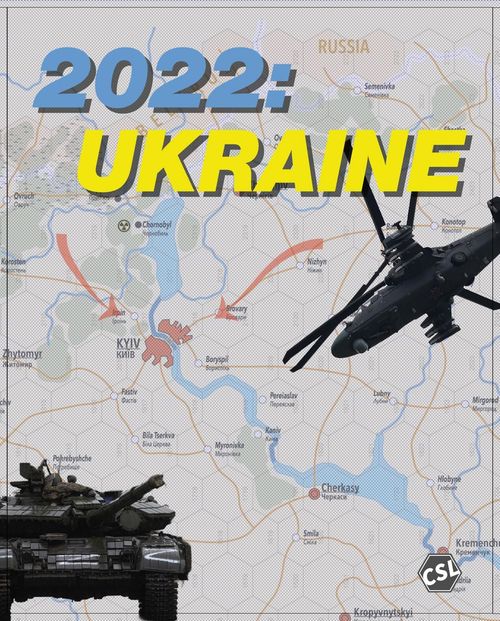
2022: Ukraine
2022: Ukraine Rulebook
Table of Contents
Table of Contents
- 1.0 Introduction
- 2.0 Scale and Map
- 3.0 Important Concepts
- Abbreviations & Glossary
- 3.1 Units
- 3.1.1 Special Units
- 3.1.2 Naval Units
- 3.2 Initiative
- 3.3 Air Power
- 3.3.1 Airmobile Infantry
- 3.4 Zones of Control
- 3.5 Combat Chits
- 3.6 Stacking
- 3.7 Lines of Communication (LOC)
- 3.7.1 Ukrainian Lines of Communications
- 3.7.2 Russian Lines of Communication
- 3.7.2.1 Russian Railheads
- 4.0 Sequence of Play
- 5.0 Joint Reinforcement and Recovery Phase
- 6.0 Air Missions
- 7.0 Action Phase
- 8.0 Combat
- 8.2 Loss Ratio
- 8.3 Satisfying LP
- 8.4 Retreating and Advance After Combat (AAC)
- 9.0 Terrain
- 10.0 Cleanup Phase
- 11.0 Special Rules
- 12.0 Victory
- 13.0 Setup
- 14.0 Design Notes
1.0 Introduction
It is important for me to note and acknowledge my own bias as a wargame designer which is admittedly pro-western in this instance. I am not saying this to argue the politics of the situation nor berate anyone for their own, but because mechanics are present in the game which clearly present Russia as the aggressor and willing to tolerate war crimes.
Finally – 15% of all sales for 2022: Ukraine upon release will be sent to mine removal efforts in the region. In the designer notes I will discuss some more serious topics concerning the war and my take on the ethics of modeling something currently ongoing. 2022: Ukraine is not meant to be a granular, detailed simulation, but a plausible model which is enjoyable to study. It is entirely possible that after this game is published, some of the OOB information will prove to be incorrect, I will do my best to update the OOB given we are print on demand and if anyone sees some glaring errors in our current OOB, please feel free to get in touch through our website.
2.0 Scale and Map
Units are primarily brigades (x), divisions (xx) regiments (iii) and battalions (‘’). Ground units are defined by a Unit Quality Rating - a reflection of training, morale, and equipment - ranging from D to A (worst to best) rather than by pure numbers of men. Each hex is approximately 24 miles from side to side. The game covers one year of operations and each full game turn is the equivalent of a month for a total of 12 turns.
3.0 Important Concepts
The following concepts are essential to understanding the rest of the rules. Those familiar with the PCS system will find these concepts familiar but should carefully read this section and note changes made to account for differences in scale compared to other games in the series.
Abbreviations & Glossary
- 1d8 – Die roll with an 8-sided die.
- 2d8 – Dice roll with two 8-sided dice.
- AAC – Advance After Combat.
- AACMA – Advance After Combat Movement Allowance.
- ATAC – Air-to-Air Combat.
- CD – Combat Differential = Difference between each side's FCR in a combat.
- CS – Combat Strength.
- CSA – Combat Strength Adjustments.
- DRM – Die Roll Modifier.
- EC – Effectiveness Check, a roll equal to or less than the ER is a success (-1 DRM for initiative player).
- ER – Effectiveness Rating.
- F – Fighter Air Units.
- FCR – Final Combat Result (Lead unit CS + applicable CSA + 1d8).
- Fresh – A unit that is available to be activated this turn.
3.1 Units
2022: Ukraine features armored, motorized, and mechanized formations supported by various types of foot infantry. In reality, these formations comprise of a mix of assets and unit types, but in the game they are represented by their predominant type and role. All ground unit counters are set out in the same way. The letter on the bottom left is the Unit Quality Rating (UQR) which is used during combat to determine Combat Strength (CS) when selecting random combat chits and calculating Combat Strength Adjustments (CSA) by comparing the UQR of each side's lead unit. To the right of the UQR is a unit's Movement Allowance (MA). To the right of the unit type is the Army ID, which is used for reference during setup. To the left of the unit type is the name ID of the unit and has no effect on mechanics. The backside of each counter represents a unit's static side. Units with a hollow MA are foot Infantry, units with a black MA are motorized and units with a red MA are Mechanized.
[Counter diagram: Unit Type, Name ID, Army ID, UQR, MA. Examples shown: Ukrainian Motorized Infantry, Ukrainian Mechanized Infantry, Russian Foot Infantry.]
3.1.1 Special Units
2022: Ukraine features special unit types which are allowed to stack with one other unit in an exception to the Stacking rules (see 3.6). Each side starts with one special unit, Ukraine has the Drone unit while Russia has the Engineer unit, both of these units feature a +1 on their counter, this is because they raise the UQR of any unit they are stacked with by 1. Special units cannot attack by themselves and if attacked while alone in a hex they are instead eliminated permanently. The Drone unit can not be targeted by SAM fire or engaged in ATAC.
[Counter diagrams: Ukrainian Drone unit; Russian Engineer unit.]
3.1.2 Naval Units
Russia has 2 Naval Units, Frigates and Missile Ships. For both, these units function much like the Special Units mentioned above except they are kept off-map or somewhere in one of the black sea hexes. Stacking limits are ignored for Naval Units.
Naval units all have a chance of being detected and eliminated by Ukrainian missiles when used. Each time after one of the Frigates or Missile Ships are used in combat, roll 1d8, on a result of 6 or greater the Naval unit is eliminated, and the Ukrainian player earns 1 VP.
[Counter diagrams: Russian Frigates; Russian Missile Ships.]
3.2 Initiative
Initiative for each turn is randomly determined for each turn of the game by each player rolling 1d8 and the highest result winning (ties go to Ukraine). However, on the first turn of the game, Russians have the initiative and the Ukrainians do not get to activate any ground units. The player with the initiative acts first during the Air Commitment Phase, takes the first activation during the Action Phase, and receives a -1 Die Roll Modifier (DRM) when undertaking an Effectiveness Check (EC).
3.3 Air Power
There are two basic types of air units in 2022, Fighters (F) and Ground Support (G). The number on an air unit counter is its Effectiveness Rating (ER). An EC is successful if a 1d8 roll is equal to or less than the ER, with a -1 DRM for the initiative player.
[Counter diagrams: Ukrainian Fighters; Russian Ground Support.]
Air missions are explained in more detail later (see 6.0), but below is a summary of the different missions that air units can conduct.
- Strategic (F & G): Undertake one of three different missions; strategic bombing (G attack VP), airstrike (G against an enemy ground unit) or suppression (F against enemy air patrols).
- Patrol/Escort (F): Intercept enemy air missions or protect friendly air missions.
- Interdiction (G): Interrupt enemy Strategic Movement (SM) or attack their Line of Communication (LOC) during combat.
- Ground Support (G): Support ground units in combat.
3.3.1 Airmobile Infantry
Infantry units with the airmobile NATO symbol and a movement rating are airmobile units that possess special qualities. When activated, a unit using airmobile movement first designates a destination hex, which can be any unoccupied hex on the map. The phasing player then decides if any friendly F air units in their Patrol/Escort box will provide escort. The airmobile unit then traces a continuous path of hexes from its existing hex to its destination hex. The non-phasing player may decide to intercept once in any hex along the path using any F air units from their own Patrol/Escort box. See 6.2 and 6.4 for the interception resolution process. If the airmobile unit is not intercepted then it is placed on the designation hex and immediately becomes static.
[Counter diagrams: Russian Airmobile, Front and Back.]
Units may not use airmobile movement to enter enemy-occupied hexes on the map. If an Airmobile unit is placed on an unoccupied but enemy-controlled city, it will be subject to SAM fire with a +1 DRM (see 6.6). When using normal ground movement airmobile units use their printed MA and are considered Foot infantry. They cannot combine airmobile and normal movement in the same activation.
3.4 Zones of Control
All combat units project a Zone of Control (ZOC) into the six hexes adjacent to the hex they occupy. Units that are static continue to project a ZOC. A ZOC does not extend into enemy-controlled major city hexes. An Enemy ZOC (EZOC) forces a friendly unit to stop moving or immediately attempt a Meeting Engagement (ME). A unit may retreat through an EZOC if occupied by a friendly unit but must not finish its retreat in an EZOC. If it is forced to do so it is routed. A LOC cannot be traced through an EZOC unless occupied by a friendly unit. Units can move from one EZOC hex to another EZOC hex but must stop moving upon entering the new hex and the new hex cannot be occupied (see Stacking, 3.6).
3.5 Combat Chits
Prior to the start of the game, all the white chits with letters and numbers on both sides are placed into an opaque cup (preferably empty). Whenever a unit enters combat with another unit, each player draws a random chit from the cup and randomly chooses a side. The number next to the letter that corresponds to a unit's UQR is its Combat Strength (CS). This combat chit remains with the unit until the end of the game turn when it is removed during the Cleanup Phase and returned to the cup.
3.6 Stacking
Only one unit may occupy a hex at the end of any movement or combat phase. Air units, special units, and other markers do not count towards stacking. Reinforcements can temporarily overstack (i.e. more than one unit) when placed, but overstacked units must be activated and moved before other friendly units on the map can be activated during an Action Phase. If an overstacked hex is attacked, the player whose units are overstacked must eliminate friendly units until the stacking limit of one unit is reached. Air units may not attack overstacked hexes. (Printed as "Air units can may not attack overstacked hexes"; read here as "may not".)
3.7 Lines of Communication (LOC)
Units need to check LOC to perform Strategic Movement (SM), during combat if they wish to fight at full strength, substitute 1 VP for 1 LP (see 8.3), or during the Cleanup Phase to avoid attrition (see 10.0). A LOC is defined as a path of hexes from the tracing unit to a railway hex unobstructed by enemy units or EZOC to a Supply Source. An LOC can be traced through an EZOC only if it is occupied by a friendly unit.
3.7.1 Ukrainian Lines of Communications
Ukrainian units trace an unlimited path of hexes (regardless of the presence of railways) unobstructed by enemy units or their EZOC (unless the EZOC is occupied by a friendly unit) towards any friendly controlled city or major city to establish a LOC.
3.7.2 Russian Lines of Communication
Russian units must be adjacent to or occupying a hex with a Russian Railhead marker, which in turn must be able to trace a line of friendly controlled rail hexes unobstructed by enemy units or their EZOC (unless the EZOC is occupied by a friendly unit) off map back to Russia.
Important: These rules also apply to the Belarusian border, which for game purposes is considered part of Russia.
Also Important: Railheads are markers and so they don't count towards stacking limits, the number of Railhead markers are limited, although they can be redeployed during the Cleanup Phase as described below.
3.7.2.1 Russian Railheads
During the Cleanup Phase of every turn when checking LOC, the Russian player must determine the friendly occupied railway hex furthest from the Russian border from which it is able to trace a LOC unobstructed by the presence of enemy units or their EZOC (unless the EZOC is occupied by a friendly unit) back to the Russian border. The Russian player then places Railhead markers on these hexes or other legal hexes (closer towards Russia) along an eligible LOC. During the game, events or Airstrikes (6.1.3) can take place which force the Russian player to move back these Railhead markers towards Russia. Players may also place multiple railheads along a single LOC noting that the number of Railhead markers is a hard limit.
Design Note: Russia has really had an extremely difficult time supplying their units beyond their established rail depots. This is for a number of reasons, most prominent among them being a lack of trucks able to ferry guns, food, and fuel to units safely. Almost ironically, this is similar to the problems the Russian army experienced in East Prussia in 1914 (not to mention tensions between army leadership), hence their LOC rules are fairly restricted.
4.0 Sequence of Play
- Joint Reinforcement & Recovery Phase
- Initiative Determination Phase: Refer to the Game Turn Track.
- Air Commitment Phase
- Allocate air units to Air Missions.
- Perform Strategic Air Missions.
- Action Phase
- The initiative side activates a unit followed by the non-initiative side.
- Continue alternating activations until both sides pass or all units have been activated.
- Cleanup Phase
- Refresh all units by flipping static units to their fresh side (Exception: 10.0)
- Check for Russian Railheads (3.7.2.1)
- Check for Ukrainian Knockout (11.5)
- Check for Random Event (11.6)
- Remove all combat chits from map and place back into the cup
- Advance game turn marker
5.0 Joint Reinforcement and Recovery Phase
All Russian and Ukrainian units with an M are placed in separate cups. After the first turn, during the Reinforcement and Replacement Phase, the Ukrainian player draws 4 random units and enters them as Reinforcements. After the first turn, the Russian player draws 2 random units during the Reinforcement and Replacement Phase until turn 7 when they start to draw 3 units per turn. Russian Reinforcements must enter from their respective Military District (the player can choose if one is not named). After drawing Reinforcements, both players check each routed unit to see if it recovers or surrenders. Reinforcements and Recovered units may only enter the map in or adjacent to an eligible entry hex. To be eligible the hex must be controlled, but it may be in an EZOC. Reinforcements may temporarily overstack in eligible entry hexes, but all overstacked units must be activated and moved in the Action Phase before any other units are activated. Eligible entry hexes are Supply Sources (see 3.7) and the hexes adjacent to them (note that Russian Reinforcements must enter the map from their respective military district or at the player's choice if the unit is not assigned to any military district).
5.1 Recovery Rolls
After processing reinforcements, both players check to see whether their routed units recover or surrender. Recovery rolls are made for each routed unit by rolling 1d8 and comparing the result to the number on the Recovery Table (see 5.3.1 below). A result equal to or more than the nationality's listed number results in the unit's successful recovery and it re-enters the game immediately like a reinforcement. A unit that rolls a 1 is considered to have 'surrendered' and is permanently removed from the game, earning the opponent 1 VP per unit (see 11.0).
Recovery Table
| Nationality | Recovery Number |
|---|---|
| Ukraine | 7 |
| Russia | 6 |
6.0 Air Missions
Both sides have air units that are used to influence maneuvers and combat on the ground. Starting with the player who holds the initiative, players remove all air units from all air boxes on the map and then alternate placing air units into the mission boxes – Strategic (three separate mission types), Patrol/Escort, Ground Support, and Interdiction – printed on the map.
The initiative player then performs all three of the Strategic type of missions in order (suppression, strategic bombing, airstrike), followed by the non-initiative player. The other air missions are performed during the Action Phase. After a strategic bombing, airstrike, ground support or interdiction mission, the defending player checks for Surface-to-Air Missile fire (SAM fire, see 6.6). After completion of any mission, remaining air units (i.e. those not in the Spent Air box or eliminated) check On-Call (see 6.7) status.
6.1 Strategic Phase
For Strategic Air allocation, each air unit must be assigned to one of the strategic bombing, airstrike, or suppression boxes. After all air assignments are completed, players conduct missions with air units assigned to the three Strategic boxes, with the initiative player first undertaking all missions in the order below and then the non-initiative player undertaking all missions in order.
6.1.1 Suppression
F air units assigned to the suppression box in the Strategic box aim to suppress enemy F air units that are currently on Patrol/Escort. Each air unit attempts an EC and for each success the enemy player must place one F air unit currently in the Patrol/Escort box into the Spent Air box (where it stays for the remainder of the turn). At completion of its mission, each active F air unit checks On-Call status (see 6.7).
6.1.2 Strategic Bombing
Strategic Bombing refers to air strikes made against infrastructure, communications, and other strategic assets that for play purposes are considered off-map. Strategic Bombing is done to earn VPs and has no other effects on gameplay.
The active player selects all G air units in the strategic bombing box and decides if any F air units from the Patrol/Escort box will accompany them. The opposing player then decides whether to intercept with F air units from the Patrol/Escort box. Once any ATAC is completed (see 6.4), then if any G air units remain in flight they each attempt an EC. If there are one or more successes the bombing player earns 1 VP (i.e. Russian bombing would cause VP to increase by 1, Ukrainian bombing would cause VP to fall by 1). The G air units then each check for SAM fire (see 6.6) and each remaining air unit that participated checks On-Call status (6.7).
6.1.3 Airstrike
The active player identifies an enemy unit or Railhead on the map as the strike target, and then selects any number of G air units assigned to the airstrike mission box inside the Strategic box and decides if any F air units from the Patrol/Escort box will accompany them. The opposing player then decides whether to intercept with any F air units from the Patrol/Escort box. Once any ATAC is completed (see 6.4), any G air units remaining in flight each attempt an EC. If there is at least one successful roll the player rolls 1d8; on a 1 or 2 the defending ground unit is routed, otherwise it becomes static. If a railhead is targeted, on a 1-2 the Railhead marker is moved back 2 hexes towards the Russian border, otherwise the Railhead marker is moved back 1 hex towards the Russian border. The G air units then check for SAM fire (see 6.6) and each remaining air unit that participated checks On-Call status (6.7). A ground unit can be attacked by multiple airstrikes (each can be made up of different numbers of G air units), but additional static results have no effect.
6.2 Patrols/Escort
Air units in Patrol/Escort boxes may be used to intercept enemy air units (or units using airmobile movement) or escort friendly air units (or units using airmobile movement) during the Strategic or Action Phases. The Patrol box and the Escort 'sub-box' are interchangeable (unlike the Strategic Bombing 'sub-boxes') and are simply available as a reminder for players.
After the active player has decided whether to provide escorts for a mission, the opposing player decides whether to intercept the mission with any F air units in the Patrol/Escort boxes. If so then they conduct ATAC and at its conclusion determine if any interceptors get past any escorts to attack the G air units (see 6.4). Upon completion of the mission each remaining F air unit that participated checks On-Call status (6.7).
When attacking an airmobile unit any interceptors that get past escorts each attempt an EC. If a '1' is rolled by any of them then the airmobile unit is immediately routed. If at least one EC is successful (but no '1' has been rolled), the airmobile unit halts in the hex it was intercepted in and becomes static; otherwise, the airmobile unit continues to its destination and becomes static there.
6.3 Interdiction
G air units assigned to the Interdiction box may attempt to interrupt enemy ground units undertaking SM or tracing an LOC for combat. After any G air units are selected for interdiction, the player then determines whether any F air units in the Patrol/Escort box will escort them, and then the other player decides whether to intercept with any F air units from their Patrol/Escort box.
6.3.1 Strategic Movement Interdiction
Whenever the phasing player is using SM, the non-phasing player may interrupt the movement at any point with an interdiction attempt. After the conclusion of any ATAC, remaining G air units each attempt an EC. If at least one EC is successfully performed, the phasing player must immediately end their activation, flipping the activated unit to static in the hex where it was halted. Exception: no interdiction attempt may be made against overstacked hexes. The G air units must then check for SAM fire (see 6.6) and each remaining air unit that participated checks On-Call status (see 6.7).
6.3.2 Combat LOC Interdiction
When combat is declared (whether ME or PA), both players may use G air units assigned to Interdiction missions to cut their opponent's LOC. This occurs at the same time as the resolution of any G air units assigned to Ground Support. The phasing player decides first what air units – including interdiction, ground support (see 6.5) and escorts – to use, and then the non-phasing player makes the same determination. If either player commits F air units then ATAC occurs. After ATAC if any G air units on the interdiction mission remain then the opponent must reduce their UQR by 1 and may not satisfy LP in combat using VP (see 8.3). The G air units must then check for SAM fire (see 6.6) and each remaining air unit that participated checks On-Call status (see 6.7).
6.4 Air-to-Air Combat (ATAC)
Whenever air units are intercepted, ATAC takes place, involving two rounds of ATAC between F air units, and potentially two rounds of ATAC between surplus remaining intercepting F air units and any opposing G air units on a mission.
In a round of ATAC between F air units, each F air unit on both sides undertakes an EC and for each success the enemy incurs 1 LP. After all EC are done, the LP are tallied and absorbed by each side (see 6.4.1). After the second round of combat deduct the number of remaining escorts from the number of remaining interceptors. If the number is negative, then all F air units of both sides immediately finish their mission and check On-Call status. If the number is positive, then that number of interceptor F air units will attack any enemy G air units on mission that were being escorted. In the case of Interdiction and/or Ground Support missions where both sides send escorts, then the side with the greatest number of escorts remaining can attack the enemy G air units with the surplus of escorts.
ATAC between F and G air units is conducted in the same way, but with two exceptions. First, G air units suffer a +1 DRM for their EC. Second, any LP inflicted by the G air units is deducted from the LP inflicted by the F air units. If the resulting amount is positive then that number of LP must be absorbed by the G air units, and if negative then that number of LP must be absorbed by the F air units. Any remaining F air units then immediately finish their mission and check On-Call status. Any remaining G air units may continue with their assigned missions.
6.4.1 Absorbing LP in ATAC
LP incurred in ATAC are absorbed at the end of each round of combat, and may be absorbed in a combination of ways, at the owning player's discretion:
| LP | Result |
|---|---|
| 1 LP | Air unit aborts mission, immediately place in Spent Air box. |
| 2 LP | Air unit is damaged; either flip unit and immediately place in Spent Air box; or, if already flipped, then unit is permanently eliminated (and VP adjusted accordingly, see 11.1). |
6.5 Ground Support
When a combat is declared (whether ME or PA), both players may use G air units assigned to Ground Support missions to support units in combat. This takes place at the same time as any G air units assigned to LOC interdiction. The phasing player decides first what air units – including interdiction (see 6.3.2), ground support and escorts – to use, and then the non-phasing player makes the same determination. If both players commit F air units then ATAC occurs. After ATAC if any G air units remain on the Ground Support mission the player may add the highest ER of the G air units as a CSA (see 8.1). The G air units must then check for SAM fire (see 6.6) and each remaining air unit that participated checks On-Call status (see 6.7).
6.6 SAM Fire
All G air units that complete a mission, and any airmobile units landing on enemy controlled cities, are subject to SAM fire. The opposing player rolls 1d8 for each air unit (or airmobile unit) and applies appropriate DRMs. If the result is 7 or higher, the air unit is damaged (an airmobile unit is routed). It is flipped to its reduced side and placed in the Spent Air box or, if already reduced, permanently eliminated (and VP adjusted accordingly, see 11.1). Targeted units with a UQR of D do not roll for SAM fire unless in a friendly city that started the game in the player's control.
SAM DRMs
| DRM | Condition |
|---|---|
| +1 | Targeted unit has a UQR of A |
| +1 | Targeted unit is in a city hex (except a unit with UQR 'D', which does not get a DRM) |
| +1 | Airmobile/Air Assault unit landing on an enemy-controlled city |
| +2 | Major City Hex (except a unit with UQR 'D', which does not get a DRM) |
Example: a D quality unit in a city would need a roll of 7 or more to damage an attacking air unit. A unit with UQR A that is inside a city, would need to roll at least a 5 (the combination of the A UQR and the city hex granting a +2 DRM).
6.7 On-Call
After an air unit completes any mission (after rolling for any SAM fire, if relevant), if the air unit is not spent a check is done to see if it remains On-Call. If the air unit successfully passes an EC it may stay On-Call, and either remain in the same mission box or move to a different mission box, at the player's discretion. If the EC is not successful, then the air unit is placed in the Spent Air box until the Air Commitment Phase of the next turn.
7.0 Action Phase
The Action Phase is the heart of the game. Players, starting with the player who holds the initiative, alternate back and forth activating individual units to move and/or attack enemy units until both players have passed or all units have gone static. Units go static after finishing their activation or as a result of other actions during the turn. If a player chooses to pass then they may not activate any more units that turn, and the other player can continue activating units until they are finished. When any hex is overstacked, one of those units must be activated and moved before any other units on that side may be activated. A unit that is activated chooses one of four potential actions:
- Regular Movement
- Strategic Movement
- Meeting Engagement
- Prepared Assault
7.1 Regular Movement
When a unit is activated, it may move from hex to hex, paying the MP cost of the terrain as specified in the TEC (see 9.0) for each hex entered, up to the total of its MA. Upon completing movement, the unit is flipped to its static side. A unit's movement type is indicated by the color of its MA; black indicates Motorized, transparent with a black outline indicates Foot, and red indicates Mechanized.
7.2 Strategic Movement (SM)
SM functions the same as regular movement except the unit's movement allowance is doubled and units using SM may not move adjacent to an enemy unit at any point in its movement. A unit utilizing SM is flipped to its static side when finished moving. Enemy air units set aside for Interdiction may attempt to interrupt a unit using SM (see 6.3.1). SM requires a unit to begin its movement in a hex with a LOC.
Units using SM may not move further than the furthest friendly unit in enemy territory (i.e. a Ukrainian unit on the map may not move east further than the easternmost Russian unit).
7.3 Meeting Engagement (ME)
A ME is a combination of regular movement and combat. A unit may undertake multiple MEs during movement if it has the MP available to do so. When adjacent to an enemy unit, the activated unit must spend MP equal to the movement cost of the enemy hex plus a chosen number of MP (1-4) for the ME Combat Strength Adjustment (CSA) (see table below).
ME CSA
| MP Spent | CSA |
|---|---|
| 1 MP | -2 CSA |
| 2 MP | -1 CSA |
| 3 MP | 0 CSA |
| 4 MP | +1 CSA |
In a ME combat, only the lead unit may suffer losses, supporting units do not. For the combat procedure see 8.0.
7.4 Prepared Assault (PA)
If one or more fresh units begin their activation adjacent to an enemy unit, they may conduct a PA against the enemy unit. The attacking player must designate one of these attacking units as the lead unit. Only the lead unit automatically becomes static after combat. A supporting adjacent unit does not become static unless it decides to in order to absorb LP or Advance after Combat (see 8.4), then any units who do so become static when finished. For the combat procedure see 8.0.
8.0 Combat
Combat during both ME and PA attacks is performed the same way, but the adjustments involved, and the way results are applied differ. Whenever combat is declared, the players perform any relevant air operations, and then each player randomly draws a combat chit, randomly chooses a side of their chit, and places it underneath their lead unit. For the defender the lead unit is always the single defending unit. For the attacker, in a ME the lead unit is the single activated, attacking unit, while in a PA the lead unit is selected by the player (see 7.4).
Each player then determines their own CSA for combat, summarized in 8.1 below and in the game charts. All CSA are cumulative. The appropriate CSA are added to the CS on the combat chit drawn for their respective lead unit to determine the final CS. Each player then rolls a 1d8 and adds the result to the final CS to get the Final Combat Result (FCR). The Victor of the combat has the higher FCR and the Combat Differential (CD) is equal to the difference between the two FCR.
Note that the defender does not go static from the combat unless it chooses to do so to absorb losses. The lead attacker always goes static, while other participating attacking units only go static if they choose to AAC.
8.1 Applicable Combat Strength Adjustments (CSA)
All CSA modifiers are cumulative.
All combats
- Air Ground Support: +ER (see 6.5)
- UQR Difference: +1 to +3 scaled difference in quality (see 8.1.1)
- Friendly units adjacent to combat hex: +1 per unit, excluding the lead unit (see 8.1.2)
- Terrain: See 9.0 or TEC
ME only
- Unit Size Modifier (see 11.7)
- MP Spent: -1 to +2 CSA (see 7.3)
- Flanking Attackers: +2 each, max of +4 (see 8.1.3)
PA only
- Flanking Attackers: +3 each, max of +6 (see 8.1.3)
8.1.1 UQR
This CSA is scaled by class; for example, an A unit fighting against a D unit would get a +3 CSA, a B unit against a D unit +2 CSA and a C unit against a D unit +1 CSA. A B unit against a C unit would receive a +1 CSA, etc. Only the side with the better UQR receives a CSA.
8.1.2 Adjacent Combat Support
Each friendly unit adjacent to the combat hex provides a +1 CSA.
8.1.3 Flanking Units
An enemy unit is considered flanked if there is a friendly unit on the opposite side of the lead unit, or if there are at least 3 units (including the lead unit) in 3 non-adjacent hexes that are all adjacent to the combat hex. The flanking bonuses are cumulative with the bonuses for unit adjacency. Units may provide flank support whether fresh or static.
8.1.4 Line of Communication
A unit which cannot trace a LOC at the start of combat (or a unit's LOC was attacked by an enemy air unit) subtracts their UQR by 1 (minimum of D).
8.1.5 Combat Example
During an activation, foot infantry unit X conducts an ME against unit Y, spending 4 MP thus granting unit X a +1 CSA in the upcoming combat. In addition, unit X has 3 friendly units adjacent to unit Y granting another +3 CSA bringing its total CSA to +4. Unit X has a UQR of C while unit Y has a UQR of B, so unit Y receives a +1 UQR CSA. Unit Y is across a ridge hexside and has 1 friendly unit adjacent granting a further +2 CSA, and it also receives Ground Support from a G air unit with an ER of 2 which brings its total CSA to +5. So, for the upcoming combat, the attacker unit X has a +4 CSA while the defender unit Y has a CSA of +5. Unit X draws a 6 for its Combat Strength while Unit Y draws a 2, so X has a final CS of 10 (4+6) and Y has a final CS of 7 (5+2). Both players then each roll 1d8, X rolls an 8 and Y rolls a 1. This is added to their final CS to determine their FCR, so X has an FCR of 18 (10+8) and Y has an FCR of 8 (7+1). As it has the higher FCR, unit X is the Victor and the CD is 10 (18-8).
8.2 Loss Ratio
The losing side in a combat suffers LP. This is the CD modified by the Loss Ratio, which is dependent upon the type of combat, terrain, and who is the winner. A Loss Ratio can never be less than 1:1 or more than 3:1. The TEC can include increases in the Loss Ratio.
8.2.1 Loss Ratio for ME
If the defender is the winner, use a 1:1 Loss Ratio. For every 1 point of the CD, 1 LP is inflicted on the attacker (e.g. if the attacker's FCR is 6 and the defender's FCR is 8, the CD is 2 and the attacker suffers 2 LP).
If the attacker is the winner, use a 2:1 Loss Ratio. For every 2 points of the CD, 1 LP is inflicted on the defender, always ignoring any remainder (e.g. if the attacker's FCR is 9 and the defender's FCR is 6, the CD is 3 and the defender suffers 1 LP).
8.2.2 Loss Ratio for PA
LP are applied on a 1:1 ratio to the CD for both attackers and defenders.
8.2.3 Terrain Adjustment
See TEC.
8.3 Satisfying LP
All LP must be absorbed, which may be done in several ways cumulatively:
- A defending unit may flip to static to satisfy 1 LP.
- Retreat: select only one of the following two options (if eligible):
- All units may retreat 1 hex to satisfy 1 LP.
- All UQR A or B unit may retreat 2-3 hexes to satisfy 2 LP.
- Spend 1 VP maximum (i.e. Russian loss would cause VP to decrease by 1, and Ukrainian loss would cause VP to increase by 1) to satisfy 1 LP (only if the lead unit can trace a LOC at that time).
- An adjacent supporting unit may go static to satisfy 1 LP each (EXCEPTION: supporting attacking units during an ME may not go static to satisfy LP).
- The lead unit can be routed to satisfy ALL LP.
8.3.1 Absorbing LP in Combat Example
Continuing the example from 8.1.4 the attacker, unit X, is the winner and the CD is 10 (18-8). As it is an ME, the Loss Ratio is 2:1, so 5 LP (10/2) must be absorbed by the defender. If this were a PA, 10 LP would have been generated against the defender. The defender could choose to absorb all 5 of LP by a combination of spending VP, retreating units, flipping supporting units to static or by routing the lead unit to absorb all 5 LP at once. If the CD is not enough to generate any LP, the combat has no effect and the attacking unit goes static.
Note: A and B units are allowed to retreat 2 hexes to satisfy 1 LP if they choose.
(The printed cross-reference reads "8.1.4"; the example itself is section 8.1.5.)
8.4 Retreating and Advance After Combat (AAC)
A unit must attempt to retreat towards a supply source and away from enemy units, if possible. If the defender's hex is vacated, the attacker may AAC into the hex (with no MP cost). In a ME, the attacker may continue movement with any MP which remain unspent. Note that if the defender's hex is not vacated, the attacker may attack again with a ME if it has sufficient MP remaining.
In a PA, if the combat hex is vacated by defending units, roll 1d8 and halve the result (rounded down); this is the AAC Movement Allowance (AACMA) for any attacking units involved that choose to advance. Each unit may immediately move into the combat hex (for no MP) and then it uses the AACMA to move in any direction. Any supporting units that choose to advance become static after they spend their AACMA, while any supporting units that do not advance remain fresh and in place. Units may not over stack a hex as a result of AAC.
9.0 Terrain
The movement costs and combat effects for terrain are listed in the Terrain Effects Chart (TEC).
10.0 Cleanup Phase
Russian and Ukrainian units that cannot trace an LOC during the Cleanup Phase only return to fresh status during a Cleanup Phase in which they can trace a LOC. (note that all Russian units are considered to have an LOC on the first turn.) All combat chits are removed from the map and placed back in the cup. In 2022: Ukraine the Cleanup Phase includes some additional steps:
- Refresh all units by flipping static units to their fresh side (Exception: 10.0)
- Check for Russian Railheads (3.7.2.1)
- Check for Ukrainian Knockout (11.5)
- Check for Random Event (11.6)
- Remove all combat chits from map and place back into the cup
- Advance game turn marker
11.0 Special Rules
The rules in the following chapter take precedent to the rest of the rules in cases where conflicts may occur.
11.1 Russian Surprise
To simulate the conditions which lead to the Russian invasion, all Ukrainian ground units may not activate on the first turn. On the second turn, all Ukrainian units may activate. Note that Ukrainian air units may still activate on turn 1.
11.2 Ukrainian Partisan Activity
On all turns when the Ukraine holds the initiative, the Ukrainian player receives a +2 CSA to any combat involving a lead Ukrainian Foot Infantry and lead Russian Armor or Mechanized unit.
11.3 Russian Atrocities
Whenever Russian units with a UQR of C or less attack a Ukrainian City, if the Russian player rolls a raw 7 or 8 (not counting DRM), the Russian forces have committed atrocities against the population. Whenever an Atrocity is generated, the Ukrainian player rolls 2d8 on the following Western Aid table.
Each time an Atrocity occurs, add a cumulative DRM of +1 to each subsequent 2d8 Roll (max DRM of +3). This DRM resets to 0 once a player successfully receives Western Aid. Events with a * may only occur once and if rolled again are treated as No Effect.
11.3.1 Western Aid Table
| 2d8 Result | Effect |
|---|---|
| 2-3 | No Effect |
| 4-5 | Media Support |
| 6-7 | Increased Supplies |
| 8-10 | HIMARS System* |
| 11-12 | Abrams Tanks* |
| 13-14 | Patriot Missiles* |
| 15 | F-16s* |
| 16+ | ATACMS* |
11.3.1.1 No Effect
Nothing happens although the next Western Aid Table roll receives a +1 DRM (max of 3).
11.3.1.2 Media Support
Western media uses its vast resources to stir donations and volunteers to Ukraine – Ukraine receives 1 VP.
11.3.1.3 Increased Supplies
NATO members send guns and butter to the front – all Routed Ukrainian units are instantly recovered.
11.3.1.4 HIMARS System
The USA sends the HIMARS artillery system to Ukraine – the Ukrainian player receives the HIMARS unit. This unit grants a +1 UQR modifier on one combat per turn with a 3 hex range from any friendly controlled city. The HIMARS unit is otherwise held off-map as a reminder each turn.
11.3.1.5 Abrams Tanks
The US opens up its reserve of Abrams Tanks – The Ukrainian Player receives the Abrams unit. This unit grants a +1 UQR to any one combat per turn so long as the unit in combat has a LOC. The Abrams unit is otherwise held off-map as a reminder each turn.
11.3.1.6 Patriot Missiles
The US sends the Patriot Missile SAM system to Ukraine – the Ukrainian player receives the Patriot Missile unit and for the remainder of the game, the Ukrainian player receives a +2 DRM to all SAM fire attempts. This unit is kept off-map as a reminder.
11.3.1.7 F-16s
The US agrees to send Ukraine F-16 aircraft. The Ukrainian player receives the Ukrainian F-16s which are useable for the remainder of the game as regular air units. If destroyed in combat, they are worth 2 VP each.
11.3.1.8 ATACMS
The US sends the long range tactical ballistic missile system to Ukraine – the Ukrainian player receives the ATACMS unit. This unit grants a +2 UQR bonus in one combat each turn. The unit is otherwise kept off-map as a reminder.
11.4 Russian Missile Barrage
Starting on the second turn during the Air Commitment phase after all Air Missions have been performed, the Russian player may spend 1-2 VP to place one or two Missile Barrage markers anywhere on the map. The Missile Barrage markers force any units entering the hex or any adjacent hex to spend +1 MP to each Missile Barrage marker. Missile Barrage markers are removed during the Cleanup Phase of every turn.
Design Note: I decided to give this option a VP cost as the human toll it tends to take on the population is excessive, making it more politically precarious to do these things (granted it seldom has seemed to stop Russia from targeting civilians in reality).
11.5 Ukrainian Knock Out
If the Russian player manages to occupy Kyiv with any unit for 1 full turn, the Russian player rolls 1d8, on a 1-4 there is no effect but on a 5-8 the Ukrainian player immediately loses and the Russian player earns a major victory as it is assumed President Zelensky is assassinated. If both Kyiv hexes are occupied for 1 full turn, the Russian player automatically wins on a result of 3-8.
11.6 Random Event Table
At the end of every turn during the cleanup phase, the players roll 2d8 and check the following Random Event Table, note that events marked with a * can only happen once and if an event is rolled twice it is treated as No Event.
| 2d8 Result | Effect |
|---|---|
| 2-3 | Trouble in Paradise |
| 4-7 | Partisan Activity |
| 8-10 | No Event |
| 11-13 | North Korean Builders* |
| 14 | Iranian Drones* |
| 15 | Chinese Supplies* |
| 16 | False Flag Operation |
11.6.1 Trouble in Paradise
If this event is rolled, the mercenary forces within the Russian forces all make public and theatric protests about a lack of support and supplies from Moscow, with Prigozhin the head of Wagner stating that others like Shoigu of Gerasimov should kill themselves out of shame (not unlike Samsonov back in 1914). On the following turn, the Wagner unit and any other Russian units adjacent to them must remain (or become) static and cannot activate.
11.6.2 Partisan Activity
Local Partisans make concerted attacks against Russian supply lines. All Russian Railhead markers must move back towards their supply source 1d4 hexes (roll 1d8 and halve the result, rounding down).
11.6.3 No Event
Nothing happens and there is no effect.
11.6.4 North Korean Builders
North Korea sends a contingent of builders and other laborers to free up more Russian forces. The Russian player receives the North Korean Builders unit. Once per turn, this marker may be used during a defensive combat to add a +2 CSA modifier to the unit leading the defense. This unit is kept off the map otherwise to serve as a reminder.
11.6.5 Iranian Drones
Iran agrees to send a fresh supply of modern Drones to Russia. The Russian player receives the Iranian Drone unit which can be used once per turn to grant a +1 UQR modifier to any combat. The unit is otherwise kept off-map to serve as a reminder.
11.6.6 Chinese Supplies
China agrees to send Russia critical supplies such as weapons, weapons systems, and ammunition. The Russian player receives the Chinese Supplies unit which can be used once per turn to grant a +2 CSA modifier to any combat. This unit is otherwise kept off the map to serve as a reminder.
11.6.7 False Flag Operation
This event assumes that Russia manages to pull off a competent/convincing attempt at exposing outside intervention in the conflict. A less convincing example of this was when Russia reported to find copies of Shakespeare as proof that English forces were present in Ukraine (as if young squaddies would be reading Macbeth in between patrols). As a result of rolling this event, the Russian player immediately earns 2 VP.
11.7 Unit Size CSA Modifier
2022: Ukraine includes a slight modification to the standard PCS rules regarding unit sizes in combat. Any time a smaller or larger lead unit is facing off against one another, the larger unit receives a +1 CSA adjustment. Use the following table to determine the size of units in relation to one another, starting from smallest to largest:
- Battalion (")
- Regiment (iii)
- Brigade (X)
- Division (XX)
11.8 Event-Based Units
With the exception of the F-16s from the Western Aid Table (11.3.1), these units cannot be attacked or destroyed as they are normally kept off map. Therefore, in practice they function more like markers and have no effect on stacking limits.
11.9 Nuclear Hexes
Several hexes on the map are noted with a fallout symbol which indicates the presence of a nuclear power plant. Whenever a unit in one of these hexes is attacked in combat, targeted by an air unit, or whenever a Russian Missile Barrage is in or adjacent to a Nuclear Hex, a chance is generated that the attacking force generates a Nuclear Event using the following Nuclear Event Table (each subsequent roll on this table adds a cumulative +1 DRM to the result with no cap).
11.9.1 Nuclear Event Table
| 2d8 Result | Effect |
|---|---|
| 2-12 | No Effect |
| 13-15 | Infrastructure Damage |
| 16+ | Catastrophic Event |
11.9.1.1 No Event
There is no effect as nothing important is damaged.
11.9.1.2 Infrastructure Damage
Nuclear infrastructure is damaged during an attack – The attacking force immediately loses 2 VP.
11.9.1.3 Catastrophic Event
A nuclear reaction is triggered rendering the immediate area completely uninhabitable – the attacking force immediately loses 3 VP and a Fallout marker is placed in the hex.
11.9.2 Fallout Markers
Fallout markers represent nuclear disasters as a result of combat, air/ground strikes or Russian Missile Barrages against hexes with a nuclear power plant. A fallout marker increases the movement cost of the hex it occupies and each adjacent hex by 1 MP. There is no limit to the number of Fallout Markers which can be placed in a hex increasing the relevant movement cost by +1 each. Fallout markers are permanent and remain for the rest of the game.
Design Note: The purpose of these rules is to discourage players from attacking forces occupying Nuclear hexes.
12.0 Victory
VP are a loose representation of the Russian National Morale. VP go up for the Russian and down for Ukraine (reflected by +/- VP designations in section 12.1)
An automatic major victory is achieved by any one of the following at the end of any turn:
Russia
- VP total reaches 20 or more
- At any point, the map is free of Ukrainian units
- A Ukrainian Knockout occurs (11.5).
Ukraine
- VP total reaches 1 or less
- At any point, the map is free of Russian units
The game begins with the VP marker at 10. If an automatic victory is not achieved players determine the winner by referencing the number of VP at the end of the game using the chart below:
- 1-4 VP: Substantial Ukrainian Victory
- 5-10 VP: Minor Ukrainian Victory (Historical Result)
- 11-15 VP: Minor Russian Victory
- 16-19 VP: Substantial Russian Victory
12.1 VP Schedule
VP are adjusted according to the following schedule:
- City hexes: +/- 1 VP at the moment a friendly unit occupies a previously uncontrolled city hex
- Each Major City hex: +/- 1 VP at the moment a friendly unit occupies a previously uncontrolled major city hex
- Surrendered units: +/- 1 VP
- VP Exchanged for LP: +/- 1 VP
- Eliminated Air/Naval Unit: +/- 1 VP for each air/naval unit
Design Note: The term Victory here is really only for the purposes of determining the winner of the game, obviously the war is still going on so no one has technically won the war, that said the margin of victory in this game should correspond with what would have realistically been possible within the 1st year of the conflict.
13.0 Setup
It does not matter which player sets up first. Russian units setup according to their military district, each of which are labeled on the map. Russian units can be stacked during setup, but stacked units must move before other units (remember that only the Russian player activates during Turn 1). The Russian player may optionally place units on the following turn to enter as Reinforcements from their respective Military District.
Ukrainian units may set up anywhere inside of Ukraine, though there is the one Sep Presidential SF brigade which must set up and remain in Kiev. All Russian or Ukrainian units with an M are placed in separate cups (these cups represent unmobilized units).
14.0 Design Notes
Section 14.0 of the printed manual is the designer's essay on the subject matter, the Russian army, and the war crimes referenced in the game. It is commentary rather than rules and is not reproduced here. Section 15.0 (Credits) is likewise omitted.