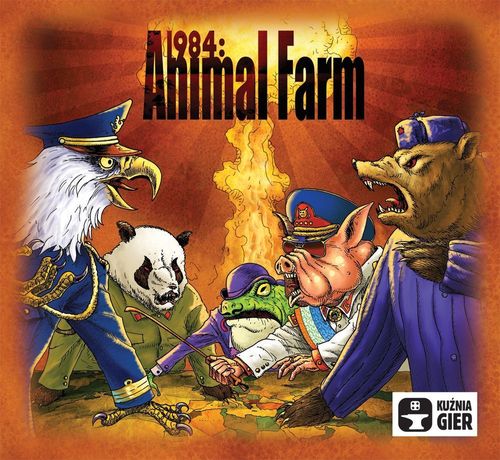
1984: Animal Farm
1984: Animal Farm Rulebook
Table of Contents
Table of Contents
Game Objective
1984: Animal Farm is a board game capturing the atmosphere of the cold war, with a strong element of negotiations. It is designed for 3-5 players, aged 12 and above. In 1984 animals took control over particular countries and started an arms race on an unprecedented scale. You are the leader of one of the world powers and you take part in the battle for world domination. Using your influence and agents in unstable regions you gain advantage in the international arena, represented by Victory Points. The player who has the most points after 9 rounds wins the game.
Editorial note: the Game Objective says the game is won after 9 rounds, while the Ending the Game section says it ends when the 6th round is finished. Both are transcribed as printed. The Rounds 3 and 6 box addresses 9-round play.
Game Components
The box contains: 50 cards, 96 tokens, 73 wooden markers and this rulebook.
In case any elements are missing, please contact us by email: [email protected] – we will supply the missing pieces as soon as possible.
Editorial note: the printed counts do not add up to the stated 50 cards. The rulebook describes 20 Revolution cards, 25 action cards (as printed) and political moods cards (see Cards below). The tokens are 60 influence tokens and 36 Victory Point tokens, and the markers are 45 agents and 25 advanced action markers, plus first player, first region and round markers.
The Board
It represents the world after the animal revolution.
Important elements of the board:
- Unstable regions – you fight for influence in these regions;
- Round counter – see Round marker below;
- Places for political moods cards – see Game Setup.
Unstable Regions
Each region has:
- Areas in the colors of world powers for placing agent markers;
- A place in the middle for putting influence tokens – marked with a symbol of a given influence type;
- A place for the first region marker.
World Powers
The players are their leaders. Each world power has a place for the first player marker and two areas:
- New influences – here you place influence tokens after you gain them;
- Owned influences – at the end of the round you place new influences here. Important: You can have no more than two influence tokens here.
- Airdrop zone – influences in this zone may be used only to activate advanced actions. If you have any unused influences in this zone at the end of the spies phase – remove them.
- Agents – here you may keep the agents that will enter play in future rounds.
Tokens
Influences
60 tokens in 5 types, 12 pieces each, used for starting revolutions in order to gain VP and activating action cards.
- Cats – Latin America
- Donkeys – Middle East
- Elephants – India
- Kangaroos – Australia
- Lions – Africa
Victory Points
36 tokens with values of 1, 2, 5, 10 and 20 used for counting your VP. Remember that your VP should be kept face down and other players should not see them.
Markers
Agents
45 wooden markers in 5 colors, 9 pieces for each player. They are used for marking the strength of world powers' influences in unstable regions.
Depending on the number of players, you will start the game with different number of agents, and during the game after rounds 3 and 6 new agents will appear.
Advanced Action Markers
25 wooden markers in 5 colors, 5 pieces for each player. They are used for marking advanced actions a player bought.
First Player Marker
It indicates the player who acts first in a given round.
First Region Marker
It indicates the region where the players' influences are resolved first.
Round Marker
It is used for marking subsequent game rounds on the board.
Game Setup
Before the beginning of the game take all the elements out of the box and:
- Place the board in the middle of the table.
- Randomly choose two political moods cards and put it on the appropriate place on the board. Place the rest near the board – they will be used later in the game.
- Choose (intentionally or randomly) one basic action card of each type and place them at one side of the board – return the remaining 5 cards to the box, they will not be used later in the game.
- Choose (intentionally or randomly) one advanced action card of each type and place them next to the basic action cards. Return the remaining cards to the box – they will not be used later in the game.
- Put the round marker on number 1 on the counter.
- Choose (intentionally or randomly) one region and place the first region marker there.
- Randomly choose the starting player – this payer gets the first player marker.
- Each player puts one agent in every region on the board (on appropriate places). Then you add extra agents depending on the number of players:
- 3 players – going clockwise, each player adds 1 agent to a chosen region. Then, going counter-clockwise, each player once again adds 1 agent to a chosen region. Each player starts the game with 7 agents.
- 4 players – going counter-clockwise, each player adds 1 agent to a chosen region. Each player starts the game with 6 agents.
- 5 players – you do not add any extra agents, you start the game with 5 agents each.
- Put 1 revolution card between each pair of neighboring players. There cannot be two revolution cards related to the same region (requiring the same influences in the top line).
- Put each 12 influence tokens on apropriate regions.
- Now you can start the game.
Note: rule 3 says the basic action cards are chosen "one of each type" (5 cards), and rule 4 the same for advanced actions (5 cards), as printed.
Game Overview
The game is divided into subsequent rounds, each round is divided into phases:
- Moves
- Alliances
- Spies
- Revolutions
- Buying
- Ending
In phases 1, 3, 4, 5, 6 players act beginning with the first player and then going clockwise.
Example: The players are: Mateusz, Rafał and Dominika. Rafał USA is the first player during this round, Dominika Russia sits to his left, Mateusz China to his right. Rafał will be the first to act, then Dominika, and Mateusz will act last.
1. Moves Phase
Each player – beginning with the first player and continuing clockwise – may move 1 agent from a chosen region to another one.
A player may decide not to move agents – this player passes.
You may not move more agents, unless you use an action – but remember that you may use action cards only when it is your turn to act according to the order.
Example: Rafał moves his agent from Australia to Latin America. Dominika passes, and Mateusz moves his agent from Africa to Australia.
Example: In some next round Dominika moves her agent from Africa to Australia, then she uses an available basic action card, discards 1 Cat influence token and moves an additional agent to Australia – this time from the Middle East.
Discarding Influence Tokens
When you discard tokens in order to use an action or start a revolution, put them on the board on the same region as the symbol on the token.
2. Alliances Phase
The longest and the most important phase in the round. In each region the world powers' agents form temporary alliances to gain influence tokens that represent the influences in the international arena.
This phase does not start from the first player, but from the first region, and then goes according to the arrows on the board - this is an exception.
Temporary Alliances
In a region where the situation is being resolved you try to form a winning alliance, that is the an alliance whose agents will be stronger than agents of any other alliances.
How to form an alliance:
- Each agent in a region has strength = 1.
- You may use basic and advanced action cards to strengthen your alliance and negotiate – negotiations are the most important element of the game.
- Each player may be involved only in one alliance at a time. Alliances may (and probably will) be different in different regions.
Negotiations
When you negotiate, you may promise everything you have at your disposal in the game, or you hope to have – apart from VP.
For example, you may promise another player that – in exchange for participating in an alliance – you will use a Lion card in the next region to strengthen your agents and give 1 token to your current ally, or you may promise your neighbor you want to form an alliance with that you will use more tokens than him to start a revolution.
You can threaten others with using an action, but this remains only a threat until you actually take a token into your hand to pay for using this action. If you touch an influence token that could be used to pay for such an action (blackmail in negotiations), its rule is immediately applied.
Remember – no holds barred.
- The maximum number of players in one alliance is X-1, where X = number of players. Example: Rafał, Dominika, Mateusz and Krzysztof are playing. Only 3 of them may join in one alliance.
- If a player is able to have the majority alone, he does not need other players (you may say that a "one-person alliance" is formed).
- If a winning alliance is formed, the players who formed it take the influence tokens from the region. Each agent allows the player to take one token from the region, but the number of tokens taken may be subject to negotiations.
- The maximum number of influence tokens taken is X+2, where X = number of players.
- All tokens obtained should be placed in the area of new influences (remember that they cannot be used until they are activated in the next round).
- If the players cannot agree on the division of influences or form a winning alliance, nobody takes the tokens.
After forming alliances and taking the tokens, the situation in the next region is resolved according to the arrows on the board. Each region situation is resolved only once in a round.
Example: Rafał has 4 agents in Australia, Dominika and Mateusz have 2 agents each. No player has the majority, so two of them have to form an alliance. Rafał may enter an alliance with Dominika or Mateusz. The strength of such an alliance is 4 + 2 = 6. Dominika will not be able to form an alliance with Mateusz, as their agents' strength is 2 + 2 = 4. The players have to negotiate. Rafał offers the place in an alliance to anyone who will give him an extra influence token in the next region. Dominika agrees, Mateusz does not. Rafał forms an alliance with Dominika. They can take only 3 (number of players) +2 = 5 tokens. He takes 3 Kangaroo tokens, Dominika takes 2.
Example: In the Middle East Dominika has 3 agents, Rafał has 1 agent, Mateusz has 2. During negotiations Dominika uses an advanced action (bought in previous round) and discards 1 Lion influence token. For the purpose of this negotiation the strength of her agents in this region doubles 3x2 = 6 (3). Other players do not use any cards, so Dominika wins in this region. There are 4 Donkey tokens in this region, she takes 3 – according to the number of her agents (4). Will she prove a trustworthy player and fulfill her promise from the previous example?
3. Spies Phase
In this phase each player may use actions involving Kangaroo influence, according to the order.
You can never form an alliance of all players taking part in the game - always at least one player has to be excluded from the winning alliance.
At the end of the spies phase all players put all the tokens from the Airdrop zones back on the board.
Example: Rafał collected 4 Kangaroos, but he has them in his area of new influences, so he cannot use them until the actions are activated. Dominika has 2 tokens (not used in previous rounds) in her owned influences area. Mateusz has 1 Kangaroo in the same area. Dominika decides to use a Kangaroo to remove 1 chosen token from Rafał's new influences (1), and to use another token to remove Mateusz's Kangaroo from his owned influences (2). After this action Mateusz has no Kangaroos and he cannot use actions that require this type of tokens as the cost.
4. Revolutions Phase
In this phase you and your neighbors use your influences to gain VP.
Starting from the first player and going clockwise, each player may spend his influences (from the new influences zone or from the owned influences) to start a revolution together with his neighbors, placing the influence tokens on the revolution card on his left or right side.
- The influence token has to have the same symbol as the revolution card.
- You may place from 0 to 3 tokens on one revolution card.
- You cannot place tokens on other revolution cards than those on your left or right side.
- You are free to negotiate the number of tokens each player spends – see Negotiations.
- The round track indicates which revolutions (to the players' right or left side) are worth 1 more VP. A successful revolution means that you and the person you are making a revolution with get 2 VP. Extra 1 VP goes to the player on the left or right - this depends on the particular round.
- When you place your tokens, you may talk, debate and negotiate.
Successful Revolution
If there are as many tokens on a revolution card as required, both players between whom this card is placed gain 2 VP – regardless of how many tokens each of them spent.
All tokens used for gaining VP are returned to appropriate regions on the board.
Example: Rafał has Dominika to his left. Between them a revolution card requiring 2 Kangaroos and 1 Donkey lies. Rafał agrees with Dominika (who does not have any Kangaroos) that in this round he will spend 2 Kangaroos and she will spend 1 Donkey, but it will be the other way round next time. Rafał puts 2 Kangaroo tokens on the card and Dominika adds 1 Donkey. It is round 2. The round track indicates that revolutions on the players' left side are worth 1 more VP, so Rafał gets 3 VP, while Dominika gets 2 VP.
Unsuccessful Revolution
If a revolution card is not fully filled with tokens, none of the players between whom this card is placed gains VP, and the tokens spent are returned to their owners.
Example: Rafał has Mateusz to his right. Between them there is a revolution card with 2 Cats and 1 Elephant. Rafał has 2 Cat tokens and 2 Elephant tokens, Mateusz has 1 Cat. Rafał suggests that he will spend 1 Elephant and 1 Cat this round, while Mateusz will add a Cat. Mateusz does not agree. Rafał is not willing to spend all the required tokens by himself, so they do not gain any VP (but Rafał does not lose any tokens – this was only an offer).
5. Buying Phase
In this phase you enhance your abilities by buying advanced actions or invest your influence tokens in VP. Starting from the first player and going clockwise, each player may spend his influences (both new and owned) on actions or VP. The tokens spent are returned to appropriate regions on the board.
Advanced Actions
If you want to buy an advanced action, spend as many influence tokens as it is required for buying the action and place your world power marker on the card.
Example: Rafał spends 3 tokens: 2 Donkeys and 1 Kangaroo, and buys an advanced card for Elephants, placing the marker of his power on the card.
Victory Points
You gain 1 VP for each 3 tokens spent.
Example: Rafał and Dominika do not buy VP. Mateusz exchanges 1 Cat, 1 Elephant and 1 Donkey for 1 VP.
6. Ending Phase
Each player decides which of the resources collected they will put in the owned influences area and which in the airdrop zone. You cannot have more than 4 resources in both areas at the end of the round. Each area can hold 2 resources. At the end of this phase move al meta-game cards according to the direction shown on the board (1-2-3). Then draw a new meta-game card and put it on the beginning of the route.
Editorial note: "meta-game cards" in this sentence appears as printed in the source and refers to the political moods cards on the route; the two terms are not otherwise defined in the source.
If a political moods card leaves the board, put it inside the box.
If you have more than 4 owned influences you have to discard the excess.
Example: At the end of the round Dominika has 3 tokens in her new influences area, and 2 in the owned influences area. She moves all tokens to the owned ones and she has 5 then. She has to choose 1 and discard it (it is returned to the appropriate region) – that token is an Elephant.
The first player moves the first region marker to the next region, according to the arrows on the board, then he moves the round marker to the next round and passes the first player marker to the neighbor on the left.
Example: Rafał moves the first region marker from the Latin America to Middle East, he moves the round marker to 2, and then gives the first player marker to Dominika. She will be the first player in the next round.
Rounds 3 and 6
When rounds 3* end, you take the following actions:
- You draw new revolutions between neighboring players, remembering about the following limitations:
- there cannot be two revolution cards from the same region (requiring the same influences in the top line),
- between neighboring players revolution cards from the same region cannot be repeated.
- Counter-clockwise, starting from the last player, each player adds one agent to a chosen region.
- The first player draws a new political moods card. Since round 4 there are two such cards in play, and since round 7 – three. They all affect the ways of gaining VP.
When round 6 is finished, move to Ending the game.
* When playing 9 rounds, take all the actions described above in rounds 3 and 6.
Ending the Game
The game ends when the 6th round is finished.
All players count their VP. The player who has the most VP wins.
Cards
Before you start playing, read carefully the rules of the cards of actions, revolutions and political moods, and explain them to other players.
Revolution Cards
20 cards that in each round are placed between the neighboring players and indicate what influences can be used to start a revolution that will result in both neighboring players gaining 2 VP.
The line at the top of the card indicates in which region there is a revolution – it is important for the use of other cards and rules.
Political Moods Cards
5 cards, from which two are drawn at the beginning of the game. These cards indicate options for gaining extra 1 VP.
Editorial note: the source says 5 political moods cards, but the card list in the Political Moods Cards section below has 15 cards, and the Rounds 3 and 6 rules refer to more than two cards in play. The full list is transcribed as printed.
Action Cards
25 cards divided into two groups: basic and advanced. They have different types, depending on the influence they refer to: Lions (Africa), Cats (Latin America), Donkeys (Middle East), Elephants (India) and Kangaroos (Australia). Basic cards are double-sided - you always use one rule.
Important elements of action cards:
- Action rule – see page xxx Action cards.
- Phase when you may use this action.
- Cost (for advanced actions).
- Place for the advanced action marker (for advanced actions).
Editorial note: "see page xxx" is printed in the source as a placeholder; no page number was given.
Using an action always costs 1 influence token of the type marked on the card – you have to discard it from your owned influences area (never from the new influences).
You may use actions as long as you have enough tokens to pay the cost of using them, but only when it is your turn to act according to the order, apart from the Elephants' actions – you use them as a reaction to the actions of other players.
You may use basic actions multiple times in one round.
You may use advanced actions only once per round.
Actions for the Beginners
Some of the actions are easier for the first gameplay. Those actions are recommended for new players and marked by the green border around the card.
Basic Actions
These actions are available from the beginning of the game.
Editorial note: some basic cards carry a "Departament of" header above the title on the card; the titles below are as printed after that header.
- Peace (Lion) – Use a Lion when a region situation is being resolved: add 1 to your agents' strength in this region. (strength +1)
- Freedom is slavery (Lion) – Use a Lion when a region situation is being resolved: choose a player and divide his agents' strength in this region by 2 (rounding up). (strength /2)
- War is peace (Elephant) – Use an Elephant when a player uses a basic action: cancel the action's effect. Note! You may use an Elephant to cancel another Elephant.
- Love (Elephant) – Use an Elephant when a player uses a basic or advanced action: cancel the action's effect unless the player discards 1 resource. Note! You may use an Elephant to cancel another Elephant.
- Truth (Kangaroo) – Use a Kangaroo: choose a player and remove a chosen influence token.
- Plenty (Kangaroo) – Use a Kangaroo: take any 1 token from a chosen region and place it in your new influences area.
- Particular Needs (Cat) – Use a Cat in the moves phase: move one of your agents to any region.
- Friendship (Cat) – Use a Cat in the moves phase: choose an opponent and move 1 of his agents to any region.
- Orthodoxy is unconsciousness (Donkey) – Use a Donkey when a region situation is being resolved: this region generates 2 influence tokens fewer than the maximum available.
- Peaceful Solutions (Donkey) – Use a Donkey when a region situation is being resolved: choose an opponent who will take 2 tokens fewer from this region, but minimum 1.
Advanced Actions
You have to buy these actions, paying an appropriate number of tokens.
- We share our love (Lion) – Cost: any 2 tokens. Use a Lion when a region situation is being resolved: multiply the strength of your agents in this region by x2.
- Love knows no borders (Lion) – Cost: any 3 tokens. Use a Lion when a region situation is being resolved: choose two opponents, they cannot form an alliance in this region.
- Too much peace (Lion) – Cost: any 1 token. Use a Lion when a region situation is being resolved: -1 strength for chosen participants in the alliance.
- Continental Embargo (Elephant) – Cost: any 2 tokens. Use an Elephant at any time: block a chosen module until the end of the round.
- Pacifist Resolution (Lion) – Cost: any 2 tokens. Use a Lion when a region situation is being resolved: add 2 to your agents' strength in this region.
- Freedom of the press (Elephant) – Cost: any 1 token. Use an Elephant at any time: choose an opponent who will lose 1 VP.
- Confession is not betrayal (Elephant) – Cost: any 2 tokens. Use an Elephant to use the rule of a different advanced action card bought by a chosen opponent.
- I love Big Brother (Elephant) – Cost: any 2 tokens. Use an Elephant when a player uses a basic or advanced action: cancel the action's effect. Note! You may use an Elephant to cancel another Elephant.
- We are not like that (Kangaroo) – Cost: any 2 tokens. Use a Kangaroo: choose an opponent and change two chosen influence tokens to other – regardless of the area they are kept in.
- The object of terrorism is terrorism (Kangaroo) – Cost: any 2 tokens. Use a Kangaroo: remove one chosen influence token from each opponent.
Editorial note: the source describes 25 action cards, but the basic and advanced lists above contain 10 basic and 20 advanced cards, one of each type set aside at setup. The card list is transcribed as printed.
Political Moods List
The political moods cards are listed here as printed. Each card has a title and an effect; the effect text is given after the title.
- History rectifyied – A player who attempts two succesful revolutions in a given round gains 1 VP.
- No darkness in here – In the buying phase: spend any three resources to gain 1 VP.
- Collectivism – An extra region where you may place your agents. The players in the winning alliance gain 1 chosen influence token (regardless of the number of agents).
- 2+2=5 – An extra region where you may place your agents. The players in the winning alliance gain 1 VP (regardless of the number of agents).
- Less is more – When each region is resolved: the player who collected the most influences gains 1 VP.
- Peace is war – An extra region where you may place your agents. Victory = choose a player whose VP -1 (each player may be targeted only once per round).
- Big Brother is watching you – In the buying phase: the player who spends 4 different influences gains 2 VP. (x4!)
- Range of Love – 1 VP for victory in the first resolved region.
- Miniwin – 1 VP for buying a module (advanced action card).
- Strenght is Ignorance – 1 VP for successful revolution with the player to your right.
- Inner Party Victory – 1 VP for successful revolution with the player to your left.
Editorial note: titles and wording are transcribed as printed, including the source's spelling ("rectifyied", "succesful", "Strenght", "strenght").
Icons
Icon key as printed in the rulebook, with the labels as printed:
- Strength of agents
- Number of resources required to pay for an advanced action; any resource token
- Advanced / basic action cards
- Cancelling an action, cancelling the effect of an action / resolving a region situation blocked
- "Buy an action" marker
- Agents
- Direction
- Resources
- Move / put on
- No alliances can be formed
- VP – Victory Points
- Exchange
- Chosen rule applies to a chosen opponent, if there are several soldiers – to all opponents
- Chosen opponents
- Removing
- The board / all unstable regions
- Victory in the first region resolved
- 4 different (!)
- Player sheet: New Influences
- Player sheet: HQ
- Chosen rule applies only to you
- Chosen region