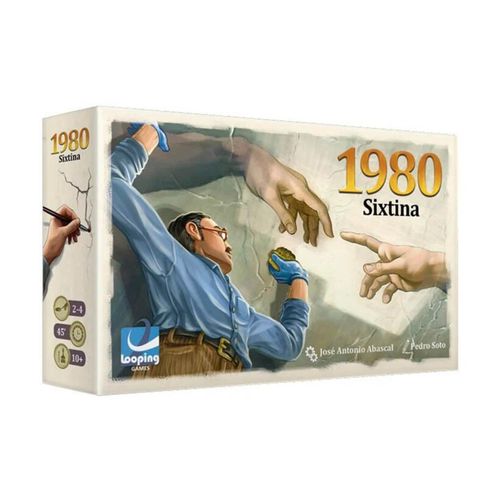
1980 Sixtina
1980 Sixtina Rulebook
Table of Contents
Table of Contents
Components
- 1 score board.
- 84 technique cards, representing 6 restoration techniques: Repainting, Solvent Sponge, Laboratory, Infrared, Plaster Injection and Washi Paper.
- 26 large fresco cards: 6x Jesus Christ, 9x Genesis, 6x Moses, 5x The Last Judgment. One side shows the fresco un-restored, and the other side shows the fresco restored.
- 9 large sheet cards. One side shows the basic sheet, and the other side features the "Sheets with History" variant.
- 12 objective cards. One side for 2-3 player games, and the other side for 4 player games.
- 4 summary cards. One side with the turn summary and the other side with the summary of bonuses for performing excellent restorations.
- 4 black materials.
- 60 materials, 15 in each player color.
Setup
-
Set up the Sistine Chapel in the center of the table. To do this, separately shuffle the four decks of fresco cards: Jesus Christ, Genesis, Moses, and The Last Judgment. Draw 12 cards at random: 3 Jesus Christ, 4 Genesis, 3 Moses, 2 The Last Judgment, and place them with their unrestored side up following the layout shown (example of game setup for 3 players and for 4 players).
-
Cover all the fresco cards with basic sheet cards, except the top three cards of the Jesus Christ, Genesis, and Moses columns. In four-player games, also leave the second top Genesis card visible. Store the remaining fresco cards back in the game box as they will not be used during the game. (You can use the other side of the sheet cards to play the "Sheets with History" variant — see the Variant section.)
-
Place the score board to the side.
-
Shuffle the objective cards and place three of them next to the score board, with the side corresponding to the number of players facing up. Store the rest back in the box as they will not be used in this game.
-
Shuffle the technique cards and deal five face down to each player, forming a draw deck with the remaining cards. Give each player their colored summary card as well. During the game, technique cards in hand should be kept hidden from other players.
-
Each player takes their colored materials (15, 14, or 13) based on the number of participants (2, 3, or 4 respectively) and places:
- Four in front of them in their play area.
- The rest in a general supply.
-
Add three black materials to the general supply and store the other in the box. In four-player games, use all four black materials.
The rest of the rules for two-player games can be found in the Two-Player Games section.
-
Randomly select a starting player. This player places one material from the general supply on the "0" value of the score board. In a clockwise direction, the remaining players place their material on the 2, 4 and 6 respectively.
-
Each player, in a clockwise direction starting from the first player, reveals a card from the technique deck and places one of his material directly from the supply on the top space (correct restoration example) of a fresco using that technique, regardless of the value indicated on the card.
Example: Red draws a Washi Paper card and places one of their materials from the supply on the top space of one of the available frescoes.
If there are multiple frescoes available with that technique, you can choose which one to place the material on. If you reveal a technique card that is not present on any fresco, discard it and reveal another.
Thus, each player will start with a material placed on a correct restoration technique.
Know the Cards
Frescoes (un-restored side). An icon indicates the type of fresco. There is a space for correct restoration and a space for excellent or prudent restoration. There is also a space for the material of the player who has contributed the most to the restoration.
Frescoes (restored side).
Techniques. Each technique card shows a value and icon of the technique, and information on materials to be used exclusively in two-player games (see the Two-Player Games section).
Objectives. Each objective card shows points for the first 3 players who achieve them, the objective itself (for a detailed description, see the Objectives section), and a player count indicator.
Structure of the Sistine Chapel
The Sistine Chapel, named after Pope Sixtus IV, is extraordinarily decorated in all its areas:
On the north wall, six frescoes depicting the life of Jesus Christ are displayed; all created in 1480 by Perugino, Ghirlandaio, Botticelli, and Cosimo Rosselli.
On the south wall, six more frescoes illustrate the life of Moses, crafted by the same artists.
On the west wall, the stories of Christ and Moses are concluded with two additional frescoes that had to be recreated in 1572 and 1574 because the originals were destroyed.
The ceiling was commissioned to Michelangelo in 1508, and he dedicated four years to painting nine scenes from Genesis, as well as twelve prophets and sibyls, ten medallions, and many more decorations.
The success of his work led to the commission of the east wall in 1536. A more mature Michelangelo, now influenced by Mannerism, decided to paint a large mural of The Last Judgment, featuring 300 figures and stirring controversy due to the number of nudes depicted.
How to Play
The starting player begins the game, which runs clockwise. On his turn a player must perform one of the following three actions:
Technique Preparation. Draw three technique cards, with a hand limit of 8 cards (if you have 6 or 7 cards, draw only 2 or 1 respectively). If the draw pile is exhausted, shuffle the discard pile to create a new draw pile.
Acquire Material. Discard as many technique cards from your hand as you wish. For each discarded card, you can take one material of your color from the general supply and place it in your play area.
Even if there aren't enough materials in the supply, you can discard as many cards from your hand as you want to make room for more.
Restore Fresco. Choose a fresco to restore and a technique for that fresco that does not already have a material on it. Play one or more technique cards of that type and compare their total value to the required amount:
- A. Correct Restoration.
- B. Excellent Restoration.
- C. Prudent Restoration.
"The restoration of the Sistine Chapel not only brings a masterpiece of human genius to light, but also restores an essential part of humanity's spiritual heritage." — Pope John Paul II
A. Correct Restoration
Restorers had to be very precise with the technique used to avoid overdoing it and irreparably damaging any part of the fresco.
The sum of the values of the technique cards played must be greater than the value of the technique on the fresco.
Place one material from your play area on the top space of the corresponding technique on the fresco card you are restoring. You need at least one material in your play area to perform this action.
Additionally, you can place additional materials from your play area onto the fresco. Up to the amount of technique cards you have played.
Discard the used restoration cards face up.
EXAMPLE: Red plays three "Repainting" cards with a total value of 7 points, and since the required value is 6, they perform a correct restoration. They have four materials in their play area. They must place one on the top space of the technique and decide to place two more on the fresco card (they could have placed up to three, as many as the technique cards played).
B. Excellent Restoration
The restoration lasted 14 years, four times longer than it took Michelangelo to paint. The process was very meticulous: they built an aluminum scaffold using the holes from the original scaffolding, spent 6 months investigating the condition of the frescoes, and installed an air conditioning and environmental control system to prevent surface deterioration.
The sum of the values of the restoration cards played must be equal to the value of the technique on the fresco.
Place one material from your play area on the bottom space of the corresponding technique on the fresco card you are restoring. You need at least one material in your play area to perform this action.
Additionally, you may place up to as many materials of your color as the number of cards played from your play area onto the fresco.
Discard the used restoration cards face up.
Claim one of the bonuses for excellent restoration (summarized on the other side of the summary card).
Bonuses
- Refined Technique: Draw two restoration cards from the draw pile. Due to the hand limit, if you have 7 cards, only draw one.
- Additional Material: Obtain a material of your color from the general supply, if available, and place it in your play area.
- Objective: If you meet the condition of an objective card, place one material of your color from the general supply on the highest unoccupied scoring space. You cannot place more than one material per objective. For detailed descriptions, see the Objectives section.
EXAMPLE: Blue plays a "Solvent Sponge" card with a value of 2 to perform an excellent restoration and places one material on the bottom space of the technique. By playing one card, they can add an extra material and do so, even though it leaves them with no materials in their play area. They discard the played card and immediately receive the bonus.
Although they considered acquiring another additional material, they prefer to take the opportunity to fulfill an objective and place a material from the general supply on the highest available scoring space.
C. Prudent Restoration
A very prudent restoration does not recover the vivid original colors that were so surprising when discovered, but it preserves the shadings and dark tones that Michelangelo and his assistants created, sometimes taking advantage of the soot generated by the candles that illuminated them. This careful approach is appreciated in the restoration community.
The sum of the values of the restoration cards played must be less than the value of the technique on the fresco.
Place one black material from the general supply on the bottom space of the corresponding technique on the fresco card being restored. You need at least one black material available to perform this action.
Additionally, you may place up to as many materials of your color as the number of cards played from your play area onto the fresco.
Do not discard the restoration cards used; keep them visible in your play area. These cards will be scored at the end of the game.
EXAMPLE: White plays two "Washi Paper" technique cards with a total of 3 points to perform a prudent restoration. They place one black material from the supply on the bottom space of that technique and, choosing between placing zero, one, or two additional materials, they decide to place one from their play area. They then take the two played cards and keep them visible in their play area along with others obtained in previous turns, sorted by technique type. It is important that players can see the quantity and value of the technique cards their rivals have accumulated.
"Buon Fresco" or "A Secco"?
The "buon fresco" mural painting technique is an ancient method where painting is done on wet lime plaster so that the pigments integrate into the wall.
In the restoration of the Sistine Chapel, a cleaning process using distilled water and solvents was employed to remove centuries of environmental grime and candle soot. This revealed the vivid and bright colors used by Michelangelo, challenging the notion that he preferred darker tones. However, the issue with this technique is that anything not painted using "buon fresco" would disappear during the cleaning.
Critics of the restoration argued that the restorers of the Sistine Chapel assumed Michelangelo always painted "buon fresco" and never added anything on dry plaster (the "a secco" technique). This is questionable because, in four years of intense work, it is hard to believe that he never changed techniques or needed to make corrections.
This is evident in some details of architectural decorations that are preserved or disappear depending on the technique used.
Completing the Restoration of Frescoes
After completing any restoration action, check if any fresco has all its restoration techniques occupied by materials. If so, it is considered fully restored and it is scored.
1. Modify Scores
Calculate the points to be distributed by modifying the indicated points at the top of the fresco card as follows:
- +1 point for each excellent restoration.
- -2 points for each prudent restoration.
The sum of these modifiers affects all scores, regardless of who performed each excellent or prudent restoration.
It is possible for a score to take on a negative value due to prudent restorations.
2. Contribution
Determine who contributed the most to this restoration by determining:
- The player with the most materials on the fresco.
- In case of a tie, the player among them with an excellent restoration material furthest to the left.
- If none have this, the player among them with a correct restoration material furthest to the left.
- If still tied, the tied players share the position.
If you performed a prudent restoration but did not place any of your materials, you did not contribute to the restoration and do not score any points.
3. Scoring
The top three players who contributed the most, score according to their position. In case of a tie, sum and divide the corresponding scores, rounding down.
EXAMPLE: Continuing the previous example, White restored the last free space of that fresco, so it is immediately scored. The score (12, 5, and 4 points) is modified by one excellent restoration (+1 point) and two prudent restorations (-4 points), resulting in 9, 2, and 1 points. Red and Blue tie with three materials each, but Blue has the excellent restoration furthest to the left, so they gain 9 points, and Red gets 2 points. White, with one material, takes the third position and earns 1 point.
4. Revealing the Restoration
Return all materials to the general supply and flip the fresco card. The player who contributed the most places one of their materials from the general supply on the fresco zone icon.
In case of a tie for the first position, no player places a material.
5. New Restorations
The player who completed the last restoration space on their turn chooses a new fresco adjacent orthogonally (not diagonally) to any of the visible frescoes. Reveal the fresco by removing the sheet card on top and returning it to the box. If no frescoes remain covered by sheets, skip this step.
Each fresco in the Last Judgment is adjacent to the two frescoes above it.
Objectives
Materials in Frescoes
- Have at least 8 materials (7 for 4 players) between ongoing and completed restorations.*
- Have at least 6 materials on three ongoing restorations.*
- Have at least 5 materials on one ongoing restoration.*
*If the fresco is completed, the materials on it count towards this objective because the bonus is executed before flipping the fresco to its restored side.
Restored Frescoes
- Have at least 2 excellent restorations of Repainting, Washi Paper or Laboratory.*
- Have at least 2 correct restorations of Laboratory, Infrared or Solvent Sponge.
- Have at least 3 excellent or correct restorations (2 in 4-player games) of Solvent Sponge, Plaster Injection or Repainting.*
*The excellent restoration used to achieve these objectives counts towards their fulfillment.
Type of Restoration
- Have your materials on at least 3 restored frescoes (on 2 for 4-player games) that are orthogonally adjacent.
- Have your materials on at least 2 restored frescoes of the same type.
- Have your materials on at least 3 restored frescoes (on 2 for 4-player games) of the different type.
Prudent Restorations
- Have at least 3 technique cards of the same type in your play area.
- Have at least 5 technique cards in your play area.
- Have at least 3 technique cards of different types in your play area.
Variant: Sheets with History
To play this variant, place the sheet cards with the reward side visible during game setup.
Each sheet shows a reward. Upon completing a restoration, the player who removes the sheet during step 5 (New Restorations) immediately receives the reward. If the sheet indicates a reward that cannot be received, the player receives nothing.
- Receive the indicated points (2, 3, or 4).
- Draw the shown amount of technique cards.
- Take the shown amount of materials from the general reserve.
- Claim an objective (if you meet the conditions).
End of the Game and Scoring
The game ends after the turn in which, after a fresco of the Sistine Chapel is completely restored, only one fresco remains.
Next, the final incomplete fresco is scored but only grants half of the points, rounded down. Flip the card to see the completed restoration of the chapel, but no one places materials on it.
Add the following points to the ones obtained during the game:
- Objectives: Points from claimed objective cards.
- Contribution to Restored Frescoes: The player with the most materials on restored frescoes earns 10 points, the second earns 6 points, and the third earns 3 points. In case of a tie, sum and divide the points, rounding down.
- Prudent Restorations: For each of the 6 restoration techniques in each player's area, count the number of technique cards of each player:
- The player with the most cards discards a number of cards equal to the second-highest player's count. They must discard the lowest value cards and then score the remaining cards.
- The second-highest player scores 2 points per card they have, regardless of value.
- In case of a tie, tied players score 2 points per card.
- Leftover Materials and Techniques: Each player sums the number of technique cards and materials remaining in their play area and scores half of that sum, rounded down.
The player with the highest final score wins the game. In case of a tie, the player who has completed more objectives wins. If the tie persists, the player with more materials in their personal reserve wins. If there is still a tie, victory is shared.
The Loincloths of the Last Judgment
Michelangelo's "The Last Judgment" faced censorship due to the large number of nudes in "compromising" positions. In 1564, at the request of Pope Pius V, Daniele da Volterra added many loincloths to the artwork (earning him the nickname "Il Braghettone").
During the restoration, it was decided to retain some of these censures since they are a documented part of art history, but to remove those added in the 18th and 19th centuries due to a lack of historical documentation (except for a few left as a record of later interventions). This required chemical analysis of the pigments used in each loincloth to differentiate the originals from those added later.
Final Scoring Example
Points During the Game: Red has 40 points, White has 38, and Blue has 32.
Objectives: Red gains 9 points, White gains 7 points, and Blue gains 17 points.
Contribution to Restored Frescoes: Red and White both have 4 restored frescoes. They share 16 points (10 + 6) equally, getting 8 points each. Blue has 3 restored frescoes and gets 3 points.
Prudent Restorations:
- In the technique Plaster Injection: Blue has 4 cards and Red has 3 cards. Blue discards the 3 lowest value cards and keeps the one worth 5 points. Red scores 6 points (2 points per card for 3 cards, regardless of their value). Red has achieved more points than Blue! During the game Red analyzed very well how to snatch points from Blue. White scores nothing for not having placed among the top two positions.
- In the technique Infrared, White and Red tie for second place with 1 card each, therefore Blue discards the card worth 2 points and scores the card worth 4 points. White and Red each score 2 points for their single card.
- In the technique Laboratory, White and Blue tie for first place and score 2 points each.
- White is the only one who has Repainting cards, so they sum up their values and earn 6 points.
Leftover Technique Cards and Materials: White has 3 technique cards and 1 material, scoring 4/2 = 2 points. Red has 5 technique cards and 3 materials, scoring 4 points. Finally, Blue has 1 card and 2 materials, so they score 1 point due to rounding down.
After summing up the results, White scores 65 points (38 + 7 + 8 + 10 + 2), Red scores 69 points (40 + 9 + 8 + 8 + 4), and Blue ends up with 64 points (32 + 17 + 3 + 11 + 1).
Red has contributed the most to the restoration of the Sistine Chapel and wins the game!
Two-Player Games
Two-player games follow the same rules as three-player games with these adjustments:
Preparation
Each player receives 15 materials. Place one on the scoring track, four in each players' play area, and one on an initial correct restoration as indicated in the base rules.
Gianluigi* is a fictitious third player who uses the 15 materials of a third color not used by the two players, which he leaves in the general reserve. Place one of his materials on space 15 of the scoring track and 3 more materials on the second positions of the three objectives.
*Gianluigi Colalucci (1929-2021) was the principal restorer of the Sistine Chapel from 1980 to 1994.
Gameplay
Turns alternate between the two participating players.
Gianluigi does not use his own technique cards to place materials or earn cards for prudent restorations. During the game he does not have a play area and places materials on the frescos directly from the general supply.
During your turn, after performing any restoration action, also activate a restoration by Gianluigi.
Gianluigi Restorations
Gianluigi uses the same value and restoration technique as the one just played.
Gianluigi places a material in any empty space of a fresco with the same restoration technique, with the following priority order:
- Perform an excellent restoration by placing a material of his color.
- If not possible, perform a correct restoration by placing a material of his color.
- If not possible, perform a prudent restoration by placing a black material (if available).
If there are multiple valid restorations for each of the three cases, the player who activated Gianluigi chooses which one he restores. If none, Gianluigi does not restore.
Additionally, place as many additional materials on the fresco as the sum (rounded down) of the materials and half-materials shown on the technique cards used.
Once Gianluigi's restoration is complete, if the fresco has been fully restored, all players (including Gianluigi) score points.
Gianluigi's restoration may cause the completion of one or two frescos in a player's turn. In this case, the player who activated him chooses one or two new frescoes to reveal.
EXAMPLE: Blue plays 3 "plaster injection" cards totaling 8 points for an excellent restoration and decides to place an additional material. Since they have restored on their turn, Gianluigi, playing with yellow materials, also performs an 8-point restoration with the same technique on another fresco. Since the only one available requires 9 points, he must perform a prudent restoration, placing a black material and three yellow materials due to the rounded-down sum (1 + 1 + 1.5 = 3.5) of the materials indicated on the cards.
End of the Game
Gianluigi adds the score by objective cards and by his contribution to restored frescoes. As he doesn't have a play area, he does not score for prudent restoration neither for leftover materials and techniques.