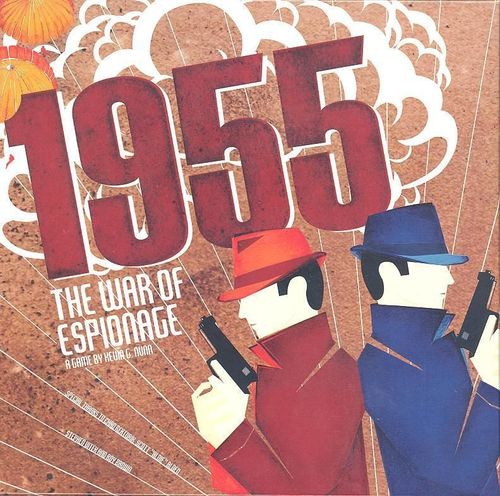
1955: The War of Espionage
1955: The War of Espionage Rulebook
Table of Contents
Table of Contents
- Terminology
- Physical Components
- Important Areas
- Objective
- Setup
- Factions and Home Countries
- The Opening Move
- Anatomy of a Country Card
- Anatomy of a Mercenary Card
- Standard Turns
- Types of Card Plays
- Influence Action Card Play
- Mercenary Cards
- Step 3, Refilling Your Hand
- Step 4, Moving Your Spy
- Securing Countries
- Blocking Your Opponent's Influence Actions
- Victory Conditions
- Special Actions
Terminology
Advance To move a Control Marker a number of spaces towards your end of that country's track.
Block To prevent the Advance of a Control Marker targeted by an Influence Action.
Counter To negate a Special Action. Cards are placed in the Discard Pile.
Faction There are 2 Factions, Red and Blue. A country is affiliated with one of the Factions as represented by the color of its track.
Influence Action An attempt to Advance that country's Control Marker.
Secure When a Control Marker reaches the end of its track, it is secured and counts towards the Objective.
Special Action An effect that manipulates the board, the rules, the Spies or the hands. May not be Blocked, but may be Countered.
Physical Components
- Game Board 7.5" x 15", 2-Sided. Basic and Shortened sides.
- 1 Deck of Cards 54 Cards
- 2 Spy Pawns These Spies represent your active operatives. One player will have a Red Spy and the other a Blue Spy.
- 6 Control Markers These represent the current status of that country's allegiances. Each country has a Control Marker on its track. 4 Control Markers are Neutral (Black), 1 is Red and 1 is Blue.
- 2 Reference Cards These handy reference cards brief you on available actions and turn order.
- Rule Book A 16 page full color rule book that explains everything you need to know to control the world.
Important Areas
- Draw Deck
- Discard Pile
- Gadgets
- Country Track(s)
- Spy Locations
Objective
Secure control of countries on the game board by Advancing the Control Markers to your end of the track.
Your goal is to Secure any 3 countries, or to Secure your enemy's Home Country.
Setup
Place the six Control Markers and two Spies adjacent to the board.
Now, choose a player to be Start Player. The Start Player shuffles the deck of cards and places the deck face down adjacent to the game board. This is the draw deck.
Each player draws five cards as his starting hand.
Factions and Home Countries
In this game, you are the Spymaster, directing your forces in missions against your opponent's forces.
Take a look at the board. Each of the six tracks represents a country. Although every country could be controlled by either faction, the people who live there are naturally predisposed towards one or the other. To show this, each country is shaded either blue or red.
After looking at his hand, the Start Player chooses his Home Country and his Faction by picking a country and placing the Spy of the color that matches the country's Faction at the Spy space of the country on his side of the board. He also places the Control Marker of the matching color on the center space of that country's track.
Now, the second player chooses her Home Country. This country must belong to the faction the start player did not chose.
For instance, if the dealer chose a country in the blue Faction, the second player must pick a country from the red Faction.
The second player places the other Spy on the Spy space of the country on her side of the board. She also places the Control Marker of the matching color on the center space of that country's track.
Place neutral colored Control Markers in the center space of the other four country tracks.
Everyone gets a head start in their Home Country. Advance the Control Marker in your Home Country one space towards your end of the track.
Protect your Home Country—if your opponent Secures it, you have lost!
The Opening Move
In the first turn of the game, the Start Player makes a single card play as explained below, refills their hand and moves their Spy Pawn to any country they wish (Steps 2, 3 and 4).
From then on, players alternate taking standard turns, beginning with the second player.
Anatomy of a Country Card
Card Name The name specifies the Special Action the card has available for use.
Influence The distance this card can move a Control Marker when used on an Influence Action.
Affiliated Country Every Country Card is affiliated with a country.
Faction (Color) A card will either have a Blue banner or a Red banner to signify what Faction the card is aligned with.
Special Action Symbol This symbol provides a quick iconic reminder of the card's Special Action.
Special Action Rules These rules provide the necessary information to use the card for its Special Action. Further information can be found in the rule book under Special Actions section.
Influence & Faction The number of stars reflects the Influence value of the card (Also seen at the top of the flag pole) and the style of star reflects the Faction the card is aligned with (4 Pointed star is Blue Faction, 5 Pointed is Red).
Anatomy of a Mercenary Card
Influence The distance this card can move a Control Marker when used on an Influence Action. May also be freely Combined with other cards during Influence actions.
Mercenary Cards do not have Special Actions or Faction. They are neutral and are not affiliated with a Country.
Standard Turns
Turn Order
On your turn, you will take four steps, in order.
- Make a Card Play
- Make a Card Play
- Refill your hand
- Move your Spy
Once you've completed these four steps, it is your opponent's turn.
Steps 1 and 2, Make a Card Play
If you hold no cards, skip this step.
Cards come in two types. Most cards are Country Cards. Some are Mercenary Cards. These cards are played in different ways, as explained in the next few sections.
Cards go to the top of the discard pile immediately after they are played or discarded. The only exception to this is when a "Gadget Research" card is played for its Special Action (See the Gadgets section for details).
Playing Country Cards
Country Cards have two kinds of information on them, and they can be played in two ways. Most of the card shows its Special Action – a unique power the card has. Every Country Card also has a country's flag and a number in its top-left corner called the Influence.
For example, a card whose country is France and whose Influence value is 2, with the special action Military Transport. Cards will be referred to by their Country name, a colon and its Influence value, i.e. France:2.
Country cards are very flexible. When you play one, you may choose to use it one of two ways:
A. Special Action
B. Influence Action (Flag & Influence)
Types of Card Plays
A. Special Action: Every Country Card may be played for the special action described on the bottom of the card. In this case, you should completely disregard the nation flag and number printed in the top corner of the card.
Special Action cards utilize the following key phrases, "Your Turn", "Opponent's Turn" and "Any Turn". These are explained below.
Your Turn These effects may only be played on your current turn. Unless otherwise noted on the card, it uses up one of your Card Plays.
Opponent's Turn These effects may be played only on your opponent's turn.
Any Turn These effects may be played on your turn or your opponent's turn. Unless otherwise noted on the card, it uses up one of your Card Plays if played on your turn.
A detailed list also appears in the Special Actions section of these rules.
B. Influence Action (Flag & Number):
If you play a card for Influence, you use the Flag and the number (Influence) in the corner. You completely ignore the Special Action part of the card. Influence will Advance the position of one of the Control Markers.
You can play a card for Influence in one of three places:
a. the Country represented by the flag
b. the country your Spy is in.
c. your Home Country.
Influence Action Card Play
A. Its Own Country
Country cards can always be played in their own country. When you apply a Country card to its own country, Advance its Control Marker towards your end of its track as many spaces as the card's Influence value (the number at the top of the card's flag pole).
If your Spy is also in this country, you may either:
-
Add 1 to the number on the card.
A France:2 card played in France with your Spy in France counts as a France:3 card for the Influence Action.
-
Or Combine your card with another card of that Country from your hand.
Combining Cards
When you Combine cards, you create a new card with a higher number by adding the two cards together. Normally, there are two major restrictions on Combining Country Cards: Both cards must have the same flag as the country where your Spy is located and must be applied to that country.
Combined Cards count as a single card play.
For example: A France:2 card Combined with a France:2 card creates a single France:4 card that must be used in France as your Spy is there.
Not Allowed: A France:2 card may not be combined with a Poland:2 card.
Not Allowed: A France:2 card and a France:3 card may not be combined and used in France while your Spy is in Poland.
Not Allowed: A France:2 card and a France:3 card may not be combined and used in Poland, even if your Spy is in France.
Note: Mercenary Cards may always be combined regardless of number of cards, country or Spy location.
B. The Country Your Spy Is In
Your Spy is a gifted secret agent. He enables you to play cards in places you otherwise could not.
When you apply a Country Card to the country your Spy is in, Advance its Control Marker towards your end of its track as many spaces as the card's Influence value (the number at the top of the card's flag pole).
This covert work may come at a price. If the Faction Color of the card does not match the Faction color of the country, subtract 1 from the Influence number on the card when resolving the card's Influence attempt. (Your own Faction color is irrelevant here).
Example: Your spy is in Hungary. You decide to apply a France:2 to Hungary. Your France:2 card is from the Blue Faction while Hungary is from the Red Faction. This modifies your France:2 card to a France:1 card for the Influence Action. A successful Influence Action would only Advance Hungary's Control Marker 1 space.
C. Your Home Country
You have many advantages in your Home Country. One advantage is that you can play any Country Card there. When you do this, Advance your Home Country's Control Marker towards your end of its track as many spaces as the card's Influence value (the number at the top of the card's flag pole).
If the Faction Color of the card does not match the Faction color of your Home Country, subtract 1 from the Influence number on the card when resolving the card's Influence attempt.
(Example: a France:2 card, which is Blue, acts as a France:1 card in the U.S.S.R., a Red country.)
Mercenary Cards
Mercenary are soldiers for hire, with no allegiance to any faction or country. As the Spymaster, you may use them alone or you may choose to use them to enhance other operations.
Mercenary cards have a unique look to them to differentiate them from a Country Card.
Mercenary cards may be played in one of two ways:
A. Mercenary cards may be applied to any country as an Influence Action. Choose a country and advance its Control Marker the indicated number of spaces towards your end of the track.
Because of their independence, Mercenary Cards are not modified by your choice of country or by the presence of your spy.
B) Mercenaries may be freely Combined with any Country Card. Any number of Mercenary Cards may be Combined in an Influence Action. These cards add their value to the other Country Card(s) as part of the Influence Action.
When a Country Card and Mercenary card(s) are applied to a country, their values are added together and this counts as a single Card Play, no matter how many mercenary cards you add.
You may still Combine the Country Card with another Country Card provided you meet all the requirements in a normal Combine for the two Country Cards.
The Location of your Spy has no bearing on being able to Combine a Mercenary Card with another Card.
Example 1: You play a France:2 Country Card in France. Your Spy is in Poland. You Combine a Mercenary:1 Card with the France:2 Card to create a France:3 card in France. This counts as a single card play.
Example 2: You play a France:2 Country Card in France. Your Spy is in France. You Combine your France:2 Country Card with another France:2 Country Card from your Hand forming a France:4 Country Card. You also Combine a Mercenary:2 Card with your France:4 Country Card to form a new France:6 Country Card in France.
Example 3: Your Home Country is Poland. You play a France:2 Card in Poland (Allowed due to it being your Home Country). Your Spy is in Hungary. Your France:2 Card is modified down to a France:1 card due to being of the wrong Faction. You Combine a Mercenary:2 card with it to create a France:3 card for the Influence Action in Poland.
Step 3, Refilling Your Hand
Draw cards from the draw deck until you have cards equal to your Hand Size. Your Hand Size starts at 5 but may be improved to 6 with an Improved Resources gadget.
If you already hold this many cards or more, skip this step. You are not required to discard. Refilling can only give you cards, never cost you cards.
If the draw deck is empty, immediately reshuffle the discard pile to create a new draw deck.
Step 4, Moving Your Spy
Your Spy has access to resources that enable quick travel to anywhere in the world. You may now move your Spy to any country on the board or leave it where it is. Your Spy stays on the Country flags on your side of the board. Maneuvering your Spy across the world may prepare you for your next turn or enable you to block your opponent.
Gadgets
Gadget Research is one Special Action available to your operatives. Gadgets remain in play until destroyed by the opponent. To reflect this, when the Gadget Research card is played, slide the card, face up with the Card name showing, under the edge of the board adjacent to the Gadget you have chose. Leave it there for the duration of the game or until it is removed by a Special Action.
There are two types of Gadgets in the basic game. You may have both Gadgets at once but may not have multiple copies of a single Gadget (i.e. You may not take Advanced Transport twice).
Improved Resources Increase Hand Size by 1. This increases your Hand Size from 5 to 6 cards.
Advanced Transport You may move your Spy one additional time during your turn on Steps 1 or 2 in addition to the normal move during Step 4. To make this extra move, you must discard a card showing the destination country you want your Spy to move to or the departure country your spy is leaving. Mercenary Cards may not be used.
Example: If your Spy is in Poland and you want to move him to France, you may either discard a France Country Card (Destination) or a Poland Country Card (Departure).
Securing Countries
Any time you Advance a Control Marker to the end of its track—the Star Space on your end of the track—you have Secured that Country. This Control Marker will remain Secured and in the Star Space and card play will no longer move it (Exception-Revolution can unSecure a Control Marker and bring that Country back into play. See the Special Action rules for details). Protect your Home Country. Securing your Opponent's Home Country will win you the War!
Blocking Your Opponent's Influence Actions
Any time your opponent chooses to apply cards to a country in an Influence Action, you may be able to block them and prevent their Influence Action from Advancing the Control Marker.
In order to Block, you must have a presence in the country. Either:
a) your Spy must be there or
b) it must be your Home Country.
If your have neither type of presence, you cannot Block.
If you do have a presence in the country, you can Block your opponent's Advance by discarding cards from your hand with a total Influence value that meets or exceeds your opponent's.
A successful Block prevents the Control Marker from being moved by the Blocked Influence Action. Blocks are either completely successful or fail. You may not partially Block an Influence Action.
The Blocking value of each card you discard is modified by its type:
a. Cards from Factions (Blue or Red) opposite that of the country being attacked may not be used to block. Therefore, Red Cards may not block Influence Actions against Countries in the Blue Faction.
b. Mercenary Cards have their face value.
c. If a Nation Card matches the country in which you're playing it AND your Spy is also there, add +1 to the card's value.
Special Actions may not be Blocked, although they may be Countered. See the Special Actions section for more details.
Example a. Your Opponent plays 4 Influence against France. Your Spy is in France. You may attempt to Block.
Example b. Your Opponent plays 4 Influence against France. France is your Home Country. You may attempt to Block.
Example-Unable to Block Your opponent plays 4 Influence against France. Your Spy is in Poland and your Home Country is the U.S.S.R. You may not Block.
Example Your Opponent plays 4 Influence against France, a Blue Faction country. To Block, you must use Blue Faction aligned Country Cards.
Example A Poland Country Card (Red Faction) may not be used to Block an attack in France (Blue Faction Country).
Example Your opponent has their Spy in Great Britain and plays a Great Britain:4 card, along with a Mercenary:1, announcing a total of "Great Britain:6" (The Spy adds +1). Because your Spy is also in Great Britain, you may block them. You discard a France:3 card and a United States:4 card, both Blue Faction cards, for a total of 7, blocking the Influence attempt. The Control Marker is not Advanced.
Example Your Spy is in Poland. You use a Poland:3 Card to Block an Influence Action against Poland. Your Poland:3 Card counts as a Poland:4 Card for purposes of Blocking.
Victory Conditions
The game ends immediately when one of two events occur:
A. A player has any three (3) countries Secured.
Example: The Red Player has Secured France, U.S.S.R. and U.S.A.
B. A player Secures their opponent's Home Country.
Example: The Red Player has Secured the Blue Player's Home Country.
The first player to do either has secured enough global support for their Faction and wins the game.
Special Actions
Special Actions are the tricks of the trade that allow your operative to function in the field. Wise use of these Actions will allow you to out maneuver your opponent on the global stage. There are fifteen (15) Special Actions to utilize during the game.
Blockade Name a Country. This Country's Control Marker may not be moved until the end of your next turn.
Coordinated Assault Advance up to three unsecured Control Markers one space each. This Advance may not be Blocked.
Opponent's Turn: Counter any Coordinated *Special Action.
Coordinated * applies to any Special Action that has Coordinated at the beginning of its name.
May not Counter a Coordinated Assault or Coordinated Attack used to Counter another card.
Coordinated Attack Advance up to two unsecured Control Makers one space each. This Advance may not be Blocked. Opponent's Turn: Counter a Coordinated Attack.
May not Counter a Coordinated Attack used to Counter another card.
Deport Move your opponent's Spy to her Home Country.
Detain Your Opponent's Spy may not be moved until the end of your next turn.
Gadget Research Put this card adjacent to a Gadget. Gain that Gadget while this card is in play. See Gadget section for further details.
Gadget Buster Your opponent must discard a Gadget Research of your choice.
Military Transport Any Turn: Move your Spy to any Country. Does not count as a Card Play.
Paid Informant Your opponent must play with her hand face-up on the table until the end of your next turn.
Pilfer Accounts Your opponent must discard all but two of her cards. Your opponent chooses which cards to keep.
Rebel Forces Counter a Special Action.
Opponent's Turn: Counter a Special Action.
Rebel Forces does not Block an Influence Action.
Revolution Advance the Control Marker of any country two spaces. This Advance may not be Blocked.
This action may be applied to a country your opponent has Secured. This unSecures that country.
Safe House At the end of your turn, after refilling your hand but before moving your Spy, draw 2 additional cards.
Supply Drop At the end of your turn, after refilling your hand but before moving your Spy, draw 3 additional cards.
Strategic Resupply Discard your hand. Refill it by drawing cards equal to your Hand Size.
White Icons apply to your Spy/Cards.
Black Icons apply to your Opponent's Spy/Cards or to Control Markers.
Card names also give an indication as to the Special Ability:
- B Restricts Control Markers
- C Moves multiple Control Markers
- D Opponent's Spy
- G Gadget type Cards
- M Movement of your Spy
- P Opponent's Cards
- R Rule Breakers
- S Hand Manipulation