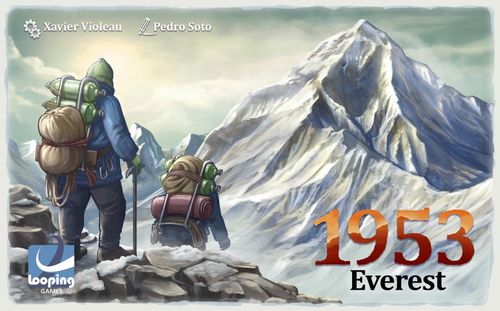
1953 Everest
1953 Everest Rulebook
Table of Contents
Table of Contents
Components
- 1 Bivouac board (with a normal side and an advanced side)
- 16x Mountain (4 per expedition), each with a daytime side and a nighttime side
- 60 Resources (20 of each colour): Tent, Supplies, Oxygen
- 110 Cards
- 4 Flag tokens (1 per expedition): United Kingdom, France, Austria, Switzerland
- 12 Secondary action tokens (3 per expedition): Ice Axe (x4), Double Ice Axe (x4), Extra Action (x4)
- 49x Everest cards: Sherpas (x16), Funding (x10), Innovation (x11), Nepalese Culture (x12)
- 20x Climbers (5 per expedition)
- 13x Backpack
- 10x Weather: Pre-monsoon (x5), Monsoon (x5)
- 1x Starting Expedition card
- 1x Summary card (Main Actions on one side and Solo Mode on the other)
Setup
-
Place the Bivouac board in the centre of the table. The board has two sides, "I" and "II". Choose which side you want to use, although side "I" is recommended for your first games.
-
Shuffle the 49 Everest cards and place the deck face down next to the Bivouac board.
-
Shuffle the 13 Backpack cards and place the deck next to the Bivouac board.
-
Separately shuffle the 5 Pre-monsoon Weather cards ("A") and the 5 Monsoon Weather cards ("B"). Create the Weather deck with 4 cards face down (two "A" cards on top of two "B" cards).
For 4-player games, include only one Pre-monsoon Weather card ("A"), making a 3-card deck.
Place this deck next to the Bivouac board and return the remaining Weather cards to the box without revealing them.
-
Choose a nationality and receive: a) Four Mountain cards, one of each level (1 to 4). Place them with their daytime side face up in your play area, forming a column in ascending order. If there are fewer than 4 expeditions, return the remaining cards to the box.
Each Mountain card has a nighttime side with a different effect. Do not look at that side. Keep it hidden until a Weather card tells you to flip the Mountain card.
b) The flag token, which you place to the left of the Bivouac board. c) The five Climber cards, which you shuffle and place face down in your play area. d) 3 tokens of each secondary action, which you place next to your Mountain with their exhausted side showing.
-
Create a common supply with the 60 resources.
-
Whoever has most recently reached the summit of a mountain receives the Starting Expedition card.
-
To determine each expedition's starting cards and resources, follow these steps:
- Reveal a number of Everest cards equal to the number of expeditions plus one and place them face up in a visible row.
Game Objective
Be the first expedition to reach the summit of Everest by placing a Climber card on level 4 of your Mountain before the Weather deck runs out.
To achieve this, you must build your ascent route, manage your resources, and make the most of your expedition's abilities to overcome the challenges of the mountain.
The Cards
Mountain Cards
- Maximum resource storage capacity.
- Mountain level (1 to 4).
- Ice Axe ability at level 1 (gain a resource at level 1 or move a resource to level 2).
- Permanent ability at levels 2 to 4 (move resources to lower levels).
- Additional cost for playing cards at this level.
Everest and Climber Cards
Card types: Climber, Sherpa, Innovation, Funding, Nepalese Culture.
- Cost reduction for the card placed on top of it.
- Immediate effect gained when the card is played and when an Ice Axe is activated.
- Permanent ability.
- Card type.
- Immediate effect gained when the card is played and when taking the "Go to the Bivouac" action.
- Immediate effect gained only when the card is played.
- Base cost with the resources required to play the card. These resources must be at the Mountain level where the card is played. Cost symbols can require: any resource, resources of specific types (Tent, Supplies, and Oxygen), or any resource of the same type.
Backpack Cards
- Immediate effects activated when taking the card. They must be resolved from left to right.
How to Play
A game lasts a maximum of four weeks (three weeks in games with four expeditions).
Each week consists of two phases:
- Phase 1 - Start of the Week.
- Phase 2 - Ascent Period.
If an expedition manages to place a Climber card on level 4, the game ends immediately and that expedition wins the game.
The game also ends if the final week ends without anyone reaching the summit.
Phase 1 - Start of the Week
Perform the following steps in order:
1. Weather
Deactivate any permanent effect from the previous card and reveal the top card of the Weather deck. Its effect may be immediate, resolving at that moment, or permanent, remaining active for the entire week.
Weather Effects
- Clear Skies / Fine Weather: Flip the indicated secondary action tokens to their active side.
- Cloudy: When playing a card, you cannot use the discounts from the cards it is supported by.
- Thunderstorm: All Mountain levels lose one storage space. If you had a level that was full, you must remove a resource of your choice.
- Fog / Strong Winds / Extreme Cold / Snowfall: Flip the indicated Mountain card to show its nighttime side. The nighttime side of each level is different and therefore the penalties will not be the same.
- Blizzard / Avalanche: Each time you are about to play a card of the indicated type, you must pay one additional resource of your choice.
2. Everest Cards
Discard any Everest cards left over from the previous round and reveal 5, 6, or 8 cards from the deck (depending on whether there are 2, 3, or 4 expeditions) to form the market.
3. Backpack
Discard any Backpack cards left over from the previous round and reveal 3, 4, or 5 cards from the Backpack deck (depending on whether there are 2, 3, or 4 expeditions).
4. Climbers
Each expedition secretly reveals the top two cards of their Climber deck, chooses one to add to their hand, and returns the other to the bottom of the deck.
5. Bivouac
Place all flag tokens next to the board. In addition, whoever has the Starting Expedition card returns it next to the Bivouac board and becomes the first expedition to play during the Ascent Period.
Facts and figures of an epic feat: In 1852, Everest was recognised as the highest mountain in the world. The first British expedition arrived in 1921, and in 1924 George Mallory and Andrew Irvine disappeared during their attempt to reach the summit. It has never been proven whether they reached the summit, making it one of the great mysteries of mountaineering. In 1952, Swiss climber Raymond Lambert and Sherpa Tenzing Norgay reached 8,598 metres, setting a new altitude record. Tenzing would return with the British expedition the following year and reach the summit. The 1953 British expedition transported 8.3 tonnes of equipment with the help of 350 porters. It included 20 Sherpas and 10 climbers. They transported 173,000 litres of oxygen and designed an open-circuit oxygen system derived from the one used by the RAF during the Second World War. The work of doctor Griffith Pugh was fundamental, as he established the amount of oxygen that should be supplied at high altitude (4 litres per minute), the climbers' diet, and even established the use of supplemental oxygen at night on the higher camps.
Phase 2 - Ascent Period
Starting with the starting expedition and proceeding clockwise, each expedition takes turns until the week ends when one of the following two conditions is met:
- All expeditions have gone to the Bivouac.
- An expedition reaches the last space on the Bivouac board.
During your turn, you must perform ONE main action:
- A Take a Card.
- B Play a Card.
- C Take a Backpack.
- D Go to the Bivouac.
Optionally, before or after your main action (never during it), you may perform ONE (and only one) secondary action:
- Ice Axe
- Double Ice Axe
- Extra Action
To do so, flip one of your active secondary action tokens to show its exhausted side.
Main Actions
A. Take a Card
Choose an Everest card from the market and add it to your hand. Then, you may perform the action indicated at level 1 of your Mountain for free (place a resource at level 1 or move a resource from level 1 to level 2).
The card taken is not immediately replaced. The market is only refreshed at the beginning of the following week.
You can never have more than 4 cards in your hand, unless a permanent ability indicates otherwise. If you draw beyond your limit, immediately discard the necessary cards. This rule also applies at the beginning of the week when you take a Climber card.
B. Play a Card
Choose a card from your hand and place it at any level of your Mountain, paying its cost. To play a card, take the following steps in order:
1. Position
The first card played is placed to the right of the level 1 Mountain card. Subsequent cards at level 1 are always placed to the right of the last card at that level. You cannot leave empty spaces.
From level 2 onwards, each card must be placed supported by two adjacent cards on the level below. However, the card does not have to be the leftmost card or be adjacent to other cards already placed at that level.
2. Cost
You must pay the resource cost to play the card. The resources must be at the Mountain level where you want to play the card. Calculate the total cost as follows:
- The card's base cost, indicated at the bottom of the card.
- Apply the discounts indicated at the top of the two cards supporting it.
- Subtract the resources from any permanent effects you have (see "Permanent Effects" below).
- Add the additional cost of the level where the card is played. This additional cost can NEVER be reduced by discounts or permanent effects.
3. Immediate Effect
You can activate the effect indicated on the card. There are 3 types of activatable effects:
- One-time use (without a box).
- Activatable with an Ice Axe.
- Activatable with the "Go to the Bivouac" action.
When you play the card, you can always activate its effect, regardless of whether it has an Ice Axe or Bivouac icon.
The difference is that if the card has an Ice Axe or Bivouac icon, its effect can be activated again either by using Ice Axes or, each week, the first time you take the "Go to the Bivouac" action.
Permanent Effects
Some cards have permanent effects that remain active while you have the card in your Mountain:
- Subtract one resource of your choice from the base cost of a card of the indicated type.
- Your hand limit increases by one or two cards.
- Whenever you have to choose between two rewards at the Bivouac, you receive both.
- Levels 2, 3, and 4 of the Mountain have a permanent ability that allows you to move resources down. Keep in mind that you can use this ability whenever you want and as many times as you want.
Example of Playing a Card
You play the "British Climber" on level 2 of your Mountain. The card's base cost is 3 resources of the same type. You decide that the resource type will be "Tent" to take advantage of the discounts from the cards supporting it. This means you must pay one Tent. You must also pay the "Supplies" resource required by level 2 of the Mountain. So you pay one Tent and one Supplies, exactly what you had at that level. After that, you activate the card's immediate effect.
The journey to the summit: Colonel John Hunt led the British expedition of 1953, made up of a team of climbers, scientists, doctors, and Sherpas. They established Base Camp on April 12 and, from there, set up successive camps through the Khumbu Icefall, the Western Cwm, and the Lhotse Face until they reached the South Col. On May 26, Tom Bourdillon and Charles Evans made the first attempt to reach the summit and reached the South Summit, at 8,748 metres, but had to turn back. Three days later, Edmund Hillary and Tenzing Norgay began the second summit attempt and managed to overcome the final great obstacle, later known as the Hillary Step, to reach the summit. They remained there for barely fifteen minutes before beginning their descent.
C. Take a Backpack
Choose one of the available Backpack cards and resolve all its effects in the indicated order, from left to right (see the effects under "Main Icons"). Then discard the card. As with Everest cards, Backpack cards are not immediately replaced. In addition, each expedition may only take one Backpack each week.
There are two Backpack cards with a final effect that immediately forces you to "Go to the Bivouac" (see below).
From now on, whenever it is your turn in subsequent turns, you cannot choose any of the other actions (A, B, C). You may only "Go to the Bivouac" and advance your flag token one space to the right to activate the effects of the new space (see the effects under "Main Icons").
If your flag reaches the last space, receive the indicated rewards and the week ends immediately.
In addition, the other expeditions that are not at the Bivouac must discard one card from their Mountain that does not support another card.
When the Bivouac rewards show a slash (/) you must choose one of them. When they show a (+) you receive both.
D. Go to the Bivouac
The first time you go to the Bivouac during the week, place your flag token on the leftmost space of the board and resolve the indicated effects.
In the first space, you may activate the Bivouac effects of ALL your cards in the Mountain.
Then, place one resource of your choice from the supply at level 1 of your Mountain and take the Starting Expedition card if it is next to the board. If another expedition has taken it before (through the effect of a Backpack), ignore this effect.
Secondary Actions
Before or after their main action, each expedition may flip one token (exhaust it) to perform one secondary action per turn.
- Ice Axe — Resolve the Ice Axe effect of one of your cards.
- Double Ice Axe — Resolve the Ice Axe effect of two different cards.
- Extra Action — Perform one additional main action. If you are already at the Bivouac, you may only choose the "Go to the Bivouac" action, advancing one additional space and activating the new effects.
Remember that you have an Ice Axe effect on the level 1 Mountain card, which is activated when you choose the "Take a Card" action but can also be activated with Ice Axes.
End of the Week
The week ends at the end of the turn in which:
- The last expedition reaches the Bivouac (with all expeditions at the Bivouac).
- An expedition reaches the last space of the Bivouac. In this case, all expeditions that have not yet reached the Bivouac discard one played Everest card that does not support another card.
End of the Game
The game ends immediately when an expedition places the first Climber card on level 4 of its Mountain. That expedition wins the game.
If no expedition has reached the summit by the end of the final week, the expedition that has played the most cards on level 3 wins. In case of a tie, the expedition that has played the most Climber cards wins. If the tie persists, the victory is shared.
Solo Mode
Compete against George Leigh Mallory's English expedition, the great climber who lost his life on the summit of Everest in 1924. Will he succeed this time?
Setup
Set up the game exactly as for a 2-expedition game. You start with the Starting Expedition card and give Mallory:
-
A flag token of an unused expedition, which he places to the left of the Bivouac board.
-
4 Mountain cards, forming a column in ascending order in front of him, with the cards on their initial side.
-
9 Climber cards from the unused expeditions that have the following base cost:
- 3 cards requiring the same-resource symbol.
- 3 cards requiring the three different resources.
- 3 cards requiring three resources of the same type, of any type.
Shuffle these cards and place the deck face down to the left of the Mountain. Return the remaining Climber cards to the box.
Choose a difficulty level and make the following changes during setup:
- Easy:
- You start with 4 random resources.
- Remove the "Cloudy", "Fog" and "Strong Winds" cards from the Weather deck.
- Normal:
- You start with 3 random resources.
- Hard:
- You start with 2 random resources.
- Remove the "Clear Skies" and "Fine Weather" cards from the Weather deck.
Phase 1 - Start of the Week
This is the same as in a 2-expedition game, except that Mallory is not affected by Weather cards and does not draw Climber cards.
Phase 2 - Ascent Period
On his turn, Mallory takes the top card of his Climber deck (if the deck is empty, create a new one reshuffling the discard pile) and, according to the card's base cost, performs the following action:
-
A Take a Card. Discard the leftmost card from the Everest market and add one resource from the supply to the empty lower space of his Mountain.
-
B Play a Card. Take the top Everest card from the deck and place it on his Mountain to build a pyramid of 4, 3, 2, and 1 cards on levels 1, 2, 3, and 4 respectively.
-
C Take a Backpack. Discard the leftmost Backpack card.
Hard: Also add 1 resource to the empty lower space of his Mountain.
-
D Go to the Bivouac. Mallory activates the Bivouac action when:
- He takes the last Everest card or the last backpack card. He immediately places his flag token on the Bivouac.
- He must take an Everest card or a backpack, but none are available. Instead, he places his flag token on the Bivouac.
- He is already at the Bivouac. On his turn he does not draw a Climber card. Instead, he moves his flag token one space.
In all these cases, he adds one resource from the supply to the empty lower space of his Mountain. Mallory ignores any effects of the board, except taking the Starting Expedition card and applying the penalty if he reaches space 5 of the Bivouac.
If, on your turn, you activate an effect that grants a benefit to your opponent, Mallory instead adds one resource to the lower space of his Mountain.
Mountain Progress
If Mallory fills a Mountain level with resources, draw the top card of the Everest deck and place it on his Mountain pyramid.
End of the Game
You win the game if you reach the summit before Mallory. You lose immediately if Mallory reaches the summit before you (places the tenth card), or if you have not reached the summit by the end of the final week.
Main Icons
Gain Resources
- Place one resource of your choice from the supply at the Mountain level where the card with the effect is located.
- Place one resource of your choice from the supply at level 1 of your Mountain.
- Place one resource of your choice from the supply at a Mountain level where you have a card.
- Place the indicated type and quantity of resources from the supply at the Mountain level where the card with the effect is located.
- Place one resource of each type from the supply at level 1 of your Mountain.
- Place 3 resources of the same type from the supply at level 1 of your Mountain.
- Return one resource to the supply to place 3 resources at the Mountain level where the card with this effect is located.
Move Resources
- Move 1 resource of your choice from the level where the card with the effect is located to the next level of your Mountain.
- Move one resource of your choice from level 1 of your Mountain to level 2.
- Move one resource of your choice from a Mountain level where you have a card to the next level.
Gain and Move Cards
- Take an Everest card from the deck. Respect the hand limit and discard if necessary.
- Play a card from your hand following the placement rules and paying its cost.
- Rearrange all the cards you have at one level of your Mountain as you wish.
- Discard a card from your hand to swap 2 adjacent cards in your Mountain (whether they are on the same level or on different levels).
- Discard a played card in your Mountain that does not support any other card.
Other Effects
- Flip the indicated secondary action token to its active side.
- Activate all immediate Bivouac effects on your cards.
- Activate the Ice Axe effects of as many different cards in your Mountain as indicated.
- Take the Starting Expedition card if it is next to the Bivouac board. If another expedition has already taken it, ignore this effect.
- Ignore the effect of the Weather card during this week. If you have already flipped any level of your Mountain to its nighttime side, return it to its daytime side.
- The effect found next to this icon is performed by the other expeditions, regardless of whether or not the expedition that played the card resolves its main effect.
Frequently Asked Questions
Can I have more than 4 cards on level 1? Yes. Ideally, you should build a pyramid of 4/3/2/1 cards, but you can have more cards at any level to have access to more abilities and supports.
Do I have to play Sherpas at every level? No, but it is advisable. There may be other effects that help you, but it is best to have the ability to move resources up at every level.
If an effect causes me to gain or increase 3 resources and I don't have enough space or resources, can I gain or increase fewer? Yes. The only restriction is on cards with a condition icon. You must meet the requirement on the left in order to achieve what is shown on the right.
If I have full storage at level 2 and the "Thunderstorm" Weather card forces me to discard a resource, can I use the permanent ability indicated on the Mountain card to move a resource down to level 1 and avoid losing it? Yes, as long as there is an empty space at level 1. Since it is a permanent effect, you can use it both during and outside your turn.
If I receive a resource at a level that is full, can I discard one to make room? Yes, although if you use the Mountain's permanent effect to move it down to the lower level, you won't lose it.
When another expedition activates the effect of a card that gives the other expeditions a resource, at which level do I store it? At the same level where your opponent has their card. So, if they activate it at level 3, you can receive that resource at level 3 even if you have no cards there.
Why are 3 Sherpas also considered Climbers? Because their work and knowledge of the mountain made them so valuable that they accompanied many different expeditions. In Tenzing Norgay's case, he even reached the summit carrying the flag of Nepal.