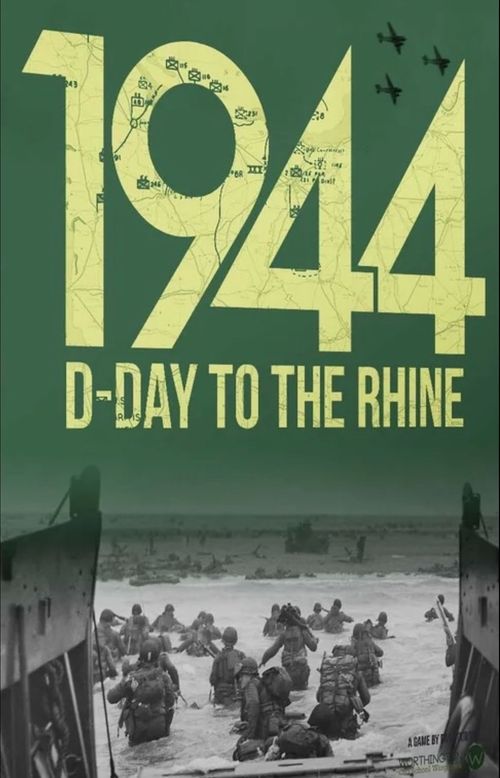
1944: D-Day to the Rhine
1944: D-Day to the Rhine Rulebook
Table of Contents
Table of Contents
- 1.0 Components
- 2.0 Game Board
- 3.0 The Units
- 4.0 Unit Colors
- 5.0 Markers
- 6.0 Set Up
- 7.0 Sequence of Play
- 8.0 Resource Points (RP)
- 9.0 Reinforcements and Replacements
- 10.0 Activating Units for Movement and Combat
- 11.0 Movement
- 12.0 Combat
- 13.0 Supply
- 14.0 Control of Cities
- 15.0 Invasion of Southern France
- 16.0 Rundstedt's Counter-Offensive (RCO)
- 17.0 Victory
- 18.0 Optional Rules
- 19.0 RP Table
- 20.0 Terrain Effects Chart
1.0 Components
- Game board
- 2 Counter Sheets
- 2 sets of Rules
- 3 Double-Sided Set-up and Reinforcement Charts
- 6 Custom Blue Allied Dice
- 6 Custom Black German Dice
- 1 Six-Sided Die
- 3 Variable Objective Cards
- Won/Lost Record
2.0 Game Board
The game board shows a map of most of France, Belgium, Holland and western Germany. On the game board is a hex grid and terrain features that affect and regulate movement, supply, and combat. Each hex measures about 25 miles/40 kilometers across. The German player controls all cities at the start of the game. Control changes as players move units through cities the other player controls. Current control of cities is indicated with control markers. The Ruhr comprises the three major cities of Essen, Dusseldorf and Dortmund.
The combat effects of terrain are based on the location of the defending unit. Terrain combat effects are cumulative. This means some units are not able to roll any dice when attacking through/into certain terrain.
For example, a defender is located in a forest terrain hex adjacent to a river. An infantry corps unit (2 dice rolled in combat) is attacking it across the river. The attacking unit would be -1 die for the forest terrain and -1 die for crossing the river. The cumulative effect is -2 dice for the attacking unit, resulting in no dice rolled. The player can still choose to include this unit in the attack to absorb potential losses.
Terrain movement effects within a hex are not cumulative. The terrain cost to enter a hex is the highest cost if more than one condition exists. However, the cost for crossing a Rhine river hex-side to enter a hex is added to the cost of the terrain in the hex.
For example, for a unit to enter a woods terrain hex that is located in an enemy ZOC would cost 2 MP, not 4.
For more see back cover for Terrain Effects Chart.
3.0 The Units
From the counter sheets the players will divide the army units into their two respective armies based on the unit colors. Green, blue and khaki represent the Allied forces; gray, black, and white for German forces. Round bomber, naval, airborne, rail and RCO units are also provided.
Combat Units
Each combat unit is comprised of symbols and data. Each unit has a row along the bottom with three numbers. From left to right these are DRC (# of Dice Rolled in Combat), SP (unit steps or strength points), and MP (movement points).
- DRC: Dice Rolled in Combat; this is the number of dice the unit rolls when attacking or defending in combat.
- SP: This number is the strength points (SP) of the unit and determines how many hits in combat the unit can take before it is eliminated. Corps size units have 1 or 2 steps maximum and Army sized units have 3 or 4 steps maximum.
- MP: This number is the unit's total movement points for the monthly turn. When activated the unit has this many movement points to spend while moving. MP are reduced by -1 when Out of Supply.
In the center of the unit is a symbol showing the unit type: infantry or panzer (German only). Special types of infantry (parachute, mountain, coast, fortress and volksturm) have an additional symbol under or on the infantry symbol. Each unit's center square symbol is color coded to indicate to which army group it is assigned. Along the sides of the unit's symbol are the Corps ID (roman numerals on the left side), Army ID (arabic number on the left side) and Army Group ID (arabic number or letter on the right side) which are given for historical purposes and to aid in set up and order of battle.
Army Units Have 2 Counters Each
Unit step reduction: Full strength unit (4/4); first hit applied (flipped, 3/4); second hit applied (use replacement unit, 2/4); third hit applied (flipped replacement, 1/4); fourth hit (unit removed).
Players can stack both counters of an army on the board for ease of play, ensuring the current strength is displayed. However, the army is considered one unit (there is no stacking of units).
- Allied infantry armies: Have a maximum of 4-SP. Most Allied armies have 4 MP, but the 3rd US Army has 5 MP.
- German infantry armies: Have a maximum of 3-SP and 4 MP.
- German panzer armies: Have a maximum of 3-SP and 6 MP. Panzer Armies may be included with any German Army Group in an attack.
Corps Units Have 1 Counter Each
- Allied infantry corps: Have a maximum of 2-SP. Most Allied infantry corps have 5 MP, but the mountain and airborne corps have only 4 MP. The Allied Airborne Corps may be included with any Allied Army Group in an attack.
- German regular and elite infantry corps: Have a maximum of 2-SP and 4 MPs. Elite corps are designated by a red border around the inner infantry symbol box.
- Volksturm infantry corps: Have a maximum of 2-SP and 0 MPs (static).
- Coast and fortress infantry corps: Have a maximum of 1-SP and 0 MPs (static); and cannot be replaced.
- German panzer corps: Have a maximum of 2-SP and 6 MPs. Panzer corps may be included with any German Army Group attack.
- Mountain infantry corps: The German XIII SS Corps and the French II Corps have 2 special abilities in mountain terrain:
- Not required to stop when entering mountain terrain, if sufficient MPs remain to continue.
- Do not suffer the -1 DRC penalty when attacking into mountain terrain.
4.0 Unit Colors
Allied Set
| Nationality | Outer color |
|---|---|
| USA | Green |
| France | Blue |
| Commonwealth | Khaki |
| Army group | Inner color |
|---|---|
| 6th | Dark Blue |
| 12th | Dark Green |
| 21st | Red |
German Set
| Unit class | Outer color |
|---|---|
| Regular Infantry | Grey |
| Static Infantry | White |
| Panzer | Black |
| Army group | Inner color |
|---|---|
| B | Yellow |
| G | Dark Grey |
| H | Blue |
| Volksturm | Yellow, Dark Grey, or Blue |
| Coast | Yellow |
| Fortress | Red |
| Panzer | White |
4.1 Support Units
These round counters enhance combat or movement at no RP cost and are kept off board until used.
Naval units: The two Allied naval units in the game have a battleship icon. They are kept off board and placed during combat in coast hexes, once per monthly turn. Naval units bombard, adding +1 die to a combat (attack or defense) in a coast hex. Only one Naval unit can be added to a combat, but it can be combined with an airborne division or bomber unit.
- The Eastern Task Force (ETF) naval unit can support any Commonwealth unit.
- The Western Task Force (WTF) naval unit can support any US unit.
Once used, naval units are flipped to the FIRED side and placed off the map for the remainder of the monthly turn.
Terrain restrictions: Naval units cannot bombard Antwerp or the 2 coast hexes to the north if Walcherin is German controlled.
Bomber units: carpet-bomb adding +2 dice to an attack. The Allied player can carpet bomb once per monthly turn (in clear weather). A player cannot carpet-bomb Paris. The bomber unit can support an attack of any army group. Procedure: Roll 2 dice before the regular combat. If both dice rolled are blank faces, one die is re-rolled and can score a hit against an attacking allied unit. Hits from carpet bombing are applied immediately, before regular combat begins. The bomber unit can be combined with a naval unit, but not with an airborne division. Once used, the bomber unit is removed.
Airborne units: Each of the five Allied airborne units are used once for an airborne operation. A maximum of two airborne units can conduct airborne operations in the same monthly turn.
Airborne Operation Procedure
A. Airborne operations can be conducted in clear weather only. Airborne units may support attacks of any army group. B. The Allied player selects a hex being attacked across a river, or a fortress hex being attacked. C. One airborne unit is placed on the selected hex on top of the German unit being attacked. The attack can also be supported by naval gunfire, but not carpet bombing. D. The Allied player adds +1 combat dice (not effected by terrain) to the attack. E. After combat is concluded, the airborne unit is removed and cannot be replaced.
5.0 Markers
- Beach-head: These two markers are used to indicate an invasion beach-head which acts as a source of supply and entry point for the Allies. If occupied by a German unit, the beach-head is eliminated.
- Turn: This marker is used to track game monthly turns.
- RP: Each side has an RP marker to keep track of RP available and expended.
- PC: The Allied side has a PC marker to keep track of the current Port Capacity number.
- Rail movement: This marker is used to track which German unit has used rail movement.
- RCO & RCO Dietrich: The 3 RCO markers and the RCO Dietrich marker are for Rundstedt's Counter Offensive (RCO). (see rule 16.0)
- Attacked/Finished and Moved/Finished: The markers are used to assist a player in keeping track of which units have attacked and/or moved. When a unit has completed both actions, the marker is flipped to the FINISHED side.
- Out of Supply/In Supply: these markers indicate if a unit is in or out of supply.
- German Hidden & Phantom markers: Optional (see rule 18.5).
- Weather marker: Used by Allied Player as a reminder of current weather.
6.0 Set Up
Based on the Standard Set-Up chart, both players set their units on board matching the unit's image to the location shown. Units start at the SP level indicated. Place the RP markers for both players on the RP track; and the monthly turn marker on June (see rule 18.1 for Optional Quick Start).
6.1 Normandy Invasion
The Allied player invades with the units listed as starting forces before the regular German June turn. There is no RP cost to conduct the invasion attacks or to move into the vacant beach-head hex after combat.
6.2 Resolving the Normandy Invasion
Step 1 - Amphibious invasion battle:
The Allied player makes two attacks (at no cost in RPs). Both players roll combat dice. The Allied player rolls 4 dice (3 for the Army; +1 for naval unit; +1 for airborne unit; and -1 for the coast hexside effect) for each attack. The German player rolls 2 dice (1 for coast unit and +1 for coast hexside effect) for both combats. Hits are applied simultaneously. If one German coast unit is not eliminated, that landing has failed. The invading army becomes a reinforcement unit in June, with possible lost steps from the combat. If both German coast units survive, the D-Day invasion has failed and the German player wins by sudden death. Don't worry, there is less than a 1 percent chance both invasion attacks will fail and just over a 5 percent chance that one attack will fail. You can always start a second game.
Step 2 - Establish beach-head:
If the invasion landing succeeds, the invading Army moves into the target hex, at no cost in RPs. Place the Army Group beach-head marker in the hex. No further movement or combat is allowed for the Allies before the German player begins his June turn.
June German movement restriction: Manteuffel's 5th Panzer Army cannot be activated for movement in June.
7.0 Sequence of Play
A full game monthly turn is described in the sequence below. After the Allied player finishes, the monthly turn marker is advanced one space, unless sudden death victory is determined earlier. The Normandy invasion takes place before this sequence begins in the June turn.
- German reinforcements and replacements phase. Optional: Phantom Units (see rule 18.5).
- German activation phase: the German player activates units for movement and combat, checking supply for a unit activated for movement.
- Allied RP calculation, reinforcements and replacements phase.
- Allied activation phase: the Allied player activates units for movement and combat, checking supply for a unit activated for movement.
8.0 Resource Points (RP)
Allied RPs are indicated on the monthly turn record track, with bonus RPs for controlled ports.
Allied RPs are calculated each monthly turn by adding the RP # from the Monthly Turn Record Track to the Port Capacity (PC) values of all controlled ports, with a maximum of 24 RPs per monthly turn. The Allied player marks his current PC # on the track with the PC marker. He marks his current RP number on the track with the Allied RP marker.
Port Capacity: Each port/beach-head has a PC # indicated on the board/counter.
- PC-3: Antwerp
- PC-2: Brest
- PC-1: All other ports
Antwerp does not function as a port for the Allies until the 4 hexes (including Walcherin) to the north are clear of German units. Bordeaux does not function as a port for the Allies until Royan is clear of German units. Royan and Walcherin are not ports, do not provide any PC (RPs), and cannot be used as entry hexes for Allied units.
German fortress units in fortress hexes on the coast are never out of supply; but these hexes do not serve as a German source of supply.
German RPs are indicated on the chart on the board.
RPs are used by each player to add replacement steps to units or to add eliminated units. RPs are used to activate units for movement and combat. As each player spends their RPs they move their marker down the track to reflect their lower RP total. Once a player has spent all of his RPs or wants to perform no other activations then their turn is over. No player can spend more RPs than they receive in a monthly turn. RPs cannot be saved for future monthly turns. For Resource Point cost, (see rule 19.0).
9.0 Reinforcements and Replacements
9.1 Reinforcements
The active player checks the order of battle chart to determine if he receives reinforcements.
Allied reinforcements: are placed in any controlled beach-head or port; on or adjacent to the controlled, in supply, city specified; in a "from Marseilles" hex, if noted. If the specified entry city is not under Allied control, the reinforcement can be placed in or adjacent to any controlled beach-head or port. All Allied reinforcements enter the game at their maximum SP.
German reinforcements: are placed by Army Group. If the specified entry city is no longer under German control, the reinforcement can be placed in or adjacent to any controlled city in Germany that is in supply. All German reinforcements enter the game at 1 SP level except for Rundstedt's Counter-Offensive (RCO) units. Replacement steps can be added.
Army Group G: (Grey) reinforcements can be placed in or adjacent to the following in-supply controlled cities: Frankfurt, Strasbourg, Stuttgart or Trier; or in a "from Marseilles" hex if noted.
Army Group H: (Blue) reinforcements can be placed in or adjacent to the following in-supply controlled cities: the Ruhr, Enschede, Koln or Munster.
Panzer: (White) reinforcement can be placed in or adjacent to any in-supply controlled city in Germany, or Enschede or Strasbourg.
Units can temporarily over stack when entering the game, but the entry hex can only have one unit by the end of the turn. Only the original unit in the hex can attack from that hex while over-stacked. Not all reinforcements have to enter on the monthly turn designated on the monthly turn track but can be delayed until future monthly turns.
Allied Reinforcement/Replacement Unit Temporary Stacking
The Allied player can find he has no accessible vacant hex to move into after placing a reinforcement or replacement unit on a beach-head or port hex.
- Units can temporarily over stack in a beach-head or port hex hex, but only one unit can remain in the hex at the end of the turn.
- Only the original unit in the hex can attack from that hex while over-stacked.
- If the beach-head or port hex is over-stacked at the end of a turn, excess units are placed back on the turn track for placement next turn.
9.2 Replacements
Replacements include steps and units, with varying costs indicated on the RP use chart for different types of units. The player's RP marker is adjusted on the track as they spend RP for replacements.
Replacement Units
The active player can spend RP to build 1 SP replacement units from the replacement pool. It costs 1 RP to build a German volksturm replacement unit, 2 RPs to build an infantry replacement unit, and 3 RPs to build a German panzer replacement unit. Additional steps can be added to a reinforcement or replacement unit by spending additional RPs. Reinforcement and replacement units can be brought in at a location that is in enemy ZoC. Reinforcement and replacement placement locations must be in supply. Cities must be controlled.
Allied Replacement Units Are Placed by Army Group
- 12th Army Group US and 21st Army Group Commonwealth replacement units can be placed in any beach-head or port.
- 6th Army Group US replacement units can be placed in any "from Marseilles" hex.
- 6th Army Group French replacement units can be placed in or adjacent to any city in France.
German Replacement Units Are Placed by Army Group, in or Adjacent to These Cities
- Army Group B (yellow) the Ruhr, Frankfurt, Koln or Trier.
- Army Group G (grey) Frankfurt, Strasbourg, Stuttgart or Trier.
- Army Group H (blue) the Ruhr, Enschede, Koln or Munster.
- Panzer (white) any city in Germany, Enschede or Strasbourg.
- Volksturm replacement units can only be placed in the German city named on the counter.
Replacement Steps
The active player can add replacement steps to units on board that are not at full strength. It costs 1 RP for each infantry (including volksturm) SP or 2 RP for a panzer SP. Replacement steps can also be added to reinforcement and replacement units just placed during the current monthly turn. Units in enemy ZoC can only add 1 SP per monthly turn. A unit not in enemy ZoC can add as many steps as a player wants as long as enough RPs are available.
9.3 National Replacement Limits
Some nationalities suffered from manpower or equipment shortages, limiting the number of RPs that can be spent on replacements each monthly turn.
- Commonwealth: A maximum of 2 RPs can be spent on replacements for Commonwealth (British and Canadian) units each monthly turn.
- US: A maximum of 4 RPs can be spent on replacements for US units each monthly turn.
- France: There is no limit on replacement spending for French units.
- Germany:
- Infantry units - There is no limit on replacement spending for German infantry units, however eliminated German fortress and coast units cannot be replaced.
- Panzer units - A maximum of 3 RPs can be spent on German panzer replacements each monthly turn.
- German armies (infantry and panzer) and elite infantry corps - Cannot be replaced in January, February and March, but can still receive replacement steps.
10.0 Activating Units for Movement and Combat
A unit can be activated once a monthly turn to move. Also, a unit can be activated once a monthly turn to attack. This can be done in any order, and other friendly units can be activated in between the two actions. (In other words, units can be activated in any order to perform a move or attack as long as they are only activated once for each in a monthly turn).
Once a unit has been activated for movement, it cannot be activated again in the same monthly turn to move. Once a unit has been activated to attack, it cannot be activated again in the same monthly turn to attack. Markers are provided to assist players in keeping track of which units have moved and/or attacked.
Check supply for an activated unit at the time of activation for movement. If the unit is in supply then 1 RP allows 1 unit to make a tactical move up to its full movement allowance or a motorized/rail move. If the unit is out of supply, 1 RP allows the unit to make a tactical move with -1 MP, but not a motorized/rail move.
1 RP allows all adjacent units of the same army group to attack 1 hex with a defender located in it, following all terrain rules. If an attack includes units from two or more army groups, it costs 2 RPs. Allied airborne and German panzer units do not belong to an Army Group. These units can combine with any Army group to make attacks at the 1 RP cost. German Fortress infantry corps function as a separate army group, and must pay the extra RP to attack with units of any army group.
11.0 Movement
Unit Zone of Control: Each land unit has a Zone of Control (ZOC) which extends into all 6 hexes around the hex the unit is located in. The ZOC affects movement and supply. It costs 2 MP to enter an enemy ZOC and for each hex moved through an enemy ZOC. An enemy ZoC blocks supply. A friendly unit in a hex negates enemy ZoC for supply purposes, but not for the 2 MP movement cost for the hex.
Tactical movement: An activated unit spends its supply adjusted MP to move. It costs 1 RP to activate a unit for tactical movement, allowing it to move its available MP. When activated a unit checks its supply status and if out of supply it reduces its available MP by -1.
Movement is from hex to adjacent hex. Units cannot skip hexes when moving. Units cannot spend more MP than they have in a monthly turn. MP cannot be saved or transferred between units. The cost of the terrain in each hex is deducted from the unit's available MP until it does not have enough MP to move any further, or the player does not want to move the unit further. The terrain cost in MP is not cumulative, but you must pay the highest cost.
For example, moving into a clear hex in an enemy ZoC costs 2 MP, not 3 MP.
It costs +1 MP to cross the Rhine River. The Rhine River crossing cost is added to the terrain cost of the hex entered.
For example, to cross a Rhine River hexside into a clear hex in enemy ZoC costs 3 MP (2 MP to enter a hex in enemy ZoC-which is greater than the open terrain cost, but not cumulative-plus 1 MP to cross the river).
No hex can have more than 1 unit located in it at the end of a unit's movement. Units can move through hexes with friendly units located in them, but cannot stop. Units cannot enter a hex that contains an enemy unit.
11.1 Strategic Movement
Units can make a strategic (Allied motorized or German rail) move instead of a tactical move, at the same cost of 1 RP, if the following conditions are met:
A. Unit must be in supply when activated for movement. B. Unit must not start, move through or end movement in an enemy ZoC. C. Units can use strategic (motorized or rail) movement after attacking, as long as the enemy unit is destroyed and the unit is activated for movement in a hex free of enemy ZoC. Attacking after a strategic (motorized or rail) move is not possible.
11.2 Allied Motorized Movement
Motorized move distance can be up to double the unit's MPs in hexes (ignoring terrain costs) and is subject to these additional conditions:
A. Unit cannot cross the Rhine. B. Units can enter hexes not in Allied supply, and can extend Allied supply by gaining control of cities during movement.
For example, an Allied unit with 4 MP can move 8 hexes using motorized movement; and an Allied unit with 5 MP can move 10 hexes using motorized movement, as long as all the conditions above are met.
11.3 German Rail Movement
Beginning in July, the German player can move one unit per turn by rail. A rail move can be of unlimited distance (unit's MPs and terrain do not matter) and is subject to these additional conditions:
A. A rail move is from current location to any in-supply hex in Germany; or any controlled city hex or hex adjacent to a controlled city outside Germany. B. The unit must remain in supply throughout the entire rail move.
12.0 Combat
Units are never required to attack. Only units in an enemy ZOC are eligible to attack. Not all units in the defender's ZOC have to attack. Supply has no effect on combat. To attack a defending hex containing an enemy unit with units of the same army group a player spends 1 RP; if units of two or more army groups participate in the attack a player spends 2 RPs.
The attacker announces which adjacent units will be attacking, and the Allied player announces if a bomber, airborne and/or naval unit will be added. This costs zero RP, but adds attack dice to the combat. Bomber, naval and airborne units are not affected by terrain. Bomber units may not be combined with airborne units.
Combat is simultaneous so both players roll for attack and defense at the same time. The attacker totals the number of dice to roll for the attacking units, and modifies that total by any terrain factors. The defender then adds any terrain modifiers to his defending unit's dice total. The players roll their attack and defense dice.
Hits Are Scored for Symbols Rolled on Dice as Follows
Each Blue Allied die and Black German die shows an aircraft symbol, a panzer symbol and an infantry symbol (and blank faces).
- Aircraft symbol: (In clear weather) Scores a hit on a panzer unit. If no panzer unit is present, the hit is applied to an infantry unit. In overcast weather, the aircraft symbol is a miss.
- Panzer symbol: Scores a hit on a panzer unit. If no panzer unit is present, the hit is applied to an infantry unit.
- Infantry symbol: Scores a hit on an infantry unit.
Hits are applied simultaneously; no hits are applied until both players have rolled. The owning player decides how to apply hits to his attacking units, in any manner he desires (all to one unit, or spread amongst units).
12.1 Weather Effect on Combat
During overcast weather (December and January) allied rolls of an aircraft symbol are treated as misses, not hits.
For example: During combat, each time a unit receives a hit, it is flipped or replaced to the next lower SP. When a unit is reduced below 1 SP it is removed from the board and placed in the replacement pool or permanently eliminated (German coast and fortress corps; and German armies and elite infantry corps from January to March).
13.0 Supply
For a German unit to be in supply it must be able to trace a supply chain from the unit 5 hexes to a German controlled city in supply; to the east or south German board edge; or to the south France board edge (from June to August). Controlled cities must be able to trace a continuous chain of controlled cities, within 5 hexes of each other, to a supply board edge.
For an Allied unit to be in supply it must be able to trace a supply chain from the unit 5 hexes to an Allied controlled city in supply; to an Allied controlled port or beach-head; or to the south France board edge (beginning in September). Controlled cities must be able to trace a continuous chain of controlled cities, within 5 hexes of each other, to the south board edge or an Allied controlled port or beach-head.
A supply chain cannot enter or pass through an enemy ZoC, or an enemy controlled city. Friendly units negate enemy ZoC in hexes they occupy, but friendly ZoC does not negate enemy ZoC. A unit located on a friendly supply board edge is always in supply. Supply chains cannot be traced through an enemy unit or an enemy ZOC.
When a unit is activated it checks supply for movement effects. If it is out of supply it receives -1 MP for movement. Units that are out of supply cannot use motorized/rail movement. Supply has no effect on combat.
A unit that is out of supply at the end of the player's turn (German phase 2 or Allied phase 4) is eliminated and placed in the replacement pool or discarded.
German units located along the east or south German map edge hexrow are never out of supply.
German fortress units are never eliminated for being out of supply.
Allied units located in a beach-head, port, or along the southern French map edge hexrow (beginning in September) are never out of supply.
14.0 Control of Cities
All cities are under German control at the start of the game. The Allies can liberate friendly cities or occupy German cities to gain control, indicated by placing an Allied control marker on the city. If the German player later re-occupies a city, the Allied control marker is removed.
Liberation: Cities in France, Belgium and Holland (Allied countries) can be liberated as follows.
A. Moving into or through an Allied city causes immediate liberation. B. If the German player cannot trace supply to a vacant Allied city at the end of his turn (phase 2), the city is liberated. This includes fortress ports that have lost their German garrison unit through combat.
Occupation: To gain control of a city in Germany the Allied player must occupy or move through the city with an Allied unit. If an Allied controlled German city is out of supply at the end of an Allied turn, it reverts to German control.
Once a city is liberated or occupied, place an Allied control marker on the city to aid in supply line tracing and victory determination.
15.0 Invasion of Southern France
The Allied invasion of Southern France takes place off board. The invasion succeeds automatically in August, and triggers the entry of units for both sides in September:
German Army Group G units: Enter in September. Units can enter in any hex on the southern board edge in France. Both German units can be activated for movement at no RP cost in September (only); one unit can be activated for a rail movement, exhausting the only rail move available for Germany for September.
Franco-American 6th Army Group units: Enter in September and later. Units can enter in any "from Marseilles" hex. Later reinforcements will also enter in the same way when "from Marseilles" is noted on the Allied Order of Battle chart.
16.0 Rundstedt's Counter-Offensive (RCO)
The German high command decided in September to launch a major counter-offensive on the western front. Units and resources were secretly gathered and deployed for this attack over the next 3 monthly turns. The German player can choose to launch Rundstedt's Counter-Offensive (RCO) in November, December or January, with increasing forces and decreasing surprise over time (see German Turn Track Chart).
Variable Reinforcements
- November: Dietrich's 6th Panzer Army (3-SP)
- December: Dietrich's 6th Panzer Army (3-SP) and I SS Panzer Corps (1-SP)
- January: Dietrich's 6th Panzer Army (3-SP) and I SS Panzer Corps (2-SP)
Dietrich's 6th Panzer Army - Free Move and Attack
The 6th Panzer Army can both move and attack at no RP cost in the monthly turn of the RCO. An RCO Dietrich Attack/Move marker is provided. Other units can participate in the 6th Panzer Army attack, as the player desires.
Surprise Attack RCO Bonus
The German player receives 1 (in January), 2 (in December) or 3 (in November) RCO Surprise! markers that can be used during the German turn to provide a movement and attack benefit. Upon activation of a selected in-supply unit for movement or an attack, in either order, place the RCO marker on the activated unit. Only one RCO marker can be committed to a unit. The German player adds +1 MP during movement for this unit and adds +1 combat dice (not effected by terrain) to its attack. Remove and discard the RCO marker after both movement and attack are completed. RCO markers cannot be saved for a later turn.
17.0 Victory
Either player can win by Sudden Death or by End of Game victory conditions.
17.1 Sudden Death
German sudden death: The German player wins if there are no Allied units on the continent at the end of any German turn.
Allied sudden death: (By end of the February 1945 turn) The Allied player wins by exiting an Army using tactical (not motorized) movement, in any of the three exit zones, by the end of February. The Allied army must be in supply in the hex it exits from, to score a Sudden Death victory.
17.2 End of Game Victory Conditions
(At the end of the March 1945 Turn)
German Major
- There are no Allied units in Germany east of the Rhine; OR
- Control 6 German cities east of the Rhine in supply; AND control 1 city (excluding fortress port cities) west of the Rhine in supply.
German Minor
- Control 5 German cities east of the Rhine in supply; OR
- Control 1 city (excluding fortress port cities) west of the Rhine in supply.
Draw
Neither player fulfills his victory conditions.
Allied Minor
The Allied player wins if:
- There are no cities (excluding fortress port cities) under German control in supply west of the Rhine; AND
- A. Allies have isolated (placed out of supply) or control the Ruhr (Essen, Dusseldorf, Dortmund); OR
- B. Control 1 northern city (Essen or Munster) AND 1 southern city (Frankfurt or Stuttgart).
Allied Major
The Allied player wins if:
- There are no German units west of the Rhine, excluding fortress port units; AND
- Allies have isolated (placed out of supply) or control the Ruhr (Essen, Dusseldorf and Dortmund); AND
- Allies have exited at least one army in each of the three exit zones (To Hamburg, To Berlin and To Prague/Vienna), using tactical (not motorized) movement. The Allied armies must be in supply at the moment of exit and it costs 1 MP to exit.
18.0 Optional Rules
18.1 Quick Start
Instead of fighting the Normandy invasion, the game begins with the Allies already ashore. Use the Quick Set-Up deployment chart. The German LXXXIV Corps begins in the Replacement Pool, One German Coastal Unit and the American 82/101 and British 6 Airborne units are removed from play. The US 1st Army (Hodges) and UK 2nd Army (Dempsey) are both at a reduced strength of 3-steps. Begin the game with the German June turn (the Allied June turn has already occurred and is not played).
18.2 Variable Objectives
Before the start of the September turn, the Allied player randomly selects one of the three Objectives Cards, without revealing it to the German player. The Objective card provides a set of Victory conditions the Allied player must pursue. The German player wins by preventing Allied victory.
Optional: The Allied player may choose (rather than randomly select) one of the three Objectives Cards, without revealing it to the German player.
Single Thrust
A modified version of the historical operation, in 9 monthly turns. Allied Victory cannot be achieved by end of game conditions, but only by Sudden Death. The Allied player wins by exiting an Army in any of the three exit zones, using tactical (not motorized) movement, by the end of the February turn. The Allied army must be in supply in the hex it exits from and it costs 1 MP to exit.
Broad Front
The Allied player wins at the end of the March turn if:
- There are no German units west of the Rhine, excluding fortress port garrisons; AND
- Allies control Essen or Munster and Frankfurt or Stuttgart.
Objective: Ruhr
The Allied player wins at the end of the March turn if:
- There are no cities under German control in supply west of the Rhine, excluding fortress port cities; AND
- Allies control the entire Ruhr (Essen, Dusseldorf and Dortmund).
18.3 Short Scenarios
Home by Christmas
A shortened scenario of the first 6 (June-November) monthly turns. The German player does not receive RCO forces. The German player wins if the Allied player fails to achieve victory by the end of the November turn.
Victory conditions: The Allied player wins by crossing the Rhine with at least one in supply army east of the Rhine in Germany, by the end of the Allied November turn, or earlier.
Ardennes Counter Offensive and 1945
A shortened scenario of the last 4 (December to March) monthly turns. Use standard end of game victory conditions.
Ardennes Counter Offensive (Learning Scenario)
A shortened scenario of just the December monthly turn, using only the northern portion of the map. German player wins: Major Victory if he captures and holds Antwerp; Minor Victory if he captures and holds Brussels. Allies win by preventing a German victory.
18.4 Free Invasions
The Allied player can conduct two invasions at locations of his choice. Use the same invasion procedures listed in Resolving the Normandy Invasion above. The invading armies are Dempsey's 2nd UK Army and Hodges' 1st US Army and all support units listed as starting forces. The third invasion of Southern France is unchanged and occurs automatically, unless the accelerated Dragoon option is played.
A. Invasions can be made in any coast hex marked with an arrow of the 5 invasion zones. B. Both armies can invade immediately before the German June turn, or one army can invade in June and the second invasion may be delayed until immediately before the German July turn. C. The two armies can invade in the same invasion zone or different invasion zones. D. If the second invasion is delayed till July, the Allied player receives only half his scheduled RPs in June (4 RPs instead of 8). In addition, only the listed started forces may take part in the second invasion (not the unit scheduled for July). So, if a delayed invasion is made, July and August reinforcements for that army group are delayed one turn each. E. From June to August, Commonwealth reinforcements can only arrive at the Commonwealth beach-head or any controlled port; and US reinforcements can only arrive at the US beach-head or any controlled port.
Invasion Zones and Effects
Effects are based on the easternmost zone invaded in a turn.
- Brittany: four coast hexes between Brest and St Malo.
- No Allied air power: air-faces on the dice rolled do not score hits during both the invasion and the June turn.
- Manteuffel's 5th Panzer Army: cannot be activated for movement in June.
- Lower Normandy: two coast hexes between Cherbourg and Caen.
- Manteuffel's 5th Panzer Army: cannot be activated for movement in June.
- Upper Normandy: two coast hexes east of Le Havre.
- The German player receives 7 RPs per turn, from the German turn immediately following the invasion up to and including August.
- Pas de Calais: two coast hexes west of Calais.
- The German player receives 8 RPs per turn, from the German turn immediately following the invasion up to and including August.
- Belgium: two coast hexes east of Dunkirk.
- The German player receives 9 RPs per turn, from the German turn immediately following the invasion up to and including September.
Accelerated Dragoon
Operation ANVIL/DRAGOON was originally planned to occur simultaneously with the Normandy landing. Although the forces were available, a shortage of landing craft and transport aircraft forced a two-month delay. This option presupposes that the Allies decided to go ahead with the simultaneous landing in northern and southern France, by curtailing the forces in the north.
The Allied player can conduct one invasion at a location of his choice with Dempsey's 2nd UK Army and all support units listed as starting forces. The invasion of southern France succeeds automatically, with the following changes:
- US and French units of 6th Army Group arrive on the southern map edge in July-September (2 months early).
- Allied RPs are reduced to 4 in June, and increased to 12 in July and 14 August.
- German Army Group G forces also arrive July-August (2 months early).
- German RPs are increased to 8 in July and August.
- The Allied player can conduct a third invasion at a location of his choice in August, with Hodges' 1st US Army and all support units listed as starting forces.
- US units of 12th Army Group schedule to arrive in June-August instead arrive in August-October (2 months late).
- All other units arrive as scheduled.
18.5 German Phantom Units
The two German phantom units provide realistic uncertainty and fog of war, as the Allied player will not know which units behind the lines are real and which are phantoms.
Procedure
- Entry: Whenever the German player receives a reinforcement or replacement unit in Phase 1, he can bring on one phantom unit per monthly turn in the same entry hex, or an adjacent entry hex, with a real unit, as long as the entry hex is more than two hexes from any Allied unit. The real unit and the phantom unit are both covered with a Hidden marker. The player can activate both the real unit and the phantom unit for movement on the turn of entry at the cost of 1 RP.
- Its costs 1 RP to activate a phantom unit for movement after its turn of entry.
- Phantom units can move as either panzer (6 MP) or infantry (4 MP). Phantom units can never move within two hexes of an enemy unit. Phantom units do not exert a ZOC.
- Phantom units are immediately eliminated if an enemy unit moves within two hexes. If the enemy unit has MP remaining it can continue to move.
- Phantom units can be removed by the owning player at any time, for example to allow a new phantom unit to be brought into play.
19.0 RP Table
| Jun | Jul | Aug | Sep | Oct | Nov | Dec | Jan | Feb | Mar | |
|---|---|---|---|---|---|---|---|---|---|---|
| German | 4 | 5 | 6 | 8 | 10 | 12 | 14 | 12 | 10 | 8 |
| Allied | 8 | 10 | 12 | 16 | 16 | 14 | 14 | 14 | 14 |
| Resource point use | Resource point cost |
|---|---|
| Replace one infantry SP | 1 RP |
| Replace one German panzer SP | 2 RPs |
| Build one German volksturm (infantry) unit at 1 SP | 1 RP |
| Build one infantry unit at 1 SP | 2 RPs |
| Build one German panzer unit at 1 SP | 3 RPs |
| Activate one unit for movement | 1 RP |
| Activate units of the same Army Group for combat | 1 RP per hex attacked |
| Activate units of two or more Army Groups for combat | 2 RPs per hex attacked |
20.0 Terrain Effects Chart
| Terrain type | Movement cost in MP | Combat effect |
|---|---|---|
| Clear | 1 MP | None |
| Forest or Bocage | 2 MP | -1 DRC for each unit attacking into a Forest/Bocage hex |
| Marsh | 2 MP & Must Stop Upon Entering | -1 DRC for each unit attacking from a Marsh hex |
| Mountain | 2 MP & Must Stop Upon Entering* | -1 DRC for each unit attacking into a Mountain hex*; +1 DRC for defending unit |
| Fortress | 1 MP | -1 DRC for each unit attacking into Fortress |
| Major City | 1 MP | -1 DRC for each unit attacking into Major City; +1 DRC for defending unit |
| Minor City or Port | Other Terrain | +1 DRC for defending unit |
| Minor River |
*Note: Mountain Infantry are not required to stop when entering and do not suffer the -1 DRC attack penalty in mountain terrain.