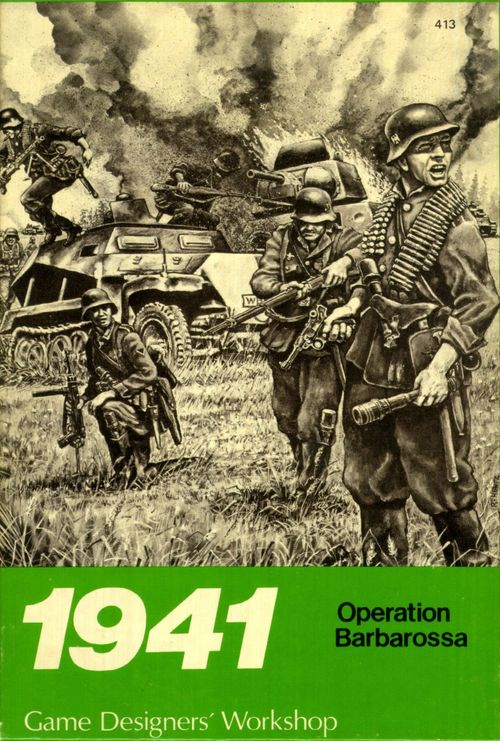
1941: Operation Barbarossa
1941: Operation Barbarossa Rulebook
Table of Contents
Table of Contents
- 0.0 Barbarossa
- 1.0 Game Components
- 2.0 Sequence of Play
- 3.0 Stacking
- 4.0 Control of Territory
- 5.0 Movement
- 6.0 Zones of Control
- 7.0 Combat
- 8.0 Supply
- 9.0 Armor
- 10.0 Air Power
- 11.0 Fortifications
- 12.0 Shock Armies
- 13.0 Weather
- 14.0 Reinforcements and Replacements
- 15.0 Axis Nations
- 16.0 Surrender of Soviet Units
- 17.0 Invasion (Turn 1)
- 18.0 Victory
- 19.0 Preparing for Play
- 20.0 Optional Rules
0.0 Barbarossa
A. 1941 is an operational/strategic level game covering the German invasion of the Soviet Union. Using one month turns and corps to army sized units, the game covers the critical period of the invasion, June through December 1941.
B. Optional rules allow the game to be extended to cover the Soviet winter counteroffensive during the first few months of 1942.
C. 1941 is a two player game. One player controls the forces of Germany and the various German allies (the German player or side). The other player controls the forces of the Soviet Union (the Soviet player or side).
D. Each side maneuvers its forces and engages in combat, attempting to win the game.
1.0 Game Components
1941 consists of a game map, 120 die-cut counters, this rules booklet, and a six-sided die.
1.1 The Map
1.1.1 In General
A. The game map portrays the western half of the European Soviet Union, where the crucial events of the invasion occurred. Overlaid upon this map is a hexagonal grid which serves to regularize the location and movement of the counters.
B. Each hexagonal cell (a hex) is numbered to assist definition of specific hexes.
C. Half hexes along the edges of the map are considered to be full hexes for all game purposes.
D. The map scale is approximately 41 miles (65 kilometers) per hex.
1.1.2 Errata
A. Krasnodar and Vologda are misspelled on the map.
B. A rail line connects hex 0105 directly to hex 0106.
C. A river (the Northern Dvina) should run southeast from hexside 0101/0102.
1.2 The Counters
1.2.1 In General
A. The sheet of counters provides the playing pieces (units), representing the forces which fought in the campaign. Units are color coded to denote side, nationality, and/or ability.
Nationality colors:
| Nationality | Colors |
|---|---|
| German | Black printing on gray-green counters |
| German Allies | White printing on gray-green counters |
| Soviet Shock Armies | White printing on gold-brown counters |
| Other Soviet | Black printing on gold-brown counters |
B. All units on a side are considered to be friendly forces, and all units on the other side are considered to be enemy forces.
1.2.2 Errata
The 46th Panzer Corps (6-6) is not a Turn 2 reinforcement, as indicated on the counter. Instead, it should be in play at the start of the game. Its deployment hex is hex 1825.
1.3 Counter Format Example
The unit above is the 12th (unit ID) Infantry (unit type) Army (unit size).
1.3.1 Unit Size Symbols
| Symbol | Size |
|---|---|
| XXX | Corps |
| (group symbol) | Group |
| XXXX | Army |
1.3.2 Unit Type Symbols
The unit type symbols are as follows: Tank/Panzer, Infantry, Mountain, and Shock (the symbols themselves are graphic on the counters).
Tank/panzer are armor-type. All others are infantry-type.
1.3.3 Unit Abbreviations
| Side | Abbr | Explanation |
|---|---|---|
| Any | Cst | Coastal |
| Soviet | M | "Mechanized" |
| Soviet | S | Shock |
| Axis | F | Finnish |
| Axis | R | Romanian |
1.4 The Rules
This booklet contains all the rules and, located on the back cover, the charts governing play of the game.
1.5 The Die
Combat resolution requires a die roll to generate a random number. The die is included in the game for this reason.
2.0 Sequence of Play
A. The game is played in a series of game turns, each representing one month of time.
B. Each game turn is composed of a German player turn followed by a Soviet player turn.
C. During the German player turn, the German player is the phasing player and the Soviet player is the non-phasing player. During the Soviet player turn, these roles are reversed.
D. All activity in a player turn is divided into segments and phases, which are listed below.
E. All activity must be performed in sequence.
F. Units that move and engage in combat in the First Ground Segment may move fully and engage in combat in the Second Ground Segment. As each side has two Ground Segments in a player turn, its units can move and attack twice before its opponent's units may move.
2.1 Air Segment
The phasing side may use its air power to negate the air power of the non-phasing side.
2.2 First Ground Segment
2.2.1 Movement Phase
A. The phasing side may move any or all of its units up to the limits of their movement abilities.
B. Units may move by rail.
C. Reinforcements and replacements may enter play.
2.2.2 Combat Phase
The phasing side may resolve attacks.
2.3 Second Ground Segment
2.3.1 Movement Phase
A. The phasing side may move any or all of its units up to the limits of their movement abilities.
B. Units may move by rail.
2.3.2 Combat Phase
The phasing player may resolve attacks.
3.0 Stacking
Depending upon unit size, more than one friendly unit may be placed (stacked) in a hex. Axis and Soviet units have different stacking limits.
3.1 Axis
A. German group and army sized units may not stack with any other unit.
B. Germany may stack a maximum of two corps sized units per hex.
C. Thus, Germany may have the following combinations of units in a hex: one group, one army, one corps, or two corps.
3.2 Soviet
A. In hexes other than fortifications, the Soviets may have one unit of any size plus one corps sized unit.
B. Thus, the Soviets may have the following combinations of units in a non-fortifications hex: two corps, one corps and one group, or one corps and none army.
C. In a fortifications hex, the Soviets may stack two units of any size.
3.3 Effects
A. Stacking limits are in effect at the end of each Movement Phase. A unit may ignore the stacking limits during movement as long as the unit does not end the movement phase in violation of stacking.
B. Stacking limits are in effect during each Combat Phase. If a unit is forced to violate the stacking limits when retreating, it must retreat additional hexes until it reaches a hex where stacking is not violated. If it can not do this, it is eliminated instead.
C. Stacking limits are in effect when reinforcements are placed at cities (14.0).
4.0 Control of Territory
A. At the start of the game, all hexes in the Soviet Union are controlled by the Soviets, and all hexes outside the Soviet Union are controlled by Germany.
B. A side controls a hex when:
- A unit occupies the hex, or
- A unit exerts an uncontested zone of control into the hex (6.0).
C. When one side gains control of a hex, the other side no longer controls that hex. Controlled hexes are called friendly territory or hexes.
5.0 Movement
A. During each Movement Phase, the phasing side may move any or all of its units.
B. A unit's movement allowance (MA) expresses the number of movement points (MPs) a unit has available in each Movement Phase.
C. A unit moves from hex to adjacent hex, spending MPs to enter hexes and, in certain cases, to cross hexsides.
D. A unit may never spend more MPs than it has available in a single Movement Phase. It may spend less than the total available.
E. A unit may never enter a hex occupied by enemy units.
5.1 Terrain Effects
A. The Movement Effects column of the Terrain Effects Chart (TEC) specifies the MP costs for the various types of terrain hexes and hexsides.
B. The cost to cross a hexside is in addition to the cost to enter a hex.
C. MP costs differ by unit type: armor-type units use the costs listed in the Armor column of the chart and infantry-type units use the costs listed in the Infantry column of the chart.
5.2 Special Unit Abilities
A. A mountain unit expends 1 MP to enter a rough hex.
B. A Finnish unit expends 1 MP to enter a swamp hex (15.2.3).
5.3 Halving MA
A. A unit's MA may be halved due to a number of reasons.
B. When halving a unit's MA, always round remaining fractions up (e.g., half of 3 is 2).
C. All effects halving MAs are cumulative.
5.4 Rail Movement
A. Units of the phasing side may move by rail during the Movement Phase. A unit that moves by rail may not otherwise move in the same phase. Thus, it must start and end its movement on a railroad.
B. A unit may move by rail only in friendly territory, as determined by the map situation at the instant the unit is moved.
C. When moving by rail, a unit may move an unlimited distance, traveling along connected railroad hexes (i.e., the railroad runs directly from one hex to another).
D. A unit may not start in, end in, or pass through an enemy zone of control at any time during rail movement.
E. Each side has a rail capacity limiting the number of units able to move by rail during the player turn.
- The Axis rail capacity is three corps sized units or one group or army sized unit per friendly player turn.
- The Soviet rail capacity is eight units of any size per friendly player turn.
- Unused rail capacity may not be saved for use in later turns.
- In addition to the Axis rail capacity, Finnish units are allowed a special rail ability (15.2.4).
6.0 Zones of Control
A. Each unit has a zone of control (ZOC). A ZOC extends from the unit into the six surrounding hexes.
B. A ZOC never extends through an unfrozen all-sea or all-lake hexside.
6.1 ZOC Effects on Infantry Movement
A. An infantry-type unit must cease movement for the rest of the Movement Phase upon entering a hex in an enemy ZOC.
B. If an infantry-type unit begins the Movement Phase in a hex in an enemy ZOC, it may leave the hex. However, it may not move directly to another hex in an enemy ZOC. It must first enter a hex not in any enemy ZOC.
6.2 ZOC Effects on Armor Movement
A. An armor-type unit is not required to cease movement upon entering a hex in an enemy ZOC. It may continue to move and may enter a hex not in any enemy ZOC without penalty.
B. An armor-type unit may move from a hex in an enemy ZOC directly to another hex in an enemy ZOC as long as it is neither entering nor exiting a ZOC of an enemy armor-type unit. An armor-type unit must spend 2 MPs, in addition to the regular terrain costs, to make this move.
Example: If a German panzer group is in hex 2621 and Soviet infantry armies are in hexes 2522 and 2720, then the panzer group may move from hex 2621 directly to hex 2620, expending 3 MPs to do so. If Soviet tank units occupy hex 2522 or hex 2720 (or both), then the panzer group may not move from hex 2621 directly to hex 2620.
6.3 Other Effects
The effects of ZOCs on other game functions are specified in the appropriate rules sections.
7.0 Combat
7.1 In General
A. During a Combat Phase, the phasing side's units may attack adjacent enemy units.
B. A unit is never required to attack, but it always has the option of doing so.
C. Combat is resolved as a series of attacks against enemy occupied hexes; the attacking (phasing) side may resolve the attacks against the units of the defending (non-phasing) side in any desired order.
7.2 Restrictions
A. Each attack must be directed against the occupants of a single hex.
B. Two or more hexes may not be attacked in a single attack; each defending hex must be attacked separately.
C. All units in an attacked hex defend as a combined total; individual units in a hex may not be attacked separately.
D. A unit may attack only once per Combat Phase.
E. A unit may be attacked only once per Combat Phase.
7.3 Subsequent Attacks Against Retreated Units
If a defending unit retreats to a hex which is subsequently attacked, the unit contributes nothing to the defense of the hex but is affected by all combat results achieved against the defenders of the hex.
7.4 Procedure
A. Total the combat strengths of the attacking units to determine the attack strength.
B. Total the combat strengths of the defending units to determine the defense strength.
C. Modify the strengths of units for terrain (TEC), supply (8.0), and weather (13.0).
D. After modifying the strengths for these factors, compare the attack strength to the defense strength, in the ratio attacker to defender. Simplify this ratio to correspond to one of the odds columns on the combat results table (CRT), rounding down any fractions in favor of the defender.
Example: An attack of 23:5 (i.e., 23 attack strength against 5 defense strength) rounds down to 4:1.
E. The odds are then adjusted (shifting the column used) for terrain (TEC), armor (9.0), and air power (10.0), if any.
F. Once the final odds are determined, the attacker rolls a die and cross-indexes the number rolled with the final odds column to obtain a combat result. This result is immediately implemented.
7.5 Halving Strengths
A. The strengths of units may be modified for a number of reasons. When strengths are halved, total the strengths of all units to be halved, halve this total, and then round any fractions up.
Example: Three 5-3 units attacking at half strength with a strength of (15/2 = 7½) round to 8.
B. All effects which halve the strengths of units are cumulative.
C. Do all required halving of strengths before rounding any fractions up.
7.6 Terrain Effects
A. The Combat Effects column of the TEC specifies the effects of terrain on combat.
B. Terrain effects on combat are based on the type of hex occupied by the defending units and the type of hexside across which the attacking units attack.
C. Some terrain Shifts the odds are shifted one column to the left on the CRT.
Example: If a 6-3 unit attacks a 3-3 unit, the odds normally would be 2:1. If the 3-3 unit occupies a forest hex, then the odds are shifted one column to the left due to the terrain, so the combat would be resolved at 1:1 odds in this case.
7.7 Combat Results
7.7.1 Attacker Eliminated (AE)
All attacking units are removed from play.
7.7.2 Attacker Retreat (AR)
All attacking units are retreated one hex by the attacker.
7.7.3 No Effect (NE)
The attack achieved no appreciable result.
7.7.4 Defender Retreat (DR)
All defending units are retreated one hex by the defender.
7.7.5 Defender Eliminated (DE)
All defending units are removed from play.
7.7.6 Exchange (EX)
A. All defending units are eliminated.
B. The attacker must remove one unit having a combat strength that most closely approximates the total combat strength lost by the defender.
Example: Three units (6-3, 4-3, and 3-3) attack a 5-3 unit. An exchange is rolled, eliminating the 5-3 unit. The 6-3 unit and the 4-3 unit are each within one strength point of the eliminated unit, so the attacker may chose to eliminate either one as the unit that most closely approximates the total combat strength lost by the defender.
C. If the combat strength of each attacking unit is at least three times the total combat strength lost by the defender, the attacker does not eliminate any units due to the exchange.
Example: Two units (16-6 and 14-6) attack a 4-3 unit. An exchange is rolled. The 4-3 unit is eliminated. Since the 16-6 and 14-6 units are each at least three times the strength of the eliminated unit, the attacker loses no units in the exchange.
D. For all exchange calculations, the printed combat strengths of the involved units are used. If a unit contributes nothing to the defense of a hex (due to retreating to a hex that is subsequently attacked), then its combat strength is not counted for exchange purposes.
7.8 Retreat
7.8.1 Priorities
A unit must retreat according to the following priorities:
A. A hex not in any enemy ZOC, then B. A hex in an enemy ZOC that is occupied by a friendly unit.
7.8.2 Restrictions
A. A unit may not retreat:
- Across any hexside that is prohibited to movement.
- Into an enemy occupied hex or into a hex in an enemy ZOC unless the hex is occupied by a friendly unit.
B. A unit unable to retreat without violating the above conditions is eliminated instead.
C. A unit may not end its retreat in violation of stacking. If forced to violate stacking when retreating, it must retreat additional hexes (the minimum necessary) until it no longer violates stacking or is eliminated due to an inability to retreat.
7.8.3 Advance After Combat
A. If a hex is cleared of defending units, then one attacking unit may advance into the hex. The advance must be made before resolving any other combat.
B. Advance is unaffected by enemy ZOCs and costs no MPs.
8.0 Supply
A. Supply affects the ability of units to move and attack.
B. The phasing side traces supply for all of its units at the start of each Ground Segment.
C. A unit is supplied if a supply line can be traced from the unit to a supply source.
8.1 Supply Lines
A. A supply line up to three hexes in length may be traced from a unit to a supply source or to a railroad leading to a supply source.
B. This three hex line may not:
- Cross a prohibited hexside,
- Pass through a prohibited hex, nor
- Enter a hex occupied by an enemy unit or a hex in an enemy ZOC unless occupied by a friendly unit.
C. The railroad portion of a supply line must be traced to a supply source entirely along connected rail lines. This supply line may only be traced through friendly territory and may not enter a hex in an enemy ZOC unless the hex is occupied by a friendly unit.
8.2 Supply Sources
Each side has a number of supply sources. Axis units may never use Soviet supply sources; Soviet units may never use Axis supply sources.
8.2.1 Axis Supply Sources
A. Any hex containing a railroad leading off the west edge of the map is a supply source for Axis units.
B. Finnish units (15.0) may use Helsinki (hex 0416) as a supply source.
8.2.2 Soviet Supply Sources
A. Any hex containing a railroad leading off the east edge of the map is a supply source for Soviet units.
B. All Soviet units occupying a fortifications hex are always in supply.
8.3 Effects on Unsupplied Units
A. If a unit is unsupplied at the start of a segment, it is considered to be unsupplied for the entire segment.
B. An unsupplied unit attacks at half combat strength, has its MA halved (round fractions up; e.g., half of 5 is 3).
C. Unsupplied units may not use rail movement.
D. A unit's ability to defend is not affected by supply.
9.0 Armor
9.1 In General
A. Armor-type units may receive a special attack bonus.
B. When armor-type units attack only infantry-type units, the attacker receives a one column shift to the right on the CRT is shifted one to the right (e.g., a 2:1 attack becomes 3:1).
C. No column shift is received if any infantry-type unit attacks in conjunction with the armor-type units.
D. No column shift is received if any defending units are armor-type units.
E. The bonus may be used only if the defenders occupy a clear hex. The hex may contain a city, and the attack may be made across a river. If the defenders occupy any other type of hex, no column shift is received.
F. Weather also affects the use of the armor bonus. The armor bonus may not be used in turns with mud or snow weather conditions.
9.2 German Armor
German armor-type units have the following special abilities.
A. A German armor-type unit may trace the non-rail portion of its supply line through hexes in enemy ZOCs, even if those hexes are not occupied by friendly units.
B. It may retreat into a hex in an enemy ZOC even if the hex is not occupied by a friendly unit. It may retreat in this manner only if there is no other legal retreat route available (7.0).
10.0 Air Power
10.1 In General
A. Air power is represented in the game by air points. Each side receives a varying amount of air points per the Turn Record Chart (TRT).
B. Each air point may be used only once per turn.
C. Unused air points are lost and may not be used. Air points may not be accumulated from turn to turn.
10.2 Use in Combat
A. During the Combat Phase, the phasing side may use air points to raise the combat odds. Each air point allocated to a specific attack shifts the odds one column to the right.
Example: A 3:1 attack to which the phasing side allocates two air points becomes a 5:1 attack.
B. During the Combat Phase, the non-phasing side may use air points to lower the combat odds. Each air point allocated to a specific attack shifts the odds one column to the left.
Example: A 3:1 attack to which the non-phasing side allocates two air points becomes a 1:1 attack.
C. For each attack, the phasing side declares the number of air points allocated before the non-phasing side allocates air points.
10.3 Axis Limitations
Germany may allocate air points only to attacks in which at least one German unit is attacking or defending.
10.4 Negating Enemy Air Points
During the Air Segment, the phasing side may use air points to negate the non-phasing side's air points on a one-for-one basis. An air point that is negated may not be used.
Example: On Turn 6, Germany receives three air points and the Soviets receive two. During its air segment, Germany uses two air points to negate both Soviet air points. Germany has one air point remaining for use this turn, and the Soviets have no air points remaining this turn.
11.0 Fortifications
A. Fortifications benefit Soviet units only.
B. Axis units receive no defensive, supply, or stacking benefits for occupying fortifications hexes.
C. A maximum of two units of any size may occupy a fortifications hex.
D. Infantry-type units have their combat strength doubled when defending in a fortifications hex.
E. Armor-type units receive no special defensive abilities when defending in a fortifications hex.
F. Units occupying a fortifications hex are always supplied.
G. A fortifications hex may not be destroyed. If Germany gains control of a fortifications hex and the Soviets subsequently regains control, the fortifications hex has full effect for the Soviets.
12.0 Shock Armies
A. The Soviets have four shock armies. Shock armies operate under certain restrictions and thus are specially color coded for ease of recognition.
B. During each Soviet Ground Segment, a shock army attacks at half strength if it moved during that segment's Movement Phase.
C. A shock army may attack at full strength in a segment only if it did not move during that segment's Movement Phase.
D. A shock army may never advance after combat.
13.0 Weather
The weather condition for each turn is specified on the TRT. The effects of weather are defined below.
13.1 Clear
There are no special restrictions on units.
13.2 Rain
Each armor-type unit has its MA halved during the Movement Phase of its Second Ground Segment.
13.3 Mud
A. Each unit has its MA halved during each of its movement phases.
B. The MP cost to enter a clear hex is raised from 1 MP to 2 MPs for armor-type units.
C. The non-rail portion of the supply line is reduced from three hexes to one hex for each Axis unit.
D. The armor bonus may not be used by either side.
13.4 Frost
A. All rivers and swamps are frozen.
B. A frozen river has no effect on movement or combat.
C. A frozen swamp has no effect on combat. The MP cost to enter a swamp hex is 1 MP for infantry-type units and 2 MPs for armor-type units.
13.5 Snow
A. Each armor-type unit has its MA halved.
B. Rivers and swamps are frozen, as described for frost.
C. All lakes plus the Gulf of Onega and the White Sea are frozen. Treat their hexes and hexsides as clear terrain.
D. Each Axis unit has its attack strength halved.
E. The non-rail portion of the supply line is reduced from three hexes to one hex for each Axis unit.
F. The armor bonus may not be used by either side.
14.0 Reinforcements and Replacements
14.1 Reinforcements
A. Each unit has a deployment code printed in its upper right corner.
B. Units with a four digit deployment code start the game on the map (19.0).
C. All other units enter the game as reinforcements; their deployment codes specify the turns they enter play.
Example: The German 3-3 50th Infantry Corps enters on Turn 2.
14.1.1 Axis Reinforcements
A. Axis reinforcements enter at any friendly clear or rough hex on the west map edge.
B. Reinforcements pay normal MP costs for their hex of entry.
C. Reinforcements may enter using rail movement provided that they enter at an Axis supply source on the west edge.
D. Reinforcements entering via rail movement count against Axis rail capacity.
14.1.2 Soviet Reinforcements
Soviet reinforcements may enter at a friendly controlled supply source on the east edge or at a friendly controlled major city in the Soviet Union.
14.1.2.1 Entry at East Edge Supply Source
A. A Soviet reinforcement may enter at any friendly controlled supply source on the east map edge.
B. Reinforcements pay normal MP costs for their hex of entry.
C. Reinforcements entering play using rail movement count against Soviet rail capacity.
14.1.2.2 Entry at Soviet Major City
A. A Soviet reinforcement may enter at any friendly controlled major city in the Soviet Union.
B. For a major city to be eligible, a supply line must be able to be traced from the city to a supply source on the east edge of the map.
C. There is no MP cost for placing a Soviet reinforcement at a major city.
D. Reinforcements appearing at major cities must be placed before any units move in the phase.
E. Stacking limits must be observed when placing such reinforcements.
Example: The Soviets have an infantry army and a tank corps at Kalinin. They may not place any arriving reinforcements at Kalinin, since doing so would violate the stacking limits.
14.1.3 Timing
A. The phasing side's reinforcements enter during the Movement Phase of the First Ground Segment.
B. Reinforcements entering from a map edge may enter at any time during the Movement Phase of the First Ground Segment.
C. Reinforcements may not be delayed: they must enter on the turn specified.
D. If a reinforcement is unable enter play due to enemy control of its entry hexes, it is eliminated instead.
14.2 Replacements
The Soviets receive replacements, which may be used to return previously eliminated Soviet units to play.
14.2.1 Timing
Replacements are received each turn from August 1941 (Turn 3) through December 1941 (Turn 7), noted on the TRT.
14.2.2 Composition
A. Each turn the Soviets may replace:
- Four infantry-type units plus one tank corps, or
- Three infantry-type units plus one tank group.
B. Only one unit with a combat strength greater than four may be taken, regardless of which option is selected. The remaining units taken must have combat strengths of four or less.
C. Within those limits, the Soviets may take any previously eliminated Soviet unit as a replacement.
14.2.3 Entry
A. Soviet replacements must enter play from the east map edge and do so in the same manner as Soviet reinforcements.
B. Soviet replacements may not enter at major cities.
14.2.4 Restrictions
A. Unused replacements are not accumulated. If the Soviets do not use their full replacement ability in a turn, they do not receive any extra replacement ability in later turns.
B. If Moscow (hex 1808) is Axis controlled, then the Soviet replacement rate is reduced by one infantry-type unit (i.e., either three infantry-type units plus one tank corps or two infantry-type units plus one tank group). If the Soviets recapture Moscow, the replacement rate returns to normal on following turns.
15.0 Axis Nations
15.1 Hungary
A. No unit (Soviet or Axis) may enter any hex of Hungary on Turn 1 (June 1941).
B. Units may enter Hungary starting with Turn 2.
15.2 Finland
15.2.1 Setup
Finnish units are marked with the letter F as part of their unit identifications and start the game deployed in Finland.
15.2.2 Movement and Combat Restrictions
A. On Turn 1, no Finnish unit may move across or attack across the Finnish-Soviet border.
B. On subsequent turns, Finnish units are under the following restrictions.
- Finnish units may not attack Leningrad (hex 0712) except in conjunction with German units attacking the hex.
- Finnish units may not attack Soviet units that are south of the Svir River or east of the White Sea Canal unless Leningrad is Axis controlled.
Example: Finnish units occupy hexes 0708 and 0809; Soviet units occupy hexes 0707, 0808, and 0910. Assuming that Leningrad is not controlled by the Axis, the Finnish units in hex 0708 could attack the Soviet units in hex 0707 but could not attack the Soviet units in hex 0808. The Finnish units in hex 0809 could not attack the Soviet units in hex 0910.
15.2.3 Swamp Movement
A Finnish unit expends 1 MP to enter a swamp hex.
15.2.4 Rail Movement
A. In addition to the Axis rail capacity, the Axis may move one Finnish unit per turn by rail, if the unit can trace a supply line entirely by rail to Helsinki.
B. No Finnish unit may move by rail using the regular Axis rail capacity unless a supply line can be traced from the unit to an Axis supply source on the west edge of the map.
15.2.5 Supply
Finnish units may use Helsinki as a supply source, in addition to the regular Axis supply sources.
16.0 Surrender of Soviet Units
A. At the end of each turn, an unsupplied Soviet unit surrenders if there is no supplied Soviet unit within five hexes of the hex it occupies.
B. A unit which surrenders is removed from play but may be taken as a replacement in later turns.
17.0 Invasion (Turn 1)
Certain special rules are in effect on Turn 1.
17.1.1 Omit Second Combat Phase
For each player turn, the Second Ground Segment consists solely of a Movement Phase. Omit the Combat Phase in this segment. Thus on Turn 1, the German player turn ends when Germany completes the Movement Phase of its Second Ground Segment and the turn ends when the Soviets completes the Movement Phase of their Second Ground Segment.
17.1.2 Turn 1 (Only) Rail Capacity
A. Germany may not move any units by rail.
B. The Soviet rail capacity is reduced to two units.
17.1.3 Soviet ZOCs
Soviet ZOCs do not extend across border hexsides into hexes in Greater Germany throughout the German First Ground Segment of Turn 1.
17.1.4 Soviet Retreats
The German side, not the Soviet, retreats all Soviet units that are required to retreat due to combat during both player turns of Turn 1. The regular rules of retreat must be followed, but the German side may retreat the Soviet units as desired within these limitations.
17.1.5 Soviet Reinforcements
Soviet reinforcements arriving on Turn 1 enter as follows:
A. Place the unit with the deployment code of 1:Od at Odessa. If Odessa is Axis controlled, the unit is eliminated instead.
B. The unit with the code of 1:E enters the map at any Soviet supply source on the east edge.
18.0 Victory
18.1 Awarding Victory Points
A. The game is played for seven turns, June through December 1941. Upon the conclusion of Turn 7, play ceases and victory is determined.
B. Victory is determined through the awarding of victory points (VPs) and the calculation of losses, based on the situation at the end of the game.
C. Germany accumulates VPs for the capture or encirclement of various Soviet cities and loses VPs if the Soviets control certain cities, specified in the Victory Point Table.
D. Control of cities is governed by the same rules as control of territory (4.0).
E. A city is encircled if it is Soviet controlled but a functioning supply line can not be traced from the city to a Soviet supply source on the east edge of the map.
18.2 Victory Level
A. To determine the level of victory, total the VPs gained and lost by Germany and consult the Victory Table.
B. Adjust the level of victory is adjusted as follows:
- Shift the level of victory by one in favor of Germany if forty or more Soviet units are eliminated.
Example: If a German marginal victory were achieved and there were 43 eliminated Soviet units, then the level of victory would become a German substantial victory.
- Shift the level of victory by one in favor of the Soviets if twenty-five or more Axis units are eliminated.
Example: If a German marginal victory were achieved and there were 27 eliminated Axis units, then the level of victory would become a Soviet marginal victory.
C. Losses are based upon the situation at the end of the game. Thus, a Soviet unit that was eliminated and then returned to play as a replacement does not count as eliminated.
D. If both sides suffer excessive losses, then the effects of those losses upon victory cancel out.
18.3 German Strategic Victory
Germany wins a strategic victory if all Soviet major cities on the map plus Archangel and Sevastopol are either German controlled or encircled. This rule reflects the expectations of the German High Command for the 1941 campaign rather than any level of victory the German player can reasonably expect to obtain given minimally competent Soviet play.
19.0 Preparing for Play
A. Sort all units, placing reinforcements aside. (Placing them on the TRT on the turn they enter play may be helpful).
B. Each remaining unit has a four digit deployment code printed its upper right corner. This number specifies the hex in which the unit must be placed.
Example: The Soviet 11th Army has a deployment code of 1222 and thus must be placed in hex 1222.
C. After all units have been deployed, the game begins.
20.0 Optional Rules
The following rules sections are optional and may be used only by agreement of both players. Each of the following optional rules may be used by itself or with other optional rules.
20.1 Soviet Naval Abilities
A. The Soviets have some limited naval abilities in the Gulf of Finland and the Black Sea/Sea of Azov sea areas.
B. Germany may use air power to neutralize Soviet naval ability.
20.1.1 Baltic Sea Fleet
A. The Soviets may move one infantry-type unit per friendly Movement Phase across the all-sea hexside between Leningrad (hex 0712) and hex 0713.
B. If the Baltic Sea Fleet is neutralized, Soviet units may not cross the 0712/0713 hexside. Additionally, hex 0713 is no longer considered to be a fortifications hex and is treated as clear terrain. Overstacking in this hex may occur when the Baltic Sea Fleet is neutralized; the Soviets must meet the stacking limits in this hex by the end of the first Movement Phase following neutralization of the fleet or else eliminate units from the hex until the stacking limits are met.
20.1.2 Black Sea Fleet
A. In each Soviet Ground Segment, the Soviet naval ability in the Black Sea/Sea of Azov area may be used to do one of the following during the Movement Phase:
- Move one infantry-type unit from a Soviet controlled port to another Soviet controlled port in this area. A port is any city (major or reference) in a coastal hex.
- Move one infantry-type unit across one all-sea hexside in this area, regardless of the presence of ports. The unit must start and end its movement on a land hex.
- Allow one infantry-type unit to attack across an all-sea hexside in this area during the Combat Phase. a. The unit is treated as attacking across a river. b. It may advance after combat. c. The attack may be made alone or in conjunction with other units attacking normally.
B. If the Black Sea Fleet is neutralized, then none of these abilities may be used.
20.1.3 Restrictions
A unit using the Soviet naval ability to move may not otherwise move during the Movement Phase. That is, it may neither move overland nor by rail during a Movement Phase it moves across one or more all-sea hexsides.
20.1.4 Neutralization
A. During the German Air Segment, Germany may neutralize a Soviet fleet by using three air points to do so. All three air points must be spent in the same air segment in order to neutralize a fleet.
B. Over the course of the game, the German player may neutralize either or both Soviet fleets. Once a fleet is neutralized, it remains neutralized for the rest of the game. The effects of neutralization are specified above, per fleet.
C. In addition to neutralization by air power, Germany neutralizes the Baltic Sea Fleet if it ever gains control of hex 0713.
D. In addition to neutralization by air power, Germany neutralizes the Black Sea Fleet if it ever simultaneously controls all Soviet ports on the Black Sea.
20.2 Partisans
A. The Soviets may disrupt Axis rail capacity through the use of partisans. At the start of each game turn, the Soviets indicates if they are using their partisan ability on that turn.
B. When doing so, then the Axis rail capacity (5.0) is reduced to one corps sized unit for that turn.
C. The Soviets may use this partisan ability twice per game, but not prior to Turn 3.
20.3 Bombing Soviet Railroads
During the German Air Segment, Germany may use air points to bomb Soviet railroads. Each point used for this purpose reduces the Soviet rail capacity by two units for the turn.
20.4 Soviet Winter Counteroffensive
Instead of ending on Turn 7, the game may be extended through Turn 10, covering the Soviet winter counteroffensive in the first months of 1942. The game is played with the following modifications and additions.
20.4.1 Weather
Any unit occupying an all-sea or all-lake hex when the weather changes from snow to mud is immediately eliminated.
20.4.2 Soviet Replacements
A. For each turn of 1942, the Soviet replacement rate is reduced by two infantry-type units (i.e., the rate is two infantry-type units plus one tank corps or one infantry-type unit plus one tank group).
B. The penalty for German control of Moscow remains in force and is in addition to the reductions for 1942.
20.4.3 Partisans
If the partisan rule (20.2) is used along with this rule, then the Soviets may use their partisan ability on every turn of 1942 in addition to any use prior to 1942.
20.4.4 Victory Conditions
A. Award VPs for cities as normal.
B. Subtract 2 VPs per German panzer group eliminated.
C. Use the Winter Victory Table and do not adjust the level of victory for troop losses as in 18.2.
20.5 German Air Supply
A. During the German Air Segment, Germany may use air points to supply German units.
- One air point supplies one corps sized unit.
- Two air points supplies one group or army sized unit.
- The unit must occupy the hex at the time the air point is expended.
B. Each unit supplied by air is considered to be supplied for the entire player turn, even if it moves from the hex.
20.6 Axis Free Deployment
20.6.1 Finnish, Romanian, and Soviet Units
All Finnish, Romanian, and Soviet units are deployed as in the historical game.
20.6.2 German Units in Greater Germany
Germany may then deploy all German units that start the historical game in Greater Germany in any hexes in Greater Germany, observing stacking limits.
20.6.3 German Units in Romania
A. The three German corps that historically started in Romania may be in an hex in Romania.
B. Germany may substitute its Turn 1 panzer corps reinforcement for any of the corps that begins in Romania. The corps removed from Romania appears as a reinforcement on Turn 1.
20.6.4 Possible Soviet Redeployment
If detected by the Soviets, the presence of a panzer corps in Romania would likely have produced some sort of response. Stalin might well have decided that Hitler intended to use it to stage some kind of border incident or provocation so as to demand the return of Bessarabia to Romania.
If Germany deploys the panzer corps in Romania, the Soviets roll a die.
A. On a 1-3, the presence of the corps in Romania is not detected, and the game begins with units in their current positions.
B. On a roll of 4-6, the panzer corps is detected, and the Soviets may redeploy certain units as follows:
- All Soviet units on or south of the Kiev hex row may be redeployed.
- Units that start adjacent to the border must be placed in hexes adjacent to the border in this area. The other units may be placed anywhere in this area the Soviets wish. Once the Soviets have redeployed their units, the game begins.