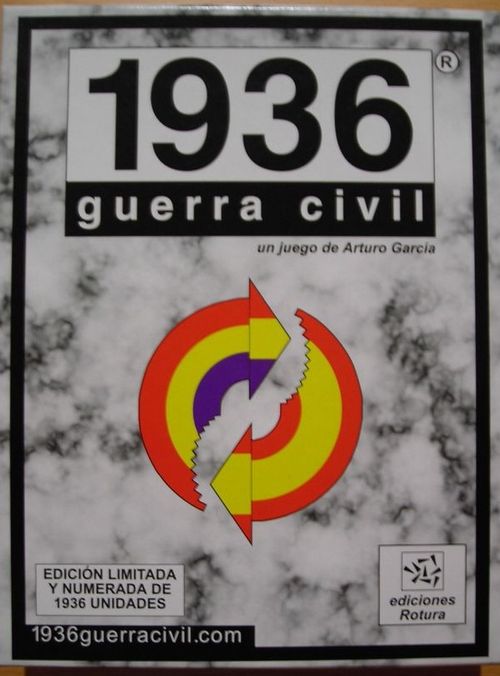
1936: Guerra Civil
1936: Guerra Civil Rulebook
Table of Contents
Table of Contents
Introduction to the Game
To play 1936 Guerra Civil you do not need dice, writing implements or special knowledge about the historical period in which the game is set.
The basic game is for two players, each player taking one of the two sides. Alternatively, at the end of this rulebook some variants are offered for playing with four players.
There are several roads that lead to victory: military conquest, diplomacy and the demoralisation of the enemy. The side that first fulfils one of the victory conditions is the winner of the game.
1936 Guerra Civil is played in alternating turns. On each turn, the side that has the initiative may carry out a series of actions, while the opposing side has more limited options.
Each turn has three phases: a first adjustments phase, a second main phase where the most important events take place and which is the core of the turn, and a third phase where it is checked whether any of the circumstances occur for the game to be considered finished with a winning side.
The most frequent actions during the game are playing cards and using cards already in play. Additionally, the markers that indicate the state of some of the game's concepts must also be adjusted on the boards. Some of the cards remain on the table when played, while others are played and immediately removed.
Before the game each player prepares the deck of cards with which they will play, based on a set of construction rules and on the choice of a strategy. Chance will determine in what order the previously selected cards will become available, but the strategy with which the deck has been designed allows planning and will be key in victory or in defeat.
Although 1936 Guerra Civil uses a very detailed setting of the Spanish Civil War, a balance has been sought between the two sides and between the different roads that lead to victory, with the object of allowing any outcome to be possible, always of course as a function of the skill of the players themselves.
Components
The components of the game are cards (252), boards (4) and markers (24).
The Cards
The background and the shape of the image of each card identify it:
- Red background: character, army and management cards of the side of the Republic
- Blue background: character, army and management cards of the Nationalist side
- Green background: military objective cards
- Yellow background: political objective cards
The Boards
The boards reflect the situation of the game. They are separate to make it easier to place them in the play area according to the space available.
- Board of the side of the Republic
- Board of the Nationalist side
- Political board
- Military board
The Markers
They are used to indicate the state of some of the game's concepts within the boards during the game, being placed on the appropriate value of the table corresponding to the associated concept.
The concepts associated with the boards, and whose state is reflected by means of the tables and the markers, are indicated in the rules and on the cards starting with a capital letter (Diplomacy, Resistance Points, Resistance Turns, Political Victory Points and Military Victory Points).
The Rulebook
In addition to the rulebook itself, some additional loose sheets are supplied with some of the key concepts of the game to make consulting them easier: leadership, iconography, the turn sequence and the combat sequence.
The Cards
Each card type carries a set of printed features. Some of them have an incidence on the game and some do not.
Character card. Features with an incidence on the game: leadership, faction, base cost, military bonus, military command, mobilisation cost, character type (land, sea, air), game text. Features with no incidence on the game: birth and death of the character, portrait of the character, name of the card, archive the image comes from, number of the card, historical text.
Management card. Features with an incidence on the game: faction, base cost, game text. Features with no incidence on the game: name of the card, image, archive the image comes from, number of the card, historical text.
Army card. Features with an incidence on the game: class of army, faction, army abilities, base cost, strength, defence capability, mobilisation cost, army type (land, sea, air), game text. Features with no incidence on the game: name of the card, image, archive the image comes from, number of the card, historical text.
Political objective card. Features with an incidence on the game: defending and attacking sides, activation conditions, Political Victory Points, Diplomacy, Military Victory Points, game text. Features with no incidence on the game: name of the card, image, archive the image comes from, number of the card, historical text.
Military objective card. Features with an incidence on the game: defending and attacking sides, activation conditions, Political Victory Points, Military Victory Points, Resistance Points, types of army and character that may be mobilised, Resistance Turns, game text. Features with no incidence on the game: image, name of the card, archive the image comes from, number of the card, historical text.
Not all cards have all the possible features. For example, only some character cards have military characteristics, and some army cards have no game text (their military characteristics already define their use in the game).
The cards that are played are the side cards: character cards, management cards and army cards. Political objective cards and military objective cards are not played; they are available on the table near the players, or else on one of the boards.
The game text, together with the rest of the features, determines how the card works in the game.
How Cards Are Played
When playing a card, the side that plays it reduces its Economy on its side board by the amount indicated by the effective cost of the card. The base cost of playing a card is indicated by a number of "gold coins". If the cost is zero it is represented by a "black coin". The effective cost may be different because of some circumstance of the game that makes playing some cards cheaper or more expensive.
Management cards are played, take effect and are immediately eliminated.
Character and army cards are played and remain in play indefinitely until some event of the game eliminates them. Only armies and characters with a military bonus may be mobilised to a military objective.
Some cards, in order to be played or to be used once already in play, have restrictions of use. One icon indicates that the indicated effect must compulsorily be carried out in order to make use of the card. Another icon indicates that the card may only be used if the condition indicated next to it is fulfilled. A card cannot be played if all of its conditions are not met or if all of its compulsory effects cannot take place. However, a card that indicates that when played it has several non-compulsory effects could be played without all of them taking place.
Possible Locations Where Cards Can Be
Reserve. Deck of cards from which cards are drawn. When a card is searched for in the reserve, it must be shown to the opponent.
Hand. Cards in hand (up to 6) available to be played. If some circumstance causes the hand size to be exceeded, the excess is immediately discarded.
When a side discards, it chooses which card or cards to get rid of unless explicitly indicated otherwise.
Rearguard. Area near the player where characters and armies are played and remain until they are eliminated or mobilised to a military objective. Management cards are also considered to pass momentarily through the rearguard when played.
Military objective. Area near a military objective card where characters and/or armies have been mobilised.
Limbo. Cards eliminated and discarded of each side. Either of the players may consult either of the limbos at any moment. The last card of the limbo is the most recently eliminated or discarded card. All cards in the limbo are eliminated cards, but elimination implies that a card passes from play to the limbo. If it passes from the hand to the limbo the term discard is used.
Terminology relating to the movement of side cards according to their origin (row) and their destination (column):
| From \ To | Reserve | Hand | Rearguard | Military objective | Limbo |
|---|---|---|---|---|---|
| Reserve | — | draw / search - add | put into play | — | — |
| Hand | — | — | play | — | discard |
| Rearguard | — | return | — | mobilise | eliminate |
| Military objective | — |
Military objective and political objective cards may be in any area near the players if they have not yet been activated or if they have already been resolved, or else on the corresponding board if they are active.
The Factions
Side of the Republic: Republicans; Socialists; Communists; Anarchists; Military of the Republic; Catalan nationalists; Basque nationalists; P.O.U.M. (Partido Obrero de Unificación Marxista); international aid to the side of the Republic — U.S.S.R.; international aid to the side of the Republic — International Brigades; side of the Republic — generic cards.
Nationalist side: National military; Falangists; Monarchists; Carlists; the Church; Spanish Protectorate of Morocco; international aid to the Nationalist side — Germany; international aid to the Nationalist side — Italy; Nationalist side — generic cards.
The side of the Republic is referenced by a flag of three equal stripes coloured red, yellow and purple. The Nationalist side is referenced by a flag of three stripes, the central one twice as tall as the other two, coloured red, yellow and red.
The factions of republicans, socialists, communists, anarchists, national military, falangists, monarchists and carlists are main factions and contain characters who may be named leaders of their respective sides.
The international aid factions each have in turn two subfactions, but all of them are considered as a single faction.
Some cards may belong to more than one faction simultaneously, a circumstance indicated by a composite icon. These cards are of both factions for all purposes, independently of their convenience.
The Boards
Each side has a board on which the situation of several game concepts whose value evolves during the game is reflected (Economy, Morale, Political Victory Points, Military Victory Points, which character is leader of the side), as well as various useful information (the factions that make up the side, the consequences of losing the leader and the victory conditions).
During the game two markers are used on each of the tables of Economy, Morale, Political Victory Points and Military Victory Points to reflect their value (one marker for the tens, another for the units). The starting values of each of them are indicated in red.
The maximum value of Economy, Morale, Political Victory Points and Military Victory Points is 39. Likewise, the minimum value of any of them is 0.
Concepts of the Side Boards
Economy. Payment mechanism with which each side plays cards or uses cards in play. Each turn it increases in the adjustments phase and it is cumulative. Its starting value is 0.
Morale. Indicator of the state of mind of a side. War produces a wear that means that by default there is a loss of Morale each turn. Morale at 0 implies defeat; the opponent's Morale at 0 means victory. Its starting value is 36.
Political Victory Points. Victory points accumulated by winning political objectives.
Military Victory Points. Victory points accumulated by winning military objectives.
The Political and Military Boards
Each board can manage up to two objectives of its type (political objectives on the political board, military objectives on the military board). If there are two active objectives of the same type, each of them must be defended by each of the two sides. When an objective is activated, it is placed on the side of the board that corresponds, depending on which side defends it and which side attacks it.
At the moment of the activation of the objective, the corresponding markers are placed in the positions indicated on the objective itself: Diplomacy in the case of political objectives, Resistance Points (units and tens) and Resistance Turns in the case of military objectives. During the game, the markers are moved to reflect the evolution of these concepts.
The maximum value of Diplomacy is the value indicated on the political objective card itself. The minimum (and starting) value of Diplomacy is 0 (marked in red). If it reaches its maximum value, it can no longer decrease.
The maximum (and starting) value of the Resistance Points is the one indicated on the military objective card itself. The minimum value of the Resistance Points is 0. If it falls to that value, it can no longer increase.
The maximum (and starting) value of the Resistance Turns is the one indicated on the military objective card itself. The minimum value of the Resistance Turns is 0. If it is reduced to that value, it can no longer increase.
Concepts of the Political Board
Diplomacy. Difficulty of a political objective. It indicates the space of the political board that must be reached in order to win the objective.
When the effect of a card refers to the gain of Diplomacy, the side that gains that Diplomacy may decide on which political objective it uses it if there is more than one active political objective.
If there is no active political objective where the Diplomacy could be moved and a side loses Diplomacy, the opposing side may use one point of that Diplomacy to activate a political objective without taking its activation conditions into account. Gaining Diplomacy, on the other hand, cannot be used to activate a political objective.
Concepts of the Military Board
Resistance Points. Strength of a military objective. The purpose of the attacking side is to reduce the Resistance Points to 0 in order to win the objective.
Through combat the Resistance Points of a military objective may increase or decrease, but never rise above its upper limit (indicated on the military objective) nor fall below its lower limit (0).
Resistance Turns. Time needed for the defending side to consolidate control over a military objective. The purpose of the defending side is that the Resistance Turns fall to 0 without the Resistance Points doing so. The Resistance Turns go down each turn only if the Resistance Points of the military objective are at least half of its maximum (rounding up).
About the Objectives
Activation of an objective. Intention to resolve the struggle over a given political or military objective.
An objective may be activated by either of the two sides (each one has different activation conditions). When it is activated, the objective is placed on the corresponding board.
An active objective is one that is placed on one of the boards. The others are objectives either resolved or not yet activated.
An objective that has already been resolved cannot be activated again.
Activation conditions. Conditions that one side or the other must fulfil in order to be able to activate the objective.
Political objectives are activated on the basis of the number of characters without a military bonus in the rearguard. The only way to skip the activation conditions for a political objective is for the opposing side to lose Diplomacy and for there to be no active political objective where the Diplomacy could be moved.
Military objectives are activated on the basis of the number of armies in play (attacking side) or in the limbo (defending side).
Political Victory Points. Victory points that the political objective provides to the side that achieves victory in it. They serve for political victory and for combined military / political victory.
Military Victory Points. Victory points that the military objective provides to the side that achieves victory in it. They serve for military victory and for combined military / political victory.
Preparation and Logistics
Deck Design
Each side builds its own deck in secret according to the following rules:
- Each deck may only contain cards of its own side.
- Each deck must be composed of at least 36 cards, with no upper limit.
- Each deck must contain cards of at least one of the main factions of its side.
Boards
The political and military boards are placed between the two players in such a way that each one has the flags of their side facing towards themselves.
Around the military board enough space must be left to be able to place cards next to it.
At the beginning of the game there are no active objectives.
Each player must place their side board visible to the opposing player.
Markers
Markers are placed on the starting spaces of the side boards, indicated in red (in total, sixteen markers).
The other markers may be placed on the military and political boards while waiting for some objective to be activated.
Beginning of the Game
Each player must shuffle their cards.
Each player must offer the cut to the opposing player.
Each player begins the game with a hand of 6 cards.
As the side that rose up, the Nationalist side always begins the game.
During the Game
Each side plays its cards in front of itself, in what is its rearguard. The armies and characters mobilised to military objectives must be placed next to them. It is important that there is a distance between the rearguard and the military board.
Each player has, or may have:
- Cards in hand (up to 6).
- Characters and armies played in front of them (rearguard).
- Mobilised characters and armies (next to the military board).
- Deck of cards to draw from (reserve).
- Deck of eliminated cards (limbo).
- Deck with the resolved political and military objectives.
Each player is free to place their limbo, their reserve, their side board and their won objectives as they find convenient.
The Turn Sequence
Each turn consists of three phases, and in each of them different actions are carried out. Each turn it is one side that has the initiative.
Some Preliminary Definitions
Active side and passive side. The active side is the one that has the turn and is the one that has the initiative. The opposing side is the passive side and its possible actions are more limited.
Influence of a character. Permanent or automatic effect when the character is played or from being in play. The effect may take place in any of the phases, one single time or every time that a given event occurs.
Adjustments Phase
In the adjustments phase the active side carries out a series of adjustments. The order is open, but one is indicated for convenience and to reduce the risk of some adjustment being forgotten. The passive side does nothing.
-
Economy. The active side increases its Economy. By default, the increase is 6. The maximum accumulable Economy is 39.
If one or more cards in play affect the Economy in the adjustments phase (normally characters through their influence), all the effects take place simultaneously.
-
Morale. The active side reduces its Morale by 1.
-
Resistance. The active side reduces by 1 the Resistance Turns of the military objective it defends, if the Resistance Points are at least half of their maximum (their starting value, rounding up).
-
Reinforcement. The active side draws 1 card. If on drawing the card the player exceeds the maximum of their hand, they must discard the excess (it does not have to be the card just drawn). The starting hand is 6 cards, and on the first turn of play no card is drawn.
| Adjustments |
|---|
| 1st Economy |
| 2nd Morale |
| 3rd Resistance |
| 4th Reinforcement |
Main Phase
In the main phase both sides have the capacity to carry out actions, although the active side is the one that has more options. There is no set order in which to carry out the different actions, but some of them can only be done once.
Play cards. The active side may play character cards, army cards and management cards. The passive side may only play management cards. Playing a card requires reducing the Economy by an amount equal to its cost. Some cards require certain conditions to be met in order to be played. When a card is played, its effects are carried out immediately. The side that plays it determines where these effects are carried out, unless the card explicitly mentions otherwise.
Note: on its first turn, a side cannot play international aid cards.
Use cards in play. Both sides may use their cards in play (characters and armies). There are several ways of using cards in play: naming a leader among the characters in play, using the previously named leader, the military actions of characters and armies, the abilities of armies and the intervention of characters.
-
Name leader (once per turn). The active side names a leader if it has in play some character with leadership and fulfils the naming requirements of its faction.
-
Use the leader. Having a leader allows the associated abilities to be used. Some leader abilities are common, others depend on each faction.
-
Military actions. The three military actions that military characters and armies may carry out are mobilisation, demobilisation and participation in combat (being declared as attacker or as defender). Each army and military character may only carry out one military action per turn. The active side may make use of the three military actions, but the passive side may only make use of participation in combat, and only if the active side has previously declared it.
Mobilisation is taking a character or an army from the rearguard to a military objective (if it is of a type that may be mobilised), and it has a cost, indicated on the card. Demobilisation is taking a character or an army from a military objective to the rearguard, and it has no cost. Only military characters (those with a military bonus) may be mobilised.
Some cards may force an extraordinary mobilisation or demobilisation. This does not count as the military action of the character or army for the turn.
Participation in combat. After combat has been declared, it takes place between the mobilised characters and armies. Combat takes place for all characters and armies simultaneously and has its own sequence.
-
Activate the abilities of the armies. The normal thing is to make use of these abilities in combat, but some may be activated outside it.
-
Intervention of characters. Specific effect of a character that is defined on the basis of the turns in which the character may intervene (on their own turn, on the opposing turn or on both turns) and by the cost that it has for its use. Each intervention may only be used once in each turn in which it may be used. Some characters may have more than one intervention, being able to use each one of them. As with playing a card, using the intervention of a character may be subject to restrictions of use.
Activate objectives. The active side may activate political objectives and/or military objectives if it fulfils the activation requirements indicated on each objective. An objective cannot be activated if there is already an active objective of the same type.
The passive side may only activate a political objective if the active side carries out an action that makes it lose Diplomacy and there is no active political objective where the Diplomacy could be moved.
Declare combat (only once). The active side may declare combat in order to fight for the military objectives, both defended and attacked.
Pass. When both sides pass consecutively, the main phase comes to an end.
Once a player declares that they play or use a card, the opposing player cannot prevent them from playing or using it: the card is played/used and its effect is carried out. However, there exists a right of reply, having the right to respond every time the opposing side does something: play a card, use the intervention of a character, name or use the leader, mobilise / demobilise a character or an army, activate an objective, declare combat. In the case of the passive side, the reply may be to play a management card or to use the intervention of a character. The active side is the one that has the initiative, so the passive side may only reply if the active side does something or passes, but it cannot get ahead of its play. The reply ends at the moment in which both sides pass.
| Main phase |
|---|
| Play cards |
| Use cards in play — Name leader |
| Use cards in play — Use the leader |
| Use cards in play — Military actions |
| Use cards in play — Abilities of armies |
| Use cards in play — Intervention of characters |
| Activate objectives |
| Declare combat |
| Pass |
Armistice Phase
In the armistice phase the objectives that are due are resolved and the victory conditions are analysed. There are actions that a side may only carry out in the case of winning some objective.
Resolution of objectives. The political and military objectives are resolved.
The political objectives to be resolved are those in which the Diplomacy has reached the value indicated on the objective card.
The military objectives to be resolved are those in which the Resistance Turns are 0 (the defending side wins) and those in which the Resistance Points are 0 (the attacking side wins, provided that it has some army with the Conquest ability mobilised in the military objective to be resolved).
If in the same turn a military objective is left at 0 Resistance Points and at 0 Resistance Turns, the winner of the military objective is the active side.
If a military objective is left at 0 Resistance Points but the attacking side does not have armies with Conquest mobilised in the military objective, it is not resolved and remains in this situation until in a later turn the attacking side has an army with Conquest mobilised in that military objective at the resolution of objectives.
On resolving each objective, the winner may — only if it has a leader — determine additional consequences as a function of the Victory Points that the objective gives (those Victory Points are still awarded).
The costs of the additional consequences of winning an objective are the following:
| Additional consequence | Cost |
|---|---|
| +1 Economy to your own side | 2 Military Victory Points |
| −1 Economy to the opposing side | 3 Military Victory Points |
| +1 Morale to your own side | 3 Military or Political Victory Points |
| −1 Morale to the opposing side | 2 Military or Political Victory Points |
| Draw 1 card, your own side | 4 Political Victory Points |
| Make the opposing side discard 1 card | 5 Political Victory Points |
Depending on the additional consequences decided, it may happen that not all the Victory Points granted by the objective won are taken advantage of.
Victory conditions. If after resolving all the political and military objectives the victory conditions are not fulfilled for either of the two sides, the game continues and a new turn begins. If the victory conditions are fulfilled for one of the two sides, that side obtains victory and the game ends. If the victory conditions are fulfilled for both sides at once, the active side obtains victory and the game ends.
- Military victory: 24 Military Victory Points.
- Political victory: 24 Political Victory Points.
- Mixed military / political victory: 22 Victory Points (minimum 5 Military and 5 Political).
- Victory by demoralisation: the Morale of the opposing side has been reduced to 0.
| Armistice phase |
|---|
| Resolution of objectives |
| Victory conditions |
Combat
Military Characteristics
Military bonus. Additional strength granted by a character to armies of the same type (land / sea / air) during combat.
Military command. Number of armies that a character with a military bonus may boost. The armies that receive a military bonus from a character are considered to be under the command of that military character.
Defence capability. Land / sea / air icons indicate the types of army that each army can defend.
Strength. Offensive and defensive military capacity of an army.
Abilities. Special capabilities of an army, which may have more than one.
Type. Characters and armies may be of land, of sea or of air. It is relevant when mobilising and when forming groups in combat.
The Combat
During the main phase, the active side may declare that there is combat. Once declared, the passive side has the right of reply. Once the reply is resolved (when both sides pass), combat proper begins. In each of the military objectives, both defended and attacked, the active side may decide whether to fight or not.
During the course of combat neither characters nor armies may be played.
Attacking side and defending side. The attacking side is the side that attacks a military objective; its mission is to reduce its Resistance Points to 0. The defending side is the side that defends a military objective and its mission is to reduce its Resistance Turns to 0. Each side may be the attacking side at one military objective and the defending side at another military objective in the same turn.
Attack and counterattack. The attacking side of a military objective carries out an attack to try to reduce its Resistance Points (conquering territory or positions). What the defending side of a military objective does is counterattack, to try to increase its Resistance Points (recovering territory or positions).
First strategy phase. Both sides may play management cards, use the intervention of characters, activate abilities of armies and pass. It ends when both sides pass.
Offensive declaration. The active side determines how it attacks and/or counterattacks at each of the military objectives. It could fight at one and do nothing at the other.
Once combat has been declared the active side has the option of not making its offensive declaration and renouncing the combat, which is then considered finished.
The active side organises its characters and armies into groups according to the following rules:
- Only characters and armies that have not previously spent their military action in the turn may attack/counterattack.
- Groups must be formed of characters and armies of the same type (land, sea, air).
- Each group must contain at least 1 army. Military characters that fight cannot go alone and must have some army under their command.
- Each army may only be under the command of 1 character, but it may not go in the same group if it has the Discipline ability.
- It is not compulsory for all mobilised characters and armies to participate.
In addition, the active side may decide whether or not to activate the ability of each of its armies that participates in the combat.
Second strategy phase. Both sides may use the intervention of characters, activate abilities of armies and pass. It ends when both sides pass.
Defensive declaration. The passive side determines how it defends at each of the military objectives where the active side has made its offensive declaration.
The passive side organises its characters and armies according to the following rules:
- Each army may only be under the command of 1 character.
- Each army is assigned to an attacking group as a function of its defence capability. A character must be assigned to the same attacking group as the army or armies under their command, unless one of them has Discipline. Armies may only defend armies of the types indicated on their card.
- Several armies and characters may be assigned to each attacking group.
- It is not compulsory for all mobilised characters and armies to participate.
The characters and armies that defend the same group are not considered a group, since there could be armies or characters that could not be grouped with each other (for example, air and land armies).
In addition, both sides may activate abilities of their armies.
Third strategy phase. Both sides may use the intervention of their characters, activate abilities of armies and pass. It ends when both sides pass.
Resolution of combat. The Resistance Points of the military objectives where there is combat are adjusted and the confrontation between armies and characters is resolved.
At the military objectives where the active side attacks, the groups that have not been defended reduce the Resistance Points of the military objective by an amount equal to their total strength. If the Resistance Points of a military objective are 0, at the end of the turn the military objective will be resolved unless by then the attacking side has no armies with Conquest left.
At the military objectives where the active side counterattacks, the groups that have not been defended increase the Resistance Points of the military objective by an amount equal to their total strength.
In the groups that have been defended, a confrontation takes place between the armies and characters of both sides. The confrontations have no incidence on the Resistance Points of the military objective.
Each confrontation is resolved on the basis of the following rules:
- Armies are eliminated in increasing order of strength until the total strength of the opposing side has been used up.
- An army is eliminated if it receives damage equal to or greater than its strength (which may have been altered by the bonuses it may be receiving from being under the command of characters or by the effect of management cards previously played in the turn).
- The side that receives the damage decides which of its armies is eliminated in the case of there being more than one possibility (more than one army with the same strength).
- A character is eliminated if all the armies under their command are.
| The combat |
|---|
| Strategy |
| Offensive declaration |
| Strategy |
| Defensive declaration |
| Strategy |
| Resolution of combat |
Example of Combat (setting the strategy phases aside)
-
The active side (attacker) makes its offensive declaration in three groups: Group 1 with total strength 3; Group 2 with total strength 3; Group 3 with total strength (2+1)+(2+1)=3+3=6. The passive side (defender) opposes Group 1 with a total strength of (2+1)=3 and Group 3 with a total strength of 2+(3+2)=2+5=7.
-
The passive side (defender) makes its defensive declaration.
-
Resolution of the confrontations:
Group 1: the attacking army and the defending army have total strength 3, so both are eliminated (cards 4 and 6) and, with the defending army, the character under whose command it is (card 9).
Group 2: the army (card 3) is not defended, so there is no confrontation and it reduces 3 Resistance Points of the military objective.
Group 3: the active side (attacker) has total strength 6, while the passive side (defender) has 7, so the two armies of the active side are eliminated (cards 1 and 2) and, with them, the character under whose command they are (card 5). From the side that has the greater total strength, armies are eliminated until the total strength of the opposing side is used up, 6. With 2 of strength the weakest army of the passive side is eliminated (card 7), of strength 2. A strength of 4 remains to be attributed, but since the remaining defending army (card 8), counting the military bonus of the character (card 10), has strength 5, it is not enough to eliminate it.
After the resolution of the combat, the military objective has lost 3 Resistance Points and cards 3, 8 and 10 remain mobilised at it. The rest have been eliminated.
The resolution of the confrontations may be simplified by following these shortcuts: a) if the total strength on both sides is equal, all are eliminated; b) if the total strength on both sides is different, everything on the side of lesser total strength is eliminated, and it will only be necessary to assign the total strength of the eliminated side onto the armies of the other side.
Abilities of the Armies
The abilities of the armies may be permanent or activatable during the turn.
Different armies may have a different activation cost but, once activated, the ability is the same.
Assimilation (Asimilación)
Permanent. It has no activation cost.
In addition to continuing to be of its own faction, the army is considered to be of the same faction as the leader when played or while it is in play. In the reserve, in the hand or in the limbo the army is only of the faction indicated on the card.
Ranged Attack (Ataque a distancia x)
Activatable in combat. Activation cost: −x Economy.
It allows an army to resolve its basic damage in combat first. In this way, armies of the opposing side may be eliminated without getting to inflict any damage. The additional strength due to management cards or to the military bonus of a character is not resolved first.
If there are several armies with this ability in the resolution of a combat, the damage of all of them is resolved first (only the basic damage). Once that is resolved and the eliminated armies removed, the rest of the damage is resolved.
If after this ability's damage is resolved no armies have been eliminated for all the damage assigned, the difference is kept for the resolution of the rest of the combat.
If after resolution all the armies that defend an attacking group are eliminated, that group does no damage to the military objective, since once defenders have been declared for a group, that group is already considered defended.
Conquest (Conquista)
Permanent. It has no activation cost.
Armies with this ability are necessary to definitively win an attacked military objective. If the Resistance Points of an attacked military objective are reduced to 0 but no mobilised armies with this ability are held, the objective is not finished being resolved, remaining at 0 Resistance Points.
It has no effect on defended military objectives.
Discipline (Disciplina x)
Activatable in combat. Activation cost: −x Economy.
It allows an army to benefit from the military bonus of a character without the need to group with them (although it is indeed under their command). The character must be able to give their military bonus to more than one army (military command greater than 1) and be grouped with at least one of them.
Enthusiasm (Entusiasmo x)
Activatable in the main phase, before combat. Activation cost: −x Economy.
An army with this ability may be mobilised to a military objective without it being considered a military action, so the army may subsequently fight in the same turn, or else be demobilised and subsequently mobilised to another military objective. In addition to the activation cost of the ability, in order to mobilise the army its normal mobilisation cost, indicated on the card, must still be paid.
Fury (Furor x)
Activatable in combat. Activation cost: −x Diplomacy.
The army has +x strength in combat in the turn.
Example of Resolution of Confrontations with Armies with Ranged Attack
-
The active side makes its offensive declaration in two groups: Group 1 with total strength 2+2=4, of which 2 at range; Group 2 with total strength (3+1)=4, of which 3 at range. The defender opposes Group 1 with total strength 2 and Group 2 with total strength (3+2)=5.
-
The passive side (defender) makes its defensive declaration.
-
Resolution of the confrontations:
Group 1: the active side (attacker) has 2 of Ranged Attack strength. That strength is enough to eliminate the army of the passive side (defender), so it is eliminated before getting to fight (card 5). No army of the active side is eliminated (cards 1 and 2). If no army had had Ranged Attack, only one army of the active side would have survived (the active side itself would have chosen which), and one army of the active side and another of the passive side would have been eliminated.
Group 2: the active side (attacker) has 3 of Ranged Attack strength. That strength is not enough to eliminate the army of the passive side (defender, card 6), so afterwards all the remaining strength is assigned. The army of the active side has total strength 4, while the defending army has total strength 5. The army of the attacking side (card 3), and with it the character under whose command it is (card 4), is eliminated. The army of the passive side (card 6) remains at the military objective. In this confrontation the Ranged Attack has been irrelevant.
After the resolution of the combat, cards 1, 2, 6 and 7 remain at the military objective; the rest have been eliminated.
Leadership
Each side may have one leader character. The characters that can be leader are indicated by the Leadership icon. The leader grants advantages to their side. When the leader stops being so (elimination, return or substitution), their side loses Morale. The leader has no special protection from being the leader. On being named, their card is placed on the side board and the character is considered to be in the rearguard.
To name a leader it is necessary to have in play a character with Leadership and an additional number of characters that varies according to the faction. Characters that have another, smaller icon over their faction icon are considered "sympathisers" of that faction and count as characters of it for the purposes of naming a leader (and only for these purposes).
Only by having a leader can the additional consequences of winning an objective be taken advantage of.
The abilities of the leader are not considered a normal intervention, so cards that refer to the intervention of characters do not affect the leader.
If a leader is held and the conditions necessary for the naming cease to be met, the character continues to be leader, but to name another one the conditions would have to be met again.
Side of the Republic
The leader is the president of the government and may be voluntarily replaced each turn by another character (who must also fulfil the naming requirements).
General ability: on your own turn, 1 Economy — your side discards 1 card and draws another.
Republicans (President of the government, renewable each turn).
- Requirement: 3 Republican characters in play.
- Ability: on your own turn, 2 Economy — +1 Diplomacy for your side.
- Continuous ability: −1 Economy to the cost of playing Republican cards.
Socialists (President of the government, renewable each turn).
- Requirement: 3 Socialist characters in play.
- Ability: on your own turn, 0 Economy — 1 Nationalist character cannot intervene for the rest of the turn.
- Continuous ability: −1 Economy to the cost of playing Socialist cards.
Communists (President of the government, renewable each turn).
- Requirement: 3 Communist characters in play.
- Ability: on your own turn, 2 Economy — +3 Resistance Points at a military objective defended by the side of the Republic.
- Continuous ability: −1 Economy to the cost of playing Communist cards.
Anarchists (President of the government, renewable each turn).
- Requirement: 3 Anarchist characters in play.
- Ability: on your own turn, 3 Economy — 1 army is demobilised.
- Continuous ability: −1 Economy to the cost of playing Anarchist cards.
Nationalist Side
The leader is permanent (once named they cannot be voluntarily replaced). Depending on the faction, they receive a different name.
General ability: on your own turn, 1 Economy — your side discards 1 card and draws another.
National military (Generalísimo, permanent).
- Requirement: 3 National military characters in play.
- Ability: on your own turn, 2 Economy — 1 Nationalist army has an extra military action this turn.
- Continuous ability: −1 Economy to the cost of playing National military cards.
Falangists (Jefe, permanent).
- Requirement: 3 Falangist characters in play.
- Ability: on your own turn, 2 Economy — +3 Resistance Points at a military objective defended by the Nationalist side.
- Continuous ability: −1 Economy to the cost of playing Falangist cards.
Monarchists (King, permanent).
- Requirement: 3 Monarchist characters in play.
- Ability: on your own turn, 2 Economy — +1 Diplomacy for the Nationalist side.
- Continuous ability: −1 Economy to the cost of playing Monarchist cards.
Carlists (King, permanent).
- Requirement: 3 Carlist characters in play.
- Ability: on your own turn, 0 Economy — 1 character of the side of the Republic cannot intervene for the rest of the turn.
- Continuous ability: −1 Economy to the cost of playing Carlist cards.
Note 1: Each Nationalist turn, the National military leader may use their military bonus from the rearguard as if they were mobilised at any objective and participate in combat. The Nationalist leader is not eliminated in combat even if all the armies under their command were.
Note 2: Making use of the cheapening of the cards of the leader's faction is not considered as using the leader, so it may be made use of as many times as desired, on your own turn and on the opposing turn, as if it were an influence.
Variants
1936 Guerra Civil allows for multiple variants. Each one of them may imply a different approach when building the deck or when playing the cards. The important thing is that the players agree beforehand on how to play.
Variant: Cohesion
Cohesion is a measure of the internal union between the factions within a side.
When the first card of a faction is played, its space on the side board is marked.
| When playing the first card of the... | Effect |
|---|---|
| first faction | −0 Morale |
| second faction | −1 Morale |
| third faction | −2 Morale |
| fourth faction | −3 Morale |
| fifth faction | −4 Morale |
| sixth faction | −5 Morale |
| seventh faction | −6 Morale |
| eighth faction | −7 Morale |
Cards that belong to more than one faction only count, at the time of being played, as of one of them (at the choice of the player who plays it), this being the only moment in which they are not "double". The sympathiser icon present on some characters still has relevance only for the naming of a leader.
The fact that previously played cards may be eliminated does not mean that the Morale lost earlier is recovered.
Variant: Four Players, Two Independent Players on Each Side
Each player prepares their deck in the usual way, except that main factions (those with characters with leadership) cannot be shared. Each player has their own reserve, their own limbo and their own hand.
Turns are alternating (first player of the Nationalist side, first player of the side of the Republic, second player of the Nationalist side, second player of the side of the Republic, etc.).
Each player carries out their complete turn as in the one-against-one game. The Economy not used by one player may be used by their partner.
If there is no leader, each player may only use their own characters and their own armies to attack. In defence, the two players may decide which of the two defends (with their armies and their characters). If there is a leader, the player who played them may also use the characters and armies of their partner to attack and defend.
In this variant the leader is of great importance, so it may be interesting to make obtaining them easier (simplifying the naming conditions, determining that the opposing side cannot eliminate them with management cards, etc.).
Variant: Four Players, Combined Pair
Each pair of players jointly prepares the two decks with which they are going to play. Each player has their own reserve and their own hand, but the limbo is shared.
Turns are alternating (first the Nationalist side, then the side of the Republic, etc.). On each turn the two players of a side may play their cards, show each other their respective hands and coordinate the combat, jointly using the armies and characters of both.
Ideas for Playing by Modifying Some Basic Rules
With the variants described here, the intention is to show the possibilities the game offers to be able to enjoy it in another way, seeking new challenges. Other parameters subject to generating variants:
- Requiring a different number of Victory Points.
- Beginning with another value in the Morale (lower or higher).
- Drawing more cards in the adjustments phase (reinforcement).
- Obtaining more Economy each turn (or less).
- Beginning directly with one or more active objectives.
- Activating the objectives at random.
- Beginning directly with a leader or considering that one is held (without designating a particular character).
- Playing without leaders.
Examples of Pre-designed Decks
To start playing 1936 Guerra Civil when the criteria for building decks are not yet clear, some examples of possible decks are suggested. The decks are not optimised, since for example cards that have a more complex game mechanism have been avoided. The player is invited, once familiar with the mechanics of the game and the cards, to look for their weak points and to make whatever modifications they consider appropriate to improve the composition of each of these decks, or of course to build new ones.
Each card is referenced by its card number.
Side of the Republic: very military deck 004, 008, 015, 016, 019, 026, 037, 045, 049, 058, 061, 076, 080, 087, 096, 098, 100, 102, 113, 116, 117, 119, 121, 122, 130, 139, 153, 157, 177, 178, 192, 200, 208, 231, 247, 251
Nationalist side: very military deck 023, 028, 038, 039, 042, 044, 050, 053, 062, 063, 073, 085, 086, 090, 101, 107, 120, 140, 146, 158, 162, 171, 174, 181, 191, 194, 196, 213, 216, 217, 221, 224, 228, 238, 240, 252
Side of the Republic: very political deck 007, 010, 016, 018, 024, 036, 040, 043, 056, 069, 072, 075, 083, 094, 096, 098, 112, 116, 121, 125, 127, 134, 141, 142, 145, 147, 160, 170, 187, 189, 202, 211, 220, 229, 239, 244
Nationalist side: very political deck 005, 009, 014, 031, 034, 035, 047, 054, 055, 059, 060, 063, 065, 066, 067, 077, 088, 097, 107, 110, 120, 155, 162, 167, 175, 181, 184, 198, 199, 226, 227, 230, 232, 235, 241, 249
Side of the Republic: mixed military and political deck 003, 004, 013, 016, 033, 048, 049, 056, 057, 071, 083, 087, 096, 098, 106, 112, 113, 116, 117, 127, 141, 147, 156, 159, 170, 176, 177, 178, 187, 197, 223, 225, 229, 233, 239, 251
Nationalist side: mixed military and political deck 009, 017, 023, 028, 034, 039, 042, 046, 051, 059, 060, 063, 067, 073, 077, 085, 088, 097, 107, 109, 120, 131, 133, 162, 167, 181, 191, 199, 203, 215, 226, 228, 230, 232, 240, 243
Side of the Republic: very defensive deck 003, 007, 010, 015, 016, 027, 033, 071, 083, 087, 095, 100, 103, 108, 113, 116, 117, 134, 136, 144, 157, 165, 168, 187, 190, 205, 218, 222, 223, 225, 229, 233, 244, 248, 250, 251
Nationalist side: very defensive deck 002, 009, 020, 023, 042, 044, 045, 060, 068, 070, 074, 085, 092, 115, 120, 128, 131, 138, 152, 166, 169, 174, 179, 181, 184, 186, 203, 204, 213, 224, 226, 227, 230, 240, 246, 249
In the very military decks some political cards have been included to seek to slow down the political development of the adversary. In the same way, in the very political decks some cards have been included seeking defence against the military. In general, a combination of the military and political aspects will always be necessary. In addition, a game where both sides develop both facets of the game is more interesting, because there is more interaction.
Reference Sheets
The following tables come from the official reference sheets supplied with the game alongside the rulebook.
Turn Sequence
| Phase | Order | Actions | Comments / restrictions | Side |
|---|---|---|---|---|
| Adjustments | 1 | Economy | +6 Economy by default | active |
| Adjustments | 2 | Morale | −1 Morale | active |
| Adjustments | 3 | Resistance | −1 Resistance Turns at the defended military objective if its Resistance Points are at least half of its maximum | active |
| Adjustments | 4 | Reinforcement | +1 card | active |
| Main | — | Use cards in play | Name leader (only 1 time) |
Combat Sequence
| Step | Content |
|---|---|
| Strategy | Management cards / intervention of characters / abilities of armies / pass |
| Offensive declaration (active side) | Groups: characters and armies of the same type (land / sea / air) and at least 1 army. Each army may only be under the command of 1 character. Activation of abilities of armies. |
| Strategy | Intervention of characters / abilities of armies / pass |
| Defensive declaration (passive side) | Each army may only be under the command of 1 character. Each army may only defend according to its defence capability. Each army is assigned to an attacking group. Activation of abilities of armies. |
| Strategy | Intervention of characters / abilities of armies / pass |
| Resolution of combat | Undefended groups: −Resistance Points at the military objective if it is an attack; +Resistance Points at the military objective if it is a counterattack. Defended groups (confrontation): elimination of armies in increasing order of strength (the owning side chooses); a character is eliminated if all the armies under their command are eliminated. |
In the armistice phase
- If the Resistance Points of a military objective are 0: the attacking side (if it has 1 army with Conquest) wins the military objective; the surviving armies and characters of both sides are demobilised; attribution of Military Victory Points, and the winner of the military objective determines the consequences.
- If the Resistance Turns of a military objective are 0: the defending side wins the military objective; the surviving armies and characters of both sides are demobilised; attribution of Military Victory Points, and the winner of the military objective determines the consequences.
Iconography
Factions of the side of the Republic: Republicans; Socialists; Communists; Anarchists; Military of the Republic; Catalan nationalists; Basque nationalists; P.O.U.M.; side of the Republic — generic cards; international aid to the side of the Republic; U.S.S.R.; International Brigades.
Factions of the Nationalist side: National military; Falangists; Monarchists; Carlists; the Church; Spanish Protectorate of Morocco; Nationalist side — generic cards; international aid to the Nationalist side; Germany; Italy.
Side and objective icons: side of the Republic; objective defended by the side of the Republic; objective attacked by the side of the Republic; turn of the side of the Republic; Nationalist side; objective defended by the Nationalist side; objective attacked by the Nationalist side; turn of the Nationalist side.
Other icons:
| Icon | Meaning |
|---|---|
| Green star | Military Victory Points |
| Half-green, half-yellow star | Military or Political Victory Points |
| Yellow star | Political Victory Points |
| Brown triangle | Land |
| Blue triangle | Sea |
| White triangle | Air |
| Three coloured squares | Defence capability (land / sea / air) |
| Gold coin | Cost |
| Black coin | Cost zero |
| Question mark | Its value depends on a circumstance |
| Down arrow | Reduction |
| Up arrow |