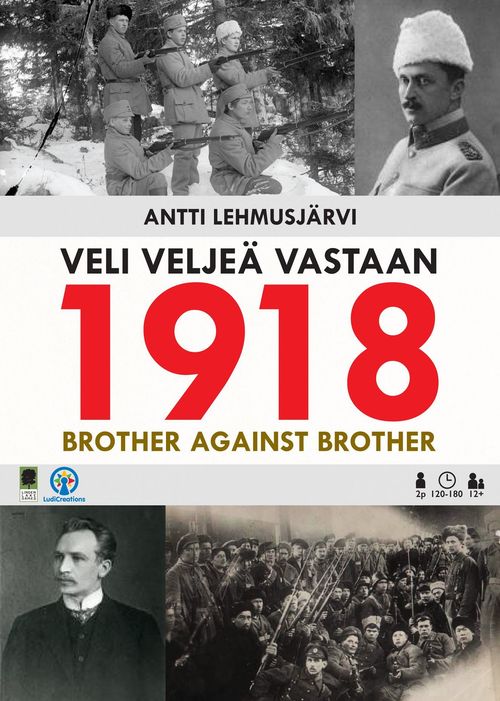
1918: Brother Against Brother
1918: Brother Against Brother Rulebook
Table of Contents
Table of Contents
1. Game Overview
The game consists of five rounds. Each round represents one month from January to May 1918.
See the included Setup and Reinforcement sheet for the initial composition and placement of the units.
During each round, each player takes eight turns – except in January, when they only take three turns each. The White Player begins each round by playing a card and taking their first turn. The players then take turns until the Red Player has played their last card. After that, check the supply of all units (See section 4.4. Supply).
There is a Round Indicator at the upper edge of the game board. When a round ends, move the token to the following month.
When a new round begins, both players add that round's new cards to their deck (See section 4.1. Playing Cards).
Starting from February, both players also receive reinforcements at the beginning of each round, before taking their first turns (See section 4.5. Reinforcements).
TURN STRUCTURE
Each turn consists of:
- Playing a card as an Event or Action Points.
- The actions caused by the card.
If a card is played as Action Points, the turn proceeds in this order:
- Activation of units.
- Movement of units in a desired order.
- Battles in the order selected by the attacker.
If a card is played as an Event, the event described on it takes place and nothing else happens during that turn.
2. Components
The 1918 – Brother Against Brother box includes:
- Mounted game board
- 206 counters
- 68 Civil Guards
- 86 Red Guards
- 10 German Units
- 10 Jaeger Units
- 4 Armoured Trains
- 3 Field Fortifications
- 14 Control Tokens
- 10 Activation Tokens
- 1 Round Indicator
- 55 cards in English and 55 cards in Finnish
- Rules in English and in Finnish
- Setup and Reinforcement sheet
- Two 6-sided dice
2.1. Game Board
The game board is the map of Finland with 1918 borders. The board also includes a table of the game rounds (a Round Indicator), main tables of the game and a legend.
Towns are marked on the map, with roads and railways connecting them. Roads are black and railways are brown. Five towns are 8-sided (Helsinki, Viipuri, Tampere, Vaasa and Oulu); these are Strategic Towns. Ordinary towns are marked with a rectangle. (All locations are called towns in this game even though some of them were cities in 1918.) If these rules refer to "towns", this means both ordinary and Strategic ones.
The dotted red line on the game board represents the initial front line at the beginning of the game. All towns north of this line belong to the White Player, except for Oulu, Varkaus and Kuopio. All towns south of the line belong to the Red Player, except for Loviisa, Porvoo and Uusikaupunki.
When a player conquers a town from the other player, mark the ownership of the town with a Control Token if needed. (A player may conquer a town without placing any units there, for example when the town's supply route has been cut off. See section 4.4. Supply)
The board also includes a box that represents Russia. This only affects certain cards when they are played as Events.
Some town names are marked with an anchor. The White Player's German units may land in these towns.
The initial placement of the units is marked with squares (half-squares represent partially manned units).
Icon Key
- Strategic town
- Ordinary town
- German landing site
- Road (2 movement points)
- Railroad (1 movement point)
- Initial front line
- Initial placement of units
2.2. Cards
This game is card driven. Each player has their own set of cards. The backs of the Red Player's cards are red and marked with the words "Red Guard". The White Player's cards are white with the words "Civil Guard".
Each card has six types of information:
- The coloured bar at the top of the card indicates the month when the card enters the game.
- The number of Action Points that the player may use to activate units.
- An individual card name that may be followed by an asterisk (*).
- An Event whose consequences are described on the card.
- Historical text of the Event.
- Card identification number.
2.3. Units
Each unit has:
- A name at the top. The name describes the type of the unit.
- A Battle Value in the lower left corner. This is the unit's strength in battle.
- Movement Points in the lower right corner. These indicate how far the unit may move during a single turn.
The White Player's units are: Civil Guards, Jaeger units, German units.
Civil Guards (Suojeluskunta, shortened S.K)
The Red Player's units are: Red Guards, Armoured trains.
Red Guards (Punakaarti, shortened P.K)
Every unit may be either fully or partially manned. A fully manned unit is placed face up on the board. A partially manned unit is placed face down. Partially manned units have upper part of the unit white to indicate their status. Partially manned units have lower Movement Points and Battle Value than the corresponding fully manned units.
Fully manned / Partially manned
A unit may enter the game partially manned, or become only partially manned if it is damaged in a battle or its supply line is cut off.
Partially manned units may become fully manned only if the Event card allows it.
There may not be more than three units in a single town. The maximum number of armoured trains in a single town is two. These numbers may not be surpassed at the end of the movement phase or when the units move after a battle. This limit on numbers stays in force when reinforcements are placed into towns at the beginning of each month. It also applies when a player plays an Event card that brings reinforcements into towns. Units may travel through a town in the movement phase even if it already has a maximum number of units.
Note! Field Fortifications are not taken into account when determining the stacking limits.
Field Fortifications - used by both players (See section 4.3 Battles). See the included Location of Units at the Beginning of the Game Table for the initial placement of these units.
The special characteristics of units
All game rules fully apply to Civil Guards and Red Guards. Other units have special rules.
Armoured trains
- An armoured train may only move and attack via a railway.
- Maximum number of armoured trains in one town is two.
- An armoured train is always in supply.
Jaegers
- If a Jaeger unit participates in an attack, the attacking player does not subtract 2 from the attack roll even if some of the units attack by road. The Jaeger unit itself does not need to attack by road.
German units
- If German units participate in an attack, the player does not subtract 2 from the attack roll even if some of the units move by road. The German unit itself does not need to attack by road.
- Any Red units that fight against German units get –2 to their attack and defence rolls.
- Any Red units that attack against German units receive a 1 column shift left in attack table.
- German units may move after a battle even if they are only partially manned.
- German units are always in supply.
2.4. Control and Activation Tokens
The game includes Control Tokens that are white on one side and red on the other. These may be used to indicate ownership of towns that do not have any units.
Example: The Red Player has conquered Vilppula. On their next turn, they move all units from Vilppula to Pieksämäki. Vilppula is left empty but the Red Player puts a Control Token there with the red side up, to remind both players who controls the town.
Activation tokens may be used to indicate the towns where units are activated.
3. Setup
At the beginning of the game, each player forms a Draw Deck from their respective January cards. These are shuffled and placed face down next to the game board (initial Draw Deck has only three cards). During the game, both players form their personal Reshuffle Deck from cards that have been played, but not removed from the game.
Each player places their initial units and field fortifications on map in accordance with the setup table.
The turn marker is placed on first box (January).
4. Gameplay
4.1. Playing Cards
At the beginning of each round, both players draw eight (8) cards from their Draw Deck. These form the player's hand for this round. The players do not show their hands to each other.
Exceptions:
- In January, both players only take three (3) cards in their hand, as the 1918 battles only began in late January.
- In February, the Red Player always takes the card "Armoured trains arrive" and only draws seven other cards from the Draw Deck. If this card is not played as an Event in February, the player returns it to the Reshuffle Deck, and it will periodically return to the game.
- In April, the White Player always takes the card "German units land in Finland" and only draws seven other cards from the Draw Deck. If this card is not played as an Event in April, the player returns it to the Reshuffle Deck, and it will periodically return to the game.
The players take turns to play one card at a time. Each card has different consequences depending on whether it is played as an Event or as Action Points. One turn always consists of two things: a card is played and its effects (e.g. movement or an event) take place.
If a card is played as an Event, the event described on it takes place. If the card name is followed by an asterisk (*), remove it from the game after the Event. Cards marked with an asterisk describe unique events of the Civil War and may be played only once. If the card name is not followed by an asterisk, the card goes into the Reshuffle Deck. In this case, this event could be repeated during the war. Event instructions take precedence over rules if they conflict (e.g. Event may allow repairing of armoured trains that is usually prohibited).
*Example: On their turn, the White Player plays the card "Swedish volunteers" as an Event. They place two fully manned Civil Guard units on the board. Finally, they remove the card from the game (the card name is followed by an asterisk ). It is now the Red Player's turn and they play the card "Tokoi's grain train" as three Action Points. They activate units in Tampere (2 units), Toijala (1 unit) and Helsinki (3 units).
Players place some of the cards on the table in front of them and may use them later in the game, at the time described in the card (for example, "The Red Guard refuses to attack".)
If a card is played as Action Points, the number of points on the card equals the number of towns where the player may activate units. The activation of all units in a single town costs one Action Point, regardless of how many units there are. Units must be activated before they can move and attack. If activated unit may both move and after that attack on same turn.
Example: The Red Player plays the card "Trained machine gunner" as two Action Points. The player activates an armoured train and two Red Guards in Riihimäki, and two Red Guards in Toijala. The armoured train moves from Riihimäki to Vilppula, where two Red Guards are already stationed. One of the Red Guards in Riihimäki moves to Toijala, the other stays in Riihimäki. There are now three Red Guards in Toijala. They can all attack the Civil Guard stationed in Humppila.
If a card has been played as Action Points, it goes into the Reshuffle Deck even if its name is followed by an asterisk (*). The event described on the card does not take place when the card is played as Action Points.
When a new round (i.e. month) begins, both players add that month's cards to their respective Reshuffle Decks. After this, each player shuffles together their Reshuffle Deck and the cards left unused in their Draw Deck from the previous round. Together these form their new Draw Decks. Cards marked with an asterisk (*) that were played as Events never return to the game once they have been removed. To summarise, all cards that a player has left are shuffled together at the beginning of each month.
4.2. Movement
Each unit has 2–5 Movement Points. These are indicated by a number in the lower right corner of the unit.
A unit must be activated before it can move.
Activated units move one by one in an order selected by the player. One unit must complete its movement before another may start moving.
Units move between towns by taking a road or a railway.
- Moving along a road section costs two Movement Points.
- Moving along a railway section costs one Movement Point.
Units always start their movement in a town and finish their movement in another town.
If a player moves a unit through a town that is controlled by the other player but has no enemy units, the first player conquers that town.
Armoured trains only move on railways.
Example: A fully manned Jaeger unit (4 Movement Points) may make the following movements: A. Take the road from Jämsä to Jyväskylä (2 Movement Points) B. Take the train from Jyväskylä to Pieksämäki (1 Movement Point) C. Continue with the train from Pieksämäki to Mikkeli (1 Movement Point).
Example: A partially manned Red Guard (2 Movement Points) may take the train from Kokemäki to Pori (1 Movement Point) but cannot continue further to Ahlainen (movement by road would take 2 Movement Points).
Movement Points cannot be transferred from one turn to another.
A unit may not move into a town if an enemy unit is stationed there. (To get to this town, the first unit must fight. This takes place in the attack phase after the movement phase.)
Furthermore, a unit may not stop in a town if this would surpass the maximum number of units in that town (three units or two armoured trains)
Example: If there are three units in Toijala and two in Hämeenlinna, an activated unit may leave Tampere, move through Toijala and stop in Hämeenlinna.
The player may choose the movement order of activated units. This enables the player to move units to make room for other ones.
Example: If the player in the previous example had activated the units in both Tampere and Toijala, they could have first moved them from Toijala to Hämeenlinna (or further, if the units would have had sufficient Movement Points), and then move the units from Tampere to Toijala.
The players cannot move their units to Russia.
4.3. Battles
The aim of battles is to conquer towns from the opponent and to harm the opponent's units. When the movement phase is over, activated units may attack enemy units that are next to them. They can attack via roads or railways. However, armoured trains can only attack via railways.
SEQUENCE OF BATTLE:
- The attacker selects units and the town they will attack.
- The players calculate their Attack and Defence Values.
- The players check the battle tables on the game board to see what column they use (taking account of any effects caused by field fortifications and cards).
- Both players roll the die and apply die roll modifiers. Find the number of damage points inflicted from the battle tables based on the modified roll.
- Both players remove the number of units that correspond to the damage points they suffered. The defending player removes their units first.
- If the attacker caused at least one damage point more than the defender, the latter must withdraw.
- In Strategic Towns and towns with field fortifications, the defender retreats only if attacker inflicts at least two damage points more than the defender.
- If the defending player withdraws from a town or their units were destroyed, the attacker may move their fully manned units into the town.
A battle is fought until it is completed. The player whose turn it is may then announce a new battle if they still have activated units left. A single unit may only attack once per turn. Additionally, a single town may only be attacked once in a turn.
Units stationed in different towns can attack the same target.
Example: Units in Tampere and Hämeenlinna can join forces in an attack against enemy units in Toijala.
When a town is under attack, all units placed there will defend it against the attacker.
Units stationed in the same town may attack in different directions.
Example: At the beginning of the battle phase, there is an armoured train and two Red Guards in Pori. The armoured train and one Red Guard may attack Kokemäki, while the other Red Guard may attack Ahlainen. The armoured train cannot attack Ahlainen, as there is no railway.
The Battle Values of all attacking units are added together to form their combined Attack Value.
Example: Toijala is attacked by an armoured train and two fully manned Red Guards from Tampere and two partially manned Red Guards from Hämeenlinna. Their combined Attack Value is 5+2+2+1+1=11.
The Defence Value is calculated by adding together the Battle Values of all units that defend the town.
Example: Toijala is attacked as described in the previous example. It is defended by one fully manned and one partially manned Civil Guard. Their combined Defence Value is 2+1=3.
When a battle begins, the players calculate their Attack and Defence Values. Then both players roll the die to see how much damage they cause to each other. The attacker reads the Attack Table, the defender the Defence Table. As it is usually easier to defend than to attack, it is easier for the defender to cause damage to the attacker than the other way around. If the modified Attack or Defence Value is less than 1 or greater than the maximum value of the table, use the weakest or strongest column of the table. In other words, it is impossible to "fall" outside the table.
During a battle, the die roll is cross-referenced with the units' Attack or Defence Value on the Attack or Defence Table.
Example: The attacker's Attack Value is 7, and they roll 6. As a result, they inflict 3 damage points on the defender. The defender's Defence Value is 4, and they roll 2. They cause 2 damage points to the attacker.
For each damage point, the player must turn one fully manned unit face down to make it partially manned, or remove one partially manned unit from the game board. A fully manned unit may be first turned to partially manned and then eliminated for total of two points.
If the resulting damage point number is followed by an asterisk (*), the suffering player must allocate at least one damage point to a Jaeger or German unit or an armoured train, if such units participated in the battle. If not, the player may decide which units will suffer the damage points.
The defender is the first to pick the units that suffer damage points, then the attacker.
Example: An armoured train and two fully manned Red Guards attack from Tampere to Karkku. Karkku is defended by one fully manned Jaeger unit and two fully manned Civil Guards. The Red Player's Attack Value is 9, while the White Player's Defence Value is 8. Red rolls 6, White 3. As a result, the Red Player inflicts 4 damage points to enemy, and the White Player 3. The White Player turns their Jaeger unit face down to make it partially manned (this is obligatory, as the attacker's Battle Value had an asterisk ) [1 damage point]. They make one Civil Guard partially manned [1 damage point] and then remove it from the game [1 damage point]. Finally, the White Player makes their other Civil Guard partially manned [1 damage point, 4 damage points in total]. The White Player now has one Jaeger unit and one Civil Guard left, both partially manned. Then it is the Red Player's turn and they make one Red Guard partially manned [1 damage point], remove it from the board [1 damage point] and make another Red Guard partially manned [1 damage point, 3 damage points in total].
Die roll modifiers
Roads
If any of the attacker's units attack via roads, the attacker subtracts –2 from their die roll. This reflects the difficulty of coordinating attacks via underdeveloped road networks. In 1918, railways were clearly the most important way of moving units. However, this reduction does not apply if one of the attacking units is a Jaeger or German unit. These do not need to make a road attack; they only need to participate in the same attack. The military direction and headquarters of the Jaeger and German units improved their coordination, compensating for the disadvantages of the poor road network.
Cards
Many cards modify the attacker's or the defender's die rolls, or cause column shifts in the Attack and Defence Tables.
All modifications are added up. Regardless of all modifications, the die roll is always at least 1 and not higher than 6.
German units
Any Red units that fight against German units get –2 to their attack and defence rolls.
Example: The Red Player plays the card "Russian artillery troops help the Red Guard" as an Event. Following the card's instructions, the Red Player activates two fully manned Red Guards in Joutseno and a fully manned armoured train and two Red Guards in Viipuri. These attack Antrea which is defended by two fully manned Civil Guards. The Attack Value is 13, the Defence Value 4. As two units attack via road, the Red Player subtracts –2 from the battle roll. Meanwhile, the card gives the Red Player +2 to the die roll. At this point, the White Player announces their intention to use a card they played earlier and put face up on the table to wait for a suitable Red attack: "Eero Haapalainen's drinking disturbs the Red military direction". This card forces the Red Player to subtract –3 from the die roll. The Red Player rolls 5, which is reduced to 2. The White Player also rolls 2. Both inflict 2 damage points on each other, and the Red Player is unable to advance.
Advancing after a battle
If the attacker causes at least one damage point more than it suffers, the defender must withdraw. However, if the defender is in a Strategic Town or in a town that has field fortifications, the attacker must win by at least two damage points. The defender withdraws to any adjacent town in their control. If multiple units are retreating they may retreat to different towns. If town with retreated units is attacked later on the same turn, the units that withdrew there will defend it normally. Units may not withdraw to towns controlled by the enemy even if the towns are empty.
Example: The Red Player has used two Action Points to activate the units in Kristiina and Vilppula. The units from Kristiina attack Seinäjoki, forcing the White Player's units to withdraw. They move to Haapamäki and join forces with the White units already positioned there to defend Haapamäki against the Red units that attack from Vilppula.
If there is no withdrawal route, the defender does not withdraw. Instead, the units in question surrender and leave the game. This also happens to any units that have no room to withdraw because the surrounding towns are full.
After the defender has withdrawn from the conquered town, the attacker may advance there with 1–3 units that participated in the battle, if these units are still fully manned.
Exception:
- German units may advance into conquered towns even if they are only partially manned.
The attacker may also advance into a town if it destroyed all units who defended it, regardless of the difference between the players' damage points, as long as one of the attacking units remained fully manned. If the attacker cannot or will not enter a town whose defenders have been destroyed or forced to withdraw, the town remains empty and stays in the defender's control. If necessary, the defender puts a Control Token in the town as a sign of their ownership.
The defender never advances after a battle.
Example: There is an armoured train and two fully manned Red Guards in Haapamäki. They attack Seinäjoki, which is defended by two fully manned and one partially manned Civil Guard. The Red Player rolls 3 and causes 3 damage points. The White Player rolls 1 and causes 1 damage point. The White Player removes one fully manned Civil Guard from Seinäjoki and makes the other partially manned. In the end, the player has two partially manned units. The Red Player turns one Red Guard face down to make it partially manned. The White Player can now withdraw both units to the same town, Vaasa, Kauhava or Kristiina, or withdraw the units to different towns. The Red Player may use the armoured train and the fully manned Red Guard to advance to Seinäjoki. The partially manned Red Guard cannot advance.
Field Fortifications
Field fortifications did not play a very significant role in the Civil War. Critical sections of the front line were nonetheless fortified to some extent, and mostly the Red side used fortifications built in Finland by the Russian army.
When the game begins, there are field fortifications in Vilppula (where it was critically important for the White side to defend the railway) and in Helsinki (where the Russian army had constructed fortifications). The Event cards may bring more field fortifications into the game. If a town has field fortifications, the corresponding Token is placed there.
A field fortification helps the player defend the town. If the town under attack has field fortifications, the attacker gets a column shift left. The defender gets a column shift to right.
Example: A field fortification has been built in Tampere. The attacking units' total Attack Value is 13, but the field fortification forces the player to use the column 11–12. The defender's Defence Value is 7, but they shift up to column 9–11.
Field fortifications are destroyed if their location is conquered. In addition to Field Fortification, a town may have up to three other units in it. In addition to a Field Fortification, a town may have up to three other units in it.
4.4. Supply
At the end of each round (i.e. month), the players check their units' supply lines. A town and all units stationed there receive supplies if the town is connected to any of the player's own Strategic Towns by road or rail. Strategic Towns are always fully supplied.
Players must hand over towns with no supply line and no units to the opponent. Any fully manned units stationed in a town with no supply line become partially manned. If the units are already partially manned, the lack of supply has no effect. (In 1918, troops were usually able to acquire at least some food and other necessary items from the surrounding areas.) If a town does not have a supply line, it cannot receive reinforcements (See section 4.5. Reinforcements).
Exception:
- Armoured trains and German units do not suffer from a lack of supply. (In armoured trains, the number of fighters was not as important as its firepower. Furthermore, firewood was available everywhere. German units had organised their own supply.)
Example: At the beginning of the game, the Red Player has fully manned units in Varkaus and Oulu. The White Player has fully manned units in Uusikaupunki, Loviisa and Kirkkonummi. These units may operate normally until the end of January. The units in Varkaus, Uusikaupunki, Loviisa and Kirkkonummi become partially manned if the players do not establish supply lines for these units by the end of January, or the units are unable to move to a town with a supply line. The unit in Oulu remains fully manned, as Oulu itself is a Strategic Town and a source of supply.
Note! Reinforcements can only arrive in towns that are supplied at the time of their arrival.
4.5. Reinforcements
At the beginning of each month (except January), the players receive the following reinforcements:
White Player
- February: 1 Jaeger unit; Civil Guards: three times the number of Strategic Towns under the player's control
- March: 3 Jaeger units; Civil Guards: three times the number of Strategic Towns under the player's control
- April: 3 Jaeger units; Civil Guards: three times the number of Strategic Towns under the player's control. Always include the card "German units land in Finland" in the hand this month
- May: Civil Guards: three times the number of Strategic Towns under the player's control
The Jaegers must be placed in Vaasa or Oulu, but the Civil Guards can be placed in any town that is located north of the initial front line, controlled by the White Player and connected to a supply line.
Red Player:
- February: Red Guards: four times the number of Strategic Towns under the player's control. Always include the card "Armoured trains arrive" in the hand this month
- March: 1 armoured train; Red Guards: two times the number of Strategic Towns under the player's control
- April: Red Guards: two times the number of Strategic Towns under the player's control
- May: Red Guards: two times the number of Strategic Towns under the player's control
The armoured train must be placed in Tampere, Helsinki or Viipuri. The Red Guards can be placed in any town that is located south of the initial front line, controlled by the Red Player and connected to a supply line.
All units enter the game fully manned.
Note! The players should ensure that their Strategic Towns have room for the arriving reinforcements at the beginning of each round. If there is no room, the reinforcements that should be placed in these towns do not enter the game at all.
Example: At the beginning of the game, the White Player controls Vaasa and Oulu. They receive 3 Jaeger units and 6 Civil Guards as reinforcements. If the player already has two units in both Oulu and Vaasa, they can only place one Jaeger unit in both towns. The other Jaeger unit has no room to enter the game. (This represents the fact that the military organization of units required functioning supply lines and headquarters. These required proper support areas.)
Reinforcements may also enter as an effect of an Event.
Reinforcements must always be placed in a town with a functioning supply.
When the Red Player receives reinforcements at the beginning of each month, these must always be placed south of the initial front line. The White Player places their reinforcements on its northern side. This limitation does not apply to reinforcements that enter the game because of an Event card.
5. The End of the Game
The Red Player wins immediately if they control Vaasa at the end of any of the White Player's turns.
The game ends and the White Player wins if they control four Strategic Towns at the end of any of the Red Player's turns by the end of April.
If the game continues until May, the White Player wins if they control all five Strategic Towns. If the Red Player has even one Strategic Town at the end of May, they win. (This means that the Red Player has done much better than their historical counterpart by surviving the White Player's attacks.)