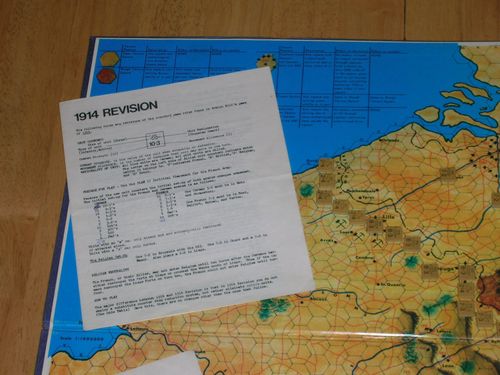
1914: Revision Kit
1914: Revision Kit Rulebook
Table of Contents
Table of Contents
Unit Counters
The sample counter is labelled, as printed:
- Size of unit (Corps)
- Type of unit (Infantry, Active)
- Combat Strength (10)
- Unit Designation (Prussian Guard)
- Movement Allowance (3)
The sample counter's face reads "10-3".
COMBAT STRENGTH is the value of the unit when attacking or defending.
MOVEMENT ALLOWANCE is the number of hexagons that unit may move in one turn.
NATIONALITY OF UNIT: All blue units are German; all gold units are Allied. The letter on the left side of Allied unit counters indicates which nation it belongs to. "F" indicates French, "B" British, "R" Belgian, and "D" Dutch.
Prepare for Play
Use the PLAN 17 Inititial [sic] Placement for the French Army.
Because of the new unit counters the initial set-up of both armies changes somewhat. The initial set-up for the French and German armies is as follows:
German set-up:
- two 10-3's (the word "two" is partly covered by a pen mark in the photo)
- 21 9-3's
- 14 6-3's
- 4 4-2's
- 1 2-2
- 2 3-2's
- 10 4d4's
- 2 305's
- 1 420
- 4 8a2's
One German 3-2 must be in Metz and Strassburg.
French set-up:
- 21 8-3's
- 8 7-3's
- 3 3-3's
- 2 1-3's
- 1 1-4
- 4 6a2's
- 10 2d4's
One French 7-3 must be in Toul, Belfort, Epinal, and Verdun.
Units with an "a" may only attack and are automatically destroyed if attacked alone. Units with a "d" may only defend.
The Belgian Set-Up
One 7-2 in Brussels with the 2d3. One 7-2 in Ghent and a 7-2 in Namur. Also place a 2-2 in Liege.
Belgian Neutrality
The French, or their Allies, may not enter Belgium until two turns after the Germans have either destroyed the forts at Liege or crossed the Meuse south of Liege. Thus if the Germans destroyed the Liege Forts on turn two, the French could not enter Belgium until turn four.
How to Play
The major difference between 1914 and 1914 Revision is that in 1914 Revision you do not employ a substitute counter step reduction system, but rather eliminate entire units. (See Odds Table)
Save this, there are no changes other than the ones that follow.
Combat Results Table
Transcribed from the separate "1914 Revision Combat Results Table" sheet. The right-hand edge of the scan is cut off in several definitions; the cut-off letters are marked [...] and were not filled in.
| Die roll | 1-3 | 1-2 | 1-1 | 2-1 | 3-1 | 4-1 | 5-1 | 6-1 and up | Die roll |
|---|---|---|---|---|---|---|---|---|---|
| 1 | EX | EX | DB | EX | EX | DE | DE | DE | 1 |
| 2 | AE | AE | EX | EX | EX | EX | DE | DE | 2 |
| 3 | AE | AE | EX | EX | EX | EX | EX | DE | 3 |
| 4 | AE | AE | EX | DB | DB | EX | EX | DE | 4 |
| 5 | AE | AE | AE | AB | DB | DB | EX | DE | 5 |
| 6 | AE | AE | AE | AE | AE | AE | AB | EX | 6 |
| 7 | AE | AE | AE | AE | AE | AE | AB | EX | 7 |
| 8 | AE | AE | AE | AE | AE | AE | EX | EX | 8 |
DB- The Defender must move back one hex OR lose one Corps. The defender must move away from enemy units and towards his source of supply whenever possible.
DE- Defender eliminated. Defender must lose one Corps and retreat all remaining units o[...] square (if any units remain) OR lose two Corps and stay put (with any surviving uni[...]).
AE- Attacker eliminated, handled in the same way save that losses apply to the attacker. Defending units may advance into the vacated square.
AB- Attacker loses one corps and stays put or retreats all his units one hex. Defender may advance into the attackers' vacated square.
EX- Exchange. The weaker side, in combat strength, loses at least one corps while the ot[...] side must lose forces at least equal to the other sides losses in terms of combat strength.
Attacks at greater than 6-1 odds always count as 6-1 odds.
Attacks at less than 1-3 odds are not permitted.