Expansion counters and rules for Michael Resch's 1914OaO and 1914SmS games
Expansion counters and rules for Michael Resch's 1914OaO and 1914SmS games Rulebook
Table of Contents
Table of Contents
Advanced Railroad Rules for the Grand Campaign Scenario
DESIGN NOTE: Along every RR line that passes from territory held by one belligerent to that held by the other there will be a stretch of track that is non-operational to both sides. This is due to the fact that as an army withdraws its RR engineers "clear" the RR lines left behind. When RR engineers clear the tracks they remove and take with them all rolling stock and anything useful they can carry. Almost everything that is left behind is damaged or destroyed. If the RR engineers have sufficient time, station structures and RR accessories, such as signal blocks, water towers, telephone and telegraph systems, are blow up. Therefore once an area has been abandoned, even if the enemy did not occupy it, the former occupant cannot use the RR lines found there until the area has been reoccupied and the RR lines "prepared" for use.
In 1914, when a RR line was (re)captured, it was invariably found in a cleared state. Even if there was no physical damage to the line, the RR engineers had a great deal of work to do to return the line to service. Switches had to be reset, water towers refilled, coal yards replenished, telegraph lines checked and repaired and the personnel who would operate the infrastructure positioned.
In addition to all this, in 1914 the German RR Engineers met with particular problems as they advanced into Belgium and France. It was found that the French and Belgian interchanges (Kreuzungen) and sidings (Uberholungsgleise) at the stations were often too short for German trains. Further it was determined that some Belgian coal was "dirty" and not suitable for German locomotives. Conductors had to accustom themselves to driving on the left and to using a signal system very different to that used in Germany. Often the telegraph and telephone lines were destroyed or insufficient so that neighboring stations could not communicate.
This did not stop the Germans from immediately putting captured RR lines into service and pushing traffic onwards, even without workable timetables. When operation of such lines did begin it was not always safe which led to accidents which led to delays. All these circumstances (and more) led to overwork and fatigue of the personnel.
The concept of changing a RR line to friendly operational represents all of this in addition to repairing physical damage to the track. Double-tracked RR Lines were prepared incrementally, first one track being put into operation and then later the second. To prepare a RR line for a high amount of traffic takes additional time. The LOC-Capacity Railhead concept is a simplified way of simulating this fact.
PLAY NOTE: Players will find that this RR process is not needed over most of the map. It will only have an effect in areas with a great deal of movement. Specifically this means the northern portion of the map and predominately at the beginning of the campaign. In areas where the front lines are stable, this process is not needed and players can dispense with determining where the railheads are and their Ammo Capacity.
Due to Rule 18.3 Reseau du Nord, the Allied Player does not need to mark railheads until GT 13.
Rule 15.0 LOC Limitations (Amended)
(The following supersedes the LOC Limitations found in Rule 15.0)
LOC Limitations: At any time, only one army's supply units' LOCs can pass through an individual RR line hex at LOC Capacity 1 (18.1.2). Likewise, only two armies' supply units' LOCs can pass through an individual friendly operational RR line hex at LOC Capacity 2. Likewise, only three armies' supply units' LOCs can be traced via a Double-Track RR line hex at LOC Capacity 3.
Rule 18.0 Railroad (RR) Lines and RR Engineering (Advanced)
(The following entirely supersedes Rules 18.1 RR Lines & 18.2 RR Engineering.)
18.1 RR Lines
There are three types of RR lines in the game: Double-Track, Single-Track and Narrow-Track. All three types can be used to provide supply and move depots. Other unit types are restricted to moving only along double-track RR lines with the exception, Allies only, of the single-track RR line (highlighted in purple) Abancourt (hex 16.24)—Eu (hex 16.18)—Abbeville (hex 20.18).
18.1.1 RR Line States
RR lines may be found in one of three states: "non-operational" or "friendly controlled" or "friendly operational."
- Non-Operational RR line hexes are those that are NOT CONNECTED to a friendly map edge by a contiguous path of other friendly controlled, or friendly operational RR line hexes.
- Friendly Controlled RR line hexes are those that are behind the nation's Railhead markers and are connected to a friendly map edge by a contiguous path of other friendly controlled, or friendly operational, RR line hexes. Note that friendly controlled RR line hexes cannot be used to move units or depots.
- Friendly Operational RR line hexes are those that are behind the nation's LOC Capacity railhead markers and are connected to a friendly map edge by a contiguous path of other friendly operational RR line hexes.
PLAY NOTE: Depot units can move only along Operational RR lines—see 15.7.3.
18.1.2 Operational RR Lines & LOC Capacity
Operational RR line hexes are always classified into one of three LOC Capacity categories (Exception: Liege and Brussel). These categories determine the number of Armies that can trace a LOC over that RR line and the volume of Ammo that these Armies' supply units can provide.
LOC Capacity 1 = Maximum of one Army's supply units can trace a LOC and any supply unit tracing a LOC is placed on its Extended side (and therefore its ability to provide Ammo is limited—see see 9.4.2 [sic]).
LOC Capacity 2 = Maximum of two Armies' supply units can trace a LOC. If only one Army's supply units are tracing a LOC then the supply units can provide unlimited Ammo. If two Armies' supply units are tracing a LOC then any supply unit tracing a LOC is placed on its Extended side.
- Capacity 2 is the maximum state for a Narrow- or Single-Track RR line.
- If any section of a supply units' LOC passes through a Narrow-Track RR line then the supply unit is flipped to its Extended side.
LOC Capacity 3 = Maximum of three armies' supply units can trace a LOC. If only two armies' supply units are tracing a LOC then the supply units can provide unlimited Ammo. If three armies' supply units are tracing a LOC then any supply unit tracing a LOC is placed on its Extended side.
- Only Double-Track RR lines that are connected to a friendly map edge exclusively via Double-Track RR lines can attain Capacity 3.
Exceptional LOC Capacity = The RR line that runs from Aachen to Liège (hex 58.28) and the purple-shaded RR line that runs from Liège to Brussel (hex 49.21) can attain Special LOC Capacity limits. Between Liège and Brussel (and between Aachen and Liège) three (five) armies' supply units tracing a LOC can provide unlimited Ammo.
18.1.3 Railhead and LOC Capacity Railhead Markers
These markers are used to indicate the extent of "friendly controlled" and "friendly operational" RR line hexes; and the LOC capacity level of the operational RR lines.
18.1.4 Enemy Units and RR Lines
The state of a friendly controlled and operational RR line changes to non-operational when: 1) an enemy unit passes through or stops in the RR line's hex and/or 2) when a RR line's hex is behind the enemy's Front Line (17.9.1).
18.2 RR Engineering
During the RR Engineering Phase, all RR lines that are in friendly controlled hexes (17.9) and can be connected to a friendly map edge by a contiguous path of other friendly operational RR line hexes are Friendly Operational. RR lines that are not in friendly controlled hexes, or cannot be connected to a map edge, are Non-Operational.
EXCEPTION: Inside Belgium, RR Lines are Allied Friendly Operational if they are in a friendly controlled hex and can be connected to Oostende (hex 37.10) by a contiguous path of other Friendly Operational RR line hexes.
18.2.1 RR Engineering Procedure
During the RR Engineering Phase perform the following steps in the order presented:
1A. Note reconstructed RR Structures (18.4). This is done because RR Engineering cannot advance beyond a demolished structure's hexside.
1B. Replace any LOC Capacity 3 Railhead marker found between Aachen and Brussel with an Exceptional Ammo Capacity marker.
2. Replace LOC Capacity 2 Railhead markers with LOC Capacity 3 Railhead markers (and remove redundant Capacity 3 markers). Note that a Capacity 3 Railhead marker cannot be placed on a Narrow- or Single-Track RR line or any Double-Track RR line that at any point traces its connection to a friendly map edge via a Narrow- or Single-Track RR line.
3. Replace LOC Capacity 1 with Ammo Capacity 2 Railhead markers.
4. Replace friendly controlled Railhead markers with LOC Capacity 1 Railhead markers (i.e. flip the markers from their front to their back sides).
5. Place new friendly controlled Railhead markers as needed.
RR Line Depot Capacity Summary
The published summary diagram ("RR Line Depot Capacity Summary") is reproduced below. The top line shows the RR line types: "Double-Track RR Lines only" for LOC Capacity 3, and "Double-, Single- or Narrow-Track RR Lines" for LOC Capacity 2 and 1. Each Depot marker face is shown with its multiplier (x3, x2, x1).
| Capacity 3 (Double-Track RR lines only) | Capacity 2 (Double-, Single- or Narrow-Track) | Capacity 1 (Double-, Single- or Narrow-Track) | |
|---|---|---|---|
| Depot, extended side (8 / 9 R) | x3 (Capacity 3): Three Armies' supply units can trace a LOC and provide limited Ammo, OR Two Armies' supply units can trace a LOC and provide unlimited Ammo. | x2 (Capacity 2): Two Armies' supply units can trace a LOC and provide limited Ammo, OR One Army's supply units can trace a LOC and provide unlimited Ammo (exception: not Narrow-Track). | x1 (Capacity 1): One Army's supply units can trace a LOC and provide limited Ammo. |
| Depot (6 R) | x2 (Capacity 3) | x1 (Capacity 2) | — |
The summary diagram prints the 6 R depot faces beneath the Capacity 3 column (x2) and the Capacity 2 column (x1); the Ammo conditions are printed once per column, as shown above.
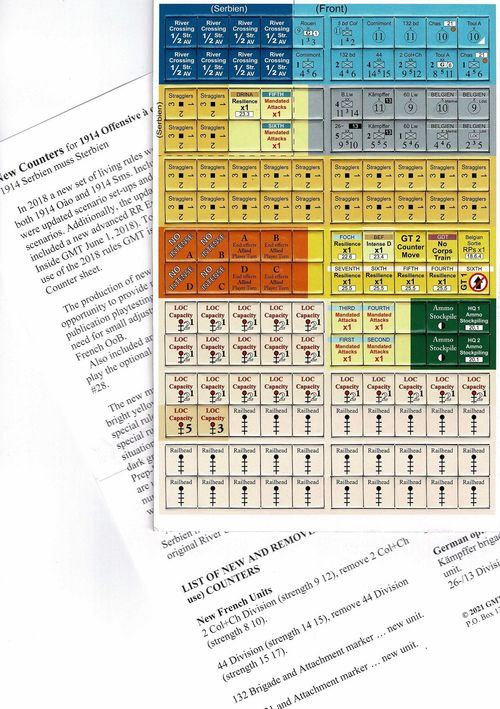
Counter Sheet: Advance RR Engineering Markers
Marker reference from the GMT "LOC Capacity Railhead Counter Sheet". The sheet is a component reference, not rules text; the rules above govern what each marker does.
Front ("Advance RR Engineering markers (Front)")
- LOC Capacity markers, with a red-dot counter and a numeral printed on the face (two rows of ten, plus two named "LOC Capacity" faces).
- Railhead markers, with a black railhead symbol, in several rows.
Back
- LOC Capacity markers with a numeral 3, 2 or 1 on the face, and blank LOC Capacity faces.
- Brussel (49.21) and Liège (58.28) markers, each noted "18.1.2" (the Exceptional LOC Capacity hexes in Rule 18.1.2).
The small numerals on these faces are at the limit of legibility in the scan used for this transcription, so this section names the marker types and the printed references only; the capacity each face carries is the one set by Rules 18.1.2 and 18.2.1.