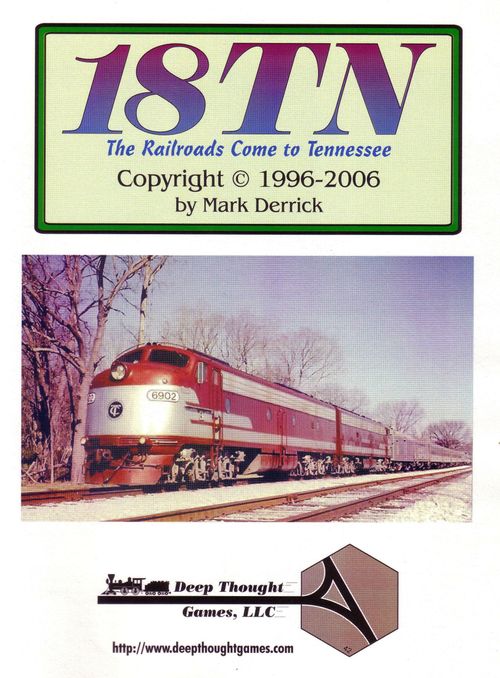
18TN: The Railroads Come to Tennessee
18TN: The Railroads Come to Tennessee Rulebook
Table of Contents
Table of Contents
- 1. Introduction
- 2. Starting the Game
- 3. Stock Round
- 4. Operating Round
- 5. Historical Events
- 6. End of Game
- 7. Miscellaneous
- 8. Optional Rules
- 9. Game Hints
- 10. Game Support
- Table I. Game Phases
- Table II. Starting Cash and Certificate Limit
- Table III. Private Companies
- 1. Tennessee Copper Company - Par value $20, Revenue $5
- 2. East Tennessee and Western North Carolina RR - Par value $40, Revenue $10
- 3. Memphis and Charleston Railroad - Par value $70, Revenue $15
- 4. Oneida and Western Railroad - Par value $100, Revenue $20
- 5. Louisville and Nashville Railroad - Par value $175
- Table IV. Tile Manifest and Upgrade Chart
- Appendix 1. Comparison with Other 18xx Games (Q&A)
1. Introduction
18TN is a railroad and stock market manipulation game, based on the original 18xx game system created by Francis Tresham. Each player takes the part of an investor, and the object of the game is to have the most money at the end. 18TN is intended for 3-5 players.
Players who are familiar with other 18xx games may wish to skip ahead to Appendix 1, which summarizes the differences between 18TN and several of the better-known 18xx games.
1.1. Rounds and Turns
The game is played in two types of rounds: Stock Rounds and Operating Rounds.
In a Stock Round, players buy and sell stock in companies. The players take turns in order, clockwise around the table, and each player usually gets multiple turns. The round ends when all players consecutively pass.
In an Operating Round, companies operate. Each company gets one turn.
At the beginning of the game, the two types of rounds simply alternate. In later phases there will be two or three operating rounds after each stock round. The turns of players during a Stock Round are called stock turns. The turns of companies during an Operating Round are called operating turns.
1.2. Game Phases
The game is divided into phases. (The sequence of phases happens in parallel with the sequence of turns. A phase change does not end the round or the turn in which it happens.)
When the game begins, it is Phase 1. Each time the first train of a new type is purchased, a new phase begins; the phase number is the same as the train number. (There are also two phases that begin with the purchase of trains which are not the first of their types.) Each phase change modifies some of the rules of play.
Table I lists all the train types, and the phases and their effects. (All tables appear at the end of the rules.)
1.3. Companies
The game has two types of companies in which players can invest: Private and Major Companies.
1.3.1. Private Companies
A private company is owned as a whole, and thus is represented in the game by a single stock certificate. When a private company operates, the bank simply pays a fixed dividend to its owner.
A private company can be owned either by a player or by a major company.
Private companies cannot have any money or possessions of their own. They do not build track or run trains. Some private companies also have a special ability that can be used if a major company owns the private company. (This ability can only be used during the major company's operating turn - not during the private company's operating turn.) See Table III for details.
1.3.2. Major Companies
A major company is represented by eight or nine certificates representing stock in the company, each of which may be owned by a player or the bank. (There are one 20% president's certificate and eight 10% certificates for each major company, except the Illinois Central (IC), which has one 30% president's certificate and seven 10% certificates.) No company of any kind can own stock in a major company.
In most respects, a major company is like a modern publicly traded company. It has its own possessions (money, trains, tokens, and private companies). Each major company has a large card called a "charter" on which to keep its possessions.
The player with the greatest number of shares (percentage of ownership) in the major company is its president and controls all aspects of its operation. (See 4.2 for details which are omitted here.) He keeps the company's charter in front of himself. In addition, the percentage each player owns determines how much of the dividends he receives, if and when the major company pays dividends.
Note that a major company's assets must be kept separate from those of any other company or player, including the president. The president may not move assets between the company's charter and his own hand, or to or from other companies he controls, except for transactions specifically permitted by the rules.
Players should be careful of the distinction between a certificate and a share. One "share" is defined as 10% of the ownership of a major company; thus each stock certificate equals either one, two or three shares. Shares determine the presidency and the allocation of dividends. However, players can only buy and sell certificates, not shares (even though the price paid or received is based on the number of shares those certificates represent), and the limit on each player's total holding is counted in certificates.
During its operating turn, a major company may build or upgrade track tiles; place station tokens; operate trains; pay out (or withhold) the resulting revenue; purchase trains (from the bank or from other companies); and purchase private companies from players. (Most of these actions are optional, and some may be forbidden or limited, depending on the current phase of the game; this is just a summary. See 4.2 for the complete details.)
1.4. The Bank and the Open Market
As in many other economic games, "the Bank" is an abstract entity which is said to own all money and property that does not belong to any player or company. This includes unowned stock certificates and trains, as well as all tiles which are not currently on the board and all tokens of major companies that have not yet floated (see 3.4).
The Bank contains two separate areas for displaying stock certificates and trains, called the Initial Offering and the Open Market. The Initial Offering contains only "new" stock certificates and trains, meaning those which have never been owned by a player or company. The Open Market contains any previously owned stock certificates and trains. This distinction exists because the rules treat "new" shares and trains differently from "used" shares and trains in several ways:
- Stock certificates of major companies are always purchased from the Initial Offering at their original Par Value (per share). They are purchased from, or sold to, the Open Market at their current Market Value (per share).
- To "float" a major company (put it into operation, see 3.4) requires that 60% of its stock be removed from the Initial Offering. But this 60% does not all have to be in the hands of players at any one time. Some of it can be in the Open Market.
- When a major company pays dividends, its treasury collects the dividend for any shares it has in the Open Market. It does not collect anything for shares in the Initial Offering.
- Trains in the Initial Offering can only be purchased in order of their types as listed in Table I. For example, no major company can purchase a 5-Train until all of the 2, 3, and 4-Trains in the Initial Offering have been purchased. However, the presence of a train in the Open Market does not similarly prevent a major company from buying trains of later types from any source.
The private companies belong to the bank at the beginning of the game, but once purchased by players, they cannot be sold back to the Bank, and so they can never be in the Open Market. (In some 18xx games, the Open Market is referred to as the "Bank Pool").
Note that the game comes with exactly $8,000 in cash. Changing this total is not recommended, because it will alter the length of the game. Poker chips or other money substitutes can be used, but the correct total should be verified before starting play.
1.5. The Stock Chart and Par Display
Each major company has two values for its stock, which are called the Par Value and the Market Value. Each of these is a value per 10% share.
When a player founds a major company by purchasing its president's certificate from the Initial Offering display, he chooses its Par Value as described in 3.2(c)(1). The major company's Par Value is then fixed for the rest of the game. The Par Value determines the price per share of all purchases of certificates from the Initial Offering area (which have never been owned by a player). Of course, the president's certificate is two shares, so it costs twice the Par Value.
A major company's Market Value begins equal to its Par Value. But unlike the Par Value, the Market Value will change throughout the game as described in 3.2(a), 3.6, and 4.2.5.2(d). The Market Value determines the price per share of all stock purchases from, and sales to, the Open Market.
The private companies also have Par Values, which are shown on their certificates (but do not necessarily determine the initial purchase prices; see 3.1). They do not have Market Values, because they can never be sold to the Open Market. (However, private companies may be sold directly from one player to another. Stock certificates of major companies cannot.)
2. Starting the Game
First, determine randomly (or by agreement) where each player will sit, and determine randomly who gets the Priority Deal card. The private company cards may be used to assign order.
Each player starts with the amount of money shown in Table II. The rest of the money is set aside as the Bank. You may want to designate someone as banker, or even appoint different people to handle different bank resources. (For instance, one person can handle money and shares while another handles tiles.)
Set up the map and Stock Chart near the center of the table. Leave space in front of each player so that he can manage his cash, stock certificates, and the charters of major companies he will control.
Spread out the certificates of the private companies in numerical order, since they will be sold first. Place the 20% president's certificate of the L&N Railroad with the L&N Railroad (#5).
All trains and all other major company stock certificates should be placed on the Initial Offering display. Place the token using the supplied label in the "Stock Round" box of the "Round of Play" display on the Stock Chart. (This is explained in 7.0.) The rest of the map begins empty, as does the Stock (Market Value) Chart. The game then begins with a Stock Round.
One method used by some players to track bids on private companies is to allow each player to take the tokens of one major company and use them to mark the private companies on which he has bid. (This does not cause a problem because no major companies are in play yet.) Once all of the private companies have been purchased by players, the banker should collect the tokens and put them near the Initial Offering display, where he can hand them out as major companies form.
3. Stock Round
In each Stock Round, the player who holds the Priority Deal card has the first turn, and play proceeds clockwise around the table.
3.1. Stock Turn While Unsold Private Companies Remain
While the bank still holds one or more unsold private companies, each player can only do up to one of these actions on his turn:
(a) Buy the lowest-numbered unsold private company for its par value (or a discounted value if 3.1.2 applies).
After this purchase, if the lowest-numbered remaining unsold private company has been bid on at least once under 3.1(b), it is immediately auctioned according to the procedure in 3.1.1. Repeat this process for each succeeding private company until the lowest-numbered one remaining has not been bid on, or until all of the private companies have been purchased by players. The Stock Round then continues with the turn of the next player after the one who made the purchase under 3.1(a). (Turns in an auction are not part of the sequence of turns in the Stock Round. They are separate.)
(b) Place a bid on any other unsold private company.
Each bid must be for a whole number of dollars, and must exceed the preceding bid on the same company (or if none, the company's par value) by at least $5. Players must set aside the amount of their bid, and cannot use that money for anything else, until the company they have bid on comes up for auction as described in 3.1.1. They cannot bid more money than they have (minus any amounts set aside for bids on other companies that have not yet come up for auction). Once a (legal) bid is made, it cannot be withdrawn. All bids on a company remain in force until the company comes up for auction, even if an operating round intervenes. Note that it is pointless for any player to bid on the same company more than once before it comes up for auction.
Either of these actions uses up a player's entire stock turn. Even if they purchase the last unsold private company (or the only one that hasn't been bid on, thus causing the rest to be auctioned off), their turn is over; they cannot perform any of the actions described in 3.2 on the same turn.
If a player does not wish to place a bid, they may pass (exception: 3.1.2).
3.1.1. Private Company Auction Procedure
Only those players who placed bids under 3.1(b) on the company being auctioned may participate in the auction. (Therefore if only one player has bid on the company, the auction ends immediately; he simply pays the amount he bid and takes the company.)
The participating players take turns, clockwise, beginning with the player after the one who made the highest bid on the company under 3.1(b). (That bid is considered to be the first bid of the auction.) Each player must either pass, or bid a whole number of dollars that is at least $5 more than the preceding bid. Players cannot bid more money than they have (minus any amounts set aside for bids on other companies that have not yet come up for auction). Note that the money that was set aside when bidding on the same company under 3.1(b) may be used to bid for it now. A player who has passed may bid later, if he gets another turn before the auction ends.
The auction ends when all but one of the players participating in the auction consecutively pass (that is, when it would otherwise become the high bidder's turn again). The high bidder immediately pays the bid amount and takes the company.
3.1.2. First Company Discount and Forced Purchase
If the first stock round ends (that is, everyone passes consecutively) without any player purchasing the Tennessee Copper Company (private company #1), any player may purchase it in the second stock round for $15. Similarly, if no one buys it in that round, it may be purchased in the third stock round for $10, and in the fourth stock round for $5.
If it still hasn't been purchased, then in the first turn of the fifth stock round, the player with the Priority Deal card must accept the Tennessee Copper Company for free. This is considered a purchase under 3.1(a); it uses up that player's stock turn, and may trigger one or more auctions.
There is no similar discount on (or forced purchase of) any other company. (Once someone owns that first private company, the bank will be paying revenue to some player or company every operating round, thus ensuring that the game will eventually end).
3.2. Regular Stock Turn
Once all of the private companies have been purchased from the bank, each player may do any, all, or none of the following on his turn:
(a) Sell any stock certificate(s) of a major company to the Bank for their current Market Value (per 10% share), placing the certificate(s) in the Open Market.
These restrictions apply:
(1) No one may sell any certificates to the bank during the first Stock Round of the game.
(2) No sale may be made which will cause more than 50% of the shares of any one major company to be in the Open Market. (It is legal for exactly 50% to be there. Certificates in the Initial Offering do not count toward this limit.)
(3) You may sell a 20% president's certificate (or the 30% Illinois Central president's certificate) only if another player owns at least two shares (20%) of that major company's stock (30% for the Illinois Central only), and only if you sell enough of the company's stock that a change of presidency will result. (See 3.5, Change of Presidency)
(4) As a special case, if you own only the president's certificate of a major company, you may sell only one share (10%) and keep 10%. The two conditions for selling a president's certificate in the previous paragraph must still be met. To do this you first announce that you are selling only 10%; then determine the new president and exchange certificates with him as if the sale had already taken place (per 3.5); and then place one of the two 10% shares he just gave you into the Open Market. For the Illinois Central, the president may sell either 10% or 20% using the same procedure as described above.
Even if a major company has not floated (see 3.4) or has not operated, its stock may still be sold.
After selling, you must move the major company's Market Price token downward one space for each 10% share of its stock that was sold. If this would cause the token to go off the bottom of the Stock Chart, it stops at the bottom row and does not move further. If you move the token into a space that already contains one or more tokens, place it underneath them all.
(b) Sell any private company directly to another player, for any positive whole number of dollars the two can agree upon.
(c) Buy one certificate, which can be any of the following:
(1) From the Initial Offering, the 20% or 30% President's Certificate of any major company.
In this case the player must set the Par Value of the major company to one of these values: $65, $70, $75, $80, or $90 (per 10% share). The major company's square token is placed in the column showing that value under "Par Values" on the Initial Offering display, and one of its round tokens is placed in the gray space with the same value on the Stock Chart, thus setting the major company's Market Value equal to its Par Value (for now). (If you place the round token in a space that already contains one or more tokens, place it underneath them all.) Since the President's Certificate is either 20% or 30%, it costs the player either double or triple the par value he sets.
(2) From the Initial Offering, a 10% certificate of any major company whose President's Certificate is already owned by a player. The player pays the bank the par value.
If this purchase reduces the amount of the major company's stock in the Initial Offering to exactly 40%, the major company floats. (Follow the procedure in 3.4.)
(3) From the Open Market, a 10% certificate of any major company. The player pays the bank the market value.
Notice that it is not possible for the president's certificate of a major company to be available in the Open Market, because a president's certificate can only be sold to the Open Market if it will cause an immediate change of presidency (3.5).
(4) From another player, a private company, for any positive whole number of dollars the two players can agree on.
All purchases are subject to the limits given in 3.3. In addition, you are not allowed to purchase any stock of a major company if you have sold any stock of that company earlier in the same stock round.
You may not sell one or more certificates, buy a certificate, and then sell it on the same turn. That is, your one purchase (if any) must either precede or follow, all sales (if any) you make on the same turn. You may do any of these things, except (c), more than once on a turn.
If you don't want to do any of these things, you may pass (exceptions: 3.3).
Notice that a private company can be sold directly from one player to another on either player's turn. However, it is better for the buyer to do this on the seller's turn, because if it happens on the buyer's turn, it counts as the one purchase he is allowed on that turn.
3.3. Ownership Limits and Purchase Restrictions
There are two upper limits on a player's stock ownership.
(a) No player may own more than 60% of the stock of any one major company. No player may ever make a purchase that causes him to exceed this limit. An exception to this is that shares of any company whose value is $40 or less and is within the green zone of the stock chart can be held in any amount up to 100%.
(b) The total number of certificates a player owns must not exceed the "Certificate Limit" listed in Table II. This limit includes private company certificates and the stock certificates of major companies. (Special cases: A 20% or 30% president's certificate of a major company counts as only one. Stock of companies whose market values are in the yellow or green section of the Stock Chart also do not count against this limit. And of course, private company certificates owned by a major company do not count either, since they do not belong to the player personally.)
No player already holding the maximum number of certificates allowed by this limit may purchase another certificate (unless it is a 10% certificate of a company whose market value is in the yellow or green section of the Stock Chart), even if the purchase would cause a change of presidency that would result in the player's holding no longer exceeding the limit.
It is possible to exceed this limit because another player has made a purchase that caused you to lose a presidency (thus exchanging certificates as described in 3.5(b)), or because you own stock whose market value has risen out of the yellow section of the Stock Chart since you bought it. In either case, you may keep the excess until your next stock turn, but on that turn, you must sell enough certificates that you comply with the limit once more.
3.4. Floating a Major Company
A major company "floats" when exactly 40% of its shares are in the Initial Offering. Until this happens, the major company is not considered fully formed, and cannot operate.
When a major company floats, perform these steps.
(a) The bank gives the president the major company's charter.
(b) The bank gives the major company its tokens that will be used as stations (that is, all but the one round and one square token that are being used to mark its two stock values). There are circles on the charter showing how many station tokens the major company should have.
(c) The bank pays the major company ten times its Par Value.
If your group prefers, you may wait until the end of the round in which the major company floats, or until the beginning of its first operating turn, to perform these steps physically. (However, the payment is considered to have occurred immediately if it makes a difference such as causing the Bank to run out of money.) These steps are performed only once for each major company.
3.5. Change of Presidency
Whenever a purchase or sale of stock causes another player to hold a greater percentage of a major company's shares than the president, a change of presidency occurs. (A change of presidency does not occur merely because another player holds the same percentage as the president, nor because the Initial Offering or the Open Market contains a percentage equal to or greater than the president's.)
When a change of presidency occurs, follow these steps immediately:
(a) The player who holds the greatest percentage of the major company's shares is the new president. If there is a tie (which can only happen if a sale by the outgoing president caused the change of presidency), the first tied player clockwise from the outgoing president is the new president.
(b) The new president takes 20% of the stock of the major company from his own holding and exchanges it for the 20% president's certificate, wherever it is (either in the Open Market or in the outgoing president's holding). (If the company changing presidents is the Illinois Central, the new president takes 30% of the Illinois Central stock from his holding and exchanges for the 30% president's certificate as described above.)
(c) The major company's charter and belongings are moved in front of its new president. (Disregard this step if the bank still has the major company's charter because it hasn't yet floated, or it just floated and the banker hasn't given the charter to the president yet.)
3.6. End of Stock Round
The Stock Round continues until all players consecutively pass (take no action on their turns). That ends the Stock Round, and the Priority Deal card goes to the player following the last player who took an action on his turn. (If no one did anything but pass during the stock round, the Priority Deal card stays where it was at the beginning of the round.)
At the end of the round, if all 100% of the stock of any major company is owned by players, move that major company's market value token upward one space. If this would cause the token to go off the top of the Stock Chart, the token does not move. If you move the token into a space that already contains one or more tokens, place it underneath them all. (If more than one major company has 100% of its stock owned by players, perform this move for each such major company in descending order of market value, breaking ties as in 4(b).)
4. Operating Round
In an operating round, each company (except unfloated major companies) operates exactly once.
(a) First, all private companies operate. These can be done simultaneously.
(b) Then, all major companies which have floated (see 3.4) take their operating turns. The company with the highest market value goes first; then the next highest (which hasn't yet operated this round); and so on. If there is a tie, the major company whose market value token is farthest to the right goes first; if there is still a tie, the major company whose market value token is stacked on top goes first.
Players should flip each major company's market value token face down after moving it during the pay-dividends-or-withhold step of the major company's turn (see 4.2.4), to indicate which major companies have run. (If there is a stack of tokens in one space on the Stock Chart, the face-down ones should always be underneath any face-up ones. If each newly flipped token is placed on top of any other face-down ones in the space so it will wind up underneath them when the face-down tokens are turned face-up again as a group, at the end of that operating round, the correct order will be preserved.)
4.1. Operating a Private Company
When a private company operates, the bank simply pays its fixed dividend (stated on its certificate) to the player or major company that owns the private company.
4.2. Operating a Major Company
A major company can do the following on its turn. Unless otherwise stated, each step is optional, but if done, must be done in the order listed (4.2(h) is optional but can be done at anytime during the major company's turn). All operations are carried out by the major company's president, and unless otherwise stated, all decisions are his and his alone.
(a) If this is the major company's first operating turn of the game, place a station token on its home city at no cost. (Required.)
(b) Lay one or two yellow tiles, or upgrade one tile, as described in 4.2.1.
(If the major company owns a private company and it has not exercised its special ability of a free tile placement in its hex, it may lay this extra tile during this step. Since this does not count as a normal placement, a major company may be able to lay multiple tiles during this step.)
(c) Place a station token, as described in 4.2.2.
(d) Run trains, as described in 4.2.3. (Required if any player who owns stock in the major company insists.)
(e) Pay out dividends or withhold revenue, as described in 4.2.4. (Required if major company owns a train and has a valid route.)
(f) Remove from play all obsolete trains it owns, as explained in 4.2.5.1. (Required.)
(g) Purchase one or more trains, as described in 4.2.5. (May be required, as described in 4.2.5.2.)
Notice that purchasing trains comes after running trains. This means that each newly floated major company, on its first turn, will be unable to run any trains.
(h) Purchase one or more private companies directly from players, as described in 4.2.6. This may be done more than once per turn, and may be done at any time(s) during the major company's turn.
4.2.1. Laying a Tile
The major company may build track by laying a tile in the one of the printed hexes on the map. All allowed tile lays are determined by the following rules.
(a) At the beginning of the game, only yellow tiles are available for building. Green, brown, and gray tiles become available in later phases, as listed in Table I.
(b) All tiles which are not on the map are available for anyone to use for building. Unused tiles cannot be owned by any player or company.
Similarly, once track exists on the map (whether preprinted or as the result of a tile lay), no one owns it, and any company is free to run trains on it or to lay another tile there (if otherwise legal).
(c) Yellow tiles may only be placed in pale green hexes (which make up most of the map at the beginning of the game). Green tiles may only be laid on yellow hexes or to replace existing yellow tiles. Similarly, brown tiles may only be laid to replace existing green tiles, and the gray tile may only be laid to replace an existing brown tile. No tile may be laid on a red or gray area, or off the hex grid.
Note: Laying any green tile is considered an "upgrade" even if the tile is placed on a preprinted yellow hex rather than replacing a yellow tile. Laying any brown or gray tile is also an "upgrade".
(d) White circles on a tile represent cities, and can only be laid in places where the map, or the existing tile, shows a white circle. No tile without such a circle may be laid in those places. (Upgrading one circle to two circles or two to three is allowed.) The circles are also spaces where station tokens may be placed.
(e) Similarly, a crossbar or dot on a tile represents a small town, and can only be laid in places where the map, or existing tile, shows one of those symbols. The two are interchangeable.
(f) Where the map shows rivers or mountains, they have no effect on track building, except that the first time a tile is laid on each of those hexes, the company must pay the bank the dollar amount (if any) shown in the hex. This represents the cost of building bridges, tunnels, etc. All other tile laying is free.
(g) Tiles labeled with a city name may be laid only in the hex named. If one of these tiles exists for a hex, no other tile of the same color may be laid in that hex.
(h) When a tile is laid in a hex that already contains any cities, towns, or track (whether because those features are preprinted or because a tile was placed in the hex earlier), all existing cities, towns, and track must be preserved. (They need not be in exactly the same places, but any edges that were connected must remain so, and any town or city that was connected to an edge must remain so.) All tokens on the old tile (or hex) are moved to corresponding spaces on the new tile, and the old tile (if any) is removed from the board and becomes available for reuse.
Note: Table IV shows all possible tile upgrades (replacements), and all orientations of them, which are allowed by (c), (d), (e), (g), and (h).
(i) No tile may be laid that causes track to run across the printed impassable hex sides as shown on the map, into a blank side of a preprinted red off-board area or off the hex grid. (It is okay to connect track to the tracks in the red areas.)
(j) Each tile laid must contain either some newly added track that is connected to an existing station of the company, or a city which is connected to an existing station of the company. The connection is traced as if you were running a train (with no limit on the number of cities it can visit); thus it may not backtrack at a fork, and may not run through a red area or through a city whose circles are all occupied by stations of other companies. (But unlike the route on which a train is run, this connection route need not begin at a city, town, or red area; it may begin at any point on track which is added by the new tile, or at any city on the new tile.)
Once a tile is laid on the map, it stays there for the rest of the game, unless and until it is replaced by another tile as described in (c) and (h). The gray tile can never be replaced.
4.2.2. Placing a Station Token
If the major company has any station tokens remaining on its charter, it may place one in any unoccupied circle in any city which is connected by track to an existing station of the major company, subject to the following restrictions:
(a) The connection is traced as if you were running a train (with no limit on the number of cities it can visit); thus it may not backtrack at a fork, and may not run through a red area or through a city whose circles are all occupied by stations of other companies.
(b) No major company can have more than one station in the same hex.
(c) In each city that is the home of a company which has not yet placed its home station, one circle must be left open for that purpose.
The major company must pay the bank $40 if this is its first station other than the home station, or $100 otherwise.
Once placed, a station cannot be moved for the rest of the game.
4.2.3. Running Trains
The company may run any or all of the trains it owns. Each train must follow a route that meets the following conditions.
(a) The route must be a continuous path of track (shown as wide lines) that connects two or more cities, towns, and/or off-board locations (shown as arrows on red areas of the board).
(b) The route may not use a single section of track more than once, no matter how short. (Thus "doubling back" is not allowed, nor are loops of any kind). Note that there is at most one section of track crossing each edge of any hex.
(c) Where the train passes through a fork (switch), it may only follow one side of the fork. In other words, the engine cannot "shift into reverse" partway through its run.
(d) When the route enters a city, it may exit on any piece of track connected to that city, except the one from which it came, provided that the city is not blocked.
(e) A city is considered "blocked" if all of the circles (spaces for station tokens) in that city are occupied by stations of companies other than the operating company. The route cannot pass through a blocked city. However, the beginning or end of the route (or both) may be blocked cities.
(f) The route must include at least one city or off-board location containing a station of the operating company.
(g) The route cannot include any city, town, or off-board location more than once. Different arrows in the same red area are considered to be the same location.
(h) The route cannot pass through an off-board location (red area), even if it contains a station of the company. An off-board location can only be used as the beginning or end of a route.
(i) The total number of cities, towns, and off-board locations must be equal to or less than the train type number. (So for example a 2-Train may run to 2 cities, or one city and one town.) Remember that all off-board areas are considered cities.
(j) When a major company operates more than one train on a turn, no two trains may use a single section of track, no matter how short. It is all right for multiple trains to run to the same city, town, or off-board location, so long as the tracks used by each train are separate.
4.2.3.1. Calculating Revenue
Each train run generates revenue equal to the sum of the revenue values of each of the cities, towns, and off-board locations on its route. (The revenue value of a town or city is shown in a small circle next to that town or city. For St. Louis, Little Rock, Gulf Coast, Birmingham, Cincinnati, Bristol/Coalfields and Atlanta, two values are shown in a box; the yellow value applies until the first 5-Train is purchased, and the brown value applies for the rest of the game.)
A major company must run train(s) each turn for the greatest total revenue possible, if any player who owns stock in the major company insists. (This rule does not restrict the president's options in any step of the major company's turn other than Running Trains.) This means that if any stockholder points out a better paying route or combination of routes than one that the president has announced, the president must use those route(s) unless he can find other(s) that pay still more. (However, players who spot a better paying route or combination are not required to point it out.)
4.2.4. Pay or Withhold Dividends
Once the major company has run its trains, if any, and calculated the revenue they produce, its president must choose one of two options:
(a) Pay out dividends. In this case, each player who owns shares in the company receives a dividend from the Bank equal to the same percentage of the revenue as the percentage of the company's shares he owns. For example, if the total revenue from the runs is $70, a player who owns 60% of the company's stock would be paid 60% of $70, or $42.
If there are shares of the company's stock in the Open Market, the Bank pays the dividend for those shares into the company's treasury. If there are shares in the Initial Offering, the Bank does not pay the dividend for those shares to anyone.
(b) Withhold revenue. In this case, the Bank pays the total revenue generated by the runs into the company's treasury, and nothing to any player.
If the company earns revenue and pays out dividends, move its Market Value token one space to the right on the Stock Chart. If the token cannot move to the right because it's at the end of a row, move it upward one space instead. If it's already at the upper right corner, it does not move.
If the company withholds its revenue, or does not run any trains, move its market-value token one space to the left on the Stock Chart (Exception: see 5.1). If the token cannot move to the left because it's in the leftmost column, move it down one space instead. If it's already at the lower left corner, it does not move.
4.2.5. Purchasing Trains
A major company may purchase one or more trains from the bank, or from other major companies, or both, in any order (during this step of the turn). These restrictions apply:
(a) Like stock certificates, trains in the Bank are kept in two separate areas, the Initial Offering and the Open Market. All trains begin in the Initial Offering.
(b) All trains in the Initial Offering must be purchased in increasing order of type; that is, all the 2-Trains must be purchased before any company is allowed to buy a 3-Train, and so on. For this reason, all trains in the Initial Offering are usually kept in a single pile, except that the next train currently on offer and those of its type are usually fanned out to show how many are left. The left side of the map has spaces for this purpose.
(c) Trains in the Bank, whether in the Initial Offering or the Open Market, are purchased at face value.
(d) Trains may also be purchased from other major companies, for any agreed price of at least $1 each. The price is public information. (Unlike some other 18xx games, it is legal to do this in any phase of the game, but only during the train-purchase step of the buying company's turn)
(e) When the first train of a new type is purchased from the Initial Offering, a phase change occurs. (The fourth 3-Train purchased from the Initial Offering also causes a phase change.) Most of the effects of a phase change are immediate. For example, when the first 4-Train is purchased, all 2-Trains are immediately removed from play.
(f) In the first part of the game, each major company is limited to buying at most one train from the Bank each turn. This limit disappears when the first 4-Train is purchased; thus the major company that buys the first 4-Train may immediately buy additional trains, subject to (g), below. Purchases of trains from other major companies do not count against this limit.
(g) There is also a limit on the total number of trains each major company may own. (The limit depends on the game phase; see Table I.) A major company which already owns this maximum number of trains is not allowed to buy another from any source, even if the purchase would cause a phase change that would cause some of its trains to be removed from play.
When a phase change reduces this limit, each major company which owns more trains than are allowed by the new limit must immediately discard the excess train(s) into the Open Market, without compensation. Each major company's president chooses which of its trains to discard (but can discard only enough trains to comply with the limit). This is the only way that trains can go into the Open Market.
A major company which owns fewer than the maximum number of trains may purchase one even if the purchase will cause a phase change that reduces the limit and causes the company to exceed the new limit, but the company must then discard one train as above.
Companies may not sell trains to the Bank, nor may they voluntarily discard trains. The only way for a major company to get rid of an unwanted train (other than arranging a forced discard as in (g), above) is to persuade another major company to buy it, and the sale can only take place on the buying company's turn.
4.2.5.1. Train Obsolescence
In most instances, when a phase change causes trains of a certain type to be removed from play, it does so immediately. However, the 4-Trains are an exception. (Optional rule 8(c) creates another similar exception.)
When the second 6-Train is purchased, only those 4-Trains which are in the Open Market are removed from play immediately. All 4-Trains owned by companies are instead designated "obsolete".
Each obsolete train remains in play until after step 4.2(e) (the pay-or-withhold step) of the owning corporation's next turn. Then it is removed from play. Thus, a corporation which owns only obsolete trains at the beginning of its turn will be able to run them, but will then have to buy another train (see 4.2.5.2).
No company may ever purchase an obsolete train from another major company.
4.2.5.2. Forced Train Purchase
If a major company has a legal run (a track route on which it could run a train) but does not own a train during the train purchase step of its turn, it must buy at least one train. (Exception: If there are no trains left in the Initial Offering or the Open Market, the company is relieved of its obligation to buy a train.)
If the company is required to buy a train but cannot afford to buy one from the bank, and its president cannot (or chooses not to) arrange to have the company purchase one from another company, then the president must contribute sufficient funds from his own personal cash to enable the company to buy a train.
These restrictions apply if the president contributes personal funds:
(a) The cheapest train available in either the Initial Offering or the Open Market must be purchased. (For example, if the next train available in the Initial Offering is a 6-Train, but there is a 3-Train in the Open Market, you have to buy the 3-Train.) No train may be purchased from another company if the president contributes personal funds.
(b) Only one train may be purchased.
(c) The president may contribute only enough cash for the purchase. That is, after the purchase, the company cannot have any cash left.
(d) If the president does not have the needed cash, he must sell stock. The normal rules for stock sales in 3.2(a) apply unless otherwise stated here. In particular, the market value of each major company whose stock is sold is adjusted as in 3.2(a). However, he may only sell just enough shares to raise the needed cash and he may not make a sale that would cause a change of presidency of the operating company.
These sales are not considered a stock turn. The Priority Deal card does not change hands, and the player is not required to bring himself into compliance with either of the limits in 3.3 (normal certificate limits) at this time.
If the president is unable to raise the needed cash, even after selling all the stock he is allowed to sell under (d) above, he is bankrupt and the game ends immediately. (see 6)
4.2.6. Purchasing Private Companies
During the first operating round of the game only, each major company may purchase a single private company from a player for exactly the face value of the private company (maximum of one private company total per player on the first operating round). Any major company that chooses not to use this option at this time must wait until phase 3 to purchase private companies from players. (though at that time they would have more options for the purchase price as described in the next paragraph) This special rule could allow a major company in operation on the first turn of the game to use the free tile laying ability on the first operating round by purchasing a private company.
Once a 3-Train has been purchased, a major company may buy private companies from players at any time during the major company's turn. The price is subject to negotiation between the player and the major company's president, but must be at least half, and no more than 1.5 times, the par value of the Private Company. The price paid is public information.
Once a major company owns a Private Company, it can never sell it to either another player or another major company.
5. Historical Events
Since this game abstractly represents the passing of years, the number of railroads in operation will increase as the game progresses. Their income will generally increase and the cost of locomotives will also increase. The American Civil War is also abstractly portrayed as an event.
5.1. Phase 3½: The Civil War
The Civil War occurs immediately after the fourth 3-Train is purchased from the Initial Offering. Beginning immediately, each corporation, including the one that triggered the Civil War, will lose the income from one of its trains (president's choice) during the next operating round. The affected company's next operating turn is unchanged otherwise (it is still entitled to lay tiles, tokens, purchase trains, etc.) Markers are provided to indicate which companies will be affected by the Civil War and can be placed on their charter when the Civil War is triggered. As each railroad experiences the effects, the markers are then removed.
Procedure: For example, suppose the Tennessee Central owns a 2-train and a 3-train when the civil war is triggered. One of its trains (president's choice, presumably the 2-train) would simply run for zero income during the next operating round. If an affected major company has no trains or has no valid route when the civil war is triggered, the event has no practical effect on that railroad company and it should not receive a Civil War token. If a major company only has one train when the effects of the Civil War are applied, it will not be entitled to move forward on the stock chart. A company in such a situation will have its stock price remain the same when the Civil War effects are applied. This is an exception to the normal rules.
6. End of Game
There are three possible events that can cause the game to end:
(a) The bank runs out of cash.
If the bank runs out of cash during an operating round, improvise additional cash (or have everyone contribute equal amounts to the bank) and complete the round (not the whole sequence of operating rounds). If the bank runs out of cash during a stock round, improvise additional cash and complete the stock round and one operating round.
(b) Any major company's market value reaches $300 per share. As in case (a), improvise additional cash if needed and complete the current round (if it happens during an operating round) or one more operating round (if it happens during a stock round). The price change described in 3.6 is considered part of the stock round.
(c) A player goes bankrupt. (This can only happen during a forced train purchase, as described in 4.2.5.2.) This ends the game immediately.
Note that after (a) or (b) happens, it is still possible for a bankruptcy to occur. The bankruptcy still ends the game immediately.
6.1. Determining the Winner
The winner is the player with the greatest total of:
(a) Cash;
(b) Stock, counted at its current market value; and
(c) Private companies, counted at their par values.
Only assets owned directly by the player are counted. Assets owned by companies are not.
If a player goes bankrupt, he forfeits all cash, so his total is only the market value of the stock he was not allowed to sell (and the par values of his private companies, if any). It is still possible for a bankrupt player to win the game!
Ties are possible. However, in tournament situations where a tie causes problems, the recommended procedure is to play one extra operating round. (Skip any stock round which would otherwise precede that next operating round.) This cannot be done after a bankruptcy!
7. Miscellaneous
The small token is placed in one of the four small boxes in the "Round of Play" display on the Stock Market chart to indicate which round it is. When a stock round ends, move the token to the box that matches the latest available tile color (but to the yellow box if either of the events in 6(a) or (b) has occurred). With this feature, players can remember how many operating rounds are supposed to be played before the next stock round, even if a phase change has occurred since the preceding stock round. The money and certificate holdings of each player are public information and must be revealed on request. Similarly, the money, trains, private companies, and tokens on a company's charter are public information.
8. Optional Rules
Players who are familiar with the game may want to try some or all of the following optional rules. Any use of optional rules should be agreed upon in advance:
(a) Allow each major company the option to lay three yellow tiles on its first turn of operations. This would help the map develop more quickly, but may help some railroads more than others.
(b) Allow a major company to purchase a private company from a player anytime during Phase 2, for at least $1 but no more than the face value. This will make the free tile lay that each private company provides more potentially useful to the purchasing railroad. This differs from the rule in 4.2.6 in that this optional rule allows multiple private company purchases at anytime during phase 2 and allows for a wider range of purchase prices.
(c) When 3-trains become obsolete and are removed from play, the owning major corporation immediately receives a salvage value of $50 per 3-train just removed. This will be helpful to newer players.
9. Game Hints
Major companies that start near each other tend to be mutually profitable for each company. The Illinois Central is perceived to be more isolated than the other companies. However, its president's certificate represents three shares which allows its owner to hold another share of stock. The railroads have different numbers of available tokens. This should be taken into consideration when deciding which major company to start.
Expect Nashville and Chattanooga to fill up with tokens quickly. They have a strong income late in the game and are logical stops in profitable north-south routes.
If you have an opportunity to operate two railroads, one strategy is to pay dividends every time with one railroad while withholding frequently with the other one. Then use the higher valued railroad to buy trains from the lower priced railroad in order to keep paying maximum dividends. This strategy can also have the advantage of forcing the second railroad into the yellow zone on the stock market chart where its shares don't count against limits of holding. If you are president of only one railroad, you have to be more careful in operating it in terms of planning for late game train purchases.
10. Game Support
The most current version of these rules, including the Questions and Answers in Appendix 1 can be found at http://www.deepthoughtgames.com. Questions can be submitted by e-mail to [email protected].
Table I. Game Phases
| Phase | Train | How Many | Price | Effects |
|---|---|---|---|---|
| 1 | Initial conditions | Only yellow tiles are available. Each major company may own up to four trains, and may only buy up to one train from the bank each turn. (Major companies may also buy trains from other major companies, for any agreed price of at least $1 per train. These do not count against the limit of one train purchase from the bank per turn, but they do count toward the ownership limit of four trains.) Red off-board areas are worth the yellow values. One operating round follows each stock round. | ||
| 2 | 2 | 5 | $80 | No changes. |
| 3 | 3 | 5 | $180 | Green tiles become available. Major companies may buy private companies from players for 0.5 to 1.5 times par value. Beginning next stock round, two operating rounds follow each stock round. |
| 3½ | No new train type. Phase begins when four of the five 3-Trains have been purchased from the Initial Offering. |
Table II. Starting Cash and Certificate Limit
| Number of Players | 3 | 4 | 5 |
|---|---|---|---|
| Starting Cash | $600 | $450 | $360 |
| Certificate Limit | 16 | 12 | 10 |
Table III. Private Companies
1. Tennessee Copper Company - Par value $20, Revenue $5
Only a major company that owns the TCC may lay a free yellow tile in hex H-17. It need not be connected to an existing station token of the major company. It does not count toward the major company's normal limit of two yellow tile lays per turn. (But it still must be laid during the tile-laying step of the major company's turn.) Using this special ability does not close the company. If any other tile is laid in hex H-17 prior to this company's use of this special ability, this special ability is lost.
2. East Tennessee and Western North Carolina RR - Par value $40, Revenue $10
Only a major company that owns the ET&WNC may lay a free yellow tile in hex F-19. It need not be connected to an existing station token of the major company. It does not count toward the major company's normal limit of two yellow tile lays per turn. (But it still must be laid during the tile-laying step of the major company's turn.) Using this special ability does not close the company. If any other tile is laid in hex F-19 prior to this company's use of this special ability, this special ability is lost.
3. Memphis and Charleston Railroad - Par value $70, Revenue $15
Only a major company that owns the M&C may lay a free yellow tile in hex H-5. It need not be connected to an existing station token of the major company. It does not count toward the major company's normal limit of two yellow tile lays per turn. (But it still must be laid during the tile-laying step of the major company's turn.) Using this special ability does not close the company. If any other tile is laid in hex H-5 prior to this company's use of this special ability, this special ability is lost.
4. Oneida and Western Railroad - Par value $100, Revenue $20
Only a major company that owns the O&W may lay a free yellow tile in hex E-16. It need not be connected to an existing station token of the major company. It does not count toward the major company's normal limit of two yellow tile lays per turn. (But it still must be laid during the tile-laying step of the major company's turn.) Using this special ability does not close the company. If any other tile is laid in hex E-16 prior to this company's use of this special ability, this special ability is lost.
5. Louisville and Nashville Railroad - Par value $175
The purchaser of this private company receives the president's certificate of the L&N Railroad and must immediately set its par value. This company automatically floats once this private company is purchased and is an exception to the normal rules. This private has no other ability and is discarded as soon as the par value for the L&N is set.
Table IV. Tile Manifest and Upgrade Chart
The printed chart shows tile pictures; it is transcribed here by tile number. "Map" means the hex is preprinted on the map. Tiles with no number are labeled by city name.
Footnotes: (1) Only in Nashville. (2) Only in Memphis. (3) Only in Chattanooga, Memphis, or Nashville.
Yellow and map tiles
| Tile | Number | Legal upgrades |
|---|---|---|
| Plain hex (map) | map | 7, 8, 9 |
| City hex (map) | map | 5, 6, 57, Nashville green tile (1) |
| Town hex (map) | map | 3, 4, 58 |
| Chattanooga hex, yellow (map) | map | Chattanooga green tile |
| 3 | 2 | 141, 142, 143 |
| 4 | 3 | 141, 142 |
| 5 | 3 | 14, 15, 619 |
| 6 | 3 | 14, 15, 619 |
| 7 |
Green tiles
| Tile | Number | Legal upgrades |
|---|---|---|
| Chattanooga (green) | 1 | 170 |
| Nashville (green) | 1 | 170 |
| 14 | 3 | 63, 170 (2) |
| 15 | 3 | 63, 170 (2) |
| 16 | 1 | 43, 70 |
| 17 | 1 | 47 |
| 18 | 1 | 43 |
| 19 | 1 | 45, 46 |
| 20 | 2 |
Brown and gray tiles
| Tile | Number | Legal upgrades |
|---|---|---|
| 39 | 2 | No further upgrades |
| 40 | 2 | No further upgrades |
| 41 | 3 | No further upgrades |
| 42 | 3 | No further upgrades |
| 43 | 2 | No further upgrades |
| 44 | 1 | No further upgrades |
| 45 | 1 | No further upgrades |
| 46 | 1 | No further upgrades |
| 47 |
Appendix 1. Comparison with Other 18xx Games (Q&A)
Can private companies that have not yet been sold to major companies be sold between players at a mutually agreed price? Yes (during stock rounds).
Is 60% always the minimum amount needed to float a major company? Yes, except for the L&N which is 20%.
When railroads float do they get 10 times the par value as starting capital (full capitalization)? Yes.
Is a railroad's home station placed during the stock round when it floats? No, at the beginning of its first operating turn.
Can players sell shares in a major company that has not yet operated? Yes (but not in the first stock round of the game).
Is 50% the maximum amount of a major company's stock allowed in the open market (bank pool)? Yes.
May a player buy a share and sell it in the same stock turn? Yes (but not in the first stock round of the game).
May a player sell some stock, then buy a certificate, and then sell more, all in one stock turn? No.
If a player sells stock of multiple major companies in one turn, and their market values end up in the same square on the stock chart, can he choose the order in which he sells them in order to arrange their market-value tokens in any order he likes? Yes.
May a player sell stock certificates one at a time, and adjust the market value after each sale, in one stock turn in order to receive a lower price? Yes.
Do shares in the yellow zone of the stock chart count toward holding limits? No.
Do private companies owned by a player count toward his holding limit? Yes.
Can a major company replace a tile if one of its stations is connected to track on the existing tile, but not to any track added by the new tile? No, unless the tile contains a city.
Do private companies owned by players block tile laying in their hexes? No.
Do towns count towards length of routes? Yes.
If another player points out a higher-paying set of runs for a company than the one the president wants to use, does he have to use the higher-paying runs? Yes, if the player who pointed out the runs holds stock in the company.
Do shares in the Initial Offering pay dividends to the company? No.
Do shares in the Open Market pay dividends to the company? Yes.
Can the owner of a private company voluntarily close it? No. All private companies must remain in the game until the first 5-Train is purchased.
May a major company buy more than one train from the Initial Offering per turn? Only after the first 4-Train is purchased (including that same turn).
May a major company buy trains from other companies if no 3-Train has been purchased? Yes.
Are obsolete trains always removed immediately? Yes, except 4-Trains (see 4.2.5.1).
Can trains be "traded in" on newer trains? No.
May a company voluntarily discard a train in order to buy a better train? No.
Is the number of 8-Trains limited to those provided in the set? Yes.
Is the amount of money a player has known to other players? Yes.
Is the amount in a company's treasury known to other players? Yes.
Is the exact amount a company pays for a train disclosed? Yes.
Must railroads in a forced train purchase situation always buy the cheapest train available from the bank (initial offering or open market)? Yes (if the president contributes funds).
Can the game ever end during a stock round? No.
Suppose I am president of a major company launched in the first stock round and I own several private companies. Can the major company buy all of these from me during phase 2? No, only one private company (from any player) can be bought by a given major company and only during the first operating round of the game.
Can the game end in the middle of a set of operating rounds? Yes. If the bank breaks or a company's market value reaches $200 per share, you complete only one operating round. If a player goes bankrupt trying to make a forced train purchase, the game ends immediately. (Printed as "$200"; rule 6(b) states $300.)