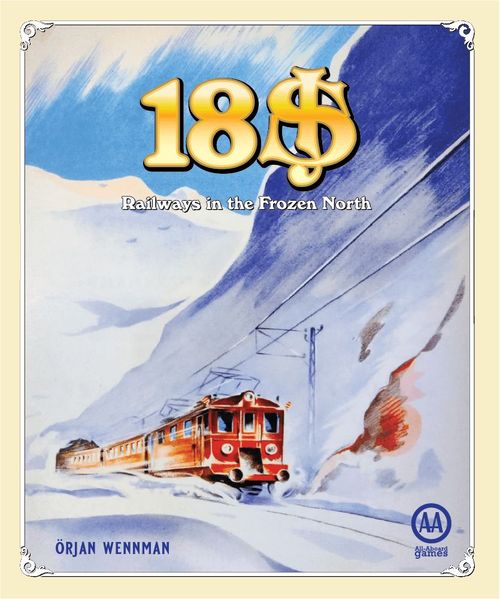
18SJ: Railways in the Frozen North
18SJ: Railways in the Frozen North Rulebook
Table of Contents
Table of Contents
- Game Components
- 1. Introduction
- 2. Setup
- 3. Overview
- 4. Game Board
- 5. Stock Market
- 6. Corporate Entities
- 7. Game Phases
- 8. Private Company Auction
- 9. Stock Rounds
- 10. Operating Rounds
- 11. Nationalization
- 12. Game End
- 13. Variants
- 14. Rules Summary For 18xx Veterans
- Tile Manifest and Upgrade Chart
- Omitted From This Transcription
- Transcription Notes
Game Components
- 1 game board
- 1 Initial Offering board
- 31 train cards
- 105 track tiles
- 12 corporation charters
- 91 tokens (66 company tokens, 12 SJ exchange tokens, 6 KHJ tokens, 3 Göta Kanalbolag tokens, 1 Sveabolaget port token, 2 mine tokens, 1 round marker token)
- 20 orange cubes to mark the mainline hexes
- 99 corporation stock certificates
- 10 private company cards plus 1 Första Tjing card
- 6 player order cards
- 1 moose Priority Deal marker
- The players must supply a bank of 10,000 kr (Kronor). Poker chips are recommended.
1. Introduction
18SJ is a game in the 18xx family set in Sweden and pits two to six players into competition as investors in railway corporations in the formative years of the Nordic railways.
Each player starts as an investor in private companies and later public railway corporations. Personal wealth is accumulated during the game as players invest cash in the stock market and by running profitable railways. Railway corporations are just a means to an end and the corporate treasury might very well be looted by one player and the empty company dumped on an unsuspecting opponent. The player who has accumulated the highest net worth by the end of the game is the winner.
18SJ features a simple mechanism for the nationalization of public corporations and simulates the construction of the mainlines (stambana) of Swedish rail. The nationalization means that each game will ultimately end with a varying number of corporations in play. Shareholders need to be careful in their stock investment and the timing of train purchases to maximize personal profit.
2. Setup
See section 13.2 for an explanation of the rule changes for two players.
Players must supply a bank of 10,000 kr (Kronor).
- Take 2,400 kr from the bank and distribute it evenly among the players.
- 2 players: 800 kr (A.W. Edelsvärd's share of the starting capital stays in the bank)
- 3 players: 800 kr
- 4 players: 600 kr
- 5 players: 480 kr
- 6 players: 400 kr
- Lay out the game board and place the bank nearby.
- Place the two mine tokens on the respective hexes (D3 and D13).
- Place an orange cube in each hex marked with a thick orange line.
- Place the Initial Offering board near the game board, with the regular side up (the "Oscarian Era Variant" side down).
- Sort and stack the train cards so that the most expensive trains (the D-trains/E-trains) are on the bottom of the stack, followed by the next most expensive (the 6-trains), and so on, until the 3-trains) are on top. Splay this stack in the "future trains" space on the Initial Offering board. Then spread out the 2-train cards in the "available trains" space so that everyone can see how many are left.
- Lay out the track tiles nearby for easy access. Only the yellow tiles are needed at first, but the others are relevant to planning for the later stages of the game and should be available for inspection.
- Place the corporation charters and tokens nearby. (There is one extra token for each corporation for use in the Oscarian Era variant.)
- Place each corporation's stock certificates in a stack, with the president's certificate on top, in the indicated space on the Initial Offering board.
- Shuffle the appropriate number of place cards (two to six) and distribute them randomly, one to each player. Reseat the players in numerical order clockwise from the player with the number one place card and also give them the Priority Deal marker. Select one player to manage the bank.
- Remove some private companies and public corporations as described in the next section.
If you are playing with two players, follow the setup rules above but also see section 13.2.
2.1 Remove Corporate Entities
Randomly remove from the game one of the following public corporations:
- Malmö-Ystads Järnväg (MYJ)
- Östra Skånes Järnvägsaktiebolag (ÖSJ)
- Sundsvall-Torphammars Järnväg (STJ)
- Trafikaktiebolaget Grängesberg-Oxelösunds Järnvägar (TGOJ)
The removed company's home city is no longer reserved (see section 10.4). Return the removed corporation's charter and share certificates to the box.
Randomly remove from the game one private company from each pair specified below:
- P1 Frykstabanan and P2 Nässjö-Oskarshamns Järnväg
- P3 Göta Kanalbolag and P4 Sveabolaget
- P6 Motala Verkstad and P7 Nydqvist och Holm AB
- P9 Nils Ericson and P10 Adolf Eugène von Rosen
Return the removed private companies to the game box. If P9 Nils Ericson is in the game (meaning P10 was removed), randomly select one corporation's president's certificate and place it with the P9 certificate.
3. Overview
The game proceeds in a series of alternating stock rounds and sets of operating rounds, beginning with the private company auction. At the start of the game there will be one operating round per set, which will later increase to two and then three operating rounds per set.
The game begins with the auction of the private companies as described in section 8. Once the private companies have been bought by the players, they may also buy and sell stock in the public corporations during stock rounds, as described in section 9.
During operating rounds, players operate the corporations: they lay track, place station tokens, operate trains, and buy trains. Operating rounds are described in section 10.
The game starts in Phase 2 and proceeds through a series of phases with the purchases of trains. See section 7 for details on phase changes.
4. Game Board
The game board features a hexagonal grid superimposed over a map of Sweden and some of Norway. The area marked "Earnings per share" is used to keep track of how much the corporations earn during each operating round.
Cities are represented on the map by large circles, also called station token slots, which may be white or have a corporation's logo in them.
There are also four red off-board areas: Malmö, Göteborg, Stockholms Hamn and Narvik.
The mainline routes are indicated by thick orange lines running from Stockholm to Malmö, Stockholm to Göteborg, and Stockholm to Luleå. Orange cubes are provided to mark these hexes once a tile is placed there, but the mainline has not been constructed.
Mountains are indicated by a red icon and a cost, as in hex B5.
Lakes are represented by thick blue lines between hexes.
Two mines are represented with mine tokens. Routes may score a bonus (section 10.5.3) if they also run the respective destination hex.
4.1 The Trains and Initial Offering Board
This smaller board is two-sided: one side is for use in the normal game, and the other is for use in the Oscarian Era variant. It includes spaces for the train cards and the initial offering of each corporation's stock certificates. The Oscarian Era side also includes an area to indicate corporation par prices.
5. Stock Market
The stock market is a grid where stock market tokens are placed to indicate the current price of one share in a public corporation (known as the share price). Shares are always bought and sold at this price.
5.1 Price Changes and Stock Market Token Movement
A corporation's share price will change throughout the game, which is indicated by moving its stock market token. A token that is moved to a space already containing one or more tokens of other corporations is always placed on the bottom of the stack, underneath the tokens already there. If a token needs to move up or down one or more rows, but cannot because it is at the edge of the market, it does not move. If the token needs to move left or right, but cannot because it is at the edge of the market, it moves up or down as indicated by the arrows.
5.2 Special Zones on the Market
There are several colored areas on the stock market. A corporation's stock market token entering one of these areas impacts the game as follows:
- Corporations in the gray/teal/maroon zones do not count against the certificate limit (section 9.3).
- Gray: The corporation may redeem one share from the Bank Pool at half cost, rounded down (section 10.1).
- Teal: The corporation may redeem all shares from the Bank Pool at half cost, rounded down per share (section 10.1). Additionally, the 60% limit on ownership of the corporation's shares no longer applies (section 9.3).
- Maroon: The corporation may redeem all shares from the Bank Pool at no cost (section 10.1). Additionally, players may buy any number of the corporation's shares, from the Bank Pool and/or the corporation's treasury in a single stock action (section 9.2).
- Blue: if a corporation's stock market token enters the blue area, the game ends at the end of the current operating round (section 12).
- The light red area indicates the prices at which corporations may be started (sections 9.2.1 and 9.2.2), and has no impact on gameplay.
There is a red line on the market, between the 82-value and 90-value spaces. If a corporation's token is to the right of this line, it is eligible to move two steps to the right as a result of dividend payments (section 10.6).
5.3 Descending Share Price Order
Descending share price order is the order of corporations determined by share price, from highest to lowest. The company with the highest share price is first, that with the next highest price is second, and so on. If two or more corporations have the same price, the corporation with the stock market token furthest to the right is first. If two or more corporations' tokens are in the same location, the company whose token is highest in the stack is first.
6. Corporate Entities
6.1 Private Companies
There are ten private companies (or just "companies") in the game, numbered from 1 to 10 (but only six will be used in a game; see section 2.1 for setup details). References in these rules to "P#" are to the private company with the indicated number.
Each private company is represented by a certificate, which indicates its face value, revenue, and special ability.
Private companies start the game owned by the bank. They are purchased by players during the private company auction (section 8), and from Phase 3 onward may be purchased from players by public corporations. Most private companies confer a special ability to their owner.
Private company revenue is paid from the bank to the company's owner at the start of every operating round.
In Phases 3 and 4, a corporation can buy private companies from players. The selling player must agree to the sale. The price can be any whole amount from one-half to twice the company's face value. This may be done at any time during its operating turn, by giving the money to the player.
Private companies owned by players count towards the certificate limit (section 9.3).
A private company cannot be purchased or sold once it belongs to a corporation. Players cannot purchase private companies from each other.
All private companies close and are removed from the game at the start of Phase 5 (unless otherwise specified).
6.1.1 P1 Frykstabanan
Face Value: 20 kr, Revenue: 5 kr
Track may not be laid in hex B15 while this company is owned by a player.
6.1.2 P2 Nässjö-Oskarshamns Järnväg (NOJ)
Face Value: 20 kr, Revenue: 5 kr
Track may not be laid in hex D23 while this company is owned by a player.
6.1.3 P3 Göta Kanalbolag
Face Value: 40 kr, Revenue: 15 kr
When this company is purchased by a corporation, the president of that corporation places one of the three Göta Kanal bonus tokens (50/30/20) on each of the Göta Kanal hexes (C16, C20, C24, and E24). When this corporation operates, if any of the hexes are included in a train route, the route's value is increased by the sum of all Göta Kanal bonuses that are reached by that route. After operating trains, the highest-valued Göta Kanal bonus token that was included in a route is removed from play. The tokens only affect the corporation that owns the Göta Kanal private company. Remove any remaining bonus tokens when this company closes.
6.1.4 P4 Sveabolaget
Face Value: 45 kr, Revenue: 15 kr
The owning corporation may place the port token in, or move it to, hex A26, C30, D27, F9, F13, or G6 during its operating turn (when this company is owned by a player the port token may not be placed). Add 30 kr per port symbol to all routes run to this location by the owning corporation; only the owning corporation receives this bonus. Remove the port token when this company closes.
6.1.5 P5 The Gellivare Company
Face Value: 70 kr, Revenue: 15 kr
During the owning corporation's operating turn, it may place two extra track tiles in hexes E4 and F5. These tiles must be connected to each other. The corporation does not need to be able to trace a route to these hexes. If track tiles have already been placed in these hexes this ability may not be used. The corporation may also lay track normally in the same operating turn.
Additionally, if the owning corporation places a track tile in D3 the terrain cost is reduced to 0 kr. The terrain cost for C2 is likewise reduced to 75 kr.
Track may not be laid in hexes E4 and F5 while this company is owned by a player.
6.1.6 P6 Motala Verkstad
Face Value: 90 kr, Revenue: 20 kr
Once during the game, immediately before the run trains action, owning corporation may buy one or more new trains from the bank. The purchase train action (10.7) must be skipped by this corporation in the operating round when the ability is used. Using this ability does not close this private.
6.1.7 P7 Nydqvist och Holm AB (NOHAB)
Face Value: 90 kr, Revenue: 20 kr
The owning corporation may buy one new train from the bank at half price. This may only be done once during the game. Using this ability does not close this private.
6.1.8 P8 Köping-Hults Järnväg (KHJ)
Face Value: 140 kr, Revenue: 0 kr
This company is a minor corporation (KHJ) controlled by the owning player. When bought by a player, give KHJ a 2-train and place its home station token in hex D17. KHJ operates at the start of every operating round, after private company revenues have been paid. It places track normally, and when it runs its train, its earnings are split evenly between its own treasury and the owning player. KHJ may never buy or sell trains. After its 2-train rusts, it may continue to lay track normally. KHJ is not obligated to own a train. KHJ is not eligible to be nationalized. See section 10 for details on how corporations operate.
When bought by a corporation, the purchasing corporation receives KHJ's 2-train and treasury, and replaces KHJ's station token with one of its station tokens. This is an extra white-colored token in excess of the number given in the table below. If the purchasing corporation already has a station token in Köping (D17) then remove the KHJ station token from the game.
A major corporation at train limit may not purchase KHJ. The purchasing corporation may not run a route with KHJ's train in the same operating round that it was purchased.
6.1.9 P9 Nils Ericson
Face Value: 220 kr, Revenue: 25 kr
The purchasing player receives the president's certificate set aside during setup (see section 2). They must immediately set that corporation's starting share price by placing one of its tokens on the stock market in one of the light-red areas. Twice the starting value is placed in the corporation's treasury. This company cannot be bought by a corporation and closes when the associated corporation buys its first train.
The purchasing player also takes the "Nils Ericson Första Tjing" card. This card grants the player the ability to take the Priority Deal marker at the beginning of one stock round. This ability remains with the player until used, even after Phase 5.
6.1.10 P10 Adolf Eugene von Rosen
Face Value: 220 kr, Revenue: 30 kr
The purchasing player receives the president's certificate for ÖKJ. They must immediately set ÖKJ's starting price by placing one of its tokens on the stock market in one of the light-red areas. Twice the starting price is placed in the corporation's treasury. This company cannot be bought by a corporation and closes when ÖKJ buys its first train.
6.2 Public Corporations
There are eleven public corporations in the game. There are ten shares of stock available in each corporation, each representing 10% of the corporation. These shares are divided across nine certificates: one president's certificate and eight regular certificates. The president's certificate is worth two shares, (20% of the corporation), and the eight regular certificates are each worth one share. The value of each share is equal to the corporation's share price, which is indicated by the location of the corporation's stock market token.
The term "stock" is used in situations where the certificate-share distinction is unimportant.
The owner of the president's certificate is the current president of the corporation and makes all of the decisions for the corporation. This will usually be the player who is the majority shareholder. Presidencies may change as described in section 9.4.
The following table gives an overview of each of the public corporations:
| Corporation name | Abbreviation | Color | Home city | Station tokens |
|---|---|---|---|---|
| Swedish-Norwegian Railroad Company | SNJ | Dark Blue | G6 | 4 |
| Kil-Fryksdalen Järnväg | KFJ | Gray | C16 | 3 |
| Uppsala-Gävle Järnväg | UGJ | Pink | F19 | 3 |
| Örebro-Köpings Järnvägsaktiebolag | ÖKJ | Purple | C20 | 2 |
| Bergslagernas Järnvägar AB | BJ | Brown | A22 |
* This may be one of the four companies removed during setup (see section 2.1).
7. Game Phases
Note: if you are new to 18xx games you may wish to skip this section for now and come back to it after you have read the rest of the rules.
18SJ proceeds through a series of phases, beginning in Phase 2. New phases cause some rules to be modified and new rules to come into effect.
Phases are generally named for the latest type of train that has been purchased (exceptions: Phase 2 and 7). Phases change with the purchase of the first of the next type of train: when the first 3-train is bought the game enters Phase 3, and so on. Phase 7 begins with the purchase of either the first D-train or E-train.
Phase change effects take place immediately, except for the number of operating rounds per set, which changes after the following stock round. Trains that rust are immediately removed from the game without compensation. The table below summarizes the different phases. Each phase is explained in detail afterwards.
The train limit is the number of trains a corporation is allowed to own. A phase change may cause one or more corporations to be in excess of the limit; in this case the corporation's president must discard trains (their choice) to the Bank Pool until the limit is met.
| Phase | Begins | Trains rusted | Train limit | Track tiles | Operating rounds per set | Private companies in stock round | Capitalization |
|---|---|---|---|---|---|---|---|
| 2 | Start of game | 4 | Yellow | 1 | Players | Incremental | |
| 3 | First 3-train | 4 | Yellow and Green | 2 | Players or Corps. | Incremental | |
| 4 | First 4-train | 2 | 3 | Yellow and Green | 2 |
-
Check for nationalization after trains rust.
-
The number of operating rounds only increases after the stock round following the purchase of the train that triggered the phase change.
Phase 2
Phase 2 begins with the start of the game.
- Only yellow tiles are available.
- One operating round between stock rounds.
- Train limit is 4.
- Private companies may only be owned by players.
- New corporations that are started in this phase are capitalized incrementally (see 9.2.1).
Phase 3
Phase 3 begins with the purchase of the first 3-train.
- Yellow and green tiles are available.
- Two operating rounds between stock rounds.
- Train limit is 4.
- Corporations may purchase private companies from players.
- New corporations that are started in this phase are capitalized incrementally.
Phase 4
Phase 4 begins with the purchase of the first 4-train.
- Yellow and green tiles are available.
- Two operating rounds between stock rounds.
- Train limit is 3.
- Corporations may purchase private companies from players.
- The 2-trains rust. Check for nationalization.
- New corporations that are started in this phase are capitalized incrementally.
Phase 5
Phase 5 begins with the purchase of the first 5-train.
- Yellow, green, and brown tiles are available.
- Three operating rounds between stock rounds.
- Train limit is 2.
- All private companies are closed and removed from the game. If P8 KHJ is still owned by a player, remove its station token from play and return its treasury to the bank.
- New corporations are fully capitalized when they float (see 9.2.2); corporations that were already started continue to be capitalized incrementally.
Phase 6
Phase 6 begins with the purchase of the first 6-train.
- Yellow, green, brown, and gray tiles are available.
- Three operating rounds between stock rounds.
- Train limit is 2.
- The 3-trains rust. Check for nationalization.
- The D-trains and E-trains are now available for purchase, in addition to the remaining 6-trains.
- New corporations are fully capitalized when they float.
Phase 7
Phase 7 begins with the purchase of the first D-train or E-train.
- Yellow, green, brown, and gray tiles are available.
- Three operating rounds between stock rounds.
- Train limit is 2.
- The 4-trains rust. Check for nationalization.
- New corporations are fully capitalized when they float.
8. Private Company Auction
Lay out the private company certificates in a line, beginning with the lowest-numbered company and proceeding in order to the highest-numbered one. Players may only buy stock in the corporations once all of the private companies have been purchased.
The player with the Priority Deal marker takes the first turn, and play proceeds clockwise around the table.
On their turn players must do one of the following:
- Buy the first private company in the line.
- Place a bid on a private company later in the line.
- Pass.
Each action is explained below.
8.1 Buying the First Private Company
To buy the first private company, the purchasing player pays the company's face value to the bank and takes the certificate. Next, check the following private company in the line. This company will have zero, one, or two or more bids on it.
- Zero bids: stop here. It is now the next player's turn. Give them the Priority Deal marker.
- One bid: the bidding player purchases the company for the amount bid. Now repeat this check for the next company in line.
- Two or more bids: the bidding players auction the private company as described below in "Resolution Auction Procedure," and then repeat this check for the next company in line.
If there are no private companies remaining, the auction is over.
8.2 Placing a Bid
A bid for a private company must exceed the face value of the company, or the highest previous bid, by at least 5 kr and in multiples of 5 kr. Set aside the bid money: it may not be used until ownership of the company is resolved. Any number of players may bid for the same company. Play continues with the next player.
Note: players may use any desired method to track player bids on private companies. For instance, they could place the money on the corner of the card closest to themself, or give each player the tokens from a corporation and place the token with the money on the card.
8.3 Passing
A passing player declares that they pass, and play continues with the next player. A player who has passed may act as usual on their next turn.
8.4 Resolution Auction Procedure
The player whose bid is lowest takes the first turn. That player must bid an amount at least 5 kr greater, and in multiples of 5 kr, than the current highest bid on this private company, or pass. A player who passes is out of the resolution auction. Continue with the next player in clockwise order. Repeat this procedure until all but one bidder has passed. This player purchases the company from the bank for the amount they bid, using the money they have already set aside in their initial bid. Unsuccessful bidders take back the money they had set aside in their initial bid.
8.5 Auction End
The private company auction ends in one of two ways:
- All companies have been purchased. In this case, continue with the stock round. The Priority Deal marker will be held by the player to the left of the last player who purchased the first company in the line, as described in 8.1.
- All players pass while companies remain unsold. In this case, conduct an operating round wherein purchased private companies pay revenue to their owners. KHJ does not operate, even if owned by a player. Then restart the private company auction with the remaining companies. Bids already made remain in place.
If, in the second case, P1 was not sold, reduce its face value by 5 kr. This procedure may be repeated if necessary, the price being reduced in 5 kr decrements until a buyer is found. If there is no buyer at 5 kr, then the player with Priority Deal must accept it now for free. This counts as a purchase as described above under 8.1, Buying the First Private Company.
Once all of the private companies have been purchased, proceed to the first stock round.
9. Stock Rounds
In stock rounds, players have the opportunity to sell and buy stock and to start new corporations. Players take turns in clockwise order, starting with the holder of the Priority Deal marker.
The active player may perform the following actions in this order:
- Sell any number of certificates (section 9.1).
- Buy one certificate (section 9.2).
- Sell any number of certificates (section 9.1).
These actions are optional (exception: a player exceeding the certificate limit or the 60% ownership limit is forced to sell; see 9.3 for details). A player may alternatively choose to do nothing and pass.
The stock round ends when all players have passed consecutively. This means that if a player takes any action, they are guaranteed another turn in the current round. A player who has passed on their turn may act on a future turn, so long as another player takes an action before then.
9.1 Selling Stock
To sell shares, place any number of owned stock certificates in the Bank Pool. The bank pays the player the current share price for each share sold. The sold corporation's stock market token is then moved down one row per share sold.
The following restrictions apply:
- No stock may be sold during the first stock round.
- No stock in unfloated corporations may be sold.
- There may never be more than 50% of a company's shares in the Bank Pool.
- A president's certificate may not be sold directly to the Bank Pool, but it may be sold under certain circumstances; see section 9.4 for details about changes in presidency.
A player selling stock in multiple corporations chooses the order in which they are sold. A player selling stock in a corporation may choose to sell some or all of their shares. A player may sell some of their stock in a corporation on one turn, and sell more shares in the same corporation on a later turn.
If a player is in violation of the certificate limit or 60% ownership limit (see section 9.3), they must sell stock on their turn until they are back within the limit.
9.2 Buying Stock
Players may buy stock from a corporation's treasury, initial offering, or from the Bank Pool. The following restrictions apply:
- The player may not purchase a share of a corporation if they sold stock in that corporation earlier in the stock round.
- Only one certificate may be purchased on a turn. Exception: If the corporation's stock market token is in the maroon zone, any number of its shares may be purchased from the Bank Pool, initial offering, and corporate treasury in a single action.
- Certificate and share limits must be respected (see 9.3).
- The first stock certificate of a corporation that is purchased must be the president's certificate, as part of starting that corporation (see 9.2.1 and 9.2.2).
For shares from the initial offering or Bank Pool, payment is made to the bank. For shares from a corporation's treasury, payment is made to the corporation.
As a "buy" action players may start a new public corporation. The procedure depends on the current phase.
9.2.1 Starting a New Corporation in Phases 2, 3, or 4 (Incremental Capitalization)
A player may start an unstarted corporation as a "buy" action. The procedure is as follows:
- Set the corporation's share price by placing a token on the stock market in one of the red boxes: 67, 71, 76, 82, 90, or 100 kr. The token goes beneath any other tokens already in that box.
- Move the corporation's stock certificates to its treasury.
- Purchase the president's certificate from the treasury for twice the share price.
The corporation floats (becomes active) once 60% of the corporation's stock has been purchased from the treasury. At this point, the president takes the corporation's treasury and tokens. One token is placed on the revenue tracker.
A corporation that starts before Phase 5 but does not float still remains incrementally capitalized for the rest of the game (like corporations that do float before Phase 5).
9.2.2 Starting a New Corporation in Phases 5, 6, and 7 (Full Capitalization)
Note: the printed heading reads "in Phases, 5, 6, and 7"; the comma after "Phases" is a typographical error in the source.
The procedure for starting a new corporation changes at the start of Phase 5.
A player may start an unstarted corporation as a "buy" action. The procedure is as follows:
- Set the corporation's share price by placing a token on the stock market in one of the red boxes: 67, 71, 76, 82, 90, or 100 kr. The token goes beneath any other tokens already in that box.
- Purchase the president's certificate from the initial offering for twice the share price.
The corporation floats once 60% of the corporation's stock has been purchased. At this point, the president takes the corporation's charter and tokens. One token is placed on the revenue tracker. The bank then pays ten times the corporation's share price to its treasury. The unsold stock certificates remain in the initial offering.
9.3 Certificate and Share Ownership Limits
The number of certificates (stock and private companies) a player may own is limited, depending on the number of players in the game and the number of corporations in play. The game starts with ten corporations in play, and each nationalization can reduce this number by one. President's certificates, regular 10% certificates, and private companies each count as one certificate.
If a corporation's stock market token is in the gray, teal, or maroon zone of the stock market, then that corporation's stock does not count against the certificate limit.
A player in excess of the certificate limit must sell stock during their next stock round turn in order to comply with the limit. The 50% limit on per-corporation stock in the Bank Pool still applies and takes precedence over the requirement to sell shares.
Additionally, a player may not own more than 60% of a corporation. However, this limit does not apply if the corporation's stock market token is in the teal or maroon zones of the stock market. If the token later moves out of the teal and into the gray zone, a player owning more than 60% of the corporation must sell stock during their next stock round turn in order to comply with the limit. The 50% limit on per-corporation stock in the Bank Pool still applies and takes precedence over the requirement to sell shares.
The certificate limit is given by the following table (corporations in play down the left side, number of players across the top):
| Corporations in play | 2-3 players | 4 players | 5 players | 6 players |
|---|---|---|---|---|
| 10 | 26 | 20 | 16 | 13 |
| 9 | 23 | 18 | 14 | 12 |
| 8 | 20 | 15 | 12 | 10 |
| 7 | 17 | 13 | 11 | 9 |
9.4 Presidency Changes
A change in presidency occurs if a player owns more shares in a corporation than the current president. This can occur due to a player purchasing a share giving them a greater holding in the corporation, or due to a president selling shares in the corporation such that they now hold fewer shares than another player. Equal share ownership does not cause a change in presidency.
If more than one player holds more shares than the president, the new president is the player with the largest holding, or, in the case of a tie, the tying player closest to the outgoing president's left. The outgoing president exchanges their president's certificate for two ordinary certificates of the affected corporation belonging to the new director.
Although a president's certificate may not be sold to the Bank Pool, a president may sell the president's certificate shares so long as another player holds at least two shares in the corporation. To do so, the outgoing president first exchanges the president's certificate for two normal certificates from the player who will become the new president, and then sells the desired number of shares to the Bank Pool. This can be done even if the outgoing president is already at certificate limit because they are immediately selling stock. The 50% limit on shares in the Bank Pool applies.
9.5 End of Stock Round
The stock round ends when all players have passed consecutively. Give the Priority Deal marker to the player to the left of the last player who sold or bought stock.
If all of a corporation's shares are owned by players, move the corporation's stock token up one row on the stock market. If it is already at the top, it does not move.
10. Operating Rounds
At the start of each operating round, private company revenue is paid by the bank to the company's owner. Next, the Köping-Hults Järnväg (KHJ) minor corporation operates (see 6.1.8 for details). Then floated corporations operate in descending share price order (see 5.3). This order is determined dynamically: after a corporation operates, the next corporation to operate is the next one currently in order. Corporations are operated by their president. Unfloated corporations do not operate.
The number of operating rounds in a set is determined by the phase the game was in at the end of the preceding stock round. If a phase change increases the number of operating rounds, that change only takes effect after the following stock round (see section 7 for more details on phase changes).
On their operating turn, corporations take the following actions, in this order:
- Redeem shares from the Bank Pool (optional)
- Lay and/or upgrade track tiles (optional)
- Place a station (optional)
- Run trains (mandatory)
- Distribute earnings and adjust share price (mandatory)
- Purchase new trains (may be optional or mandatory)
From Phase 3 and onwards private companies may be bought by a corporation at any time during its operating turn. The price must be between half and twice the company's face value, inclusive.
At the beginning of a corporation's first operating turn, it must place a station token in its home city. There is no cost to perform this action and the corporation may place another station in the same operating turn.
10.1 Redeeming Shares
To redeem a share, the corporation purchases it from the Bank Pool and puts the share into the corporate treasury.
The location of the corporation's stock market token affects how many shares can be redeemed and the price paid.
- Corporations with a share value of 65 kr or more may redeem one share at the current price.
- Corporations with a share price of 60 kr or 63 kr (the gray zone) may redeem one share from the Bank Pool at half the current price, rounded down.
- Corporations with a share price of 50 kr (the teal zone) may redeem all shares from the Bank Pool at half the current price (rounded down per share).
- Corporations with a share price less than 50 kr (the maroon zone) may redeem all shares from the Bank Pool for no cost.
10.2 Routes
Routes are used in determining where a corporation may place track tiles, place station tokens, and run trains. A route of a company is a continuous length of track, including somewhere along it at least one station with a station token on it that belongs to the company.
A corporation has a route to a location if a continuous length of track connects that location to one of the corporation's station tokens. A route may only pass through cities where the corporation has a station token, or where there are one or more empty station token slots. Routes may not pass through red off-board areas.
A route may not reuse any segment of track; backtracking is not allowed. A route entering a city from any direction may exit by any other direction. A route may not enter or pass through a city more than once, including Stockholm.
A route may pass through the same hex multiple times over plain track, so long as no track is reused. A route may not reverse direction at a junction.
Routes may begin or end at any city or off-board area, including those fully occupied by station tokens of other companies.
10.3 Placing and Upgrading Track Tiles
Corporations may place or upgrade one track tile during this step. There are two types of track tiles: plain and cities. City track tiles are used in hexes with cities, and plain track tiles are used everywhere else.
Further, there are two named city tiles: Stockholm and Ystad. Tiles labeled with a named city may only be placed on the corresponding hex. The others are plain city tiles and are placed on the other cities.
Tiles may not be placed such that track runs:
- off of the hex grid.
- against a side of a gray or red hex where there is no track connection.
- into one of the blue hex sides around Lake Vänern.
- into the three blue hex sides representing Lake Vättern.
Additionally, tiles may not be placed on hexes containing private companies owned by players. If the private company has been closed, or is owned by a corporation, then tiles may be placed in that hex normally. Tiles may not be placed on gray cities or on red off-board areas.
Tile availability depends on the game phase: yellow tiles are available from the start of the game; green tiles are available from Phase 3; brown from Phase 5; and gray from Phase 6.
Track tiles are limited to the quantity supplied. However, the quantity of plain yellow track tiles #7, 8 and 9 is unlimited. Construct additional track as needed if these tiles run out.
Whenever a tile is placed on a hex that contains an orange mainline cube, replace it on the new tile unless that tile has built the respective mainline track (see 10.3.3).
10.3.1 Placing Yellow Tiles
Yellow tiles are placed on and aligned with the light green hexes on the map. The placed tile must extend a route of the placing corporation. While there is no track in a corporation's home hex, it may lay any suitable city tile there. Any terrain costs must be paid before the tile is placed, see 10.3.4 for details.
10.3.2 Upgrading Tiles
Track tiles are upgraded by removing the previous tile and replacing it with a new tile of the next color in sequence: yellow to green, green to brown, and brown to gray. The removed tile is returned to the supply and available for reuse. Plain tiles and city tiles must be upgraded with a tile of the same type.
When upgrading a tile, all of the previous track segments must be retained. For plain track, the upgrading corporation must also have a route to some of the new track added by the tile upgrade. City tiles may be upgraded so long as the corporation has a route to the tile, even if it does not necessarily have a route to new track on the tile.
If the upgraded tile has one or more station tokens on it, these are replaced on the new tile in the same position as before.
Terrain costs may be incurred as a result of a tile upgrade; see 10.3.4 for details.
10.3.3 Additional Mainline Tile Actions
There are three different mainlines marked on the map, represented by orange lines. A corporation may place or upgrade (phase permitting) one extra tile in an operating turn if the new track completely matches the path of the mainline within the hex. This represents the government constructing the mainline for the corporation.
When a tile is laid that builds mainline track, remove the orange cube from the game. These cubes have no gameplay purpose. They only serve as a reminder of where mainline track remains to be built.
The additional mainline tile action may be taken before or after the normal track action. Upgrades with both the normal track action and the additional mainline track action is permitted. See the examples below.
Terrain costs may be incurred as usual; see the next section for details.
Mainline Example 1:
ÖKJ has a station token in Skövde. The corporation lays tile #8 in D19 (the hex between Katrineholm and Köping) with its regular track action. ÖKJ then lays tile #57 in Västerås using an additional mainline track action. This is allowed since the track on the second tile matches the orange mainline track for the first time in Västerås. Since the mainline track action can be before or after the regular action, the reverse would also be possible (mainline track action in D19 and regular track action in Västerås). In this example, the result is the same either way. In both cases, remove both orange mainline cubes because the mainline was built in both hexes.
Mainline Example 2:
This example illustrates that the mainline rule is still in effect even after a tile covering the mainline has been placed (the orange mainline cube marks this). Green tiles are available. ÖKJ upgrades to tile #25 in hex D19 using a mainline track action (removing the cube). This is legal because the new track matches the path of the mainline in hex D19. If the orientation of tile #25 had been different and the path of the mainline not matched, the second tile action would not have been allowed. The path of the mainline in hex D19 matches because the edges of the hex towards Västerås and Skövde are now connected by track following the orange line under the #8 tile. Since ÖKJ has not yet used its regular track action, it can now lay track in Västerås using any tile available and is free to match or not match the mainline in Västerås. In this case a #6 city tile pointing towards Uppsala to the right is chosen.
Mainline Example 3:
In this example, KFJ has laid its first tile in its home hex using its regular track action (outlined in red). Then the president wishes to lay the outlined tile in the right image. However, no matter how the tile is laid, it will not match the mainline track in the hex and so the extra track action cannot be used.
(The diagrams for Mainline Examples 1 to 3 are not reproduced here.)
10.3.4 Terrain Costs
There are two types of terrain costs: mountain costs and connection costs.
Mountain costs are indicated in a hex by a mountain symbol and a cost, either 75 kr or 150 kr. A corporation placing a yellow tile in these hexes must pay the cost before the tile is placed. If the corporation cannot afford the cost, the tile may not be placed. These costs are only paid once; upgrading a tile in a mountain hex incurs no further cost.
Connection costs are indicated by a triangle line and a 75 kr cost between two hexes. This cost must be paid when a corporation places a tile completing a track connection across the line. If the corporation cannot afford the cost, the tile may not be placed. Connection costs may be triggered by the placement of a yellow tile or an upgrade.
10.4 Placing Station Tokens
A corporation may place one station token per operating turn from its charter in any open station token slot to which it has a route. This is in addition to placing its home token at the start of its first operating turn. A corporation may never have more than one station token in a hex. Station tokens may not be placed in the reserved home city slot of another corporation (or the SWB's home station token slot in Stockholm) unless one or more open station token slots remain open afterward.
The first non-home station token a corporation places costs 40 kr and each subsequent token costs 100 kr. These prices are also indicated on the corporation charters.
10.5 Running Trains
The corporation must now run its trains on train routes to generate revenue and earnings.
10.5.1 Train Routes
Each train runs on a train route; all of the rules covering normal routes (section 10.2) apply. In addition, train routes must begin and end at two different cities and/or off-board areas (collectively referred to as stops), and include at least two different stops. A train route may only enter a stop once. Trains may not use any track segments used by any of the corporation's other trains in the same operating turn. Multiple trains owned by a single corporation may pass through and count a single stop as long as no section of track is reused.
The maximum number of stops a train can run to is equal to the train's type, indicated on the card. A 2-train can run to up to two stops, a 3-train up to three stops, and so on.
The D-trains are diesel trains; they have no maximum number of stops.
E-trains are electric trains; they also have no maximum number of stops, but may additionally run trains through the SJ station tokens (see section 11) as if they were empty station token slots. This special ability only serves for running trains, not placing tiles or station tokens. E-trains also earn a bonus for running routes that include their station markers (see 10.5.2).
To run a train, demonstrate its route to the other players and announce its revenue (see next section). Do this for all of the corporation's trains.
10.5.2 Revenue and Earnings
The run's revenue is the sum of the values of all stops on the route, plus any bonuses (see 10.5.3). The corporation's earnings is the sum of the revenue of all its train runs. Corporations must run for the maximum possible earnings that can be demonstrated. If a player finds a better run than that used by the president, they are not obligated to demonstrate it.
The value of a city is indicated by a circled number in the city's hex (either on the board or the track tile). The value of an off-board area is color-coded based on the current phase: use the yellow value during Phase 2, the green value in Phases 3 and 4, the brown from Phase 5 onward.
When an E-train runs to a stop containing one of the corporation's station tokens the value of the stop counts double (for that E-train only).
10.5.3 Revenue Bonuses
There are four bonuses a train route may earn if it includes certain groups of stops.
Cross-Country Bonuses
A route earns the printed bonuses if it includes a cross-country bonus. (The bonus amounts are printed on the game board and are not stated in the rules text.)
- Norr-Söder (North-South): A train route that includes both Stockholms Hamn (hex H23) and Narvik (B1).
- Öst-Väst (East-West): A train route that includes both Stockholms Hamn and either Malmö (A30) or Göteborg (A22).
Ore Mine Bonus
A route that includes the mine and one ore destination earns a 50 kr bonus. If the train route includes both corresponding ore destinations, it earns a 100 kr bonus. Both bonuses may be earned by the same train.
- Malmfälten: A train route including the ore mine Malmfälten (D3) and either ore destination Luleå (G6) or Narvik (B1).
- Bergslagen: A train route including the ore mine Bergslagen (D13) and either ore destination Stockholms Hamn (H23) or Göteborg (A22).
10.5.4 Revenue Tracker
After calculating the corporation's total earnings, update the revenue tracker by placing its token in the space matching one-tenth of the total earnings.
Example: Albin is operating MYJ. It runs two 2-trains for 40 kr each (80 kr total). He places MYJ's revenue tracker token in the "8" space.
10.6 Distributing Earnings
After running its trains, the corporation distributes its earnings. It may withhold the earnings in the company treasury or pay dividends.
If the corporation withholds, the bank pays the full earnings amount into the corporation's treasury and the share price token moves left one step.
If the corporation pays dividends, the bank pays the earnings to the shareholders based on their holdings: 10% of the earnings are paid to the owner of each 10% share. Dividends for shares in a corporation's treasury are paid to the treasury. Dividends for shares in the Bank Pool or Initial Offering are kept by the bank.
After paying dividends, move the stock market token as follows:
- If the amount paid (including money kept by the bank) is less than the corporation's share value, the token does not move.
- If the amount paid is at least equal to the corporation's share value, but less than twice the value, move the stock token one step to the right.
- If the amount paid is at least twice the corporation's share value and that value is greater than 82 kr (meaning the stock market token is to the right of the red line on the market), move the stock token two steps to the right. If the share value is 82 kr or less, then move the stock token only one step to the right.
10.7 Purchasing Trains
The operating corporation may now purchase trains. If the corporation has a valid train route, but does not own a train, it must purchase one; otherwise this step is optional. Trains are purchased one at a time, and any phase change effects take place immediately (see section 7). A corporation may not purchase a train if it is at the train limit.
Trains may be purchased from the bank (only those in the "available trains" space), the Bank Pool, or other corporations.
When purchasing trains from the bank or Bank Pool, the corporation pays the train's face value to the bank. After the last train has been purchased from the "available trains" space, refill the space with the train cards of the next type from the train stack. Exception: Once the first 6-train has been purchased the D-trains and E-trains become available, along with the remaining 6-train.
When purchasing a D- or E- train, the corporation may trade-in a 4-, 5-, or 6-train for a 300 kr discount off the cost of the new train. This trade-in may be done even if the corporation is at train limit. The traded-in train is removed from the game.
Trains may be purchased from the Bank Pool by paying their face value to the bank. Trains in the Bank Pool are always available alongside the trains in the card stack, and they do not have to be purchased in order.
Trains can also be purchased from another corporation, for any price (minimum of 1 kr) that is mutually agreed-upon by the president(s) of the two corporations. This is done during the purchasing corporation's operating turn.
If a corporation with a train route does not have a train, then it must purchase one. If it cannot afford any of the trains in the bank or Bank Pool, and is unable to secure a purchase from another corporation, then the president must conduct emergency money raising; see section 10.8.
The train supply is as follows:
| Train type | Number | Face value (kr) |
|---|---|---|
| 2-train | 6 (+1 for KHJ) | 80 |
| 3-train | 5 | 180 |
| 4-train | 4 | 300 |
| 5-train | 3 | 530 |
| 6-train | 2 | 630 |
| Diesel (D) | No limit* | 1100 (800) |
| Electric (E) | No limit* | 1300 (1000) |
* There is no limit on the number of D- and E-trains available. In the unlikely event that more are needed, use the 2- and 3-train cards as substitutes.
10.8 Emergency Money Raising
If a corporation is obligated to purchase a train, but does not have enough money to purchase one from the bank or Bank Pool, and is unable to arrange a purchase from another corporation, the president must contribute their own money to the purchase. They may only contribute enough to purchase the cheapest train available (this means the corporation will have no money left in its treasury after the purchase).
The corporation may purchase a train from another corporation this way. The price paid for the train may not exceed its face value, and the president contributes money as described above. A corporation is never required to purchase a train from another corporation, even if the train is offered at a lower cost than the cheapest train otherwise available.
If the president is unable to contribute enough money to buy a train, both the corporation and president spend all of their money. The president must then sell shares until they have raised enough additional money to purchase the train. The following rules apply:
- The acting president decides which shares to sell and the order they are sold.
- The president must stop selling shares as soon as the necessary amount has been raised.
- Share prices are lowered as in normal stock sales, as described in 9.1.
- The 50% limit on shares in the Bank Pool applies.
- Sales may not cause a change in the presidency of the corporation that is attempting to buy a train.
- Changes in presidencies of other corporations take place immediately.
If the president is unable to raise enough money, they are bankrupt and the game ends immediately, and no train is purchased.
Example: Ebba is president of the SNJ and must raise 100 kr from selling stock to purchase a new train. In addition to her SNJ shares, she owns three shares of SWB, currently valued at 71 kr, and one share of UGJ valued at 110 kr. She may choose to sell either two shares of SWB (for 142 kr) or her share of UGJ for 110 kr. She may not sell all three SWB shares, as the total amount (213 kr) is more than she needs to buy the train.
11. Nationalization
Nationalization may take place at the start of Phases 4, 6, and 7, after trains have been rusted (these are the 2-trains, 3-trains, and 4-trains, respectively). A corporation is eligible to be nationalized if it has no train and has completed at least one operating turn. KHJ is not eligible to be nationalized. If there are no eligible corporations, then nationalization does not occur.
Only one corporation is nationalized per phase change. If multiple corporations are eligible, the first corporation in descending share price order is nationalized.
The nationalization steps are as follows:
- Move the corporation's stock market token two steps to the left.
- The bank purchases the shares of the corporation from shareholders at the new price.
- Exchange all of the corporation's station tokens for SJ tokens. If this causes two SJ tokens to be in the same city, remove one of them.
- Return the corporation's treasury to the bank.
- Remove all of the corporation's remaining trains, money, private companies, and tokens from the game.
12. Game End
The game ends when one of the following conditions has been met:
- The bank runs out of money. In this case, finish the current set of operating rounds (the bank continues to pay dividends; use any desired method to track this) and then determine who has accumulated the highest net worth. If the bank breaks during a stock round, finish the following set of operating rounds.
- A player goes bankrupt. The game ends immediately.
- If a corporation's stock market token enters the blue area (375 and 400), the game ends at the end of the current operating round.
Determine each player's net worth by adding together their personal cash and the total value of their owned stock. In the rare case that private companies are still owned, they are worth face value.
A bankrupt player may have a net worth greater than 0 kr if they were unable to sell all of their stock, and/or still have private companies at game end. The wealthiest player is the winner. If there is a tie, players should reenact the Rainhill Trials and compete to build the fastest locomotive.
13. Variants
Note: the subsection numbers printed in the source for the variants are inconsistent (the body headings for the Oscarian Era variant read 13.1.1, 13.2.2, 13.3.3, 13.3.4 and 13.3.5, and the two-player variant is printed as 13.2). They are transcribed as printed; the cross-references in the rules text (section 13.2 for the two-player rules) follow the printed body.
13.1 The Oscarian Era - Full Capitalization Variant
This variant changes 18SJ into a more traditional full capitalization game. Use the following rule changes.
13.1.1 Setup
Use the Oscarian Era Variant side of the Initial Offering board. Use all of the tokens for each corporation.
13.2.2 Starting New Corporations
All corporations are fully capitalized, regardless of the phase. To start a new corporation:
- Set the corporation's par price by placing a token on the par price chart on the Initial Offering board.
- Place another token in the corresponding box on the stock market. This token goes beneath any other tokens already in that box.
- Purchase the president's certificate from the initial offering for twice the share price.
The corporation floats once 60% of the corporation's stock has been purchased. At this point, the president takes the corporation's charter and tokens. One token is placed on the revenue tracker. The bank then pays ten times the corporation's share price to its treasury.
The unsold stock certificates remain in the initial offering.
13.3.3 Selling and Buying Shares
Stock in unfloated corporations may be sold.
Shares are bought from the initial offering at the corporation's par price. Shares are bought from, and sold to, the bank pool at the share price indicated by the stock market token (as normal).
If the corporation's stock market token is in the maroon zone, any number of its shares may be purchased from the Bank Pool, initial offering, corporate treasury, and IPO in a single action.
13.3.4 Earnings Distribution
Shares in the Bank Pool pay dividends to the corporation's treasury.
13.3.5 Share Redemption
Corporations may not redeem shares.
During King Oskar II's reign, Sweden underwent a period of industrialisation and rapid technological development. Most of the railroads were built during this time and inaugurated by the King himself. At the same time, the union between Sweden and Norway grew weaker, and was eventually dissolved. This Golden Age of steam, industry, and strict morals is sometimes known as the Oscarian era and is a Nordic parallel to the Victorian era.
13.2 "A.W. Edelsvärd" - 2 Player Variant
This variant makes use of a virtual "third player" who partly acts in an automated fashion, and is partly controlled by the two players. This virtual player is referred to here as "A.W."
Use the following rules:
- Each player receives starting capital as in a three-player game (800 kr). A.W. does not start with any money.
- The players must keep track of the number of stock rounds that have been played. The first stock round is "Stock Round 1," the second is "Stock Round 2," and so on.
- In even-numbered stock rounds: After both players have passed, A.W. starts a new corporation and requisitions (buys without paying for) 100% of the corporation's shares. This must be a corporation with an unsold president's certificate; skip this if there are no unsold presidencies. No money is moved with this transaction. The player with the fewest number of shares chooses the corporation; in the case of a tie, the player with the Priority Deal marker chooses.
- A.W.'s corporations have no stock price. They do not have a stock market token, and so their stock may not be bought or sold. This also means that A.W.'s corporations cannot be nationalized.
- A.W. corporations always act last in each operation round. If there are several, then they operate in alphabetical order.
- When laying track tiles, A.W.'s corporations are controlled by the player with the fewest number of shares (the player with the Priority Deal marker in the case of a tie). The player must lay track in the priorities given below. If there are several possibilities that satisfy the condition within a priority or substep, the player may choose freely (e.g. rotation of a tile). If the first track action improves the mainline (the path of the mainline is followed completely with track within a hex for the first time, as described in 10.3.3), one additional track action must be executed in the same manner. Ignore terrain cost when laying track for A.W.
- The first priority is hexes on the mainline. Only hexes with a mainline that can be improved with the tile action are eligible. The following substeps must be applied in order and within each substep the hex closest to Stockholm must be chosen if more than one qualifies.
- a) Yellow tile (city or plain)
- b) Upgrade a tile (city or plain)
- The second priority is hexes with a city and no possibility to improve the mainline. Within each substep (a through d) the city of highest upgraded value must be chosen (if applicable).
- a) The home station of the corporations
- The first priority is hexes on the mainline. Only hexes with a mainline that can be improved with the tile action are eligible. The following substeps must be applied in order and within each substep the hex closest to Stockholm must be chosen if more than one qualifies.
Adolf W. Edelsvärd was hired in 1855 as SJ's chief architect. During his 40 years in the management of the State Railways' architectural office, no less than 5,725 buildings were erected on the mainlines built by the state, of which 297 were station buildings. Edelsvärd placed great emphasis on the station building's style and function as a new focal point in cities and towns.
14. Rules Summary For 18xx Veterans
If you are familiar with 18xx games, or just need a quick rules refresh, this section highlights the salient points.
Setup
- Some private companies and one corporation are removed randomly; see 2.1.
Private Company Auction
- Waterfall-style as in 18Chesapeake. If everyone passes and P1 is unsold, reduce the cost by 5 kr and resume the auction. Repeat as necessary, if cost becomes 0 kr the player with Priority Deal must "purchase" it for 0 kr.
Stock Rounds
- Sell / Buy / Sell.
- No sales in first stock round.
- No sales of unfloated corporations.
- Stock market token drops one row per share sold.
- 50% limit on shares in the Bank Pool.
- Must sell if in violation of certificate limit or 60% ownership limit.
- Purchase shares from corporate treasuries, Bank Pool, or Initial Offering.
- If a corporation's stock market token is in the maroon zone, players may purchase any number of its shares from any/all locations as a single buy action.
- Corporations started in Phases 2–4 are capitalized incrementally.
- Corporations started in Phases 5–7 are fully capitalized.
- Stock round end: PD to left of last player to act, sold out corporation stock tokens rise one row (if possible).
Operating Rounds
- Privates pay revenue, KHJ operates, then corporations operate in descending share price order.
- Privates can be purchased from Phase 3 on for half to double face value.
- Home station is placed at start of corporation's first operating round turn.
- Corporations redeem shares from Bank Pool. Cost and amount varies by location of stock market token; see 10.1.
- Track: one lay or upgrade plus one mainline tile action (10.3.3).
- Track upgrades: route to new track or increasing value of a city (semi-restrictive).
- Terrain cost between hexes is paid when a complete connection is made across that hex edge.
- D-trains: infinite length.
- E-trains: infinite length, can run through SJ tokens, doubles revenue of the corporation's tokens.
- Revenue bonuses for E-W, N-S, and mine runs (10.5.3).
- Pay / withhold dividends.
- Shares in corporate treasury pay to treasury, shares in Bank Pool do not pay.
- Amount paid must equal share price to go up, can double jump if amount paid is twice or more and share price is greater than 82.
- 4/5/6-trains can be traded-in for 300 kr discount on D- and E-trains.
- Corporations must own a train if they have a train route.
- Emergency Money Raising: director contributes cash, then sells shares.
Nationalization
- After a train type rusts, the highest-valued, trainless corporation is nationalized.
- If no corporation is trainless, no nationalization happens.
- Tie: earliest corporation in descending share price order is nationalized.
- Stock price moves left two spaces.
- Bank buys all shares from players at new price.
- Replace station tokens with SJ tokens (max one SJ token per city).
- Return cash to bank, all other assets removed from the game.
Game End
- Bank breaks: finish operating round set.
- Player bankruptcy: end immediately.
- Corporation stock token hits 375 or 400: end after this operating round.
Tile Manifest and Upgrade Chart
The supplied quantity of plain yellow tiles is not intended to limit play. The tiles supplied with the game should be sufficient for most cases, but players should improvise additional tiles of these types if required.
The printed Tile Manifest and Upgrade Chart (page 19 of the rulebook) is a graphic listing each track tile, its supply count, and its legal upgrades. It is not reproduced as text here; consult the printed chart.
Omitted From This Transcription
The following printed sections are not transcribed: the Credits block (attribution), the Design Notes (designer commentary on historical background, with no rules content), the Sources and Further Reading list, and the printed Index. The printed table of contents is also not reproduced, as navigation only.
Transcription Notes
Transcribed from the official English rulebook "18SJ Rules Web Version sm" (Örjan Wennman, 2021; BGG file 374457). Obvious printing errors are transcribed as printed, except where noted in the body: the "Phases, 5, 6, and 7" heading in 9.2.2 and the "Phases 5 7" wording in the Rules Summary, which are shown with the dash or comma corrected; the "coroporation" spelling in the Game Components list is shown as "corporation"; and the "3-trains)" parenthesis in setup step 6 and the Variant subsection numbers (13.1.1, 13.2.2, 13.3.3 to 13.3.5) are kept as printed.