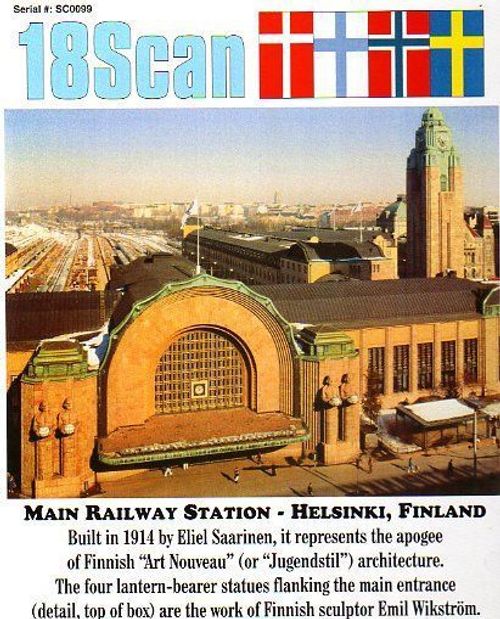
18Scan
18Scan Rulebook
Table of Contents
Table of Contents
1 Introduction
18Scan is an "18xx" game set in the Scandinavian peninsula of Northern Europe. It includes most of Norway, Sweden, Denmark, and Finland. 18Scan is a small 18xx game, in the style of Mark Derrick's "one-state" games 18GA and 18AL, and is intended as a change from the more robust 18xx games often played.
1.1 Game Components
The game includes a Map; a Stock Market chart; various additional play-aid cards; five Corporation charters, each associated with nine share certificates representing ten shares; three Private Company cards; three Minor Company "mini-charters"; train cards, each representing a train; track tiles; markers, mostly representing station tokens; and six thousand Kroner (Crowns) (K6,000) in various denominations, which represents the amount of money in the Bank.
For the purposes of these rules, "Company" should be understood to mean "Corporation or Minor Company". Where relevant differences exist, "Minor Company" or "Corporation" will be used.
1.2 How To Win
Players win by having the highest net worth at the end of the game, when the Bank has broken. Cash on hand and stock shares owned add to net worth. Private Companies, Minor Companies, and shares in Corporations for which a Starting Value has not been assigned add nothing to net worth. Company capital and other Company-owned assets, such as trains, neither add to nor subtract from net worth.
1.3 Player Etiquette
Players should attempt to speed play as much as possible. In particular, determining what share to buy or what tile to lay or upgrade is best done during another player's turn.
A player must disclose his current cash and the current capital of any Company he controls upon request by another player. Both player cash and Company capital should be piled neatly in front of the player (in the case of personal cash) or in the Treasury section of the Company Charter. Company trains should also be neatly displayed in the train section of the Company Charter.
Each player should display his owned Certificates neatly in front of him and must reveal his holdings in a Corporation on demand.
Corporate transactions are public knowledge, whether conducted between a Company and the Bank, a Company and a player, or two Companies.
Players may engage in public discussions and enter into public agreements. Such discussions should be reasonably brief in order to speed play. Performance is not enforceable except by moral suasion: a player who has performed an action under such an agreement in the anticipation of future action by his partner has no other recourse if his partner reneges on the agreement. Secret discussions or agreements are prohibited.
1.4 The Stock Market, Shares, Share Certificates, and Limits on Ownership
A Corporation's value is represented on the Stock Market by a marker, referred to as the Current Market Value (CMV) token, placed in one of the numbered spaces on the Stock Market. When a Corporation is started, the Corporation's President establishes the Corporation's Starting Value. Starting Values are a subset of CMVs, and are highlighted on the Stock Market. Once a Corporation has begun operating, its value may fluctuate, and the token is moved to signify this.
A single share of a Corporation is equivalent to ten percent of a Corporation. Each single share is worth that Corporation's CMV. The President's Certificate represents twenty percent of a Corporation, and is worth twice the Corporation's CMV.
There are important distinctions between shares and share Certificates. For the purposes of share ownership in a Corporation, only the percentage of ownership as represented by shares is relevant: for the purposes of Certificate limits, only the number of Certificates held is relevant.
Each Private and Minor Company is considered a Certificate. Players are limited to owning Certificates (not shares) in accordance with the following table:
| Number of Players | 2 | 3 | 4 |
|---|---|---|---|
| Certificate Limit | 18 | 12 | 9 |
Players are limited to owning sixty percent (60%) of a Corporation's stock. Two-player note: as an optional rule in the two-player game only, allow up to seventy percent (70%) ownership in each Corporation.
2 Game Phases
18Scan proceeds through a series of Phases that affect which tiles may be played, which trains are available to be bought or scrapped, how many trains Companies may own, and the status of Private Companies. Each Phase lasts until the Triggering Event for the next Phase.
| Phase | Triggering Event | Maximum Trains Owned (SJ / Corp / Minor) | New Tiles and Improvements Available | Shares Needed to Open / Funding Type | Trains Available | Trains Scrapped | Off-Map Values Used |
|---|---|---|---|---|---|---|---|
| 2 | - | -/4/2 | Yellow | 2 / Incremental | 6 x 2/1+1 | - | First |
| 3 | First 3/2+2 train bought | -/4/2 | Green | 3 / Incremental | 4 x 3/2+2 | - | Second |
| 4 | First 4/3+3 train bought | -/3/1 | - | 4 / Incremental |
(1) Private and Minor Companies close; SJ eligible to form.
3 Setting Up and Starting the Game
3.1 Setting Up The Game
Lay the Map and the Stock Market flat between the players. Place the Round Marker (the white token with the flanged wheel) in the Turn Order space marked "Stock Round". Separate and sort the Corporation charters, share certificates, Private Companies, Minor Companies, train cards, track tiles, and tokens.
Put the Private Companies and Minor Companies in the Pool, along with the following share certificates (with the Private Companies) and starting capital (with the Minor Companies):
| Private or Minor Company | Starting Capital | Accompanying Certificate |
|---|---|---|
| Stockholm-Åbo Ferry Company | - | VR single share certificate |
| Lapland Ore Line | - | S&NJ single share certificate |
| Sjællandske Jernbaneselskab (Zeeland Railway Company) | - | DSB President's Certificate |
| Västra Stambanan (Western Mainline) | K200 | - |
| Nordvästra Stambanan (Northwestern Mainline) | K220 | - |
| Södra Stambanan (Southern Mainline) | K260 | - |
Arrange the trains in a stack, in order from top to bottom, such that the first (topmost) train is a 2/1+1 train and the last (bottommost) one is a 4D train. Insert each of the five Phase cards as indicated into the stack, and place the stack in the space marked "Trains Available".
Put the Corporation charters near the play area. Put the remaining share certificates for each Corporation except the SJ in the "Treasury" section of the associated Corporation's charter, with the President's Certificate on top.
For the SJ, Arrange the certificates in a stack, with the President's Certificate on top, followed by the five unmarked single shares, and then finally the three single shares marked "Exchange Share". Then place the entire stack on the space marked "SJ Shares".
Sort the Bank into denominations and place it near the play area within easy reach of the players. Distribute money to each player as shown below:
| Number of Players | 2 | 3 | 4 |
|---|---|---|---|
| Initial Cash | K900 | K600 | K450 |
Randomly determine the move order using the markers numbered one through four (players may find it convenient to seat themselves so that move order is clockwise round the table): give the Priority Deal card to the first player, and begin the Initial Stock Round.
3.2 Initial Stock Round
During the Initial Stock Round, the Private and Minor Companies may be bought from the Pool.
Starting with the player who has the Priority Deal card, and continuing in accordance with the move order determined by the numbered tokens at the beginning of the game, each player may bid for the right to buy any of the six items on offer or he may pass.
Bidding is done in multiples of K5. The initial bid must be zero or more, and each subsequent bid must be K5 or more higher than the previous bid. Once a player has passed, he may not re-enter the current auction. Players may never bid more in total (that is, the amount of their bid, plus the face value of the least expensive item on offer) than their remaining cash.
Players continue to bid until all have passed consecutively. The player who initiated the round of passes is given the Priority Deal card. The player who has the high bid now pays this amount to the Bank, and then selects any item on offer that he can afford with his remaining cash. He then pays the item's face value to the Bank and places it in front of him. If the item is a Private Company, he also takes the associated share certificate. If the item is a Minor Company he also takes the associated starting capital.
The SJS Private Company comes with the President's Certificate of the DSB. When a player buys the SJS, he sets the Starting Value of the DSB, takes twice this amount from the Bank (not the SJS face value), and places it in the DSB Treasury as its starting capital. He then takes the DSB charter, along with the associated starting capital and station tokens, and places it in front of him.
A new auction now begins, with the player having the Priority Deal card (i.e., the player who initiated the original round of passes) making the first bid (or pass). The auction proceeds as before, with players bidding for the right to buy any of the remaining items they can afford. The auction process is repeated until all six Private and Minor Companies have been sold, or until all players consecutively decline to open the bidding.
Once all six Private and Minor Companies are sold, players continue with the Initial Stock Round and may buy stock in accordance with the normal rules, concluding with a complete set of consecutive passes.
Should all players consecutively decline to open the bidding in the first round, the player holding the Priority Deal card is deemed to have won the first purchasing option with a bid of zero, and must buy one item of his choosing at face value, at which point the Initial Stock Round ends.
Should all players consecutively decline to open the bidding in any subsequent round while there are still unsold items in the Pool, the Initial Stock Round ends.
No matter how the Initial Stock Round ends, the players then perform a pair of Operating Rounds. If the Initial Stock Round ends with unsold items remaining in the Pool, only the sold items and (possibly) the DSB operate. The unsold items remain in the Pool, whence they may be bought at face value in a subsequent Stock Round. Note that a Private or Minor Company always includes the associated share certificate or starting capital, whether purchased from the Pool in the Initial Stock Round or a subsequent one.
3.3 Private Companies
Private Companies represent peripheral organizations connected to the early phases of Scandinavian rail development. Private Companies enter play by being bought from the Pool. Once bought, Private Companies remain in the possession of the purchasing player until they close (unless the owner goes bankrupt). As described above, each Private Company comes with a share certificate. The single share certificates have no value until the associated Corporation opens, at which time they are treated like any other share certificates of the Corporation. The President's Certificate of the DSB that comes with the SJS is normally enough to start the DSB: the owner must in any case assign a Starting Value to the DSB when he buys the SJS.
Private Companies provide fixed revenue to the owning player as shown until they close. Each of the Private Companies also controls a special power that the owning player may permit a Company to exercise during the appropriate phase of the Company's turn in the Operating Round. Only the Private Company's owner may authorize the use of the special power: he is never compelled to do so.
The following chart summarizes the Private Companies:
| Name | Cost | Pays | Special Power |
|---|---|---|---|
| Stockholm-Åbo Ferry Company ("Ferry") | K120 | K20 | Two +20 Bonus Tokens (1) |
| Lapland Ore Line ("Mine") | K150 | K25 | +50 Bonus Token for Kiruna (2) |
| Sjællandske Jernbaneselskab (SJS) (Zeeland Railway Company) | K180 | K30 | Lays COP tile for free (3) |
(1) The Private Company allows up to two Companies to increase the value of a route that runs between Turku and Stockholm via the Ferry (G12) by K20. Two "+20" Bonus Tokens are provided to indicate this, one for each Company. These tokens may be bought for K20 each during the Additional Token Placement step of the relevant Company's turn. The money is paid to the owner of the Private Company. The Private Company closes when both +20 tokens have been bought. The owner of the Private Company decides whether he wants to sell: he cannot be compelled to sell while the Private Company is still operating. The +20 tokens are permanent. If the Private Company is still operating when the first 5/4+4 train is bought, it is closed immediately, and any unbought tokens are placed in the Pool, whence any Corporation may buy them. If both tokens are owned by Minor Companies when the first 5/4+4 train is bought, only one is inherited by the SJ: the other is placed in the Pool. If a Bonus Token is bought from the Pool, the money is paid to the Bank.
(2) The Private Company allows a Company to increase its earnings by K50, if the Company has a route that includes the Kiruna Iron Mines (A20). The bonus is only added once to the Company's earnings, even if two of the Company's trains run to Kiruna. A "+50" Bonus Token is provided to indicate this. This token may be bought for K50 during the Additional Token Placement step of the relevant Company's turn. The money is paid to the owner of the Private Company. The Private Company closes when the +50 token has been bought. The owner of the Private Company decides whether he wants to sell: he cannot be compelled to sell while the Private Company is still operating. The +50 token is permanent. If the Private Company is still operating when the first 5/4+4 train is bought, it is closed immediately, and the token is placed in the Pool, whence any Corporation may buy it. If a Bonus Token is bought from the Pool, the money is paid to the Bank.
(3) The Private Company allows a Company to lay (or upgrade) the yellow "Copenhagen" tile at no cost. The special power is exercised in the track-laying phase of the placing Company. The Private Company closes when the DSB buys its first train (normally at the end of the first OR). If the Private Company is still operating when the first 5/4+4 train is bought, it is closed immediately, and the special power is lost.
3.4 Minor Companies
The three Minor Companies represent three early branches of Swedish rail development, during a period when Norway was attached to the Swedish Crown. In effect, the Swedish Crown contracted out the construction of the principal axes of the future Swedish rail system to private contractors, using an approach pioneered by both France and Belgium (players familiar with 1826 will recognize the underlying concepts). Minor Companies enter play by being bought from the Pool. Once bought, Minor Companies remain in the possession of the purchasing player until they close at the beginning of Phase 5.
Minor Companies provide revenue to the player. Minor Companies are not stock companies: they are fully owned by a single player. They lay track and operate trains for revenue, but always divide their earnings into a 50 percent dividend and 50 percent retained in their Treasury. In addition, to represent the (relatively minor) subsidies paid to the operators by the Swedish Crown, the Bank pays K10 to the owner of a Minor Company in any OR in which it otherwise would earn no revenue.
The cost of each Minor Company (shown below) is also its starting capital: when a player buys a Minor Company from the Pool, the amount shown comes with the Minor Company.
The chart below summarizes the Minor Companies:
| Name | Cost | Move Order | Starts In | Destination |
|---|---|---|---|---|
| Södra Stambanan (Southern Mainline) | K260 | 1 | Malmö | Göteborg |
| Nordvästra Stambanan (Northwestern Mainline) | K220 | 2 | Stockholm (NW) | Trondheim |
| Västra Stambanan (Western Mainline) | K200 | 3 | Stockholm (SW) | Oslo |
All three Minor Companies are closed immediately when the first 5/4+4 train is bought. All Minor Company assets (capital, trains, and any tokens including bonus tokens) are placed on the SJ charter. Each of the Minor Companies is then exchanged for a single share of SJ (marked "Exchange Share"). Unexercised Bonus Runs are lost.
3.5 Destination Check and Bonus Run
Each of the Minor Companies has a Destination. Connecting the Minor Company's home station to its Destination allows the Minor Company a Bonus Run. If the Bonus Run has not been earned when the Minor Company closes (i.e., is incorporated into the SJ), the opportunity is foregone.
Whenever a Company performs a tile placement or upgrade, it may establish a route between the home station of one (or more) of the Minor Companies and its Destination. If such a route has been established, the turn of the operating Company is temporarily interrupted and each now-connected Minor Company performs its Bonus Run.
The Bonus Run is performed in strict accordance with the following steps. If more than one Minor Company has been connected to its Destination by the tile placement or upgrade, the steps are performed for each Minor Company thus connected, in normal (ascending) turn order from the current (or—if the connection was established by a Corporation—the first) Minor Company.
Once a Minor Company has performed each of the following steps, its Bonus Run is complete. Play now continues, either with the next eligible Minor Company, or—if all eligible Minor Companies have executed their Bonus Runs—with the Company which was operating previously.
3.5.1 Place Destination Token
If the Minor Company has not previously placed its extra token in accordance with the normal rules for additional token placement, it may now place its extra token, free of charge, in its Destination hex. It is not required to do so, but this is the one and only opportunity to place the token under these rules: if the opportunity is foregone, the token may only be placed in an Additional Token Placement step using the normal rules. Note that some of the normal requirements are waived for a Destination token placement (see below).
3.5.2 Operate Trains and Calculate Earnings
The Minor Company now conducts a normal earnings step, running its trains from its existing station tokens. The total earnings are calculated normally, and then K80 is added to the total. Note that this step does not actually require any trains to be owned by the Minor Company: if this is the case, the "earnings" consist solely of the K80 bonus.
3.5.3 Pay out Dividends
The Minor Company now pays out its earnings as a normal 50/50 dividend. If the earnings consisted solely of the K80 bonus, the dividend is K40 for the owner and K40 for the Minor Company.
3.5.4 Special Token Rules for Bonus Runs
There are several possible interactions that require special exceptions to the normal rules:
- A tile lay or upgrade may simultaneously connect two or more Minor Companies. It is then possible that one of the Minor Companies, in the course of performing its Bonus Run, may place its Destination token so as to cut off a subsequently running Minor Company from its Destination. Nevertheless, when the other Minor Company conducts its Bonus Run, it is allowed to place its Destination token, even if it can no longer trace a route to it from its home station.
- If a Minor Company's Destination token should be placed while the tile in the Destination hex is still yellow, and the placement would not normally be allowed (either because a Company has already placed a token there, or—in the case of Oslo—because it is reserved for the NSB's home station), the Destination token is placed at the edge of the tile instead. When the tile is upgraded to green and gains a second City circle, the Minor Company's token occupies the second City circle: no other Company is permitted to claim it. While on the yellow tile, the token functions in all respects as if it occupied a City circle other than the existing one.
- If the Destination city has been upgraded to a green tile prior to the Minor Company's establishing a connection to it, and the City circle that the Destination token would normally occupy has been filled, the opportunity to place the Destination token is lost: the space is only reserved so long as the tile is yellow.
4 Sequence of Play
The game consists of a series of Stock Rounds, in which players buy and sell stock, and may open new Corporations, punctuated by Operating Rounds, in which players—acting on behalf of any Companies they control—perform various actions involving those companies.
Two Operating Rounds follow each Stock Round: this does not change at any time, including at the end of the game. Even if the Bank breaks (i.e., runs out of money) during a Stock Round, the game must conclude with two complete Operating Rounds.
5 Stock Round
A Stock Round consists of a number of turns. Each player takes a turn, beginning with the player who has the Priority Deal card and continuing in accordance with the move order determined by the numbered tokens at the beginning of the game (this is also referred to as "Stock Round order"). During each of their turns in a Stock Round, players may sell stock and then buy stock. A player who neither sells nor buys stock in one of his turns in the Stock Round is said to have passed. A player who passes in one turn of a Stock Round may act at his next turn in the same Stock Round (assuming that he gets one).
This process continues until all players have passed consecutively. The player who initiated the round of passes is then given the Priority Deal card, the share prices of any fully owned Corporations are adjusted upwards, and players perform two Operating Rounds. If the Bank has broken at the end of a set of Operating Rounds, the game is over.
5.1 Selling Stock
During each of his turns in the Stock Round, a player may sell as many shares of stock as he wishes, subject to the limitations stated below. Once a player has sold stock of a particular Corporation, he may not buy stock in that Corporation for the remainder of the current Stock Round. Players who sell shares of different Corporations in a single turn may sell them in any order they choose.
Stock is sold into the Pool at the Current Market Value shown on the Stock Market. When selling more than one share of stock in the same Corporation, the amount received from the Bank is the same for each share sold. The share price of the sold Corporation moves down a number of rows equal to the total number of shares sold, or to the bottom row in its column, whichever is less. If the share price of the sold Corporation moves to an occupied space, it goes to the bottom of the stack of tokens in that space. Players may not choose to sell multiple shares of a single Corporation's stock as multiple transactions in the same turn of a Stock Round.
5.2 Buying Stock
After selling all the shares he wishes to sell, a player may then buy one Certificate. He may buy any certificate available in a Corporation's Treasury, or in the Pool, subject to Corporation share limits and Certificate limits. Once a player has bought stock, he may not sell any more stock that turn.
Stock bought is bought at Current Market Value, whether bought from the Pool or from a Corporation's Treasury, and the player pays this amount to the Bank: the Bank then pays the Corporation for any shares bought from the Corporation Treasury.
5.3 Limitations on Stock Transactions
Private and Minor Companies are bought at face value, and the money is paid to the Bank. Private and Minor Companies may never be sold.
When a Corporation's stock is bought for the first time, the President's Certificate must be the first Certificate bought (in the case of the DSB, the President's Certificate is "bought" when a player buys the SJS Private Company).
A player may not buy a share that would result in his exceeding either the overall Certificate Limit or the 60 percent limit on any individual Corporation. This is true even if, by buying such a share, he would cause a change in presidency that would cause him to return to the Certificate Limit.
Stock of Corporations that have not yet operated may not be sold.
A player may not sell a share of stock if the sale would have the result of putting more than fifty percent (50%) of that Corporation's stock in the Pool.
A President's Certificate may never be sold, and consequently may never enter the Pool (except in a Bankruptcy). It may, however, be transferred to another player as a result of stock sales. A player who owns a President's Certificate may only sell sufficient shares to transfer it if another player (not the Pool or the Corporation's Treasury) owns at least two shares. All adjustments in share holdings are made concurrently: hence, a player who owns a President's Certificate may always sell a number of shares sufficient to transfer the President's Certificate while leaving himself with exactly one share, provided the sale is otherwise legal.
5.4 Change in Presidency
The President of a Corporation is the player who owns the most shares of the Corporation. If two or more players are tied for most owned shares, the player who currently owns the President's Certificate is the President.
If at any time the President owns fewer shares than another player does, he must exchange the President's Certificate for two single share certificates owned by the other player. The new President receives the Corporation charter and all assets of the Corporation. If two or more players are eligible to become President and have an equal number of shares, the player whose turn is the earliest in Stock Round order after the current President becomes the new President.
5.5 Ending the Stock Round
Once the Stock Round has been ended by a complete set of passes, the Priority Deal card is given to the player who initiated the final round of passes. If, at the conclusion of the Stock Round, players own all of a Corporation's shares, the share price of the Corporation moves up one row: however, if it is already on the top row, it does not move. The share prices are adjusted in Stock Round order: that is, in descending order of CMV; from right to left on the Stock Market when CMVs are equal; and from top to bottom within a stack of tokens. If the share price of an adjusted Corporation moves to an occupied space, it goes to the bottom of the stack of tokens in that space.
Once the share prices of all fully owned Corporations have been adjusted, the first Operating Round of two begins.
6 Formation and Financing of Corporations
Corporations enter play when their President's Certificate is bought. Depending on the game phase, it is possible that more share certificates must be bought prior to the Corporation's complete formation.
The Corporations that may enter play are as follows:
| Corporation | Abbreviation | Livery | Tokens | Home Station |
|---|---|---|---|---|
| Danske Statsbaner (Danish State Railways) | DSB | White/Red | 3 | Copenhagen |
| Sveriges & Norges Järnvägar (Swedish & Norwegian Railway Company) | S&NJ | White/Green | 3 | Gällivare |
| Norges Statsbaner (Norwegian State Railways) | NSB | White/Blue | 4 | Oslo |
| Valtionrautatiet (Finnish State Railways) | VR | Blue/White | 4 | Helsinki |
| Statens Järnvägar (Swedish State Railways) | SJ | Blue/Yellow |
6.1 Starting A Corporation
To start a Corporation, the player sets its Starting Value on the Stock Market and then buys the President's Certificate from the Corporation's Treasury, paying twice the Starting Value to the Bank. The highlighted spaces on the Stock Market represent the possible Starting Values for new Corporations: K70, K75, K82, K90 and K100. If the share price of the new Corporation is occupied by one or more other CMV tokens, it goes to the bottom of the stack of tokens in that space.
After the player has paid for the President's Certificate, he takes the following amounts from the Bank and places them in the Corporation's Treasury:
| Corporation | President's Certificate bought | Each subsequent share |
|---|---|---|
| Danske Statsbaner (Danish State Railways) | 2 x Starting Value (1) | Current Market Value (2) |
| Sveriges & Norges Järnvägar (Swedish & Norwegian Railway Company) | 3 x Starting Value | Current Market Value (2) |
| Norges Statsbaner (Norwegian State Railways) | 2 x Starting Value | Current Market Value (2) |
| Valtionrautatiet (Finnish State Railways) | 3 x Starting Value | Current Market Value (2) |
| Statens Järnvägar (Swedish State Railways) | K700 (3) | - |
(1) This amount is placed in the DSB Treasury when the SJS is bought and the owner establishes the DSB Starting Value.
(2) The Current Market Value is the same as the Starting Value in the Stock Round during which the Corporation is started.
(3) The Starting Value of the SJ is always K100 and the SJ receives full funding for the seven shares that are not reserved as Exchange Shares.
Additional single shares may be bought at the Starting Value by other players, or by the same player in subsequent turns of the Stock Round.
6.2 Floating and Financing A Corporation
Once a number of shares of the Corporation's stock equal to the current Phase number have been bought, the Corporation "floats":
| Phase | 2 | 3 | 4 | 5 and subsequent |
|---|---|---|---|---|
| Shares | 2 (President's Cert only) | 3 (President's Cert + 1) | 4 (President's Cert + 2) | 5 (President's Cert + 3) |
| Funding | Incremental (1) | Incremental (1) | Incremental (1) | Full (2) |
(1) Incremental funding means that the Corporation receives money for its shares as they are sold (shares distributed with Private Companies are considered "sold"), at Current Market Value. Unsold shares are placed in the Corporation's Treasury.
(2) Full funding means that the Corporation receives money for all its shares at its Starting Value when the Corporation floats. Unsold shares are placed in the Pool.
As soon as the Corporation "floats", the Corporation Charter and the appropriate number of station tokens are given to the Corporation President. The President then places one of the Corporation's station tokens in the appropriate home station hex. A Corporation that has floated will operate in the subsequent Operating Round.
Note that the criteria for floating are those in effect during the Stock Round: a Corporation never "unfloats" once it is floated.
6.3 Formation of the Statens Järnvägar (SJ)
The Statens Järnvägar (SJ) does not float in accordance with the normal rules, and is not allowed to float prior to Phase 5. However, it is legal for SJ stock to be bought prior to Phase 5. The SJ always starts at a par value of K100, and its President's Certificate may therefore be bought for K200. In addition, no more than seven shares total (the President's Certificate and five ordinary shares) may be bought: three shares (marked "Exchange Share") are reserved and are exchanged for the Minor Companies when these close at the beginning of Phase 5.
However many shares are bought prior to Phase 5, the SJ does not "float" until (at the earliest) the OR in which the first 5/4+4 train is bought. If at that time at least five shares of SJ are in play (that is, if the President's Certificate has been bought in a previous Stock Round), the SJ floats. However, it does not operate until the subsequent OR.
When the first 5/4+4 train is bought, the three Minor Companies immediately close. Any trains, capital, bonus tokens, and unassigned station tokens are removed from the Minor Company "mini-charters" and placed on the SJ charter. The mini-charters are discarded and the owners each receive a single share of SJ (marked "Exchange Share"). Any of the remaining unbought SJ shares are now placed in a stack in the Pool, with the President's Certificate (if previously unbought) on top.
All of the station tokens are now exchanged for SJ station tokens. For any green City tile with two SJ tokens (this will always include Stockholm if it has been upgraded to green prior to Phase 5), one is removed and returned to the SJ Corporation's charter.
If the SJ President's Certificate was previously bought, and another player has more shares than the player with the President's Certificate, a normal change of presidency now occurs. The President receives the charter and all the assets thereon, and the SJ operates normally starting with the next OR.
If the SJ President's Certificate was not previously bought, the SJ remains unfloated and inoperable until its President's Certificate is bought in a subsequent Stock Round. Once floated in this manner, the SJ operates normally, starting in the subsequent OR.
6.4 New Corporations after Phase 5
Any other Corporations that start after the beginning of Phase 5 are floated and financed similarly to the SJ. Once 50 percent of the stock has been bought, the Corporation receives ten times the Starting Value, and the remaining five single shares are placed in the Pool, whence they may be bought.
7 Operating Round
Each Operating Round begins with revenue collection from open Private Companies. This revenue is paid to the owner of the Private Company. After all revenues from Private Companies have been paid, each Minor Company operates, in ascending numerical order.
After all the Minor Companies have operated, each Corporation that has floated operates in descending order of CMV. Corporations whose CMV tokens are at the same CMV but in different spaces of the Stock Market operate in order from rightmost to leftmost. Corporations whose stock tokens are stacked in a single space on the Stock Market operate in order from top to bottom. This is sometimes referred to as "Operating Round order".
Each Company operates once during each Operating Round. If a Corporation that has not yet operated this Round has its CMV altered by stock sales during the Round, it operates at the point in the Round dictated by the new CMV, not its CMV at the start of the Round. When all Companies have operated, players begin a second Operating Round. After the second Operating Round, a new Stock Round begins.
Companies must conduct their operations in strict conformance to the order described below. The special powers may be exercised during the appropriate phase of the operating Company's turn.
7.1 Lay or Upgrade Track
Each Company may place one yellow tile or upgrade one tile.
7.1.1 Tile Placement and Tile Upgrades
Companies lay track by placing tiles on the map or upgrading previously placed tiles. At first, only yellow tiles may be placed. Once the first 3/2+2 train has been bought, Companies may upgrade yellow tiles to green tiles. Once the first 5/4+4 train has been bought, Corporations may upgrade green tiles to brown tiles.
A Company that lays a yellow tile in a hex that contains a terrain feature must pay the amount shown (K40 or K60). The Company must immediately pay the requisite amount from its Treasury. The SJS special power—if available to the Company—may be exercised at this time by the Company, with the consent of the SJS owner. Also, when Copenhagen is upgraded from yellow to green, the Company performing the upgrade must pay an additional K40, unless the SJS special power is used.
Tiles must always be upgraded progressively: a yellow tile must be upgraded to a green tile before it can be upgraded to a brown tile. It is possible for a yellow tile to be blocked from being upgraded to a brown tile because of the lack of the intervening green tile upgrade.
The general rule for both tile placement and tile upgrade is that the new track created must extend a route of any length for the operating Company. In the case of City tiles, the upgrade must extend or increase the value of a City on a route for the operating Company. If a Company has no route at all, its first tile placement must be a yellow City tile on its home station hex.
Once placed, a tile becomes part of the Map and is only removed if it is upgraded to another tile. In addition, the following restrictions apply:
- Tiles may not be placed or upgraded in such a fashion as to cause any new track to run to a prohibited hex. A prohibited hex is defined as any impassable (dark green) hex, any ocean (light blue) hex, any ocean (dark blue) hexside, or any blank hexside of a red Off-Map Area hex.
- Tiles may not be placed or upgraded in such a fashion as to preclude any Company that has not yet operated from creating a legal route using available tiles and upgrades.
- Upgraded tiles must maintain all connections and track existing prior to the upgrade. The old tile is removed from the map and may subsequently be used again.
The track in hex G12 (the ferry from Stockholm to Turku) is treated as normal track for all purposes, though it may never be upgraded. Once a Company connects to this track (by either upgrading Stockholm or placing or upgrading Turku), it may treat the Ferry track as an extension of its existing routes. A Company is not required to own a Ferry token to use this track, though—if it runs a train across it—it is entitled to score the Ferry bonus.
Certain hexes, marked with a Town (●) or City (O) symbol, or with a letter or group of letters, may only have certain tiles placed on them. The tiles placed on such hexes may then only be upgraded to certain other tiles. No other tiles than those specified may be used to upgrade these hexes. The specified tiles may not be used to upgrade any other hexes.
| Mapboard hex type | Yellow Tiles Allowed | Green Tiles Allowed | Brown Tiles Allowed |
|---|---|---|---|
| Plain | #8 or #9 | #80, #81, #82 or #83 | #544, #545 or #546 |
| Town (●) | #58 | #141, #142, #143 or #144 | #145, #146 or #147 |
| City (O) | #5 | #15 | - |
| Copenhagen (COP) | #403 (1) | #121 | #584 |
| Helsinki (Y) | #5 | #622 | #582 |
| Oslo (Y) | #5 | #622 | #623 |
(1) The yellow Copenhagen tile (#403) may be laid in any orientation.
7.2 Destination Check and Bonus Run
If a legal route has been established between the home station of one (or more) of the Minor Companies and its Destination, the turn of the operating Company is temporarily interrupted and any connected Minor Companies perform their Bonus Run.
7.3 Additional Token Placement
A Company may place an additional station token, if it has one available, in any open City circle to which it has a legal route on a hex in which it does not already have a station token. A City circle is defined as a white circular space on either a City tile or in an Off-Map Area. A Company may place a station token in any such City circle, either on-map or in an Off-Map Area, regardless of what sorts of trains it owns (including none).
The cost of such a token placement is K40 for the first such token placed after the home station token, and K100 for each subsequent station token (only Corporations have K100 tokens). The Company must immediately pay the requisite amount from its Treasury. The Ferry and Mine Bonus Tokens may be bought in this phase: buying Bonus Tokens is in addition to any normal token placement.
A Corporation may only place a station token in the home City of another Company (1) if the Company has already formed and placed its station marker, or (2) if after doing so, a City circle is left open for the unopened Company. This means that a Corporation may never lay one of its station tokens in the home City of another Company while the tile there is still yellow.
7.3.1 Off-Map Areas
The red areas marked with arrows and empty City circles are Off-Map Areas. They are treated as if they were normal Cities, except that (1) they must be at one end of a route, and (2) a Company must have a station token in the Off-Map Area in order to include it in its route.
Kiruna is a non-upgradeable Town. Its value changes with the phase, as the Off-Map Areas do, but tokens may not be placed in Kiruna and any Company may run trains to or through there. Notably, however, 5E and 4D trains cannot score Kiruna (and thus a Corporation with only such trains cannot benefit from the +50 Mine bonus).
7.4 Train Operation and Earnings Calculation
A Company that owns one or more trains now operates them and calculates the resulting earnings. A Company must calculate the maximum possible earnings using all its trains (not necessarily the maximum possible dividend for any particular train if more than one train is owned). Earnings are calculated as follows:
- Each train must operate on a legal route. A legal route consists of a continuous unbranched length of track (possibly including the Turku-Stockholm Ferry), including on it a City containing the Company's station token (not necessarily at the beginning or end of the route). The City containing the Company's station token may be in an Off-Map Area. In order to score revenue, the route must also contain one or more other Cities (which may contain additional station tokens of the Company) or (except for 5E and 4D trains) Towns.
- There are four different types of trains: ordinary trains (2, 3, 4, 5); "plus" trains (1+1, 2+2, 3+3, 4+4); express trains (5E); and high-speed trains (4D). Each type of train scores differently, as described below:
| Train Type | 2 | 1+1 | 3 | 2+2 | 4 | 3+3 | 5 | 4+4 | 5E | 4D |
|---|---|---|---|---|---|---|---|---|---|---|
| Maximum Cities and Towns | 2 | - | 3 | - | 4 | - | 5 | - | 5 | 4 |
| Maximum Cities | 2 | 1 | 3 | 2 | 4 | 3 | 5 | 4 | 5 |
(1) Assuming only one City is used.
- All Cities and Towns included in the route count for revenue, except that Express (5E) and High-Speed (4D) trains ignore Towns.
- If a train runs to an Off-Map Area (except Kiruna), it must be at one end of the train's route, and must contain one of the Company's station tokens. A train may not both begin and end a route at Off-Map Areas (except Kiruna).
- A train may not use any track segment more than once. The junction in the middle of a green or brown plain track tile is not considered part of any track segment.
- A train may not run more than once to the same City or Town, including those at junctions on green or brown tiles.
- A train may run to, but not through, a City that is completely filled with other Companies' station tokens. Running to a City in an Off-Map Area (except Kiruna) that does not contain one of the Company's station tokens is prohibited.
- Trains may not use track used by any of the Company's other trains in the same Operating Round, except for junctions. Trains may, however, run to or through the same Cities or Towns, provided they do not reuse any track used by the other train.
- The route value is equal to the sum of the values of all Cities, Towns, and Off-Map Areas included in the route. For Express (5E) trains and High-Speed (4D) trains, ignore any Towns (including Kiruna) on the route: they are treated as having zero value, and they do not count against the Train Number. For High-Speed (4D) trains only, the sum of the (up to four) Cities (possibly including an Off-Map Area) included in the route is doubled, as is the Ferry bonus if applicable (4D trains cannot benefit from the Mine bonus). The Company earnings are equal to the sum of the value of all the Company's train routes.
7.5 Dividend Payment
A Minor Company always splits its earnings 50/50 between the owner and its Treasury. If its earnings are zero, the Bank pays K10 to the owner.
A Corporation may pay out or withhold its Dividend. If the Corporation pays out its dividend, the Bank pays each player the earnings per share, multiplied by the number of shares owned by the player. Shares in the Corporation Treasury pay dividends to the Corporation. The Bank retains the dividends for shares in the Pool. If the Corporation withholds its Dividend, the Bank pays the entire Corporation earnings to the Corporation Treasury.
7.6 Share Price Adjustment
The President of the Corporation adjusts the Corporation's current value token, if necessary:
- If a Corporation Operates and withholds its earnings or its earnings are zero, its share price is moved one column to the left.
- If a Corporation does not Operate, or Operates and declares a Dividend which is less than the current market value of the Corporation shown on the Stock Chart, its share price remains unchanged, and it retains its relative position in a stack of tokens.
- If a Corporation Operates and declares a Dividend which is greater than or equal to, but less than twice, the current market value of the Corporation, its share price moves one column to the right.
- If a Corporation Operates and declares a Dividend which is greater than or equal to twice the current market value of the Corporation, its share price moves two columns to the right.
If a share price should be moved left or right but cannot do so because it is at the end of a row, it is moved down or up respectively, following the arrow. If a share price should be moved up but is on the top row, it does not move. If a share price should be moved down but it is already on the bottom row, it does not move.
If a Corporation's token must be moved to a space which one or more other Corporations' tokens already occupy, it is placed at the bottom of the stack of tokens.
8 Train Buying and Phase Changes
8.1 Train Buying
A Company that has fewer trains than its current Train Limit may buy additional trains from the Bank, the Pool, or other Companies, up to the limits of the money in its Treasury:
- To buy a train from the Bank or Pool, a Company must pay the face value of the train to the Bank from its Treasury.
- To buy a train from another Company, a Company must pay the other Company a mutually agreed price, which may be as little as K1.
When a Company buys a train from the Bank, no more than one train of the current type may be bought from the Bank in an Operating Round: the Company may not buy additional trains of the same type from the Bank until the next Operating Round. However, if the next train available from the Bank is of a new type, and the Company still has both fewer trains than its current Train Limit and sufficient cash in its Treasury, the Company may buy that train also. Thus, a Company may normally buy at most two trains from the Bank in an Operating Round: the last train of the current type and the first train of the next type. There are no limitations on trains bought from the Pool or from other Companies.
If a new type of train is bought from the Bank, a new phase begins and any adjustments pertinent to that new phase come into effect immediately after the new train is bought. These adjustments are noted on the Phase cards that were inserted into the train stack at the start of the game. Note that "type" refers to trains regardless of their designation:
| Total Number Available | 6 | 4 | 3 | 2 | 2 | 6 |
|---|---|---|---|---|---|---|
| Regular Train | 2 | 3 | 4 | 5 | 5E | 4D |
| Cost Each | K100 | K200 | K300 | K500 | K600 | K800 |
| "Plus" Train | 1+1 | 2+2 | 3+3 | 4+4 | - | - |
| Cost Each | K80 | K180 |
"Plus" Trains cost K20 less than the equivalent regular train. The total number available is the sum of both types.
Until Phase 5, trains are bought from the Bank in the order they appear at the top of the train stack. At the beginning of the game, the next train available is a 2/1+1 train. When a Company buys a new train, it must normally buy the topmost train in the train stack. However, once the first 5/4+4 train has been bought, 5E trains become available: likewise, once the first 5E train has been bought, 4D trains become available. To indicate this, when the first 5/4+4 is purchased, place the remaining 5/4+4 train in the pool: the 5E trains are now available for purchase as well. Likewise, when the first 5E is purchased, place the remaining 5E train in the pool: 4D trains are now available for purchase as well. It is possible for a Corporation to have a choice of all four permanent train types: 5, 4+4, 5E and 4D (thus, with sufficient funds, the SJ might buy the second 5/4+4, a 5E, and then the first 4D).
8.2 Phase Changes
A complete table of game phases is shown in section 2 of the rules. The effects of each new phase are also synopsized on the Phase cards in the train stack. The following synopsizes the phase changes:
- When the first 3/2+2 is bought, green tiles become available, and the second (green) Off-Map Value is used. Players must own three shares of a Corporation to float it.
- When the first 4/3+3 is bought, 2/1+1 trains are scrapped, and train limits go down by one. Players must own four shares of a Corporation to float it.
- When the first 5/4+4 train is bought, brown tiles become available, and the third (brown) Off-Map Value is used. 3/2+2 trains are scrapped, and train limits go down by one. 5E trains become available. Any remaining Private and Minor Companies are closed, and the SJ is eligible to form. Players must own five shares of a Corporation to float it, and the Corporation is fully funded when floated.
- When the first 5E train is bought, 4D trains become available.
- When the first 4D train is bought, 4/3+3 trains are scrapped.
If, as the result of a phase change, a Company owns more trains than are allowed by the new Train Limit, the Company President must discard the excess to the Pool, without compensation. The President chooses which trains to discard: however, once the Company is back on limit, he may not discard any further trains.
8.3 Mandatory Train Buying
A Corporation that has operated in the current Operating Round must own a train at the end of its turn in the current Operating Round whether or not it has a legal route. If it has sufficient funds in its Treasury, it may buy any train or trains that are available from the Bank or Pool, subject to the limitations above.
Unlike Corporations, Minor Companies are never required to own trains. If a Minor Company finds itself without a train and insufficient funds to buy a train from the Bank or Pool, it is only allowed to buy trains from other Companies, and the owner may not contribute any of his cash for the purpose.
8.3.1 Emergency Money Raising
If a Corporation does not have sufficient funds to buy any train from the Bank or the Pool, the Corporation President must make up the difference from his own cash to allow the Corporation to buy any (not necessarily the least expensive) train available, from the Bank or Pool. If he has insufficient cash on hand, he must sell sufficient stock to raise the difference. The President may sell any stock he wishes to raise the required amount, subject to the normal limitations on stock sales. Since stock in a Corporation that has not yet operated may never be sold, the President may be prohibited from selling stock in the operating Corporation, or in any other Corporation that has not yet operated for the first time. The President may not sell sufficient stock in the operating Corporation to cause a change in presidency. He may, however, cause a change in presidency of any other Corporation.
8.3.2 Train Buying from Other Companies
As an alternative to buying from the Bank or Pool, the President of a Company that has no train may buy a train from another Company, at a mutually agreed price as little as K1, and up to all its remaining cash. If a Corporation (not a Minor Company!) purchasing the train has no money at all, the President may use his cash on hand to make the buy, paying the other Company up to the face value of the train to be bought. However, he may not sell stock to raise additional cash: the maximum he may contribute is the actual cash he has on hand.
8.3.3 Bankruptcy
If, after selling all the stock he is legally permitted to sell, the President cannot raise sufficient cash to buy a train, he is bankrupt. His remaining holdings (including any Private or Minor Companies still operating) are placed in the Pool (for the purposes of this rule, the Pool may contain more than fifty percent of a Corporation, and the share price remains unaffected) and he is eliminated from the game. The Presidency of any of his controlled Corporations is transferred to the next eligible player.
If the Presidency of the Corporation for which the bankrupt player was buying a train is transferred in this manner, its Treasury will contain the total amount raised by the now bankrupt President during his Emergency Money Raising. The new President must complete the Emergency Money Raising using his own resources and buy a train for the Corporation.
If no player holds at least two shares of an affected Corporation, that Corporation's President's Certificate is placed in the Pool (this is a notable exception to the normal rule precluding a Presidency from entering the Pool), from which it may be bought at current market value (that is, for twice the current price of a single share) in the next Stock Round. As an alternative to buying the Presidency directly from the Pool, a player who owns one share may buy an additional share and perform a normal change of President exchange with the Pool.
Players who own stock in such a Corporation may not sell it, and its stock continues to count against their certificate limit: all of the Corporation's existing assets (its station tokens, trains, and capital) remain in place, and the Corporation's market value remains at its current level until it is controlled once again by a player.
9 Ending The Game
The game normally ends after the end of the last Operating Round of the set of rounds in which the Bank runs out of money. This applies whether the Bank runs out of money during the Stock Round or during an Operating Round: in either event a full set of Operating Rounds is played and players receive all revenues earned during the final set of Operating Rounds. At the conclusion of the final Operating Round, players calculate their net worth as follows:
- Calculate the total value of all shares of stock held by multiplying the final market value by the number of shares held.
- Add total cash on hand.
- Private Companies, Minor Companies, and shares in Corporations for which a Starting Value has not been assigned are worth nothing.
- Ignore all assets (cash and trains) owned by Companies, as they make no contribution to a player's net worth.
The total is the player's net worth. The player with the highest net worth wins the game.
If all players but one have gone bankrupt, the game ends immediately, with the sole solvent player being declared the winner.
10 Designer's Notes
10.1 Thoughts On Designing An Introductory Game
This is my second attempt at a "small, short" 18xx game: the first, 18VA, has matured—alas! —into a solid, medium-length performer, but has become quite unsuited for a quick "fill-in-the-cracks" session. I am hoping that 18Scan will not only prove to be a better short game, but will be sufficiently straightforward that it can also be used as an introduction to the 18xx system.
There are plenty of other games that can plausibly fill that niche, but each has its flaws: my own preference, 1851, suffers from having been distributed with only a "rules difference sheet" (a more complete rulebook has been subsequently created) and—worse yet—having the base rules from which the differences are applied be 1830, a game with a notoriously badly-written rulebook. I suppose if one wants to introduce the players early on to the "rules lawyers", one could do worse! But my sense is that it is precisely the "rules lawyers" who turn people off to board games in general.
In 18Scan, I hope to bring to the table a simple game, yet with some strategic options, and a forgiving game—unlike, say, 1830. At the same time, 18Scan has a number of subsystems (Minor Companies, a merger railroad, Destinations, various categories of trains) that provide a panoply of the wide variety within the 18xx gaming space.
18Scan is also a short game, and hopefully will fulfill the "quick-hitter" niche I was aiming for with 18VA.
10.2 Scandinavian Railway History
I have enumerated a number of on-line resources in the bibliography, which do more justice to this topic than I can. Suffice it to say that the railway history of Scandinavia is—for both structural and historical reasons—largely Swedish railway history. Not only is Sweden the largest and most centrally located of the four Scandinavian countries (I have ignored Iceland completely, of course), but two out of its three neighbors were profoundly influenced by it: Finland, politically dominated by Sweden until 1809, and then—from 1809 to 1917—under Russian political control but still very much under Swedish cultural influence; and Norway, which was dynastically attached to the Swedish crown after the Napoleonic wars, until gaining its independence in 1905. Denmark, too, would fall in this category, but for the fact that it was—from a railway point of view—largely in the orbit of its even vaster southern neighbor, Prussia (subsequently Germany).
10.3 The Personalities of 18Scan
As with many other games, I have attempted to personalize 18Scan by using pertinent historical figures on the currency. Those that appear are—for the most part—the rulers of the various countries at various periods relevant to the game. I would have added more railway-related figures, but there seems to be a dearth of them: the only one I have found is John Ericsson, a Swedish-American who is mostly famous for developing the Monitor—the first purpose-built ironclad (he also developed the screw propeller, a feat perhaps less heralded, but—in an historical sense—more enduring). Here are the personalities of 18Scan:
K200: Tsar Alexander II, Grand Duke of Finland (1855-1881). Alexander II—famous for his emancipation of the serfs—was a surprisingly progressive ruler, who is revered in Finland as the guarantor of the Finnish liberties. An equestrian statue of him remains prominent in Helsinki's Senate Square to this day.
K100: King Oskar I of Sweden and Norway (1799-1859). As the ruler of Sweden and Norway in dynastic union, presided over the initial phase of Swedish railroad development.
K50: King Christian VIII of Denmark (1786-1848). Presided over the initial phase of Danish railroad development, which mostly involved the "mainland" part of Denmark, including territories (Schleswig-Holstein) later ceded to Prussia.
K20: King Karl XV of Sweden and Carl IV of Norway (1826-1872). Attended the inaugural run of one the early Swedish lines. Said to have been something of a railfan: "When the Stockholm-Södertälje railway was inaugurated on October 15th [1860], the not-yet King Karl XV acted sort of like a railfan. He liked the view near a lake close to Tullinge, had the train stopped, walked up a nearby hill and watched the train with 20 coaches back up and run past and greatly enjoyed the spectacle."
K10: King Frederik VII of Denmark (1808-1863). Succeeded Christian VIII, consummated the liberalization of Denmark into a fully constitutional monarchy.
K5: King Haakon VII of Norway (1872-1957). The first ruler of independent Norway in several hundred years, he acceded to the throne after the dynastic union with Sweden was peacefully terminated in 1905.
K2: Baron Carl Gustav Emil Mannerheim, Marshal of Finland (1867-1951). At various times in his career, Marshal Mannerheim was Regent of Finland (1917), Acting President (1918-1919), Commander-In-Chief (1939-1944), and President (1944-1946). He also commanded the White Guards, which allowed Finland both to win its independence from Russia in 1917, and to fend off a communist putsch in 1918-1919. Perhaps the most consequential personality of post-independence Finland, his equestrian statue may be found in downtown Helsinki. Mannerheim also has the unusual distinction of having received meritorious awards from Russia, Germany, and the United States.
K1: John Ericsson (1803-1889). Developer of the Monitor, inventor of the screw propeller, John Ericsson's locomotive The Novelty competed unsuccessfully in the Rainhill Trials.
10.4 A Note on City Names
During the period covered by the game, several of the cities shown on the map had alternate names (generally Swedish). This was due to the long-time domination of Finland and Norway by Sweden. For purposes of clarity I have only shown the "national" names. In addition, Vyborg was renamed several times during the period covered by the game: again, I have chosen to use the name it held at the end of the game, at which point it was part of Russia. Finally, I have chosen to use the "Anglicized" spelling of Copenhagen, as I believe it is somewhat of an affectation to use the "authentic" spellings when well-known cognates exist and are in common use.
| Map Name | Oslo | Helsinki | Tampere | Turku | Oulu | Viborg |
|---|---|---|---|---|---|---|
| Swedish Name | Christiania | Helsingfors | Tammerfors | Åbo | Uleåborg | Vyborg (1) |
(1) Also called Viipuri while under Finnish sovereignty (1919-1940 and 1941-1945).
12 Tile Manifest / Upgrade Chart
| Tile | # | Legal Upgrades |
|---|---|---|
| Blank plain hex | map | #8 or #9 |
| Blank Town (●) hex | map | #5 |
| Blank Y City (○) hex | map | #5 |
| Blank Copenhagen (COP) hex | map | #403 (†1) |
| Blank Town (•) hex | map | #58 |
| #5 (yellow City) | 12 | #15 (†2), #622 (†3) |
| #8 (yellow plain) | 8 | #80, #81, #82, #83 |
| #9 (yellow plain) | 8 | #82, #83 |
†1 May be placed in any orientation
†2 Only in Non-Y cities
†3 Only in Y cities
†4 Only in Helsinki, Stockholm
†5 Only in Oslo