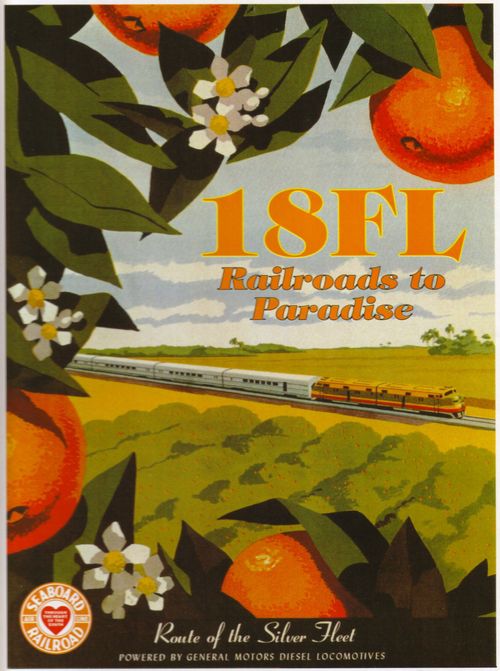
18FL: Railroads to Paradise
18FL: Railroads to Paradise Rulebook
Table of Contents
Table of Contents
Introduction
The game includes a Map, on which is printed the Stock Market and various other additional play-aids; six Corporation charters, each associated with nine share certificates representing ten shares; four Private Company cards; train cards, each representing a train; track tiles; markers, mostly representing station/Hotel tokens; and eight thousand dollars ($8,000) in various denominations, representing the amount of money in the Bank.
How to Win
Players win by having the highest net worth at the end of the game when the Bank runs out of money. Cash on hand and stock shares of opened Corporations owned add to net worth. Private Companies and shares of unopened Corporations add nothing to net worth. Corporation capital and other Corporation-owned assets, neither add to nor subtract from net worth.
Player Etiquette
Players should attempt to speed play as much as possible. In particular, determining what share to buy or what tile to lay or upgrade is best done during another player's turn.
A player must disclose his current cash and the current capital of any Corporation he controls upon request by another player. Both player cash and Corporation capital should be piled neatly in front of the player (in the case of personal cash) or in the Treasury section of the Corporation Charter. Corporation trains and tokens should also be neatly displayed in the train and token sections of the Corporation Charter.
Each player should display his owned Certificates neatly in front of him and must reveal his holdings in a Corporation on demand.
Corporate transactions are public knowledge, whether conducted between a Corporation and the Bank, a Corporation and a player, or two Corporations.
Players may engage in public discussions and enter into public agreements. Such discussions should be reasonably brief in order to speed play. Performance is not enforceable except by moral suasion: a player who has performed an action under such an agreement in the anticipation of future action by his partner has no other recourse if his partner reneges on the agreement. Secret discussions or agreements are prohibited.
The Stock Market, Shares, Share Certificates, and Limits on Ownership
A Corporation's value is represented on the Stock Market by a marker, referred to as the Current Market Value token, placed in one of the numbered spaces on the Stock Market. When a Corporation starts, the Corporation's President establishes the Corporation's Starting Value. The yellow highlighted values on the Stock Market are the available Starting Values and are a subset of Current Market Values. Once a Corporation has begun operating, its value may fluctuate, and the token moves to signify this.
10-Share Corporations may fluctuate in value from a minimum of $60 to a maximum of $400. 5-Share Corporations may fluctuate in value from $60 to $200. A 5-Share Corporation that reaches $200 on the Stock Market may not advance any further until it converts to a 10-Share Corporation. The Stock Market spaces from $225 to $400 are tinted blue as a reminder of this.
The "$250" and "$275" spaces are adjacent. There is nothing unusual about the top five spaces on the Stock Market.
A single share of a 5-Share Corporation is equivalent to twenty percent of the Corporation. A single share of a 10-Share Corporation is equivalent to ten percent of the Corporation. Each single share is worth that Corporation's Current Market Value. The President's Certificate represents two shares of the Corporation, and is worth twice the Corporation's Current Market Value.
There are important distinctions between shares and share Certificates. For the purposes of share ownership in a Corporation, only the percentage of ownership as represented by shares is relevant: for the purposes of Certificate limits, only the number of Certificates held is relevant. In addition, players may hold Private Companies in excess of these limits: they do not count as Certificates.
| Number of Players | 2 | 3 | 4 |
|---|---|---|---|
| Certificate Limit | 21 | 15 | 12 |
Players are limited to owning sixty percent (60%) of a Corporation's stock. Optional rule: in the two-player game only, allow up to seventy percent (70%) ownership in each Corporation.
Game Phases
18FL proceeds through a series of Phases that affect which tiles are in play, which trains Corporations may buy or must scrap, how many trains Corporations may own, and the status of Private Companies. Each Phase lasts until the Triggering Event for the next Phase.
| Phase | Triggering Event | Maximum Trains Owned (10-Share / 5-Share) | New Tiles and Improvements Available | Shares Needed to Open / Funding Type | Trains Available | Trains Scrapped | Off-Map and Hotel Values Used |
|---|---|---|---|---|---|---|---|
| 2 | - | - / 2 | Yellow | 3 / 5x | 5 x 2 | - | Top |
| 3 | First 3-Train bought | 4 / 2 | Green | 3 / 5x (1) | 4 x 3 | - | Top |
| 4 | First 4-Train bought | 3 / 1 | - | 3 / 5x or 5 / 10x (1) | 3 x 4 | 2 | Top |
| 5 | First 5-Train bought | 2 / - | Brown | 5 / 10x (2) | 2 x 5 | (3) | Bottom |
| 6/3E | First 6 or 3E-Train bought | 2 / - | Grey | 5 / 10x | 7 x 6/3E | 3 (4) | Bottom |
- 5-Share Corporations may become 10-Share Corporations.
- Any remaining 5-Share Corporations immediately become 10-Share Corporations (whether or not they have previously operated).
- Any remaining Private Companies close and the Port Token is eliminated.
- The Key West Extension is destroyed (but may be rebuilt).
Setting Up and Starting the Game
Setting up the Game
Lay the Map flat between the players. Place the Round Marker (the white token with the Boxpok™ wheel) in the Turn Order space marked "Stock Round". Separate and sort the Corporation charters, share certificates, Private Companies, train cards, track tiles, and tokens.
There are four Private Companies, each with an associated cost, revenue, and Bonus Action. The number of Private Companies that enter the game is equal to the number of players: see section 3.3 for additional detail.
Put the appropriate Private Companies in the Pool based on the number of players, along with the associated Bonus Tokens.
Place one station token from each Corporation in the City circle on the Map that contains the Corporation's herald. Unlike in many 18xx games, each Corporation's home station starts on the Map, whether the Corporation itself ever enters play or not and accordingly blocks other Corporations from either building in or running through that particular City circle. Place the Corporation's three station/Hotel tokens in the "Tokens" section of the charter.
Place the share certificates marked "Preferred Stock" in the spaces provided on the Map, with the President's Certificate on top. Place the remaining five unmarked single-share certificates face down in the spaces provided on the Map (below the Preferred Stock). The unmarked shares are initially out of play and enter play only when the 5-Share Corporation becomes a 10-Share Corporation. Place the trains in the spaces provided on the Map.
Sort the Bank into denominations and place it near the play area within easy reach of the players. Distribute $300 to each player. Randomly determine the move order using the numbered markers: once they have done this, players may find it convenient to seat themselves so that move order is clockwise round the table. Give the Priority Deal card to the first player, and begin the Initial Stock Round.
Initial Stock Round
During the Initial Stock Round, players buy Private Companies from the Pool using a simple competitive procedure. Each player secretly writes down $0, $5, or $10, which is the amount he is paying for the right to choose a Private Company (as an alternative, each player secretly puts zero, one, or two tokens in his hand: each token is equivalent to a $5 bid). The bids are then simultaneously revealed and paid to the Bank from the players' cash. The player with the highest bid then picks one of the Private Companies from the Pool and buys it, paying its face value to the Bank. In case of ties, the players pick in increasing order of player number, starting with player #1.
Once the players have paid for their Private Companies, the Priority Deal card is given to the player who bought the Tallahassee Railroad Private Company: the seating order remains otherwise the same. The players then continue with the Initial Stock Round and may buy stock in accordance with the normal rules, starting with the player who has the Priority Deal card.
Private Companies
Private Companies represent organizations connected to the early phases of Florida's rail development. Private Companies enter play by being bought from the Pool. Once bought, Private Companies remain in the possession of the purchasing player until they close (unless the owner goes bankrupt). Private Companies provide fixed revenue to the owning player as shown until they close. Each of the Private Companies allows a "Bonus Action" that the owning player may permit a Corporation to exercise during the appropriate step of the Corporation's turn in the Operating Round. Only the Private Company's owner may authorize the use of the Bonus Action: he is never compelled to do so.
Bonus Actions take place in the appropriate step of the Corporation's turn in the Operating Round, after the Corporation's normal activity. A Bonus Action is always in addition to the normal action: a Corporation may (for example) place a token normally and then place the Terminal Bonus Token.
Private Companies close when their Bonus Action is exercised. Any Private Companies still operating when Phase 5 begins are closed immediately, and the Bonus Action is lost.
The following chart summarizes the Private Companies:
| Private Company | Cost | Pays | Bonus Action | Two Players | Three Players | Four Players |
|---|---|---|---|---|---|---|
| Tallahassee Railroad | $20 | $5 | Extra Yellow Tile Placement (1) | Yes | Yes | Yes |
| Peninsular and Occidental Steamship Company | $40 | $10 | Port +20 Bonus Token (2) | Yes | Yes | Yes |
| Terminal Company | $70 | $15 | Extra Station Token (3) | No | Yes | Yes |
| Florida East Coast Canal and Transportation Company | $110 | $20 | Free FEC Share (4) | No | No | Yes |
- The Private Company allows a Corporation to place an additional yellow tile (not an upgrade) during its tile placement step. If the additional tile is in an Everglades ($40) or Keys ($80) hex, it must be paid for normally.
- The Private Company allows a Corporation to increase the value of a port City by $20 for that Corporation only. Two "Port +20" Bonus Tokens are provided to indicate this: one should be placed on the Corporation's charter and the other on the selected City. The Port Bonus Token must be placed in a coastal City (Mobile, Jacksonville, Tampa, or Miami): it may not be placed in Tallahassee, Orlando, or Fort Lauderdale. Once placed, the token may not be moved. The Port Bonus Token is removed at the beginning of Phase 5.
- The Private Company allows a Corporation to place an extra station token on any tile (not an empty hex) that contains one or more City circles. This token is in addition to the tokens allocated to the Corporation. The additional token is not actually placed in a City circle, but to one side of the tile: it does not block passage, nor does it occupy a City circle. However, it functions in all ways as a normal station token (railhead). The owning Corporation need not be connected to the tile in which the token is placed, or be able to trace a legal route there. If the extra token is placed in Jacksonville (B23), the owner must specify whether it is in northern or southern Jacksonville. Once placed, the token may not be moved. The extra station token is permanent.
- The Private Company entitles the owning player to a single share of the Florida East Coast Railway (FEC). When a player buys the Private Company, he also receives a single share of FEC Preferred Stock. When a player starts the FEC, this share is treated as if bought normally. Thus, the FEC will float when an additional forty percent (40%) is bought. The Private Company is closed when the FEC buys its first train.
Sequence of Play
The game consists of a series of Stock Rounds in which players buy and sell stock and may open new Corporations, punctuated by Operating Rounds in which players—acting on behalf of any Corporations they control—perform various actions involving those Corporations.
A variable number of Operating Rounds follow each Stock Round:
- At the beginning of the game, there is one Operating Round following each Stock Round.
- Once Phase 3 begins, there are two Operating Rounds following each Stock Round, beginning after the next Stock Round.
- Once Phase 5 begins, there are three Operating Rounds following each Stock Round, beginning after the next Stock Round.
Even if the Bank runs out of money during a Stock Round, the game must conclude with a complete set of Operating Rounds.
Stock Round
A Stock Round consists of a number of turns. Each player takes a turn, beginning with the player who has the Priority Deal card and continuing in accordance with the move order determined by the numbered markers at the beginning of the game (this is also known as "Stock Round order"). During each of their turns in a Stock Round, players may sell stock and then buy stock. A player who neither sells nor buys stock in one of his turns in a Stock Round is said to have passed. A player who passes in one turn of a Stock Round may act at his next turn in the same Stock Round (assuming that he gets one).
This process continues until all players have passed consecutively. The player who initiated the round of passes receives the Priority Deal card, and players perform a set of Operating Rounds. If the Bank has run out of money at the end of a set of Operating Rounds, the game is over.
Selling Stock
During each of his turns in the Stock Round, a player may sell as many shares of stock as he wishes, subject to the limitations stated below. Once a player has sold stock of a particular Corporation, he may not buy stock in that Corporation for the remainder of the current Stock Round. Players who sell shares of different Corporations in a single turn may sell them in any order they choose.
Stock is sold into the Pool at the Current Market Value shown on the Stock Market. When selling more than one share of stock in the same Corporation, the amount received from the Bank is the same for each share sold. The share price of the sold Corporation moves one space to the left, regardless of the number of shares sold. If the share price of the sold Corporation moves to an occupied space, it goes to the bottom of the stack of tokens in that space. Players may not choose to sell multiple shares of a single Corporation's stock as multiple transactions in the same turn of a Stock Round.
Buying Stock
After selling all the shares he wishes to sell, a player may then buy one Certificate. He may buy any certificate available in the Bank or Pool, subject to Corporation share limits and Certificate limits. Once a player has bought stock, he may not sell any more stock that turn.
Stock bought is bought at Current Market Value, whether bought from the Pool or from the Bank, and the player pays this amount to the Bank.
Limitations on Stock Transactions
Private Companies are bought at their face value, and the money is paid to the Bank. Private Companies may never be sold.
When a Corporation's stock is bought for the first time, the President's Certificate must be the first Certificate bought.
A player may not buy a share that would result in his exceeding either the overall Certificate Limit or the 60 percent limit on any individual Corporation. This is true even if, by buying such a share, he would cause a change in presidency that would cause him to return to the Certificate Limit.
Stock of Corporations that have not yet operated may not be sold.
A player may not sell a share of stock if the sale would have the result of putting more than fifty percent (50%) of that Corporation's stock in the Pool.
The owner of a President's Certificate may never sell it, and, consequently, a Presidency may never enter the Pool (except in a Bankruptcy). It may, however, be transferred to another player as a result of stock sales. A player who owns a President's Certificate may only sell sufficient shares to transfer it if another player (not the Pool or the Corporation's Treasury) owns at least two shares. All adjustments in share holdings are concurrent: hence, a player who owns a President's Certificate may always sell a number of shares sufficient to transfer the President's Certificate while leaving himself with exactly one share provided the sale is otherwise legal.
Change in Presidency
The President of a Corporation is the player who owns the most shares of the Corporation. If two or more players are tied for most owned shares, the player who currently owns the President's Certificate is the President.
If at any time the President owns fewer shares than another player does, he must exchange the President's Certificate for two single share certificates owned by the other player. The new President receives the Corporation charter and all assets of the Corporation. If two or more players are eligible to become President and have an equal number of shares, the player whose turn is the earliest in Stock Round order after the current President becomes the new President.
Ending the Stock Round
Once the Stock Round has ended with a complete set of consecutive passes, the player who initiated the final round of passes receives the Priority Deal card, and an Operating Round begins.
Formation and Financing of Corporations
Corporations enter play when their President's Certificate is bought. The Corporations that may enter play are as follows:
| Corporation | Abbr. | Home Station | Hex |
|---|---|---|---|
| Atlantic Coast Line Railroad | ACL | Tampa | G20 |
| Florida East Coast Railway | FEC | Miami | K28 |
| Louisville and Nashville Railroad | L&N | Mobile | B5 |
| The Plant System | TPS | Tallahassee | B15 |
| Seaboard Air Line | SAL | Jacksonville (S) | B23-S |
| Southern Railway | SR | Jacksonville (N) | B23-N |
Starting a Corporation
To start a Corporation, the player sets its Starting Value on the Stock Market (if the share price of the new Corporation is occupied by one or more other Current Market Value tokens, it goes to the bottom of the stack of tokens in that space) and then buys the President's Certificate from the Corporation's Treasury, paying twice the Starting Value to the Bank. The highlighted spaces on the Stock Market ($70, $75, $80, $90, $100, and $110) represent the possible Starting Values for new Corporations.
Floating and Financing a Corporation
10-Share Corporations have ten shares available: the President's Certificate, worth twenty percent of the Corporation, and eight shares in single certificates, each worth ten percent of the Corporation. 5-Share Corporations have five shares (labeled "Preferred Stock") available: the President's Certificate, worth forty percent of the Corporation, and three shares in single certificates, each worth twenty percent of the Corporation. 5-Share Corporations eventually convert to 10-Share Corporations by issuing five additional shares of stock:
- Corporations that float in Phases 2 and 3 float as 5-Share Corporations.
- Corporations that float in Phase 4 may be floated as either 5-Share Corporations or 10-Share Corporations. The prospective President makes a verbal declaration of which it is at the time he buys the Presidency.
- Corporations that float in Phases 5 and 6 float as 10-Share Corporations.
A Corporation "floats" once fifty percent (50%) or more of the Corporation's stock has been bought. Note that the number of shares that fulfill this requirement is a function of the Phase in which the Corporation actually floats, not when it starts:
| Phase | Shares | Percent | Funding |
|---|---|---|---|
| 2 and 3 | 3 (President's Cert + 1) (1) | 60% | 5x (2) |
| 4 (5-Share) | 3 (President's Cert + 1) (1) | 60% | 5x (2) |
| 4 (10-Share) | 5 (President's Cert + 3) (1) | 50% | 10x (3) |
| 5 and 6 | 5 (President's Cert + 3) (1) | 50% | 10x (3) |
- Note that the free FEC share that is issued with the associated Private Company counts in these numbers, and thus the FEC floats in Phases 2 and 3 when a Player buys the Presidency.
- A 5-Share Corporation receives five times its Starting Value as its initial capital.
- A 10-Share Corporation receives ten times its Starting Value as its initial capital.
As soon as the Corporation floats, the Corporation Charter, the three station/Hotel tokens, and the Corporation's starting capital are given to the Corporation President. A Corporation that has floated will operate in the subsequent Operating Round.
Operating Round
Each Operating Round begins with revenue collection from open Private Companies. This revenue is paid to the owner of the Private Company.
Each Corporation that has floated then operates in descending order of Current Market Value. Corporations whose stock tokens are stacked in a single space on the Stock Market operate in order from top to bottom. This is sometimes referred to as "Operating Round order".
Each Corporation operates once during each Operating Round. If a Corporation that has not yet operated this Round has its Current Market Value altered by stock sales during the Round, it operates at the point in the Round dictated by the new Current Market Value, not its Current Market Value at the start of the Round. When all Corporations have operated, players—in function of the Corporation Phase—either begin a new Operating Round or a new Stock Round. After a number of Operating Rounds appropriate to the Phase, a new Stock Round begins.
Corporations must conduct their operations in strict conformance to the order described below. The operating Corporation may exercise a Bonus Action (if available) during the appropriate step of its turn.
Converting To a 10-Share Corporation
Once Phase 3 has begun, a 5-Share Corporation that has operated at least once may be converted to a 10-Share Corporation at the beginning of the Corporation's turn in the Operating Round. To convert a Corporation, the player takes the five shares that were previously face down in the Bank and turns them right side up. The Bank then pays the newly upgraded 10-Share Corporation five times its Current Market Value.
Once Phase 5 has begun, immediately convert all remaining 5-Share Corporations to 10-Share Corporations, whether or not they have previously operated.
Lay or Upgrade Track
Each Corporation may place two yellow tiles or upgrade one tile. The bonus tile placement is performed in this step. It is legal to upgrade a yellow tile to green and then exercise the bonus tile placement in addition.
Tile Placement and Tile Upgrades
Corporations lay track by placing tiles on the map or upgrading previously placed tiles. As the game progresses, additional types of tiles become available:
| Phase | Types of Tiles Available |
|---|---|
| 2 (At Start) | Yellow |
| 3 | Yellow and Green |
| 5 | Yellow, Green and Brown |
| 6 | Yellow, Green, Brown and Grey (1) |
- Jacksonville only.
A Corporation that lays a yellow tile in an Everglades ($40) or Keys ($80) hex must immediately pay the amount shown from its Treasury.
Tiles must always be upgraded progressively: a yellow tile must be upgraded to a green tile before it can be upgraded to a brown tile. It is possible for a yellow tile to be blocked from being upgraded to a brown tile because of the lack of the intervening green tile upgrade.
The general rule for both tile placement and tile upgrade is that the new track created must extend a route of any length for the operating Corporation. In the case of City tiles, the upgrade must extend or increase the value of a City on a route of the operating Corporation.
Once placed, a tile becomes part of the Map and is only removed if it is upgraded to another tile. In addition, the following restrictions apply:
- Tiles may not be placed or upgraded in such a fashion as to cause any new track to run to a prohibited hex. A prohibited hex is any impassable (medium green) hex, any ocean (light blue) hex, any lake or inlet (black) hexside, or any blank hexside of a red Off-Map Area hex. Note that there are two small track stubs printed in hexes A4 and A6: these exist solely so that Mobile (B5) may be upgraded to a #15 green City tile. Trains cannot run to these track stubs, and they have no scoring value.
- Tiles may not be placed or upgraded in such a fashion as to preclude any Corporation that has not yet operated from creating a legal route using available tiles and upgrades.
- Upgraded tiles must maintain all connections and track existing prior to the upgrade. The old tile is removed from the Map and may subsequently be used again.
Certain hexes, marked with a Town (dot) or City (circle) symbol, or with a letter or group of letters, may only have certain tiles placed on them. The tiles placed on such hexes may then only be upgraded to certain other tiles. No other tiles than those specified may be used to upgrade these hexes. The specified tiles may not be used to upgrade any other hexes.
| Mapboard hex type | Yellow Tiles Allowed | Green Tiles Allowed | Brown Tiles Allowed |
|---|---|---|---|
| Plain | #8 or #9 | #80, #81, #82 or #83 | #544, #545 or #546 |
| Town (dot) | #3, #4 or #58 | #141, #142 or #143 | #146 |
| Tallahassee / Mobile | - | #15 | - |
| Orlando | #6 | #443 | #63 |
| Fort Lauderdale | #6 | #443 | #611 |
| Tampa / Miami (T) | - | #405 | #431 |
| Jacksonville (JAX) | - | #487 | #488 (1) |
- A Corporation may upgrade Jacksonville to a grey #489 tile once any Corporation has bought a 6 or 3E-Train.
The Keys
The Florida Keys are represented in the game by hexes M24 and M26. A Corporation may build across the Keys and connect to the Havana Off-Map Area, paying $80 for each of the two Keys hexes. However, when Phase 6 begins, the two tiles in the Keys are removed, and any Hotel in Key West is removed and permanently eliminated: it is not returned to the Corporation. The track may then be rebuilt, once again paying $80 per hex, and another Hotel may be built in Key West.
Additional Token Placement
In 18FL—in addition to building station tokens in large cities—a Corporation may build a token in a Town—representing a Hotel—and thereby increase the Town's value. Each Corporation starts with its home station token on the map. In addition, it receives three tokens that may be used either as stations (railheads) or Hotels (bonus markers). Finally, a player who owns the Terminal Private Company may assign an additional station token to one of his Corporations.
When a Corporation places a token—whether in a City circle as a station or in a Town as a Hotel—the cost is $20 per hex of distance from the Company's nearest station token (not a hotel!), traced along the rail network (not "as the crow flies"). The Company must immediately pay the requisite amount from its Treasury.
A Corporation may build one station token or one Hotel per Operating Round. The Port and Terminal Bonus Tokens may be placed in this step, in addition to a normal token placement.
Station Tokens
Station tokens function as railheads: they serve as bases from which track construction is performed, additional token placement is measured, and routes are traced. The station token with which a Corporation starts—its base station—is always a station token.
A Corporation may place an additional station token, if it has one available, in any open City circle to which it has a legal route on a hex on which it does not already have a station token. A City circle is defined as a white circular space on a City tile. A Corporation may place a station token in any such City circle, regardless of what sorts of trains it owns (including none).
Hotels
Hotels function as bonus tokens: they permanently add their value to the value of the town in which they are built for the owning Corporation. Hotels are placed in Towns.
A Corporation may place one of its tokens in any Town to which it has a legal route that does not already have a Hotel. The value of the Town is permanently increased for the owning Corporation only. The token should be placed on its "10/20" side to signify this.
Unlike station tokens, Hotels do not block other Corporations' routes, nor do they function as railheads: notably, there must be at least one station token (in a City circle) on a route, in addition to any Hotel, in order for the route to be legal.
At the beginning of the game, Hotels add a $10 bonus to the towns in which they are located. Beginning with Phase 5, Hotels add $20 to their towns.
Train Operation and Earnings Calculation
A Corporation that owns one or more trains now operates them and calculates the resulting earnings. A Corporation must calculate the maximum possible earnings using all its trains (not necessarily the maximum possible dividend for any particular train if more than one train is owned). Earnings are calculated as follows:
- Each train must operate on a legal route. A legal route consists of a continuous unbranched length of track, including a City containing the Corporation's station token (not a Hotel), not necessarily at the beginning or end of the route. In order to score revenue, the route must also contain one or more other Off-Map Areas, Cities (which may contain additional station tokens of the Corporation) or (except for 3E-Trains) Towns.
- There are two different categories of trains: regular trains (2, 3, 4, 5, and 6), and Express trains (3E). The two categories score revenue differently, as described below:
| Train Category | Scores Towns and Hotels | Revenue Doubled |
|---|---|---|
| 2, 3, 4, 5, and 6 | Yes | No |
| 3E | No | Yes |
- The total number of Cities and Off-Map Areas that may be included in the route is the train number. Each City and Off-map Area counts against the train number: trains may not skip Cities on their route. Towns do not count against the train number and—in the case of Express (3E) trains—do not count at all.
- For ordinary (2, 3, 4, 5, and 6) trains, all Off-Map Areas, Cities and Towns included in the route count for revenue. Express (3E) trains ignore Towns.
- If a train runs to an Off-Map Area, it must be at one end of the train's route. A train may both begin and end a route at Off-Map Areas: necessarily, only 4, 5, and 6-Trains are capable of this.
- A train may not use any track segment more than once. The junction in the middle of a green or brown plain track tile is not considered part of any track segment.
- A train may not run more than once to the same City or Town, including those at junctions on green or brown tiles.
- A train may not run between the northern and southern City circles on hex B23 (Jacksonville).
- A train may run to, but not through, a City that is completely filled with other Corporations' station tokens.
- Trains may not use track used by any of the Corporation's other trains in the same Operating Round, except for junctions. Trains may, however, run to or through the same Cities or Towns, provided they do not reuse any track used by the other train.
- The route value is equal to the sum of the values of all Cities, Towns, and Off-Map Areas included in the route. For Express (3E) trains, ignore any Towns (and associated Hotels) on the route: they are treated as having zero value. For Express (3E) trains, the sum of the three Cities (possibly including an Off-Map Area) included in the route is doubled. The Corporation earnings are equal to the sum of the value of all the Corporation's train routes.
Dividend Payment
A Corporation may pay out or withhold its Dividend. If the Corporation pays out its dividend, the Bank pays each player the earnings per share (i.e., 20% per share for 5-Share Corporations and 10% per share for 10-Share Corporations), multiplied by the number of shares owned by the player. The earnings for shares in the Pool are paid to the Corporation. The Bank retains the dividends for unbought shares remaining in the Bank. If the Corporation withholds its Dividend, the Bank pays the entire Corporation earnings to the Corporation Treasury.
Share Price Adjustment
The President of the Corporation adjusts the Corporation's Current Market Value token, if necessary:
- If a Corporation Operates and withholds its earnings or its earnings are zero, its share price is moved one space to the left.
- If a Corporation does not Operate, or Operates and declares a Dividend which is less than the Current Market Value of the Corporation shown on the Stock Chart, its share price remains unchanged, and it retains its relative position in a stack of tokens.
- If a Corporation Operates and declares a Dividend which is greater than or equal to, but less than twice, the Current Market Value of the Corporation, its share price moves one space to the right.
- If a Corporation Operates and declares a Dividend which is greater than or equal to twice the Current Market Value of the Corporation, its share price moves two spaces to the right.
If a Corporation's token must be moved to a space which one or more other Corporations' tokens already occupy, it is placed at the bottom of the stack of tokens.
The lowest Current Market Value is $60. The highest Current Market Value is $400. A Current Market Value token that should move below $60 or above $400 does not move.
A 5-Share Corporation that reaches $200 on the Stock Market may not advance any further until it converts to a 10-Share Corporation. The Stock Market spaces from $225 to $400 are tinted blue as a reminder of this.
The "$250" and "$275" spaces are considered adjacent for all the above movements. There is nothing unusual about the top five spaces on the Stock Market.
Train Buying and Phase Changes
Train Types
There are six types of trains. Prior to Phase 6, there is only one type of train available per Phase. In Phase 6, the player has a choice between a regular (6) train and an Express (3E) train. When buying a train in Phase 6, the player declares at the time he buys the train whether it is a 6 or a 3E. He turns the train card to the side that displays the type of train he has selected, and the train remains in that orientation for the remainder of the game:
| Total Number Available | 5 | 4 | 3 | 2 | 7 (1) |
| Regular Train | 2 | 3 | 4 | 5 | 6 |
| Express Train | - | - | - | - | 3E |
| Cost Apiece | $100 | $200 | $400 | $500 | $600 |
| Trains Made Obsolete | - | - | 2 | (2) | 3 |
- The game provides seven 6/3E-Train cards. The only limit on the number of 6/3E-Trains that may enter play is the ability of Corporations to buy them.
- Close any remaining Private Companies and discard the Port Tokens.
Train Buying
A Corporation that has fewer trains than its current Train Limit may buy additional trains from the Bank, the Pool, or other Corporations, up to the limits of the money in its Treasury:
- To buy a train from the Bank or Pool, a Corporation must pay the face value of the train to the Bank from its Treasury.
- To buy a train from another Corporation, a Corporation must pay the other Corporation a mutually agreed price, which may be as little as $1.
Trains are bought in ascending order from the Bank: once a type of train has sold out, the next type becomes available. All of the trains of the current type must be bought before any train of a new type may be.
No more than one train of the current type may be bought from the Bank in an Operating Round: the Corporation may not buy additional trains of the same type from the Bank until the next Operating Round. However, if the next train available from the Bank is of a new type, and the Corporation still has both fewer trains than its current Train Limit and sufficient cash in its Treasury, the Corporation may buy that train also. Thus, a Corporation may normally buy at most two trains from the Bank in an Operating Round: the last train of the current type and the first train of the next type. Once a Corporation has bought 6-Train or a 3E-Train, this restriction ends: a Corporation may—subject to the limit of two trains per Corporation—buy two 6-Trains, two 3E-Trains, or a 6-Train and a 3E-Train.
If a Corporation buys a new type from the Bank, a new Phase begins and any adjustments pertinent to that new Phase come into effect immediately after buying the new train.
Phase Changes
A complete table of game Phases is in section 2 of the rules. The following synopsizes the Phase changes:
- When a Corporation buys the first 3-Train, green tiles become available. 5-Share Corporations may convert to 10-Share Corporations once they have operated.
- When a Corporation buys the first 4-Train, scrap 2-Trains, and reduce Train Limits by one. 5-Share Corporations may convert to 10-Share Corporations once they have operated. New Corporations may start as 5-Share or 10-Share.
- When a Corporation buys the first 5-Train, brown tiles become available, and the increased (bottom) value for Off-Map Areas and Hotels is used. Reduce Train Limits by one. Any remaining Private Companies are closed and the Port Bonus Tokens are removed. Any remaining 5-Share Corporations instantly convert to 10-Share Corporations. All new Corporations start as 10-Share.
- When a Corporation buys the first 6/3E-Train, scrap 3-Trains, and the grey JAX tile becomes available. Remove any track tiles placed in the two Keys hexes (M24 and M26): remove and permanently discard any Hotel in Key West (M24): do not return it to the Corporation. Any Corporation may rebuild the Keys hexes, if it can trace a legal route there and has the necessary cash.
If, as the result of a Phase change, a Corporation owns more trains than are allowed by the new Train Limit, the Corporation President must discard the excess to the Pool, without compensation. The President chooses which trains to discard: however, once the Corporation is back on limit, he may not discard any further trains.
Mandatory Train Buying
A Corporation that has operated in the current Operating Round must own a train at the end of its turn in the current Operating Round whether or not it has a legal route. If it has sufficient funds in its Treasury, it may buy any train or trains that are available from the Bank or Pool, subject to the limitations above.
Emergency Money Raising
If a Corporation does not have sufficient funds to buy any train from the Bank or the Pool, the Corporation President must make up the difference from his own cash to allow the Corporation to buy any (not necessarily the least expensive) train available, from the Bank or Pool. If he has insufficient cash on hand, he must sell sufficient stock to raise the difference. The President may sell any stock he wishes to raise the required amount, subject to the normal limitations on stock sales. Since it is illegal to sell stock in a Corporation that has not yet operated, the President may be unable to selling stock in the operating Corporation if it is operating for the first time, or in any other Corporation that has not yet operated for the first time. The President may not sell sufficient stock in the operating Corporation to cause a change in its presidency. He may, however, cause a change in presidency of any other Corporation.
Train Buying from Other Corporations
As an alternative to buying from the Bank or Pool, the President of a Corporation that has no train may buy a train from another Corporation, at a mutually agreed price, which may range from $1 up to all its remaining cash. If a Corporation purchasing the train has no money at all, the President may use his cash on hand to buy the train, paying the other Corporation up to the face value of the train to be bought. However, he may not sell stock to raise additional cash: the maximum he may contribute is the actual cash he has on hand.
Bankruptcy
If, after selling all the stock he is legally permitted to sell, the President cannot raise sufficient cash to buy a train, he is bankrupt. His remaining holdings (including any Private Companies still operating) are placed in the Pool (for the purposes of this rule, the Pool may contain more than fifty percent of a Corporation, and the share price remains unaffected), and he is eliminated from the game. The Presidency of any of his controlled Corporations is transferred to the next eligible player.
If the Presidency of the Corporation for which the bankrupt player was buying a train is transferred in this manner, its Treasury will contain the total amount raised by the now bankrupt President during his Emergency Money Raising. The new President must complete the Emergency Money Raising using his own resources and buy a train for the Corporation.
If no player holds at least two shares of an affected Corporation, place that Corporation's President's Certificate in the Pool: this is a notable exception to the normal rule precluding a Presidency from entering the Pool. Such a Presidency may be bought at Current Market Value (that is, for twice the current price of a single share) in a subsequent Stock Round. As an alternative to buying the Presidency directly from the Pool, a player who owns one share may buy an additional share and then exchange his two single shares with the Pool for the President's Certificate.
Players who own stock in such a Corporation may not sell it, and its stock continues to count against their certificate limit: all of the Corporation's existing assets (its station tokens, trains, and capital) remain in place, and the Corporation's Current Market Value remains at its current level until it is controlled once again by a player.
Clarifications, Conflicts, and Errata
The official rules consist of the latest version of these rules combined with any officially published errata. The latest version and any errata are maintained by the publisher. In the event of a conflict between game components and the official rules, the rules take precedence.
Tile Manifest
The following chart summarizes every track tile in the game, the number of that tile in the supply, and the tiles it may legally be upgraded to. Pre-printed hexes on the Map itself (marked "map" in the count column) are not part of the tile supply but are listed to show their legal upgrade paths. Tile colors follow the normal progression: yellow, then green, then brown, then grey.
| Tile | Count | Legal Upgrades |
|---|---|---|
| Plain hex (pre-printed, yellow-eligible) | map | #8, #9 (yellow) |
| Town hex, single circle (pre-printed) | map | #6 (yellow) |
| Town hex, dot (pre-printed) | map | #3, #4, #58 (yellow) |
| Tampa / Miami hex (pre-printed, "T") | map | #405 (green) |
| Tallahassee hex (pre-printed, "Tal") | map | #15 (green) |
| Mobile hex (pre-printed, "Mob") | map | #15 (green) |
| Jacksonville hex (pre-printed, "Jax/Jax") | map | #487 (green) |
| #3 (yellow) | 6 | #141, #142, #143 (green) |
| #4 (yellow) | 8 | #141, #142 (green) |
| #6 (yellow) | 2 | #443 (green) |
| #8 (yellow) | 10 | #80, #81, #82, #83 (green) |
| #9 (yellow) | 14 | #82, #83 (green) |
| #58 (yellow) | 8 | #141, #142, #143 (green) |
| #15 (green, double city) | 2 | No further upgrades |
| #80 (green) | 4 | #545, #546 (brown) |
| #81 (green) | 4 | #546 (brown) |
| #82 (green) | 6 | #544, #545, #546 (brown) |
| #83 (green) | 6 | #544, #545, #546 (brown) |
| #141 (green) | 5 | #146 (brown) |
| #142 (green) | 5 | #146 (brown) |
| #143 (green) | 5 | #146 (brown) |
| #405 (green, double city) | 2 | #431 (brown) |
| #443 (green, double city) | 2 | #63 (brown, Only in Orlando) or #611 (brown, Only in Ft. Lauderdale) |
| #487 (green, Jacksonville, double city) | 1 | #488 (brown) |
| #63 (brown, double city) | 1 | No further upgrades |
| #146 (brown) | 8 |
Ending the Game
The game normally ends after the end of the last Operating Round of the set of rounds in which the Bank runs out of money (i.e., falls to $0 or less). This applies whether the Bank runs out of money during the Stock Round or during an Operating Round: in either event, players complete a full set of Operating Rounds and receive all revenues earned during this final set of Operating Rounds. At the conclusion of the final Operating Round, players calculate their net worth as follows:
- Calculate the total value of all shares of stock held by multiplying the final Current Market Value by the number of shares held.
- Add total cash on hand.
- Private Companies and shares of unopened Corporations are worth nothing.
- Ignore all assets (cash and trains) owned by Corporations, as they make no contribution to a player's net worth.
The total is the player's net worth. The player with the highest net worth wins the game.
If all players but one have gone bankrupt, the game ends immediately, with the sole solvent player being declared the winner.
Designer's Notes
The following notes on the game's design, setting, and history are the designer's own words.
Thoughts on Designing an Introductory Game
Once again, I have tried to create a game that is simple to explain and play, interesting, and relatively short: hoping thereby to fill the elusive niche of "good introductory 18xx game" while at the same time not completely losing hold of "good short 18xx game". My first effort in this regard—18VA—proved unsatisfactory in both categories (though, to be sure, it is perfectly satisfactory as a medium-length game); the consensus seems to be that my second—18Scan—seems to be a good short game but slightly too complex to a proper introductory game. As the phrase would have it, I am hoping that "the third time's the charm".
Florida's Geography
Unlike 18GA and 18AL—the games on which 18FL is modeled—Florida is not easy to model on a small map. It's a long string bean of a state: driving from Pensacola to Key West today requires nearly 840 miles (1350 km) of road distance: conversely, driving across the peninsula at its widest point—say, from St. Petersburg to Titusville—is only about 147 miles (235 km)—an aspect ratio of nearly six to one.
Furthermore—as is so often true in such situations—most of the important railroad activities were confined to the northern and central parts of the state: Henry Flagler's FEC did not arrive in Miami until 1896—more than 40 years after railroad development in northern Florida began in earnest. The Key West Extension—begun in 1905—was not completed until 1912.
Therefore, in order to balance the geographic development of the map, I have relocated the FEC's starting position from its historic origin in Jacksonville to Miami. Similarly, the ACL's home base has been moved from Fernandina—north of Jacksonville—to Tampa. These changes also mitigate somewhat what would otherwise be a substantial overcrowding of the northern and especially northeastern part of the map. 1830 players will recognize this as analogous to the displacement of the C&O's home base from Richmond to Cleveland and the PRR's home base from Philadelphia to Harrisburg.
Florida Railway History
Railroading in Florida was—to some degree—an adjunct of the winter hotel trade: much of Florida's passenger trade was what we have come to call in the modern age "snowbirds"—a seasonal migration from colder climates. Both Henry Plant—builder of the eponymous system—and Henry Flagler—builder of the FEC—came to Florida initially for reasons of their wives' health: each then built several luxurious, modern hotels, in support of which a "modern" transportation infrastructure was a necessity.
The Keys and the FEC's "Key West Extension"
The Florida Keys are a series of barrier islands extending over a hundred miles out to sea from the shore. In an effort to capture what was expected to be a lucrative Panama Canal trade, Henry Flagler extended the Florida East Coast line—at vast expense—along the Florida Keys, as far as the end of the island chain—Key West. There were five hurricanes during the construction phase (1905-1912) that did considerable damage to the works in progress, and additional hurricanes—notably the 1926 hurricane—caused significant additional damage while the Key West Extension (as it was known) was operational. However, the line was always rebuilt, until the Labor Day hurricane of 1935: on that occasion—the railroad being in receivership—the management decided not to repair the damage. Ultimately, the company sold the entire works to various government agencies for a few pennies on the dollar: later, the government used the surviving infrastructure in the construction of U.S. Highway 1 to Key West. It is a tribute to the soundness of Flagler's engineering and construction efforts that the roadbeds and bridges formerly used by the Railroad were used essentially "as is" in constructing U.S. 1.
The Personalities of 18FL
As with many other games, I have attempted to personalize 18FL by using pertinent historical figures on the currency. Here are the personalities of 18FL:
$1: General Richard Keith Call (1792-1862) served as aide-de-camp to General Andrew Jackson in the War of 1812 and as Territorial Governor of Florida (1836-1839 and 1841-1844). After the War of 1812, he moved to Florida and later controlled the Tallahassee Railroad.
$2: David Levy Yulee (1810-1886) represented Florida as its first U.S. Senator (and as the first Jewish U.S. Senator from any state) from 1845-1850 and 1855-1861. He served as President of the Yulee Railroad (later Florida Railroad) which ran from Fernandina to Cedar Key. He was the key sponsor of the Florida Internal Improvement Fund Act of 1855.
$5: General Joseph Finnegan (1814-1885) served as a Brigadier in the Confederate States Army and was the victor of the Battle of Olustee (20 February 1864). He later headed the construction company (J. Finnegan & Company) that built the Florida Railroad from Ferdinandina (north of Jacksonville) to Cedar Key.
$10: Henry Bradley Plant (1819-1899) was the major developer of Florida's West Coast. He built the Plant System of hotels, steamships, and railroad lines, which the Atlantic Coast Line later took over.
$20: Henry Morrison Flagler (1830-1913) was perhaps the most consequential personality in the history of Florida's development. He was a major developer of the Florida East Coast: starting in Jacksonville, he built the Florida East Coast Line down to St. Augustine, then to Daytona and Ormond Beach, then to West Palm Beach, and then to Miami, also building major resort hotels in each city. Ultimately he wound up building an extension of the line across the Florida Keys that terminated in Key West, over 100 miles out to sea.
$50: Colonel William Dudley Chipley (1840-1897) fought for the Confederacy at Shiloh and Chickamauga with the 9th Kentucky Infantry. He later became manager of the Louisville and Nashville's Florida operations, and subsequently chartered the Pensacola and Atlantic to connect Pensacola to the rest of Florida.
$100: Henry Walters (1848-1931) served as President and General Manager of the Atlantic Coast Line. He later founded the Walters Art Museum in Baltimore.
$200: Solomon Davies Warfield (1859-1927) served as President and General Manager of the Seaboard Air Line. He was the uncle of Wallis Warfield Simpson, later the (morganatic) Duchess of Windsor. A Baltimore-to-Norfolk ferry (the President Solomon D. Warfield) was named for him and was later sold to the Haganah as the Exodus 1947, a name that later inspired the title of Leon Uris' novel of Israeli independence.