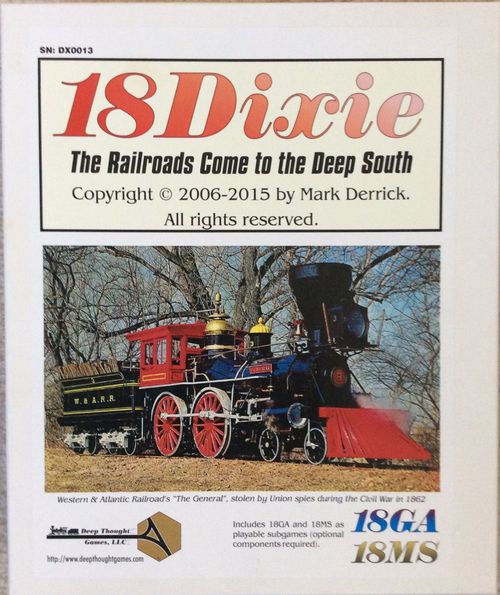
18Dixie with 18MS and 18GA
18Dixie with 18MS and 18GA Rulebook
Table of Contents
Table of Contents
- 18Dixie: The Railways Come to the Deep South
- 18GA: The Railroads Come to Georgia
- 18MS: The Railroads Come to Mississippi
- 18Dixie Errata and Clarifications (publisher's document)
18Dixie: The Railways Come to the Deep South
1 Introduction
Cross-references within the rules are denoted by square brackets – [2.2] refers the reader to section 2.2 for additional information about the topic under discussion.
18Dixie is a railroad and stock market manipulation game, based on the 18xx game system created by Francis Tresham. Each player takes the part of an investor, and the object of the game is to have the highest net worth at the end. The bank size is $12,000.
The money and certificate holdings of each player are public information and must be revealed on request. Similarly, the money, trains, and tokens on a Major or Minor Company's charter are public information. (Many groups find that it speeds game play to keep assets neatly organized for easy inspection.)
18Dixie is designed as a modular game, allowing 18GA and 18MS to be played using the map and many of the 18Dixie components. Additional components are required to play 18GA and 18MS, and are available as an option.
1.1 Rounds and Turns
The game is played in two types of rounds: Stock Rounds and Operating Rounds.
In a Stock Round, players buy and sell stock in Companies. The players take turns in order, clockwise around the table, and each player usually gets multiple turns. The round ends when all players consecutively pass.
In an Operating Round, each Private Company, Minor Company and floated Major Company operate. The game is played as a series of Stock Rounds, each of which is followed by two Operating Rounds. The turns of players during a Stock Round are called stock turns. The turns of Companies during an Operating Round are called operating turns.
1.2 Game Phases
The game is divided into phases. The sequence of phases happens in parallel with the sequence of turns. A phase change does not end the round or the turn in which it happens.
When the game begins, it is Phase 1. Each time the first train of a new type is purchased, a new phase begins; the phase number is the same as the train number. Each phase change modifies some of the rules of play.
[12.1] lists all the train types, and the phases and their effects.
1.3 Companies
The game has three types of Companies in which players can invest: Private, Minor, and Major Companies.
1.3.1 Private Companies
A Private Company is owned as a whole, and thus is represented in the game by a single stock certificate. When a Private Company operates, the bank simply pays a fixed dividend to its owner.
A Private Company can only be owned by a player. Private Companies cannot have any money or possessions of their own. They do not appear on the map, and they do not build track or run trains. Each Private Company has a special ability that can be used on behalf of a Major Company controlled by the same player. In general, these special abilities are used during the operating round of a Major Company. See [12.3, 12.4, 4a] for details.
1.3.2 Major Companies
A Major Company is represented by multiple certificates representing stock in the company. Each certificate may be owned by a player or the bank, but not by another company.
In most respects, a Major Company is like a modern publicly traded company. It has its own possessions (money, trains, and tokens). Each Major Company has a large card called a "charter" on which to keep its possessions.
The player with the greatest number of shares (percentage of ownership) in the Major Company is its president and controls all aspects of its operation. He keeps the company's charter in front of himself. In addition, the percentage each player owns determines how much of the dividends he receives, if and when the Major Company pays dividends.
Note that a Major Company's assets must be kept separate from those of any other company or player, including the president. The president may not move assets between the company's charter and his own hand, or to or from other companies he controls, except for transactions specifically permitted by the rules.
Players should be careful of the distinction between a certificate and a share. One "share" is defined as 10% of the ownership of a Major Company. Shares determine the presidency and the allocation of dividends. Each stock certificate equals either one or two shares. Players buy and sell certificates, not shares. The price paid or received is based on the number of shares those certificates represent. The limit on each player's total holding is counted in certificates.
During its operating turn, a Major Company may build or upgrade track tiles; place station tokens; operate trains; pay out (or withhold) the resulting revenue; and purchase trains (from the bank or from other Companies) [4].
1.3.3 Minor Companies
The description of a Minor Company has been listed last because it combines some of the features of both Private and Major Companies.
Like a Private Company, a Minor Company is owned as a whole, not divided into multiple shares. A Minor Company can be owned only by a player – not by another company.
Like a Major Company, a Minor Company can have money of its own. A Minor Company's only "stock certificate" is its charter. A Minor Company starts the game with no cash in its treasury, but it does come equipped with a built-in 2-Train. The company is not allowed to sell this train, or to buy any other trains.
Like a Major Company, a Minor Company's assets must be kept separate from those of any other company or player, including its owner. The owner may not move assets between the company's charter and his own hand, or to or from other companies he controls.
A Minor Company's operating turn is a simplified version of a Major Company's operating turn. During its operating turn, the Minor Company may lay up to one track tile (it may lay either one or two yellow tiles on its first turn of operation only). It must operate its 2-Train, and must split the resulting revenue 50-50 between its owner and its treasury. This train is not rusted after the first 4-Train is purchased and lasts as long as the Minor Company is in play. See [4] for the complete details.
At the end of the Operating Rounds 3, 4, and 5, groups of Minor Companies will close. See [5.2] for details.
1.4 The Bank and the Open Market
The bank is an abstract entity which is said to own all money and property that does not belong to any player or company. This includes unowned stock certificates and trains, as well as all tiles which are not currently on the board and all tokens of Major Companies that have not yet floated [3.5].
The Bank contains two separate areas for displaying stock certificates and trains, called the Initial Offering and the Open Market. The Initial Offering contains only "new" stock certificates and trains, meaning those which have never been owned by a player or company. The Initial Offering chart has a special holding area for preferred shares of stock that will be exchanged for Minor Companies as they close. Eventually, the remaining preferred shares are moved to the Open Market. See [3.4.1] for more information on preferred shares. The Open Market contains any previously owned stock certificates and trains. This distinction exists because "new" shares and trains differ from "used" shares and trains in several ways:
- Stock certificates of Major Companies are always purchased from the Initial Offering at their original Par Value (per share). They are purchased from, or sold to, the Open Market at their current Market Value (per share).
- To "float" a Major Company (put it into operation, see [3.5]) 50% of its stock must be held by a combination of players and the Open Market. Unowned preferred shares [3.4.1] do not count for purposes of floating Major Companies.
- When a Major Company pays dividends, its treasury collects the dividend for any shares it has in the Open Market. It does not collect dividends for shares in the Initial Offering or for unowned preferred shares.
- Trains in the Initial Offering can only be purchased in order of their types as listed in [12.1]. For example, no Major Company can purchase a 5-Train until all of the 2, 3, and 4-Trains in the Initial Offering have been purchased. However, the presence of a train in the Open Market does not similarly prevent a Major Company from buying trains of later types from any source.
The Private and Minor Companies also belong to the Bank at the beginning of the game. Once purchased by players, they cannot be sold back to the Bank. Only trains, unsold Private and Minor Companies can ever be in the Open Market. (In some 18xx games, the Open Market is referred to as the "Bank Pool".)
The game should be played with exactly $12,000 in cash. Poker chips or other money substitutes can be used, but the correct total should be verified before starting play.
1.5 The Stock Chart and Par Display
Each Major Company has two values for its stock: the Par Value and the Market Value. Each of these values is per 10% share.
When a player founds a Major Company by purchasing its president's certificate from the Initial Offering display, he chooses its Par Value [3.2c1]. The Major Company's Par Value is then fixed for the rest of the game. The Par Value determines the price per share of all purchases of certificates from the Initial Offering area (which contains certificates that have never been owned by a player). The president's certificate is two shares so it costs twice the Par Value.
A Major Company's Market Value begins equal to its Par Value. But unlike the Par Value, the Market Value will change throughout the game [3.1a, 3.7, 4.5, 4.7.1]. The Market Value determines the price per share of all stock purchases from, and sales to, the Open Market.
The Private and Minor Companies also have printed prices, which are shown on their certificates (but does not necessarily determine the initial purchase price in the case of Private Companies [3.2a]). They do not have Market Values, because they can never be sold to the Open Market.
2 Starting the Game
First, determine randomly (or by agreement) where each player will sit, and who gets the Priority Deal card.
Each player starts with the amount of money shown in [12.2]. The rest of the money is set aside as the Bank.
Set up the map and Stock Chart near the center of the table. Spread out the certificates of the Private and Minor Companies in numerical order, since some of the Private Companies will be sold first and it is helpful to have them and the Minor Companies readily available for examination. Place the 20% share of the Southern Railway (SOU) alongside the South Carolina Canal and Rail Road Company (Private Company #6).
All trains and all other Major Company stock certificates should be placed on the Initial Offering display. Special case: The special stock certificates marked as "Preferred Shares" [5.2] are placed in the "Preferred Shares" box on the Initial Offering Chart.
Place the token labeled "Round" in the "Stock Round 1" circle in the "Round of Play" display on the map. This marker gets moved to indicate which round it is and any special actions which take place in certain rounds. The rest of the map begins empty, as does the Stock (Market Value) Chart. The game then begins with the Initial Stock Round [3.3.1].
3 Stock Round
In each Stock Round, the player who holds the Priority Deal card has the first turn, and play proceeds clockwise around the table. The Stock Round ends when each player passes in succession. Each turn, a player may make at most one purchase and sell as many things as they wish (subject to limitations). The purchase must occur either before or after all stock sales for a single turn, not in the middle of them. A player neither buying nor selling on their turn must pass. Passing does not prevent a player from acting in a subsequent round in the current Stock Round. After all players pass, give the priority deal marker to the player to the left of the last player to make a sale or purchase.
3.1 Sales
Each sale may be:
a) Sell any stock certificate(s) of a Major Company to the Bank for their current market value (per 10% share). Collect the money from the bank and place the certificate(s) in the Open Market.
These restrictions apply:
-
Stock of a Major Company whose president's certificate is still in the Initial Offering cannot be sold to the Bank, because its Market Value has not been set yet. For the same reason, these certificates are worth zero when determining the winner [6.1]. This restriction (and zero value) ends for each share as soon as the president's certificate of that company is purchased by a player and the price is set. No sale may be made which will cause more than 50% of the shares of any one Major Company to be in the Open Market. It is legal for exactly 50% to be there). Shares in a Major Company cannot be sold until it has operated at least once. This restriction also applies to SCL/ICG shares, if either of these railroad systems forms during the game [5.4].
-
You may sell a 20% president's certificate only if another player owns at least two shares (20%) of that Major Company's stock, and only if you sell enough of the company's stock that a change of presidency will result [3.6].
Note that the president's certificate of a Major Company can never be available in the Open Market.
- As a special case, if you own only the president's certificate of a Major Company, you may sell only one share (10%) and keep 10%. The two conditions for selling a president's certificate above must still be met. To do this you first announce that you are selling only 10%; then determine the new president and exchange certificates with him as if the sale had already taken place [3.6]; and then place one of the two 10% shares he just gave you into the Open Market.
After selling, you must move the Major Company's Market Price token downward one space for each 10% share of its stock that was sold. If this would cause the token to go off the bottom of the Stock Chart, it stops at the bottom row and does not move further. If you move the token into a space that already contains one or more tokens, place it underneath them all.
b) Sell any Private Company directly to another player, for any positive whole number of dollars the two can agree upon.
Private Companies and Minor Companies can never be sold to the Open Market.
3.2 Single Purchase
The single purchase may be:
a) Start an auction to buy a new Private Company, as described below. (Note that the auction counts as your purchase action this turn, even if someone else wins the auction).
Procedure: The player chooses an unsold Private Company and place a bid at least equal to or higher by $5 multiples than the printed list price on the Private Company certificate. That bid is considered to be the first bid of the auction. For example, suppose a player nominates the South Carolina Canal and Rail Road Company. (Private Company #6) Acceptable bids include the $140 list price, $145, $150, etc.
Once a Private Company has been nominated, starting to the left of this player each player continuing clockwise around the table must either pass or bid a whole number of dollars that is at least $5 more than the preceding bid. Players cannot bid more money than they have. A player who has passed may not bid later on that particular Private Company. Once all players have passed on this auction, the winner pays the bank the winning bid for the Private Company.
b) Buy an available Minor Company by paying the list price shown on the Minor Company charter to the bank. Minor Companies are never auctioned and may never be sold.
c) Buy one certificate, which can be any of the following:
- From the Initial Offering, the 20% President's Certificate of any Major Company.
In this case the player must set the Par Value of the Major Company to one of these values: $65, $70, $75, $80, or $90 (per 10% share). Place one of Major Company's tokens in the column showing that value under "Par Values" on the Initial Offering display. Place another token in the red outlined space with the same value on the Stock Chart, thus setting the Major Company's current Market Value equal to its Par Value. (If you place this token in a space that already contains one or more tokens, place it underneath them all.) Since the President's Certificate is 20%, it costs the player twice the Par Value he sets.
- From the Initial Offering, a 10% certificate of any Major Company whose President's Certificate is already owned by a player. The player pays the bank the Par Value.
If this purchase increases the combined amount of the Major Company's stock in player's hands and the Open Market to exactly 50%, the Major Company floats [3.5].
(Note: Players may never purchase a certificate from the "Preferred Shares" box of the Initial Offering. Certificates in that box are reserved for the trades described in [5.2].)
- From the Open Market, a 10% certificate of any Major Company or any unsold Minor Company or Private Company. The player pays the bank the market value.
d) Buy a Private Company from another player for any positive whole number of dollars the two players can agree on. Private Companies may not be sold in the Initial Stock Round.
All purchases are subject to the limits given in [3.4]. In addition, you are not allowed to purchase any stock of a Major Company if you have sold any stock of that company earlier in the same stock round.
3.3 Early Stock Rounds
The first three stock rounds have special procedures.
3.3.1 Initial Stock Round
During the first turn of the game, until each player owns exactly one Private Company, a player that owns a Private Company must pass. Otherwise, a player that does not own a Private Company must choose and auction an available Private Company (numbered 1-7) as described in [3.2a]. It follows that the last player to obtain a Private Company in this process will simply choose an unsold Private and purchase it for the printed price of the Private Company.
Pass the priority deal marker to the player who has purchased the lowest numbered Private Company. Since there are more Private Companies than the number of players, there will be one or more unsold Private Companies. Remove the highest numbered unsold Private Company from the game. Place any remaining unsold Private Companies in the Open Market where they will be available for purchase without an auction, starting with the current holder of the priority marker.
The Stock Round continues beginning with the player who now holds the priority deal marker, who may purchase shares in Major Companies, Minor Companies, or any unsold Private Companies as described above. During the initial Stock Round, no sales may be made. (Stock may not be sold because no Major Company has operated yet and Private Companies may not be sold between players in the initial Stock Round.) After all players have passed, give the priority deal marker to the player to the left of the player who made the last purchase.
3.3.2 Second Stock Round
At the start of the second stock round:
- Any unpurchased 2-trains are moved to the Open Market.
- Private Companies 8-10 are now available for auction as described above, except that players are not limited to winning only one auction of Private Companies 8-10. Any of these unsold Private Companies are place in the Open Market at the end of this Stock Round.
- Minor Company #13 is now available for purchase.
3.3.3 Third Stock Round
Any remaining Private Companies or Minor Companies may be purchased for the printed price from the Open Market. At the end of the third Stock Round, take any unsold Private Companies and Minor Companies from the Open Market and remove them from the game permanently.
3.4 Ownership Limits
There are two upper limits on a player's stock ownership.
a) No player may own more than 60% of the stock of any one Major Company. No player may ever make a purchase that causes him to exceed this limit. However, "Preferred Shares" [3.4.1] do not count towards this limit.
It is possible to hold as much as 80% of some Major Companies (90% of the L&N) as a result of owning the normal limit of 60% of regular shares plus all of the preferred 10% shares in a given Major Company.
b) The total number of certificates a player owns must not exceed the "Certificate Limit" listed in [12.2]. This limit includes Private Company certificates, Minor Company charters, and the stock certificates of Major Companies. (Special cases: A 20% president's certificate of a Major Company counts as only one. A 10% preferred share certificate counts as a single certificate against this limit. Stock of Companies whose market values are in the yellow section of the Stock Chart do not count against this limit. Note that [12.2] shows two stock limits. The higher share limit applies prior to the formation of the SCL/ICG and for the rest of the game if the SCL or ICG does not form [5.4]. The lower certificate limit applies after the formation of the SCL or ICG.
No player already holding the maximum number of certificates allowed by this limit may purchase another certificate (unless it is a share of a company whose market value is in the yellow section of the Stock Chart), even if the purchase would cause a change of presidency that would result in the player's holding no longer exceeding the limit.
You may exceed this limit because another player has made a purchase that caused you to lose a presidency [3.6], or because you own stock whose market value has risen out of the yellow section of the Stock Chart since you bought it. In either case, you may keep the excess until your next stock turn, but on that turn, you must sell enough certificates that you comply with the limits once more. You may sell just enough shares to make a Major Company's market value fall back into the yellow zone, which would immediately change the number of shares which count towards this limit.
3.4.1 Preferred Shares
18Dixie introduces the concept of preferred shares. These are special shares of stock. Preferred share certificates are initially obtained from the closure of Minor Companies. They can also be sold to and purchased from the Open Market. They are labeled to distinguish them from normal share certificates.
Preferred shares do not count against the normal 60% limitation for the president of that Major Company. They are treated as normal shares otherwise and any player can own preferred shares, subject to normal holding limits. Preferred shares certificates of a company whose share price is in the yellow zone of the stock market also do not count as a share towards normal certificate limits and can also be held over the normal certificate limit by the owning player.
Below are some examples of the purchase and sale of preferred shares during stock rounds.
Example #1: Suppose a player holds 60% of the L&N with no preferred shares and there is one or more 10% preferred shares for sale in the open Market. That player may purchase one during a stock round to raise his holding to 70% (60% in normal shares and 10% in preferred shares). That player can purchase another preferred L&N share (if available) in a future stock round.
Example #2: Suppose a player is trying to float the L&N and holds a total of 30% in shares, no other player holds any and there is one 10% preferred share in the Open Market. The Major Company is not floated since only 40% are either in player hands or in the Open Market. He may buy an L&N share from the initial offering to raise the total to 50%, thereby floating the L&N. He may instead buy the preferred share from the Open Market during his stock round, but that purchase by itself does not help float the L&N.
Example #3: Suppose a player holds a total of 70% in the L&N (60% in regular shares and one 10% preferred share) and wishes to sell a share during a stock round. He may sell either a regular share or a preferred share. In neither case could he buy more L&N until the next stock round.
Example #4: Suppose a player holds a total of 70% in the Frisco (60% in regular shares and 10% in preferred shares) and the share value is not in the yellow area of the stock chart. There are three shares of Frisco available for purchase (one regular share in the Initial Offering, and one preferred share and one regular share in the Open Market). The player cannot buy either regular share of Frisco because it would bring his total of regular shares over 60%. He could buy the preferred share of Frisco from the Open Market since it does not count towards his holding limit of 60%.
In summary, preferred shares are normal shares except they can be held in excess of 60% in a company.
3.5 Floating a Major Company
A Major Company "floats" when the combined amount of its shares held by players and in the Open Market reaches 50%. Until this happens, the Major Company is not considered fully formed, and cannot operate. (As an exception, the SOU and WRA both automatically float if the president's certificate is obtained via the purchase of its associated Private Company; see [12.3,12.4] for more details). The player holding the most shares in the company becomes its president. If there is a tie, the current holder of the president's certificate becomes the president.
When a Major Company floats, perform these steps.
a) Place the Company's charter in front of the player holding the President's certificate (after determining whether it changes hands.)
b) The bank gives the Major Company its tokens that will be used as station markers. The circles on the charter show how many station tokens the Major Company should have.
c) The bank pays the Major Company ten times its Par Value. This payment is in addition to any funds the Major Company received from Minor Companies as they closed [5.2].
If your group prefers, you may wait until the end of the stock round in which the Major Company floats, or until the beginning of its first operating turn, to perform these steps physically. (However, the payment is considered to have occurred immediately if it makes a difference such as causing the Bank to run out of money.) These steps are performed only once for each Major Company.
Note: Companies will usually float only during stock rounds. It is possible for a Major Company to float between operating rounds when Minor Companies close, causing one or more preferred shares to suddenly appear in player holdings or in the Open Market from the exchange of preferred shares during the Minor Company closures. If such an occurrence causes a company to float, the Major Company will operate in the subsequent operating round.
3.6 Change of Presidency
Whenever a purchase or sale of stock (or one of the trades described in [5.2]) causes another player to hold a greater percentage of a Major Company's shares than the current president, a change of presidency occurs. (A change of presidency does not occur merely because another player holds the same percentage as the president, nor because the Initial Offering or the Open Market contains a percentage equal to or greater than the president's holding.)
When a change of presidency occurs, follow these steps immediately:
a) The player who holds the greatest percentage of the Major Company's shares is the new president. If there is a tie (which can only happen if a sale by the outgoing president caused the change of presidency), the first tied player clockwise from the outgoing president is the new president.
b) The new president takes two 10% share certificates of the stock of the Major Company from his own holding and exchanges it for the 20% president's certificate, wherever it is (either in the Open Market or in the outgoing president's holding).
c) The Major Company's charter and belongings are moved in front of its new president.
Example: Suppose Player A is president of the CoG with only 30% total: the 20% presidents certificate and a 10% preferred share. Player B has 30% of the CoG, two regular 10% shares and a 10% preferred share. There is a 10% regular share in the Open Market and the rest are in the Initial Offering. Player A decides to dump the SAL on player B by selling only one share. Player B must put two 10% shares in the Open Market and takes the presidents certificate from Player A. These can be any combination of regular and preferred shares. Player A collects the current market value of the CoG for the one share he sold then selects one of the available shares of CoG from the Open Market. The stock price of the CoG is reduced one space as normal. In this situation, Player B can choose any two shares to exchange for the presidents certificate.
3.7 End of Stock Round
The Stock Round continues until all players consecutively pass (take no action on their turns). That ends the Stock Round, and the Priority Deal card goes to the player following the last player who took an action on his turn. (If no one did anything but pass during the stock round, the Priority Deal card stays where it was at the beginning of the round.)
At the end of the round, if all 100% of the stock of any Major Company is owned by players, move that Major Company's market value token upward one space. If this would cause the token to go off the top of the Stock Chart, the token does not move. If you move the token into a space that already contains one or more tokens, place it underneath them all. (If more than one Major Company has 100% of its stock owned by players, perform this move for each such Major Company in descending order of market value, with ties broken by the token that is furthest to the right, or on the top of the stack). Place any moving tokens underneath any existing tokens in the new space.
Note that shares in the Preferred Shares [3.4.1] box of the Initial Offering do prevent a company's market value from increasing in this way since they are not held by players.
4 Operating Round
In an operating round, each Company (except unfloated Major Companies) operates exactly once.
a) First, all Private Companies operate by paying its fixed dividend stated on its certificate to the player that owns it. These can be done simultaneously.
Note that any special ability of a Private Company is assigned or executed by its owner on behalf of a Major Company that they control at any time during the operating turn of that Major Company. Generally, using the special ability causes the Private Company to close. See [12.3, 12.4] for details.
b) The Minor Companies owned by players operate in the order they are numbered (Minor 1, then Minor 2, Minor 3, etc.).
c) Then, all Major Companies which have floated [3.5] take their operating turns. The company with the highest market value goes first; then the next highest (which hasn't yet operated this round); and so on. If there is a tie, the Major Company whose market value token is farthest to the right goes first; if there is still a tie, the Major Company whose market value token is stacked on top goes first.
Players should flip each Major Company's market value token face down after moving it during the pay-dividends-or-withhold step of the Major Company's turn [4.5], to indicate which Major Companies have operated. (If there is a stack of tokens in one space on the Stock Chart, the face-down ones should always be placed underneath any face-up ones. Each newly flipped token is placed on top of any other face-down ones in the space so it will wind up underneath them when the face-down tokens are turned face-up again as a group at the end of that operating round. This preserves the correct order (Take care that the tokens of companies that have had a par price set but have not floated, and thus do not operate, remain on top of the stack after all manipulations are done).
Major and Minor Companies perform the steps listed below in order, decided by the owner of a Minor Company or the president of a Major Company. Not all steps apply to Minor Companies. A Major Company may use the special abilities of one or more Private Companies owned by its president, each at anytime during its operating round.
4.1 Place Home Token
If this is the Company's first operating turn of the game, it must place a station token on its home city (Minor Companies #9 and #12 choose one of their possible home cities at this point) at no cost.
4.2 Laying Tile(s)
A Major Company normally lays up to two tiles on each operating turn, while a Minor Company may lay at most one tile.
On a Major or Minor Company's first operating turn of the game, it may lay one extra yellow tile, which may be before or after its normal tile lay(s) and paying any costs shown on the map.
The Major or Minor Company may build track by laying a tile in the one of the printed hexes on the map. All allowed tile lays are determined by the following rules.
a) At the beginning of the game, only yellow tiles are available for building. Green, brown, and gray tiles become available in later phases, as listed in [12.1].
b) All tiles which are not on the map are available for anyone to use for building. Unused tiles cannot be owned by any player or company.
Similarly, once track exists on the map (whether preprinted or as the result of a tile lay), no one owns it, and any company is free to run trains on it or to upgrade it (if otherwise legal).
c) Yellow tiles may only be placed in pale green hexes (which make up most of the map at the beginning of the game). They may be laid on pale green partial hexes, even though part of the tile will overlap the ocean. Green tiles may only be laid on yellow hexes or to replace existing yellow tiles. Similarly, brown tiles may only be laid to replace existing green tiles, and the gray tile may only be laid to replace an existing brown tile. No tile may be laid on a red or gray area, or off the hex grid.
Note: Laying any green tile is considered an "upgrade" even if the tile is placed on a preprinted yellow hex rather than replacing a yellow tile. Laying any brown or gray tile is also an "upgrade".
White circles on a tile represent cities. Tiles can only be laid in places where the map, or the existing tile, shows a white circle. No tile without such a circle may be laid in those places. (Upgrading one circle to two circles or two to three or four is allowed.) The circles are also spaces where station tokens may be placed.
Similarly, a crossbar on a tile represents a small town, and can only be laid in places where the map, or existing tile, shows a dot or crossbar symbol. The two symbols are interchangeable.
d) Where the map shows rivers, hills, mountains, or swamps, they have no effect on track building, except that the first time a tile is laid on each of those hexes, the company must pay the bank the dollar amount (if any) shown in the hex. This represents the cost of building bridges, tunnels, etc. All other tile laying is free.
e) Tiles labeled with one or more city names may be laid only in the hex named. If one of these tiles exists for a hex, no other tile of the same color may be laid in that hex. The brown city tiles labeled with a P can only be played in Nashville, Chattanooga or Memphis.
f) When a tile is laid in a hex that already contains any cities, towns, or track (whether because those features are preprinted or because a tile was placed in the hex earlier), all existing cities, towns, and track must be preserved. (They need not be in exactly the same places, but any edges that were connected must remain so, and any town or city that was connected to an edge must remain so.) All tokens on the old tile (or hex) are moved to corresponding spaces on the new tile. The replaced tile (if any) is removed from the board and becomes available for reuse.
Note: [13] shows all possible tile upgrades (replacements) which are allowed as described above.
g) No tile may be laid that causes track to run off the hex grid. (It is okay to connect to track in red or gray areas.)
h) Each tile laid must contain either some newly added track that is connected to an existing station of the company, or a city which is connected to an existing station of the company. The connection is traced as if you were running a train (with no limit on the number of cities it can visit); thus it may not backtrack at a fork, and may not run through a red area or through a city whose circles are all occupied by stations of other Companies. (But unlike the route on which a train is run, this connection route need not begin at a city, town, or red area; it may begin at any point on track which is added by the new tile, or at any city on the new tile, as long as the route can be traced to an existing station of the company.)
i) Once a tile is laid on the map, it stays there for the rest of the game, unless it is replaced by another tile as described above. Gray tiles can never be replaced.
4.3 Placing a Station Token
If the Major Company has any station tokens remaining on its charter, it may place one in any unoccupied circle in any city which is connected by track to an existing station of the Major Company, subject to the following restrictions:
a) The connection is traced as if you were running a train (with no limit on the number of cities it can visit); thus it may not backtrack at a fork, and may not run through a red area or through a city whose circles are all occupied by stations of other Companies [4.4].
b) No Major Company can have more than one station in the same hex.
c) No company can place a token in the home city of another company which has not yet placed its home station (including Major and Minor Companies which have not yet operated). This rule does not apply to the home location of Minor Companies that have been removed from play.
The Major Company must pay the bank $40 if this is its first station other than the home station or $100 for subsequent stations.
Once placed, a station cannot be moved for the rest of the game. The process of closing the Minor Companies [5.2] and the SCL/ICG merger [5.4] are exceptions to parts of this rule.
4.4 Running Trains
The Company must run the trains it owns for greatest total revenue. (In the case of a Minor Company, it must run its built-in 2-Train, which still operates even if a 4-Train has been purchased.)
Each train must follow a route that meets the following conditions.
a) The route must be a continuous path of track (shown as wide lines) that connects two or more cities, towns, and/or off-board areas (shown as arrows on red areas of the board).
b) The route may not use a single section of track more than once, no matter how short. (Thus "doubling back" is not allowed, nor are loops of any kind). Note that there is at most one section of track crossing each edge of any hex.
c) Where the train passes through a fork (switch), it may only follow one side of the fork. In other words, the engine cannot "shift into reverse" partway through its run.
d) When the route enters a city, it may exit on any piece of track connected to that city, except the one from which it came, provided that the city is not blocked.
e) A city is considered "blocked" if all of the circles (spaces for station tokens) in that city are occupied by stations of Companies other than the operating company. The route cannot pass through a blocked city. However, the beginning or end of the route (or both) may be blocked cities.
f) The route must include at least one city or off-board location containing a station of the operating company, and at least one other city, town, or off-board areas.
g) A single route cannot include any city, town, or off-board area more than once. Arrows into a red off-board area may only be at the beginning or end of a route.
h) The earliest permanent trains are labeled with a plus sign as either 6+1 or 7+3 trains. The number after the plus sign indicates the number of towns (only) that can be included in the route. For example, a 6+1 train could run a route that includes either 6 cities and one town, four cities and three towns or any combination of cities and towns that don't exceed seven as long as only towns are used for the number after the plus. Towns cannot be skipped and any routes must include a city or off board area with the Major Company's token and be otherwise legal as described earlier in this section.
i) The total number of cities and off-board locations included in the route must be less than or equal to the train type number. Towns do not count toward this limit for non-permanent trains, but do count against this limit for permanent trains (which start with the 6+1 Train), and can be at the ends of a run. A 4D-train counts four consecutive cities, towns, or off-board areas (and doubles them), while a 2D-train counts two.
j) When a Major Company operates more than one train on a turn, no two trains may use the same section of track, no matter how short. Multiple trains may run to the same city, town, or off-board location, so long as the tracks used by each train are separate.
4.4.1 Calculating Revenue
Each train route generates revenue equal to the sum of the revenue values of each of the cities, towns, and off-board locations on its route. The revenue value of a town or city is shown in a small circle next to that town or city. For Greenville, Charleston, Savannah, Jacksonville, Tallahassee, New Orleans, Jackson Mississippi, Little Rock, St. Louis, Lexington, and Bristol / Coalfields, two values are shown in a box; the yellow value applies until the first 6+1-Train is purchased, and the value in brown applies for the rest of the game.
The D-Trains are an exception to this formula. A 2D/4D-Train or 5D-train generates double the normal revenue for each city, town or off-board location it runs to. Towns on 2D/4D/5D routes cannot be skipped [4.4i].
A Company must run train(s) each turn for the greatest total revenue possible. (This rule does not restrict the president's options in any other step of the Company's operating turn.) This means that if any player points out a better paying route or combination of routes than one that the president has announced, the president must use those route(s) unless he can find other(s) that pay still more. (However, players who spot a better paying route or combination are not required to point it out.)
4.5 Pay or Withhold Dividends
Once the Company has run its trains, if any, and calculated the revenue they produce, the revenue is distributed.
A Minor Company always pays half its revenue to its owner and half to the Company's treasury.
A Major Company's president must choose one of two options:
a) Pay out dividends. In this case, each player who owns shares in the company receives a dividend from the Bank equal to the same percentage of the revenue as the percentage of the company's shares he owns. For example, if the total revenue from the runs is $70, a player who owns 60% of the company's stock would be paid 60% of $70, or $42.
For any shares of the company's stock in the Open Market, the Bank pays the dividend into the company's treasury. Shares in the Initial Offering or Preferred Shares box do not pay dividends to anyone.
b) Withhold revenue. In this case, the Bank pays the total revenue generated by the runs into the company's treasury, and nothing to any player.
If the Company earns revenue and pays out dividends, move its Market Value token one space to the right on the Stock Chart. If the token cannot move to the right because it's at the end of a row, move it upward one space instead. If this places the token in the maximum stock value in the upper right corner of the stock chart, each Major Company that has not yet operated in the current operating round gets one more operation, and then the game is over [6].
If the company withholds its revenue, or does not run any trains, move its market-value token one space to the left on the Stock Chart. If the token cannot move to the left because it's in the leftmost column, move it down one space instead. If it is already at the lower left corner, it does not move.
4.6 Remove Obsolete Trains
In most instances, when a phase change causes trains of a certain type to be removed from play, it does so immediately. The Major Company immediately receives a payment equal to the salvage value for each train just removed from play as shown on the train card. However, 5-Trains and any train that has a spare part token provided by the New Athens Yards (Private Company # 7) are an exception. 5-Trains are considered to have a built in spare parts token. Any train with a spare parts token on it when it would ordinarily be removed from play is instead designated "obsolete".
Any obsolete train now has a spare parts token removed from it. If it then has no more spare parts tokens remaining, it is removed from play and the owner receives the salvage value payment. Thus, a corporation which owns only obsolete trains at the beginning of its turn will be able to run them, but will then have to buy another train if they all use their last spare parts token. If for example, a 5-Train has had a spare parts token placed on it by the owner of Private Company #7, it could operate again in the next operating round before being removed from play (for a total of two operations after it would normally be removed). It is possible for a train to have multiple spare parts tokens placed on it and thus get multiple operations after it is rendered obsolete.
4.7 Purchasing Trains
Minor Companies only ever operate the built-in 2-Train and may not purchase another. A Major Company may purchase one or more trains from the bank, or from other Major Companies, or both, in any order (during this step of the turn). These restrictions apply:
a) Like stock certificates, trains in the Bank are kept in two separate areas, the Initial Offering and the Open Market. All trains begin in the Initial Offering.
b) All trains in the Initial Offering must be purchased in increasing order of type; that is, all the 3-Trains must be purchased before any company is allowed to buy a 4-Train, and so on. (Note: 2-Trains in the Open Market after the first operating round do not prevent the purchase of 3-Trains) For this reason, all trains in the Initial Offering are usually kept in a single pile, except that the next train currently on offer and those of its type are usually fanned out to show how many are left.
c) Trains in the Bank, whether in the Initial Offering or the Open Market, are purchased at face value.
d) Non-obsolete trains may also be purchased by Major Companies from other Major Companies, for any agreed price of at least $1 each. The price is public information but may only be done during the train-purchase step of the buying company's turn. Exception: The SCL/IGC may buy or sell trains only at face value.
e) When the first train of a new type is purchased from the Initial Offering, a phase change occurs. Most of the effects of a phase change are immediate. For example, when the first 4-Train is purchased, all 2-Trains are immediately removed from play. As previously described, built-in 2-trains belonging to Minor Companies continue to operate until the Minor Companies close regardless of train purchases.
f) In the first part of the game, each Major Company is limited to buying at most one train from the Bank or the Open Market each turn. This limit disappears when the first 6+1-Train is purchased; thus the Major Company that buys the first 6+1-Train may immediately buy additional trains, subject to (g) below. Purchases of trains from other Major Companies do not count against this limit.
g) 2D-trains and 4D-trains are printed back-to-back; the type of train is chosen when the train is purchased and may never be changed, even if the train is discarded to the Open Market.
h) Each Major Company is also limited on the total number of trains it may own. (The limit depends on the game phase; see [12.1].) A Major Company which already owns this maximum number of trains is not allowed to buy another from any source, even if the purchase would cause a phase change that would cause some of its trains to be removed from play. Note that obsolete trains with spare parts tokens do not count towards this limit.
When a phase change reduces this limit, each Major Company which owns more trains than are allowed by the new limit must immediately discard the excess train(s) into the Open Market, without compensation. Each Major Company's president chooses which of its trains to discard and can discard only enough trains to comply with the new limit. This and [5.4] describe the only ways that trains can go into the Open Market.
(Note: When the first 4-Train is purchased, the 2-Trains are removed from play before the new lower limit of three trains takes effect.)
i) A Major Company which owns fewer than the maximum number of trains may purchase one even if the purchase will cause a phase change that reduces the limit and causes the company to exceed the new limit, but the company must then discard one train as above.
j) Companies may not sell trains to the Bank, nor may they voluntarily discard trains. The only way for a Major Company to get rid of an unwanted train (other than arranging a forced discard as in (h), above) is to persuade another Major Company to buy it, and the sale can only take place on the buying company's turn.
Note that purchasing trains comes after running trains. This means that each newly floated Major Company, on its first turn, will be unable to run any trains. Exceptions to this are the SCL or ICG inheriting one or more trains from its predecessors [5.4] or using Private Company #5 or #9.
4.7.1 Forced Train Purchase
If a Major Company has a legal run (a track route on which it could run a train) but does not own a train during the train purchase step of its turn, it must buy at least one train. (Exception: If there are no trains left in the Initial Offering or the Open Market, the company is relieved of its obligation to buy a train.)
If the company is required to buy a train but cannot afford to buy one from the bank, and its president cannot (or chooses not to) arrange to have the company purchase one from another company, then the president must contribute sufficient funds from his own personal cash to enable the company to buy a train.
These restrictions apply if the president contributes personal funds:
a) Any available train in the Initial Offering or Open Market can be purchased if more than one type is for sale (For example, if the next trains available in the Initial Offering include the last 2D/4D-Train and the first 5D Train, the player may buy either train.) No train may be purchased from another corporation if the president contributes personal funds
If the Major Company is facing a forced train purchase and does not wish to purchase a train from another Major Company, and has enough money to buy a train from either the Initial Offering or from the Open Market, it must do so, even if the president would prefer to contribute money to allow it to buy a more expensive train. If the corporation has less money than the cheapest available train from either the Initial Offering or Open Market costs and the president contributes any money at all to assist in the train purchase, any available train can be bought.
b) Only one train may be purchased.
c) The president may contribute only enough cash for the purchase. That is, after the purchase, the company cannot have any cash left.
d) If the president does not have the needed cash, he must sell stock. The normal rules for stock sales apply and the market value of each Major Company whose stock is sold is adjusted [3.1a]. However, the president may only sell just enough shares to raise the needed cash and he may not make a sale that would cause a change of presidency of the operating company. He may sell shares that cause a change of presidency of other companies.
These sales are not considered a stock turn. The Priority Deal card does not change hands, and the player is not required to bring himself into compliance with either of the limits in [3.4] at this time.
If the president is unable to raise the needed cash, even after selling all the stock he is allowed to sell, he is bankrupt and the game ends immediately [6].
5 Historical Events
The development of the railroads in the area of this game is abstractly simulated through the use of Private and Minor Companies that eventually merge into larger Major Companies. In 1967, the first Major railroad system to serve the south was formed through the merger of the Atlantic Coast Line (ACL) and the Seaboard Air Line (SAL) to form the Seaboard Coast Line (SCL). The rules in this section are intended to generally simulate this historical development from Antebellum (before the American Civil War) railroads to modern railroad systems.
5.1 Minor Railroads / Successors
The Minor Railroads are mostly named after some of the earliest railroads to serve parts of the South. Gradually, over time, they give way to larger railroad Companies through bankruptcy, reorganization or merger.
Each Minor Company has an associated exchange 10% share in a Major Company. This succession begins after Operating Round 3 (the first Operating Round after the second Stock Round) and continues after Operating Round 4 (the second Operating Round after the second Stock Round) and Operating Round 5 (the first Operating Round after the third Stock Round). When a Minor Company closes, its station(s) are replaced with additional free tokens for the railroad that succeeds it. The succeeding Major Company receives any cash the Minor Company had in its treasury. This applies even if the Major Company is not yet in operation. In this case, the cash is placed on the charter of the Major Company for holding until that Major Company floats.
5.2 Minor Company Closing Rounds
After all Companies have operated in Operating Round 3, the first Minor Companies close as described below. The following procedure is independent of which trains have been purchased and forces the closing of the first set of Minor Companies.
Procedure: As soon as this special round is triggered, Minor Companies 1-4 close in numerical order beginning with Minor Company number 1. The owner chooses a stock certificate of the corresponding Major Company (from the "Preferred Shares" box of the Initial Offering), as listed on the Minor Company's charter. Note that some Minor Companies are associated with more than one Major Company as shown on the Minor Company charter. For those Minor Companies, the owner may exchange the Minor Company for a preferred share in any of the Major Companies shown on the charter. The money in each Minor Company's treasury is transferred to the corresponding Major Company's charter, whether or not the Major Company has floated. Then the Minor Company's token is replaced with a token for the Major Company represented on the preferred share that was exchanged for this Minor Company. Finally, the Minor Company charter is removed from play for the remainder of the game.
These exchanges must be done sequentially as described above. These exchanges for the preferred shares could trigger a change of presidency in Major Companies. If this happens, it occurs immediately as described in [3.6]. If the exchange for shares in a Major Company cause it to float, (this could happen, for example, if a player had purchased only a 40% stake of a Major Company in a stock round preceding the Minor Company closure round and the closure causes a preferred share to move from the holding box to a player's holding) the Major Company will get its initial operation in the next operating round.
Example of Minor Company Closure: Suppose the Alabama and Tennessee River Railroad (Minor #4) has just closed, has $60 in its treasury and the Western Railway of Alabama is in operation. The owner of the Alabama and Tennessee River Railroad takes a preferred share of the Western Railway of Alabama from the holding box. If this causes a change of presidency, it is carried out according to the rules. The Minor Company's token in Selma is then exchanged for a token of the Western Railway of Alabama and the $60 from its treasury is transferred to the Western Railway of Alabama. If the Western Railway of Alabama has not yet floated, the token exchange in Selma still takes place and $60 is placed on the unowned charter of the Western Railway of Alabama to be added to its initial capitalization.
5.2.1 Second Group of Minor Closures
The next group of Minor Companies numbered 5-8 will automatically close after Operating Round 4. In other words, Minor Companies 5-8 will operate exactly one more time after Minor Companies 1-4 close.
5.2.2 Final Group of Minor Closures
The final group of Minor Companies numbered 9-13 will automatically close in numeric order after Operating Round 5. In other words, Minor Companies 9-13 will operate exactly one more time after the Minors 5-8 close. Note that a stock round will occur between closure of the second and third groups of Minor Companies. Some Minor Companies have an extra token that can be placed on the map. When those Minor Companies close, those extra tokens (if they have been placed on the map) are also exchanged for additional free tokens in the successor Major Companies. This exchange occurs even if the Major Company is not yet in operation and the token can block routes through the city. Any tokens not yet placed when the Minor Company closes are lost to the successor Major Company. There can never be two tokens for a given Major Company in a given city as described in section [4.3b]. If such a token exchange would cause this to happen, the token is simply removed instead.
Minor Company #13, if it is owned by a player, is always the last to close. The exchange share its owner receives is chosen from among the remaining available Preferred Shares in the exchange box. The treasury and its token are transferred to the chosen Major Company normally.
After the final Preferred Shares are exchanged, the remaining Preferred Shares are placed in the Open Market and may be purchased normally starting with the next stock round. This may result in more than 50% of the shares of a given Major Company being in the Open Market and is an exception to the normal limit. This is not considered a stock sale and no stock prices are adjusted for this placement. These final exchanges and placement of remaining shares into the Open Market could trigger the formation of Major Companies.
5.3 The Rebirth of Atlanta
Some railroads, particularly in the border areas in Kentucky and parts of Tennessee, were hardly affected by The American Civil War. For many other antebellum railroads, the Civil War ruined them. Some cities such as Atlanta were heavily damaged during the fighting but rebuilt quickly after the war. This is shown abstractly by the green city tile for Atlanta. Though it doesn't show an increase in revenue from the yellow Atlanta tile, it is still considered an "upgrade" and signals the beginning of a burst of growth for railroads that served Atlanta. Atlanta becomes even more valuable with the specific brown and gray tiles that are available later in the game.
5.4 SCL / ICG Mergers
There are two possible mergers, at most one of which may happen, which simulate the beginning of the final consolidation of southern railroads into large railway systems. The SCL may be formed from the ACL and SAL immediately after the first 4D is purchased, and the ICG may be formed from the IC and Frisco immediately after the first 5D is purchased. Note that these merger opportunities may occur in either order or not at all, depending on when the corresponding trains are purchased.
The merger requirements and procedures are largely the same, differing only in the railroads which merge, which of those breaks ties for becoming president of the merged company, and the limit on capitalization from shares in the Initial Offering. These differences will be noted in the appropriate sections.
First, complete the operating turn of the company which purchased the triggering train. If the first 4D and the first 5D are both bought by the same company in the same operating turn, the order they are purchased determines the order potential mergers are evaluated.
To merge, the predecessor companies must have both floated and completed an operating round. If not, that merger cannot occur.
Both presidents must agree to a merger. If one player is president of both predecessor companies, he decides whether the merger occurs.
To complete the merger, follow the steps below:
a) First determine the initial stock value of the SCL/ICG. Add together the current stock value of the predecessor companies. The initial stock value of the SCL/ICG is the highest stock value along the top row of the stock chart that does not exceed this sum, with a lower limit of $90 and an upper limit of $160. For example, suppose the ACL has a stock value of $70 and the SAL is $140. The sum is $210 per share but the cap is $160 so, therefore, place the SCL/ICG token in the $160 space along the top row.
b) Now, the president of the first predecessor (ACL if forming the SCL, IC if forming the ICG) first exchanges any combination of shares of either predecessor companies equaling 40% for the 20% presidents' certificate of the SCL/ICG. If they owns less than 40% combined, he must immediately pay into the bank a penalty equal to the SCL/ICG initial stock value for each 10% less than 40% he owns of the predecessor companies. If necessary, this will trigger emergency money raising [4.7.1d] if the SCL/ICG president does not have enough cash to pay this fee. This exchange is mandatory and could lead to a player bankruptcy (or the player deciding not to perform the merger).
Next, the president of the other predecessor company exchanges any combination of shares of either predecessor companies equaling 40% for the special 20% SCL/ICG share. In a similar manner to that described above, if he owns less than a combined 40%, he must pay the current value of the SCL/ICG to the bank for each 10% less than 40% of the predecessor companies that he owns.
If the same player is president of both predecessor companies, the same procedure is used to obtain both special 20% shares of the SCL/ICG, paying for any shares less than a combined 80% of the predecessor companies. Note: SCL/ICG shares are not preferred shares, so it is possible in this case the president could wind up with more than 60% of the SCL/ICG from exchanges, which would then have to be corrected in the ensuing stock round.
Additional shares of predecessor companies held by their presidents in excess of 40% of each are held for the moment and will be exchanged in the next step.
Example: The SCL has just formed with an initial stock value of $140 and the SAL president owned only 20% of the SAL and only 10% of the ACL at the time of the merger. He must still take the 20% share of the SCL and must immediately pay $140 to the bank because he has 1 share less than a 40% combined holding of the ACL/SAL. Note that this is effectively a 100% penalty per share shortfall.
c) Starting with the current president of the SCL/ICG, each player in turn proceeding clockwise exchanges pairs of predecessor shares for 10% shares of the SCL/ICG.
d) Starting with the current president of the SCL/ICG, each player in turn proceeding clockwise with an odd predecessor share may sell it for half the current market price (rounded down), or if an SCL/ICG share is available, may pay half the current market price (rounded up, using only cash on hand) to exchange it for an SCL/ICG share.
e) If any player now has more shares than the current SCL/ICG president does, perform the handover of the SCL/ICG as described in [3.6] immediately, before continuing with the next step.
f) Any remaining shares of SCL/ICG not traded for as described above are placed in the Open Market (without adjusting the current market price) and all shares of the predecessor companies are removed from the game.
g) The SCL/ICG now receives additional capital. If the SCL is being formed, it receives $100 from the bank; if the ICG is being formed, it receives $200.
h) The president of the SCL/ICG now chooses up to six tokens from the predecessor companies that are currently on the board and replaces them with SCL/ICG tokens. If six or less are on the board, they must be exchanged with any unused tokens lost. Similarly, any tokens in excess of six are removed from play and are not reused. If either predecessor company had the extra free token in Atlanta provided by Private Company # 3, the SCL/ICG may retain an additional token (for a total of up to seven though one of them must be retained in Atlanta). The SCL/ICG, just as any railroad, may not have more than one token in Atlanta or any other city. As the tokens are exchanged, the SCL/ICG cannot keep more than one token in any given city. The president of the SCL/ICG is under no obligation to retain tokens in the home city of either predecessor company. Place two SCL/ICG tokens on its charter which can be built for $100 each in later turns regardless of how many tokens were exchanged.
i) All money and trains of both predecessor companies are transferred to the SCL/ICG charter. The SCL/ICG has a train limit of three and the SCL/ICG can only buy or sell trains for exactly face value. If the transfer of trains causes the SCL/ICG to own more than three trains, the SCL/ICG president must discard all but three trains into the Open market without compensation. The SCL/ICG will retain any Spare Parts tokens on any of its trains, but may not transfer them. Finally, after the merger is complete, use the lower certificate limit on [12.2] for the rest of the game.
j) If either predecessor company has operated in the operating round in which the triggering train is purchased, the SCL/ICG may not operate until the next operating round. Otherwise it will operate in its normal order, which may be next if it now has the highest stock value among those companies which have not yet operated this round.
If neither the SCL or ICG form, the certificate limit remains at the higher value for the entire game.
6 End of Game
There are three possible events that can cause the game to end:
a) The bank runs out of cash.
If the bank runs out of cash during an Operating Round, improvise additional cash (or have everyone contribute equal amounts to the bank) and complete the current Operating Round. If the bank runs out of cash during a Stock Round, improvise additional cash and complete the Stock Round and one Operating Round.
b) Any company's market value reaches $300 per share. As above, improvise additional cash if needed and complete the current Operating Round.
c) A player goes bankrupt. (This can only happen during a forced train purchase [4.7.1] or during the formation of the SCL/ICG [5.4].) This ends the game immediately.
Note that after (a) or (b) happens, a bankruptcy may still occur which ends the game immediately.
6.1 Determining the Winner
The winner is the player with the greatest total of:
a) Cash
b) Stock, counted at its current market value
c) Private and Minor Companies, counted at their printed values
If a player goes bankrupt, he forfeits all cash, so his total is only the market value of the stock he was not allowed to sell (and the printed values of his Private and Minor Companies, if any).
7 Optional Rules
Players who are familiar with the game may want to try some or all of the following optional rules. Any use of optional rules should be agreed upon in advance:
a) Early Minor Closure: Allow each player the opportunity to close Minor Companies just prior to the beginning of each stock round. This would be in ascending order of remaining Minor Companies (#1, #2, #3, etc.). The Minor Companies would still close at the scheduled time as described in the rules but this gives players the opportunity to close Minor Companies in order to gain shares to sell just prior to a stock round or to help float the corresponding Major Company.
b) Historical Service Areas: Major Companies are now limited to placing their tokens only in their historical service areas. In addition to the placement of purchased tokens, if a Major Company inherits a token outside its historical service area when Minor Companies are closed, the token is removed from play instead. These historical service areas are defined as follows:
-
Southern: East of Column 9
-
L&N: East of Column 6
-
WRA: South of Row G
-
IC: West of Column 13
-
Frisco: West of Column 16
-
CoG: South of Row F
-
ACL: South of Row F
-
SAL: East of Column 11
-
SCL/IGC: No restrictions
c) Stockholder Battle: With this optional rule, the President of either the ACL or IC can compel the SAL and Frisco to agree to the merger. They can do this only if they own at least 70% of their own company (ACL or IC) and at least ten shares in the pair of predecessor Companies (ACL/SAL or IC/Frisco).
d) Extended Game: With this optional rule, add $4000 to the bank for a total of $16,000, and an extra 4-Train (borrow one from the 18GA kit or another game). The game can still end if a company's stock price reaches $300. This will probably only add one or two ORs to the game.
8 Designer Notes and Game Hints
8.1 Designer Notes
Dixie is defined by Webster's Collegiate Dictionary as the southern states of the U.S. There is still speculation as to the origin of the word; some believe the word derives from a nickname for a French bank note that was widely traded around New Orleans in the mid-1800s. The first widespread use of the word was in the song Dixie, from 1859; it has long been associated with the rebellious Southern states during the American Civil War. I have always thought of Dixie more in terms of the Deep South, which I arbitrarily define as the southernmost states including Louisiana, Mississippi, Alabama, Georgia, South Carolina and Florida. In any event, the 18Dixie map includes portions of most of the southeastern states; the southwestern states were not yet part of the US during the American Civil War.
The original design goes back to the late 1990s was for a modular game, with parts that would have to be borrowed from 18TN. Because of the map hex orientation that was necessary for 18AL, it could never be incorporated directly into 18Dixie, though I was able to use some of the 18AL Major Companies and Private Companies. The 18GA map is incorporated into 18Dixie and I intended for it to represent a reprint of my old 18GA design as a part of 18Dixie. Indeed, an original design goal was to create a new game using as much from my previous 18GA and 18TN as possible to create a newer, larger overall game. Since the map extends to the western gulf coast, I wanted add an even smaller scale game in 18MS which might be useful as a shorter game to teach some 18xx basics. Some parts of the map and companies will seem familiar to those who have played either 18GA, 18AL or 18TN. The 18GA/18MS add-on kit allows for 2 more games to be played in with 18Dixie components for those who are interested.
The main purpose of the Minor Companies is to help develop this fairly large map. Even with their short life spans, they construct the early rail network that their successor companies will use as they begin operations. Since they will be owned by players in different combinations, it will lead to somewhat different rail networks in each game. By linking these Minor Companies to preferred shares in certain Major Companies, the players will hopefully have some meaningful decisions to make in early tile laying as well as choosing which Major Companies to start.
Originally, the closure of the Minor Companies was triggered by the purchase of a certain train. This led to an unpredictable number of operations of the Minor Companies and the possibility of some players cooperating to slow down the rate of train purchases. The possibility of this made the Minor Companies potentially too powerful and impossible to evaluate. It has been changed to the current predictable life span for the early Minor Companies. Some of the Minor Companies seem better than others and their prices have been adjusted to somewhat account for this.
A later addition was the new Private Companies that are available starting in Stock Round 2. Though it seems a little fiddly, it gives the players something to do in the stock round before the Minors start closing. Nearly all of the Private Companies can be very useful and several may have very competitive bidding.
18xx games are themselves very abstract simulations of railroad operations, but hopefully there is an illusion of the progression of railroad operations, beginning with the Private Companies and the Minor Companies which quickly give way to Major Companies. Late in the game, there is an opportunity to form one of the major railroad systems as railroad consolidation continued in the late 20th century.
8.2 Game Hints
Sometimes the SAL and/or the ACL are started at minimum pars by players hoping to make money on the exchange if the SCL merger occurs. In general, later starting Major Companies should start at the maximum par, since the best permanent trains can cost more than the starting capitalization of a company at a lower par price.
Expect Atlanta to fill up with tokens quickly. It has a strong income late in the game and is critical to north-south runs from Tennessee to coastal Georgia.
In 18Dixie, special attention should be paid to the fact that non-permanent trains do not count the towns in their runs, but permanent trains do. This means that train routes often change late in the game to avoid having to stop in towns. Players should plan for this by considering building by-passes around towns at about the time that permanent trains become available for purchase.
Originally, the merger of the ACL and the SAL was mandatory but tended to cripple one or both owners of the ACL and SAL. I considered taking it out altogether but left it in and added the possibility of another merger later in the game. It can still be attractive, especially if a player concentrates on trying to own both the SAL and ACL from early on. Presidents should also consider that merging the ACL and SAL prevents the possibility of the later and possibly more profitable merger of the IC and the Frisco. In practice, I doubt the mergers will happen very often unless one player controls both Companies as it will be perceived to be too advantageous to the president of the ACL or the IC.
Planning for the permanent train purchases is important as some of the permanent trains are capable of very high income late in the game. As usual, a decision has to be made whether it is better to withhold or force the president to contribute in order to get additional permanent trains. With the game end tied to the operating round in which the bank runs out of money, this is obviously a critical decision.
Later playtesting showed that investing in Major Companies that will run extra trains the last couple of operating rounds can be more critical to winning than simply investing in the highest priced stocks. A Major Company that owns a couple of trains with spare parts or the ID+1 Train along with even the worst permanent train can pay huge dividends several times just as the bank drains and the game ends.
9 Conflicts and Errata
The official rules are this document plus any officially-published errata. In the event of conflict between the official rules and any components, the rules take precedence. Published errata may be retrieved from the publisher's web site.
11 Differences from other 18xx / FAQ
Once owned, can Minor Companies be sold? No, neither to the bank nor to other players.
Can any Private Company ever be sold to Major Companies? No.
Does a purchase of a 2D Train rust the 5-Trains? No, only the purchase of a 5D.
Do obsolete trains with spare parts tokens count towards train limits? No.
When Major Companies float do they get 10 times the par value as starting capital (full capitalization)? Yes.
Is a railroad's home station placed during the stock round when it floats? No, at the beginning of its first operating turn.
Can players sell shares in a Major Company that has not yet operated? No, including SCL/ICG.
Is 50% the maximum amount of a Major Company's stock allowed in the open market (bank pool)? Yes, except after the unclaimed preferred shares are placed in the Open Market.
May a player buy a share and sell it in the same stock turn? Yes (but not in the first stock round of the game and sales cannot be done if the Major Company has not operated).
If a player sells stock of multiple Major Companies in one turn, and their market values end up in the same square on the stock chart, can he choose the order in which he sells them in order to arrange their market-value tokens in any order he likes? Yes.
Can a player assign a spare parts token to a 5-train? If they do, does it get an extra "sunset run"? Yes, yes.
Do shares in the yellow zone of the stock chart count toward holding limits? No.
Is a route with a 2-train from a city with its token to a town considered legal? Yes, though it is really just a one stop route.
Do Minor Companies count towns in calculating their income? Yes.
Do towns count towards length of routes? Not at the start of the game. Later, permanent trains must stop at (and count) towns for income.
May a Major Company buy more than one train from the Initial Offering or Open Market per turn? Only after the first 6+1 Train is purchased (including that same turn).
May a train that runs to its maximum number of cities also run to (and count) towns before the first city, or after the last city? Yes, with any non-permanent train, otherwise each town counts as a stop with permanent trains.
Do red areas pay double revenue when a 4D-Train runs to them? Yes.
May a Minor Company withhold dividends? No.
Can the purchase of a 2D train trigger the formation of the SCL? No, only the purchase of the first 4D train.
Do shares in the Open Market pay dividends to the company? Yes.
Can a company float during an operating round? Yes (in only one case - if a trade-in share, when exchanged as Minor Companies close, cause exactly 50% to be held in player hands for the first time for that company). If this happens, the Major Company will not operate until the next operating round.
May a Major Company buy trains from other Companies from the start of the game? Yes.
May a company voluntarily discard a train in order to buy a better train? No.
Is the number of 5D-Trains limited to those provided in the set? Yes.
Can a Major Company lay a yellow tile and upgrade it to green as its second allowed tile placement? Yes, from phase 3 on.
Can the game ever end during a stock round? No.
Is it possible for the ICG merger to occur before the SCL merger? Yes, if a 5D train is purchased before a 4D train.
Can the special 1D+1 train run to just a city with the owning Major Company's token in it? No, see section [4.4f].
Can I discard the special 1D+1 train once it is assigned to a Major Company? No, but it could be sold to other Major Companies except the SCL/IGC.
Can I sell the special 1D+1 train to either the SCL or IGC after I have assigned it to a Major Company? No, because it does not have a list price with which to set a purchase price. It could be inherited by the SCL or IGC if owned by a predecessor company at the time of the merger.
No one bought Private Company #6 and it was removed from the game during the first Stock Round. I want to start the SOU in the second Stock Round. How many shares does it take to launch now? Five.
12 Tables
Table 1: Game Phases
| Phase | Train Type | How Many, Price | Train Limit | Effects |
|---|---|---|---|---|
| 1 | Initial conditions | 4 | Only yellow tiles are available. Each Major Company may own up to four trains, and may only buy up to one train from the bank each turn. (Major Companies may also buy trains from other Major Companies, for any agreed price of at least $1 per train. These do not count against the limit of one train purchase from the bank per turn, but they do count toward the ownership limit of four trains.) Red off-board areas (and Savannah, Tallahassee and Jackson, Mississippi) are worth the value shown in yellow. Two Operating Rounds follow each stock round. | |
| 2 | 2 | 5 @ $80 | 4 | No changes. |
| 3 | 3 | 5 @ $180 | 4 | Green tiles become available. |
| 4 | 4 | 4 @ $300 | 3 | All 2-Trains are removed from play. |
Table 2: Starting Capital / Certificate Limits
| Number of Players | 3 | 4 | 5 | 6 |
|---|---|---|---|---|
| Starting Cash | $700 | $525 | $425 | $375 |
| Certificate Limit * | 20/19 | 15/14 | 12/11 | 11/10 |
* Note: the smaller certificate limit shown applies only after the formation of the SCL or ICG (if it occurs).
Table 3: Private Companies 1-7 (available in Stock Round 1)
1. Atlanta, Valdosta & Western Rwy. Par Value $20. Revenue $5. - Owner may allow a Major Company controlled by the owner to lay a tile in a river hex at no cost. This can be an extra tile lay if desired. Taking this action closes the Private Company.
2. Atlanta, St. Andrews Bay Railway Co. Par Value $30. Revenue $10. - Owner may place a +$10 token on any city or town within 4 hexes of Dothan (L-14). Place the other token on the assigned Major Company's charter during its operating turn. The token adds +$10 to the value of the city for all trains that Major Company runs to the tokened city or town. This income bonus never expires and can never be given or sold to another railroad. It can be inherited by the SCL or ICG if assigned to the predecessor Companies. Assigning the token to a Major Company closes the Private Company.
3. Atlanta & West Point Railroad. Par Value $50. Revenue $10. - This Private Company reserves a token slot in Atlanta. A placeholder token is placed in Atlanta as soon as the Private Company is purchased. This token blocks routes. During a Major Company's operating turn, the owner of this Private Company, may place an extra free token in Atlanta, replacing the placeholder token with an extra Major Company's token that he controls. This extra token may be transferred to the SCL or ICG if it belonged to a predecessor company. Exchanging the token closes the Private Company. If the placeholder token is not exchanged prior to the start of phase 6 when the Private Companies close, it is removed from Atlanta and any Major Company may place a token there, using normal token placement rules.
4. Derrick, Carver & Thomas, RR Accountants. Par Value $50. Revenue $10. - At any time during any company's operating turn, or just prior to a stock round, the owner may take the priority deal card from the current holder (including himself) and an extra immediate payment of $10 from the bank. Taking this action closes the Private Company.
5. Alabama Great Southern Railroad. Par Value $80. Revenue $10. - The owner may use this Private Company to allow a Major Company he is president of to purchase a train from the Initial Offering for 50% of the listed price at any time during that operating company's turn. This is an exception to rule [4.7] regarding when trains can be bought. If this option is used prior to the purchase of the first 6+1-train, it counts as the only allowed train purchase from the Initial Offering by that company. Using this special ability closes the Private Company.
6. South Carolina Canal and Rail Road Company. Par Value $140. Revenue N/A. - The purchaser of this Private Company immediately receives the 20% president's certificate of the Southern Railway. The owner then immediately sets the par value for the Southern Railway, places 3 regular shares of the Southern Railway into the Open Market (thus it is floated and will operate with no further share purchases), and discards this Private Company. As long as this Private Company is in the game and unbought, the Southern Railway's president's share is reserved.
7. New Athens Yards. Par Value $100. Revenue $15. - The owner of this Private Company may assign one or two spare parts tokens to any existing trains owned by a Major Company of which he is the president. This must be done during the Major Company's operating turn. The spare parts tokens give the trains delayed obsolescence as described in section [4.6]. If assigning two tokens, both tokens must be assigned at the same time and to trains owned by the same Major Company. It is possible to assign both tokens to the same non-permanent train. Assigning either or both tokens closes the Private Company. These tokens cannot be reassigned to another train but the trains can transfer to the SCL or ICG if previously assigned to a train owned by a predecessor. Once assigned to a train, that train cannot be sold to any other Major Company.
Table 4: Private Companies 8-10 (available in Stock Round 2)
8. "Pan American" Pullman Service. List Value $50. Revenue $15. - Comes with an assignable +$20/+$30 Pan American token which can be placed on any train belonging to a Major Company at any time. Placing the token closes the Private Company and adds to the income of a run. The +$30 side is used if assigned to a train owned by the IC, Frisco, ACL or WRA. The +$20 side is used if assigned to a train owned by all other companies. Once placed on a train, this token can never be transferred, nor can that train be sold to any other Major Company, although it could be inherited by the SCL (if placed on a 5-Train). If neither token has been placed when phase 6 begins, this ability is lost. The token is removed as soon as the train it was assigned to is scrapped.
9. Dixie Flyer Pullman Service. List Value $110. Revenue $5. - This Private Company comes with a 1D+1 Train (printed on the reverse side of the certificate). When the Private Companies close at the start of Phase 6, the owner may assign the 1D+1 train to a Major Company that he is president of at no cost. It may not be assigned to a Major Company at any other time. If the owner chooses not to assign the train to a Major Company, it is removed from the game. If the 1D+1 Train causes the owning company to exceed its train limit, its President must choose a train to be discarded. If the 1D+1 Train is discarded, it is removed from the game instead of being placed in the Open Market.
10. Western Railway of Alabama. List Value $150. Revenue N/A. - The purchaser of this Private Company immediately receives the 20% president's certificate of the WRA. The owner then immediately sets the par value for the WRA, places 3 regular shares of the WRA into the Open Market (thus it is floated and will operate with no further share purchases), and discards this Private Company. As long as this Private Company is in the game and unbought, the WRA's president's share is reserved.
Table 5: Minor Companies
| Minor Company Number and Share | Minor Company Name |
|---|---|
| 1 (SOU) | Georgia & Florida Railroad |
| 2 (L&N, SOU) | Tennessee Central Railroad |
| 3 (Frisco) | Mississippi Central Railroad |
| 4 (WRA) | Alabama & Tennessee River Railroad |
| 5 (SAL) | Tallahassee Railroad |
| 6 (ACL) | Atlanta, Birmingham & Coast Railroad |
| 7 (L&N) | Western & Atlantic Railroad |
| 8 (CoG) | Georgia Railroad |
| 9 (L&N) | Nashville, Chattanooga & St. Louis Railway |
| 10 (IC) | Gulf, Mobile & Ohio Railroad |
| 11 (IC) | Mobile & Ohio Railroad |
13 Tile Manifest / Upgrade Chart
Tiles are listed by tile number with the number of copies in the set and the tile numbers they may legally be upgraded to. "map" means the plain or preprinted map hex (no tile in the set). Yellow tiles: 3, 4, 5, 6, 7, 8, 9, 57, 58, X10; green tiles: 14-29, 87, 88, 141-143, 204, 442, 443, 453, 598, 599, 619, X20-X22; brown tiles: 39-47, 63, 70, 170, 456-458, X30-X33; gray tiles: 446, X40, X44. Footnotes: †1 Only in Mobile; †2 Only in Memphis; †3 Only in Birmingham; †4 Only in Augusta; †5 Only in Nashville; †6 Only in Brunswick; †7 Only in Macon.
| Tile | Copies | Legal Upgrades |
|---|---|---|
| (blank city hex) | map | 5, 6, 57 |
| (blank town hex) | map | 3, 4, 58 |
| (blank hex) | map | 7, 8, 9 |
| Chattanooga yellow | map | 599 |
| Montgomery yellow | map | 443 |
| X10 (Atlanta) | 1 | X20 |
| 3 | 5 | 87, 88, 141, 142, 143, 204 |
| 4 | 7 | 87, 88, 141, 142, 204 |
| 5 |
18GA: The Railroads Come to Georgia
Rules 6.0 (19 October 2015). The Western & Atlantic Locomotive, the Texas (circa 1900).
1 Introduction
Cross-references within the rules are denoted by square brackets – [2.2] refers the reader to section 2.2 for additional information about the topic under discussion.
18GA is a railroad and stock-market manipulation game, based on the 1829 game system created by Francis Tresham. This edition is based on the Cotton Port Variant published in Rail Gamer Magazine around 2001 and includes map corrections that were current as of about 2007 when the rules document was overhauled by John Galt. The descriptions of the map and other physical components in these rules are based on the 18GA map and components created by Deep Thought Games for use with 18Dixie, published in 2015.
Players who wish to play the game as originally published can find instructions on how to recreate the original components in [10.3], which summarizes the changes between the original version of 18GA and this one.
1.1 Rounds and Turns
The game is played in two types of rounds: Stock Rounds and Operating Rounds.
In a Stock Round, players buy and sell stock in companies. The players take turns in order, clockwise around the table, and each player usually gets multiple turns. The round ends when all players consecutively pass.
In an Operating Round, companies operate. Each company gets one turn. At the beginning of the game, the two types of rounds simply alternate. In later phases there will be two or three operating rounds after each stock round.
The turns of players during a Stock Round are called stock turns. The turns of companies during an Operating Round are called operating turns.
1.2 Game Phases
The game is divided into phases. A phase change does not end the round or the turn in which it happens.
The game begins in Phase 1. Each time the first train of a new type is purchased, a new phase begins; the phase number is the same as the train number. Each phase change modifies some of the rules of play.
[12.I] lists all the train types, and the phases and their effects.
1.3 Companies
Players can invest in two types of companies: Private Companies and Major Companies.
1.3.1 Private Companies
A Private Company is owned as a whole, and thus is represented in the game by a single stock certificate. When a Private Company operates, the bank simply pays a fixed dividend to its owner.
A Private Company can be owned either by a player or by a Major Company. Private Companies cannot have any money or possessions of their own. They do not build track or run trains.
Some of them do appear on the map, but their only effect on the map is the restriction on Major Companies' ability to lay tiles in hexes occupied by Private Companies. (See [4.2.1k] for details.)
Some Private Companies also have special abilities that can be used if a Major Company owns the Private Company. (These abilities can only be used during the Major Company's operating turn – not during the Private Company's operating turn.) See [12.III] for details.
1.3.2 Major Companies
In most respects, a Major Company is like a modern publicly traded company. It has its own possessions: money, trains, tokens, and Private Companies. Each Major Company has a large card called a Charter on which to keep its possessions.
A Major Company is represented by nine certificates representing stock in the company, each of which may be owned by a player or the bank: one 20% president's certificate and eight 10% certificates. No company of any kind can own stock in a Major Company.
The player with the greatest percentage of ownership in the Major Company is its president and controls all aspects of its operation. The percentage each player owns determines how much of the dividends he receives, if and when the Major Company pays dividends.
Note that a Major Company's assets must be kept separate from those of any other company or player, including the president. The president may not move assets between the company's charter and his own hand, or to or from other companies he controls, except for transactions specifically permitted by the rules.
Note the distinction between a certificate and a share. One "share" is defined as 10% of the ownership of a Major Company; thus each stock certificate equals either one share or two shares. Shares determine the presidency and the allocation of dividends. However, players can only buy and sell certificates, not shares (even though the price paid or received is based on the number of shares those certificates represent). The limit on each player's total holding is counted in certificates.
During its operating turn, a Major Company may build or upgrade track tiles; place station tokens; operate trains; pay out (or withhold) the resulting revenue; purchase trains (from the bank or from other companies); and purchase Private Companies from players. Most of these actions are optional, and some may be forbidden or limited, depending on the current phase of the game. See [12.I] for the complete details.
1.4 The Bank, Initial Offering, and Open Market
The Bank is an abstract entity which is said to own all money and property that does not belong to any player or company. This includes unowned stock certificates and trains, as well as all tiles which are not currently on the board and all tokens of Major Companies that have not yet floated.
The Bank includes two separate areas for displaying stock certificates and trains, called the Initial Offering and the Open Market. The Initial Offering contains only "new" stock certificates and trains, meaning those which have never been owned by a player or company. The Open Market contains any previously owned stock certificates and trains. This distinction exists because the rules treat "new" shares and trains differently from "used" shares and trains in several ways:
- Stock certificates of Major Companies are always purchased from the Initial Offering at their original Par Value (per share). They are purchased from, or sold to, the Open Market at their current Market Value (per share).
- To "float" a Major Company (put it into operation, see [3.4]) requires that 60% of its stock be removed from the Initial Offering. But this 60% does not all have to be in the hands of players at any one time. Some of it can be in the Open Market.
- When a Major Company pays dividends, its treasury collects the dividend for any shares it has in the Open Market. It does not collect anything for shares in the Initial Offering.
- Trains in the Initial Offering can only be purchased in order of their types as listed in [12.I]. For example, no Major Company can purchase a 5-Train until all of the 2, 3, and 4-Trains in the Initial Offering have been purchased. However, the presence of a train in the Open Market does not similarly prevent a Major Company from buying trains of later types from any source.
Note that the game should be played with exactly $8,000 of cash in the bank.
1.5 The Stock Chart and Par Display
Each Major Company has two values for its stock, which are called the Par Value and the Market Value. Each of these is a value per 10% share.
A player founds a Major Company by purchasing its president's certificate from the Initial Offering display, and choosing its Par Value [3.2c1]. The Major Company's Par Value is then fixed for the rest of the game. The Par Value determines the price per share of all purchases of certificates from the Initial Offering area (certificates which have never been owned by a player). The president's certificate is two shares, so it costs twice the Par Value.
A Major Company's Market Value begins equal to its Par Value. But unlike the Par Value, the Market Value will change throughout the game as described in [3.2a, 3.6, 4.2.5.1]. The Market Value determines the price per share of all stock purchases from, and sales to, the Open Market.
The Private Companies also have Par Values, which are shown on their certificates in the lower left corner (but do not necessarily determine the initial purchase prices; see [3.1.2]). They do not have Market Values, because they can never be sold to the Open Market. (However, Private Companies may be sold directly from one player to another).
2 Starting the Game
First, determine randomly (or by agreement) where each player will sit, and determine randomly who gets the Priority Deal card. Each player begins with the sum of money listed in [12.II] and shown on the map. The rest of the money is set aside as the Bank.
Set up the map and Stock Chart near the center of the table. The map and Stock Chart begin empty (no tiles or tokens). All Major Company certificates should be placed on the Initial Offering display.
2.1 Setup Using 18Dixie Components
Use the entire 18Dixie tile mix excluding the city specific tiles not used in 18GA such as Mobile, Chattanooga, Birmingham, etc (note that this is a small change from the original version which should have negligible impact, see [10.3]). Add to this the handful of 18GA specific tiles provided in the add-on kit. These consist of three replacement tiles for Atlanta. The 18Dixie Atlanta tiles are not used.
Use the six new company charters from the add on kit, and tokens and shares from 18Dixie for CoG, ACL and SAL. This may result in a few unused tokens for these companies. Ignore any references to preferred shares for these three companies. Add the tokens, charters and shares for the Georgia RR, the G&F and the W&A from the add-on kit.
Use the 18GA specific trains provided in the add-on kit labeled with a Georgia logo and the five 18GA specific Private Railroads.
Use the 18GA-specific Stock Chart / Open Market and the Par Values chart there from the add-on kit. The correct bank size for 18GA is $8,000.
3 Stock Round
In each Stock Round, the player who holds the Priority Deal card has the first turn, and play proceeds clockwise around the table.
3.1 While Unsold Private Companies Remain
While the bank still holds one or more unsold Private Companies, each player can do up to one of these actions on his turn:
a) Buy the cheapest unsold Private Company for its par value (or a discounted value if [3.1.2] applies). After this purchase, if the cheapest remaining unsold Private Company (as defined by Par Value) has been bid on at least once under [3.1b], it is immediately auctioned according to the procedure in [3.1.1]. Repeat this process for each succeeding Private Company until the cheapest one remaining has not been bid on, or until all of the Private Companies have been purchased by players.
The Stock Round then continues with the turn of the next player after the one who made the purchase under [3.1a]. (Turns in an auction are not part of the sequence of turns in the Stock Round; they are separate.)
b) Place a bid on any other unsold Private Company. Each bid must be for a whole number of dollars, and must exceed the preceding bid on the same company (or if none, the company's par value) by at least $5. You must set aside the amount of your bid, and cannot use that money for anything else, until the company you have bid on comes up for auction as described in [3.1.1]. You cannot bid more money than you have (minus any amounts set aside for bids on other companies that have not yet come up for auction).
Once a (legal) bid is made, it cannot be withdrawn. All bids on a company remain in force until the company comes up for auction, even if an operating round intervenes.
Note that it is pointless for any player to bid on the same company more than once before it comes up for auction.
Either of these actions uses up your entire stock turn. Even if you purchase the last unsold Private Company (or the only one that hasn't been bid on, thus causing the rest to be auctioned off), your turn is over; you cannot perform any of the actions described in [3.2] on the same turn.
If you don't wish to do either, you may pass (exception: [3.1.2]).
3.1.1 Private Company Auction Procedure
Only those players who placed bids under [3.1b] on the Private Company being auctioned may participate in the auction. (Therefore if only one player has bid on the company, the auction ends immediately; he simply pays the amount he bid and takes the company.)
The participating players take turns, clockwise, beginning with the player after the one who made the highest bid on the company under [3.1b]. (That bid is considered to be the first bid of the auction.) Each player must either pass, or bid a whole number of dollars that is at least $5 more than the preceding bid.
You cannot bid more money than you have (minus any amounts set aside for bids on other companies that have not yet come up for auction). But the money that you set aside when you bid on the same Private Company under [3.1b] may be used to bid for it now.
A player who has passed may bid later, if he gets another turn before the auction ends.
The auction ends when all but one of the players participating in the auction consecutively pass (that is, when it would otherwise become the high bidder's turn again). The high bidder immediately pays the bid amount and takes the company.
3.1.2 First Company Must be Purchased
If the first stock round ends (that is, everyone passes consecutively) without any player purchasing the Lexington Terminal Railroad, any player may purchase it in the second stock round for $15. Similarly, if no one buys it in that round, it may be purchased in the third stock round for $10, and in the fourth stock round for $5.
If it still hasn't been purchased, then in the first turn of the fifth stock round, the player with the Priority Deal card must accept the Lexington Terminal Railroad for free. This is considered a purchase under [3.1a]; it uses up that player's stock turn, and may trigger one or more auctions.
There is no similar discount on (or forced purchase of) any other company. Once someone owns that first Private Company, the bank will be paying revenue to some player or company every operating round, thus ensuring that the game will eventually end.
3.2 Regular Stock Turn
Once all of the Private Companies have been purchased from the bank, each player may do any, all, or none of the following on his turn:
a) Sell any stock certificate(s) of a Major Company to the Bank for their current Market Value (per 10% share), placing the certificate(s) in the Open Market.
These restrictions apply:
-
No one may sell any certificates to the Bank during the first Stock Round of the game.
-
No sale may be made which will cause more than 50% of the shares of any one Major Company to be in the Open Market. (Certificates in the Initial Offering do not count toward this limit.)
-
You may sell a 20% president's certificate only if another player owns at least two shares (20%) of that Major Company's stock, and only if you sell enough of the company's stock that a change of presidency will result. (See [3.5], Change of Presidency.)
-
As a special case, if you own only the president's certificate of a Major Company, you may sell only one share (10%) and keep 10%. The two conditions for selling a president's certificate (in (3), above) must still be met. To do this you first announce that you are selling only 10%; then determine the new president and exchange certificates with him as if the sale had already taken place (per rule [3.5]); and then place one of the two 10% certificates he just gave you into the Open Market.
Even if a Major Company has not floated (see [3.4]) or has not operated, its stock may still be sold.
After selling, you must move the Major Company's Market Price token downward one space for each 10% share of its stock that was sold. (If you sell more than one certificate, you may sell them all at once and then move the token.) If this would cause the token to go off the bottom of the Stock Chart, it stops at the bottom row and does not move further. If you move the token into a space that already contains one or more tokens, place it underneath them all.
b) Sell any Private Company directly to another player, for any positive whole number of dollars the two can agree upon.
c) Buy one certificate, which can be any of the following:
- From the Initial Offering, the 20% President's Certificate of any Major Company.
In this case the player must set the Par Value of the Major Company to one of these values: $55, $70, $90, or $110 (per 10% share). One of the company's tokens is placed in the column showing that value under "Par Values" on the Par Values chart, and another of its tokens is placed in the outlined space with the same value on the Stock Chart, thus setting the Major Company's starting Market Value to its Par Value. (If you place the token in a space that already contains one or more tokens, place it underneath them all.) Since the President's Certificate is 20%, it costs the player twice the Par Value he sets.
- From the Initial Offering, a 10% certificate of any Major Company whose President's Certificate has already been purchased. The player pays the bank the Par Value.
If this purchase reduces the amount of the Major Company's stock in the Initial Offering to 40%, the Major Company floats. (Follow the procedure in [3.4].)
-
From the Open Market, a 10% certificate of any Major Company. The player pays the bank the market value.
-
From another player, a Private Company, for any positive whole number of dollars the two players can agree on.
All purchases are subject to the limits given in [3.3]. In addition, you are not allowed to purchase any stock of a Major Company if you have sold any stock of that Major Company earlier in the same stock round.
You may do any of these things, except (c), more than once on a turn, if you like. However, you may not sell one or more certificates, buy a certificate, and then sell certificates on the same turn; Your one purchase (if any) must either precede or follow all sales made on the same turn.
If you don't want to do any of these things, you may pass (exception: [3.3b]).
Note that a Private Company can be sold directly from one player to another on either player's turn. Typically the buyer does this on the seller's turn, because if it happens on the buyer's turn, it counts as the one purchase he is allowed on that turn.
3.3 Ownership Limits / Purchase Restrictions
A player's stock ownership has two upper limits:
a) No player may own more than 60% of the stock of any one Major Company. No player may ever make a purchase that causes him to exceed this limit.
b) The total number of certificates a player owns must not exceed the Certificate Limit shown in [12.II]. This limit includes both Private Company certificates and the stock certificates of Major Companies. (The 20% President's certificate of a Major Company counts as only one. Stock certificates of companies whose market values are in the yellow section of the Stock Chart do not count against this limit. Private Company certificates owned by a Major Company also do not count.)
c) No player already holding the maximum number of certificates allowed by this limit may purchase another certificate (unless it is stock of a company whose market value is in the yellow section of the Stock Chart), even if the purchase would cause a change of presidency that would result in the player's holding no longer exceeding the limit.
d) You may exceed this limit because another player has made a purchase that caused you to lose a presidency (thus exchanging certificates as described in [3.5]), or because you own stock whose market value has risen out of the yellow section of the Stock Chart since you bought it. In either case, you may keep the excess until your next stock turn, but on that turn, you must sell enough certificates that you comply with the limit once more.
3.4 Floating a Major Company
A Major Company "floats" when 60% of its shares are no longer in the Initial Offering (that is, when the amount in the Initial Offering is reduced to 40%). Until this happens, the Major Company is not considered fully formed, and cannot operate.
When a Major Company floats, perform these steps:
- The bank gives the president the company's charter
- The bank gives the company its tokens that will be used as stations. The circles on the charter show how many station tokens the company should have.
- The bank pays the company an initial treasury equal to ten times its Par Value.
The capitalization of the newly formed company could cause the bank to run out of money and trigger the end of the game [5].
3.5 Change of Presidency
Whenever a purchase or sale of stock causes another player to hold a greater percentage of a Major Company's shares than the president, a change of presidency occurs. (A change of presidency does not occur merely because another player holds the same percentage as the president, nor because the open market contains a percentage equal to or greater than the president's.)
When a change of presidency occurs, follow these steps immediately:
- The player who holds the greatest percentage of the Major Company's shares is the new president. If there is a tie (which can only happen if a sale caused the change of presidency), the first tied player clockwise from the outgoing president is the new president.
- The new president takes two 10% certificates of the Major Company from his own holding and exchanges them for the 20% president's certificate, wherever it is (either in the Open Market or in the outgoing president's holding).
- The Major Company's charter and belongings are moved in front of its new president.
3.6 End of Stock Round
The Stock Round continues until all players consecutively pass (take no action on their turns). That ends the Stock Round, and the Priority Deal card goes to the player following the last player who took an action on his turn. (If no one did anything but pass during the stock round, the Priority Deal card stays where it was at the beginning of the round.)
At the end of the round, if all 100% of the stock of any Major Company is owned by players, move that company's market value token upward one space. If this would cause the token to go off the top of the Stock Chart, the token does not move. If you move the token into a space that already contains one or more tokens, place it underneath them all. (If more than one company has 100% of its stock owned by players, perform this move for each such company in descending order of market value, breaking ties as in [4b].)
4 Operating Round
In an operating round, each floated Major Company operates exactly once.
a) First, all Private Companies operate. These can be done simultaneously.
b) Then, all Major Companies which have floated (see [3.4]) take their operating turns. The company with the highest market value goes first; then the next-highest (which hasn't yet operated this round); and so on. If there is a tie, the company whose market value token is farthest to the right goes first; if there is still a tie, the company whose market value token is stacked on top goes first.
4.1 Operating a Private Company
When a Private Company operates, the bank simply pays its fixed dividend (stated on its certificate) to the player or Major Company that owns the Private Company.
A Private Company's special abilities (if any) cannot be used during its own turn. They can only be used during the turn of a Major Company which owns the Private Company.
4.2 Operating a Major Company
A Major Company can perform each step listed below on its turn. Unless otherwise stated, each step is optional, but if done, must be done in the order listed except (g) and (h). All operations are carried out by the company's president, and unless otherwise stated, all decisions are his and his alone.
a) If this is the Major Company's first operating turn of the game, place a station token on its home city or off-board location. Note that the Georgia Railroad has two home stations and they are both played on Augusta and Charleston as shown on its charter. (This step is required, and costs nothing.)
b) Lay or upgrade one track tile, as described in [4.2.1].
c) Place a station token, as described in [4.2.2].
d) Run trains, as described in [4.2.3]. (This step is required if any player who owns stock in the company insists.)
e) Pay out dividends or withhold revenue, as described in [4.2.4]. (This step is required.)
f) Purchase one or more trains, as described in [4.2.5]. (This step may be required, as described in [4.2.5.1].) Note that purchasing trains comes after running trains. This means that each newly floated Major Company, on its first turn, will be unable to run any trains (except possibly if it purchased the Ocilla Southern Private Company before step (d)).
In addition, the following actions may be performed any number of times at any time during the Major Company's turn.
g) Purchase one or more Private Companies directly from players, as described in [4.2.6].
h) Use any special abilities of Private Companies which the Major Company owns. [12.III] describes each of these abilities and spells out exactly when it can be used during the Major Company's turn.
4.2.1 Laying a Tile
The Major Company may build track by laying a tile in one of the printed hexes on the map. All allowed tile builds are determined by the following rules.
a) At the beginning of the game, only yellow tiles are available for building. Green and brown tiles become available in later phases, as listed in [12.I].
b) All tiles which are not on the map are available for anyone to use for building.
c) Yellow tiles may only be placed in pale green hexes (which make up most of the map at the beginning of the game). (They may be laid on pale green partial hexes, even though part of the tile will overlap the ocean.) Green tiles may only be laid to replace existing yellow tiles. Similarly, brown tiles may only be laid to replace existing green tiles. No tile may be laid on a red or gray area, or off the hex grid.
d) White circles on a tile represent cities, and can only be laid in places where the map, or the existing tile, shows a circle. No tile without such a circle may be laid in those places. (Upgrading one circle to two circles is allowed.) The circles are also spaces where station tokens may be placed.
e) Similarly, a crossbar or dot on a tile represents a small town, and can only be laid in places where the map, or existing tile, shows one of those symbols. The two are interchangeable.
f) Where the map shows rivers, mountains, or swamps, they have no effect on track building, except that the first time a tile is laid on each of those hexes, the company must pay the bank the dollar amount (if any) shown in the hex. This represents the cost of building bridges, tunnels, etc. All other tile-laying is free.
g) Tiles labeled with city names may be laid only in the hex named. If one of these tiles exists for a hex, no other tile of the same color may be laid in that hex.
h) When a tile is laid in a hex, whether or not it already contains a tile, all existing track, cities, and towns in the hex (or on the old tile) must be preserved. (They need not be in exactly the same places, but all edges that were connected must remain so, and any town or city that was connected to an edge must remain so.) All tokens on the old tile (or in the empty hex) are moved to the new tile, and the old tile (if any) is removed from the board and becomes available for reuse.
Note: The 18Dixie tile upgrade chart shows all possible tile upgrades (replacements), and all orientations of them, which are allowed by (c), (d), (e), (g), and (h).
i) No tile may be laid that causes track to run into a blank side of a red or gray area, or off the hex grid. (It is okay to connect track to the arrows in red areas.)
j) Each tile laid must contain either some newly added track that is connected to an existing station of the Major Company, or a city which is connected to an existing station of the Major Company. The connection is traced as if you were running a train (with no limit on the number of cities it can visit); thus it may not backtrack at a fork, and may not run through a red area or through a city whose circles are all occupied by stations of other Major Companies.
k) No tile may be laid in a hex that contains a Private Company owned by a player, except the Waycross hex. (Once a Private Company has been purchased by a Major Company, any company may lay tiles in its hex. When the first 5-Train is purchased, all Private Companies close and this restriction disappears with them.)
Once a tile is laid on the map, it stays there for the rest of the game, unless and until it is replaced by another tile as described in (c) and (h). Brown tiles can never be replaced.
4.2.2 Placing a Station Token
If the Major Company has any station tokens remaining on its charter, it may place one in any unoccupied circle in any city which is connected by track to an existing station of the company, subject to the following restrictions:
a) The connection is traced as if you were running a train (with no limit on the number of cities it can visit); thus it may not backtrack at a fork, and may not run through a red area or through a city whose circles are all occupied by stations of other Major Companies.
b) No Major Company can have more than one station in the same hex.
c) In each city that is the home of a Major Company which has not yet placed its home station (including Major Companies which have not yet floated), one circle must be left open for that purpose.
The Major Company must pay the bank $40 if this is its first station other than the home station, or $100 otherwise. Once placed, a station cannot be moved for the rest of the game.
4.2.3 Running Trains
The Major Company may run any or all of the trains it owns. Each train must follow a route that meets the following conditions.
a) The route must be a continuous path of track (shown as wide lines) that connects two or more cities, towns, and/or off-board locations (shown as arrows on red areas of the board).
b) The route may not use a single section of track more than once, no matter how short. (Thus "doubling back" is not allowed.) Note that at most one section of track crosses each edge of any hex.
c) Where the train passes through a fork (switch), it may only follow one side of the fork. In other words, the engine cannot "shift into reverse" partway through its run.
d) When the route enters a city, it may exit on any piece of track connected to that city, except the one from which it came, provided that the city is not blocked.
e) A city is considered "blocked" if all of the circles (spaces for station tokens) in that city are occupied by stations of companies other than the operating company. The route cannot pass through a blocked city. However, the beginning or end of the route (or both) may be blocked cities.
f) The route must include at least one city or off-board location containing a station of the operating company.
g) The route cannot include any city, town, or off-board location more than once. Different arrows in the same red area are considered to be the same location.
h) The route cannot pass through an off-board location (red area), even if it contains a station of the company. The off-board locations of Chattanooga, Greenville and Charleston can only be used as the beginning or end of a route.
i) The total number of cities and off-board locations must be equal to or less than the train type number. (So for example a 2-Train may run to 2 cities, or to one city and one off-board location. It is also legal for a 2-Train to run from a city only to a town.) Towns do not count toward this limit and are considered free stops.
Note: Gray off-board areas of Montgomery and Tallahassee are cities for this purpose, even though they may not be tokened like most cities. Jacksonville is also a city but only routes of the ACL may pass through Jacksonville.
j) When a Major Company operates more than one train on a turn, no two trains may use a single section of track, no matter how short. Multiple trains may run to the same city, town, or off-board location, so long as the tracks used by each train are separate.
4.2.3.1 Calculating Revenue
Each train run generates revenue equal to the sum of the revenue values of each of the cities, towns, and off-board locations on its route. The revenue value of a town or city is shown in a small circle next to that town or city. For all off-board locations, two values are shown in a box; the lower value applies until the first 5-Train is purchased, and the higher value applies for the rest of the game.)
A Major Company must run train(s) each turn for the greatest total revenue possible, if any player who owns stock in the company insists. (This rule does not restrict the president's options in any step of the company's turn other than Running Trains.) This means that if any stockholder points out a better paying route or combination of routes than one that the president has announced, the president must use those route(s) unless he can find other(s) that pay still more. (However, players who spot a better paying route or combination are not required to point it out.)
4.2.4 Paying Out Dividends or Withholding
Once the Major Company has run its trains, if any, and calculated the revenue they produce, its president must choose one of two options:
a) Pay out dividends. In this case, each player who owns shares in the company receives a dividend from the Bank equal to the same percentage of the revenue as the percentage of the company's shares he owns. For example, if the total revenue from the runs is $70, a player who owns 60% of the company's stock would be paid 60% of $70, or $42.
If there are shares of the Major Company's stock in the Open Market, the Bank pays the dividend for those shares into the company's treasury. If there are shares in the Initial Offering, the Bank does not pay the dividend for those shares to anyone.
b) Withhold revenue. In this case, the Bank pays the total revenue generated by the runs into the company's treasury, and nothing to any player.
If the Major Company earns revenue and pays out dividends, move its market-value token one space to the right on the Stock Chart. If the token cannot move to the right because it's at the end of a row, move it upward one space instead. If its already in the upper right corner, it does not move.
If the Major Company withholds its revenue, or does not run any trains, move its market-value token one space to the left on the Stock Chart. If the token cannot move to the left because it's in the leftmost column, move it down one space instead. If it's already at the lower left corner, it does not move.
If you move the token into a space that already contains one or more tokens, place it underneath them all.
4.2.5 Purchasing Trains
A Major Company may purchase trains from the bank, from other Major Companies, or some of each, in any order (during this step of the turn). These restrictions apply:
a) Like stock certificates, trains in the Bank are kept in two separate areas, the Initial Offering and the Open Market. All trains begin in the Initial Offering.
b) All trains in the Initial Offering must be purchased in increasing order of type; that is, all the 2-Trains must be purchased before any company is allowed to buy a 3-Train, and so on.
c) Trains in the Bank, whether in the Initial Offering or the Open Market, are purchased at face value.
d) Trains may also be purchased from other Major Companies, for any agreed price of at least $1 each. The price is public information. (Unlike some other 18xx games, it is legal to do this in any phase of the game.)
e) When the first train of a new type is purchased from the Initial Offering, a phase change occurs. Most of the effects of a phase change are immediate. For example, when the first 4-Train is purchased, all 2-Trains are immediately removed from play.
f) In the first part of the game, each Major Company is limited to buying at most one train from the Bank or Open Market each turn. (This limit disappears when the first 4-Train is purchased; thus the company that buys the first 4 may immediately buy additional trains, subject to (g), below.) Purchases of trains from other companies do not count against this limit.
g) The total number of trains each Major Company may own is limited. (The limit depends on the game phase; see [12.I].) A company which already owns this maximum number of trains is not allowed to buy another from any source, even if the purchase would cause a phase change that would cause some of its trains to be removed from play.
When a phase change reduces this limit, each company which owns more trains than are allowed by the new limit must immediately discard the excess train into the Open Market, without compensation. Each company's president chooses which of its trains to discard. This is the only way that a train can go into the Open Market.
(Note: When the first 4-Train is purchased, all 2-Trains are removed from play before the new limit of three trains takes effect.)
A Major Company which owns fewer than the maximum number of trains may purchase one even if the purchase will cause a phase change that reduces the limit and causes the company to exceed the new limit, but the company must then discard one train as above.
Major Companies cannot sell trains to the Bank, nor can they voluntarily discard trains. The only way for a company to get rid of an unwanted train (other than arranging a forced discard as in (g), above) is to persuade another company to buy it, and the sale can only take place on the buying company's turn.
4.2.5.1 Forced Train Purchase
If a Major Company has a legal run (a track route on which it could run a train) but does not own a train during the train purchase step of its turn, it must buy at least one train. (Exception: If there are no trains left in the Initial Offering or the Open Market, the company is relieved of its obligation to buy a train.)
If the Major Company is required to buy a train but cannot afford to buy one from the bank, and its president cannot (or chooses not to) arrange to have the company purchase one from another company, then the president must contribute sufficient funds from his own personal cash to enable the company to buy a train.
These restrictions apply if the president contributes personal funds:
a) The cheapest train available in either the Initial Offering or the Open Market must be purchased. (For example, if the next train available in the Initial Offering is a 5-Train, but there is a 3-Train in the Open Market, you have to buy the 3-Train.) No train may be purchased from another Major Company if the president contributes personal funds.
b) Only one train may be purchased.
c) The president may contribute only enough cash for the purchase. That is, after the purchase, the company cannot have any cash left.
d) If the president does not have the needed cash, he must sell stock. The normal rules for stock sales in [3.2a] apply; in particular, the market value of each Major Company whose stock is sold is adjusted as in [3.2a]. However, he may only sell just enough shares to raise the needed cash (that is, the president's personal funds after the train purchase must be less than the smallest amount he receives for selling any one certificate); and he may not make a sale that would cause a change of presidency of the operating company.
These sales are not considered a stock turn. The Priority Deal card does not change hands, and the player is not required to bring himself into compliance with the certificate limit in [3.3b] at this time.
If the president is unable to raise the needed cash, even after selling all the stock he is allowed to sell under (d) above, he is bankrupt and the game ends immediately [5c].
4.2.5.2 Train Obsolescence
In most instances, when a phase change makes trains of a certain type "obsolete", they are simply removed from play immediately. However, the 4-Trains are an exception.
When the 8-Train is purchased, only those 4-Trains which are in the Open Market are removed from play immediately. All other 4-Trains are instead designated "obsolete". Each obsolete 4-Train remains in play until after the pay-out-or-withhold step of the owning corporation's next turn. Then it is removed from play. Thus, a corporation which owns only obsolete trains at the beginning of its turn will be able to run them, but will then have to buy another train (see [4.2.5.1]).
No corporation may ever purchase an obsolete train from any source.
4.2.6 Purchasing Private Companies
Once a 3-Train has been purchased, a Major Company may buy Private Companies from players at any time during the Major Company's turn. The price is subject to negotiation between the player and the Major Company's president, but must be at least half, and no more than 1.5 times, the par value of the Private Company. The price paid is public information. Once a Major Company owns a Private Company, it can never sell it.
5 End of Game
There are three possible events that can cause the game to end:
a) The bank "breaks" (is unable to make a required payment).
If the bank breaks during an Operating Round, improvise additional cash (or have everyone contribute equal amounts to the bank) and complete that Operating Round (not the whole sequence of Operating Rounds). If the bank breaks during a Stock Round, improvise additional cash and complete the Stock Round and one Operating Round.
b) Any Major Company's market value reaches $300 per share. (This can only happen during an operating round.) As in case (a), improvise additional cash and complete the current round only.
c) A player goes bankrupt. (This can only happen during a forced train purchase; see [4.2.5.1].) This ends the game immediately.
Note that after (a) or (b) happens, it is still possible for a bankruptcy to occur which still ends the game immediately.
5.1 Determining the Winner
The winner is the player with the greatest total of:
- Cash;
- Stock, valued at its current market value; and
- Private Companies, valued at their par values.
Only assets owned by the player are counted. Assets owned by Major Companies are not.
If the president's certificate of the Central of Georgia is still in the Initial Offering, then the share of CoG which came with the Macon & Birmingham Private Company is worthless.
If a bankruptcy occurs, the bankrupt player forfeits all cash, so his total is only the market value of the stock he was not allowed to sell (and his Private Companies, if any). It is still possible for a bankrupt player to win the game! Ties are possible.
6 Miscellaneous
The small wooden token labeled "Round" is placed in one of the four small circles above the 18GA logo on the map, to indicate which round it is.
There is a revenue track above the game map. Each Major Company may use one of its tokens to place on the track to indicate its current earnings.
The money and certificate holdings of each player are public information and must be revealed on request. Similarly, the money, trains, Private Companies, and tokens on a Major Company's charter are public information.
7 Optional Rules
After you are familiar with the game, you may want to change the game using one or more of the following optional rules:
a) Allow each railroad the option to lay two yellow tiles, instead of one, on its first turn of operations. This would help the map develop more quickly, but may help some railroads more than others.
b) Change the starting city for the Georgia & Florida Railroad from Albany to Columbus. This should help it get to Atlanta more quickly and probably would make it a more viable starting railroad.
c) The likelihood of player bankruptcies will be increased by removing the delayed obsolescence rule for 4-Trains as described in section [4.2.5.2]. Instead, when the first 8-Train is purchased, 4-Trains are immediately scrapped. This was the rule in the original version of 18GA but is not recommended, especially for newer players of 18GA.
8 Game Hints
An examination of the map will show that Atlanta is the key hex in the game. It is vital for railroads to be able to reach or pass through Atlanta to obtain the most profitable runs late in the game. Playtesting has shown that the Western & Atlantic Railroad is almost always one of the first railroads formed. The orientation of the Atlanta tile will determine which direction the W&A will build in. The majority of recorded games seem to indicate that the W&A usually places Atlanta in a northwest orientation followed by a tile build and token placement in Rome. It is possible to score Atlanta three times after the brown tile has been played depending on token placement and this is usually the best run in the game with a 5-train. If the W&A had more tokens, it would probably be the most powerful railroad in the game.
The Macon & Birmingham is certainly the most powerful Private Company with its free share of Central of Georgia. This Private Company will ensure that the Central of Georgia is one of the earlier railroads to float, probably at a higher par value. The only down side is that the CoG doesn't have a legal route early in the game without additional track building. Because of the free share, don't expect this Private Company to go for face value and snap it up if you ever have a chance to get it for face value.
There is a limitation on the number of trains that can be purchased from the bank early in the game. This limitation keeps cutthroat players from buying trains that cannot be used effectively just to rust the 2-Trains too quickly. Players who are operating railroads should not automatically buy multiple 2-Trains without carefully considering the overall game situation. Even with the train purchase rule discussed above, 2-Trains are expensive and may rust before they can even pay for themselves.
Some railroads may appear to be better than others, but several factors should be considered including the number of tokens each railroad has and long term routes. Usually three or possibly four railroads start and starting railroads closer to each other tends to make each railroad stronger.
The question of which par value to start railroads at can present problems. Starting a railroad at a par of $55 will leave it undercapitalized but it can be necessary especially in four player games where players don't have as much money to spend. Remember that in a four player game; probably two players will only be operating one railroad. If you find yourself only operating one railroad, do you really want it to only have $550 to build track and buy tokens and trains with? You should want it to be at a higher par value, at least $70. Players should not count on their opponents to help them start their own railroad at a higher par although such cooperation does occur occasionally. Rarely do early starting railroads begin with a $110 par value but the last railroad or two usually starts at either $90 or $110 par.
This game also treats towns a little differently than the standard "whistle stops" in 1830 for example. In most other early 18xx games, players tended to avoid towns because they paid so much less than the bigger cities. The 18GA rule of not having them count towards the length of runs should insure that railroads treat them as they did historically, that is, they are worth serving and sometimes served as important junctions along routes. Of course not all important towns can be included and the selected ones for this game tend to be in the south of Georgia. This is intentional and was done to improve the runs of the railroads that don't start near Atlanta. Railroads should always build through towns if the opportunity presents itself.
Rarely can a railroad purchase an 8-Train without the president contributing part of the cost and this makes the purchase of the cheaper permanent trains more important. Any railroad that can keep paying dividends most every turn and buy one of the 5-Trains will give its president a good chance to win.
If you have an opportunity to operate two railroads, one strategy is to pay dividends every time with one railroad while withholding frequently with the other one. Then use the higher valued railroad to keep buying trains from the lower valued one in order to keep paying strong dividends. This strategy can also have the advantage of forcing the second railroad into the yellow zone on the stock market chart where its shares don't count against limits of holding. If you are president of only one railroad, you have to be more careful in the operation of your railroad in terms of planning for late game train purchases.
Another strategy some aggressive players operating two railroads use is to force one of their railroads to buy a second permanent train to lengthen the game and increase dividends. The shorter length of 18GA may keep this from being a winning strategy since the game may not be extended enough for the new train to pay for itself.
9 Conflicts and Errata
The official rules are this document plus any officially-published errata. In the event of conflict between the official rules and any components, the rules take precedence. Published errata may be retrieved from the publisher's web site.
10 Appendices
10.1 Frequently Asked Questions (Q&A)
Can Private Companies that have not yet been sold to Major Companies be sold between players at a mutually agreed price? Yes.
Is 60% always the minimum amount needed to float a Major Company? Yes.
When railroads float do they get 10 times the par value as starting capital (full capitalization)? Yes.
Is a railroad's home station(s) placed during the stock round when it floats? No, at the beginning of its first operating turn.
Can players sell shares in a Major Company that has not yet operated? Yes (but not in the first stock round of the game).
Is 50% the maximum amount of a Major Company's stock allowed in the open market (bank pool)? Yes.
May a player buy a share and sell it in the same stock turn? Yes.
If a player sells stock of multiple Major Companies in one turn, and their market values end up in the same square on the stock chart, can he choose the order in which he sells them in order to arrange their market-value tokens in any order he likes? Yes.
May a player sell stock certificates one at a time, and adjust the market value after each sale, in one stock turn in order to receive a lower price because he wants to go bankrupt? Yes.
Do shares in the yellow zone of the stock chart count toward holding limits? No.
Do Private Companies owned by a player count toward his holding limit? Yes.
Can a Major Company replace a tile if one of its stations is connected to track on the existing tile, but not to any track added by the new tile? No, unless the tile contains a city.
Do Private Companies owned by players block tile laying in their hexes? Yes, except the Lexington Terminal RR (which has no home hex) and the Waycross & Southern (which is explicitly exempted).
Can a Major Company which owns the Waycross & Southern place a station in Waycross if no tile has been laid in the hex? Yes. The station will then enable the company to place a tile there on a later turn (but not on the same turn because tile laying must take place in an earlier step of the company's turn than placing a station, except the home station).
Is Waycross reserved for the Waycross & Southern private company (either for a tile or token)? No (see [4.2.1k, 12.III]).
Do towns count towards length of routes? No (but Montgomery and Tallahassee are considered cities).
May a train that runs to its maximum number of cities also run to (and count) towns before the first city, or after the last city? Yes.
If another player points out a higher-paying set of runs for a Major Company than the one the president wants to use, does the president have to use the higher-paying runs? Yes, if the player who pointed out the runs holds stock in the company.
Do shares in the Open Market pay dividends to the Major Company? Yes.
Can the owner of a Private Company voluntarily close it? No. All Private Companies must remain in the game until the first 5-Train is purchased.
May a Major Company buy more than one train from the Bank per turn? Only after the first 4-Train is purchased (including that same turn).
May a Major Company buy trains from other Major Companies if no 3-Train has been purchased? Yes.
Are obsolete trains always removed immediately? No, see [4.2.5.2] but also [7c].
Can trains be "traded in" on newer trains as in 1830? No.
Is the number of 8-Trains limited to those provided in the set? Yes.
Is the amount of money a player has known to other players? Yes.
Is the amount in a Major Company's treasury known to other players? Yes.
Must the exact amount a Major Company pays for a train be disclosed? Yes.
Must railroads in a forced train purchase situation always buy the cheapest train available from the bank or open market? Yes (if the president contributes funds).
Can the game ever end during a stock round? No.
Can the game end in the middle of a set of operating rounds? Yes. If the bank breaks or a company's market value reaches $300 per share, you complete only one operating round. If a player goes bankrupt trying to make a forced train purchase, the game ends immediately.
Can a single City be counted as a legal route? No, a route must connect at least one city with another city (including off-board areas) or towns (see [4.2.3i]).
Is a route that begins in a city and ends in an adjacent town a legal route? Yes, as long as the city contains one of the company's tokens. (see [4.2.3f, 4.2.3I]).
10.2 Design Notes
18GA was the first in a new series of 18xx games that was smaller in scale and playable in about 3 hours. It was originally designed in the 1990's to be similar in some ways to 1830, which most American players were familiar with. The name comes from the postal abbreviation of the State of Georgia which is where most of the game takes place. There are only six railroad companies and there is a maximum of five players.
The longest train in the game is an 8-Train and the game does not include diesels. With the small map board, 8-Trains are expensive and hard to operate effectively. The American Civil War's devastating effect on Georgia-based railroads is simulated very abstractly in the game by the severe reduction in Atlanta's income until it is "rebuilt" by the impressive brown tile upgrade.
Revised Edition Notes: Players who are familiar with the original version of 18GA will notice a few differences. I have incorporated the map changes from a variant published in Rail Gamer magazine called the Cotton Port variant. This variant added a Charleston off-board area and changed Savannah to a gray hex. The Georgia Railroad now gets an additional home token in Charleston for a total of two free tokens upon launch. This was done to help the SAL and GA become more viable early starters. I also decided to change the river line from Atlanta to Tallahassee from $40 each to $20 each. This is probably more realistic compared to the other rivers shown in the game and may encourage more development of the western map and help the G&F though it is still a weak railroad. Sometime in the 2000's, John Galt and I decided to remove the Lexington Terminal Railroad from hex C-7 on the new map for reasons I do not recall. I don't feel the lack of the Lexington Terminal Railroad on the map makes a big impact on play. I am leaving the rules unchanged allowing for five players but I cannot recommend it, especially for newer players because of the train rush.
Veterans of the original version of 18GA may notice a change to Jacksonville. This was originally due to an early plan to use a single map for 18Dixie as well as 18GA. When the 18GA and 18MS maps were placed on the back of the 18Dixie map, I ultimately decided to leave the change to Jacksonville in place. I suppose it may be more accurate to think of this as 18GA version 2.
The tile mix for this version of 18GA was designed to include all of the original tiles in 18GA as well as a few new tile types used in 18Dixie. This was done largely to eliminate the effort that would be necessary to create the original tile mix. The addition of a few new tiles not present in the original version should not have a major impact on game play.
10.3 18GA Version 1
For anyone who might want to play 18GA as it was originally published, it would be possible through some additions to the map and tile mix as follows:
- All river hexes in columns 2 & 3 on the map now cost $40 each.
- Ignore the delayed obsolescence of the 4-Trains as described in section [4.2.5.2].
- The Lexington Terminal RR (Private Company #1) now is present on the map in hex C-7 and blocks tile laying in its hex until purchased by a Major Company.
- Jacksonville is no longer a pass through hex and routes must begin or end there.
- Ignore hexes E-13, F-14 and Charleston which were added with the Cotton Port variant. Savannah becomes an unbuilt city hex with no build cost like Rome. (hex C-3)
- You will have to have a tile set from an earlier version of 18GA to get the city specific tiles for Savannah. Alternately, there is a printable tile list at: http://www.diogenes.sacramento.ca.us/18GA_tile_list.txt. From the description, you would have to print out or fashion the green and brown Savannah tiles. In addition to the 18GA tiles in the add-on kit and these two Savannah tiles, you would need to borrow the following tiles from 18Dixie:
- Yellow: #6 tile x 2 copies, 4x3, 57x4, 5x2, 58x3, 3x3, 7x5, 8x11, and 9x10
- Green: #17x1, 19x1, 14x4, 15x4, 20x1, 16x1, 23x4, 24x4, 25x1, 26x1, 27x1, 28x2, 29x2 141x2, 142x2 and 143 x2.
- Brown: Augusta, Brunswick, Macon, 39x2, 40x1, 41x3, 42x3, 44x1, 45x2, 43x2, 46x2, 47x2, 70x1 and 63x4
- The Georgia Railroad now starts in Augusta only and the other free token for Charleston can be built for $100.
These rules should otherwise be compatible with the original version of 18GA.
10.4 Historical Notes
For the most part, railroads built into interior Georgia from the southern coastal region of the state. Many early railroad lines were partially built with slave labor by plantation owners who provided labor and easements to encourage railroads to serve their plantations. Most of these early railroads were built to connect plantations and large lumber mills to the Atlantic Ocean ports rather than to provide efficient travel between cities. There were a number of small railroads, now either absorbed into larger railroads or gone altogether. Some of these are represented by the private railroads as in other 18xx games.
10.4.1 Georgia Railroads in the Game
The Western & Atlantic Railroad was founded in 1836 by the State of Georgia to connect its domain with the Tennessee River near Chattanooga. The original southern terminus was to have been Decatur, Georgia (now a suburb of Atlanta), but after citizen objections, the line chose a junction with the Macon & Western RR and the Georgia Road six miles west of Decatur in a tiny town called Terminus. In December 1843 this town changed its name to Marthasville and again in 1847 to Atlanta. The W&A eventually connected to Chattanooga and was very active in the Civil War (see below for details). The W&A was merged into the L&N around 1893.
The Georgia Railroad was chartered in 1833 and began to build rail lines near Augusta to connect to existing railroads in nearby South Carolina. It built west from Augusta and connected to Atlanta. Later, it acquired stock in the Atlanta and West Point RR and the Western of Alabama to form the West Point Route in 1881. For many years, the New York - New Orleans Crescent Limited operated between Atlanta and Montgomery on the West Point Route's tracks.
The Georgia and Florida Railroad was formed in 1906 to connect Columbia, South Carolina and the Gulf of Mexico. Ironically, Madison was the only town in Florida ever served by this line although it had quite a network of lines in south Georgia. It was absorbed into the Southern Railway in 1962.
The Seaboard Air Line was formed in 1837. Its original city served was Portsmouth, Virginia, and its tracks finally reached Atlanta in 1892. After World War II, about one fifth of its total tonnage was phosphate rock to be used in fertilizer production in the south. It was a major carrier between the East coast and Florida and merged with the Atlantic Coast Line in 1967.
The Atlantic Coast Line was formed in 1830 and was another railroad that began in Virginia. From its origin in Petersburg, it began to acquire other weaker railroads like many other railroads did. When it absorbed the Plant System in 1902, it became a major carrier within Georgia. After 1961 its headquarters were moved to Jacksonville, Florida. For years it painted its locomotives purple, an unusual color for major lines, because the current president, Champion McDowell Davis, liked the color purple. Shortly after merging with the Seaboard Air Line, it formed the Seaboard System.
The Central of Georgia began in 1833 as the Central Rail Road and Banking Company and originally served Savannah. It grew tremendously by the end of the nineteenth century and had become one of Georgia's premiere railroads. Things did not go so well and, like many other railroads, entered a long period of receivership, from 1932 to 1948. It merged into the Southern Railway in 1963.
10.4.2 Civil War Impact
Railroads had just begun to develop extensive route through parts of Georgia when the American Civil War began in 1861. Railroads played an important role throughout the war in moving troops and material around the changing front lines. In September 1863, the Confederate Army of Tennessee was battling against a much stronger Union force in North Georgia not far from Rome, Georgia. Five brigades of fresh infantry from Longstreet's First Corps were moved from northern Virginia to reinforce the battles in the area by the Confederacy. They traveled over 900 miles by way of Wilmington North Carolina, Augusta and Atlanta and swung the battle in favor of the Confederacy in what is known as the battle of Chickamauga.
No Georgia based American Civil War discussion would be complete without recalling The Great Locomotive Chase. Earlier in the war, the importance of railroads was already understood and the Union launched a bold plan to destroy a vital supply line between Atlanta and Chattanooga. On April 12, 1862 a group of about 20 Union raiders led by James J. Andrews, posing as civilian passengers captured a Western & Atlantic locomotive called the General. During a scheduled stop for breakfast near Kennesaw, Georgia, the raiders captured the locomotive and, after detaching three cars from the rest of the train, headed north to try to destroy the line by tearing up track and burning bridges.
Confederate Captain W.A. Fuller saw the train as it moved out of the station and organized a hasty pursuit using an older locomotive, the Yonah. As the chase moved north, Captain Fuller switched to a locomotive called the Shorter and continued the pursuit while dodging ties and empty cars left in his path by the raiders in an attempt to derail them. In Adairsville, they switched to a newer locomotive called the Texas. Now the Confederate forces began to overtake the raiders and, out of fuel, Andrews and his men jumped out of the General near Ringgold Georgia and attempted to escape into the wilderness. After Captain Fuller recaptured the locomotive, he led a company of local militia and captured all of the raiders. Andrews and seven others were executed but the rest of his men were either eventually released or escaped. Later in the war as General Sherman was approaching the northern outskirts of Atlanta, the General carried the last trainload of refugees south from the fighting. Some of these same lines, later under control of the Union Army, carried food and ammunition to help supply General Sherman's 100,000-man strong army as it moved towards Atlanta and beyond.
Georgia railroads were in a shambles by the end of the war with some bridges and sections having been destroyed and rebuilt many times as control of the lines shifted back and forth. The economic ruin that much of the southern states suffered prevented many railroads from rebuilding at all. For the most part the railroads did recover, though, and many of the technological advances of the time such as air brakes, Pullman cars and, eventually, diesel locomotives appeared on Georgia's railroads just like many others. Consolidation meant that some railroads were merged into others and were no more. Other railroads such as the Atlantic Coast Line and the Seaboard Air Line swallowed up smaller railroads and eventually merged together in the mid twentieth century.
12 Tables
Table I - Game Phases
| Phase | Train | How Many | Price | Effects |
|---|---|---|---|---|
| 1 | Initial conditions | Only yellow tiles are available. Major Companies cannot yet buy Private Companies. Each Major Company is limited to four trains, and may only buy up to one train from the bank each turn. (They may buy any number of trains from other companies, for any agreed price of at least $1 per train – except the free 2-Train provided by the Ocilla Southern Private Company, which can never be sold.) Red off-board locations (and Montgomery and Tallahassee) are worth the lower of their two printed values. One operating round follows each stock round. | ||
| 2 | 2 | 5 | $100 | No changes. |
| 3 | 3 | 4 | $180 | Green tiles become available. Major Companies may buy Private Companies from players for 0.5 to 1.5 times par value. Beginning with the next stock round, two operating rounds follow each stock round. |
| 4 | 4 | 3 |
Table II - Starting Cash and Certificate Limits
| Number of Players | 3 | 4 | 5 |
|---|---|---|---|
| Starting Cash | $600 | $450 | $360 |
| Certificate Limit | 15 | 12 | 10 |
Table III - Private Companies
1. Lexington Terminal RR. Par Value $20, Revenue $5. No special ability. The Lexington has no home hex, so it never blocks tile laying by Major Companies.
2. Midland Railroad Co. Par Value $40, Revenue $10. A Major Company that owns the Midland may lay a tile in the Midland's hex for free, once. The tile need not be connected to an existing station of the company and the company need not pay the $40 cost of the swamp. This does not count as the company's one tile lay per turn (but it still must be laid during the tile-laying step of the company's turn and it must follow all rules for a legal tile lay). This action does not close the Midland.
3. Waycross & Southern RR. Par Value $70, Revenue $15. A Major Company that owns the Waycross & Southern may place a station token in Waycross at no cost, if there is room. Waycross is not reserved for this free token and this Private Company never blocks tile laying in Waycross by other Major Companies. The purchasing Major Company need not connect to Waycross to use this special ability. However, it can only be done during the token-placement step of the company's turn, and only if the company has a token left. This counts as the company's one station placement allowed per turn. This action does not close the Waycross & Southern.
4. Ocilla Southern RR. Par Value $100, Revenue $20. When a Major Company purchases the Ocilla Southern, the company immediately gets the designated 2-Train (if a 4-Train has been purchased or the company already has four trains, the free train is removed from play instead). This acquisition is not considered a train purchase (so it does not prevent the company from also purchasing a train on the same turn). This action does not close the Ocilla Southern. The free train cannot be sold to another Major Company. In all other respects it is a normal 2-Train, and may operate the turn acquired.
5. Macon & Birmingham RR. Par Value $150, Revenue $25. The initial purchaser of the Macon & Birmingham receives a free 10% share of the Central of Georgia. The CoG share has no value, and cannot be sold, until some player has set a market value for the CoG by purchasing its president's certificate. However, the share does count toward the 60% required to float the Central of Georgia. The Macon & Birmingham, once purchased, has no special abilities. The Macon & Birmingham does not close when the Central of Georgia operates, and may be purchased by a Major Company like any other Private Company.
18MS: The Railroads Come to Mississippi
Rules 1.0 (19 October 2015).
1 Introduction
Cross-references within the rules are denoted by square brackets – [2.2] refers the reader to section 2.2 for additional information about the topic under discussion.
18MS is a railroad and stock-market manipulation game, based on the 18xx game system created by Francis Tresham. Each player takes the part of an investor, and the object of the game is to have the most money at the end. It is intended for 2-4 players and takes about 2-2 ½ hours to play.
1.1 Rounds and Turns
The game is played in two types of rounds: Stock Rounds and Operating Rounds.
In a Stock Round, players buy and sell stock in companies. The players take turns in order, clockwise around the table, and each player usually gets multiple turns. The round ends when all players consecutively pass.
In an Operating Round, companies operate. Each company gets one turn. Throughout this short game, the stock chart indicates the order of these rounds. This is different from most other 18xx type games. Players can simply use a token and move it along this track as the game progresses. The turns of players during a Stock Round are called stock turns. The turns of companies during an Operating Round are called operating turns.
1.2 Game Phases
The game is divided into phases. When the game begins, it is Phase 1. In 18MS, a new phase begins as directed on the Round of Play chart. Each phase change modifies some of the rules of play. Game Phase Chart [10.I] lists all the train types, and the phases and their effects.
1.3 Companies
The game has two types of companies in which players can invest: Private Companies and Major Companies.
1.3.1 Private Companies
A Private Company is represented in the game by a single stock certificate. When a Private Company operates, the bank simply pays a fixed dividend to its owner. A Private Company can be owned either by a player or by a Major Company. They are not shown on the game map.
The Private Companies also have special abilities that can be used if a Major Company owns the Private Company. These abilities can only be used during the Major Company's operating turn. See [10.III] for details.
1.3.2 Major Companies
A Major Company is represented by nine certificates representing stock in the company (one 20% presidential certificate and eight 10% certificates), each of which may be owned by a player or the bank. (No company of any kind can own stock in a Major Company.)
The player with the greatest number of shares (percentage of ownership) in the Major Company is its president and controls all aspects of its operation. In addition, the percentage each player owns determines how much of the dividends he receives, if and when the company pays dividends.
Note that a Major Company's assets must be kept separate from those of any player, including the president. The president cannot move assets between his own hand and the company's charter, or between different companies he controls, except for transactions specifically permitted by the rules. A Major Company has its own possessions (money, trains, tokens, and Private Companies), which are kept on a large card called a "charter".
Note the distinction between a certificate and a share. One "share" is defined as 10% of the ownership of a Major Company; thus each stock certificate equals either one or two shares. Shares determine the presidency and the allocation of dividends. However, players can only buy and sell certificates, not shares (even though the price paid or received is based on the number of shares those certificates represent), and the limit on each player's total holding is counted in certificates. Some players think of certificates in terms of pieces of paper, regardless of the number of shares they represent.
During its operating turn, a Major Company may build or upgrade track tiles, place station tokens, operate trains, pay out (or withhold) the resulting revenue, purchase trains (from the bank or from other companies), and purchase Private Companies from players. Most of these actions are optional, and some may be forbidden or limited, depending on the current phase of the game [4.2, 10.I].
1.4 The Bank, Initial Offering, and Open Market
The Bank is an abstract entity which is said to own all money and property that does not belong to any player or Major Company. This includes unowned stock certificates and trains, as well as all tiles which are not currently on the board and all tokens of Major Companies that have not yet floated [3.4].
The Bank contains two separate areas for displaying stock certificates, called the Initial Offering and the Open Market. The Initial Offering contains only "new" stock certificates, meaning those which have never been owned by a player. The Open Market contains any previously-owned stock certificates. This distinction exists because the rules treat "new" shares differently from "used" shares in several ways:
- Stock certificates of Major Companies are always purchased from the Initial Offering at their original Par Value. They are purchased from, or sold to, the Open Market at their current Market Value.
- To "float" a Major Company (put it into operation, see [3.4]) requires that 60% of its stock be removed from the Initial Offering. But this 60% does not all have to be in the hands of players at any one time. Some of it can be in the Open Market.
- When a Major Company pays dividends, its treasury collects the dividend for any shares it has in the Open Market. It does not collect anything for shares in the Initial Offering.
- Trains in the Initial Offering can only be purchased in order of their types as listed in [10.I]. For example, no Major Company can purchase a 3-Train until all of the 2-Trains in the Initial Offering have been purchased.
The Private Company certificates also belong to the Bank at the beginning of the game, but once purchased by players, they cannot be sold back to the Bank, so they can never be in the Open Market.
Note that the game comes with exactly $12,000 in cash, the same amount as 18Dixie. The game end is not determined by the bank size [5].
1.5 The Stock Chart and Par Display
Each Major Company has two values for its stock, which are called the Par Value and the Market Value. Each of these is a value per 10% share.
When a player founds a Major Company by purchasing its president's certificate from the Initial Offering display, he chooses its Par Value as described in [3.2c1]. The Major Company's Par Value is then fixed for the rest of the game. Of course, the president's certificate is two shares, so it costs twice the Par Value.
A Major Company's Market Value begins equal to its Par Value. But unlike the Par Value, the Market Value will change throughout the game. The Market Value determines the price per share of all stock purchases from, and sales to, the Open Market.
The Private Companies also have Par Values as shown on the lower left corner of the certificate. They do not have Market Values because they can never be sold to the Open Market. However, Private Companies may be sold directly from one player to another.
2 Starting the Game
When setting up 18MS you will use most of the 18Dixie components as follows:
Use the 18MS map, which includes the Stock Market, Round of Play chart, Initial Offering, and the Par Values chart.
Use the entire 18Dixie tile mix excluding the city specific tiles not used in 18MS such as Memphis, Atlanta, Chattanooga, Macon, etc.
Use the company charters, tokens and shares from 18Dixie for L&N, Frisco, WRA, and Illinois Central. This may result in a few unused tokens for these Major Companies. Ignore the 18Dixie train limits on these charters. Add the charter, tokens and shares for the GM&O from the add-on kit.
Use the 18MS specific trains provided in the add-on kit. These 5-Trains and 6-Trains will be labeled with a Mississippi logo. Use the 2-Trains, 3-trains and 4-Trains from 18Dixie labeled with the Mississippi logo. Ignore "Rusted by" information on the trains and instead refer [10.I]. Double check against [10.I] to make sure you have the right train mix before the game. The correct bank size for 18MS is $12,000 (same as 18Dixie), though the game end is not determined by the bank size so this isn't important.
Determine randomly (or by agreement) where each player will sit, and determine randomly who gets the Priority Deal card.
Each player begins with the sum of money listed in [10.II]. The rest of the money is set aside as the Bank. Set up the trains, certificates and tokens near the map. The game then begins with a Stock Round.
3 Stock Round
In each Stock Round, the player who holds the Priority Deal card has the first turn, and play proceeds clockwise around the table.
3.1 Private Company Purchases
In the first Stock Round of the game only, prior to the first regular Stock Round, each player will purchase one Private Company as described below.
Beginning with the player to the right of the priority holder and proceeding counter-clockwise, each player will choose one Private Company to purchase and pay the List Price to the bank. Players may not pass and each player will purchase exactly one Private Company. The last player to purchase a Private Company will hold the Priority Deal card and any Private Company that was not purchased is removed from the game. The player holding the Priority Deal card begins the first Stock Round of the game.
3.2 Regular Stock Turn
Once the Private Companies have been purchased from the bank, each player may do any, all, or none of the following on his turn:
a) Sell any stock certificate(s) of Major Companies to the Bank for their current Market Value (per 10% share), placing the certificate(s) in the Open Market. These restrictions apply:
-
No one may sell any certificates to the Bank during the first Stock Round of the game.
-
No sale may be made which will cause more than 50% of the shares of any one Major Company to be in the Open Market.
-
As a special case, if you own only the president's certificate of a Major Company and at least one other player owns two shares of that company, you may sell only one share (10%) and keep 10%. The two conditions for selling a president's certificate described above must still be met. To do this you first announce that you are selling only 10%; then determine the new president and exchange certificates with him as if the sale had already taken place (per rule 3.5); and then place one of the two 10% certificates he just gave you into the Open Market.
-
A Major Company does not have to have floated or operated for its stock to be sold.
After selling, you must move the Major Company's Market Price token downward one space for each 10% share of its stock that was sold. (If you sell more than one certificate, you may sell them all at once and then move the token.) If this would cause the token to go off the bottom of the Stock Chart, it stops at the bottom row and does not move further. If you move the token into a space that already contains one or more tokens, place it underneath them all.
b) Sell any Private Company directly to another player, for any positive whole number of dollars the two can agree upon.
c) Buy one certificate, which can be any of the following:
- From the Initial Offering, the 20% President's Certificate of any Major Company.
In this case the player must set the Par Value of the Major Company to one of these values: $70, $75, $80, or $90 (per 10% share). One of the company's tokens is placed in the box showing that value in the "Par Values" section to the right of the Initial Offering display. Another token is placed in the outlined space with the same value on the Stock Chart, thus setting the Major Company's Market Value equal to its Par Value (for now). If you place the token in a space that already contains one or more tokens, place it underneath them all.
- From the Initial Offering, a 10% certificate of any Major Company whose President's Certificate has already been purchased. The player pays the bank the Par Value.
If this purchase reduces the amount of the Major Company's stock in the Initial Offering to 40%, the Major Company floats [3.4].
-
From the Open Market, a 10% certificate of any Major Company. The player pays the bank the market value.
-
From another player, a Private Company, for any positive whole number of dollars the two players can agree on.
All purchases are subject to the limits given in [3.3]. In addition, you are not allowed to purchase any stock of a Major Company if you have sold any stock of that company earlier in the same Stock Round.
You may do any of these things, except (c), more than once on a turn, if you like. However, you may not sell one or more certificates, buy a certificate, and then sell one or more certificates on the same turn. That is; your one purchase (if any) must either precede all sales, or follow all sales, made on the same turn.
If you don't want to do any of these things, you may pass (exception: [3.3b]).
Note that a Private Company can be sold directly from one player to another on either player's turn. However, if it happens on the buyer's turn, it counts as the one purchase he is allowed on that turn.
3.3 Ownership Limits / Purchase Restrictions
There are two upper limits on a player's stock ownership.
a) No player may own more than 70% of the stock of any one Major Company. No player may ever make a purchase that causes him to exceed this limit.
b) The total number of certificates a player owns must not exceed the "Certificate Limit" shown in [10.II]. This limit includes both Private Company certificates and the stock certificates of Major Companies. The 20% President's certificate of a Major Company counts as only one certificate. Stock certificates of companies whose market values are in the yellow section of the Stock Chart do not count against this limit. Private Company certificates owned by a Major Company also do not count.
No player already holding the maximum number of certificates allowed by this limit may purchase another certificate (unless it is stock of a company whose market value is in the yellow section of the Stock Chart), even if the purchase would cause a change of presidency that would result in the player's holding no longer exceeding the limit.
You may exceed this limit because another player has made a purchase that caused you to lose a presidency (thus exchanging certificates as described in [3.5b]), or because you own stock whose market value has risen out of the yellow section of the Stock Chart since you bought it in a previous stock turn. In either case, you may keep the excess until your next stock turn, but on that turn, you must sell enough certificates to comply with the limit once more.
If you are over the limit by multiple certificates of a Major Company whose market value has risen out of the yellow zone, you may not have to sell all of them. The player must only sell enough to make that Major Company's market value fall back into the yellow zone, thus allowing the remaining shares to be kept if desired.
3.4 Floating a Major Company
A Major Company "floats" immediately when 60% of its shares are no longer in the Initial Offering (that is, when the amount in the Initial Offering is reduced to 40%). When a Major Company floats, perform these steps.
a) The bank gives the president the company's charter.
b) The bank gives the company its tokens that will be used as station markers. There are circles on the charter showing how many station tokens the company should have.
c) The bank pays the company an initial treasury equal to ten times its Par Value.
3.5 Change of Presidency
Whenever a purchase or sale of stock causes another player to hold a greater percentage of a Major Company's shares than the president, a change of presidency occurs. (A change of presidency does not occur merely because another player holds the same percentage as the president, nor because the Open Market contains a percentage equal to or greater than the president's.)
When a change of presidency occurs, follow these steps immediately:
a) The player who holds the greatest percentage of the Major Company's shares is the new president. If there is a tie (which can only happen if a sale caused the change of presidency), the first tied player clockwise from the outgoing president is the new president.
b) The new president takes two 10% certificates of the Major Company from his own holding and exchanges them for the president's certificate, wherever it is.
c) The Major Company's charter and belongings are moved in front of its new president.
3.6 End of Stock Round
The Stock Round continues until all players consecutively pass (take no action on their turns). That ends the Stock Round, and the Priority Deal card goes to the player following the last player who took an action on his turn. (If no one did anything but pass during the Stock Round, the Priority Deal card stays where it was at the beginning of the round.)
At the end of the round, if all 100% of the stock of any Major Company is owned by players, move that company's market value token upward one space. If this would cause the token to go off the top of the Stock Chart, the token does not move. If you move the token into a space that already contains one or more tokens, place it underneath them all. If more than one corporation has 100% of its stock owned by players, perform this move for each such Major Company in descending order of market value, breaking ties as in [4b].
4 Operating Round
In an Operating Round, each company (except unfloated Major Companies) operates exactly once.
a) First, all Private Companies operate. These can be done simultaneously.
b) Then, all Major Companies which have floated take their operating turns. The company with the highest market value goes first; then the next-highest (which hasn't yet operated this round); and so on. If there is a tie, the company whose market value token is farthest to the right goes first; if there is still a tie, the company whose market value token is stacked on top goes first.
4.1 Operating a Private Company
When a Private Company operates, the bank simply pays its fixed dividend (stated on its certificate) to the player or Major Company that owns the Private Company.
A Private Company's special abilities cannot be used during its own turn. They can only be used during the turn of a Major Company which owns the Private Company.
4.2 Operating a Major Company
A Major Company can do the following on its turn. Unless otherwise stated, each step is optional, but must be done in the order listed except for (g) and (h). All operations are carried out by the company's president, and unless otherwise stated, all decisions are his and his alone.
a) If this is the Major Company's first operating turn of the game, place a station token on its home city or off-board location. (This step is required, and costs nothing.)
b) Lay or upgrade one track tile, as described in [4.2.1]. On its first operating turn only, a Major Company may lay a second yellow tile if desired paying any building costs.
c) Place a station token, as described in [4.2.2].
d) Run trains, as described in [4.2.3]. (This step is required if any player who owns stock in the Major Company insists.)
e) Pay out dividends or withhold revenue, as described in [4.2.4]. (This step is required.)
f) Purchase one train, as described in [4.2.5]. (This step may be required, as described in [4.2.5.2].) Note that purchasing trains comes after running trains. This means that each newly floated Major Company will be unable to run any trains, on its first turn.
In addition, the following actions may be performed any number of times at any time during the Major Company's turn.
g) Purchase one or more Private Companies directly from players. The price paid must be between ½ and 1½ of the price shown on the Private Company certificate. This cannot be done prior to the beginning of OR#3 as shown on the Round of Play chart on the map. The amount paid must be stated and once sold into a Major Company that Private Company cannot be sold again.
h) Use any special abilities of Private Companies which the Major Company owns. [10.III] describes each of these abilities and spells out exactly when it can be used (which is not necessarily at the end of the Major Company's turn).
4.2.1 Laying a Tile
The Major Company may build track by laying a tile in one of the printed hexes on the map. All allowed tile builds are determined by the following rules.
a) At the beginning of the game, only yellow tiles are available for building. Green, brown, and gray tiles become available in later phases, as listed in [11.I].
b) All tiles which are not on the map are available for anyone to use for building. Tiles cannot be owned by any player or company.
c) Yellow tiles may only be placed in pale green hexes (which make up most of the map at the beginning of the game). Green tiles may only be laid to replace existing yellow tiles. Similarly, brown tiles may only be laid to replace existing green tiles. No tile may be laid on a red or gray area, or off the hex grid.
d) White circles on a tile represent cities, and can only be laid in places where the map, or the existing tile, shows a circle. No tile without such a circle may be laid in those places. (Upgrading one circle to two circles or two to three is allowed.) The circles are also spaces where station tokens may be placed.
e) Similarly, a dot or slash on a tile represents a small town, and can only be laid in places where the map shows one of those symbols.
f) Where the map shows rivers, they have no effect on track building, except that the first time a tile is laid on each of those hexes, the company must pay the bank the dollar amount (if any) shown in the hex. This represents the cost of building bridges. All other tile-laying is free.
g) Tiles labeled with one or more city names may be laid only in the hex named. If one of these tiles exists for a hex, no other tile of the same color may be laid in that hex. In 18MS, these special tiles are labeled "Mob" for Mobile, "BHM" for Birmingham or "MGM" for Montgomery. Jackson, MS (hex E-1), is considered a regular city but can never be upgraded.
h) When a tile is laid in a hex that already contains a tile, all existing track, cities, and towns on the old tile must be preserved. (They need not be in exactly the same places, but all edges that were connected must remain so, and any town or city that was connected to an edge must remain so.) All tokens on the old tile (or hex) are moved to the new tile, and the old tile (if any) is removed from the board and becomes available for reuse.
i) No tile may be laid that causes track to run into a blank side of a red area, or off the hex grid. It is okay to connect track to the arrows in red areas.
j) Each tile laid must contain either some newly added track that is connected to an existing station of the Major Company, or a city which is connected to an existing station of the Major Company. The connection is traced as if you were running a train (with no limit on the number of cities it can visit); thus it may not backtrack at a fork, and may not run through a red area or through a city whose circles are all occupied by stations of other Major Companies. (But unlike the route on which a train is run, this connection route need not begin at a city, town, or red area; it may begin at any point on track which is added by the new tile, or at any city on the new tile.)
Once a tile is laid on the map, it stays there for the rest of the game, unless and until it is replaced by another tile as described in (c) and (h).
4.2.1.1 Special Chattanooga Bonus
The first Major Company to build to Chattanooga immediately receives a one-time $50 bonus from the bank to represent connection to the Appalachian coalfields. A token space on the map is provided to remind players if this bonus has been claimed.
4.2.2 Placing a Station Token
If the Major Company has any station tokens remaining on its charter, it may place one in any unoccupied circle in any city which is connected by track to an existing station of the Major Company, subject to the following restrictions:
a) The connection is traced as if you were running a train (with no limit on the number of cities it can visit); thus it may not backtrack at a fork, and may not run through a red area or through a city whose circles are all occupied by stations of other Major Companies.
b) No Major Company can have more than one station in the same hex.
c) In each city that is the home of a Major Company which has not yet placed its home station (including Major Companies which have not yet floated), one circle must be left open for that purpose.
The Major Company must pay the bank $40 if this is its first station other than the home station, or $100 otherwise. Once placed, a station cannot be moved for the rest of the game.
4.2.2.1 Special New Orleans Bonus
The first Major Company to connect to New Orleans and place a token there gets a one-time bonus payment of $100 immediately after placing the token there. In addition, that company (and only that company) scores an extra $10 for every run to New Orleans it makes until the first 6-train is purchased. In other words, New Orleans scores as a $60 city for that company until the first six-train is purchased. Indicate which company receives the bonus with the special token provided.
Note that the $100 payment is not made until after the company places and pays for the token.
4.2.3 Running Trains
The Major Company may run any or all of the trains it owns. Each train must follow a route that meets the following conditions.
a) The route must be a continuous path of track that connects two or more cities, towns, and/or off-board locations (shown as track on red areas of the board).
b) The route may not use a single section of track more than once, no matter how short. (Thus "doubling back" is not allowed, nor are loops of any kind).
c) Where the train passes through a fork (switch), it may only follow one side of the fork.
d) When the route enters a city, it may exit on any piece of track connected to that city, except the one from which it came, provided that the city is not blocked.
e) A city is considered "blocked" if all of the circles (spaces for station tokens) in that city are occupied by stations of companies other than the operating company. The route cannot pass through a blocked city. However, the beginning or end of the route (or both) may be blocked cities.
f) The route must include at least one city or off-board location containing a station of the operating Major Company.
g) The route cannot include any city, town, or off-board location more than once. Different arrows in the same red area are considered to be the same location. Thus only one route to Atlanta is allowed per company.
h) The route cannot pass through an off-board location (red area), even if it contains a station of the company, except for Memphis. Off-board locations such as Chattanooga, Atlanta, Tallahassee, and New Orleans can only be used as the beginning or end of a route.
i) The total number of cities and off-board locations must be equal to or less than the train type number. (So for example a 2 Train may run to 2 cities, or one city and one town or off-board location.) Towns do not count toward this limit for 2-Trains, 3-Trains and 4-Trains but do count for all permanent trains. The limit for a 4D-train is four, just as if it were a 4-Train, but like all permanent trains, it must count towns as stops.
j) The minimum length of any route must be at least two stops. A route consisting only of a tokened city would not be legal.
k) When a Major Company operates more than one train on a turn, no two trains may use a single section of track, no matter how short. It is all right for multiple trains to run to the same city, town, or off-board location, so long as the tracks used by each train are separate.
4.2.3.1 Calculating Revenue
Each train run generates revenue equal to the sum of the revenue values of each of the cities, towns, and off-board locations on its route. The revenue value of a town or city is shown in a small circle next to that town or city. For off-board locations, two values are shown in a box; the first, lower value in yellow applies until the first 6-Train is purchased, and the second higher value in brown applies for the rest of the game.
The 2D, 4D and 5D-Trains are an exception to this formula. 2D, 4D or 5D-Trains generates double the normal revenue for each city, town or off-board location it runs to. As permanent trains, they must stop at and count any towns they run through.
A Major Company must run its train(s) each turn for the greatest total revenue possible, if any player who owns stock in the company insists. (However, players who spot a better paying route or combination are not required to point it out.)
4.2.4 Paying Out Dividends or Withholding
Once the Major Company has run its trains, if any, and calculated the revenue they produce, its president must choose one of two options:
a) Pay out dividends. In this case, each player who owns shares in the Major Company receives a dividend from the Bank equal to the same percentage of the revenue as the percentage of the company's shares he owns. For example, if the total revenue from the runs is $70, a player who owns 60% of the company's stock would be paid 60% of $70, or $42.
If there are shares of the Major Company's stock in the Open Market, the Bank pays the dividend for those shares into the company's treasury. If there are shares in the Initial Offering, the Bank does not pay the dividend for those shares to anyone.
b) Withhold revenue. In this case, the Bank pays the total revenue generated by the runs into the company's treasury, and nothing to any player.
If the Major Company earns revenue and pays out dividends, move its market-value token one space to the right on the Stock Chart. If the token cannot move to the right because it's at the end of a row, move it upward one space instead. If it's already at the upper right corner, it does not move.
If the Major Company withholds its revenue, or does not run any trains, move its market-value token one space to the left on the Stock Chart. If the token cannot move to the left because it's in the leftmost column, move it down one space instead. If it's already at the lower left corner, it does not move.
If you move the token into a space that already contains one or more tokens, place it underneath them all.
4.2.5 Purchasing Trains
A Major Company may purchase trains from the bank, from other Major Companies, or some of each, in any order (during this step of the turn). These restrictions apply:
a) Like stock certificates, trains in the Bank are kept near the Initial Offering.
b) All trains in the Initial Offering must be purchased in increasing order of type; that is, all the 2 Trains must be purchased before any Major Company is allowed to buy a 3 Train, and so on. (Exception: The 4D/2D and 5D-Trains come last in this sequence, after the 6-Train.) For this reason, all trains in the Initial Offering are usually kept in a single pile, except that the next train currently on offer and those of its type are usually fanned out to show how many are left.
c) Trains in the Bank, are purchased at face value.
d) Trains may also be purchased from other Major Companies, for any agreed price of at least $1 each. The price is public information. (Unlike some other 18xx games, it is legal to do this in any phase of the game.)
e) In most 18xx games, when the first train of a new type is purchased from the Initial Offering, a phase change occurs. However 18MS differs in that trains are removed from play only as directed by the operations chart.
f) Throughout the game, each Major Company is limited to buying at most one train from the Bank each turn. Purchases of trains from other Major Companies do not count against this limit.
g) There is also a limit on the total number of trains each Major Company may own. The limit is three trains throughout the game. A Major Company which already owns this maximum number of trains is not allowed to buy another from any source. If a company owns three trains, it cannot buy any more trains until either some are removed from play as directed by the operations chart or another company purchases one or more of its trains.
4.2.5.1 Train Obsolescence
In most 18xx games, when a phase change makes trains of a certain type "obsolete", they are simply removed from play immediately. However, in 18MS this is guided solely by the sequence of turns shown on the operations chart.
When a train type is made obsolete after the end of ORs 4, 6, and 8, it is removed from play and the salvage value shown on the train card is paid to the owning company immediately. This occurs after all Major Companies have operated and immediately prior to the beginning of a Stock Round. Obsolete trains are removed from the game immediately after the salvage value has been paid to the owning company. If the owning company has no trains and would otherwise be required to own one after this salvage value has been paid, it cannot correct this situation until its next train buying phase during its next Operating Round. If any obsolete trains have not been purchased from the bank, they are simply removed from the game. No company may ever purchase a train that has operated this OR and is scheduled to be removed from the game at the end of the current Operating Round.
4.2.5.2 Forced Train Purchase
If a Major Company has a legal run (a track route on which it could run a train) but does not own a train during the train purchase step of its turn, it must buy at least one train. (Exception: If there are no trains left in the Initial Offering, the company is relieved of its obligation to buy a train.)
If the Major Company is required to buy a train but cannot afford to buy one from the bank, and its president cannot (or chooses not to) arrange to have the company purchase one from another company, then the president must contribute sufficient funds from his own personal cash to enable the company to buy a train.
These restrictions apply if the president contributes personal funds:
a) Any available train in the Initial Offering can be purchased. (For example, if the next trains available in the Initial Offering include the last 6-Train, the 2D-Train and the 4D and 5D-Train, the player may buy any of these trains.) No train may be purchased from another Major Company if the president contributes personal funds. Note that if the company has enough money to buy one or more trains that are available, one of those must be bought, even if the president would prefer to contribute funds to buy a more expensive train. If the company has less money than the cheapest available train from the Initial Offering costs and the president contributes any money at all to assist in the train purchase, any available train can be bought from the Initial Offering.
b) Only one train may be purchased.
c) The president may contribute only enough cash for the purchase. That is, after the purchase, the company cannot have any cash left.
d) If the president does not have the needed cash, he must sell stock. The normal rules for stock sales in [3.2a,b]) apply unless otherwise stated here; in particular, the market value of each Major Company whose stock is sold is adjusted as in [3.2a]. However, he may only sell just enough shares to raise the needed cash (that is, the president's personal funds after the train purchase must be less than the smallest amount he receives for selling any one certificate); and he may not make a sale that would cause a change of presidency of the operating company.
These sales are not considered a stock turn. The Priority Deal card does not change hands, and the player is not required to bring himself into compliance with the certificate limit at this time.
If the president is unable to raise the needed cash, even after selling all the stock he is allowed to sell under (d) above, he must borrow any remaining money needed from the bank. Note the amount on paper. This amount must be repaid as soon as possible and the amount to be repaid is the original amount borrowed plus 50% interest (rounded down). In practice, this happens when the player simply announces that he wishes to repay an amount and repays the bank, interrupting the game when it happens. A player may not spend personal cash on anything else until the loan is paid off. If the amount owed (including interest) is not repaid by the end of the next Stock Round, treat any remaining balance as a new loan and add 50% interest to be repaid by the end of the next Stock Round. Any loan balance at the end of the game is subtracted from a player's final score.
5 End of Game
The game ends at the end of Operating Round #10 as shown on the Round of Play chart. The winner is the player with the greatest total of:
a) Cash less any unpaid loans
b) Stock, valued at its current market value; and
c) Private Companies (if still owned), valued at their List Prices.
Only assets owned by the player are counted. Assets owned by Major Companies are not.
6 Miscellaneous
Ignore any reference to Preferred Shares on some of the certificates used in 18MS.
Note that some Major Companies start in different cities than their 18Dixie charters indicate. Also, use the ghosted $100 token slot for the L&N in 18MS only.
A game like this hardly needs any optional rules but if you want a slightly different game, add one Operating Round immediately after the tenth Operating Round with no intervening Stock Round for a total of 11 OR's. This could alter the decision as to whether to withhold to buy extra late game trains.
7 Conflicts and Errata
The official rules are this document plus any officially-published errata. In the event of conflict between the official rules and any components, the rules take precedence. Published errata may be retrieved from the publisher's web site.
8 Appendices
8.1 Frequently Asked Questions (Q&A)
If a Major Company has no train and does not have enough money to buy one from the bank, is it required to buy one from another Major Company controlled by the same player? No, but that may be the best choice.
When does the higher value score for off-board areas shown on the map such as Memphis and New Orleans? The higher value is scored after the first 6-Train is bought.
If a Major Company uses the special ability of Private Company #1 or #2 to lay an extra yellow tile after green tiles are available, can the "normal" tile lay be used to upgrade the yellow or green tile just played? Yes.
Can a 4D-train be bought if there is a remaining 6-Train for purchase? Yes, any gray train can be bought as long as at least one 6-Train has been bought.
Can Private Companies be bought by Major Companies before OR 3 even if a 3-Train has been bought? No.
Is a railroad's home station placed during the Stock Round when it floats? No, at the beginning of its first operating turn.
Can players sell shares in a Major Company that has not yet operated? Yes (but not in the first Stock Round of the game).
May a player refuse to repay a loan in order to lower his final score? No.
If a player sells stock of multiple Major Companies in one turn, and their market values end up in the same square on the stock chart, can he choose the order in which he sells them in order to arrange their market value tokens in any order he likes? Yes.
May a train that runs to its maximum number of cities also run to (and count) towns before the first city, or after the last city? Yes, with 2-Trains, 3-Trains, and 4-Trains only.
Do red off-board hexes or Jackson Mississippi pay double revenue when a 4D-Train runs to them? Yes.
Is the amount of money a player has known to other players? Yes.
Must railroads in a forced train purchase situation always buy the cheapest train available from the bank? No (if the railroad has less than the amount to buy the cheapest available train and the president contributes funds).
Do dot towns count as stops for trains? Only for permanent trains, they are free stops for 2, 3, and 4-Trains.
Could the Chattanooga bonus allow a company connecting to it on its first turn of operation to move forward on the stock chart even without a train? No.
Is a route with a 2-Train starting with a tokened city and extending to and ending at a dot town considered a legal route? Yes, see 4.2.3 (i).
When a player owes money to the bank for loans, must he pay it back at the earliest opportunity? Yes, though paying back a bit of a loan every time he gets a little money could slow down the game. At the least, the player with an outstanding loan cannot buy any shares and must pay back as much as he can by the end of the Stock Round.
When upgrading Montgomery, is it required that all preprinted tracks to Atlanta be connected? No, only existing tracks must be maintained per section 4.2.
8.2 Design Notes
18MS is a separate mini game using some of the components from 18Dixie and a few special components to create a smaller mini game that might be useful for teaching the overall 18xx game system to newer players. It should be noted that the game differs from many 18xx games in several ways; particularly in the use of the Round of Play chart to limit the game to exactly 10 Operating Rounds. The train progression is very different also. It might be more accurate to say that it is an attempt to create a shorter 18xx style game that could be useful in teaching some basic concepts to newer players. The name comes from the postal abbreviation of the State of Mississippi, which is where most of the game takes place. Hopefully, this game captures the flavor of the 18xx system but should be much faster than most other 18xx games. To that end, there are only five railroad Major Companies and there is a maximum of four players. Players should try to buy the cheapest permanent trains even more in 18MS because the game is limited in length and it is vital for Major Companies to earn the highest income as soon as possible.
This game also treats towns a little differently than the standard "whistle stops". In other 18xx games, players tended to avoid towns because they paid so much less than the bigger cities. The rule of not having them count towards the length of runs of early train types should insure that railroads treat them as they did historically, that is, they are worth serving and sometimes served as important junctions along routes. Railroads should always build through towns if the opportunity presents itself. Note that later in the game, small towns became less important and later in the game railroads may find it attractive to build tracks around some of the same towns they were anxious to serve earlier in the game.
The longest train in the game is a 6 Train and the game includes diesels. Diesels are the most expensive trains in the game and are represented by the "2D", "4D" or "5D" designation. It is possible that Major Companies might be able to arrange to obtain multiple permanent trains through withholding. That could be a winning strategy depending on the situation.
8.3 Historical Notes
For the most part, railroads built into interior Mississippi from New Orleans and from Memphis along the Mississippi River. Meridian, MS was first served by the Mobile and Ohio Railroad in 1855. The M&O had been formed in 1837 and later would become the Gulf, Mobile and Ohio from the merger of the Mobile & Ohio and the Gulf, Mobile & Northern Railroad. Its connection to Mobile, Alabama harbor was a very profitable one until after World War 2.
The Mississippi Central Railway was completed between Canton, MS and Grenada, MS in 1860. The MS Central was forced into receivership in 1875. The Southern Railway of Mississippi was chartered and built east out of Jackson, MS and completed its connection in 1861. A land grant was given to the NE &SW Alabama Railroad to eventually connect to Chattanooga, TN. It was bankrupted by the Civil War, though and later reorganized as the Alabama Great Southern Railroad in 1877.
The Meridian and Bigbee River Railroad (later the Meridian and Memphis Railway) was chartered in 1917 to connect to the Bigbee River at Myrtlewood, Alabama. This 50 mile section was completed in 1935 and connected to the existing Louisville and Nashville Railway facilities.
The Illinois Central Railroad made traffic agreements with several smaller railroads to operate in Mississippi after the Civil War and through later acquisitions beginning in the 1870s. A train wreck that killed an engineer in 1900 near Vaughn, Mississippi became famous when the story of "Casey" Jones was turned into a popular song. The formation of the Illinois Central Gulf Railroad in 1972 led to the abandonment of much duplicated track in central Mississippi. All passenger traffic was turned over to Amtrak in 1979 and daily service between New Orleans and Washington, D.C. passes through Mississippi to this day.
10 Tables
Table I - Game Phases
| Phase | Train | How Many | Price | Salvage Value | Effects |
|---|---|---|---|---|---|
| 1 | Initial conditions | Only yellow tiles are available. Major Companies cannot yet buy Private Companies. Each Major Company is limited to three trains throughout the game, and may only buy up to one train from the bank each turn. (They may buy any number of trains from other Major Companies, for any agreed price of at least $1 per train subject to the three train limit). Red off-board locations (and Jackson, Mississippi) are worth the lower of their two printed values. | |||
| 2 | 2 | 4 | $80 | $20 | No changes. |
| 3 | 3 | 4 | $180 | $30 | Triggered by the start of OR3. Major Companies may buy Private Companies from players for 0.5 to 1.5 times par value beginning in OR3. Green tiles become available after purchase of first 3-train. |
Note: In 18MS, the availability of trains for purchase is independent of the phase of the game and depends only upon the rate of train purchases by the players. Likewise, the rusting of trains is dependent only on the progress on the rounds of play and not the purchase of trains as in most 18xx games. For example, if a 4-Train has been bought prior to the end of OR4, any existing 2-Trains continue to operate (and count against the 3 train limit) until the end of OR4 as directed on the Round of Play chart. Likewise, Private Companies can be bought by Major Companies starting in OR3 as indicated on the Round of Play chart regardless of whether any 3-Trains have been bought yet. Green, brown and gray tiles are available after certain trains have been bought and are independent of the OR of the game.
Table II - Starting Cash and Certificate Limits
| Number of Players | 2 | 3 | 4 |
|---|---|---|---|
| Starting Cash | $900 | $625 | $525 |
| Certificate Limit | 20 | 14 | 10 |
Table III - Private Companies
1. Alabama Great Southern RR. Par Value $30, Revenue $10. The owning Major Company may lay an extra yellow tile at normal cost. This extra tile lay must extend existing track and could be used to extend from a yellow or green tile played as a company's normal tile lay. This ability can only be used once. Using this ability does not close the company.
2. Birmingham Southern RR. Par Value $40, Revenue $10. The owning Major Company may lay either one or two extra yellow tiles at no cost, in addition to its normal tile lay. Any extra tile lay must extend existing track and could be used to extend from a yellow or green tile played as a company's normal tile lay. This ability can only be used once. Using this ability does not close the company.
3. Meridian & Memphis Railway. Par Value $50, Revenue $10. The owning Major Company may lay a token at half price. This is not an extra token placement. This ability can only be used once. Using this ability does not close the company.
4. Mississippi Central Railway. Par Value $60, Revenue $5. The owning Major Company must exchange this private for a special 2-Train when purchased prior to SR3. This exchange occurs immediately when the purchase occurs and counts as the train purchase for that operating round for that Major Company. If this exchange would place the Major Company over the train limit of 3, the purchase is not allowed. This special 2-Train has no salvage value. If this Private Company is not purchased by the end of OR4, it may not be sold to a Major Company and counts against the owner's certificate limit until it closes during phase 6.
5. Mobile and Ohio Railway. Par Value $70, Revenue $5. A Major Company which owns the Mobile and Ohio Railway may purchase an available 3-Train or 4-Train from the bank for a discount of $90. This action closes the Private Company. This train purchase is subject to all other normal rules governing train purchases. That is, it can only be done during the train-purchasing step of the Major Company's turn, and is subject to the limit of one purchase from the bank per turn, and to the normal limits on how many trains each company can own.
18Dixie Errata and Clarifications (publisher's document)
The following lists the changes in the publisher's errata/clarifications document supplied with the rules (condensed). The 18Dixie rules text above already incorporates the changes listed under "1.0a to 1.1".
1.0 to 1.0a (never published, superseded)
- Private P5 in table 3 should have a par value of $60
- Private P6 in table 6 doesn't mention the 3 shares going into the pool
- Private P8 in table 4 should have a par value of $50
- Private P10 in table 4 should mention WRA instead of SAL, and should mention 3 shares going into the pool
- 4.7f first sentence changed to: "In the first part of the game, each Major Company is limited to buying at most one train from the Bank or Open Market each turn."
- 11 (FAQ) question 3, answer changed to: "No, only the purchase of a 5D."
1.0a to 1.1 (25 January 2017)
- 1.3.1 second paragraph: "... on behalf of a Major Company controlled by the same player."
- 3.5 first paragraph: change SAL to WRA; at the end of that sentence add "; see [12.3,12.4] for more details".
- 4a second paragraph: "... on behalf of a Major Company that they control at any time during the operating turn of that Major Company."
- 4 last paragraph: "... Private Companies owned by its president ..."
- 4.2 first paragraph: capitalize Minor Company.
- 4.2g changed to: "No tile may be laid that causes track to run off the hex grid. (It is okay to connect to track in red or gray areas.)"
- 4.4a changed "off-board locations" to "off-board areas"; 4.4f add "areas." to the end of the sentence.
- 4.4g changed to: "A single route cannot include any city, town, or off-board area more than once. Arrows into a red off-board area may only be at the beginning or end of a route."
- 4.4i changed to: "The total number of cities and off-board locations included in the route must be less than or equal to the train type number. Towns do not count toward this limit for non-permanent trains, but do count against this limit for permanent trains (which start with the 6+1 Train), and can be at the ends of a run. A 4D-train counts four consecutive cities, towns, or off-board areas (and doubles them), while a 2D-train counts two."
- 4.4.1 first sentence, change "train run" to "train route"; third sentence, add " Jacksonville," after "Savannah,".
- 4.7f first sentence, add "or the Open Market" after "Bank".
- New paragraph 4.7g (renumbering later paragraphs): "2D-trains and 4D-trains are printed back-to-back; the type of train is chosen when the train is purchased and may never be changed, even if the train is discarded to the Open Market."
- 4.7.1 first paragraph, delete the "Exception" parenthetical comment. [The printed v1.1 rules still contain this parenthetical; it is kept above as printed.]
- 5.4 third paragraph: "If the first 4D and the first 5D are both bought by the same company in the same operating turn, ..."