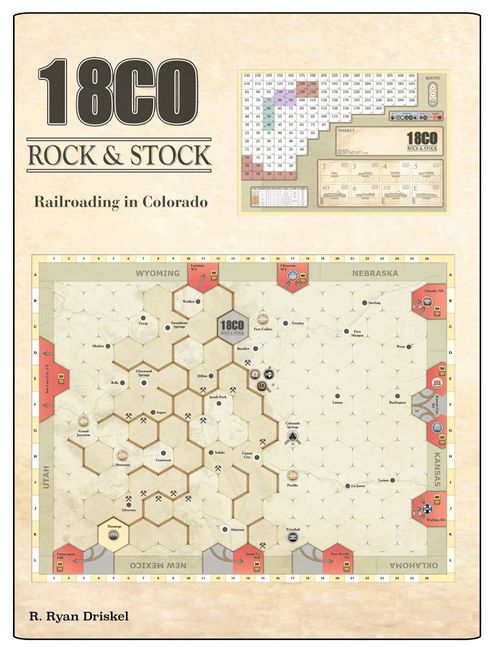
18CO: Rock & Stock
18CO: Rock & Stock Rulebook
Table of Contents
Table of Contents
- 1. Setup
- 2. Private Company Auction
- 3. General Sequence of Play
- 4. Stock Round
- 5. Operating Round
- 6. Takeover of Corporations
- 7. Acquisition Round
- 8. President's Choice Round
- 9. Game Phases
- 10. Ending the Game / Winning
- 11. Glossary
- 12. Historical Notes
- 13. Design Notes
- 15. Supporting Tables
- 16. Frequently Asked Questions
1. Setup
1.1. Setup the Game Board as follows:
- 1.1.1. Place the Round Token on "Stock Round"
- 1.1.2. Place $10,000 in the Bank.
- 1.1.3. Stack each type of Train on its location on the board.
- 1.1.4. Place the Certificates, Station Tokens and Stock Tokens on their respective Corporation Charters.
- 1.1.5. Place the Track Tiles near the Game Board.
- 1.1.6. Place the Town Markers on the hexes marked with a small, solid circle inside a larger circle.
1.2. Shuffle and deal one Player Order card to each player.
1.3. Give each player their initial money from the Bank.
- 3 Players: $500
- 4 Players: $375
- 5 Players: $300
- 6 Players: $250
1.4. Randomly draw one of the B group Private Companies. Remove the rest of the B group Private Companies from the game.
1.5. Place the remaining Private Companies in the center of the play area, organized in order of ascending base cost.
2. Private Company Auction
There are ten private companies included with the game, but only seven will be used during each session. These seven private companies are auctioned to the players.
2.1. In player order, each player may perform one of the following:
- 2.1.1. Place a new bid for one of the Private Companies.
- 2.1.2. Increase a previous bid, with the option to move that bid to a different Private Company.
- 2.1.3. Pass. This does not prohibit the player from participating in the auction on their next turn.
2.2. Bids must be multiples of $5.
2.3. Bids must be at least as high as the base cost of that Private Company, or at least $5 higher than the current bid, whichever is greater.
2.4. When placing or increasing a bid, the player must reserve the amount of the bid from their personal cash until the auction ends.
2.5. The total amount of a player's bids may not exceed their personal cash.
2.6. Once all players pass sequentially, the auction is over. Players receive the Private Companies for which they have placed the highest bid. The money from the winning bids is placed in the Bank.
2.7. Private Companies which received no bids are placed in the Market.
2.8. The Priority Deal card is given to the player to the left of the last player to place or increase a bid.
3. General Sequence of Play
Play proceeds with a sequence of rounds as follows:.
3.1. Stock Round
- 3.1.1. Starting with the Priority Deal player, each player in turn may sell Stock and then may buy one Stock Certificate. A player who does neither on their turn is deemed to pass.
- 3.1.2. A Stock Round ends after all players pass in succession.
- 3.1.3. If, at any point during a Stock Round, the Bank is reduced below $0, the game ends at the conclusion of the following set of Operating Rounds.
3.2. A set of two Operating Rounds
- 3.2.1. The owner of each Private Company receives the amount of income shown on the Private Company certificate from the Bank.
- 3.2.2. Each floated Corporation Operates in descending Stock Market Value order.
- 3.2.3. If, at any point during an Operating Round, the Bank is reduced below $0, the game ends at the conclusion of this set of Operating Rounds.
3.3. Acquisition Round (if there are Corporations with Stock Market Value in the acquisition zone of the Stock Market)
3.4. President's Choice Round (once, before the first Stock Round after the purchase of the first 5D or E)
4. Stock Round
4.1. Selling Stock
- 4.1.1. Shares cannot be sold in the first Stock Round of the game.
- 4.1.2. A player may sell any number of shares the player currently owns.
- 4.1.3. The player receives the current Stock Market Value from the bank for each share sold in the set.
- 4.1.4. The Stock Market Value of each sold Corporation is then adjusted as follows:
- 4.1.4.1. If one share is sold by the President, the token is moved one space down.
- 4.1.4.2. If more than one share is sold by anyone, the token is moved one space down for each share sold or until the token hits the bottom of the column on the Stock Market.
- 4.1.4.3. A player selling shares in multiple Corporations at once may determine the order in which they are sold.
- 4.1.5. The President's Certificate, nor one share of it, cannot be sold, unless it would trigger a Presidency Exchange.
- 4.1.6. The Market cannot hold more than 5 shares of each Corporation. If selling shares would cause more than 5 shares to be in the Market, those shares cannot be sold.
4.2. Buying Stock
- 4.2.1. A player can only buy one Stock Certificate at a time.
- 4.2.2. Stock Certificates viable for purchase include those in the Market, those in the Treasury of a Corporation, and Corporate Certificates owned by a Corporation where the purchasing player is the President. Once the President's Choice Stock Round has finished, all Corporate Certificates are available for all players to purchase.
- 4.2.3. The President's Certificate must be purchased before any of the Corporation's other Certificates.
- 4.2.4. Each Certificate represents an amount of shares in the Corporation as specified on the Certificate. The purchase price for a Certificate is the number of shares it represents multiplied by the Stock Market Value.
- 4.2.4.1. The purchase price for Certificates bought from the Market is paid to the bank.
- 4.2.4.2. The purchase price for Certificates bought from a Corporation is paid to that Corporation's treasury.
- 4.2.5. A player can never purchase nor own more than 6 shares of a Corporation.
- 4.2.6. If a player has sold shares of a Corporation during a Stock Round, that player cannot buy shares of that Corporation during the same Stock Round.
4.3. Launching a Corporation
- 4.3.1. The player purchasing the President's Certificate of a Corporation determines its initial Stock Market Value by placing the Corporation's Stock Token on the Stock Market in one of the Starting Value spaces, under any other Stock Tokens already present in the space.
- 4.3.1.1. The DSNG must start at 75 (blue). The CS, DPAC, DSL, and KPAC may be started in blue, purple, or brown. The ATSF and DRG may be started in purple or brown. The CBQ, ROCK, and UP may only be started in brown.
- 4.3.1.2. Corporations started in the blue zone (40, 50, 60, or 75) float with 40% sold. Corporations started in the purple zone (80, 90, 100, or 110) float with 50% sold. Corporations started in the brown zone (120, 135, 145, or 160) float with 60% sold.
- 4.3.2. The player receives the Corporation Charter, places its remaining Certificates and any Tokens associated with the Corporation upon its charter and twice the initial Stock Market Value is paid to the Corporation's treasury as per Buying Stock.
- 4.3.3. The Corporation will be considered floated and begin Operating once the required percentage of shares have been purchased from the Treasury.
- 4.3.4. A Corporation cannot be launched if its reserved station location is not available, or no tile upgrade containing a station location on that tile is available. (Eg: If no player had launched DSL until brown tiles were available, the station location is no longer reserved and all station locations in Denver may already be occupied. )
4.4. Certificate Limit
- 4.4.1. A player cannot hold more Certificates (not shares) than the Certificate Limit.
- 3 Players: 17 Certificates
- 4 Players: 14 Certificates
- 5 Players: 12 Certificates
- 6 Players: 10 Certificates
- 4.4.2. A player who is involuntarily in violation of the Certificate Limit must sell enough shares to be in compliance at the player's first legal opportunity.
4.5. Presidency Exchange
- 4.5.1. If, at any point, an entity owns more shares of a Corporation than its President, then the entity with the most shares becomes President of that Corporation.
- 4.5.1.1. As an exception to the above, a Corporation cannot own its own President's Certificate and the number of shares in its Treasury does not trigger a Presidency Exchange.
- 4.5.2. If multiple entities have more shares than the current President, the closest player seated clockwise from the current President becomes the new President, followed by Corporations in Operating order.
- 4.5.3. The President's Certificate is exchanged between the former President and the new President for an equivalent number of shares in the form of any number of equally valued Certificates in that Corporation.
4.6. End of Stock Round
- 4.6.1. The Priority Deal card is given to the player to the left of the last player to have taken any action other than passing.
- 4.6.2. Move the associated Stock Token one space up for each Corporation whose shares are entirely owned by Players and other Corporations.
- 4.6.2.1. If the Stock Token cannot move up, move the Stock Token one space to the right.
5. Operating Round
The first time a Corporation operates, it places its home Station Token on the reserved station location marked with the Corporation's symbol. If the reserved station location is not currently available, the Corporation's first track tile lay must be to upgrade the tile to allow placing the Station Token.
5.1. Private Revenue
Private Company owners receive income from the Bank according to the amount listed on the Private Company certificate.
5.2. Operate
Each floated Corporation operates in order of descending Stock Market Value. If two or more Corporations share the same Stock Market Value, the Corporation farther to the right on the Stock Market operates first. If two or more Corporations share the same space on the Stock Market, the Corporation whose token is on top operates first. Each floated Corporation operates as follows:
- 5.2.1. May purchase Private Companies.
- 5.2.2. May redeem shares.
- 5.2.3. May purchase shares.
- 5.2.4. May lay track.
- 5.2.5. May place one Station Token.
- 5.2.6. Must run trains, if possible.
- 5.2.7. Must Distribute Revenue, if any.
- 5.2.8. May/Must Purchase Trains.
- 5.2.9. May issue shares to the Market.
- 5.2.10. May sell shares to the Market.
All decisions regarding the operation of a Corporation are made on its behalf by the player who owns the President's Certificate.
5.3. Purchasing Private Companies
- 5.3.1. Starting in Phase 3, at any time during its operating turn, a Corporation may purchase a Private Company.
- 5.3.2. A Private Company may be purchased from a player for any mutually agreed amount between 50% and 150% of the Private Company's face value.
- 5.3.3. A Private Company in the Market is purchased at 50% of the Private Company's face value.
- 5.3.4. The Denver & Rio Grande Railway Silverton Branch cannot be bought by a Corporation.
5.4. Redeeming Shares
- 5.4.1. The operating Corporation may purchase its own shares from the Market.
- 5.4.2. All stock certificates are purchased at Stock Market Value.
5.5. Purchasing Shares
- 5.5.1. The operating Corporation may purchase the stock certificates of one other corporation from the Market and/or the operating Corporation's President.
- 5.5.2. All stock certificates are purchased at Stock Market Value.
- 5.5.3. A Corporation cannot buy a President's Certificate, nor one share of a President's Certificate.
- 5.5.4. Multiple certificates may be purchased in a single operating round, but must be purchased one at a time with a check for change of presidency and potential takeover after each purchase.
5.6. Laying Track Tiles
- 5.6.1. Track is laid by placing track tiles in the map hexes, either replacing tiles previously laid or over-laying tiles preprinted on the map.
- 5.6.2. Until phase 7, Corporations may place up to two tiles per turn, according to Table A. If two tiles are placed, at least one of them must be a yellow tile.
- 5.6.3. Track can never be laid such that it would run off the map or into a grey hex where there is no connecting track printed on the board.
- 5.6.4. There are three colors of track tiles: yellow, green and brown. Yellow tiles can only be laid in empty hexes, not pre-printed yellow or grey. Green tiles can only be laid in replacement of yellow tiles. Brown tiles can only be laid in replacement of green tiles.
- 5.6.5. No tiles can be laid in grey preprinted hexes or red off-board areas.
- 5.6.6. Replacing a tile, even a yellow preprinted one, with another tile is an upgrade. Return any previously placed tiles once they are upgraded so they can be reused.
- 5.6.7. Upgrades are further limited by the game phase: green tiles may be laid in Phase 3 and onward; brown tiles may be laid in Phase 5 and onward.
- 5.6.8. Some hexes contain symbols indicating the type of tile that can be placed, or have unique upgrades. Consult the Tile upgrade chart for more specifics.
- 5.6.8.1. City: Large Circle
- 5.6.8.2. Town: Small Solid Circle inside another circle
- 5.6.8.3. Village: Small Solid Circle
- 5.6.9. A tile upgrade must preserve, by both its type and how it is oriented, all previous track that existed in that tile.
- 5.6.10. When laying any track tile, either the value of a City must be increased, or some of the newly placed track depicted on a tile must be reachable by tracing track from one of the Corporation's Station Tokens. Each subsequent city passed through must have an empty Station Token location.
- 5.6.11. When upgrading track in non-revenue generating locations, for at least one new segment of track, all previous track segments involved in newly created junctions must have been reachable by tracing routes from any of the Corporation's tokens.
5.7. Placing Station Tokens
- 5.7.1. One Station Token may be placed each Operating Round, not including the Corporation's home Station Token.
- 5.7.2. A Station Token can only be placed on an empty station location in a hex not already containing that Corporation's Station Token.
- 5.7.3. The City must be reachable by tracing a route of any distance from one of the Corporation's existing Station Tokens. Each subsequent city passed through must have an empty station location.
- 5.7.4. Reserved station locations are marked, both on the board and on tiles, with the Corporation's symbol. Station Tokens cannot be placed on stations reserved for starting other Corporations that are still available. If the location has a Corporation's symbol printed on the board and that Corporation has floated, that station location is considered reserved.
- 5.7.5. The cost of placing a station token is printed on the station token's location on the Corporation's Charter and must be paid from the Corporation's Treasury. The home station token is free, the second token is $40 and all further tokens are priced on their respective Corporation Charters.
5.8. Running Trains
- 5.8.1. If the Corporation has a route, at least one train must run.
- 5.8.2. A route consists of a length of track traced in one direction which either begins in or passes through at least one city containing a Station Token belonging to the Corporation and at least one other revenue generating location ( City, Town, Village, Off-board location ).
- 5.8.3. A route must start at a City or Off-board location.
- 5.8.4. A route cannot visit a given revenue generating location more than once but can visit separate locations printed on the same tile, as in the case of the yellow and green Denver tiles.
- 5.8.5. A route cannot pass through a city if all of that city's station token spaces are occupied by Station Tokens belonging to other Corporations.
- 5.8.6. A route cannot re-use track already used by the same route or another of the Corporation's routes on this Operating Round.
- 5.8.7. A route cannot pass through an Off-Board location (red hex). Off-Board locations are start/end points only.
- 5.8.8. A route's Revenue is the sum of all revenue generating locations it visits, subject to its train range, plus any bonuses for that specific route.
- 5.8.8.1. A train can only visit a number of Cities and Off-board locations equal to its range, and cannot continue on to other revenue generating locations (including Towns or Villages) outside its range.
- 5.8.8.2. Towns and Villages count for revenue but do not count against the trains range.
- 5.8.8.3. "nD" trains have range n and double the value of the cities and Off-Board locations, but ignore revenue from Towns and Villages.
- 5.8.8.4. The "E" train has unlimited range and counts revenue normally.
- 5.8.8.5. When a Corporation starts its run at an East Off-Board location (Lincoln NE, Kansas City KS, Wichita KS) and ends its run in Salt Lake City, it receives a bonus revenue of $100.
5.9. Distributing Revenue
If the Corporation had any Revenue this turn, it must collect its mine income, and then Withhold Revenue or Pay Dividends.
- 5.9.1. For each mine token on the operating Corporation's Charter, take $10 from the Bank and place in the operating Corporation's Treasury.
- 5.9.2. Withhold Revenue
- 5.9.2.1. Take an amount equal to the Corporation's Revenue from the Bank and place it in the Corporation Treasury.
- 5.9.2.2. Adjust the Stock Token one space left, or one space down if it is at the left edge. Do not move the token if it is in the bottom left corner.
- 5.9.3. Pay Dividends
- 5.9.3.1. Divide the Revenue by 10. This is the dividend amount.
- 5.9.3.2. For each share owned by Players or Corporations, take the dividend amount from the Bank and give it to the shareholder.
- 5.9.3.3. Adjust the Stock Token one space right. If the revenue was at least twice the original Stock Market Value this round, also move the token one space up.
- 5.9.3.3.1. If the token is at a right edge upon a rightwards movement, instead move it one space up.
- 5.9.3.3.2. If the token is at the top edge upon an upwards movement, instead move it one space right.
- 5.9.3.3.3. If the token is at the top right corner, it does not move.
5.10. Purchasing Trains
- 5.10.1. A Corporation may, using only its own funds, purchase trains(s) as follows:
- 5.10.1.1. from the bank at list price.
- 5.10.1.2. from the market at ½ list price. ( Trains are placed in the market when Corporations are forced to discard them on a phase change )
- 5.10.1.3. from other Corporations at any agreed upon price not less than $1.
- 5.10.2. Each train purchase is performed separately, one at a time.
- 5.10.3. Trains belonging to later phases cannot be purchased until all the trains from the current phase have been purchased from the Bank.
- 5.10.4. A phase change is triggered and resolved immediately when the first train of a new phase is purchased from the Bank.
- 5.10.5. Each Corporation has a limit on how many trains it can own during which phases.
- 5.10.5.1. Trains cannot be voluntarily sold to the Market or discarded.
- 5.10.5.2. A Corporation that is at its limit may not purchase a train, even if the purchase would trigger a phase change that would put the Corporation at or below the Train Limit. (e.g.: A Corporation owns 3 "2"s and a "3", at train limit of 4. If the Corporation bought a 4, all "2" trains would rust, so the Corporation would be under limit again. This is not allowed.)
- 5.10.5.3. If, due to a phase change, any Corporation has more trains than the train limit, the Corporation must immediately place its choice of train(s) in the Market until it complies with the Train Limit. If the Durango and Silverton Narrow Gauge permanent "2" train is discarded, it is removed from the game.
- 5.10.6. A Corporation must purchase a train if it does not own a train and has a legal route.
- 5.10.6.1. If a Corporation cannot afford a train to satisfy a mandatory purchase, it must buy the cheapest available train in the Bank or Market, raising only as much money as necessary through the following means, in order:
- 5.10.6.1.1. Sell (issue) the Corporation's own certificates one at a time, moving the stock down for each share sold. Corporate Certificates cannot be sold.
- 5.10.6.1. If a Corporation cannot afford a train to satisfy a mandatory purchase, it must buy the cheapest available train in the Bank or Market, raising only as much money as necessary through the following means, in order:
5.11. Issuing Shares
- 5.11.1. Certificates of the operating Corporation can be sold, but are sold one at a time, with the operating Corporation's Stock Token moved down for each share sold or until the token hits the bottom of the column on the Stock Market.
- 5.11.2. Money from issuing shares is placed in the Corporation Treasury.
5.12. Selling Shares of Other Corporations
- 5.12.1. Corporate Certificates can be sold if the operating Corporation did not purchase any Corporate Certificates of the same Corporation in the same turn.
- 5.12.2. If more than one Corporate Share is sold, the target Corporation's Stock Token is moved one space down for each share sold or until the token hits the bottom of the column on the Stock Market.
- 5.12.3. Money from share sales is placed in the Corporation Treasury.
6. Takeover of Corporations
6.1. If, at any time, a Corporation owns the President's Certificate of another Corporation, the owning Corporation must take over the owned Corporation as follows:
- 6.1.1. Third-party shares on the owned Corporation Charter are sold to the Market with no impact to share price. This money is placed in the owned Corporation Treasury.
- 6.1.2. Remove any owned Station Tokens in hexes containing the owning Corporation's Station tokens.
- 6.1.3. Up to two owned Station Tokens on the board may be replaced with the owning Corporation's Station Tokens at no cost. Use tokens from the right side of the Corporation Charter for this purpose.
- 6.1.4. The owning Corporation receives the Trains, Certificates, Mine Tokens and Private Companies.
- 6.1.5. The owned Corporation's Treasury, rounded down to the nearest $10, is paid out to the owned Corporation's shareholders as if it were a dividend. Treasury money paid to certificates in the Market is returned to the Bank. Any leftover treasury cash is transferred to the owning Corporation's treasury.
- 6.1.6. Place the owned Corporation's Charter underneath the owning Corporation's Charter.
- 6.1.7. The owning Corporation's Train limit is increased by one.
- 6.1.7.1. Any excess trains are discarded to the Market down to the new limit.
6.2. The owned Corporation is closed. Remove its Certificates, Stock Token, any remaining Station Tokens and any previously taken over Charters underneath the owned Corporation's Charter from the game.
7. Acquisition Round
7.1. Auction each Corporation with Stock Tokens in the Acquisition (red) zone near the bottom of the Stock Market in Operating order.
- 7.1.1. In Operating order, each Corporation that is not up for liquidation and does not have the same President as the Corporation currently being liquidated may either place a single bid of at least $1 or pass.
- 7.1.2. The Corporation with the highest bid wins the auction, and pays their bid money from their Treasury to the Bank.
- 7.1.3. The winning Corporation executes a Takeover on the liquidated Corporation.
- 7.1.4. In the unlikely event that all Corporations pass in a liquidation auction, discard the liquidated Corporation's trains to the Market and return its treasury cash to the bank. Remove its Charter, Certificates, Tokens and all of its other assets from the game.
8. President's Choice Round
8.1. This special stock round will occur once after the set of Operating Rounds following the first purchase of a 5D or E train.
8.2. Starting with the Priority Deal and moving clockwise, each player may purchase one Certificate from the Treasury of a Corporation for which they are President.
8.3. Once a player passes, they may no longer purchase Certificates during this special stock round.
8.4. Once all players pass, proceed to the Stock Round. All Certificates in the Treasuries of Corporations are now available for all players to purchase for the remainder of the game.
9. Game Phases
9.1. The game changes phases when the first train of the new phase is purchased. Its effects take place immediately and persist until altered by a later game phase. See Table A.
9.2. Phase 2 - Start of Game
- 9.2.1. Yellow track tiles may be placed.
- 9.2.2. Use the upper value on off-board locations.
- 9.2.3. The base Train Limit is 4.
9.3. Phase 3 - Upon purchase of first 3 train
- 9.3.1. Yellow track tiles may be upgraded to Green track tiles.
- 9.3.2. Corporations may buy Private Companies.
9.4. Phase 4 - Upon purchase of first 4 train
- 9.4.1. Remove all "2" Trains from the game, except the special "2" train owned by the D&SNG Corporation..
- 9.4.2. The base Train Limit is 3.
9.5. Phase 5 - Upon purchase of first 5 train
- 9.5.1. Use the lower value on off-board locations.
- 9.5.2. Green track tiles may be upgraded to Brown.
- 9.5.3. Green Towns may be upgraded to Brown Cities.
- 9.5.4. Remove all Private Companies from the game without compensation. If the Idarado Mining Company is owned by a Corporation, do NOT remove it.
- 9.5.5.
4Dtrains are available for purchase.
9.6. Phase 5b - Upon purchase of first 4D train
- 9.6.1. Remove all
3Trains from the game. - 9.6.2. The base Train Limit is 2.
9.7. Phase 6 - Upon purchase of first 6 train, available after all 5s and 4Ds have been purchased.
- 9.7.1. Remove all
4Trains from the game. - 9.7.2. Remove all Mine Tokens from the game.
- 9.7.3. Remove the Idarado Mining Company.
- 9.7.4.
5DandETrains are available for purchase.
9.8. Phase 6b - Upon purchase of first 5D train
- 9.8.1. The President's Choice Stock Round will occur at the end of the set of Operating Rounds, after which all certificates owned by Corporations are available for purchase.
9.9. Phase E - Upon purchase of the E train
- 9.9.1. Remove all
5Trains from the game. - 9.9.2. Only one track tile may be placed per Corporation's operating turn.
- 9.9.3. The President's Choice Stock Round will occur at the end of the set of Operating Rounds, after which all certificates owned by Corporations are available for purchase.
10. Ending the Game / Winning
The game ends immediately if a player goes bankrupt (see 5.10.6.2). The game ends at the conclusion of a set of operating rounds if the bank runs out of money (see 3.1.3 and 3.2.3). Total each player's cash on hand, stock portfolio value based on final stock prices and face value of any remaining private companies (Note: the Denver & Rio Grande Railway Silverton Branch has no value in this calculation). Ignore money held in Corporation treasuries. The player with the highest total wins!
11. Glossary
- 11.1. Assets: Certificates, Trains and Private Companies
- 11.2. Bank: Holds all the money used in the game, as well as unsold trains and Private Companies.
- 11.3. Base Cost: Indicated in the bottom right of the Private Company certificate. The minimum bid amount during the auction.
- 11.4. Corporate Certificate: Certificate of a different corporation owned by a corporation.
- 11.5. Certificate: An item denoting a number of shares in a Corporation or control of a Private Company.
- 11.6. Corporation Charter: A physical item used to hold the Corporation's Station Tokens, Assets and Treasury.
- 11.7. Dividend: The amount of money paid per share, 1/10 of revenue.
- 11.8. Income: Indicated in the top left of the Private Company certificate.
- 11.9. President: The entity with the most and earliest ownership of a Corporation. This entity controls the Corporation's decisions.
- 11.10. Private Company: A physical item with an Ability and providing an Income. Counts as a Certificate when checking for Certificate Limit.
- 11.11. Revenue: The amount of money a Corporation generates by running trains.
- 11.12. Share: The smallest single amount of ownership of a Corporation.
- 11.13. Stock: Any number of shares.
- 11.14. Treasury: Corporation money.
12. Historical Notes
Denver Pacific: A race to connect Denver to the railroad hub of Cheyenne began in 1867 with the formation of both the Denver Pacific Railway and Telegraph Company and Colorado Central both having the same end goal. The company won the race and the first train from Cheyenne to Denver ran in 1870.
Kansas Pacific: Created in 1855 with the intention of building rail through Kansas and into Nebraska, citizens of Denver lobbied to have what would become the Kansas Pacific build instead into Colorado to connect Denver with the cities to the East. In 1874, Jay Gould gained effective control of the Kansas Pacific and consolidated it with the Denver Pacific to become part of the Union Pacific.
Colorado Midland: Building the first standard gauge railroad over the Continental Divide in Colorado was no easy feat, but the Colorado Midland was the first to accomplish this monumental task. It ran from Colorado Springs to Leadville, over Hagerman Pass and down to Grand Junction.
Colorado and Southern: Formed by the Consolidation of several small railways, the Colorado and Southern Railway had lines running deep into the mountains of Colorado, down through Trinidad to New Mexico and into Texas.
Denver and Salt Lake: While never being profitable during its initial inCorporation, the company built the Moffat tunnel route, which is still in use today. The original track was the highest mainline rail ever constructed in North America.
Atchison, Topeka and Santa Fe: The ATSF was one of the first railroads to build into southern Colorado, with the dream of an eventual continental crossing. Getting to Colorado had proved easy, but once there, good locations for laying track became difficult to survey, eventually leading to armed conflict with the Denver and Rio Grande over rights to build near the Royal Gorge.
Denver and Rio Grande: The epitome of mountain railroading, the Denver and Rio Grande was one of the most successful Colorado railroads. Starting in Denver, the line went South to the Royal Gorge, west over the Continental Divide through Gunnison and eventually to Salt Lake City via Grand Junction, completing the first transcontinental link through the Colorado Rockies.
Chicago, Burlington and Quincy: One of the larger railroads to enter into Colorado Railroading, The CBQ made its first runs to Denver after purchasing the Nebraska B&MR and completing its Denver route in 1882. The CBQ also eventually purchased the Colorado and Southern to extend its Colorado rail system.
Chicago, Rock Island and Pacific: The main competition for the CBQ, the ROCK ran its famous "Rocky Mountain Rocket", a diesel passenger train, from Chicago through Limon and west to Colorado Springs.
Union Pacific: One of the largest railroads in the United States, the Union Pacific was pivotal to early railroading in Colorado with its purchase of both the Denver Pacific and Kansas Pacific. Embroiled in the The Crédit Mobilier scandal of 1867, the Union Pacific is a perfect example of the underhandedness of the railroad barons of the age.
Durango and Silverton Narrow Gauge: Originally opened in 1882 to transport Gold and Silver from the San Juan mountains, the line has gone through many iterations, but still exists today as a tourist line. The route follows the Animas river and allows passengers access to the remote Weminuche Wilderness.
13. Design Notes
I had three goals in mind when designing 18CO; create a market mechanism that encourages cross investment but maintains liability, create a merger mechanism that can be manipulated through shareholder decisions and design a system that encourages diverse track patterns with each game.
The initial version of 18CO featured a lot of extra chrome, including many more private companies and revenue generating locations called Tourist Attractions. The game is not all that long, averaging 6.5 Stock Rounds depending on the purchase of the Electric, and this extra chrome simply was not needed. I also experimented with trains similar to 18EUs Pullman Cars called Tourist trains. These trains were cheap and had to be run from Red to City to Red. The idea being in the end game, if a Corporation had spare cash but could not afford a top tier train, they could generate a bit of extra income. In practice, it was the most powerful Corporations that purchased these trains, giving them even more of a boost.
You may notice tunnels on the map. Originally, there were three different private companies, each allowing a free tile lay across the ridge in these locations. These were the major historical tunnels in Colorado Railroading history; the Busk-Ivanhoe Tunnel, the Moffat Tunnel and the Alpine Tunnel. I very much liked the inclusion of these tunnels thematically, but in practice they were irrelevant to gameplay. We never once saw the private used to construct a tunnel. We later changed the private to include building any of the three tunnels, and it was still not terribly attractive.
The values on the eastern off-boards decrease in value in the brown phase. At the start of the railroading era in Colorado, it was extremely important to connect to the east; this is where all the people and freight was located. All Colorado was developed, it was no longer important to connect from the front range to the east, but rather the importance was getting through the Rocky Mountains to Utah and further west. Kansas and Colorado were just stops along the way to California. This is the origination of the East-West bonus.
Analysis of the stock market will show that there is more share value to be gained by going up, as opposed to right. Combined with the capability of moving up by running for double, this creates great share value appreciation, at great risk. The stock should be a tempting sale when it is near the top of the chart. Withholding to buy a train, then subsequently "doubling up" will generally create more share value than paying out for a single movement twice. If opponents do not capitalize on the high share price, the company will be much better equipped for the future with its new train.
15. Supporting Tables
Table A: Trains and Phases
| Phase | Trigger | Next Available | Train Limit | Rusts | Tile Lays | Private | Off-Board |
|---|---|---|---|---|---|---|---|
| 2 | - | 3 after all 2 | 4 | - | 2Y | - | Upper |
| 3 | 3 | 4 after all 3 | 4 | - | 2Y / 1Y+1G | Buy In | Upper |
| 4 | 4 | 5 after all 4 | 3 | 2 | 2Y / 1Y+1G | Buy In |
Table B: Private Companies
| # | Company | Face Value | Income | Group | Ability |
|---|---|---|---|---|---|
| 1 | Idarado Mining Company | 30 | 5 | A | Money gained from mine tokens is doubled for the owning Corporation. If owned by a Corporation, closes on purchase of "6" train, otherwise closes on purchase of "5" train. |
| 2 | Grand Junction and Grand River Valley Railway | 40 | 10 | A | An owning Corporation may upgrade a yellow town to a green city at any time during its turn. Action closes the company or closes on purchase of "5" train. |
| 3 | Denver, Northwestern and Pacific Railroad | 50 | 10 | A | An owning Corporation may return a station token to its charter to gain the token cost. Corporation must always have at least one token on the board. Action closes the company or closes on purchase of "5" train. |
| 4 |
Table C: Corporations
| Corporation | Class | Par Zones | Tokens | Color | Notes |
|---|---|---|---|---|---|
| Kansas Pacific Railway ( KPAC ) | III | Blue, Purple, Brown | 3 | Brown | Starts in Kansas City, KS (South) |
| Colorado Midland Railway ( CM ) | III | Blue, Purple, Brown | 4 | Light Blue | Starts in Colorado Springs, CO |
| Colorado and Southern Railway ( CS ) | III | Blue, Purple, Brown | 4 | Black | Starts in Trinidad, CO |
| Denver Pacific Railway ( DPAC ) | III | Blue, Purple, Brown | 2 | Purple |
Table D: Tile Upgrades
| Tile | # | Upgrade | Note | Tile | # | Upgrade | Note |
|---|---|---|---|---|---|---|---|
| 3 | 6 | 141,142,143 | V/T | 29 | 2 | 39,43,45,70 | |
| 4 | 6 | 141,142 | V/T | 141 - co8 | 5 | T Only: 63, 135 | V/T |
| 5 | 3 | 14,15 | C | 142 - co9 | 5 | T Only: 63, 135 |
16. Frequently Asked Questions
16.1. Can the DSNG ever go into emergency money raising? Can a company that takes over the DSNG and acquires its permanent 2 train ever go into emergency money raising?
- 16.1.1. No company with the permanent
2can go into emergency money raising.
16.2. Three brown cities value 50 have five exits, while six are value 40 with six exits. Are there any restrictions on where these may be placed, or are they first come, first served?
- 16.2.1. First come, first served.
16.3. Do players receive any compensation for the value of stock in a Corporation that is taken over, aside from the distribution of treasury funds? Or is the stock value lost?
- 16.3.1. Just treasury, no compensation for stock value. The rail barons were mischievous buggers. Plan accordingly.
16.4. If a Corporation begins its turn by buying shares in another Corporation, can it use the takeover Corporation's trains and mine tokens during its operating round?
- 16.4.1. Yes.
16.5. Do all Class III railroads have to launch before a Class II can launch?
- 16.5.1. No. You may launch any Corporation at any time. You are only limited by the money you have available. In theory, multiple players could work together to launch a Class I Corporation on the first Stock Round.