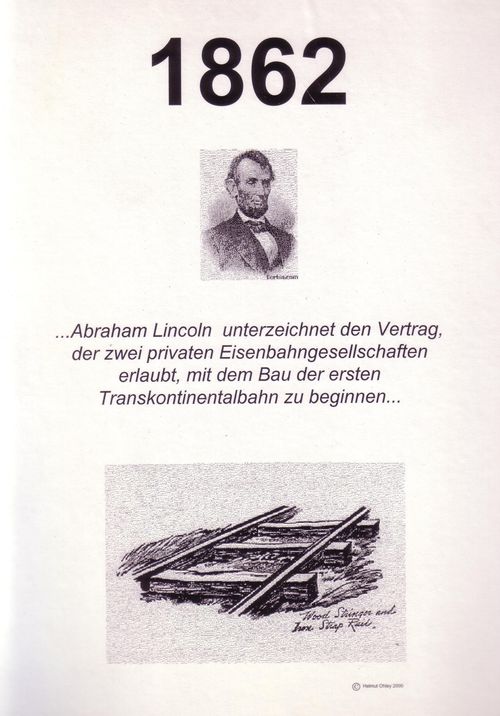
1862 (Ohley)
1862 (Ohley) Rulebook
Table of Contents
Table of Contents
- General
- Preparation to Play
- Initial Stock Round
- Private Companies
- Public Companies
- Operating Round
- Laying of Track
- Upgrading Track
- Placing Station Markers
- Operating Trains
- Income Reckoning and Payment
- Share Price Movement
- Share Price 0 (Company Closure)
- Purchasing Trains
- Bankruptcy
- Effects of Purchasing New Trains
- Share Redemption
- Stock Rounds
- Player's Turn within a Stock Round
- Ending the Game
- Share Price Index (companion table)
General
The player owning the highest combined total of cash and stock valued at market price at game end is the winner of 1862.
1862 has at its heart a very simple mechanic. The yellow, green, brown and grey tiles are used to build a railroad network on the map. As in a real railway, the tracks link stations together. The train cards steam symbolically from one station to another and so earn income. The (pretend) passengers pay for their journey. The more, and the larger, the stations at which a train calls, the more income it produces. Players own private companies and shares of 13 public companies. The public companies belong to their shareholders, one of them being the company's president. Only the president decides how the company is to be run.
After cutting and gluing you should have the following game components spread out in front of you:
- 1 mapboard
- 1 stock market board
- 1 game phase reference chart
- 1 bankpool sheet
- 1 initial offering sheet
- 85 yellow track tiles
- 47 green track tiles
- 24 brown track tiles
- 8 grey track tiles
- 1 special grey tile (Erie)
- 42 train cards
- 8 private company certificates
- 54 public company certificates of 3 companies (1 x 30% (Pres.), 7 x 10%, 1 x 10% (Pres.), 8 x 5%, 1 x 50% each)
- 190 public company certificates of 10 companies (1 x 20% (Pres.), 8 x 10%, 1 x 10% (Pres.), 8 x 5%, 1 x 50% each)
- 24 debt certificates
- 40 station markers
- 13 par value tokens
- 13 share price tokens
- 66 white plastic tokens (to glue the markers and tokens to)
- 1 black plastic token (to show changes between stock and operating rounds)
- 13 public company charters
- 8 varieties of paper money (1$, 2$, 5$, 10$, 20$, 50$, 100$ and 500$ for a total value of 22.000$)
- 1 priority deal card
- 1 plastic stand for priority deal card
- 7 starting order cards
- 1 rules of play
Preparation to Play
Starting Order
- To determine the player's starting order, each player is dealt a starting order card. The players should take their places clockwise in ascending order of their card number.
- One player should volunteer to be the banker who should have enough space to sort the money (22.000$) and other game components in front of him.
Player Starting Capital
Each player receives his starting capital according to the number of players:
- 4 players: 600$
- 5 players: 500$
- 6 players: 440$
- 7 players: 400$
Miscellaneous
- The private company certificates (numbered 1-8) are spread out on the mapboard and the public company certificates are placed on the initial offering sheet.
- New (never sold) public company certificates have to be kept separately from old (once belonging to a player) certificates. Old certificates belong to the bankpool (empty at game start).
- Train cards and yellow track tiles will be needed soon. Sort the track tiles near the mapboard for an easy overview of straights, bends and stations.
- Move the type 2 train cards to the available trains (verfügbare Loks) space on the stock market board. Sort the other train cards from type 3 to type 10E and move them to the 'unavailable trains' (nicht verfügbare Loks) space. If - excepting 'E'-trains - all available trains have been sold out, move next series of train cards to the 'available trains' space.
- The public company charters should be kept near the mapboard. They will hold the company's entire belongings (trains, treasury, station markers, redeemed shares and debt certificates). The company's treasury must be kept separately from money in players' hands and other companies' treasury.
- Paper, pen and a pocket calculator can be useful at game end.
Initial Stock Round
- The player with the lowest starting order card receives the priority deal card.
- As a matter of principle, in each turn a player may either buy a single certificate, place a bid on a certificate to be offered later or pass. Once a player has done one of these things his turn is over and the next player takes his turn.
- Initially, only the private company certificates are available in the first stock round. Only the lowest numbered unsold certificate is available for purchase at printed price. Bids on other certificates have to be at least 5$ higher than its printed price or the currently highest bid. As long as a player has placed the highest bid on a private certificate, this money is earmarked and can't be used for bids on other certificates. However, if another player places a higher bid on that certificate, the player has two options: keep the money on the bid (allows the player to participate in the following auction) or withdraw the bid and get the money back.
- If the '1' certificate is still unsold after all players have successively passed, the certificate is offered at a 5$ lower price to the next player. The first player to whom the certificate is offered at 0$ has to buy it (this has no disadvantages).
- If a certificate is bought and the next certificate that would normally be offered for sale has only one bid on it, that certificate is immediately sold to the player who bid on it at bid price. If two or more players have bid on the next company being offered, an auction is held starting with the bidding player to the left of the player with the highest bid. Auction is in clockwise order, players can either pass (ending their participation in this auction) or bid at least 5$ higher than the last bid. The certificate for auction goes to the player with the highest bid after all other participating players have passed.
- Payment for certificate goes to the bank, immediately after which the buying player receives his certificate.
- Certificates may not be sold during the initial stock round.
- After the last private certificate is sold, the certificates of the first group of public companies (NYH, NYC, CP) are available for sale. The remainder of the initial stock round follows the rules described in STOCK ROUNDS, except that players may not sell any certificates.
- If there are still unsold private certificates available after all players have passed, the stock round ends and the first operating round begins. It consists only of the private companies' revenues payment. After this operating round, another initial stock round begins.
Private Companies
General
The private companies:
| No | Name | Price | Dividend |
|---|---|---|---|
| 1 | Butterfield Overland Mail | 20 | 5 |
| 2 | Erie Steamship Company | 40 | 10 |
| 3 | Baltimore & Ohio Railroad | 70 | 15 |
| 4 | Rocky Mountain Company | 100 | 15 |
| 5 | Pacific Steamship Company | 150 | 25 |
| 6 | First New York Steamship C. | 180 | 30 |
| 7 |
- Private company certificates are certificates with fixed revenue, paid to the owning player at the start of each operating round.
- They lay no track (exception: see below) nor do they own trains.
- Private company certificates may not be sold.
- They have no value at game end.
- Private companies are closed if their owning player uses their special ability or as described below.
Special Abilities
- The owner of the Butterfield Overland Mail (BOM) has no special advantages except its revenue.
- The owner of the Erie Steamship Company (ERIE) may, at any time - even during a stock round - place the special grey Erie tile. This closes the Erie Steamship Company and is the only way to do so voluntarily. This special tile is only available to the Erie Steamship Company and may only be placed on the Erie hex E 28. In spite of its grey colour, it may be placed from the yellow phase on.
- The owner of the Baltimore & Ohio Railroad (B & O) has no special advantages except its revenue. However, immediately after purchase, he must place its station marker in Baltimore. This station marker is removed immediately after the owner chooses to close the Baltimore & Ohio Railroad voluntarily.
- The owner of the Rocky Mountain Company (RMC) may, if he acts as president of a public company in an operating round, place an additional yellow track tile with a discount of up to 160$ of the hex' printed building cost. This action closes the Rocky Mountain Company.
- The owner of the Pacific Steamship Company (PSC) receives a 10% share of the WP. When the WP pays its first revenue the Pacific Steamship Company is closed.
- The owner of the First New York Steamship Company (FNY) receives two 10% shares of the NYC. When the NYC pays its first revenue the First New York Steamship Company is closed.
- The owner of the Sacramento - Omaha Company (SOC) receives a 10% share of the CPR and a 10% share of the UP. When the first of these companies is floated, the revenue of the Sacramento - Omaha Company is reduced to 15$. It is closed if both companies have been floated.
- The owner of the New Haven Steamship Company (NYSH) receives the 30% president share of the NYH. He has to set the par value of the NYH immediately (usually 100$). The New Haven Steamship Company is closed when the NYH is floated. (Note: It is possible that the New Haven Steamship Company is closed without paying any revenue).
Public Companies
General
- With a share certificate, the player obtains ownership of a percentage of a public company.
- The company's first share sold is its president's share. (Exception: NYH - see above)
- The buyer of the president share has to set its par value immediately (see BUYING SHARES).
- Shareholders receive, during an operating round, a dividend, if the president is not withholding the earnings.
- Shares may be sold.
- The following public companies participate in the game and are brought into game in four subsequent groups:
| No | Abbr | Name | Group | Home city | Station markers |
|---|---|---|---|---|---|
| 1 | NYH | New York New Haven | 1 | New York | 4 |
| 2 | NYC | New York Central | 1 | New York | 4 |
| 3 | CP | Canadian Pacific | 1 | Montreal | 4 |
| 4 | CPR | Central Pacific Railroad | 2 | Sacramento | 3 |
Bonus Routes
- Every public company has certain bonus stations it should run a single train to, starting from its home station - the bonus station need not be the end station. In every operating round, a public company that manages to run a train from home station to bonus station receives a bonus that increases its income considerably.
- The bonus is calculated from the shortest distance in hexes from home station to bonus station.
- Home stations, bonus stations and the shortest distances between are listed on the company charters.
- Multiply this value (shortest distance home/bonus station in hexes) with 20$ during the yellow and green phases.
- Multiply this value with 30$ during the brown and grey phases.
- Subtract 10$ for each hex your train runs through.
- This sum is added to the company's normal income.
- Each bonus can only be used once during a given operating round.
- The printed value of Salt Lake City is raised by 20$ for both CPR and UP if both companies could run a train to Salt Lake City.
Presidency
- Every public company has a president. The buyer of its 30% (first group) or 20% (groups 2 to 4) share is the company's president. After share redemption, these certificates are exchanged for a 10% president's share (see SHARE REDEMPTION).
- The buyer of the president share has to set its par value immediately (see BUYING SHARES).
- The president is solely responsible for the running of the company.
Transfer of Presidency
- If a player owns a higher percentage of shares in a company than its president does, a transfer of presidency takes place.
- There is no transfer of presidency if a player owns an equal percentage of shares as its president.
- The player with the highest percentage of shares of a public company is its new president. If several players have an equal percentage then the first such player next in line to the left of the outgoing president takes over.
- A president may only voluntarily give up his presidency by selling shares to the bankpool. This is only allowed if another player holds at least as much percentage of stock equal to the president's share (30 or 20% - 10% after share redemption), and the old president must be able to sell shares to the bankpool (see SELLING SHARES).
- The old president hands his president's share and the company's charter (with all trains, station markers, treasury, redeemed shares and debt certificates) to the new president and receives in return the same percentage of the company's ordinary shares.
Operating Round
General
During an operating round the players do not act directly, but rather, control the game through the public companies and their presidents.
Sequence within Operating Round
- The bank pays out the revenue from any non-closed private companies.
- All floated (see STARTING A PUBLIC COMPANY) companies act in their current share price order, highest first.
- Should two public companies have the same share price, then the company whose marker lies uppermost on that square plays first.
- In the case of equal values where the markers lie on different squares then the company whose marker lies furthest right plays first.
Sequence within a Company's Turn
Public companies may carry out some or all of the following actions during an operating round. These actions must be carried out in the given order.
- Lay track: place one or two yellow track tiles (see LAYING OF TRACK) or upgrade track: upgrade one yellow tile to a green one, a green one to a brown one or a brown one to a grey one.
- Purchase and place a station marker.
- Trains may be run.
- Income is reckoned and either paid out as a dividend or withheld by the company.
- The share price on the share price index is altered.
- Trains may be purchased. Any consequences of train purchase (scrapping of trains, change of phase) are carried out.
- Share redemption.
The operating round ends when all floated public companies have operated. A stock round or another operating round follows (see EFFECTS OF PURCHASING NEW TRAINS).
Laying of Track
- Yellow track tiles may be laid directly onto the hexes on the mapboard and represent railway tracks. Grey and red hexes represent track already laid and may not be built on.
- In the yellow phase, companies may only lay one yellow tile. From the green phase onwards, they may lay two yellow tiles.
- At the start of the game (yellow phase), only yellow tiles are available. The track on the tile must be a direct continuation of a route already accessible to the company laying the tile. The new track must be connected with a station marker of that company and may not be laid if a station marker of another company blocks this connection.
- In its first turn, a company either lays a station tile onto its start hex, or extends track already built.
- On hexes with no markings only track with no stations may be laid.
- Only track with a small station (black crossbar) may be laid on a hex with a small city (black dot).
- Only track with a large station (white circle) may be laid on a hex with a large city (circle).
- Only station tiles marked with letter(s) (P, L, M, NY, Mtl, NO and Chi) may be laid on cities with the corresponding letter(s).
- No tile may be laid so as to leave a track running into the sea or the grey area in the north-east, nor one running off the mapboard except for the red off board destinations.
- A tile may be laid so that it does not connect with track of all adjacent tiles provided that all other rules have been observed.
- Building on hexes containing mountains, rivers or coast involves cost as shown on the map (coast 40$, river 80$, mountain 120$, mountain + river 160$). These costs must be paid (from the company's treasury) as the tile is laid.
Upgrading Track
- Instead of laying one or two yellow tiles, a public company may upgrade an existing tile or printed hex.
- Yellow tiles may be upgraded with green tiles.
- Green tiles may be upgraded with brown tiles.
- Brown tiles may be upgraded with grey tiles.
- Green tiles are only available from the purchase of the first type 3 train onwards.
- Brown tiles are only available from the purchase of the first type 5 train onwards.
- Grey tiles are only available from the purchase of the first type 8 train onwards.
- A public company may only upgrade a tile if it has a route, from an own station marker, unblocked by other companies' station markers, to the tile after upgrading.
- Existing track must be preserved during tile promotion.
- Tiles without stations may not be upgraded into tiles with stations. In the same way tiles with small stations may not be converted into large stations, or vice versa. Only station tiles marked with letter(s) (P, L, M, NY, Mtl, NO and Chi) may be used to upgrade station tiles with the corresponding letter(s).
- Upgrading of station tiles may lead to an increase of the number of station marker spaces on it. If a free space is so created, then a company may use this to build beyond a previously blocked station.
- Tiles that have been replaced by an upgrade are again available for further building.
- A yellow tile has to be laid in the printed hex of Omaha (this doesn't count as an upgrade) before upgrading it.
Placing Station Markers
- Each public company starts from its home station. Its first station marker is placed there for free when the company acts for the first time in an operating round. All public companies may place at least one additional station marker.
- Station markers have the following properties:
- Each route run by a company's train must include in it a station with a station marker of that company.
- If a station is completely filled with station markers then only trains of that (those) company(s) may run through this station. Other companies' trains must end their routes in this station.
- Every route built by a public company must be connected to a station marker of that company.
- The home station marker is for free.
- The next station marker a company builds costs 40$, any further (if available) station markers cost 100$.
- Station markers across the US/Canadian border cost 1.5 times as much as normal (60$ instead of 40$, 150$ instead of 100$).
- A company may only place one station marker (besides its home station marker) per operating round.
- A company may not build more than one station marker in any tile.
- A station marker may only be placed on a station that is directly connected with an existing station marker of that company. The connecting route may not be blocked by station markers of other companies.
- No other company may place a station marker onto a home station of another company that has not yet placed its home station marker.
Operating Trains
- A company may run each of its trains over one route per turn. Since the purchase of trains comes after running them it is impossible for a train to run in the turn in which it is purchased. Therefore, it is impossible for a company to earn any income in its first operating round.
- A route comprises at least two different stations or offboard destinations (start and end point) which are connected by track.
- Each route run must contain somewhere on it a station marker of the company using the route.
- The route may include small and large stations. The maximum of stations and offboard destinations included is determined by the train type (printed on the train card).
- Except for E-trains, which can omit any stations (of president's choice), all stations of a route are counted.
- A route must be clear, it may not include the same tile twice, except if it includes two separate stations (like the yellow and green New York tile).
- A route may have as start and end points a station whose station marker spaces are entirely occupied by markers of other companies but may not run through such a station.
- A station, which is not entirely occupied by station markers, may be freely run through.
- No route may use the same piece of track twice, no matter how short. However, separate pieces of track on the same tile may be used.
- If a company owns more than one train then their routes must be entirely separate from each other. Routes may cross or meet at stations as long as they use separate tracks into and out of the stations. Thus, a company can only use a branching off with a single train.
Income Reckoning and Payment
- The bank pays the income of each public company.
- The income is the total income of all trains run by the company plus any possibly received bonuses for running trains to certain stations.
- The income of a train is the sum of the values of all (E-trains: non-omitted) stations and offboard destinations in a train's route. The red offboard destinations have different values in the different phases of the game. The first (left) value is used in the yellow and green phases, the second (right) in the brown and grey phases.
- Only the president decides whether a dividend is to be paid or not. If no dividend is paid, the company withholds its income and adds it to its treasury.
- If a company owns a redeemed share, this is treated like a share in player possession (i.e. it earns a dividend to its treasury if the president pays one).
- If a dividend is paid then each shareholder receives a percentage of the total equal to their percentage shareholding. In case of 5% share certificates, the income is rounded up in favour of the players. (Example: Of a dividend of 150$, each 5% share receives 8$, the company's redeemed 50% share gets the remaining 70$).
- Unowned share certificates, still in the initial offering or in the bankpool, earn their dividend to the bank (in effect, the dividend stays in the bank).
Share Price Movement
- If a company pays a dividend, then its share price rises, i.e. its share price marker is moved one square to the right. When this is not possible, it is moved up one row instead.
- If a floated company fails to pay a dividend, then its share price falls, i.e. its share price marker is moved one square to the left. When this is not possible, it is moved down one row instead.
- If a company's share price marker reaches the bottommost left-hand square (marked 'closed'), the company is out of the game (see SHARE PRICE 0).
- If a share price marker is to be moved onto an already occupied square then it is placed underneath the marker(s) already there.
- It's a good idea to turn over the markers of companies which have operated, so as to show which companies have already had their turn. Once the operating round is over then all markers can be turned back over ready for the next turn.
Share Price 0 (Company Closure)
- A company whose share price marker reaches the bottommost left-hand square of the share price index is out of the game.
- Its president has to pay back the company's treasury and debt certificates to the bank immediately.
- If the company's treasury is insufficient to pay back its debt certificates, its president has to contribute the difference from his private possessions (see BANKRUPTCY).
- All remaining trains, redeemed shares, debt certificates and station markers on the company's charter are out of the game.
- The company's station markers on the mapboard are turned over to their blank side. Their only remaining function is now to block their station marker space.
- All shareholders have to return their shares of the closed company to the bank without any compensation.
- The Certificate Limit is reduced (see CERTIFICATE LIMIT).
Purchasing Trains
- Trains are purchased at the end of a company's turn (only a share redemption may take place after that) and so may not be used until the following turn.
- New trains are bought from the bank. The purchase price is printed on the train card.
- More than one train may be purchased at one time. Because the purchase of a new train may trigger a phase change, trains must be purchased one at a time. Thus, if a company wishes to purchase more than one train, it would purchase one, resolve any phase change, purchase another train, and so on. If a purchase of a train triggers a phase change and that change reduces the number of trains a company may own, the company may not be able to purchase another train.
- Trains may be bought and sold between public companies. The purchase price is freely negotiable but must be announced to all other players.
- Train purchases may only be carried out during the purchasing company's turn.
- Every floated public company with a route connecting at least two stations or offboard destinations must own a train at some point of each of its turns, i.e. if a company starts a turn without a train it must purchase one during that turn.
- New trains must be bought in order of size; i.e. no type 3 train may be bought until all type 2 trains have been sold.
- E-trains are available alternatively after the purchase of the first train of its corresponding series. They do not have to be sold before the next class of trains becomes available.
- Public companies may only own a certain amount of trains (dependent on the game phase - see EFFECTS OF PURCHASING NEW TRAINS).
- Trains, which have been scrapped as a result of a phase change, are returned to the bank without compensation and play no further part in the game.
- If a phase change leaves a company owning too many trains, then the excess trains must be returned to the bank without compensation and are again available at full price as alternatives to the new trains on offer.
- Trains may not be sold back to the bank.
- Trains may not be returned to the bank voluntarily.
Bankruptcy
- Use this rule whenever a player's private funds (cash and saleable shares) are insufficient for due payments.
- All private companies in the player's possession and all public companies under his presidency (including all their trains) are out of the game.
- If the Erie Steamship Company is now out of the game, place the special Erie tile in its hex.
- All of these companies' (public companies and B & O) station markers are now turned over to their blank side. Their only remaining function is to block other companies' routes.
- The remaining players' certificate limit is reduced - see the table under CERTIFICATE LIMIT.
- Example: In a 5-player game, player A, presiding over 3 companies, goes bankrupt. The certificate limit is reduced from 18 (5 players and 13 companies) to 16 (4 players and 10 companies).
- Shareholders of a company presided over by a bankrupted player are fully compensated (at current share price, after the bankrupted player's forced share sale) from the bank.
- A player presiding over more than one company may buy a train from one of his other companies to avoid bankruptcy but isn't forced to do so. If he does while he could still improve his position till the game end should at least make the bankrupt player feel what a mischief he's making.
- If a bankrupted player still owns shares of other companies (because there are already 5 shares in the bankpool), they are now put into the bankpool. This is not counted as a sale, i.e. the share value isn't affected. This is the only occasion in which more than 5 of a company's shares are allowed in the bankpool.
- The bankrupted player's final score is now calculated by adding up the value of his remaining shares and deducting his remaining debt.
Effects of Purchasing New Trains
At the start of the first operating round (phase yellow):
- only yellow track tiles available
- lay one yellow tile
- train limit 4
- lower bonus value (20$ per hex)
- use the left value of offboard destinations
- one operating round after each stock round
After the purchase of the first type 3 train (phase green):
- green track tiles available
- lay two yellow tiles or upgrade one yellow tile to green
- share redemption possible
- two operating rounds after each stock round
After the purchase of the first type 4 train:
- all type 2 trains are scrapped as obsolete.
- train limit 3
After the purchase of the first type 5 train (phase brown):
- brown track tiles available
- train limit 2
- higher bonus value (30$ per hex)
- use the right value of offboard destinations
- one operating round after each stock round
- type 5E train alternatively available
- three operating rounds after each stock round
After the purchase of the first type 6 train:
- all type 3 trains are scrapped as obsolete.
- type 6E train alternatively available
After the purchase of the first type 8 train (phase grey):
- grey track tiles available
- all type 4 trains are scrapped as obsolete.
- type 8E train alternatively available
After the purchase of the first type 10 train:
- type 10E train alternatively available
Share Redemption
- Share redemption is a company's only possibility to earn money for its treasury without affecting its share value through withholding a dividend.
- The company buys back 50% of its shares at current share value.
- It buys half of each share.
- For this purpose only, the company may take a debt certificate, to be paid back at game end.
- For each 100$ of debt to be paid back at game end, the company receives:
- 60$ if the debt certificate is taken in the green phase (40% interest)
- 80$ if the debt certificate is taken in the brown phase (20% interest)
- 90$ if the debt certificate is taken in the grey phase (10% interest)
Procedure
- The holder (player, bank or bankpool) of a 10% share receives a 5% share and the remaining 5%'s worth in cash to be paid by the company.
- The owner of a 30% president share receives the 10% president share and a 5% share and the remaining 15%'s worth in cash to be paid by the company.
- The owner of a 20% president share receives the 10% president share and the remaining 10%'s worth in cash to be paid by the company.
- The company may take a debt certificate whose payment equals the sum needed to pay out the shareholders, no matter how much money the company's treasury currently holds.
- If a debt certificate of the exact payment is not available, the company may take the next higher debt certificate instead. Any excess money is added to the company's treasury.
- Debt certificates are not limited by game material, if needed, players may make up their own debt certificates.
- Place the debt certificate on the company's charter.
- If, at game end, an indebted company owns insufficient money to pay back its debt certificate, the company's president must make up the difference like in a forced train purchase.
- The company now owns 50% of its own shares (and receives the 50% certificate and places it on its company charter) and receives from now on 50% of its dividend if it pays out one.
- The old 30/20/10% shares are no longer used and put aside.
Example
- Company XY decides at the end of its turn to redeem its shares. It's the green phase; the company's share price is 100$. Its shareholders are:
- Player A: 30% (pres.) + 10% (2 certificates, 40%)
- Player B: 10% + 10% (2 certificates, 20%)
- Player C: 10% (1 certificate, 10%)
- initial offering: 10% (1 certificate, 10%)
- bankpool: 10% + 10% (2 certificates, 20%)
- The company needs 500$ to buy back its shares.
- For this purpose, the company may take debt certificates of a total value of 900$ with a payment of 540$.
- The remaining 40$ are added to the company's treasury.
- The company now places the debt certificate(s) (to be paid back at game end) and its 50% share (for which it receives dividend from now on) on its company charter.
- After share redemption, the certificates are divided as follows:
- Player A: 10% (pres.) + 5% (2 certificates, 20%) + 200$
- Player B: 5% + 5% (2 certificates, 10%) + 100$
- Player C: 5% (1 certificate, 5%) + 50$
- initial offering: 5% (1 certificate, 5%) + 50$ (to the bank)
- bankpool: 5% + 5% (2 certificates, 10%) + 100$ (to the bank)
- company: 50% (1 share, 50%) + 40$ + 900$ debt certificate
Stock Rounds
General
- During a stock round, players trade.
- They may sell and buy shares (only in this order) or pass.
- Each share deal takes place between the player and the bank.
- New shares are bought from the bank's initial offering at the par value price set by its president (see STARTING A PUBLIC COMPANY).
- Old (already sold) shares are bought from the bankpool at the current price as shown by the position of the company's share price marker on the share price index.
- The share price marker always shows the price of a 10% share.
- After a stock round follows at least one operating round (yellow phase).
- If a type 3 train has already been purchased, two operating rounds follow.
- If a type 5 train has already been purchased, three operating rounds follow.
Sequence
- The player in possession of the priority deal card starts the stock round.
- When a player has finished his turn, the player to his left takes his turn.
- If all players have passed successively the stock round ends.
- The player to the left of the player who has acted (non-passed) last gets the priority deal card.
- If no player acts in a stock round, the priority deal card remains with its owner.
Share Value Changes
- If, at the end of a stock round, all of a company's shares are in possession of players or the company (i.e. no shares are left in the initial offering and bankpool), the company's share price marker is moved up one row.
- If the share price marker has already reached the topmost row, no further adjustments are made.
- If a share price marker is to be moved onto an already occupied square then it is placed underneath the marker(s) already there.
Player's Turn within a Stock Round
General
- During his turn in a stock round a player may, in this order:
- sell any number of shares
- buy one share
- pass
- During a stock round a player may have several turns.
Buying Shares
- No shares may be bought as long as any private company certificates are still for sale. This is only possible during an initial stock round.
- If all private company certificates are bought, shares are for sale.
- Public companies (and their shares) are divided into four groups:
- group 1 is available when all private company certificates have been bought.
- group 2 is available when all shares of group 1 have been bought (are no longer in the initial offering).
- group 3 is available when all companies of group 2 are floated (see STARTING A PUBLIC COMPANY).
- group 4 is available when all president shares of group 3 have been bought.
- A company's first available share is always (exception: NYH) its president's share.
- When a player buys a company's director's share, he sets the company's par value. The following par values are available:
- 70 in the sixth row of the share price index
- 75 in the fifth row of the share price index
- 80 in the fourth row of the share price index
- 85 in the third row of the share price index
- 92 in the second row of the share price index
- 100 in the first row of the share price index
- A player may buy a share at par value from the initial offering.
- A player may buy a share at current share price from the bankpool.
- Prices are always the price for a 10% share. A 30% or 20% director's share costs 3 or 2 times as much; a 5% share half of that. Prices of 5% shares are always rounded up.
Certificate Limit
- No player may own more certificates of private or public companies than the current certificate limit allows.
- If a player goes bankrupt, the certificate limit changes, according to the following table (limit depends on the number of players remaining and the number of companies still in the game):
| Companies in the game | 3 players | 4 players | 5 players | 6 players | 7 players |
|---|---|---|---|---|---|
| 13 | - | 22 | 18 | 15 | 13 |
| 12 | 26 | 20 | 16 | 14 | 12 |
| 11 | 23 | 18 | 15 | 12 | 11 |
| 10 | 21 | 16 | 13 | 11 | 10 |
| 9 |
- If a player holds more certificates than the certificate limit allows (possible through share redemption, change of presidency or a player's bankruptcy) he must sell the excess shares (his choice) in his next stock round turn.
- As long as more than 4 players are in the game, no player may hold more than 60% of a company's shares.
- As soon as fewer than 5 players are in the game, no player may hold more than 70% of a company's shares.
- Note that under no circumstances may all shares be sold out.
Starting a Public Company
- When a player buys a president's share (NYH: receives it on purchase of the NYSH private company), he sets the company's par value. Shares of that company the players may have received with their private companies during the initial stock round may from now on be sold.
- Place the company's par value token on the share price index.
- If, for the first time, at least 60% of a company's shares have been sold, the company is floated.
- The president now receives the company's charter and station markers. The bank pays the company 10 x par value as the company's initial treasury.
- Place the company's share price token to its correct marked starting position on the share price index. If another company's marker is already occupying this square, place the new company's marker underneath.
- As the first action of the new company in the upcoming operating round, place its home station marker in its home city hex.
Selling Shares
- Only public companies' certificates ("shares"), but no private company certificates, may be sold.
- A sold share is placed in the bankpool and may be bought by other players.
- The seller gets the price valid before his sale if he sells a share of a floated company to the bank.
- The seller gets the price valid after his sale if he sells a share of a non-operating company to the bank.
- During his turn in a stock round a player may sell any number of shares, with the following exceptions:
- It is an initial stock round.
- 5 of the company's shares (50%, or 25% after share redemption) are already in the bankpool.
- The company's president's share has not yet been bought and the company has no par value assigned.
- It is a president's share (see TRANSFER OF PRESIDENCY).
- No share may be sold during a forced share sale (see PURCHASING TRAINS) if this would lead to a change of presidency in any company.
Share Price Changes
- If a player sells a company's share(s), the company's share price marker is adjusted one row down. The number of shares sold is no factor. If the share price marker has already reached the bottommost row, no further adjustments are made.
- Move the marker down after the sale if the company is floated (seller gets the old = higher price), before the sale if it isn't (seller gets the new = lower price).
- Should more players, or one player more than once, sell shares of a company, the price is moved down each time.
- If a share price marker is to be moved onto an already occupied square then it is placed underneath the marker(s) already there.
Ending the Game
General
- The current set of operating rounds is always completed.
- After the last operating round, all companies must pay back their debt certificates. If the company's treasury holds insufficient money, the company's president must make up the difference from his own funds like in a forced train purchase. A sale of shares at this point of the game does not affect the share values.
Timing
- The game ends if the bank runs out of money.
- The game ends as soon as a company's share price reaches a value greater than 379$.
- The game ends if 8 public companies are out of the game.
- The game ends if fewer than three players are still in the game.
Winning the Game
- The belongings of companies (trains, station markers and treasury) are not counted at game end.
- Private company certificates have a value of 0.
- All players add together their cash and current share values.
- The player with the highest total of cash and share values is the winner.
Share Price Index (companion table)
From the companion "Kurstabelle" page of the same site. Rows are listed top row (row 1) to bottom row; each row runs left to right. The par value (starting) square of each row is marked with an asterisk; "CL" is the bottommost left-hand "closed" square.
- Row 1: 85, 92, 100, 110, 120, 132, 146, 162, 180, 200, 225, 255, 290, 330, 375, 425, 480, 540 (the first three values, ahead of 100, are preceded by three blank squares in the source layout)
- Row 2: 70, 80, 85, 92, 100, 110, 120, 132, 146, 162, 180, 200, 225, 255, 290, 330, 380, 440, 510
- Row 3: 55, 65, 75, 80, 85, 92, 100, 110, 120, 132, 146, 162, 180, 200, 225, 255, 290
- Row 4: 40, 50, 60, 70, 75, 80, 85, 92, 100, 110, 120, 132, 146, 162, 180
- Row 5: 35, 45, 55, 65, 70, 75, 80, 85, 92, 100, 110, 120
- Row 6: 30, 40, 50, 60, 65, 70, 75, 80, 85, 92
- Row 7: 25, 35, 45, 55, 62, 68, 72, 75
- Row 8: 20, 30, 40, 50, 60, 65, 70
- Row 9: 15, 25, 35, 45, 55, 62
- Row 10: 10, 20, 30, 40, 50
- Row 11: CL, 10, 25, 35