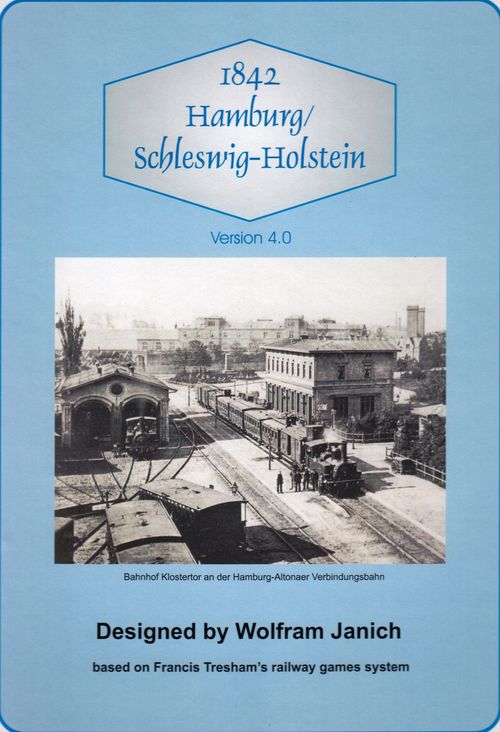
1842: Schleswig Holstein
1842: Schleswig Holstein Rulebook
Table of Contents
Table of Contents
- 1. Introduction
- 2. The Game Components
- 3. The Companies
- 4. Preparing for Play
- 5. Starting Round
- 6. Stockrounds
- 7. Operating Round
- 8. Stock Market
- 9. End of the Game
- 10. Game Ethics
- 11. Optional Rules
- 10.3 HAV simplified
1. Introduction
1842-Hamburg/Schleswig-Holstein is a railway game set in the north of Germany. The age of railways started with the building of the Hamburg-Bergedorfer Eisenbahn in 1842. All railways in this game are historical companies. The political aspects of the period were not considered in the game as the emphasis is on the economy only.
For experienced 18xx players the special features of 1842 are as follows:
- Specific for 1842 is the function of the Hamburg-Altonaer-Verbindungsbahn. This is the only railway company that may lay tracks on the hexagons of Hamburg and Harburg. The HAV does not own any train but receives its income from providing tracks to other railway companies.
- The "Private Railways" operate like corporate companies but have a limited track building capacity. They will be closed by auction among the corporate companies.
- The "Preceding Companies" are similar to the Private Railways but will be transformed into corporate companies.
- A corporate company places two tiles in its first Operating Round after it has started.
- For a route from a North Sea port to a Baltic Sea port a bonus is gained.
- For some cities have two values. The higher value is applied for those companies which have a station there.
- At least one train of a corporation must run a route including the corporation's home station.
2. The Game Components
When the game components spread out in front of you, the following should be available:
- 1 Map board
- 1 Stock market board
- 1 Phase Table
- 57 Yellow track tiles
- 47 Green track tiles
- 20 Brown track tiles
- 6 Grey track tiles (for optional rule 12.5)
- 36 Train cards
- 5 Charters for Private Railways and Predecessor Companies
- 10 Corporation Charters
- 36 Certificates of 4 railway corporations (1 x 20% Director and, 8 x 10% per corporation)
- 24 Certificates of 3 railway corporations (1 x 20% Director, 1 x 20% and 6 x10% per corporation)
- 8 Certificates of 1 railway corporation (1 x 20% Director, 6 x 10% and 1 x 20%)
- 14 Certificates of 2 railway corporations (1 x 20% Director, 2 x 20% and 4 x10% per corporation)
- 1 Card for income of the AKE director (6 players only)
- 10 Stock Value Marker (wood 15 x 4 mm)
- 31 Station Tokens (wood 15 x 4 mm)
- 7 Exchange Tokens (wood 15 x 4 mm)
- 10 Income Tokens (wood 15 x 4 mm, but without label)
- 1 Marker for indicating Stock Rounds and Operating Rounds (wood 15 x 4mm)
- 10 Marker "not available" (20 x 20 mm)
- 2 Bonus-Marker (20 x 20 mm)
- 3 Marker "Sale" (20x20mm)
(The printed page carries a stray line "1 This Rulebook" with no text following it; it is kept here as printed.)
3. The Companies
In 1842 there are four kinds of companies which have individual functions and options.
3.1 Private Railways
The following companies are Private Railways:
- No. 1 - Hamburg-Bergedorfer Eisenbahn
- No. 2 - Klosterburger Eisenbahn
- No. 3 - Rendsburg-Neumünsterche Eisenbahn
The Private Railways are offered for sale in the first Stock Round. When they are sold they start immediately. The Banker hands over to the buyer
- the company charter
- one type 2-train
- the company's starting capital (Purchase price minus 100 Mark for the type 2-train)
- track building tokens equal to the number of yellow hexagons on the charter
- one activity marker (only for no. 3)
The station is placed on the board. The track building tokens are placed on the hexagons of the company charter.
A Private Railway cannot be sold to the bank or to another player. Instead they are being auctioned among the Corporations (see 3.1.4.1).
3.1.1 Private Railways' Track Building
During its Operating Round a Private Railway may place or upgrade (in the green phase) one tile. The total number of track building activities for the whole game is indicated by number of track building tokens on the Private Railway's charter. After each tile placement/upgrading a track building token must be move from the charter into the 'Building Token' box on the stock market board.
The Private Railway No. 3 may place two tiles during one Operating Round. When doing this it renders the action marker two track building markers.
3.1.2 Revenue of the Private Railways
Private Railways receive their revenues from running their trains only. The revenues are split between the treasury and the owner, 50% each.
3.1.3 Train Ownership of Private Railways
Each Private Railway must buy a train during its first Operating Round. The number of trains a Private Railway may own is printed on the company charter.
A Private Railway may no buy 5-train!
A Private Railway is not forced to own a train, even when it owns enough cash. On the other hand the owner may not add any private money for a train purchase. The Private Railways begin the Operating Round in numerical order (lowest number first).
3.1.4 Closure of Private Railways
The closure of a Private Railway is either voluntary in the green phase or forced by the purchase of the first 5-train.
The closure is linked with one of the following activities:
- Purchase by a Corporation
- Liquidation
3.1.4.1 Auction of Private Railways
From the beginning of the green phase onwards at the start of each Operating Round, the owners of the Private Railways will be asked, whether they intend to sell their company (ascending numerical order).
The sale of a Private Railway is always done in form of an auction between the Corporations. The Directors of the latter (in the order of their operation during the current Operating Round) announce the bids. The minimum bid must be equal the money in the Private Railway's treasury. The bids must be raised by 10 Mark. If a Director passes, his Corporation is out of the auction! A bid may not be higher than the bidding Corporation's treasury (money and certificates of the HAV).
The buying Corporation pays the bid immediately to the owner of the Private Railway. If necessary it may sell certificates of the HAV. The Corporation takes over the Private Railway's treasury and trains. If the Corporation owns to many trains after the takeover, the excessive trains go into the Bank Pool (Corporation's Director's choice) without compensation. The Corporation replaces the station token of the acquired Private Railway with its exchange token. Unused track building tokens are void and moved to the "Building Token" box of the stock market board.
If the closure of the Private Railways is forced by the purchase of the first 5-train, a sales marker is placed on the remaining Private Railways charter's. The Private Railway may no longer sell train(s) it owns. The auction takes place at the beginning of the next Operating Round.
In the case no bid has been made during the auction, the Private Railway goes into „Liquidation"!
3.1.4.2 Liquidation of Private Railways
The token of the Private Railway will be removed from the board. There is a demolition charge of 40 Mark to be paid from the Private Railway's treasury. The owner takes the remaining money into his private cash. If there is not sufficient money in the treasury to pay the demolition charge, the owner must pay the missing amount with his private money. In the unlikely case that there is a train, this goes into the Bank Pool without compensation.
3.2 Predecessor Railways
These are the following two companies:
- No. 4 - Glückstadt-Elmshorner Eisenbahnen => GEE
- No. 5 – Südschleswigsche Eisenbahn => SSE
The Predecessor Railways will be offered for sale together with the Private Railways during the Starting Round. As for the Private Railways the buyer receives from the Banker
- the company charter
- one type 2-train
- the company's starting capital (Purchase price minus 100 Mark for the type 2-train)
- track building tokens equal to the number of yellow hexagons on the charter
- 2 activity markers (only for no. 4)
For these companies the same rules apply as for the Private Railways with one exception. They will neither be sold nor liquidated, but transformed into Corporations (= Successor Corporations). There are two possible situations, when transformation may happen:
a) The transformation takes place at the end of the Stock Round when 50% or more of the shares of the Successor Corporations have been sold. The exchange share counted as being sold. The transformation takes place as follows:
- The owner of the Predecessor Railway receives the Director certificate of the succeeding Corporation.
- The company charter of the Predecessor Railway will be exchanged against the Corporation's charter.
- The treasury and the trains will be transferred onto the Corporation's charter,
- The station token will be replaced by the home station token of the Corporation.
- The stock token of the Corporation will be placed on the starting field for the face value of a 10% share of the Corporation.
- The Corporation receives eight times the face value of a 10% share as additional Cash.
- If another player holds a higher percentage of the Corporation than the owner of the Predecessor Railway, the Director share is given to that player in exchange of normal shares.
b) If the Predecessor Railway is still active when the first 5-train has been bought, the transformation is carried out immediately. The transformation follows the above points 1 to 6. Point 7 is skipped. In addition the following actions will be performed:
- The certificates in the Initial Offering being reduced to 50% share. The removed certificates are placed in the Bank Pool. As this is treated as a sale of certificates, the stock value will be adjusted accordingly (e.g. if only one 10% share of the SE has been sold at this stage, two 10% shares of the SE being placed in the Bank Pool and the stock value will drop accordingly).
- The stock token is flipped over, as the Corporation will not operate this Operating Round.
3.2.1 The Activity Markers of the GEE
The GEE has two activity markers which can be used as follows:
a) When render the marker "GEE – 1 train runs 2 x" the GEE may run during its Operating Round one of its trains a second time. The train may use the same route twice!
b) When render the marker "GEE – 2nd tile" the GEE may place a second tile during its Operating Round. The second tile lay may however not take place in the same hex as the first.
If the GEE still ones any of the action markers when it is transformed into the HMBG, these markers have to be rendered without compensation.
Commentary: During the winter 1870/1871 the river Elbe was frozen with the effect that ships coming from the North Sea could only sail as far Glückstadt. All transports between Glückstadt and Hamburg were carried out by the GEE. This led to an increased transport volume of the GEE and consequently to higher profits. The latter were immediately used by the GEE to extend its network. The two action markers of the GEE reflect this event in the game.
3.3 Railway Corporations
There are 8 Corporations which will enter the game in a certain order. For the Hamburg-Altonaer-Verbindungsbahn special rules exist (see 3.4).
The Corporations are owned by one or several players. They are managed by the player who owns the Director certificate, and who is therefore called the Director (for change of the Director see 3.3.6).
3.3.1 Availability of Corporate Stocks
The shares of the Corporations are available for purchase as follows
| Corporation Name | Logo | Prerequisite | Station Tokens | Shares |
|---|---|---|---|---|
| Altona-Kieler Eisenbahn | AKE | Starting Package sold | 4 + 1 *) | 9 => 1x20% / 8x10% |
| Berlin Hamburger Eisenbahn | BHE | 50% of AKE sold | 3 + 1 | 9 => 1x20% / 8x10% |
| Lübeck-Büchener Eisenbahn | LBE | 50% of BHE sold | 3 + 1 | 9 => 1x20% / 8x10% |
| Westholsteinische Eisenbahn | WHE | 50% of BHE sold | 3 + 1 | 8 => 2x20% / 6x10% |
| Eutin-Lübecker Eisenbahn | ELE | 50% of BHE sold |
*) Exchange station marker **) Director certificate will be exchanged against SSE ***) Director certificate will be exchanged against GEE
3.3.2 Start of Corporations
A Corporation starts when 50% of its share capital has been sold (for SE and HMBG see 3.2 Predecessor Railways). At the end of the Stock Round the Banker hands over to the Director
- the Corporation charter
- the Corporation's treasury (ten times the face value of a 10%-share)
- the station tokens (the number of tokens is shown on the company charter). Several Corporations have an exchange station token which will be placed on the gray station circle on the charter.
The token for the home station is immediately placed on the board (If there is only one circle for placing the token, the route through this hex is automatically blocked).
3.3.3 Corporations' Track Construction
During their first Operating Round the Corporations may place two tiles on the board. Instead of placing a tile they may also replace a tile. But the two track building activities may not be done in the same hex.
3.3.4 Corporations' Revenue
The Corporations receive income from
- running there trains
- dividend payments of the HAV 1
- other activities
The Director decides how to use the revenue earned by running the trains. He has the option to pay out dividends to the shareholders or to divert it into the Corporation's treasury. If dividends are paid, the money for the shares in the Bank Pool goes into the Corporation's treasury while nothing is paid for the unsold shares of the Initial Offering
All other kind of income goes into the treasury.
3.3.5 Trains owned by Corporations
The maximum number of trains a Corporation may own is ruled by the game phases (see Phase Table). At the end of its Operating Round a Corporation must own at least one train. If it has started the turn without a train, it is forced to acquire a train at the end of its turn.
3.3.5.1 Forced train purchase
If there is not enough money in the treasury to buy one, the Corporation's Director has to offset the missing amount with his private cash. The money is gathered in the following steps:
- The company has to use its complete treasury first (including its HAV shares being sold)
- The Director uses his total private cash.
- Then he has to sell shares, except those of the company which requires the train.
- Then the Director has to liquidate his private railways.
- At least he must give the Predecessor Corporations to the Bank. The Director receives the face value of the Director certificate (SE or HMBG). The Director certificate is placed in the Bank Pool. The Banker manages the Predecessor Corporation until a player buys the Director certificate out of the Bank Pool at face value. This player takes over the Predecessor Corporation. The Banker may only run the trains and keeps the whole revenue in the Predecessor Corporation's treasury. He is not entitled to track building or selling/buying trains.
The Director can choose to buy a train out of the Bank Pool or the lowest new train on offer. The offer of another company he can only except if it is not higher than the buying Corporation's treasury.
If a Director' is unable to raise the required money he is declared Bankrupt and ceased from the game (see 10.4).
3.3.6 Change of Director
The player who buys the Director certificate from the Initial Offering is the first Director of this Corporation. He remains Director until another player possesses more shares of that Corporation. A change in Directorship of a certain Corporation is triggered by the following activities:
- another player acquires a larger share percentage of the Corporation than the owner of the Director certificate.
- the Director sells certificates of his Corporation and another player holds more share percentage of this Corporation after that sale
The change in Directorship becomes effective immediately after the change of share percentage holdings. The new Director receives the Director certificate from the old Director in exchange for two ordinary shares.
If several player hold the same percentage of shares, but more than the Director, after the former Director has sold shares, the Directorship is given to the player sitting left of the old Director.
Although the Director certificate may not be put into the Bank Pool, it can be sold, if at least one other player holds stock of the same percentage as the Director certificate. In this case the new Director takes the Director certificate and places certificates of the same percentage into the Bank Pool. The bank pays the stock value of these certificates to the former Director.
3.4 Hamburg-Altonaer-Verbindungsbahn
The task for the HAV is to build tracks on the hexes of Hamburg and Harburg, in order to provide routes for the other railway companies. The HAV does not buy trains! When the HAV starts it does not receive any treasury. Instead it receives one track building token for every 10% HAV share being sold from the Initial Offering. The track building tokens are moved from the "Building Tokens" box of the stock market board onto the HAV charter. If there are no track building tokens in this box, no HAV certificate can be acquired from the Initial Offering!
3.4.1 HAV Certificates
During the yellow and green phase the certificates of the HAV can be bought by other Corporations only. During their operating turn the Corporations may buy one HAV certificate or sell an unlimited number of HAV certificates in their possession. Sale or purchase takes place before the purchase of any train(s). From the brown phase onwards, HAV certificates may be acquired by players.
The stock market value of the HAV is changed according to the normal rules (see 7).
3.4.2 Operating Turn of the HAV
The HAV is floated when 50% of its shares have been sold from the Initial Offering. The stock token of the HAV is placed on the especially marked 30 Mark-field of the stock table. The Director of the Corporation which owns the HAV Director certificate receives the HAV charter.
The HAV operates always after all other Corporations.
3.4.2.1 HAV Track Construction
In its operating turn the HAV may place or replace one tile on one of the two hexes of Hamburg (HH) and Harburg (H). For each placing/replacing of one tile 2 track building tokens from the HAV charter must be spend (the markers are removed from the game).
The Director of the Corporation that holds the HAV Director certificate decides where and how a tile is placed or replaced. The HAV must perform track construction, when both of the following conditions are met:
- there are enough track building tokens on the HAV charter
- the placement is possible (Phase!)
The first tile placed must build a track link between the Hamburg hex and the Harburg hex. It is the Director's choice, which of the Hamburg stations will be connected with Harburg.
During the grey phase the HAV may upgrade the brown Hamburg tile with one of the two grey tiles after both Hamburg and Harburg are in brown.
- Tile #5028 has a grey station space marked HAV. No Corporation may place a station token there. When this tile is in use, all Corporations may run their trains through Hamburg.
- Tile #5029 has a fourth station space which may be occupied according to the standard rules.
The HAV does not need to spend building tokens for placing a grey tile on the Hamburg hex.
Some further explanations:
Assuming that there is enough track building tokens on the HAV charter for the second track construction in the yellow phase, the HAV cannot place a tile as there are only green and brown tiles left.
With the beginning of the green phase, the HAV has the choice, to upgrade either Hamburg or Harburg.
3.4.2.2 HAV Revenues
The HAV receives its income from the routes of other railways companies that include one or more of Hamburg's stations. For each route the HAV receives 10 Mark into its treasury from the Bank. The total amount in the treasury will be paid out as dividend (rounded down to 5 Mark) among the purchased stock. For shares in the Bank Pool the bank receives the dividend payment.
Example: 40% of the stock is owned by Corporations and 20% stock is in the Bank Pool. The treasury contains 110 Mark. This will be allocated to the 60% of stock purchased. For each 10% stock a dividend of 15 Mark is paid. The Corporations receive 60 Mark, the bank 30 Mark and 20 Mark remain in the treasury. The token on the stock market is moved one space to the right.
Commentary: Instead of paying for each route separately, the Banker can use the second HAV token to indicate the income on the income table. During the HAV operating turn he pays ten times the field value on which the token lays. Thereafter the token is moved to the "0"-field.
4. Preparing for Play
The map and the stock table board are placed adjacent in the middle of the table. At the top border of the map the space for the Initial Offering is shown. All certificates are sorted by descending numbers per corporation (certificate No.1 on top) and placed onto the appropriate spaces. The Director certificates of the SE and HMBG are moved to the box "Exchange Certificates" on the stock table board. The cards "verfügbar - available" are sorted into the certificate stacks or train stack as follows:
- BHE => below the certificate no. 4 of AKE
- LBE-WHE-ELE => below the certificate no. 4 of BHE
The three blue wooden sticks for marking impassable hex borders are placed between the following hexes:
D8 – E9, M7 – L8, M9 – L8
Place the bonus marker for the Vogelfluglinie „+ 60 M for 1st tile placement" on hex G17.
Lay the bonus marker for the Lauenburger Privileg „Free station on hex M15" on hex N14.
Sort the train cards in descending numbers (lowest number on top). The type 2-train cards place in the box "Available trains" on the stock table board. The stack of the remaining train cards place in the box below which is indicated "Trains not Available". The blue card „SE – HMBG shares available" is placed below the last type 4 train.
A Banker is chosen who runs the money of the bank (11.000 Mark) as well as the charters of the companies. He gives the starting capital to each player:
| Players | Starting Capital |
|---|---|
| 3 | 730 Mark |
| 4 | 550 Mark |
| 5 | 440 Mark |
| 6 | 370 Mark |
The Banker lays out the Starting Package consisting of three Private Railway and two Predecessor Companies.
The game commences with the first Stock Round.
5. Starting Round
The players select secretly which company of the Starting Package they want to buy. For this purpose they take money equal to the face value in their hands. Than they reveal simultaneously the amounts.
At first the companies selected by one player only were sold in ascending order of their numbers. Thereafter the companies chosen by two or more players were sold (again in the ascending order of their number). The player sitting left from the last buyer must buy the company he wanted, while the other player/s with the same choice must buy any of the remaining companies which have not been selected by other players (in seating order). In the rare case that there is no company selected by one player only, the Banker buys first.
EXAMPLE:
The following bids were made:
- Player A: HBE
- Player B: KE
- Player C: HBE
- Player D: KE
- Player E: SSE
- Player F: SSE (Banker)
As there is no single selection for a company player F, the Banker, buys the SSE. Player E (as he has also selected the SSE) must now buy either the GEE or the RE (let us assume he buys the RE). The next player to the left of player E is player A (player F has already bought a company). Player A buys the HBE and player C must buy the only unselected company GEE. The round continues with player D (sitting to the left of the last buyer) who must buy the KE. Player B (without a company) receives the „Priority Deal" and may buy the Director certificate of the AKE.
After all players have bought a company from the Starting Package the game continues with the First Stock Round.
5.1 Special case with 6 players
With six players the player who did not buy a Private or a Predecessor Company buys the Director certificate of the AKE. He will also receive a card which indicates that the AKE Director will receive 20 Mark each Operating Round from the Bank as long as the AKE does not process a train.
6. Stockrounds
6.1 First Stock Round
The First Stock Round starts with the player to the left of the last player during the Starting Round.
Before the Director certificate of the AKE can be bought, all companies of the Starting Package must be sold. A player may either buy the unsold company with the lowest number or pass. If all players have passed consecutively before all companies of the Starting Package have been sold, an Operating Round commences for the companies being sold. Thereafter the First Stock Round continues!
During the First Stock Round no certificates may be sold!
6.2 Next Stock Rounds
During his or her turn a player may
-
first sell any numbers of certificates to the bank (the certificates are placed in the Bank Pool) at stock market value, except:
- there will be more than 50% of a Corporation's share value in the Bank Pool after the sale
- the Director certificate is sold to the Bank Pool (the Director certificate can only be sold if another player holds 20% of the Corporation's share value - details see 3.3.6.)
- the Corporation concerned has not started (see 3.3.2).
A certificate must be sold completely (a player may not sell a 20% certificate and take back a 10% certificate!)
-
than buy one certificate, either from the Initial Offering at face value or from the Bank Pool at stock market value, except:
- the player has already sold a certificate of this Corporation during the current Stock Round
- the player owns already 60% of the Corporation's stock (see 6.3).
- the player has already reached his certificate limit (see 6.3).
If a player buys a certificate, he can sell it not before his next turn.
-
or pass
Certificates can be bought from the bank or the Bank Pool but sold to the Bank Pool only. Trading of certificates between the players is not permitted.
A Stock Round continues until all players have passed consecutively. The player left from the last buyer receives the Priority Deal Card.
After a Stock Round a set of 1, 2 or 3 Operating Rounds will be performed. The number changes when the first train of a certain type is bought; the new number is in effect after the Stock Round following this purchase.
6.3 Certificate/Share Limit
The maximum number of certificates (Private Railways, Predecessor Railways and Corporation's certificates) a player may hold depends on number of Players:
| Players | Certificates |
|---|---|
| 3 | 13 |
| 4 | 11 |
| 5 | 10 |
| 6 | 9 |
For an individual Corporation a player's maximum entitlement is 60% of the share percentage.
When a player owns more certificates then allowed (e.g. due to a change of Directorship) he has to sell the necessary number of certificates in his next turn.
6.4 Stock Token in the Marked Zone
When the stock token of a Corporation is placed in the yellow zone of the stock market table, the certificates of this Corporation do not count against the certificate limit.
When the stock token of a Corporation is in the brown zone of the stock market table the 60% share limit for this Corporation is not valid in addition.
When the Corporation's token leaves the brown or the yellow zone the certificate/share limit is in place again. A player who owns to many certificates (either in total or of an individual Corporation) is forced to sell the overdue stock during his first turn in the next Stock Round. He may sell certificates on by one in order to bring the stock market value token back into the yellow/brown zone before all overdue stock has been sold.
Example:
The stock token of a Corporation is at 67 and a player who owns 4 excessive shares holds 60% of this company. He may now sell a 10% certificate for 67 and move the market down by one space. Then he may sell another 10% certificate for 61 which will bring the stock token of that Corporation back into the yellow zone. The remaining 2 certificates do no longer count against the certificate limit.
If a stock token leaves the yellow/brown zone at the end of the Stock Round due to the 100% rule (see 7.) the surplus certificates must be sold in the next Stock Round.
7. Operating Round
7.1 Order of an Operating Round
- Exchange of Predecessor Companies against exchange shares
- Auction of Private Railways
- Operating Round of the Private Railways and Predecessor Companies in the order of their number
- 3.1 Tile placing/replacing
- 3.2 Running trains/revenue spending
- 3.3 Train acquisition
- Operating Round of the Corporations in the order of their stock market value (highest value first; same value top token or token furthest to the right first)
- 4.1 Tile placing/replacing
- 4.2 Station placing
- 4.3 Running trains/revenue spending
- 4.4 Buying or selling spare/s of HAV
- 4.5 Train acquisition
- Operating Round of the HAV
- 5.1 Tile placing/upgrading
- 5.2 Dividend pay-out
7.2 Track Construction
Companies may lay one tile or replace one tile on the board per Operating Round. Corporations may lay two tiles in their first Operating Round (see 3.3.3). A company is not forced to lay track, except the HAV (see 3.4.2.1).
At the start there are only yellow tiles available.
When the first type 3-train is purchased, green tiles become available. They can be used for replacing yellow tiles or placed on yellow board hexes. A table shows all options for tile replacing.
When the first type 5-train is purchased, brown tiles enter the game. They can be used for replacing green tiles.
After the purchase of the first type 8-train has been acquired grey tiles become available for upgrading brown tiles.
A tile once placed may never be moved, except when it is replaced by a tile of a "higher" color.
7.2.1 Board Restrictions
For laying or replacing a tile, the markings on the board must be followed. There are plan hexes without neither town nor city, hexes with towns (small black dot) and hexes with cities (white circle). Corresponding tiles must be used:
- ❖ one town (•) => tile with one black Cross-bar
- ❖ two towns (••) => tile with two black Cross-bars
- ❖ one large city (O) => tile with one/two white circles
- ❖ Hexes with capital letter => tile with designated letter
For hexes without towns, only tiles without town/cities may be used. Further restrictions are caused by the color of the hexes or by other markings:
- ❖ Tiles may not be placed on complete red, grey, green or blue hexes
- ❖ The track may not end against order of the hex grid.. In the case of red and grey hexes the track may only run against the preprinted connections or black triangles.
- ❖ Track may not run against hex borders which are blocked by blue sticks.
- ❖ During the yellow phase, companies may not lay tiles on hexes which are the starting hexes of other companies.
7.2.2 Other Restrictions
- The new track must have an unblocked connection to a token of the company placing the tile.
- A replacement must maintain all previously existing tracks.
7.2.3 Special Cases
The company that places a yellow tile on hex G17 receives a bonus of 60 Mark which goes into the company's treasury.
On the hexes L10 and M 9 (Hamburg and Harburg) only the HAV can place or replace tiles.
The Corporation, which places a tile on hex N14 and thus connects the hex M15 with the hex O13, may place a station token on hex M15 for free. The placement must be carried out immediately. If not the advantage is fortified (sic; as printed).
7.2.4 Cost of Track Building
The placement or replacement of tiles is free except for some hexes where amounts have been stated on the map. Placing the first tile on such a hex requires the payment of the amount prior to the placement. Further upgrading of these hexes are free of charge.
7.3 Station Tokens
Private Railways and Predecessor Railways have only one station token which is placed on their base hex for free.
Corporations place their first token (with a distinctive pattern) on their home station for free when they are floated, which takes place in the Stock Round. In each Operating Round they may place one station token as long as they have tokens available.
The cost for placing a token amounts to three times the town's value where the token is placed. Some cities show two values. For calculating the station's cost the lower value is valid. Replacing tokens of Private Railways and Predecessor Railways are free of charge.
There are some restrictions (except for the home station) for placing a token:
- Tokens may be placed in cities only.
- There must be an unblocked track connection to another token of the same Corporation
- A Corporation may not place more than one token in the same hex. The two station places in "Dänemark" are considered to be in different hexes.
- Most Corporations have one so-called "Exchange token". Before the gray phase these tokens may only be used to replace station tokens of acquired Private Railways. During the gray phase unused "Exchange tokens" may be used like normal station tokens.
- Tokens once placed on the board may not be moved later except they were exchanged.
7.4 Trains, Routes and Revenues
Running their trains provide the railway companies with revenues. The total amount of revenue depends on the value of the towns which are included in the trains' routes.
7.4.1 Routes
The train(s) of a company may run on valid routes only. The definitions for a valid route are as follows:
- The company must have a token at one point of the route.
- A route must be continuous.
- A route must include at least two hexes which generates income (towns/cities/off-board connections).
- The maximum length of a route is determined by the number of towns/cities indicated by the large number on the train cards (2-train = 2 cities or 1 city and 1 town).
- All cities/towns between the beginning and the end of a route are counted against the maximum route length (no city/town may be skipped)
- A route may not include the same city twice, even when the city has separated stations (e.g. Hamburg.)
- A route may not use any part of the track twice.
- A route may include a city which is blocked by other railway company's token, but may not run through this city.
- A single token in a city which two stations does not block a route!
- The station token in Bergedorf and Stade are adjacent to the track but do not block a route!
- When a railway company has two or more trains, the route of each train may not use any track of another train's route. Routes may however meet or cross at cities and towns providing each route is using different tracks of the hex in question.
- One route must include the home station of a railway company. If a railway company has only one train, the route must include the home station!
7.4.2 Calculation of Route Revenues
The revenue of a route is the total value of all towns, cities and off-board connections which are included in that route. The value of the off-board connections are changing according to the game phases.
There are some special rules in addition:
- Some hexes and tiles show two values in an oval. The higher value is taken into account, when the company has a station there. For all other companies the lower value is valid.
- For Bergedorf and Stade the higher value accounts for companies which have a station token there.
- There are coastal towns at the North Sea (white letters on medium blue) and at the Baltic Sea (dark blue letters on light blue). If a route contains coastal towns of both North Sea and Baltic Sea the route's revenue is increase by 30 Mark. The route must not end in a coastal city.
7.4.3 Revenues Treatment
Private Railways and Predecessor Railways receive 50% of the route revenues into their treasury while the other 50% goes to the owner.
The Directors of the Corporations decide whether to keep the total revenue in the Corporation's treasury or pay all as dividends to the shareholders. The dividends for certificates in the Initial Offering remains in the bank.
7.5 Purchase / Sale of HAV certificates
As soon as three Corporations have started, every floated Corporation is entitled to buy one HAV certificate during its turn in the Operating Round and it may sell as many certificates as possible (there may not be more than 50% of the HAV shares in the Bank Pool). However a Corporation may own any numbers of HAV certificates!
7.6 Purchase of Trains
The last activity of railway companies (except for the HAV) during their Operating Round is the purchase of a train. A company may buy trains as long as its total number of trains does not exceed the train limit. Changes of the train limit takes place after the purchase of the train concerned. There are several options when purchasing a train. A company may buy
- a "new" train with the lowest number at the price stated on the train card
- a train from the Bank Pool at the price stated on the train card
- a train from another company at a freely negotiated price, but the minimum is 10 Mark. The price must be announced.
A Corporation with more trains than its entitlement (e.g. due to a change of the train limit) has to place the overdue trains immediately into the Bank Pool without compensation.
When a Corporation does not own a train at the end of its Operating Round, it is obliged to purchase one train. If the Corporation does not possess enough capital in its treasury it has to use its total capital (money and certificates of HAV) first. The Director has to offset the difference from his private money without any compensation (see 3.3.5.1).
There are special rules for Private and Predecessor Railways without trains (see 3.1.3).
8. Stock Market
The initial stock market value of a Corporation equals the value printed on a 10%-share. As soon as a Corporation starts (see 3.3.2), its stock value token is placed on the appropriate field of the red marked area of the stock market table. If there is already one ore more tokens of other Corporations, the new token is placed at the bottom of the stack. This principle is always followed when a token enters a field which is occupied by another stock token(s).
The stock market value will change due to certain activities or circumstances:
- ❖ Sale of Shares After every sale of shares, the stock token of that Corporation is moved downwards on the stock market table. If it reaches the bottom field of a column, it remains there. It will never enter the blue area of the stock market table as this area is only valid for the HAV. For the sale of up to 20% share value of an Individual Corporation, the stock token is moved 1 field down only. If 30% or more of share value of a Corporation is sold, the stock token is moved 2 fields down.
- ❖ 100 % Rule When at the end of a Stock Round all shares of a Corporation are owned by the players, its stock token is moved one field upwards. If it reaches the top field of a column, it remains there.
- ❖ Declare Dividends Every time a Corporation pays dividends, the stock token of that Corporation is move one field to the right. If it is already on the rightmost field of a row, it is moved one field upwards.
- ❖ No Dividend Payment If a Corporation does not pay dividend during its Operating Turn, its stock token is moved one field to the left. When it is already on the leftmost field of a row, it is move one field downwards, but it may newer move into the blue area.
9. End of the Game
The game ends, when one of the following conditions is fulfilled:
- when a stock value token of any Corporation reaches in the top right field of the stock market table. The current Operating Round will be completed.
- when the bank runs out of money during an Operating Round. The current set of Operating Rounds will be completed.
- When the bank runs out of money during a Stock Round. A final set of Operating Rounds will follow.
When the bank is broken, either the revenues are written down or every player pays the same amount into the bank.
10. Game Ethics
Playing is for fun and not for arguments! Considering this, one should avoid any controversial discussion about rules during the game. Therefore all players who are playing 1842 for the first time should read the rules carefully, especially as the same situations are treated differently in other 18xx-games. If it turns out during the game that a rule was either disregarded or misunderstood, it is recommended to proceed that way for the rest of the game.
10.1 Payments
Payments are always made via the Bank, with the following exceptions:
- ❖ Purchase of a train from another company The buying company gives the money directly to the selling company.
- ❖ Purchase of a Private Railway by a Corporation The Corporation pays the money to the Private Railway's owner
- ❖ Liquidation of a Private Railway The owner takes the remaining money from the Private Railway's Charter
10.2 Capital
A player is not obliged to reveal his private money. The same applies to the treasury of the Private Railways. If he is asked by another player, he may either neglect to answer or announces the correct amount.
The treasury of a Corporation has to be revealed at the end of an Operating Round.
10.3 Agreements
Players may made mutual arrangements with other players as long as
- the arrangement was made verbal and public
- the arrangement is in line with the game's other rules
- no payment between the players may be part of the arrangement
The arrangement may last until the beginning of the next Stock Round.
10.4 Bankruptcy
If a player has to declare bankruptcy caused by a failed forced train purchase for a Corporation he owns, he has to leave the game. All the money he owns and had gathered by the failed train purchase is going into that (active) Corporations treasury. He now sells all certificates still in his possession into the Bank Pool. In this case there may be more than 50% of the shares of a Corporation end up there as well as any Director share. The money from these sales goes into the active Corporations treasury as well.
The Banker transfers the charter of the active Corporation to another player using the same rules as described under 3.3.6. The new Director has to buy a new train from the bank for the active Corporation now.
In the case there is no eligible player for Directorship, the Corporation goes into receivership. A Corporation in receivership is operated by the Banker. He will buy the new train and borrow the missing amount from the bank. As long as a Corporation is in receivership it only runs its train(s) and saves all income after the borrowed amount has been repaid. Receivership ends as soon as a player owns the necessary shares for Directorship.
If the bankrupt player had own another Director share, its charter will be transferred to an eligible player as well. If there is none, this Corporation goes into receivership as well.
11. Optional Rules
The following rules may be used in any combination in addition to the basic rules.
11.1 Exchange of Private Railways
The Private Railways No. 1 to No. 3 are no longer auctioned but exchanged against shares of Corporations already started. The exchange is either voluntarily from the green phase onwards or forced after the purchase of the first type 5-train.
At the start of the game a 10%-certificate of every Corporation with the exception of the HAV is placed on the box "Exchange Certificates" of the stock market table. That means that there are two certificates of SE and HMBG (the Director certificate plus an ordinary certificate) in that box!
The exchange is carried out in the following steps:
- The owner chooses one of the available exchange certificates. If this triggers a change in Directorship, this is carried out immediately.
- All possessions of the Private Railways are transferred to the Corporation's charter of the chosen exchange certificate.
- The Private Railway's station token is replaced by an extra token of the Corporation.
- When the Corporation owns too many trains, the Director moves the excessive trains into the Bank Pool.
11.1.1 Voluntary Exchange
At the beginning of every Operating Round (starting from the green phase onwards) the owners of the Private Railways No. 1 to No. 3 will be asked whether they want to exchange (in the order of the ascending company number) their company against a 10%-certificate of a Corporation. If an owner decided to exchange, this is carried out before the next owner is being asked.
The voluntary exchange can only take placer, if there is a track connection between the Private Railway's station and a station of the Corporation of the chosen 10%-share. The connection may not be blocked by stations of other companies. If the Corporation has a station in the same town as the Private Railway this counts as an unblocked connection. In the latter case the station token of the Private Railway is removed from the map only.
11.1.2 Forced Exchange
When a Corporation buys the first 5-train it finishes its turn normally. Immediately thereafter the forced exchange of the remaining Private Railway(s) starts. The rules for the exchange are basically the same as for the voluntary exchange. If a Private Railway does not have an unblocked track link to a station of a Corporation for which 10% exchange certificates are available, the owner may choose any exchange-share still available.
11.1.3 Remaining Exchange Certificates
When all Private Railways have been exchanged the remaining exchange certificates
- will be moved into the Bank Pool if the Corporation is already started (the stock market value is not affected).
- will be sorted into the stack of unsold shares if the Corporation has not yet started.
11.2 Additional Corporations
There are two additional Corporations. Their shares become available as soon as the Schleswig'sche Eisenbahn has started. To indicate this, the card "UEE - FKE verfügbar – available" is place below certificate No. 4 of the SE at the start of the game.
11.2.1 Unterelbische Eisenbahn - UEE
The home station of the UEE is Stade. Stade does not block the route to Cuxhaven. The UEE may not build a station on the right bank of the river Elbe. Consequently it cannot acquire (by exchange) a Private Railway and has no "Exchange marker".
11.2.2 Flensburg-Kieler Eisenbahn - FKE
The home station of the FKE is Flensburg. If at the start of the FKE there are already two station tokens at Flensburg the FKE-token is placed on the Flensburg hex in addition. The FKE cannot acquire a Private Railway and has no "Exchange marker".
11.2.3 New Certificate Limit
| Players | Certificates |
|---|---|
| 3 | 17 |
| 4 | 14 |
| 5 | 12 |
| 6 | 11 |
11.2.4 Trains
All "optional" trains enter the game.
10.3 HAV simplified
(The heading is printed as "10.3 HAV simplified" in the source, between 11.2.4 and the end of the rules; the numbering is as printed.)
The HAV always pays 5 Mark per share, regardless the number of routes containing Hamburg. As a consequence there is no need for money on the HAV's Charter as the payment is made by the bank.
The share price of the HAV shares remains unchanged at 30 Mark. No token for the stock table is necessary.