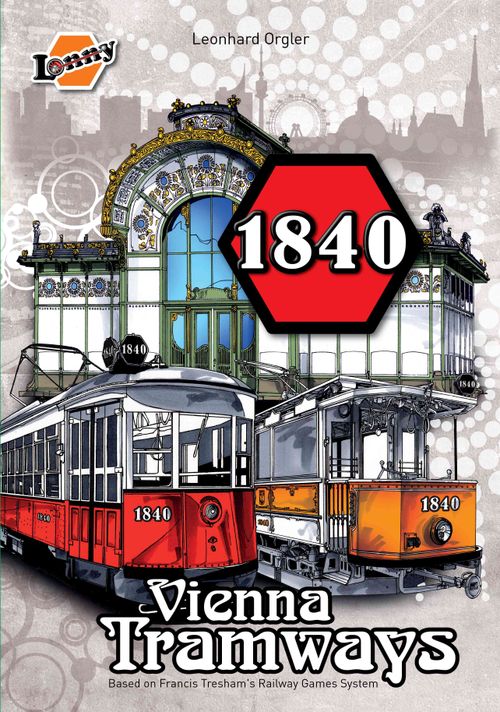
1840: Vienna Tramways
1840: Vienna Tramways Rulebook
Table of Contents
Table of Contents
- I. Components
- II. General Information
- III. Game Preparations
- IV. Companies
- V. Game Play
- VI. Pre-Share Round
- VII. Share Rounds
- VIII. Company Rounds (CR)
- VIII.1 General Information
- VIII.2 CRa: Private Companies Pay Dividends
- VIII.3 CRb: Move Tram Stack
- VIII.4 CRc: Set Company Order
- VIII.5 CRd: Share Companies Pay Revenue and Buy Trams
- VIII.6 CRe: Auctioning the Lines (Skip this step whenever all companies have three lines and in the last CR.)
- VIII.7 CRf: New Line Cards Are Put into the Line Card Box
- IX. Line Rounds (LR)
- X. Share Price Changes
- XI. End of the Game
- XII. Three Players
- XIII. Two Players
- Track Tile Chart and Upgrade Charts
I. Components
- 1 Map Board
- 1 Share Price Board
- 6 Company Charters
- 160 Cards: 18 Lines
- 36 Shares of Share Companies
- 40 Shares of Stadtbahn Companies
- 6 Private Companies (Landmarks)
- 38 Trams
- 10 Loans
- Game Money
- Share Pool
- 6 Cards "Pre-Emptive Right..."
- 6 Playing Order Cards
- 176 Track Tiles: 47 Yellow, 41 Green, 23 Brown, 4 Grey, 8 Purple, 4 Red
- Revenue Track
- 177 Tokens: 126 Small Line Tokens (6 stations, 1 income token per line), 18 Tram Company Tokens in 6 colors (1 share price token, 1 turn order token, 1 income token per line)
- 25 Stadtbahn Company Tokens for lines W, G, V, D (6 for W, 5 for G, 8 for V, 6 for D per line: 1 share price, 1 income, rest stations)
- Stadtbahn Track Tiles with orange edge: 28 Yellow, 18 Green, 3 Brown
- 2 Round Indicators
- 6 Landmark Tokens
Credits
The game is based on Francis Tresham's railway games system.
- Game Design: Leonhard Orgler
- Box, Cards, Logos: Andreas Timmelmayer
- Maps, Rules, Charters: Leonhard Orgler
- Producer: Lonny (Leonhard Orgler)
- Tram layout with kind approval of Wiener Linien
- Play tester: Ronnie Novicky, Sascha Kreindl, Thomas Kranewitter, Mathias Mahr, Uwe Gemming, Richard Rühl, Erich Stratjel, Tyler McLaughlin, Justin Rebelo, Eric Brosius and his team, Luk van Lokeren and his team and many more.
- Many thanks to Richard Scholes and Emmanuel Castanié-Magnard for editing the English rules.
© Leonhard Orgler, July 2020
II. General Information
1840 is a tramway-building and share-dealing game for 2-6 players. It is based on Francis Tresham's game 1829.
The player who has the greatest wealth in cash and shares at the end of the game is the winner.
A set of simple mechanisms forms the basis of 1840. You use the hexagonal tiles to create a track network on the map that connects tramway stations to each other. The trams (tram cards) make journeys from one location to the next and thereby earn money. The (imaginary) passengers pay for their journeys. The more numerous and the more important the revenue locations on a tram's journey are, the more money it earns for the company and its shareholders.
In the game you and your fellow players each become the director of one tram company that owns and operates up to three lines.
It is very important to distinguish between players and their private capital on the one side and companies with their treasury on the other side. Players act in Share Rounds where they buy shares of the different companies. In a Company Round the companies buy new lines and new trams and manage the money which was earned by the lines. They may pay dividends to shareholders or keep it in the company for further investments like new trams. In a Line Round each line runs one tram from one location to another to earn money.
Did you know? The earliest precursor of the Vienna tramway network was the Brigittenauer Eisenbahn, a horsecar tramway. From 1840 to 1842, it led from the Donaukanal to the recreational establishment known as the Kolosseum in Brigittenau.
III. Game Preparations
III.1 Seating Order
- Take as many Playing Order Cards as there are players, shuffle them, and deal one to each player to randomly determine the initial playing order. The player with the lowest-numbered Playing Order Card starts the auction of the Private Companies (landmarks).
- In the Pre-Share Round and First Share Round (SR) the players act in clockwise order.
- The Start Player in subsequent Share Rounds is the player holding the lowest-numbered Playing Order Card. Next is the Player with the next lowest-numbered Playing Order Card, and so on.
III.2 Etiquette
- Players should decide before the game starts whether agreements are public and binding.
- Agreements between two players might encompass any aspect of game play. Agreements between more than two players are, in general, forbidden.
- All player and company holdings and all other game material should be open and clearly visible on the table at all times.
- To reduce playing time, during the other player's turns each player should think about what they are going to do in their turn.
- Have pencil and paper ready for the calculations at the end of the game.
III.3 Starting Capital
Distribute Starting Capital as follows:
| Players | Starting Capital |
|---|---|
| 2 | 350 |
| 3 | 300 |
| 4 | 260 |
| 5 | 230 |
| 6 | 200 |
- If there are 2 players, each player receives 350 Gulden.
- 3 players each receive 300 Gulden.
- 4 players each receive 260 Gulden.
- 5 players each receive 230 Gulden.
- 6 players each receive 200 Gulden.
Each player also receives one "Pre-emptive Right for a Share Company" card worth 350 Gulden.
III.4 Game Boards
Put the map board (shown on the right side, depending on the number of players) and the share price board on the table.
III.4.1 Map Board
The map shows part of the city of Vienna. Track tiles are laid on its hexagonal grid to create a road network.
The color of areas on the map show their usage:
- White is the main part of the playing area. Some hexes have white circles with names. These are interchanges. Lines lay track tiles with halts (black bars) on the empty hexes and track tiles with interchanges on the hexes with circles.
- Light yellow indicates the edge of the map. No track tiles may be laid there. Some halts already exist there.
- The red areas at the edge of the map all have interchanges implying routes continuing off the map (exception: Grinzing). The colored boxes show their increasing value during the game. No track tiles may be laid there.
- Green hexes and spaces denote parks in Vienna. No track tiles may be laid on them (exception: Stadtpark). Three of them show famous landmarks.
- The three light red hexes with a red edge represent downtown Vienna. Only red track tiles may be laid there. All three show famous landmarks.
- Purple hexes are railway stations. Only purple track tiles may be laid there.
- Light orange hexes with an orange edge follow the lines of the Metropolitan Railway, the so called Stadtbahn. Only track tiles with an orange edge may be laid there.
- Blue lines and spaces are rivers. They have no meaning for game play except that there is a cost of 40 Gulden to lay a track tile on the blue Danube River hex.
III.4.2 Share Price Board
This board has the share price chart, tram buying section, line auction section, turn order section, and information tables.
III.5 Setup
- One player is chosen to be the Banker. They should have sufficient space nearby to place the Bank's money and the other game components. The bank size is unlimited. If the Bank runs out of bank notes please use a substitute.
- Sort the shares of the Tram Companies (TC) and Stadtbahn Companies and place them on the board "Share Pool".
- Place the hexagonal track tiles on the table, sorted by color.
- Sort the tram cards by color. Depending on the number of players you will need the following number of tram cards:
| Type | 2p | 3p | 4p | 5p | 6p |
|---|---|---|---|---|---|
| yellow | 2 | 4 | 6 | 8 | 10 |
| orange | 3 | 4 | 5 | 6 | 7 |
| red | 3 | 4 | 5 | 6 | 7 |
| pink | 3 | 4 | 5 | 6 | 7 |
| purple | 3 |
Table 1 (This table is also on the share price board at TRb)
- Place the stack of yellow tram cards on the leftmost light yellow space of the tram buying section ("CRb" = Company Round b) on the Share Price Board. All others – sorted by color – are stacked on the space left of it. Put the purple cards at the bottom, then pink, then red, and then orange on top.
- Return the unused tram cards to the box.
- Place the Tram Companies' charters on the table. During the game all of a company's possessions are kept on its charter: trams, lines, cash, station markers, and Private Companies. A company's cash must be kept strictly separated from each player's and each other company's cash. The cash on the "Treasury" and "Revenue" spaces must also be kept strictly separated.
- Place a token for each of the Stadtbahn (= city line) Companies on its marked space on the share price chart.
- Place station markers for each of the four Stadtbahn Companies on their marked locations on the map: 3 markers for G, 4 each for D & W, and 6 for V.
- Put line card #2 aside. Shuffle all the other line cards together. Place one line card more than the number of players face up in the large grey line auction space on the Share Price Board (CRe). Shuffle line card #2 into the stack of remaining line cards and place that stack face down on the small grey space (CRf).
- Place the six Private Companies ("landmarks") face up on the table. They are auctioned first. Put the appropriate token for each landmark on the map board.
- Place one Round Indicator token on the "Pre" space on the Round Bar along the top edge of the Map Board. Be sure to move this to the right as the game progresses.
- Place the other Round Indicator token on "SR" on the Share Price Board. It may be moved around this board during the game.
IV. Companies
IV.1 Share Companies
IV.1.1 General Information
- All Major Companies (Tram and Stadtbahn) have a share price as shown by their tokens' positions on the share price chart.
- Shares are traded in the Share Rounds. By purchasing a share, a player acquires an interest in the company.
IV.1.2 Tram Companies (TC)
Each player must possess one Tram Company (no more no less).
- Each player becomes director of one (and only one) Tram Company. During the First Share Round each player buys the 50% director's share of one company. There are only as many Tram Companies as the number of players.
- Only the director decides what a company does or does not do.
- The Director's Share Certificate corresponds to five standard shares but only counts as one certificate against the certificate limit. (See VI.3)
- The initial share price is set by the director during the first Share Round. The possible initial prices are 70, 80, 90, and 100 Gulden (tinted orange on the share price chart).
- There are five 10% shares in each TC.
- At the moment its director's share is purchased, a TC receives from the Bank ten times its initial share price as its starting capital.
- Each TC's charter has space for three line cards. Beside each line card space there is a space for one tramway card.
- TCs buy lines and tramways, pay out dividends, and/or withhold money.
Tram companies: 1 x 50%, 5 x 10%. May own up to three lines. Buy trams, lines and manage income.
| Name | Abbr. | Color |
|---|---|---|
| Wiener Tramway Gesellschaft | WT | black |
| Dampftramway Krauss & Comp. | DT K&C | purple |
| Schaeck-Jaquet & Comp. | SJE | blue |
| Bau- und Betriebsgesellschaft für städtische Straßenbahnen in Wien | BBG | yellow |
| Wien-Kagraner Bahn | WKB | green |
| Gemeinde Wien - Städtische Straßenbahnen | GWStStB | red |
Table 2
IV.1.3 Stadtbahn (Metropolitan Railway) Companies
- There are four Stadtbahn Companies: W, V, G, and D.
- Each Stadtbahn Company consists of ten 10% shares.
- There is no director.
- A Stadtbahn Company never lays track tiles and never buys tramways. It uses tiles laid by the Tram Company lines along its pre-printed dotted pathways to run imaginary trams (see VIII.5.2 for details). It pays out all income.
- The initial share prices are as follows:
| Name | Abbr. | Color | Initial Value |
|---|---|---|---|
| Wiental Linie | W | brown | 95 |
| Vororte Linie | V | beige | 85 |
| Gürtel Linie | G | orange | 75 |
| Donaukanal Linie | D | dark yellow | 65 |
Table 3
Stadtbahn companies: 10 x 10% (no director). Always pay out dividends.
IV.2 Private Companies (Landmarks)
Private Companies count against certificate limit, pay out dividends, and may be sold to a company for a price between 1 Gulden and face value. They give a 20 Gulden bonus for their appropriate landmark, and may be sold to the bank for face value.
- Private Companies own some landmarks in Vienna. These companies are auctioned in the Pre-Share Round at the beginning of the game amongst the players.
- The Bank pays fixed dividends to the owners of the Private Companies during step "a" of each Company Round and possibly during the Pre-Share Round.
| Name | Face Value | Dividend | Landmark Hex |
|---|---|---|---|
| Prater | 10 Gulden | 5 Gulden | D28 |
| Karlskirche | 20 Gulden | 10 Gulden | E21 |
| Schloss Belvedere | 30 Gulden | 15 Gulden | H22 |
| Hofburg | 40 Gulden | 20 Gulden | E19 |
| Stephansdom | 50 Gulden | 25 Gulden | D20 |
| Schloss Schönbrunn | 60 Gulden | 30 Gulden | K7 |
Table 4
- Private Companies DO count against the certificate limit (See VII.3).
- They may be voluntarily returned to the Bank at any time. The Bank then pays the owner (player or company) their face value.
- Beginning in Line Round 2a and during the turn of any of its lines, a Tram Company may buy with its treasury any Private Company from a player at a negotiated price between 1 Gulden and its face value (both inclusive). The revenue of a tram route is increased by 20 Gulden if it runs to or through the halt of a Private Company owned by its Tram Company.
IV.3 Lines (numbered from 1 to 18)
Lines build track tiles and stations and run their trams.
- A Tram Company may buy up to three lines during the game, but only one per Company Round.
- Lines are auctioned in CRe (See VIII.6).
- Lines lay track tiles with black bars (representing "halts", or small stops) on the empty hexes, place station markers, and run their trams to earn income. That income is placed in the "Revenue" space on the TC's charter.
V. Game Play
The game sequence is shown on the Round Bar along the top edge of the Map Board. The game starts with the Pre-Share Round, during which the Private Companies are auctioned, followed by Share Rounds, Company Rounds, and Line Rounds.
Gameplay is determined by the Round Bar, divided into: Share Rounds, Line Rounds, Company Rounds.
- During Share Rounds players use their personal assets to buy and sell shares in public companies (TC's and Stadtbahn Companies).
- During Line Rounds the lines operate in numerical order. Lines may lay or upgrade track tiles, lay Stadtbahn (orange) track tiles, place station markers, and earn income by running their trams. TC's may buy Private Companies.
- During Company Rounds Private Companies pay dividends to their owners then each TC's director manages the income earned by all their TC's lines. All, part, or none of the cash on the charter's revenue space may be distributed to the share holders. Any balance is retained in the TC's treasury. TC's may, or may be forced to, buy new trams. Stadtbahn Companies run and pay dividends to their share holders.
VI. Pre-Share Round
- The Starting Player chooses one of the six Private Companies to be auctioned. That player may make an initial bid of at least the company's face value or a multiple of 5 Gulden higher. Alternatively they may pass.
- In seating order the other players may increase the bid by amounts evenly divisible by 5 Gulden, or pass. Alternatively, if there is no current bid they may make an initial bid of at least the company's face value.
- Once a player passes, they may not bid again in the current auction. Private Companies are auctioned one after the other.
- The winning bidder pays the bid amount to the Bank and takes the Private Company card.
- The player with the next Playing Order Card chooses the next Private Company to be auctioned (or they pass).
- If all players pass (there are no bids) during the auction of the first Private Company, its face value is reduced by 5 Gulden. A new auction begins with the Starting Player. This incremental price reduction continues until the price is reduced to 0 Gulden. At this point the Starting Player must take this Private Company.
- If all players pass during the initial bid of any other Private Company, all Private Companies in players' hands pay their dividends. The Pre-Share Round begins again with the player with the lowest-numbered Playing Order Card.
- After all Private Companies have been auctioned, the player with the least money remaining chooses any Playing Order Card. The player with the second least money chooses next, and so on. Resolve any ties so that the player who was earlier in the old turn order is also earlier in the new order. Move the Round token to the next space on the Round Bar, "SR." The First Share Round begins.
Minimum bid is face value; other bids must be multiples of 5.
VII. Share Rounds
VII.1 General Information
- During a Share Round the players buy and sell shares. Each player will usually have several turns.
- A transaction may only take place between a player and the Bank.
- Shares are available from the Bank at the current Share Price shown by the company marker on the share price chart.
- During their turn a player may either pass or perform one or both of the following actions in this order (first sell, then buy):
- sell as many shares as they wish subject to the constraints listed in section VII.4
- buy one share certificate
- A player wishing to neither sell nor buy passes. They still may take action in a future turn.
VII.2 Turn Order in a Share Round (SR)
- The Starting Player in a Share Round is the player who holds the lowest-numbered Playing Order Card. Next is the Player with the next lowest-numbered Playing Order Card, and so on.
- A Share Round ends when each player has passed in sequence.
- The player with the most money remaining at the end of a Share Round takes the lowest-numbered Playing Order Card. The player with the second most money takes the next lowest-numbered Playing Order Card, and so on. Resolve any ties so that the player who was earlier in the old turn order is also earlier in the new order.
Most cash at the end of an SR takes priority deal.
VII.3 Certificate Limit
- No player may own more certificates than is allowed by the Certificate Limit.
| Players | 2 | 3 | 4 | 5 | 6 |
|---|---|---|---|---|---|
| Cert. Limit | 18 | 16 | 14 | 13 | 12 |
Table 5
- A Director's Share Certificate counts as one certificate for the purposes of the limit.
- Private company cards also count against the certificate limit.
- Players may only buy shares of a company when they own less than 60% interest in that company (maximum 60% of one company).
VII.4 Sale of Shares
- During their turn in a Share Round a player may sell as many shares as they wish with the following restrictions:
- A player may not sell shares in the First Share Round.
- A Director's Share Certificate can never be sold to the Bank.
- Sold shares are returned to the Share Pool.
- The player receives from the Bank the current Share Price for each share sold.
- A player who is selling shares in different companies chooses the order in which they are sold.
After each sale by a player of one or more of a company's shares, the company's share price marker is moved down one space per share sold. (See X.3.)
VII.5 First Share Round
- During this round all players MUST as first action buy the 50% Director's Share Certificate of a Tram Company. In seating order each player chooses that certificate for any company and sets the par value. They can choose between 70, 80, 90, and 100 Gulden (the orange tinted spaces on the share price table). They put their company's share price marker on the space for that par value. A marker that moves onto an already occupied space is put under any markers that are already there.
- The player pays the Bank five times the initial par value for the Director's Share Certificate, first using the "Pre-emptive right for a Share Company" card, worth 350 Gulden, and paying any balance with personal cash.
- The player receives the company charter. The Bank puts ten times the initial share price on the charter's "Treasury" space.
- All unsold Tram Companies are out of the game. Put their charters, tokens, and share certificates back in the box.
- The First Share Round then continues in seating order. Players may buy shares of Tram or Stadtbahn Companies or pass until all players have passed consecutively. Players may not sell shares in this round.
The director share is the first purchase after auctioning the Privates. The company receives ten times par value. All unsold Tram Companies are out of the game (one TC per player).
VII.6 Purchase of Shares
- On a player's turn they may purchase a 10% share from the Share Pool in any company that has its share price marker on the share price chart (is in the game).
- Shares from the Bank are always bought at the current Share Price.
- A player may only buy shares if they have sufficient personal cash.
- If a player sold any number of shares in a company in a SR, they may not buy shares in the same company during the same SR. The player may next buy shares in that company at the start of the next SR.
Did you know? In 1883, the Dampftramway Krauss & Comp. opened Vienna's first steam tramway line.
VIII. Company Rounds (CR)
VIII.1 General Information
Each Company Round consists of several steps. They are identified by black circles on the Share Price Board.
VIII.2 CRa: Private Companies Pay Dividends
Private Companies pay dividends to their owners (player or company).
VIII.3 CRb: Move Tram Stack
If there are any remaining tram cards on the rightmost space of the tram buying section (of CRb) remove them from the game. Move each stack on the other two spaces one space to the right. Stack the tram cards of the next available color on the leftmost space. The color order is: yellow – orange – red – pink – purple.
VIII.4 CRc: Set Company Order
Place one of each Tram Company's tokens in share price order (highest to the left) on the auction order section (CRc) of the Share Price Board. If several share price markers are on the same position on the share price table, the company with its marker on top is highest. If the share price of two or more companies that have share price markers on different spaces are equal, the one whose share marker is on the rightmost space is highest.
VIII.5 CRd: Share Companies Pay Revenue and Buy Trams
VIII.5.1: Managing Tramway Revenue
Each Tram Company's director acts in the left to right order just established for their company in CRc.
- How each company acts is determined solely by its Director. They decide how much of the money on the "Revenue" space on their company charter is paid out as dividends. The total dividend amount must be a multiple of 10 Gulden.
- Each shareholder receives the portion of the dividend corresponding to the number of shares they own. Shares in the Share Pool are ignored.
- Each company's share price marker moves according to the total dividend paid as follows:
| Dividend in Gulden | Share Price Marker Moves |
|---|---|
| 0 | 1 space to the left |
| 10 - 90 | no change |
| 100 - 190 | 1 space to the right |
| 200 - 390 | 2 spaces to the right |
| 400 - 590 | 3 spaces to the right |
| 600 - 990 | 4 spaces to the right |
| 1000 - 1490 | 5 spaces to the right |
| 1500 - 2490 | 6 spaces to the right |
| 2500 or more | 7 spaces to the right |
Table 6 (This table is also on the CRd space on the Share Price Board.)
Director decides how much of the line's income is paid out; share price rises accordingly.
- Move all money not distributed in dividends to the "Treasury" space on the charter.
- Note: In CR1 there is no money in the "Revenue" space as there has been no Line Round yet so Tram Companies pay 0 dividend.
VIII.5.2: Stadtbahn Revenue
Each of the four Stadtbahn lines runs an imaginary tram from one of the (home base) stations at an end of its pre-printed, dotted path along the Stadtbahn tiles on that path as far as tiles have been laid. Revenue is earned from all halts and Stadtbahn station markers encountered on that route.
- If track tiles were already laid from both home base stations, use the higher revenue route. If track tiles were laid from one home base to the other, all halts and Stadtbahn station markers (including both home base markers) earn revenue.
- In CR4 this revenue is multiplied by 2, in CR5 by 3, and in CR6 by 10 (as indicated on the Round Bar).
- All of a Stadtbahn line's revenue is immediately paid as dividends to its shareholders. That line's share price marker is moved as shown on Table 6.
- Note: Tram Company lines can eliminate Stadtbahn station markers which decrease the revenue earned from a Stadtbahn line. (See IX.6.)
- Note: In CR1 Stadtbahn Companies D and V pay a dividend of 70 Gulden. Companies W and G pay 0 Gulden.
Example 1: Stadtbahn Company D runs for 40+30+10 = 80.
Stadtbahn lines always pay out; run an imaginary tram from one of the starting tokens as far as possible; share price rises accordingly.
VIII.5.3: Buying Trams
- After its director manages the revenue, a Tram Company may buy one or more trams. During this step the company may rearrange trams between lines on its charter whether or not it bought a tram. (A second opportunity to buy or rearrange trams is offered during the step "Line auction".)
- The prices for the various color trams, in Gulden, are printed above the tram buying spaces.
- A company may own up to three trams regardless of how many lines it owns.
- When the first tram of a new color is purchased, the Maintenance Cost of all the older trams owned by the TC's may change. (See Table 7.) Turn or flip all tram cards to show the current maintenance cost on the top edge of the card. Maintenance Cost reduces the income of a tram (see IX.8).
Buying new trams: price is printed above the appropriate space. If the first tram of a new color is bought the Maintenance Cost of older trams may change, see Table 7.
| Tram Card Color | Maintenance Cost in Gulden while this color has been purchased at least once — yellow | orange | red | pink | purple |
|---|---|---|---|---|---|
| yellow | 0 | 0 | -50 | -200 | -400 |
| orange | - | 0 | 0 | -100 | -300 |
| red | - | - | 0 | -50 | -100 |
| pink | - | - | - | 0 | 0 |
Table 7
- Pink trams never incur maintenance costs.
- Purple trams always add 200 Gulden to their revenue.
- A company may voluntarily scrap a tram at any time without compensation. This tram is out of the game.
- Trading trams between companies is forbidden.
Mandatory Tram Purchases:
- If a company doesn't possess any trams at the end of the tram buying Rounds (CRd and CRe) it MUST buy a tram from the Bank. It may choose any tram on the buying spaces. If the company has insufficient money its director has to pay the deficiency from personal cash. The director may choose to do this even if the company has enough money to buy a cheaper tram.
- If the director doesn't have enough personal cash they must take loans. For each loan they receive a loan card and 100 Gulden from the Bank. They must not take more loans than necessary. Loans are never paid back. At the end of the game each loan card counts as -200 Gulden against the wealth of the player.
Did you know? On 28 January 1897, an electric tram operated for the first time in Vienna: on the tracks of today's line 5.
VIII.6 CRe: Auctioning the Lines (Skip this step whenever all companies have three lines and in the last CR.)
- The director of the company with its token on the leftmost space in the auction order section (CRc) starts the auction by choosing one line from the line cards on the large grey section (CRe), or they pass.
- Bidding order and the choice of additional lines to be auctioned proceeds in left to right order on the auction order section.
- A chosen line is auctioned between the company directors. Minimum bid is 20 Gulden. Each bid must be a multiple of 5 Gulden.
- Each company may only buy one line per CR.
- Each company may only buy three lines during the whole game.
- A player who passed on choosing a line for auctioning may not bid or choose an additional line in this or any other auction during this CR.
- A player who passed during bidding may not bid again in this auction but may choose a line or bid in any of the following auctions.
- When a player wins an auction, their company pays the bid from its treasury. Place the line card on an empty line space on the company charter and put six station markers next to it. The company token is removed from the auction order section. That company may immediately buy one or more trams.
- Then the director of the company on the leftmost space on the auction order section chooses a line card for auctioning, or passes.
- If a company did not purchase a line during the auctions, afterwards it may still buy one or more trams. If more than one company is in this situation the company on the leftmost space on the auction order section acts first.
- Line cards that were not purchased remain in the large grey line card section. They will be available to be auctioned in the next CR.
- Finally, each company may rearrange its tram cards on its charter.
Minimum bid: 20 Gulden. 1 line per round. A player who passed on choosing a line for auctioning may not enter this or any other auction during this CR. A player who passed during bidding may not bid again in this auction but may in any of the following auctions. After the auctions, companies may purchase one or more trams.
VIII.7 CRf: New Line Cards Are Put into the Line Card Box
- As long as any company still has space on its charter for a line card, new line cards are taken from the stack in box CRf and placed face up in the large grey box, CRe. Always add one more than the number of players, regardless of how many line cards are already in box CRe.
New line cards: number of players + 1.
IX. Line Rounds (LR)
IX.1 General Information
- During a Line Round the lines act in ascending numerical order.
- How a line acts is determined solely by the director of its parent TC.
IX.2 Definitions
- Halt: Halts are shown as black bars on track tiles and on some of the spaces on the map. Track tiles with halts are laid on white hexes.
- Interchange: Interchanges are the white circles on the map. You find them on white hexes and in the red areas. Only track tiles with white circles may be laid on the white hexes. No track tiles may be laid on the red areas at the edge of the map.
- Station: Each line has 6 station markers which may be placed on interchanges. Station markers serve the following purposes:
- Each route run by a line must contain one of its station markers somewhere on the route.
- Only interchanges with that line's station markers (and halts) are included in the revenue when a line runs a route. Only interchanges with station markers are included in the revenue.
- An interchange that is fully occupied by station markers can only be run through by lines owning one of those station markers.
- A line may only lay a tile or place a station marker if it is on part of a route connected to one of that line's existing station markers.
- Route: A route for a tram is a continuous segment of track that connects at least two halt(s) or interchange(s). Each route must have at least one of the line's station markers at some point along its length. A route may not go over the same piece of track more than once (no matter how small the track section may be). However, it is permitted for a route to use separate pieces of track on the same track tile. A route may not reverse at a junction. A route may not change track at a crossover. A route that enters a revenue location (a halt or interchange) on one track may exit it on any other track. A route can begin and/or end at an interchange where the line does not have a station marker and which has no remaining open interchange circles for station markers. A route may not go through such a "blocked" interchange. A route may go through an interchange that is not entirely blocked by other lines' station markers.
(No route: an interchange with no token placed by the line does not count. No route: an interchange with only one revenue location and no token does not count either.)
IX.3 Lines Construct and Run Tramways
A line's turn consists of two steps:
1) Construction (not mandatory)
A line may:
- Lay one track tile or upgrade one track tile
- Lay a yellow Stadtbahn tile for the cost of 20 Gulden and then perform a bonus action (see below)
- Place a station marker
These three actions may each be performed only once, in any order. None of these actions is mandatory.
2) Running the tram (mandatory)
Additionally the parent Tram Company may, beginning in LR2a, buy a Private Company from any player during the turn of one of its lines. The negotiated purchase price must be between 1 Gulden and face value (both inclusive).
A Line Round ends when each line owned by a TC has performed one turn.
A line may: 1) Construct: tracks and station markers. 2) Run trams. Private Companies may be bought from LR2a on.
IX.4 Laying Tiles
- A line may lay hexagonal track tiles on the map grid and thereby construct tramway routes that join the revenue locations shown on the map and the tiles that are laid.
- Track tiles come in six different colours: yellow, green, brown, grey, red, and purple. Some of them have an orange edge.
- At the beginning of the game only the yellow, red, and purple tiles are available.
- The following rules apply:
- In its first turn, if a line wishes to lay a tile, that tile must be laid on its home base (the interchange bearing that line's number) unless (1) a tile was already laid on that home base; or (2) that home base is on a red area or a grey hex.
- Further tiles laid must be reachable from one of that line's station markers via a route that is not blocked by station markers belonging to other lines.
- Only tiles with a black bar (= halt) may be laid in open (white) hexes.
- Laying a yellow track tile in the blue, Danube River hex in the top right corner of the map costs 40 Gulden. This is paid to the Bank from the treasury of the TC that owns the line laying the track.
- Only station tiles (with a white circle) may be laid on white interchange hexes.
- On a hex with two white circles (marked with OO), only the yellow tile marked with OO may be laid.
- On light orange hexes with an orange edge lay only the orange edged yellow track tiles (the Stadtbahn tiles). These cost 20 Gulden. They all show a brown/white dotted line, one of the four Stadtbahn lines. To produce income from their shares the dotted lines on the map must be rebuilt by covering it with the brown/white dotted Stadtbahn line track tiles.
- Each Stadtbahn line has two starting points. Stadtbahn tiles must be laid in an uninterrupted sequence from one or both of these starting station markers. Example: Stadtbahn line G has terminal station markers on I11 and A17, so its first tile may be laid on H12 or B16. The first tile of Stadtbahn line W may be laid onto hexes I3 or G23.
Lines always place one tile; the "less restrictive" building rules hold. Track tiles with a halt are laid on plain hexes.
- After laying a Stadtbahn tile the line may perform the bonus action that is indicated in the hex that tile covered. There are five different bonus actions:
- Lay an additional yellow track tile according to the above rules.
- Lay a red inner city tile: A red inner city tile may only be laid on one of the red edged inner city hexes on the map. It must be laid in a way that no black arrow points to a red edged hex or a red tile. Only red tiles may be laid on the pink inner city hexes. Red tiles may not be laid anywhere else. Red inner city tiles may only be laid by this bonus action. If a red tile is laid put the appropriate landmark token on it.
- Lay a purple railway station tile: Purple railway station hexes may only have purple tiles laid on them. Purple tiles may not be laid anywhere else. Purple railway tiles may only be laid by this bonus action. There is one bonus action "lay a purple railway station tile" less than there are purple railway hexes. Thus at least one purple railway station remains empty throughout the game. Two special purple track tiles are reserved for hexes:
- "Bahnhof Hauptzollamt" (F24): If one of them is laid on F24, put the two terminal station markers of the Stadtbahn lines D and W onto that tile.
- "Westbahnhof" (G11): If one of the two special tiles is laid on "Westbahnhof", the Stadtbahn line is treated as continuous.
- Upgrade a yellow tile to a green tile: This bonus action can't be exercised before green tiles are available (beginning with Line Round 2a) and follows the same rules as described in IX.5 Upgrading Tiles.
- Place an additional station marker: The additional marker must be the cheapest available station marker. This bonus action allows a line to place a second station marker in the same Line Round. Placing it follows the same rules as described in IX.6 Establishing Stations.
After laying a Stadtbahn tile, perform the pre-printed bonus action.
-
No tile may be laid in such a way that one or more tracks leads off the edge of the map to an unmarked area.
-
No tile may be laid in such a way that one or more tracks lead to a green, red, or grey hex which has no connection (black arrow or track). The green rectangle on hex F22 ("Stadtpark") has no effect on game play.
-
A track tile may be laid in such a way that:
- tracks connect to a track segment on the edge of the map.
- tracks connect to a black arrow in a red area on the edge of the map or a red inner city tile.
- tracks connect to a black arrow in a purple hex on the map.
A track tile may NOT be laid in such a way that it does not connect to a red inner city hex, or it does not connect to tracks on a neighboring tile.
-
Station markers on the map are transferred to the newly laid tile in the same orientation as they were on the hex.
IX.5 Upgrading Tiles
Instead of laying a yellow tile a line may upgrade a track tile that is already in place.
- Yellow tiles are upgraded to green (from LR 2a).
- Green tiles are upgraded to brown (from LR 4a).
- Brown tiles are upgraded to grey (from LR 5a).
- Grey, red, or purple tiles may never be upgraded.
- Green tiles become available in Line Round 2a.
- Brown tiles become available in Line Round 4a.
- Grey tiles become available in Line Round 5a.
- A line may only upgrade a tile if, after the upgrade, it contains at least one track which is connected to a station marker owned by that line by a route (see IX.2 Definitions) that is not blocked by stations belonging to other lines. (It is not necessary that any of the new track on the tile is usable by the active line.)
- Existing tracks may not be broken or lost as a result of an upgrade.
- Tiles with revenue locations must, after upgrading, retain any revenue locations they had before upgrading. These revenue locations must be of the same type as, and maintain all the connections of, those that were present before the upgrade (for instance OO-tiles may be upgraded only by OO-tiles).
- Orange edged track tiles may be upgraded only with orange edged track tiles (yellow to green, green to brown). This counts as normal upgrading. No bonus action may be performed at this time. Upgrading Stadtbahn tiles counts as normal upgrading.
- Station markers on a tile that is being upgraded are transferred to the newly laid tile in the same orientation as they were on the replaced tile.
- As the result of the upgrade of an interchange tile, additional unoccupied circles for station markers may become available.
- As long as an unoccupied circle remains on an interchange tile, any line may trace a route through it for the purpose of laying or upgrading tiles.
- Replaced tiles are available for re-use.
- There is no cost to upgrade a tile.
Look at the last page to see the possibilities of upgrade available.
IX.6 Establishing Stations
Each line may place one station marker during its turn. Station markers are placed only on unoccupied interchange circles. Each line has 6 station markers.
- A line must place its first station marker on its home base (numbered interchange circle matching the line's number) at the start of the turn in which it first operates, whether or not a tile was previously laid there. This first station marker is free.
- During its turn in a Line Round, a line may place one station marker on an unoccupied interchange circle. In its first turn, this placement may be in addition to placing its home base station. The bonus action "Place an additional station marker" by laying a Stadtbahn tile allows it to place an additional marker in the same turn.
- The cost for placing station markers is printed on the company charters. They are 0 Gulden (for the home base station), 20, 40, 60, 80, and 100 Gulden.
- A line may place no more than one of its station markers on each hex or board edge area.
- A line may only place a new station marker (after its home base station marker) if there is an unblocked connection between the new location and one of the line's existing station markers. The connection may be of any length but it may not involve reversing at junctions.
- If an interchange circle on the map contains the number of a line that is not yet operating, other lines may only place station markers on that hex if they leave at least one unoccupied interchange circle for that line to place its home base station marker.
- A line can remove a Stadtbahn station marker for a cost of 40 Gulden paid to the Bank. That Stadtbahn station marker is placed in the box, out of the game. The TC owning that line may then pay the cost on the company charter to place one of that line's own station markers there but it is not mandatory.
Example: Line 13 may remove the V token by paying 40 Gulden. Then it may place an own token there for the appropriate cost.
IX.7 Operating Trams
A line's tram may run once to earn revenue during its turn in a LR. Trams have unlimited range. The following rules apply:
- A route consists of at least two different revenue locations that are connected by tracks.
- Each route must have at least one of the operating line's station markers at some point along its length. Only interchanges with a station marker count for income.
- The number of revenue locations in a tram's route is unlimited.
- The dotted Stadtbahn tracks must not be used.
- A route may not pass through or to the same revenue location (including red tiles) more than once, but it can pass through or to separate revenue locations on the same tile (this can occur on green OO-tiles and purple railway station tiles).
- A route can begin or end at an interchange that is blocked by station markers of other lines (which has no remaining free spaces for station markers), but the route cannot go through such a "blocked" interchange.
- A tram which comes into an interchange or halt along one piece of track can leave it along any other piece of track.
Example (Line Round 3a): Line #18 runs a yellow tram for: A: 30 (yellow value still valid), B: 20 (city counts due to token), C: 10, D: 40 (20 bonus due to private), E: 10. Total: 110 - 50 (maintenance cost) = 60.
IX.8 Receiving Income
- The revenue of a tramway route is the sum of the revenue values of each halt (black bar) and each of that line's own station markers on that route.
- The revenue value of each station and halt is printed on the tile or hex.
- The revenue earned at some red map edge areas increases during the game. The color in the small square box matching the most recently available tile color gives the current revenue available.
- The revenue of a tram is increased by 20 Gulden if its route runs to or through the stop of the appropriate landmark owned by the company.
- The revenue claimed must be the highest total revenue that any player can show could be earned. It can be indicated with a token on the revenue table.
- Subtract all maintenance cost for the tram. Add 200 Gulden if the tram is purple.
Example 2 (each line has a tram, Line Round 2b): Line #1: Runs G-H-N-M = 110 Gulden. Line #2: Runs J-K-O-P = 130 Gulden. Line #3: Runs A-B-C-D-E-F-L-M = 160 Gulden ("I" doesn't count - no station marker). Line #12: Runs A-B-C-D-E-F = 80 Gulden.
- If the total is below zero then the TC owning that line has to pay the shortfall to the Bank. First it takes money from the "Revenue" space on its charter. If this is insufficient it takes money from the "Treasury" space. If there is still a shortfall the director has to pay it with personal cash. If the director does not have enough cash to make up the shortfall, they must take a loan. They take as many loan cards as are needed (but not more). For each loan card they receive 100 Gulden from the Bank. Loans are never paid back. At the end of the game each loan card is worth -200 Gulden.
- Note: A TC may voluntarily discard a tram without compensation at any time.
- The income is placed onto the "Revenue" space on the owning TC's charter.
Did you know? Today, Vienna's network is the fifth largest tram network in the world (after Melbourne, Berlin, Saint Petersburg, and Moscow), at about 176.9 kilometres (109.9 mi) in total length and 1,071 stations.
X. Share Price Changes
X.1 General Information
- The Share Price of a company is recorded on the Share Price Chart.
- For all movements a marker that moves onto an already occupied space is put under any markers that are already there.
X.2 Changes during Company Rounds
If the total dividend paid to all shareholders is ≥ 100 Gulden the share price rises. The marker is moved to the right. How many spaces is shown in Table 6, in the table on the left side, and at CRd on the Share Price Board. If it is at the end of a row and can't move to the right, move it one space up.
If the total dividend paid to all shareholders is between 10 Gulden and 90 Gulden the share price doesn't change. The marker doesn't move.
If no dividend is paid (a dividend of 0 Gulden) the share price falls. The share price marker is moved one space to the left. If it is at the end of a row and cannot move to the left, move it one space down.
As companies complete their turns during a CR, turn their share price markers upside down to show which have acted. When all companies have had their turn, turn the markers back right side up.
(Reference table: 0 → 1 space down; 10-90 → 0; 100-190 → 1; 200-390 → 2; 400-590 → 3; 600-990 → 4; 1000-1490 → 5; 1500-2490 → 6; 2500+ → 7. One space down per share sold, one space up if held by players only.)
X.3 Changes during Share Rounds
After each sale by a player of one or more of a company's shares, the company's share price marker is moved down on the share price chart one space per share sold. This happens after the sale, so the player receives the primary share price for all sold shares.
If a company's share price marker is at the bottom of a column on the chart the marker does not move.
If all of the shares of a TC are in players' hands at the end of a SR, move its share price marker up one space on the share price chart. If the company's share price marker is at the top of a column on the chart the marker does not move.
Note: There are no share price changes during Line Rounds.
XI. End of the Game
- The game ends at the end of CR6.
- Each player adds their personal cash and the value of their shares as shown on the share price chart. Subtract 200 Gulden for each loan card.
- The player with the greatest wealth wins the game.
- Company assets in the form of trams or treasury play no part in the final reckoning.
XII. Three Players
Although it is possible to play a 3-player game on the main board it is recommended to use the back side where part of the main map is eliminated.
Before you start playing:
- Eliminate Line cards 9, 10, 13, 14, 16, and 17.
- Eliminate all shares and markers of Stadtbahn V.
- Eliminate landmark "Prater".
XIII. Two Players
Use the 3-player map. Put the two-player overlay onto the left side of the board.
Before you start playing:
- Eliminate Line cards 8, 9, 10, 11, 12, 13, 14, 16, and 17.
- Eliminate all shares and markers of Stadtbahn V.
- Eliminate landmarks "Prater" and "Schönbrunn".
Track Tile Chart and Upgrade Charts
The rulebook's final page prints a full inventory of the game's track tiles (numbered and lettered, with their quantities) and a diagram of every possible tile-upgrade path (yellow to green, green to brown, brown to grey), including the Stadtbahn (orange-edged) upgrade paths. Consult the physical tiles or the rulebook's last page for the exact quantities and upgrade artwork; the quantities are also reproduced below.
| Tile number | Quantity | Tile number | Quantity | Tile number | Quantity | Tile number | Quantity |
|---|---|---|---|---|---|---|---|
| 3 | 7 | 8858 | 1 | 142 | 6 | 767 | 3 |
| 58 | 12 | 8859 | 1 | 141 | 6 | 768 | 3 |
| 4 | 10 | 8860 | 1 | 143 | 4 | 769 | 3 |
| Tile number | Quantity | Tile number | Quantity | Tile number | Quantity |
|---|---|---|---|---|---|
| L24 | 1 | L1 | 10 | L9 | 2 |
| L25 | 1 | L2 | 11 | L10 | 2 |
| L26 | 1 | L3 | 2 | L11 | 2 |
| L27 | 1 | L4 | 5 | L12 | 2 |
| L28 |