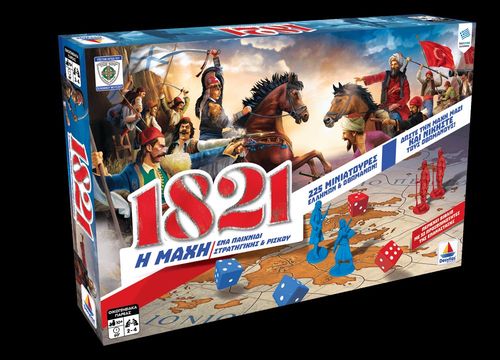
1821 Η ΜΑΧΗ
1821 Η ΜΑΧΗ Rulebook
Table of Contents
Table of Contents
Contents
- 180 miniatures / Greek forces, in 4 different shades of blue
- 45 miniatures / Ottoman forces, in red
- 20 Event cards
- 15 Apostle cards
- 1 board
- 5 blue dice
- 5 red dice
- Book of the Heroes of the Revolution
A Few Words About the Game
"1821, The Battle" is a semi-cooperative game in which the Ottomans play themselves: they are not controlled by any player. Your goal is simple, but very important: to free Greece! You must conquer Ottoman regions by moving your forces into them and giving battle. Depending on the results of the dice, you will gain or lose regions. If you defeat all the Ottoman forces in a region, you free it and take it under your Influence. If you think a battle is unequal, you may call another player for reinforcement. Each region you have freed and control gives you Fame points. However, the other players may exert greater Influence in a region you control and steal it from you. Once all players have managed to defeat all the Ottomans on the board, the game ends, and the player with the most Fame wins (see below: End of the Game).
The Board
The game board is divided into regions. The regions are joined to one another by borders. In the Peloponnese you will find 4 regions from which you will start the Revolution! Also, the 4 numbered regions at the edges of the board are the Ottoman Reinforcement Regions, where the Ottoman forces are placed at the start of their round.
The board shows two kinds of region:
- Ottoman Reinforcement Region (Περιοχή Ενίσχυσης): the numbered regions on the edges of the board, shown with red Ottoman forces.
- Starting Regions (Περιοχές Αφετηρίας): the regions shown with blue Greek forces.
Forces
The miniatures (forces) are divided into Greeks (4 shades of blue) and Ottomans (red). There are 2 kinds of forces: infantry (πεζικάριοι) and cannons (κανόνια). One cannon equals 3 infantry. Throughout the game you may replace 3 infantry in the same region with 1 cannon.
Apostle Cards
Each card has a text describing an Apostle, i.e. what you must do to complete them, as well as a text with the Apostle's Blessing (Αμοιβή). The number at the top of the card is the Fame points (Φήμη) that the Apostle offers if completed.
Some Blessings you may use continuously, while some you may use only once in the game. If during a round you complete the conditions of one or more Apostles, you collect them and place them face up in front of you.
Event Cards
At the start of the Ottoman round, you will open one Event card. Event cards contain a short historical text and an order text, which changes the course of the game in favour of either the Greeks or the Ottomans.
Dice
There are 5 blue dice and 5 red dice. You will use the blue dice for the Greeks and the red dice for the Ottomans.
Setup
Place the board in the centre of the table. Shuffle the Event cards and the Apostle cards and place them next to the board, in separate piles, face down. Open the first 4 Apostle cards, so that everyone can see them. Note: once an Apostle is completed, open a new one from the pile. Place the dice next to the board.
Each player chooses one shade of the Greek forces and places all of them in front of them. This is that player's reserve: 35 infantry and 10 cannons.
Place the Ottoman forces next to the board, so that you can see them all. Place one Ottoman infantry on every region of the board, except the 4 Ottoman Reinforcement Regions and the 4 regions of the Peloponnese.
Each player rolls one die. The player who rolls the highest goes first. The first player places 5 Greek infantry in one of the 4 regions of the Peloponnese. The next player (to the left) does the same, and so on, until all players have placed 5 infantry in one of the Peloponnese regions. (See the example image with a 4-player setup.)
Let the Battle Begin!
Each round is divided into 2 phases: the Greek phase and the Ottoman phase. First, all players play in turn order through the Greek phase, and then the Ottoman phase is played.
In each Greek phase you follow 3 steps in this order:
- Reinforcement: you receive new forces and place them in the regions you control.
- Attack: you may attack Ottoman regions or occupy friendly regions (if you wish).
- Movement: you may move forces from one region you control to another of your regions (if you wish).
Let us examine the 3 steps in detail.
Greek Phase
1. Reinforcement
At the start of every round (even the first), you receive reinforcements. That is, for each Ottoman you defeated in the previous round, place one infantry on any region or regions you control. We suggest that for each loss you cause the Ottomans (whether as attacker or defender), you remove the corresponding infantry from your reserve and keep it at the edge of the table. These will be your reinforcements for the next round.
You always take 3 infantry for Reinforcement, even if you defeated fewer than 3 Ottomans.
Example: Dimitris defeated 5 Ottomans in the previous round. In the next Reinforcement step he places 3 infantry in one region and 2 in another region.
First round: In the first round, since you have not caused any losses to the Ottomans, you take 3 infantry. Place them from your reserve in a Peloponnese region you already control (in total you will then have 8 infantry).
2. Attack
Once you have reinforced your regions, you may decide whether you want to Attack. If you attack, your target is to conquer all the Ottoman forces that are in the region. Battles are fought by using dice. If you choose to attack:
- You may attack only one region that shares a common border with one of your regions.
- You may make multiple attacks on multiple regions.
- You may attack from only one region at a time. You cannot combine forces from 2 of your regions and attack.
- An attack on a region continues until there is a winner, i.e. until the forces of one side are eliminated.
Once you decide which regions you will attack, select the number of forces with which you will attack and move them into the region you are attacking.
Important: a region cannot remain empty. You must always leave at least one infantry behind to guard the region and exercise Influence over it.
The Battle begins! Before the Attack begins, you may call one Ally (see below: Allies). The attacker rolls as many dice as there are forces in the attacking region, and the defender defends accordingly. The following restrictions apply: the attacker cannot roll more than 5 dice, and the defender rolls as many dice as the forces it has in the region minus 1, with a maximum of 4 dice and a minimum of 1 die. The players taking part in the battle must roll their dice simultaneously.
Who Wins the Battle?
After rolling the dice, place them at the top of the board, in the corresponding positions: the blue dice in the Greek and Allies' Attack Dice position (Ζάρια Επίθεσης / Άμυνας Ελλήνων και Συμμάχων), and the red dice in the Ottoman position (θέση των Οθωμανών).
Compare the dice with each other, starting from the highest results and continuing with the next lowest.
- If the attacker's die is greater than the defender's, the defender removes one of its infantry from the battle.
- If the defender's die is greater than or equal to the attacker's, the attacker removes one of its infantry from the battle.
No side may suffer more losses than the number of dice it rolled. Continue rolling the dice until you defeat all the defenders or lose all the attackers.
- If you defeat all the defenders, you win the region.
- The losses of the Greeks are placed in the "Greek Losses" area on the board (Απώλειες Ελλήνων), and the losses of the Ottomans are returned to their supply.
Example 1. (Greek dice / Ottoman dice)
The Greek attacks with 2 infantry and rolls 2 blue dice. The Ottoman defends with 2 infantry and rolls 1 red die. The Greek rolled 6 and 2, and the Ottoman rolled 4. The Greek wins the pairing, since his result on the die is higher than the Ottoman's largest die. The Greek's extra die does not cause an extra loss, because the Ottoman rolled only 1 die. The attack continues, with the Greek rolling 2 dice and the Ottoman rolling 1, until there is a winner in the region.
Example 2.
The Greek attacks with 6 infantry and rolls 5 dice. The Ottoman has 5 infantry and rolls 4 dice. The Greek rolled 6-4-4-2-2 and the Ottoman rolled 5-4-3-1. The dice are compared pair by pair, from the highest: the Greek's 6 beats the Ottoman's 5; the Ottoman's 4 beats the Greek's 4 (the defender wins ties); the Greek's 4 beats the Ottoman's 3; and the Greek's 2 beats the Ottoman's 1. The Greek therefore has only one loss. The attack continues, with the Greek rolling 4 dice and the Ottoman rolling 1, until there is a winner in the region.
Important: the more dice you roll, the more chances you have to win. However, this also increases the forces you send into battle, and therefore your possible losses. We suggest that the red dice be rolled by the player to the left of the attacking player.
Greek Regions
During your round, beyond battles with the Ottomans, you may also exercise Influence over adjacent regions of other Greeks. Each player exercises Influence over each region they control, equal to the number of their Forces on it. If you want to take control of a region of another Greek player, you simply need to move into a Greek region you do not control as many of your forces as there are forces in that region, plus one.
Forces that were removed return to the reserve of the player and not to the Greek Losses area. Forces that were needed to win the new region remain there and cannot be used again in the Attack step.
3. Movement
After you finish the Attack step, whether or not you attacked, you may make one Movement of forces. Move as many forces as you wish from one of your regions to another of your regions. You may do this to position your forces better for defence during the Ottoman round, or to organise your forces better for the Attack of the next round.
Do not forget: you may never leave a region you control empty.
Ottoman Phase
Once all the Greek players have played their phase, it is time for the Ottoman phase.
1. Event
Draw and read the first card from the Event pile. Follow its instructions and place it on the discard pile. Event cards change the game, in favour of the Greeks or the Ottomans. If the Event pile runs out, shuffle the cards that are in the discard pile and create a new pile of cards.
2. Reinforcement
Once the Revolution has broken out, the Ottomans begin to send reinforcements into Greek territory. Mercenaries and their allies begin to advance towards the regions where there is resistance. In the game this is represented by new Ottoman forces entering from the 4 Ottoman Reinforcement Regions of the board.
To calculate the Ottoman reinforcements, count how many Greek forces are in the "Greek Losses" area of the board (Απώλειες Ελλήνων) and divide the total by 4, rounding down. Place that many Ottoman infantry in each Ottoman Reinforcement Region of the board, starting from region number 1. Then return the Greek forces of the players that are in the "Greek Losses" area back to their reserves.
If an Ottoman Reinforcement Region contains Greek forces, the reinforcement takes place normally and will be followed by a battle.
Example: There are 14 infantry in the "Greek Losses" area (14 / 4 = 3.5, i.e. 3). Place 3 infantry in each Ottoman Reinforcement Region of the board.
3. Movement
The Ottoman forces move on the board every round, if they can, but they choose where to move entirely on their own!
- Each region that has more than one Ottoman unit moves one step towards the nearest region with a Greek force, always leaving one infantry behind. Regions with only one infantry do not move.
- If the distance of a region to the nearest Greek force is the same as that of another region, the Ottomans move to the region with the most Greeks.
- If there is still a tie, the Ottomans move at random to one of the regions: give each tied region a die result, roll the die, and move the Ottomans towards the region matching the result.
4. Attack
The Ottoman Attack works exactly like the Attack step of the Greek phase, with one difference: the Greek player may call a fellow player as an Ally (see below: Allies).
The Ottomans may make one Attack per region. That is, if they win a region, they remain there until the next round, when they will move again. During the Ottoman Attack step, multiple battles may take place at different points on the board. Resolve the Ottoman Attacks starting with the player who has the least Fame and moving towards the player who has the most.
Example: Giannis attacks with 5 infantry against an Ottoman region that also has 5 Ottomans. He calls for an Ally. Lefteris, the first player to his left, does not accept, but Marios, the next player, does. Giannis rolls 4 dice and Marios rolls 1 die, while the Ottomans roll 4 dice. Giannis loses one unit and defeats two Ottomans. Marios defeats one Ottoman unit.
The game continues in this manner, with the Greeks and the Ottomans fighting for the regions of Greece.
Allies
Greece was freed because the Greeks banded together and managed to defeat the Ottomans. This was achieved through alliances between the armed chieftains (οπλαρχηγοί), generals and armatoloi of the era. And you, too, in order to win, must work together with the other players.
During the Attack phases (of the Greeks and of the Ottomans) you may call Allies. At the start of your attack or defence, you announce that you need Allies. The first player to your left has the first say on whether they will support you or not.
- If they accept, they may move a single infantry of theirs into your battle, where it will take part.
- If they do not accept, it is the turn of the next player to accept or decline, and so on.
The Ally also rolls one attack or defence die in the battle, and may defeat Ottoman units or lose one of its own. The Ally's die is placed in the "Allies' Dice" position (Ζάρια Συμμάχων) and follows the same rules as above for the battle.
- In case of a tie between the active player and the Ally, the active player wins.
- At the end of the battle, if the Ally's unit is still in the region, it returns to the region from which it came.
- If during the battle the Ally's unit is lost, you may call another Ally before rolling the dice.
End of the Game
The game ends in 2 ways: if all the Apostles have been completed, or if there are no Ottomans left on the board. Regardless of how the game ends, you deserve congratulations, since you managed to defeat the Ottomans and free Greece.
The winner is the player with the most Fame (see below: Fame). In case of a tie, the player with the most regions wins. If there is still a tie, the player with the largest army on the board wins.
Fame
During the game you will earn Fame (Φήμη). Your Fame is determined by the total of the regions in which you exercise Influence, together with the Fame from your completed Apostles.
Tips
- In battles, ties (on the dice) are won by the defender, with the attacker able to have more dice in its attack. In this way there is a balance between defender and attacker. Use this difference to your advantage. Battles that seem unwinnable may turn around!
- The game is semi-cooperative. You must help the other players as Allies to defeat all the Ottomans. You cannot win alone. As Allies you also want to help, since this is a way to increase the number of Forces you will reinforce with in the next round.
- At the end of the game the player with the most Fame wins. Do not focus only on attacking, but also on holding your regions.
- If you do not attack, you will not have enough reinforcements. Keep a good balance between holding regions and attacking.
- The Ottomans, unlike the Greeks, cannot continue to attack in multiple regions in the same round once they have taken a region. Use this to your advantage.
- Event cards that strengthen both sides are in addition to those of the Reinforcement step.
- In the unlikely case that you do not have enough Forces to reinforce a side, you simply do not reinforce it. As in reality, forces are concentrated: their distribution on the battlefield and their number determine victory or defeat. (The source reads "καθορίζουν τη νίκη από την ήτα", where "ήτα" appears to be a misprint for "ήττα", defeat.)