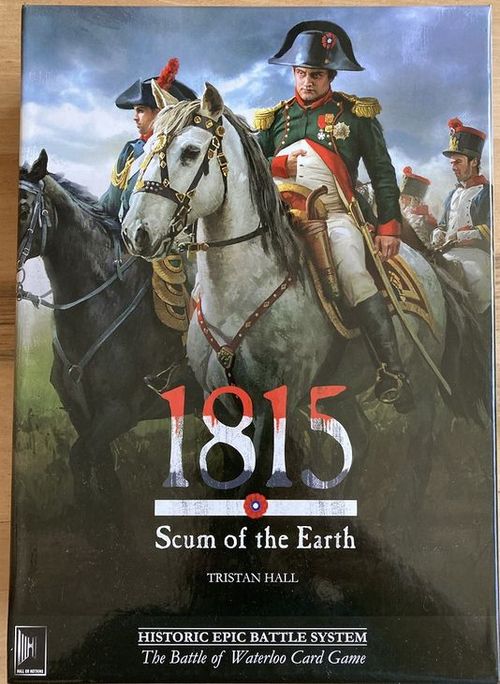
1815, Scum of the Earth: The Battle of Waterloo Card Game
1815, Scum of the Earth: Solo Play
Table of Contents
Table of Contents
Setup
1815, Scum of the Earth can be played as a solo game, where the game takes on the role of an opposing player called a Foe. The game is played using the normal rules, except where stated in these Solo rules. It is recommended – but not required – that the player uses one of the Advanced Drafting card draw variants. The player chooses a faction for themselves and a faction for their Foe, then sets up their decks, and places their Leader as normal.
Set the Resource Dial to 'Round 1' and choose the preferred difficulty level. Then set up the Foe:
Arthur Wellesley Foe
- Sir Arthur Wellesley is placed in Row 3 of La Haye Sainte Farm.
- Alexander Cavalié Mercer is placed in Row 2 of La Haye Sainte Farm.
- Charles Lennox is placed in Row 1 of La Haye Sainte Farm.
- The British deck is placed nearby.
Napoleon Bonaparte Foe
- Napoleon Bonaparte is placed in Row 3 of La Haye Sainte Farm.
- Pierre-Louis Binet de Marcognet is placed in Row 2 of La Haye Sainte Farm.
- Georges Mouton is placed in Row 1 of La Haye Sainte Farm.
- The French deck is placed nearby.
Gebhard von Blücher Foe
(Only for use with the 1815, Give Me Night expansion)
- Gebhard Leberecht von Blücher is placed in Row 3 of La Haye Sainte Farm.
- Pommersches Infanterie-Regiment is placed in Row 2 of La Haye Sainte Farm.
- Landwehr-Infanterie is placed in Row 1 of La Haye Sainte Farm.
- The Prussian deck is placed nearby.
Foe Turns
The player takes the first deployment turn, which plays as normal. Then it is the Foe's turn as follows:
- The Foe triggers an ability on a 'Setup: Reserves' Tactic card, if applicable. The Tactic is removed from the game (put back in the box) and then play passes back to the player; OR
- The Foe makes a single Cannonade (hereafter 'Artillery') or Range attack. The Artillery or Range card is Tired and then play passes back to the player; OR
- If there are no Artillery or Range attacks available for the Foe, a card is drawn and played from the Foe's deck (see Foe Deployment below), and then play passes back to the player.
Foe Deployment
- Draw the top card of the Foe's deck.
- If the cost of the card is equal to or less than the Foe's Resources (i.e. its total as shown on the Resource Dial plus any resources from the Foe's Ready cards in play), that card will either be placed on the battlefield or its Event carried out (see below).
- If that card costs more than the Foe's Resources, that card is discarded and the next card is drawn. This continues until either one card is played or until the Foe's deck is depleted, in which case:
- Play then returns to the player.
The Foe does not draw a hand of cards and cannot run out of cards. Do not shuffle the Foe's discard pile if it runs out of cards, simply turn it over to create the new deck to draw from during the next Foe Deployment and the Foe skips this turn.
In summary, draw cards until: Card Cost </= Foe's Resources.
Playing Foe Cards
Special Note: The Foe's cards DO NOT shift on the battlefield when gaps are created, and they DO NOT Tire unless otherwise stated in these rules.
When a Foe's card is played, the action listed on that card is taken immediately if possible (including Artillery/Range Attacks, but excluding End of Round abilities). The Foe always targets the player's Artillery, or Range cards with damage and destroy abilities first, otherwise the player chooses which of their cards or Frontiers to target, prioritising existing Frontiers.
Any effects that remove damage from the Foe's cards, or add damage to Frontiers or the player's cards, will target the most damaged card first.
Exception: unless otherwise stated, the Foe ignores:
- Agile and movement abilities
- Bloodlust, Zealot, Opportunist and self-damage abilities
- Family/Leader and cost discounts
- Learned/Recon/Scholarly and card draw abilities
- Reserves/Played into Reserves abilities (except Tactic card abilities)
- Response abilities, e.g. Fated
Placement Order
Place Characters and Units in the first available space in an existing Frontier following this order where 1 is the highest priority and 9 is the lowest:
From the French player's point of view, the Frontiers run Château d'Hougoumont, La Haye Sainte, Papelotte Farm (left to right), and each Frontier's Rows are numbered 1 (closest to the Frontier, highest priority) through 3 (farthest, lowest priority) – giving priority order, low to high: Row 1 (1 Château d'Hougoumont, 2 La Haye Sainte, 3 Papelotte Farm), Row 2 (4, 5, 6 in the same Frontier order), Row 3 (7, 8, 9 in the same Frontier order). From the British player's point of view the Frontier order is mirrored: Papelotte Farm, La Haye Sainte, Château d'Hougoumont (left to right), with Rows 1–3 numbered the same way.
Artillery/Range cards – always place in the first available space in the same Frontier as the player's Leader, or the player's Artillery/Range cards, if possible, otherwise follow placement order above.
Exception: Artillery are placed opposite the Frontier with the most enemies first, but only place opposite Artillery cards if there is no other choice.
Attachments – played into the same Frontier as the player's Leader if possible, otherwise: player's choice, but always into an existing Frontier.
(Coordinated/Immovable/Iron Will – see Advanced Foe Abilities).
Events – can only be played if the action can be taken at that time.
- If a drawn Event (or Attachment) cannot be played, simply discard it and draw again.
- For card discount Events, draw another card and apply the discount to the next playable card – i.e. draw until a card can be paid for AND played.
- For Events with more than one action listed, the player chooses one that can be taken, if possible.
Tactics – start in play, otherwise played as written.
Passing (End of Round)
After the player passes the Foe will continue its turn. In the following order it will:
- Tire each Ready Artillery card to use its Artillery ability (unless at Battle of Waterloo Objective),
- Tire each Ready Range card to use its Range ability (unless at Battle of Waterloo Objective),
- Activate End of Round abilities,
- Draw and play one more card,
- Move the Resource Dial one step to the next round to show the new Foe Resources total,
- Pass – the Deployment Phase is now over.
Mired Foe cards take 2 rounds to recover as normal.
Foe's Battlefield is Full
When the Foe's Battlefield is full:
-
The card drawn will replace the lowest cost card in an existing Frontier (that is not Tired, or Artillery, or Range), as long as the card to be replaced costs less than the card drawn.
-
If there is a tie for the lowest value card on the battlefield, the player chooses which card to replace.
-
Artillery and Range cards replace lower cost and same cost cards – if there is a tie for which card to replace, they prioritise:
- Player Leader's Frontier
- Player Artillery/Range card's Frontier
- Row 1 for Range, Row 3 for Artillery
- Player's choice
Artillery and Range cards cannot be replaced by higher cost cards.
-
Cavalry cards will prioritise replacing cards in Row 3 if tied.
-
If the card drawn cannot replace a lower cost card, it will not be played – discard it and the Foe will not play a card at that time. Play then returns to the player.
Artillery/Range Attacks
The Foe's cards with Artillery X or Range X abilities always target the player's Artillery, then Range cards if possible, then highest Might. Otherwise the player chooses which of his cards are targeted, and the order in which these attacks occur.
A.R.M.: The Foe always targets Artillery, then Range cards, then highest Might where possible.
Exception: If both factions are at the Battle of Waterloo Objective, the Foe will only use Range attacks if they are losing the Might battle in that card's Frontier. Compare Might values once before making the card's Range attack. If it does not make the Range attack, continue with the Foe's turn as normal. The Foe will always use Artillery attacks.
Objectives
Play using Objectives as normal, but both factions ignore all 'when destroyed' special rules and simply move on to the next Objective.
After Objective A, each time the player (not the Foe) destroys an Objective they may draw one card.
'Commander' Abilities
Any Foe cards with the Commander ability only ever trigger if that card's Frontier has been taken. In this case they activate in order of placement, on separate, following turns. Each Commander moves to a space in another Frontier (with the least total Might – player breaks ties) as their next Draw card turn, following Placement Order, replacing the lowest cost card if necessary. The player's Commanders play as normal.
Scoring
Win or lose, the player's total points for the game are calculated to find out how well they did:
- 1 point for each damage token the player placed on a Frontier
- 5 points for a player victory
- 5 points for each level beyond Easy
- 30 bonus points for killing the Foe's Leader
| Points | Rating |
|---|---|
| 0-10 | Knave |
| 11-20 | Soldier |
| 21-30 | Knight |
| 31-40 | Vassal |
| 41-50 | Duke |
| 50-60 | King |
| 61+ | Conqueror! |
'Solo:' Abilities
When the Foe plays a card with a Solo: ability, ignore the other card abilities and immediately carry out the Solo: instructions instead.
When the player plays a card with a Solo: ability, they may choose to play the card as normal, if applicable, or use the Solo: ability effect instead, if applicable.
Special Note: If there is ever any uncertainty about the Foe's action the player always chooses from those available, and always prioritises existing Frontiers, even if it is to the player's benefit.
Foe Turn Summary
- Foe triggers a Tactic ability, if applicable. The Tactic is destroyed, play passes to player. Otherwise, go to 2.
- Artillery/Range Attack and Tire card (at Battle of Waterloo, Range Attacks only happen if the Foe is losing the Might Battle in that card's Frontier), play passes back to player. If no Artillery/Range available, go to 3.
- Draw card: a. if cost </= Foe resources, go to 4. b. if cost > Foe resources, discard and repeat 3. c. if Foe deck is empty, flip it, and skip Foe turn.
- If Event: resolve one action (player's choice). If Army: play card into battlefield, following placement order. If battlefield is full and no lower cost card is available, discard and go to 5.
- Play passes back to the player. Exception: If the player already passed, the Foe:
- attacks with each Ready Artillery and Range card,
- then draws and plays a card,
- then the Phase ends.
Foe Resource Dial
The Foe's Resources value is equal to:
- The Resources on the Foe's Ready cards in play
-
- its resource value on the Resource Dial.
During the first round the Foe will have:
- –1 Resource on the Resource Dial (in Easy, Normal, or Hard mode), and
- +1 Resource symbol on Charles Lennox (for the British Foe), OR
- +1 Resource symbol on Pierre-Louis Binet de Marcognet (for the French Foe).
So, on Easy, Normal, or Hard mode, the Foe starts with 0 resources, and will be looking for a 0 cost card to play during the first round.
The Foe can never have less than 0 resources.
Experienced players should use one of the Advanced Drafting Variants of the main rules.
'Player's Choice' – Whenever a Player's Choice option presents itself the player may play the Foe to their greatest benefit. But for a real challenge, whenever Player's Choice is an option, always choose the option most detrimental to the player.
End of Round Abilities
The Foe uses the following abilities on any of its cards at the end of each round if possible. The card is Tired if used, and the abilities are activated in the following order:
- Bombard: used against Infantry if possible, once Cannon tokens are spent.
- Harry: used against Artillery if possible.
- Square Up: used against Cavalry if possible.
Quick-Play Setup
This option makes setup slightly longer but considerably speeds up gameplay:
- Shuffle all the Foe's 0 Cost cards into a pile.
- Do the same for all the 1, 2, 3, 4, and 5 Cost cards, shuffling them into separate piles.
- Only play with the 0 Cost cards to start with.
- Once the Foe's Resource value reaches a total of 1, shuffle the 1 Cost cards together with the 0 Cost cards.
- Do the same for the 2, 3, 4, and 5 Cost card piles as and when the Foe's Resource value requires them.
Advanced Foe Abilities
These abilities can be ignored in early games, but once the player is comfortable with the solo rules, these abilities can be employed by the Foe...
Where possible the Foe uses the following abilities and targeting priorities (for placement/enemies):
- Boost – the Foe always gains the Boost benefit, even if it cannot afford it.
- Coordinated – prioritise same Row, then Frontier.
- Immovable – prioritise central Frontier.
- Iron Will – prioritise cards of the same name.
- Limit: X uses – ignore until the final Objective, then use each round until uses are exhausted.
- Gallant: activates immediately when played.
- 'Mire' effects: prioritise A.R.M. – Artillery, then Range, then highest Might.
- Resilient: activates immediately when damaged.
- Stalwart: remains active continuously.