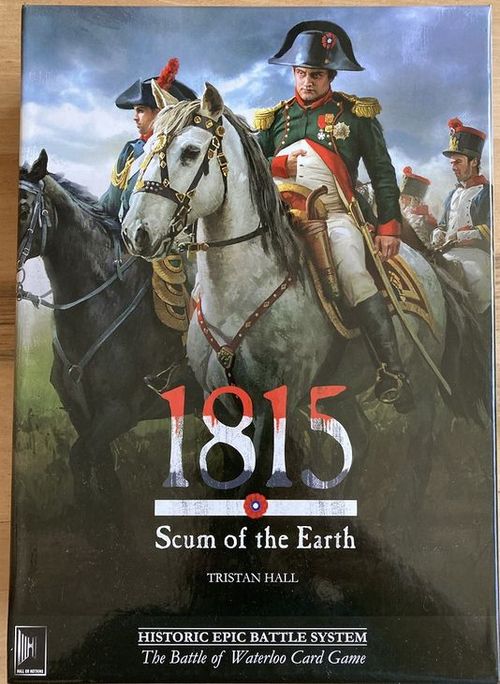
1815, Scum of the Earth: The Battle of Waterloo Card Game
1815, Scum of the Earth: The Battle of Waterloo Card Game Rulebook
Table of Contents
Table of Contents
- Game Objective
- Components
- Setup
- Gameplay
- 1. Preparation Phase
- Readying and Tiring Cards
- 2. Deployment Phase
- Playing A Card
- Executing An Action
- Sacrificing A Card
- Discarding Cards
- 3. Frontier Phase
- Winning a Frontier
- Objective Attributes
- 4. Objective Phase
- Card Abilities
- Action Abilities
- Response Abilities
- Played Abilities
- Constant Abilities
- Common Terms
- Miscellaneous Rules
- Deck Construction
- 4-Player Games
- 3-Player Games
- Cooperative Games
- Rules Changes
- 1815, Give Me Night
- HEBS Weather Deck
- Variant Rules
- Scum of Kilforth!
Game Objective
1815, Scum of the Earth retells the epic tale of the Battle of Waterloo and the events leading up to it. The winner will be the first player to:
- Destroy two Frontiers of enemy troops at the Battle of Waterloo, or
- Destroy their opponent's Leader, or
- Have their opponent run out of cards in their card deck.
Components
- 169 cards (includes 3 bonus promo cards for Call of Kilforth and 4 replacement cards for 1565, St. Elmo's Pay)
- 120 wooden teardrop tokens (red, blue, and black)
- 22 cardboard attribute modifier tokens (+1 Zeal, +1 Might)
- 14 Cannon/Mired tokens
- 1 first player token
- 2 rulebooks (one for solo play, and this one!)
- 1 solo play flow chart
- 1 solo play resource dial
Objective Decks
Each player has their own Objective deck, which is placed in the same set order each game. The players race to defeat each of the Objectives in their deck, in alphabetical order, to reach their final Objective card – the Battle of Waterloo. Once that's revealed, they can begin dealing damage to Frontiers of enemy troops (represented by Frontier cards) to try and win the game.
Advanced Objective Variant: Players may wish to shuffle their Objective decks to mix things up, but they must keep Objective G as their last Objective.
Card Decks
Each player has their own unique card deck that reflects the forces under their control and the tactics they'll employ to win the Battle of Waterloo.
A player's deck contains army cards which may be played to the battlefield. Army cards consist of Units, Characters, and a Leader:
- Units represent bands of fighting men and may be one of four types: Artillery, Cavalry, Infantry, or Ranged.
- Characters represent prominent individuals in the army.
- Leaders are Characters in all respects, with one exception: if a player's Leader is destroyed, they lose the game.
A player's deck also contains the following strategic and tactical elements:
- Events represent unexpected twists. An Event is a one-use effect which, after being paid for and resolved, is placed on the player's discard pile.
- Tactics (Reserves) represent battle capabilities. A Tactic card is placed in the player's Reserves area.
- Attachments represent enhanced capabilities. An Attachment specifies what it can be attached to, and usually alters the attached card's abilities.
Advanced Deck Variant: Players may agree to customise their faction decks before play by removing cards as they wish, in which case both players must have a minimum deck size of 50 cards.
Advanced Leaders Variant: For their first game, players should play with Sir Arthur Wellesley (British) and Michel Ney (French) as their Leaders, but either card can be flipped over to play as Gebhard Leberecht von Blücher or Napoleon Bonaparte, respectively.
Card Attributes
- Name – name of this card.
- Traits – attributes that may be referenced by card effects.
- Type – defines the rules associated with this card.
- Cost (red wax seal) – the resource cost to play this card.
- Zeal (cross) – this card's Zeal Battle Value.
- Might (cannon) – this card's Might Battle Value.
- Health (teardrop) – the amount of damage required to destroy this card.
- Resources (green wax seal) – the number of resources this card can generate, if any.
- Abilities – this card's special abilities.
- Flavour – historical quote or background; no game effect.
- Card number – identifies this card.
Combining Games
To combine 1815, Scum of the Earth with another Historic Epic Battle System game such as 1066, Tears to Many Mothers players simply choose any faction's card and Objective deck to play with, e.g. French Vs. Saxons. The game terms 'Frontier' and 'Wedge' are interchangeable.
Setup
To prepare for a game of 1815, Scum of the Earth, players resolve the following steps in order:
-
Randomly select a player. That player chooses to either play as French or British (or Prussian, if using the Give Me Night expansion). The other player takes the remaining faction. Each player takes the Objective deck and card deck for their faction, plus all damage tokens in their faction's colour.
-
The French player takes the first player token.
-
Place the three Frontier cards faceup in the middle of the table between the two players, left to right from the French player's perspective: Château d'Hougoumont, La Haye Sainte Farm, Papelotte Farm. This defines the three columns, or Frontiers, that will form the battlefield as per the example layout below. (The Frontier cards may also be flipped for an alternative setup.)
Each Frontier card represents tens of thousands of soldiers from each faction battling it out; and each damage token on a Frontier represents a thousand or so casualties inflicted by the faction that placed it.
-
The French player places their Leader card on their side of the table adjacent to (and hence belonging to) a Frontier. This defines each player's respective Row 1 of the battlefield (if playing as Napoleon Bonaparte the Leader is placed in Row 3). The British player may place their Leader card in the same or a different Frontier as the French Leader card.
-
Each player arranges their Objective deck into a faceup pile sorted by letter, with Objective A on top and Objective G at the bottom.
-
Each player takes the 3 Tactic cards that read 'Setup: Reserves' from their card deck and places those 3 Tactic cards faceup to one side.
-
Each player shuffles their card deck, places it facedown beside them, and draws 6 cards to form their hand. After reviewing their hand, each player has one opportunity to shuffle their hand back into their deck and draw a new hand of 6 cards.
Example Layout
The example layout diagram shows the table set up for a two-player game: each player's Battlefield is a 3×3 grid of Rows 1–3 across the three Frontiers (Château d'Hougoumont, La Haye Sainte Farm, Papelotte Farm, placed left to right from the French player's perspective), with the first player token, and each player's card deck and discard pile, beside their Battlefield. Each player's Reserves (Tactics) area sits to the outside of their Battlefield. Each player's Objective deck sits beside the Frontiers, divided into Active and Defeated piles.
Gameplay
1815, Scum of the Earth is played over a number of rounds. Each round, players will take turns to play cards to the battlefield, play Tactic cards to their Reserves area, and execute card abilities in an attempt to meet their Objectives as quickly as possible and then deal damage to Frontiers to win the game.
Each round consists of the following four phases:
- Preparation
- Deployment
- Frontier
- Objective
1. Preparation Phase
(Skip this phase in the first round of the game). The following steps are performed in order.
Step 1: Victory Check If neither player has cards in their card deck, the game immediately ends in a tie. If one player has no cards in their draw deck, their opponent immediately wins the game.
Step 2: Discard Down To 6 Cards Each player with more than 6 cards in hand must choose and discard cards from their hand (into their discard pile) until they have 6 cards in hand.
Step 3: Draw Cards Each player then simultaneously draws 2 cards. If a player only has 1 card remaining in their card deck, they draw that 1 card instead.
Advanced Drafting Variant: Each player draws 3 cards – or as many as are left in their draw deck if there are fewer than 3 remaining – then discards 1 card from their hand; not being limited to those just drawn. Or alternatively, players can draw 4 cards and discard 2 using these same rules. Both players should be aware that they will go through their decks much more quickly with this variant.
Advanced Drawing Variant: For a faster, deadlier game, players may agree to draw back up to 6 cards each round instead of drawing only 2 cards.
Step 4: Ready Cards Ready all cards in play.
Readying and Tiring Cards
Cards enter play in a Ready (upright) state. Some uses of cards require that a player Tires the card (rotate it 90 degrees to the horizontal position). This is only allowed if the card is in play and in a Ready state. To Ready a card means returning it to its Ready state.
2. Deployment Phase
Starting with the player who has the first player token, players alternate taking deployment turns. On a deployment turn, the player chooses one of the following:
- Play a card
- Execute an Action
- Sacrifice a card
- Pass
The first player to pass in this phase immediately takes the first player token.
When a player passes, they can take no more deployment turns this phase. Their opponent may continue to take deployment turns until also deciding to pass. When both players have passed, the deployment phase is complete.
Playing A Card
The player plays a card from their hand, first paying its cost using resources, and then placing the card into play under that player's control.
Generating Resources
A player can generate resources in any combination of the following two methods, and each method can be used multiple times until the required resources are generated:
- Discard 1 card from their hand to generate 1 resource.
- Tire an in play Ready card they control to generate resources equal to its Resources attribute.
Any excess resources cannot be saved. Resource generation can be performed anytime it's required, even on another player's turn.
Units and Characters: an army card must be placed in a Frontier (or Reserves area), and must be on the player's side of the battlefield. A Frontier that already contains 3 army cards on the player's side of the battlefield cannot be selected. Once chosen, the card must be placed in the lowest numbered Row available in that Frontier (i.e. the empty spot closest to the Frontier card in the middle of the table).
This lowest numbered Row rule must also be followed each time a Unit or Character is moved for any reason. Frontiers do not count as a Row, so there is no 'Row 0.'
Note: When an army card is removed from the battlefield, each card in that Frontier on that side of the battlefield must be moved one Row closer to the Frontier card, ensuring that there are no empty spots between an army card and its Frontier card.
Tactics: a Tactic card must be placed in the player's Reserves area, which is not considered part of the battlefield. Once in play, a Tactic card cannot be moved or removed except by card effects.
Attachments: an Attachment card is attached to (placed adjacent to or overlapping) an eligible game element as specified on the Attachment card. Attachment cards are not considered army cards and do not count towards Frontier card limits.
Note: If a game element with Attachments leaves play, all of its Attachments are discarded first.
Executing An Action
The player executes one Action ability on a Ready card they control (a player controls a card if it's in play and it originally came from their card deck). They first Tire the card, then resolve the Action.
A player can also use this deployment turn option to execute one Action ability on an Event card in their hand. The player must first pay the Event card's cost using resources. Its effect is then resolved, after which the Event card is placed on the player's discard pile. Event cards never enter play.
Sacrificing A Card
The player chooses a non-Leader card they control on their side of the battlefield and removes it from play (making sure to leave no empty spots in that Frontier), placing it on their discard pile.
Note: Sacrificing a card is not considered to be destroying a card.
Discarding Cards
The main ways that players will discard cards are:
- Destroy – discard a card from the battlefield (e.g. from playing an ability on an enemy card).
- Discard – discard a card from hand (e.g. when used to pay for resources).
- Sacrifice – discard a friendly card from the battlefield, usually to make room for another card.
Cards are not usually removed from the game, they are placed in the discard pile of the player who owns that card.
3. Frontier Phase
Only Perform This Phase If: Either player has the Battle of Waterloo Objective in play at the start of this round. The following two steps (Might and Zeal Combat) are performed in order.
Step 1: Might Combat
Only Perform This Step If: Both players have the Battle of Waterloo Objective in play at the start of this round. For each Frontier (in order: Château d'Hougoumont, La Haye Sainte Farm, then Papelotte Farm), the players resolve a Might Battle.
In a Might Battle, each player sums up their Might Total Battle Value (TBV) of all Ready cards they control at that Frontier:
- If one player has a higher TBV than the other, then that player deals damage to that Frontier (using their colour tokens) equal to the amount by which their TBV exceeds their opponent's TBV.
- If the TBVs are equal, even if 0, then each player deals 1 damage (in their respective colour tokens) to that Frontier.
Example: At Papelotte Farm, Sam's total Might on Ready cards is 3 and Dave's is 1. Sam places 2 damage tokens of his colour on Papelotte Farm. At La Haye Sainte Farm, both players have 0 Might, so they each place 1 damage on La Haye Sainte Farm.
Step 2: Zeal Combat
Only Perform This Step If: At least one player has the Battle of Waterloo Objective in play at the start of this round. For each Frontier (in order: Château d'Hougoumont, La Haye Sainte Farm, then Papelotte Farm), the players resolve a Zeal Battle.
In a Zeal Battle, each player sums up their Total Battle Value (TBV) in Zeal of all Ready cards they control at that Frontier:
- If one player has a higher TBV than the other, then that player deals 1 damage (using their colour tokens) to that Frontier.
- If the TBVs are equal, and greater than 0, then each player deals 1 damage (using their respective colour tokens) to that Frontier.
- If the TBVs are both 0, then no damage is dealt.
A player who does not have their Battle of Waterloo Objective in play at the start of the round cannot deal damage to a Frontier, even if they fulfil one of the above conditions. In this case, having a greater TBV simply has the benefit of stopping their opponent from dealing damage.
Winning a Frontier
Once a player places damage tokens (of their colour) on a Frontier equal to that Frontier's Health (e.g. 10 for Papelotte Farm), they claim that Frontier and place it in front of them, removing it from the battlefield.
Tie Breaker: If both players place their final damage token on a Frontier at the same time:
- The player with the highest Might TBV at that Frontier claims it.
- If there is still a tie, the player with the highest Zeal TBV at that Frontier claims it.
- If there is still a tie, the player with the first player marker claims it.
All rules continue to apply as if the Frontier card were still there, but no more Frontier Battles will occur at that Frontier.
The first player to claim two Frontiers wins the game!
Objective Attributes
- Name – name of this card.
- Battle Attribute – a Might or Zeal Battle Value.
- Health – defines the damage needed to destroy this Objective.
- Letter – defines the order in which this Objective appears.
- Abilities – this card's special abilities.
4. Objective Phase
Skip: If a player's current Objective is Battle of Waterloo, they skip this phase.
Starting with the player who has the first player token, each player makes one attempt to destroy the topmost Objective of their Objective deck.
Each Objective has a Battle attribute, either Might or Zeal, and a Battle Value in that attribute. The player sums up the Total Battle Value in that attribute (either Might or Zeal) of all Ready cards they control in the battlefield. If that total exceeds the Objective's Battle Value, the player deals damage to the Objective equal to the amount by which it's exceeded (by placing their damage tokens on the Objective).
An Objective is destroyed if it has damage equal to or more than its Health.
Example: the Objective's Battle attribute is Might, with a Battle Value of 2. Matthew has three Ready units on the battlefield, whose Total Battle Value in Might is 8. Matthew deals 6 damage to the Objective. The Objective's Health is 6, so the Objective is destroyed.
If the Objective is destroyed, fulfil any 'When destroyed' effects on the card, then remove the Objective from the game. This will reveal a new Objective to be battled next round. Any damage that exceeded the destroyed Objective's Health is not applied to this next Objective.
If an Objective is not destroyed, its damage remains.
Card Abilities
Card abilities come in four types – Action, Response, Played, and Constant. Abilities of the first three types are identified by a matching precursor.
Example: 'Action: Deal 1 damage to a Unit.'
Action, Response, and Played abilities are optional. But an ability without a precursor is a Constant effect, being mandatory and constantly in force while the card is in play.
Many abilities have flavour titles, which have no intrinsic effect, they're simply a thematic shorthand.
Example: 'Learned' has no effect in the following ability 'Played: Learned – Draw 1 card.'
If a card has multiple abilities, only one of its abilities can be initiated at a time.
Card Effect Rule: If the text on a card contradicts the rules, the text on the card takes precedence.
Action Abilities
An Action ability can only be initiated when performing the 'Execute an Action' option as a deployment turn.
To be initiated, an Action must either:
- Be on a Ready card the player controls – they Tire the card, then resolve the Action, or
- Be on an Event card in the player's hand – they pay the Event card's cost using resources, resolve the Action, and then place the Event card on their discard pile.
Note: Since they are Characters, Leaders can use their Commander Action ability to move themselves. They cannot move cards if their battlefield is full.
Boost, Mired, Reserves
- Boost: When a card with the 'Played: 1 Boost' ability is played it can be played as normal, or the player can spend 1 extra resource to receive the listed benefit, e.g. 'Gains Might +1'.
- Mired: When a card is Mired, place a Mired token on that card and Tire it. Its Might and Zeal are 0 and its ability text (if any) considered blank until the token is removed. As an Action, the card must be Tired to remove the Mired token. (A Mired card is effectively 'double-Tired' and out of consideration for two rounds. If not already, it is Tired when the Mired token is placed, then when it Readies next round it can only Tire to remove the Mired token).
- Reserves: Any combination of up to 3 Character and/or Unit cards can be played into a player's Reserves area (in addition to any Tactic cards). The Reserves area is not part of the battlefield and cards there cannot be targeted by abilities.
As an Action, a Character or Unit in Reserves can be moved into any Frontier. Characters and Units in Reserves cannot generate resources, be sacrificed, or use/be affected by abilities (including Played abilities) unless they specifically reference Reserves. Once moved into the battlefield, their abilities and values are then treated normally. Moving into the battlefield does not trigger a card's Played ability.
Response Abilities
A Response can only be initiated immediately after its triggering condition occurs, and before any other game processes or card effects have occurred. It interrupts the game and resolves before its triggering condition resolves.
A Response is usually in the form of either 'Cancel X' or 'when X occurs, do this', where X is the triggering condition.
Example: Matthew pays 3 resources and plays the British 'Scum of the Earth' Event card. Susannah pays 1 resource even though it is not her turn and plays her 'Everything to Lose' Event, initiating its Response which is to cancel Matthew's 'Scum of the Earth'.
To be initiated, a Response must either:
- Be on a Ready card the player controls – they Tire the card, and then resolve the Response, or
- Be on an Event card in the player's hand – they pay the Event card's cost using resources, resolve the Response, and then place the Event card on their discard pile.
It's possible for a Response to trigger another Response, and so on, causing a stack of Responses to be resolved. These are resolved in Last-In-First-Out order, with the stack being completed when the original triggering condition is resolved (which includes being cancelled).
Multiple Abilities: If a card has more than one Action and/or Response listed, the player can choose only one of these to execute.
Example: The 'Everything To Lose' card has a Response and an Action ability to choose from, but only one can be resolved when it is played.
Cancellations: Only an ability is ever cancelled. A cancellation never repeals the costs incurred in initiating the cancelled ability, such as Tiring the card or paying for the Event.
Thematic Note: Some card abilities can damage cards and Objectives even before an army arrives at Waterloo – think of the action on the battlefield as the events of Waterloo, and the Objectives as narrative 'flashbacks'.
Played Abilities
A Played ability can only be initiated at the moment its card enters play. Initiation is optional, and the card doesn't need to be Tired to initiate the ability.
Constant Abilities
A Constant ability is enforced while it is in play, even if its card is Tired. Its effect is mandatory. Unless it specifically says otherwise, a Constant ability only applies to cards belonging to its faction.
Common Terms
Terms frequently used on card abilities include...
- Cost –X: Reduce the cost of the named cards by X. Multiple Cost abilities can be used to reduce a card's cost, but a card's cost cannot be reduced below 0.
- Destroy: Remove the card from play and place it faceup in its owner's discard pile. A card may be destroyed directly by a card effect, but is also destroyed if it has damage tokens equal to or more than its Health.
- Discard: Discarded cards must always be discarded from the player's hand – not from cards in play – faceup into that player's discard pile. Players may peruse either player's discard pile, but may not change the order of those cards.
- Enemy: An opponent's army card in play.
Miscellaneous Rules
Once all modifiers are taken into account, if a value is below 0, it is set to 0.
Damage tokens are not limited to those provided. If more are needed, any substitute can be used.
Solo: abilities are ignored in the two player game, see the Solo rulebook for full details on solo play.
Deck Construction
By combining multiple copies of the game players may each build their own decks from all available cards, with the following restrictions...
- Deck size: minimum of 50 cards
- Deck size: maximum 75 cards
- Limit: 1 of each Attachment in a deck
- Limit: 1 of each Tactic in a deck
- Limit: 2 of each Character in a deck
- Limit: 4 of each Event in a deck
- Limit: 4 of each Unit in a deck
Unique Characters Rule: Whilst a Character is in any battlefield, a second copy of that same Character cannot be played into any battlefield, but it may later be played if the first copy is destroyed or otherwise removed from play.
4-Player Games
'I had never yet heard of a battle in which everybody was killed, but this seemed likely to be an exception' – Captain John Kincaid
With two copies of the game, 1815, Scum of the Earth can accommodate up to 3 or 4 players where an Allied Team battles a French Team.
Setup:
- One French player plays as Michel Ney and takes the first player token.
- One Allied player plays as Sir Arthur Wellesley and sits opposite the Michel Ney player.
- One French player plays as Napoleon Bonaparte and sits adjacent to the Michel Ney player.
- One Allied player plays as Gebhard von Blücher and sits adjacent to the Sir Arthur Wellesley player, and opposite the Napoleon player.
- Each player constructs their deck using the Deck Construction rules above, noting the Unique Characters Rule.
- Two normal games are set up simultaneously: a) Michel Ney Vs. Sir Arthur Wellesley, and b) Napoleon Vs. Gebhard von Blücher – who use the 'Flank' sides of their Frontier cards. (Experienced players may like to mix up the teams, even including armies from other HEBS games.)
Objective: Defeat the player opposite whilst helping a Teammate achieve victory too!
Turn Order:
The two games are played at once and in turn order:
- The first player takes their turn, then
- The first player's opponent takes their turn, then
- The first player's Teammate takes their turn, then
- The first player's Teammate's opponent takes their turn.
Gameplay:
Each game is played almost independently, as normal, as each player tries to defeat their opponent, with the following exceptions:
- Events, Attachments, and abilities targeting enemies (e.g. Marksman) can be played into or affect a Teammate's battlefield.
- As an Action, a Leader may use its Commander ability to move one of their own Characters or Units into their Reserves.
- As an Action, a Character or Unit in Reserves can be moved into any Frontier, including into a Teammate's battlefield.
- A Character or Unit moved into a Teammate's battlefield is now controlled by that Teammate.
Note that Commander abilities cannot be used to move a Teammate's cards.
Example: Napoleon uses Commander to move his French Tirailleurs from Papelotte Farm into Reserves (their Played ability is not triggered). Next turn as an Action he moves the Tirailleurs into his Teammate's battlefield – his Teammate now controls the Tirailleurs.
Defeated Player:
A defeated player may no longer contribute to the game and is relegated to cheerleading.
However, their victorious opponent continues to take their turns in turn order and may still send Units and Characters to their Teammate via Reserves and play Events, Attachments and other abilities to help their Teammate try to win.
Victory and Tie-breaker:
If one Team wins both games, the winner is clear, but if the Allied Team wins one game and the French Team wins the other game, then victory goes to the Team with:
- the most total damage on Frontiers in both games; but if there is still a tie then
- victory goes to the Team which possesses the first player token.
3-Player Games
3-player games function in the same way as 4-player games with the following exceptions:
- One player (usually the most experienced) – the 1 Player Team – plays both armies on one Team, taking a turn after each of their opponents in the 2 Player Team takes a turn.
- The 1 Player Team may either use two decks and play '2-handed' in the same manner as in a 4-player game, or they may construct a 1 Player Team Deck instead.
The 1 Player Team Deck is made using the Deck Construction rules, but all of the limits and deck sizes are doubled (whilst still observing the Unique Characters Rule):
- Deck size: minimum of 100 cards
- Deck size: maximum 150 cards
- Limit: 2 of each Attachment in a deck
- Limit: 2 of each Tactic in a deck
- Limit: 4 of each Character in a deck
- Limit: 8 of each Event in a deck
- Limit: 8 of each Unit in a deck
The 1 Player Team Deck also allows the 1 Player Team to draw a starting hand of 12 cards, with a hand-size limit of 12 cards.
Cards from the 1 Player Team Deck may be played into either battlefield – the 1 Player Team controls their side in both battlefields, and controls two distinct Reserve areas, one for each battlefield.
If the 1 Player Team Deck consists of multiple factions shuffled together (e.g. British and Prussian), then discarded cards and resources from cards in that deck may pay for any faction type. However, Units/Characters in play with resource generating abilities cannot generate resources to play a Unit or Character unless the card is being played into their own battlefield.
Solo Play: Solo players may use the 1 Player Team Deck to play against two Foes simultaneously, where each Foe takes a turn after each player turn.
Cooperative Games
Using the provided Solo rules, along with the 4-player rules above, two players may play together cooperatively against two Foes simultaneously.
Rules Changes
For those familiar with the previous HEBS games, here is a summary of some pertinent rules changes introduced in 1815, Scum of the Earth:
- French and British Tactic cards begin the game in play (Prussian Tactic cards do not).
- Solo: Sacrificing cards is no longer a free Action for the player.
- Solo: Artillery/Range Units take their Action and Tire immediately when played.
- Solo: Be sure to read the 'Player's Choice' and 'Quick-Play Setup' (end of Solo rules).
1815, Give Me Night
When playing with the 1815, Give Me Night Prussia expansion deck (sold separately) simply replace the British army deck with the Prussian army deck, or campaign as Prussians and British against one or two French players with the multiplayer rules.
The 3 Frontier cards should begin the game flipped to their respective 'Flank' sides when playing with the Prussians. Do not use Variant deck/draw rules. Ensure the opponent only has 50 army cards too.
HEBS Weather Deck
When playing with the HEBS Weather Deck expansion (sold separately), to add the HEBS Weather Deck to any HEBS game, simply shuffle the Weather Deck, draw a Weather card, and place a damage token on its first space. Its effect remains in play each round. At the beginning of every new round move the damage token along – if there are no more spaces, discard the current Weather card and draw a new Weather card.
Weather Deck cards each have Hot and/or Cold traits, which can be used before a game to thematically tailor the Weather Deck to a particular theatre of battle. For example, before playing 1565, St. Elmo's Pay (which takes place in the hot island of Malta), players could remove any Weather Deck cards without the Hot trait.
Variant Rules
Advanced Deck Variant: Players may agree to customise their faction decks before play by removing cards as they wish, in which case both players must have a minimum deck size of 50 cards.
Advanced Drafting Variant: Each player draws 3 cards – or as many as are left in their draw deck if there are fewer than 3 remaining – then discards 1 card from their hand; not being limited to those just drawn. Or alternatively, players can draw 4 cards and discard 2 using these same rules. Both players should be aware that they will go through their decks much more quickly with this variant.
Advanced Drawing Variant: For a faster, deadlier game, players may agree to draw back up to 6 cards each round instead of drawing only 2 cards.
Advanced Leaders Variant: For their first game, players should play with Sir Arthur Wellesley (British) and Michel Ney (French) as their Leaders, but either card can be flipped over to play as Gebhard Leberecht von Blücher or Napoleon Bonaparte, respectively.
Advanced Objective Variant: Players may wish to shuffle their Objective decks to mix things up, but they must keep Objective G as their last Objective.
Scum of Kilforth!
The three Scum of Kilforth promo cards (identifiable by their differing card backs) included in this game are a gift to our amazing supporters for bringing this game to life on Kickstarter. These promos are for use in our award-winning Kilforth series of Fantasy Quest Games: Gloom of Kilforth, Shadows of Kilforth, and Call of Kilforth, and are not for use when playing 1815, Scum of the Earth.