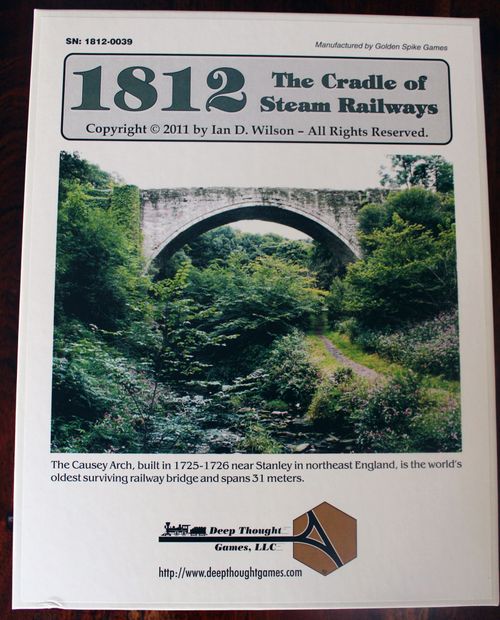
1812: The Cradle of Steam Railways
1812: The Cradle of Steam Railways Rulebook
Table of Contents
Table of Contents
1 Introduction
Cross-references within the rules are denoted by square brackets – [2.2] refers the reader to section 2.2 for additional information about the topic under discussion.
1812 is a member of the "18xx" series of games. The series is based on 1829, by Francis Tresham. 1812 is set in North-East England in the 19th century. Two to four players represent investors in railway companies, spending their initial capital to buy wholly owned Private and Minor Companies and later buying shares in Public Companies. The Public Companies are each controlled by the largest shareholder (its Director). Minor Companies and Public Companies build track and run Trains in order to earn revenues. Public Company revenues can be paid out as dividends to shareholders or retained to fund further track and Trains. A feature of 1812, as with all the other games in the series, is that the interests of a Public Company's Director and the interests of its shareholders are not identical, so minority shareholders need to be careful in their investments.
1812 is a medium length game. Experienced, brisk players can expect to take about three hours to complete a game. Novices or more deliberate players might add a few hours to that time.
1.1 Game Components
The game includes a Map and Stock Market, as well as Charters and Certificates representing the various companies in play [1.4].
There are also a number of track tiles; markers, mostly representing station tokens; and eight thousand pounds (£8,000) in various denominations, which represents the amount of money in the Bank.
The Train cards have a passenger Train on one side and a goods Train (with a "G") on the other. When bought from the Bank [7.3.8] the buyer decides which type of Train will be purchased and places that side up. This decision cannot be changed, even if the Train is later returned to the Bank Pool.
The Map shows most of North-East England (Yorkshire, Durham, and Northumberland). Superimposed on the map is a hex grid to regularize track laying, and coordinates are printed on the edges for reference purposes and to facilitate postal play. Large circles or solid black dots represent large and small cities respectively. Regions beyond the edge of the map are represented by red areas called "Red Off-board Areas", and some of them contain large circles representing large cities there. There are several ports on the east coast which are represented by an anchor symbol, and some mines represented by a pickaxe symbol. On the map are tables showing the value of a mine and the value of the North-South bonus [7.3.4], which vary by Phase.
1.2 How to Win
Players win by having the highest net worth at the end of the game. Cash on hand and stock shares owned add to net worth. Company-owned assets—such as Company cash and trains—do not contribute to net worth.
1.3 Player Etiquette
Players should attempt to speed play as much as possible. In particular, players should try to determine what share to buy or what tile to place or upgrade during another player's turn.
Player cash and Certificates owned should be arranged neatly in front of the player. Company cash should be placed in the Treasury section of the Company Charter, and the Company's trains should be neatly displayed in the train section of the Company Charter.
Upon request, a player must disclose his cash or Certificate holdings, or the assets of any Company under his control.
Corporate transactions are public knowledge, whether conducted between a Company and the Bank, a Company and a player, or two Companies.
Players may engage in public, verbal discussions and enter into public, verbal agreements. Such discussions should be reasonably brief in order to speed play. Performance is not enforceable except by moral suasion; a player who has performed an action under such an agreement in the anticipation of future action by his partner has no other recourse if his partner reneges on the agreement. Secret discussions or agreements, whether verbal or written, are prohibited.
1.4 Types of Companies
There are three classes of corporate entities represented in the game: 12 Private Companies, 10 Minor Companies, and 5 Public Companies. Minor Companies and Public Companies often act in the same way, and the term "Company" is used to mean either one (distinct from the generic word "company").
1.4.1 Private Companies
Private Companies are each represented by a single Certificate and are always completely owned by a single player or a Company. The Private Companies pay a fixed income, printed on the Certificate, to their respective owners at the start of each Operating Round. If owned by a player, the Certificate counts towards the number of Certificates owned by that player. A Private Company may be bought by a Company from a player for any mutually agreed amount between £1 and its face value (inclusive). A Company that owns a Private Company may not sell it. The parenthesized value is the minimum bid for that Private Company during the Initial Auction [3.2]
Some Private Companies, indicated in the table [14.2], add the indicated amount to the value of the indicated city, port, or Red Off-board Area when the Company that owns them runs its Trains to establish earnings. This applies to each Train running to that city or Red Off-board Area.
Some Private Companies appear on the Map, and grant owning Companies the rights to place additional track there for free [7.3.2]. Unlike some other 18xx games, these locations are not reserved and any Company may place tiles there according to the normal rules.
At the start of Phase 5, any remaining Private Companies (except #11 and #12, if in play) are closed without compensation.
1.4.2 Minor Companies
There are up to 10 Minor Companies in the game. All of them are available at the start of the game (but see variant [10]). Each is represented by a Charter, which also represents a single share Certificate. Each Minor Company has a reserved Station Marker location on the Map, which may not have a different Station Marker placed there while the Minor Company is in the game. Once a Minor Company is sold, it is always completely owned by a single player until it is removed from the game.
From Phase 3 onwards, Minor Companies may merge or convert to Public Companies, or be taken over. In Phases 5 and 6, they may not own a train.
1.4.3 Public Companies
There are up to five Public Companies in the game (Great Central Railway, Great Northern Railway, Lancashire & Yorkshire Railway, Midland Railway, and North Eastern Railway). They all function identically. Each has a Director's Certificate, worth 20%, or two shares, and eight ordinary Certificates each worth 10%, or one share. The Director is always the player with the most shares, and if another player owns more than the current Director, he swaps two of his ordinary Certificates for the Director's Certificate. The Director makes all decisions on behalf of the Public Company. Note: the Public Company's Charter is not a share Certificate, merely a convenient place to put its assets.
If a Public Company is closed, it is available to be restarted later in the game.
In a 2 or 3-player game, only 4 Public Companies may be in play at the same time. As they are all interchangeable, the player starting a Public Company may choose which one to start.
2 Game Phases
1812 goes through a series of Phases, which affect which tiles are available, which trains Companies may buy, which trains are scrapped or become obsolete, and various other aspects of the game. At the beginning of the game, only yellow track tiles and 2/1G-trains are in play.
There are always two Operating Rounds [7] between Stock Rounds [6], and Private Companies may be bought from players by Companies during any Phase before they are closed.
2.1 Phase 2
Phase 2 runs from the beginning of the game to the purchase of the first 3/2G-train. During Phase 2 the following apply:
- Yellow track is available.
- Red Off-board Areas, mines, and the N-S bonus count the lowest value.
- Minor Companies may own no more than two trains.
2.2 Phase 3
Phase 3 starts immediately after the purchase of the first 3/2G-train and runs until the purchase of the first 4/3+2G-train. During Phase 3 the following restrictions apply:
- Yellow and green track is available.
- Red Off-board Areas, mines, and the N-S bonus count the second value.
- Public Companies may own no more than four trains.
- Minor Companies may own no more than two trains.
- From now until the end of the game, there is a Merger Round [8] where Minor Companies may merge, convert, or be taken over after each Operating Round.
2.3 Phase 4
Phase 4 starts immediately after the purchase of the first 4/3+2G-train and runs until the purchase of the first 5/4+2G-train.
At the start of Phase 4, all 2/1G-trains become obsolete and are discarded without compensation.
During Phase 4 the following apply:
- Yellow, green, and brown track is available.
- Red Off-board Areas, mines, and the N-S bonus count the third value.
- Public Companies may own no more than three trains.
- Minor Companies may own no more than one train.
- Public Companies may be started without a Minor Company.
- Minor Companies may no longer be started.
2.4 Phase 5
Phase 5 starts immediately after the purchase of the first 5/4+2G-train and runs until the purchase of the first 3D/2+2GD-train.
At the start of Phase 5, all 3/2G-trains become obsolete and are discarded without compensation, and all private companies (exception: #11 and #12 are permanent) are closed.
During Phase 5 the following apply:
- All track is available.
- Red Off-board Areas, mines, and the N-S bonus count the highest value.
- Public Companies may own no more than two trains.
- Minor Companies may not own any trains.
- 3D/2+2GD-trains are available for purchase.
- Train trade-ins are allowed [7.3.8].
Note that there are an unlimited number of 5/4+2G trains available.
2.5 Phase 6
Phase 6 starts immediately after the purchase of the first 3D/2+2GD-train and runs until the end of the game.
At the start of Phase 6, all 3+1/2+1G-trains become obsolete and are discarded without compensation.
During Phase 6, the same conditions apply as in Phase 5.
Note that there are an unlimited number of 3D/2+2GD-trains available.
3 Setup and Start of the Game
3.1 Setting up the Game
Lay the Map, Stock Market, Revenue Chart, and Train chart on the table near the players. Place the share Certificates and Trains on the indicated board spaces. Each pile of share Certificates should be arranged with the Director's Certificate on top. Near the board, place the money (sorted by denomination) and the track tiles (sorted by colour). At the start of the game only the yellow track tiles will be used but the other tiles should be available for inspection. Place the Station Markers and the stock price markers for each Company by the board, near the share Certificates. Place the Company Charters nearby. Place the Round Marker on the operating round space marked Stock Round. Each player should have enough room for two or three company Charters, about ten Certificates, and a pile of money. Most players will find writing materials and a calculator useful. Appoint a player or players as Banker, who will bear responsibility for conducting transactions with the Bank. Distribute the starting capital (£195) to each player. Place the mine markers (with pickaxe symbol) on the relevant places on the board. Allocate the Place Cards (numbered 1 to 4) at random or by mutual agreement. The player holding Place Card #1 is the first to take an action in each Stock Round, followed by Place Card #2, etc. This order is called the Player Order in the rest of this document.
The number of Trains, Private Companies, Public Companies, etc. varies with the number of players. See the setup chart [14.1] for details.
Randomly select a number of Private Companies to use in the game equal to twice the number of players and discard the rest. The game starts with an initial auction, described below.
3.2 Conducting the Initial Auction
At the start of the first Stock Round, the Private Companies must be auctioned. In Player Order, each player either passes or nominates one of the unsold Private Companies and makes a bid which is a multiple of £5 and at least the minimum bid (the parenthesized value) for that company [14.2]. If a bid is made, each succeeding player in Player Order may either raise the bid in multiples of £5 or pass. A player who passes may not re-enter the auction for that Private Company. When only one player is left in the bidding for the Private Company, he wins the auction and pays his bid to the bank. The next player in Player Order after the purchaser then nominates a Private Company or passes, until either all players pass in order or all Private Companies in play are sold.
If all players in turn decline to auction any Private Company, select a new random set of Private Companies and start again. If all players pass after at least one Private Company has been sold, proceed to a pair of Operating Rounds (where only Private Companies pay their incomes), and then continue to auction the Private Companies in the next Stock Round.
After the sale of all the available Private Companies, the next player in Player Order after the one who purchased the last Private Company begins a normal Stock Round [6], by passing or nominating a Minor Company for auction.
4 Stock Market
The stock market records the current value of Minor and Public Companies by the position of the Company's price marker on the stock market track. For a Minor Company, the stock price is half the total value of the Company. For a Public Company, the stock price is the value of each share in the Company, i.e. one tenth of the total value.
4.1 Shares, Certificates, and Limits
There are important distinctions between shares and share Certificates. A single share of a Public Company is worth 10% of the Company. The Director's Certificate always represents two shares or 20% of the Company. Each Minor Company Charter also represents two shares and one Certificate. For purposes of share ownership in a Public Company, only the percentage of ownership as represented by shares is relevant.
Players are limited to buying up to 60% of a Public Company's stock. However, players may acquire and retain more than 60% of a Public Company's stock by exchanging Minor Companies for Treasury shares.
For purposes of Certificate limits, only the number of Certificates held is relevant. Each Private Company, Minor Company Charter, or share Certificate of a Public Company counts as one Certificate, whether it represents one or more shares. Players are limited to owning Certificates (not shares) in accordance with the following table:
| # of Players | 2 | 3 | 4 |
|---|---|---|---|
| Certificate Limit | 15 | 10 | 10 |
4.2 Company Closure
If a Company's stock price marker falls below £40, the Company is closed and its owner or shareholders receive no compensation. Trains owned by the Company are placed in the Bank Pool; Private Companies owned by the Company are discarded. If the Company is a Minor Company, its stock price marker, Station Marker, and Charter are discarded. If the Company is a Public Company, it is available to be re-opened later.
5 General Sequence of Play
The game proceeds in a series of rounds, starting with a Stock Round [6]. After the Stock Round, there is an Operating Round [7] followed (in Phase 3 and later) by a Merger Round [8], then another Operating Round and a Merger Round (in Phase 3 or later). When the second Merger Round is complete, the game continues with another sequence starting with a Stock Round.
During Stock Rounds, players auction Private and Minor Companies, and buy and sell shares in the Public Companies. During Operating Rounds, Private Companies earn incomes, and the Minor and Public Companies lay track, place Station Markers, operate Trains to earn revenues, and purchase more Trains. During Merger Rounds, Minor Companies may convert or merge, or be taken over.
The game starts in Phase 2, reflecting the fact that the first Train is a Type 2/1G. The game proceeds through Phases 3, 4, 5 and 6 as new types of trains are purchased. See Purchasing Trains [7.3.8] and Phases [2] for details.
6 Stock Round
A Stock Round consists of a series of turns, starting with the holder of Place Card #1 and proceeding in numerical order. The game begins with the auction of the Private Companies; on each Stock Round turn thereafter, the player may sell any number of Certificates, subject to the constraints set out below, and then may either auction a Minor Company or (in Phase 3 or later) buy one Certificate of a Public Company. A player doing neither is deemed to pass. The Stock Round ends only when all players pass consecutively. Thus, a player selling, buying, or auctioning stock is guaranteed another turn in the current Stock Round. All stock transfers in a Stock Round are done between a player and either the Bank or a Public Company; players may never buy stock directly from one another.
Any player who owns Certificates in excess of the Certificate Limit must sell sufficient shares to comply with the limit at the earliest legal opportunity. These sales are subject to the usual limits on sales [6.1]. If a player is able to sell some shares, but not enough to bring himself within the limit, he must sell what he can.
6.1 Selling Stock
To sell stock, the player transfers any number of share Certificates from his holdings into the Bank Pool, subject to the following constraints:
- Private Companies may never be sold
- Minor Companies may never be sold
- Shares in a Public Company which has not yet completed a turn in an Operating Round may not be sold
- There may never be more than 50% of the shares of any Public Company in the Bank Pool
- Director's Certificates may never end up in the Bank Pool
The player receives from the Bank the current stock price for each share sold. If as a result of selling shares the holding of a Public Company Director drops below that of another player (who must own at least 20% of the Public Company) that other player becomes the new Director. If there is more than one eligible player, the new Director is the player with the largest holding, or, in the case of a tie, the tying player next in Player Order after the outgoing Director. The outgoing Director exchanges his Director's Certificate for two ordinary 10% Certificates of the affected Company belonging to the new Director. This exchange is effected before resolving the rest of the sale.
If the Director (the outgoing Director, if there's a change during the turn) sells shares, the Company's stock price drops one space on the stock market, regardless of the number of shares sold. If any player other than the Director sells shares in a Public Company, the stock price does not move. If the marker moves to a space on the Stock Market which is already occupied by other Stock Market markers, it is placed at the bottom of the pile. The player receives the price before any adjustment for each of the shares sold. If the player sells shares in more than one Company of which he is Director in a single turn, he decides in which order to sell them; this will decide the order of Companies whose Stock Market markers drop to the same space.
6.2 Buying Stock
On each turn in a Stock Round, a player under the Certificate Limit may buy one stock Certificate or put a Minor Company up for auction. Only Minor Companies are available until Phase 3.
6.2.1 Put a Minor Company up for Auction
Instead of buying a Certificate, prior to Phase 4 the active player may elect to offer a new Minor Company for auction, similar to the way Private Companies were auctioned [3.2]. To do this, he nominates one of the unsold Minor Companies and bids a multiple of £5, with a minimum bid of £100. In Player Order, players may raise the bid in multiples of £5 or pass. A player may not bid more than his cash holding. Once a bid has been made on a Minor Company, a player who passes may not rejoin the bidding on that Minor Company. Once only one player is left in the bidding, he wins the auction. The amount paid goes into the Minor Company's Treasury. He places the Minor Company's Stock Market marker on the yellow highlighted space corresponding to half the amount paid, rounded down to the next available value (£50 to £100). If the space is already occupied, the new marker goes to the bottom of the pile. He places the Minor Company's Station Marker in its reserved starting space on the map. After an auction, the next turn in the Stock Round is taken by the next in Player Order after the player winning the auction.
6.2.2 Buying a Share of a Public Company
To buy stock, the player whose turn it is transfers one 10% Certificate from the Public Company's Treasury or the Bank Pool into his own holdings. The Director's Certificate of the Public Company must be owned by a player. The purchasing player must not already own 60% or more of that Public Company's stock, and may not have sold stock in that Public Company earlier in the same Stock Round. Only one Certificate may be bought per Stock turn. If the Certificate comes from the Bank Pool then its price is paid to the Bank. If the Certificate comes from the Public Company's Treasury then its price is paid to the Public Company. In all cases the price for the Certificate is the current stock price. Buying stock does not cause the current stock price to change. If, as a result of a share purchase, the player's holding exceeds that of the current Director, he becomes the new Director, exchanging the Director's Certificate for two 10% shares of his own.
6.2.3 Starting a new Public Company
From Phase 4 onwards, players may start new Public Companies. To do this, they buy the Director's Certificate, first setting its initial price by placing its Stock Market marker on any one of the red outlined spaces on the Stock Market (£65 to £135). If the selected space is already occupied, the new marker goes at the bottom of the pile. The cost is twice the initial price, paid into the Company Treasury. The remainder of the shares are placed in the Company's Treasury. The player puts one Station Marker of the Company on any unreserved and unoccupied city circle on the map, and the Company immediately pays two times the current value of the city to the Bank. (A hex without a tile or pre-printed city value is free).
A Public Company will operate once the Director's Certificate has been purchased.
6.3 Ending the Stock Round
The Stock Round ends when all players pass consecutively. The Round Marker is moved to the first Operating Round space. (Unlike in some other 18xx games, nothing special happens when a Public Company is fully sold.)
Allocate the Place Cards (numbered 1 to 4) to the players: the player with most remaining cash receives #1, the player with the next most cash #2, etc. In the case of a tie, the player with the lower number in the previous order receives the lower number. This new Player Order will be the order of play during the next Stock Round.
7 Operating Rounds
There are two Operating Rounds between Stock Rounds. In each Operating Round, every Private Company, open Minor Company, and started Public Company operates once. The Private Companies operate first, by paying their incomes to their owners. The Minor Companies operate next, in descending order of stock price, followed by the Public Companies, in descending order of stock price. If the Stock Market markers of two or more Minor Companies or two or more Public Companies are on the same space on the Stock Market, the one on top operates first.
The sequence of activities performed by each Company are described in [7.3]. In addition, a Company may buy one or more Private Companies at any point during its turn (except after taking a Loan and before performing the activity for which the Loan was taken); this may be done even in Phase 2.
All decisions made on behalf of the Company are made solely by its Director or owner.
Each Company operates once during each Operating Round. When all Companies have operated, the Operating Round is over and the Round Marker is moved, following the arrows, to the next space.
7.1 Routes
Many of the activities of Companies revolve around routes, an important concept which deserves its own section. A route of a Company is a continuous track segment, including on it at least one city with a Station Marker on it belonging to the Company. It may not reach or pass through any small or large city, Red Off-board Area, or port more than once. It may not pass through any city completely filled with Station Markers belonging to other Companies. It may not use any segment of track more than once, not even the small section of track at the junctions on some non-city tiles; this implies that it may not back-track over the sharp angle at such a junction. If a route visits a Red Off-board Area or Port, it must terminate there (exception: Derby and Newark). For cities such as Leeds in yellow, which have two separate disconnected circles, a route may not include both circles.
7.2 Loans
Loans are valued at £50 each. Minor Companies have a Loan limit of two; Public Companies have a Loan limit of five. The Loan interest (£5) is paid at the instant the Loan is taken out (and again in each Operating Round until the Loan is repaid), so each new Loan gives the Company a net £45.
Companies with fewer Loans than their limit may take out one or more Loans in order to pay for track building, Train purchase, and Loan interest, and for no other purpose. In each case, Companies may only take out Loans if they would otherwise be unable to afford such a payment or purchase, may only take out the minimum number of Loans to do so, and may not exceed their Loan limit. For train purchases, only Companies without a train may take out Loans to pay for a train purchase, and only in order to buy a train from the Bank (not one from another Company).
7.3 Operating Round Sequence
Each section below ([7.3.1] through [7.3.8]) represents a discrete step in the Company's turn. Companies must perform their operations in strict conformance to this order, though not every step is required.
7.3.1 Redeem Shares
A Company may buy back any or all of its own shares from the Bank Pool, placing them in its Company Treasury. It must pay the current price for each one. The Company may not take Loans in order to raise the necessary capital.
7.3.2 Lay or Upgrade Track
On each operating turn, the active Company may lay a yellow tile or upgrade one tile or map hex to the next colour (yellow to green, green to brown, or brown to grey) when available. For an additional fee of £20, a Company may do another tile operation in a different hex, but only one of the two operations may be an upgrade. Green tiles are available from Phase 3, brown from Phase 4, and grey from Phase 5. The supplied quantity of plain yellow track (tile numbers 7, 8, and 9) is intended to be sufficient for most games; if it runs out, more should be constructed. The tile mix of all other track is intended to limit play. If a vital tile is in play, then it must first be upgraded in order to free it.
When laying a yellow tile, it must be placed on and aligned with one of the pale green hexes on the map. While there is no track in the hex where a Company has a Station Marker, the Company may lay any suitable city tile there, and may not lay a tile anywhere else. Otherwise, the track on the tile must extend a route of the Company. Track laid may not run off the hex grid or into the blank side of a red or grey (impassable) hex or port, nor may it run into an impassable hex-side shown by a thick blue line. If the hex is labeled with a sum of money, representing difficult terrain, the Company must immediately pay that sum to the Bank. A Company under its Loan limit may take the minimum number of Loans required to pay for any desired track building expenses (and this includes the £20 fee for a second tile operation). If the map hex is marked with a large open circle, representing a large city, then so must the tile; if the map hex is also marked with a Y then so must the tile. If the map hex is marked with a dot representing a small city, then a tile with a bar must be used. If the map hex does not contain a dot or open circle, then plain track (i.e. track without a city) must be used.
When upgrading track, the old tile is removed (and is available for reuse) and the new substituted. Plain track, small city, normal city, and Y city tiles must be replaced with corresponding tiles. Track segments on the old tile must be represented, in the same orientations, on the new. New track on the tile may not run off the hex grid or into the blank side of a red or grey hex or port, nor may it run into an impassable hex-side shown by a thick blue line. For plain track upgrades, some part of the track on the new tile which is not on the old must constitute an extension of a route of the Company. For city upgrades, at least some part of the track (not necessarily a new part) on the new tile must be part of a route of the Company. If the tile has one or more Station Markers on it, those are replaced on the new tile. There is no charge for upgrading track in difficult terrain (exception: Newcastle from yellow to green). When cities such as Leeds in yellow are upgraded, the separate spaces are linked into one city.
Tiles with city names on them may only be played on those cities, and only those tiles may be played there if there is one for a given colour, for example Leeds in grey and Hull in brown.
The board already contains a number of hexes on which yellow track is printed. These hexes should be treated as though a yellow tile has been placed there already; yellow tiles may not be built there, but such hexes may be upgraded.
Any Company may place track on hexes shown as belonging to a Private Company in any Phase. A Company owning certain Private Companies may lay yellow tiles on any or all of their indicated hexes for free; these tile lay(s) do not have to connect to track, if any, on neighboring hexes, are in addition to the Company's normal lay(s), and terrain costs are ignored. This does not close the associated Private Company.
When laying or upgrading a tile on a mine hex, keep the mine marker (with pickaxe symbol) on top of the tile to indicate the position of the mine.
7.3.3 Place Station Marker
A Public Company may place one of its Station Markers each Operating Round on a vacant large city space which is part of a route of the Public Company. Prior to Phase 4, one space on each Minor Company's starting hex is reserved to that Minor Company and any Public Company must leave a space free if that Minor Company has not yet been started. No more than one Station Marker of any Public Company may be placed in any hex. Once placed, Station Markers may never be moved. Each Public Company has three to four Station Markers (depending on the number of players in the game) but Minor Companies only have one. Those placed during formation are free (exception, [6.2.3]). If the Public Company has only one Station Marker on the map, placing the second costs £20 times the distance between its existing Station Marker and the new site. If it has two or more Station Markers deployed, the cost of each subsequent Station Marker is £40 times the distance from the nearest Station Marker. In all cases, the distance is measured in hexes without regard to track. Example: a Public Company with only one Station Marker, in Hull, wishes to place another in Sunderland; the cost would be £120.
A Public Company may not take Loans in order to raise the necessary capital to place a Station Marker.
7.3.4 Train Operation and Earnings
If the Company has one or more Trains, it runs them to establish earnings. Each Train runs on a separate route; these routes may not share any track segments, but they may meet or cross at cities or Red Off-board Areas. The route may include no more cities and Red Off-board Areas than the number of the Train. Intermediate small cities may be skipped, large cities may not (exception: 3D and 2+2GD Trains). The value of a route is normally equal to the sum of the values of the cities or Red Off-board Areas it passes through or reaches. Skipped cities do not count. The value of a city is the number printed in the small circle in hex or tile, and ranges from £10 to £60 plus any bonus conferred by an owned Private Company. The value of a Red Off-board Area is one of the numbers printed in the rectangle; the lowest value in Phase 2, the second value in Phase 3, the third value in Phase 4, and the highest value in Phases 5 & 6 (see Phases [2]), plus any bonus conferred by an owned Private Company. The earnings of a Company is the sum of the values of the routes run by its Trains. The highest legal earnings announced by any player must be declared, but players are not obliged to announce earnings higher than those declared by the Director.
Each non-G Train must include at least two cities or Red Off-board Areas on its route.
G-Trains must run to a port and must have a mine on the route. Neither port nor mine count towards the number of the Train, but the current value of the mine is included in the calculation of the value of the route. Ports are normally worth £0 (exception: Hartlepool, Newcastle, and Whitby if the Company owns the relevant Private Company). If a Company runs more than one G-Train, each G-Train must include a different mine on its route. A G-Train may have more than one mine on the route, but only one mine is included in the calculation of the value of the route. If a G-Train runs to a hex with both a mine and a small city (e.g. Durham), then it may include both the mine and the small city.
The North-South bonus from the table on the Map is added if one end of a Train's run is a Red Off-board Area marked 'N' and the other is a Red Off-board Area marked 'S'. These two areas must be two of the cities included in the run. For example: a run from Carlisle through Leeds and Derby to Newark would gain the bonus, but a run from Carlisle through Derby to Manchester would not.
3+1/2+1G trains run the same as 3/2G trains but may add the value of one small city to the value of the route. Similarly, 3+2G trains may include up to five cities, up to three of which may be large cities or Red Off-board Areas. 3D trains count any 3 cities or Red Off board Areas (at least one city or Red Off-board Area must contain a Station Marker of the Company); the value of the route is then doubled (including any N-S bonus). 2+2GD trains count any 2 large cities or Red Off-board Areas (at least one city or Red Off-board Area must contain a Station Marker of the Company) plus 2 small cities and a mine; the value of the route is then doubled (including Hartlepool Docks Company). The bonus for the Hull Docks Company would also be doubled in both cases.
7.3.5 Dividend Payment
A Minor Company pays half of its earnings to its owner and half to its treasury. If its earnings are zero, the Company's stock price is moved one space down. Otherwise, its stock price is moved one space up. Minor Company stock prices may not go higher than £150 (this is marked on the Stock Market by a dashed red line). If the stock price moves to a space which is already occupied by one or more other markers, it moves to the bottom of the pile.
A Public Company may keep all of its earnings, pay all of its earnings as dividends, or pay half as dividends (rounded up to the next multiple of £10) and keep the rest. 10% of the dividend is paid to the holder of each share. Payments for shares in the Public Company's treasury go to the Company, while payments for shares in the Bank Pool are retained by the Bank. If the Public Company keeps all of its earnings, or if the earnings are zero, its price marker is moved one space down on the Stock Market. If ten times the dividend per share equals or exceeds the current stock price, the price marker is moved one space up (unless already at the maximum price). In any case, if the price marker moves to a space which is already occupied, the marker goes to the bottom of the pile; if the marker does not move to a new space, it retains its position relative to the other markers in the same space.
7.3.6 Pay Loan Interest
A Company which started its operating turn with one or more Loans must pay £5 interest on each one. (Loans acquired during the turn have already had their interest paid.) If a Company has insufficient money in its treasury it must take a further Loan; if it cannot then it pays all the money it has to the bank and its price marker on the Stock Market is moved one space down.
7.3.7 Redeem Loans
If the Company has at least £50 in its treasury and has one or more outstanding Loans, it must repay as many Loans as possible.
7.3.8 Train Buying
While a Company has fewer Trains than the current limit, it may purchase a Train. The Train may be from another Company, with its Director's consent; the price is any amount, at least £1 and not exceeding the active Company's treasury. The Train may be any from the Bank Pool, or the cheapest new Train in the Bank (or, in Phases 5 & 6, a 3D or 2+2GD); the price paid must be the face value (or £40 less than face value if the Company surrenders Stephenson's Engine Works). The Company may buy multiple Trains each Operating Round if it has the room and resources, but the effects of each Train purchase apply immediately after each is bought. A Company currently below its train limit may purchase a Train even if this triggers a Phase change which causes the Company to be over limit. Conversely, if the Company currently has as many Trains as the current limit, it may not buy a new Train even if this would trigger a Phase change to bring it within limit. If the purchase of a Train lowers the train limit, Companies with too many Trains immediately discard the excess into the Bank Pool without compensation - the Director chooses which trains to discard. If more than one Company has excess Trains, they decide which to discard in operating order.
The Train cards have a passenger Train on one side and a goods Train (with a "G") on the other. When bought from the Bank the buyer decides which way up the Train should go, and this decision cannot be changed, even if the Train is later returned to the Bank Pool.
If the Company has no Train, it must buy one (as above) if possible; otherwise its price marker on the Stock Market is moved one space down. It may take one or more Loans in order to buy the Train, but it may only do so if buying the Train from the Bank or Bank Pool. It may buy any Train from the Bank or Bank Pool it can afford; if it has enough money for the cheapest Train it may still take out Loans for a more expensive one. If, after taking Loans to buy a Train, a Company has some money left over it may use this money to buy another Train from another Company (according to the normal rules). Note that unlike some other 18xx games, a Director is neither required nor allowed to contribute cash to finance a train purchase.
After purchasing the first Train of a new type, immediately implement any effects of the Phase change [2].
In Phases 5 and 6 only, a Company may trade-in a Train, receiving a quarter of its original cost (rounded down) as a discount towards another Train from the Bank or Bank Pool. The Company may do this even when at train limit. The traded Train goes into the Bank Pool and is available for purchase.
Note that 2/1G, 5/4+2G, and 3D/2+2GD trains are not limited by the components supplied with the game.
After the first 2/1G is bought and just before the next Stock Round, remove any remaining unsold 2/1G trains. The next new train to buy will be the 3/2G.
After the first 3/2G is bought and just before the next Stock Round, replace any remaining unsold 3/2G trains with an equal number of 3+1/2+1G trains.
8 Merger Rounds
Starting with Phase 3 and continuing for the rest of the game, there is a Merger Round after each Operating Round. In a Merger Round, players may form new Public Companies from Minor Companies by either of two methods. A single Minor Company may convert to a Public Company if the Minor Company's stock price is at least £100. Alternatively, between two and six connected Minor Companies may merge to form a Public Company, provided the sum of the stock prices of the highest valued and lowest valued merging companies is at least £100. Most Public Companies are formed by these methods.
Minor Companies may also be taken over by existing Public Companies during a merger round, regardless of stock price.
All mergers, conversions, and take-overs are strictly voluntary and require the agreement of all involved parties.
8.1 Procedure
In normal operating order, each eligible Minor Company may elect to convert or merge to form a new Public Company, or be taken over. The owning Director(s) must give their approval: all parties to a proposed merger (or take-over) must agree before the merger can take place.
At the end of each Merger Round, the Round Marker is moved to the next space following the arrows.
8.2 Converting
A Minor Company's stock price must be at least £100 to be eligible to convert. The stock marker of the new Public Company is set to the price of the Minor Company and then moved four spaces down (placing its marker under any other stock markers already present in that space). The Public Company replaces the Minor Company's Station Marker (at no cost). The owner receives the Director's 20% Certificate and one 10% Certificate of the Public Company, even if at Certificate Limit.
8.3 Merging
Between two and six Minor Companies (no more than four from any one player) may merge to create a new Public Company, provided they are connected: one of the Minor Companies must be able to trace legal routes [7.1] to each and every other Minor Company involved. Station Markers of merging Companies do not block for purposes of this check.
Two Station Markers in the same City (e.g., Leeds in green) are considered connected, but Companies with Station Markers in the same hex (e.g. Leeds in yellow) are not automatically connected — they must be connected by track (even though two separate Cities on the same hex would not otherwise be a legal route) to be eligible to merge.
The stock marker of the new Public Company is set to the sum of the highest priced and lowest priced Minor Companies involved (rounded down if necessary), and then moved four spaces down (placing its marker under any other stock markers already present in that space). If the sum of the highest priced and lowest priced Minor Companies is less than £100 then the merger is not allowed. If the resulting final price is greater than £135 then the price is £135.
The Charter of each Minor Company involved in the merger is replaced by one and a half shares of the new Public Company, without regard to the Certificate Limit. If a player has an odd number of Minor Companies merging, he must 'upgrade' the half-share to a full share (even if at or over Certificate Limit) by paying half the new stock price (rounded up) to the Company if possible (i.e., he has funds to do so without selling stock and a share is available), otherwise he 'downgrades' and receives half the stock price (rounded down) from the Bank. Upgrading or downgrading is done from the owner of the earliest operating Minor Company involved and proceeding in operating order. The player with the most shares is the Director; resolve ties in favor of the player who owned the Minor Company that would operate earliest in the next Operating Round if it did not merge. Note: If no player has two shares at this point the merger is not allowed.
The Director must choose two Station Markers of the merging Companies to replace with Station Markers of the new Public Company (at no cost); the Public Company cannot take two Markers in the same hex; therefore if there are exactly two merging Companies and they have Station Markers in the same hex, the Public Company only takes one of them. A merger between Minor Companies with more than five Loans between them is allowed. (The Public Company may exceed its Loan limit this way).
8.4 General (Converting & Merging)
Place all the assets of the Minor Companies in the new Public Company (including all Loans). The stock marker of the new Company must be placed in a red outlined space (between £65 and £135), underneath any stock markers already present in that space. Any remaining shares are placed in the treasury of the Public Company. Starting with the Director and proceeding in Player Order, each player with shares in the new Company is granted an opportunity to buy any number of new shares in the company as a single transaction. If a player's purchase gives them more shares than the Director, they take over the directorship in the usual way. Once all shareholders have either bought or declined, then if there are still unsold shares remaining, all players may buy a single share in the Company, starting with the (possibly new) Director and proceeding in Player Order. (In theory this may also change the directorship.) This process concludes when all players have either bought or declined a share, or when all shares are sold. Players may not buy shares to take their holding over 60% of the Company, nor may they exceed their Certificate Limit. They may not sell shares during this process. The stock marker(s) of the Minor Companies involved are then removed from the stock chart.
8.5 Take-overs
A Minor Company may be taken over by a Public Company provided they are connected (the Minor Company must be able to trace a legal route to a Station Marker of the Public Company, or be collocated on the same block of station markers on a tile) and there is a share in the treasury of the Public Company. The Minor Company is exchanged for a treasury share of the Public Company; the Public Company receives the Minor Company's assets (including Loans - the Public Company may exceed its Loan limit this way) and the Minor Company's Station Marker is removed. The Public Company may replace the Minor Company's Station Marker if desired (at no cost) provided it has a spare Station Marker available (and it does not already have a token in that city).
A player may go over 60% holding in a Public Company by this means (and is never obliged to reduce his holding back to 60%).
9 End of the Game
If the Bank ever runs out of money, the game ends after completing an Operating Round. That is, if the Bank runs out of money during an Operating Round, the game ends at the end of that round. If the Bank runs out of money during a Stock Round or Merger Round, continue the normal sequence of rounds until one complete Operating Round has been played, and then stop. If the Bank becomes solvent again, the game still ends as described. Issue players with IOUs from the bank as necessary.
At the end of the game, the stock price of each Company is adjusted one space down for each of its outstanding Loans. If this takes the Company's stock price into the Closed box, the Company's effective stock price is zero.
Each player's total wealth is the value of his stock, at current prices, plus his cash on hand. Private Companies are worth face value, and Minor Companies are worth twice their current stock price. Company assets, including treasury and Trains, count for nothing. The richest player wins.
In the unlikely event that all Companies are closed, there are no Private Companies owned by players, and no player has enough money to start a Company, then the game ends and all players lose.
10 Variant
For variety in 2-3 player games, players could agree before the game to randomly choose 2n+2 minor companies (where n is the number of players) and remove the rest from the game.
11 Designer's Notes
1812 is a small 1861-style game which should take less time to finish. The design was influenced by certain features of 1846 and 18VA.
For many years, coal was mined on the banks of the Tyne and shipped to London. As the seams near the river worked out, it became necessary to transport the coal from mines further away and the obvious choice was the horse-drawn wagon-way. The first of these was the Tanfield Railway, which can trace its roots back to the early 17th century. Steam locomotives initially proved impractical on the rails used, but around 1810 better rails became available. In 1812, the Middleton Railway (near Leeds) was the first to successfully run a steam loco (Salamanca), using a rack-and-pinion system. Not long afterward, the Wylam Railway (near Newcastle) also converted to steam using the smooth wheel on smooth rail system we still use today; an early loco was Puffing Billy (1815). A young engineer from Wylam at that time was George Stephenson, who started his railway designs with the loco Blucher (1814). He went on to build many railways, including the S&D and Liverpool & Manchester Railways. In 1823 he set up, with his son Robert, a locomotive works in Newcastle. These works produced Locomotion (1825) for the S&D, and the winning entry to the L&M's Rainhill Trials (1829): the revolutionary Rocket.
By amalgamation and take-over, the NER came to dominate the area north of York. The ML became the LYR, the DP became the GNR and the NM became part of the Midland. The SAM became the Manchester, Sheffield & Lincolnshire; much later this expanded to become the GCR.
12 Conflicts and Errata
The official rules are this document plus any officially-published errata. In the event of conflict between the official rules and any components, the rules take precedence.
14 Appendices
14.1 Game Setup Table
| 2 players | 3 players | 4 players | |
|---|---|---|---|
| 3/2G Trains | 3 | 5 | 6 |
| 4/3+2G Trains | 2 | 3 | 4 |
| Other Trains | Unlimited | Unlimited | Unlimited |
| Private Companies | 4 | 6 | 8 |
| Public Companies | 4 | 4 | 5 |
| Public Company Station Markers | 4 | 4 | 3 |
| Certificate Limit |
14.2 Private Companies
| # | Name | Minimum Bid | Face Value | Income | Effect | Closed |
|---|---|---|---|---|---|---|
| 1 | Tanfield Railway | £5 | £15 | £5 | None | Phase 5 |
| 2 | Middleton Railway | £15 | £20 | £5 | +£10 Leeds | Phase 5 |
| 3 | Wylam Railway | £15 | £20 | £5 | +£10 for G-Train to Newcastle port | Phase 5 |
| 4 | Sheffield & Rotherham Railway |
Note: the Private Company Certificates show the Minimum Bid in parentheses.
14.3 Minor Companies
| # | Name | Start Location |
|---|---|---|
| 1 | Doncaster & Peterborough Railway | Newark (E20) |
| 2 | Hull & Selby Railway | Hull (G16) |
| 3 | Leeds Northern Railway | Leeds (C14-N) |
| 4 | Manchester & Leeds Railway | Leeds (C14-S) |
| 5 | Newcastle & Berwick Railway | Newcastle (E4-N) |
| 6 | Newcastle & Darlington Railway | Newcastle (E4-S) |
| 7 | North Midland Railway | Derby (C20) |
| 8 | Sheffield, Ashton & Manchester Railway | Sheffield (C18) |
14.4 Tiles and Upgrades
Note: in the source PDF (Version 1.0a) this section heading is printed with no content beneath it.