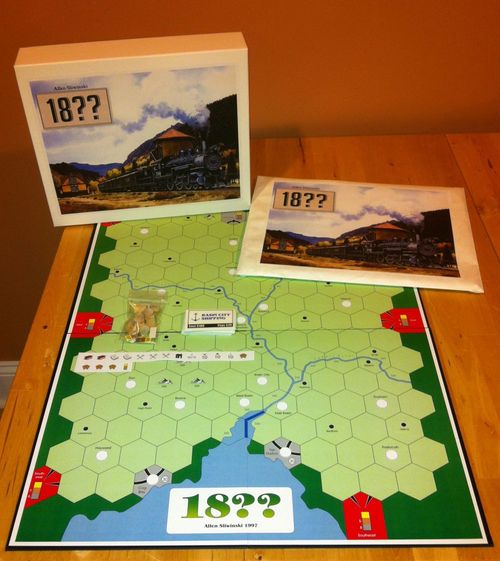
18??
18?? Rulebook
Table of Contents
Table of Contents
Game Kit Components
- 1 Map
- 16 Private Companies
- 12 Value Tiles
- 17 Tokens
Introduction
A public company does not have a designated place to start. At the beginning of a company's first operation, the company's president chooses a large city that has no station markers in it, and he places the company's free starting station there. Use the square-shaped token for this purpose and use one of the regular round station tokens to mark par value. A company may not start in a city that has an empty station marker space if there is already a station marker in that city. Companies may not start in the red off-board locations, or in Oreburg.
The six red off-board locations contain spaces for value tiles. Before the game begins, six value tiles are chosen randomly from the twelve available ones. These are randomly placed in the six spaces. The three numbers on the tiles, from top to bottom, designate the value of the off-board location at the start of the game, when the first 5-train is purchased, and when the first 8-train is purchased.
Connection Runs
A company may make one connection run per game at the end of one of its operations. A public company has no single designated destination to reach in order to make its connection run. It may trace a connection run from its starting city to one of the six red off-board locations. When a company's connection run is made, the red off-board location that it connects to becomes the company's destination, and the company's doubling destination station marker is placed there. A company's choice of possible destinations has these restrictions:
Large companies (FRISCO, MP, AT&SF, MKT, SP) can connect at off-board locations at least nine hexes away from the starting city.
Small companies (GM&O, IC, FW&D, SSW, T&P) can connect at off-board locations at least eight hexes away from the starting city.
These distances are counted using the shortest possible legal route, not the route actually used by the company. The distance hex count includes the off-board location (as if it was a hex), but not the starting city. For example, the city of Eureka is eight hexes away from the East off-board location. A small company could make this connection run, but a large company could not.
At the beginning of the game, only one company can make a connection run to each off-board location. When four or more companies have made their connection runs, one additional company may make a connection run to a location that already contains another company's destination station marker. This does not change if one or more of the four companies are later closed. If an off-board location contains two destination station markers, no other company can make a connection run to that location.
A company can only make its connection run at the end of its own operation. Making a connection run is optional. The company's president decides whether his company will make a connection run or not.
If a company is able to make a connection run at the end of its operation, the president may decide to pay $100 from the company's treasury to immediately build a regular station marker using the destination station marker. The company would then never be able to make a connection run.
Private Companies
There are 16 private companies, divided into six sets based on their price ($20, $40, $60, $80, $100, $120). There is only one $20 private company, and there are three private companies in each of the other five sets. All of the private companies are laid out in their sets at the start of the game. Starting with the first player and proceeding clockwise, a player may bid on any set of private companies, or pass. The minimum initial bid is the printed cost of one of the companies in the set. Bids must be made in $5 increments. Initial bids may exceed the printed cost, and bidding increases may exceed $5.
Players should place their bid cash next to the set that they bid on, and take back this cash when another player places a higher bid on that set. Players may not bid more cash than they have. A player who passes may place a bid on a later turn. After all players pass consecutively, the first player who passed after the last bid takes the priority deal card. Any private companies that were not bid on when all players pass are removed from the game.
Starting with the $20 private company and proceeding in order from the low-priced companies to the high-priced companies, the player who placed the highest bid for each set takes one private company of his choice from that set, and the two other companies from the triple sets are removed from the game.
All of the private companies may be purchased by public companies for one-half of their cost prior to the purchase of the first 3-train, and for one-half to double their cost after the purchase of the first 3-train. Private companies that have not been purchased by a public company are closed when the first 5-train is purchased. Private companies that have been purchased by a public company stop paying dividends when the first 5-train is purchased, but their abilities continue until the end of the game. If a private company is removed from the game or not purchased by a public company when the first 5-train is purchased, its designated tokens are not available to be played.
Oreburg
Oreburg is a small city in the gray off-board location on the north edge of the board. A company must possess an Oreburg right-of-way token to trace a route to or through Oreburg. An operating company may spend one yellow track build to take an unclaimed Oreburg token if it can trace a route there from one of its station markers. There are four regular Oreburg tokens available. These tokens are not station markers. Companies may trace routes through Oreburg without stopping, but Oreburg must always be counted against the length of the route. Oreburg may not be a company's destination.
Brown City Upgrades
Green large city tiles can be upgraded to brown large city tiles after the first 5-train has been purchased. Any green large city tile can be upgraded to a $50 brown city tile. All four $50 brown city tiles can be used. Any green large city tile, with the exception of one in West Basin, can also be upgraded to one of the five $40 brown city tiles. A $40 brown city tile cannot be upgraded to a $50 brown city tile.
Gray City Upgrades
The two gray city tiles are available after the first 8-train is purchased. Any brown large city tile, with the exception of one in West Basin, can be upgraded to a $60 gray city tile.
Cog Bay and Yar Harbor
These are large cities in the gray off-board locations on the ocean shore. Runs may be traced through Cog Bay and Yar Harbor without stopping, as with other large cities. These cities cannot be upgraded. A company may place a station marker in Cog Bay and/or Yar Harbor if one is not already there. The value of these cities is always $30.
Difficult Terrain
A company must pay $60 to the bank to build a yellow tile in a hex with the ocean, a river, or a mountain in it.
Small Cities
A company may count any number of small cities on its runs, or ignore them. Any small cities counted on a run must be counted against the length of the run. Even though it is a small city, Oreburg is always counted against the length of a run.
Optional Rules
Before the game begins, players may agree to randomly pick just one private company from each set to be available in the game, or to randomly remove one private company from each of the triple sets.
Before the game begins, players may agree to randomly pick a seventh value tile to be placed in Oreburg. The values on the tile would then supersede the regular Oreburg values.
Private Company Special Powers
Conestoga Wagon Company
$20/$5
This private company has no ability beyond paying a $5 dividend.
Pioneer Investments
$40/$10
The owning company receives a token which can be spent during its operation to exchange one pair of off-board value tiles. This includes exchanging for one of the tiles that are not currently in play.
Clanghorn Bridge & Iron Works
$40/$10
The owning company pays $20 instead of $60 to build yellow track tiles in all difficult terrain.
Metropolitan Development Company
$40/$10
The owning company may upgrade brown large city tiles to gray city tiles after the third 5-train is purchased.
Inland Steel Company
$60/$15
The owning company receives two tokens. Each token can be spent to build an additional yellow tile, or both tokens can be spent together to build an additional green tile. Only one additional yellow tile can be built in an operating round. A tile that is built or upgraded during an operation cannot be again upgraded during the same operation. The company must pay any difficult terrain costs for the additional yellow tile builds.
Calhoun Cattle Company
$60/$15
The owning company receives a 10 token that can be placed on any large city except East Basin, West Basin, Cog Bay, or Yar Harbor. The token can be placed on the West off board location instead of on a large city. The token increases the value of the city or location by $10 for the owning company. Other companies do not receive this bonus. The token can be placed during any of the owning company's operations. It may not be moved after it is placed.
Faustian Accounting
$60/$15
The owning company receives two tokens. One token may be placed in any position on the stock chart at the beginning of an operating round, before any railroads operate. The owning company will then operate at the time dictated by the position of the token instead of when it would normally operate. Its share value token is adjusted when it operates, and the token is then discarded.
Carver Locomotive Works
$80/$15
The owning company may own one more train than the current train limit, but it may not operate more trains than the current train limit. The owning company receives a 10% discount on all trains purchased from the bank.
Oreburg Mining Company
$80/$15
The owning company receives a token that allows it to immediately run to and through Oreburg if it can trace a route there. This token is not a station marker. The token increases each of the company's runs to or through Oreburg by $10. If the owning company acquired a regular Oreburg token before buying the Oreburg Mining Company, the regular token becomes available to other companies.
Terminal Realty
$80/$15
The owning company receives an extra station marker. It may be placed at no cost in any large city, including unconnected cities and cities with no open station marker spaces. The extra station marker allows the owning company to trace routes from and through the city, but track may not be built from it. The extra station marker does not fill a station marker space in the city unless the owning railroad pays $100 to make it fill an available space and block it. The extra station marker must be played when normal station markers can be played. It may be played in addition to normal station marker placement. A new company may not place its free starting station marker in a city that contains the extra station marker.
Farmers Union
$100/$20
The owning company counts all of the small cities on its runs, but it does not count small cities (with the exception of Oreburg) as stops on its runs. All small cities available in a run must be counted, including small cities beyond the end large cities on the run if the end large cities are not blocked by the station marker(s) of other companies.
Also, the owning company receives three tokens that can each be spent to place an additional yellow small city tile on a small city hex during track building. Only one token can be spent in an operating round.
Basin City Shipping
$100/$20
The owning company receives a 20/10 token and a 10 token that can be played on East Basin and West Basin in either order. The tokens can be played during any of the company's operations. They may not be moved after they are placed. The tokens increase the value of each of the owning company's runs to the 20/10 city by $20 and to the 10 city by $10. Other companies increase the value of each of their runs to the 20/10 city by $10.
Franklin Imports & Exports
$100/$20
The owning company may sell two trains per game for 40% of their printed cost, or one train per game for 60% of its printed cost. This is done after the company's trains run and before trains are purchased. The trains that are sold are removed from the game, and the money is taken from the bank. If the company sells its last train(s), the company must purchase a train only with its treasury. If this is impossible, the sale is reversed. Two trains can be sold during different operating rounds, or at the same time.
Grand Junction Investors
$120
The owner takes the president's certificate of any company and sets a par stock value for it. The company immediately places its free starting station marker in the city of Grand Junction, and the private company certificate is discarded. The company begins operating if at least one 10% share of its stock is sold.
Dutton Short Line
$120/$20
Beginning when the owning company makes its destination run, the value of the destination is tripled instead of doubled for that company.
D&OH Railroad
$120/$20
The owner immediately takes one 10% share of the stock of any company.