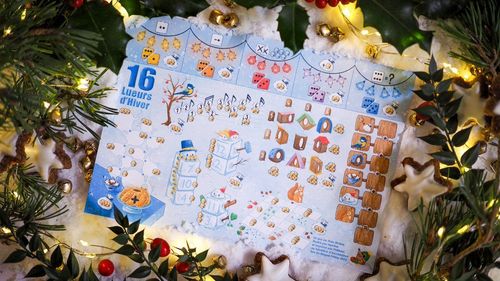
16 lueurs d'hiver
16 lueurs d'hiver Rulebook
Table of Contents
Table of Contents
Components and Setup
- 3 six-sided dice.
- For each player: 1 score sheet (fiche de jeu) and 1 pencil.
Setup: give each player a score sheet and a pencil. Place the 3 dice in the centre of the table.
The score sheet has five zones, each with its own way of marking points and its own way of recording numbers, plus a row of garlands along the top. Its key parts are:
- Game zones (dashed outlines on the sheet): the five areas where a player records dice pairs.
- Garlands (Guirlandes): the strip along the top. Each garland is a row of bulbs.
- Bulb (Ampoule): one box on a garland. Completing all bulbs of a garland unlocks its power.
- Power (Pouvoir): the icon at the end of a garland showing the power it unlocks (the +1 or -1 icons described under Bulbs and Garlands).
- Placement constraint (Contrainte de pose): the dice icon shown on the sheet next to the zones. The sheet does not explain this icon beyond its label.
- Points (Grelots): the scoring marks, shown as little bells. Scored at the end of the game.
- Grelot bag (Bourse de Grelots): a bag of Grelots awarded when a zone or garland is completed (see Completing a Zone or a Garland).
- Score track (Tableau de score): the scoring summary on the right side of the sheet (see End of Game and Scoring).
Goal
The player who accumulates the most points (represented by Grelots) by the end of the game wins!
Turn Sequence
- Roll. The 3 dice are rolled. Rolling is available to everyone.
- Form a pair and record. Simultaneously, each player chooses two of the dice to form a pair, which they record in one of the five zones of their sheet, at their choice. They then tick a bulb of a garland matching the remaining die (see Bulbs and Garlands).
- If the end-of-game condition has not been triggered (see End of Game and Scoring), a new turn begins.
If a player cannot, or does not wish to, add a pair of dice, they may choose not to do so.
The Zones
The sheet is divided into five different zones. Each zone has its own way of marking points and its own way of recording numbers.
Chanting Bird (L'Oiseau chanteur)
The player ticks the two numbers of the pair, in any place they wish. If the player can only tick one of the two numbers, they cannot place this pair in the zone.
At the end of the game, the player gains the Grelots of each ticked box that is consecutive, counting outward from the bird.
Birdhouses (Les Nichoirs)
The player ticks the box corresponding to the coordinates of the pair of dice (the two numbers give the row and column of the grid).
At the end of the game, the player gains the Grelots of each row and each column that is entirely ticked.
Cakes (Les Gâteaux)
The player writes a number in each of the puffs of smoke, starting from the box at the very bottom and moving upward. The numbers must be increasing in the kouglof (bundt cake) and decreasing in the biscuits (cookies).
At the end of the game, the player gains the Grelots of each box that contains a number.
Snowmen (Les Bonhommes de Neige)
The player adds the two dice of the pair and ticks the corresponding box.
At the end of the game, the player gains the Grelots of each ticked box.
Example on the sheet: two dice summing to 7, with an arrow to box 7 in the snowman column.
Squirrel (L'Écureuil)
The player forms a domino with the two chosen numbers and places it in one of the spaces of the zone. The first domino must be placed in the space indicated by an arrow. Later dominoes must be adjacent to a domino already placed, and the numbers of adjacent dominoes must always be identical.
At the end of the game, the player gains the Grelots of each completed domino.
Bulbs and Garlands (Les Ampoules)
Each turn, players use one die to tick a bulb on one of their garlands. The result of the die determines the colour of the bulb (a 6 lets the player tick a bulb of their choice).
When a player has ticked all the bulbs of one garland, they unlock its power for the rest of the game.
If the result of the chosen die does not allow ticking the bulb it points to (because the matching garland is already full), the player chooses a bulb of their choice.
Example:
a. After a roll, Fanny keeps a die showing 4. b. She therefore ticks a purple bulb. c. She has completed the purple garland. She now benefits from the power of the zone.
Note: the example's last line reads "zone" in the printed French. Read in context (the rule above says garland powers), it refers to the power of the completed garland.
Garland powers shown at the bottom of the sheet:
- +1 power (icon +•): each turn, the player may add 1 to the result of one die.
- -1 power (icon -•): each turn, the player may subtract 1 from the result of one die.
Bonuses
- Doubles. Each turn, if a double is rolled, the player ticks a Grelot that will give them one point at the end of the game. The double must be "natural": bonuses that modify a die's result are not taken into account.
- Grelot bags (Bourses). At the end of the game, the player gains 1 Grelot for each Bourse they have unlocked.
- Jokers. Dice showing 6 count as jokers for the player. A die modified by the bonus of Garland 1 to become a 6 becomes a joker.
Completing a Zone or a Garland
If during their turn a player has completed all the boxes of a zone or of a garland, they announce it to the other players. They circle the associated Grelot bag (two or three Grelots) and add it to their score at the end of the game. The other players cross out that bag and can no longer gain it later.
If several players complete a zone or a garland during the same turn, they all gain this bonus.
End of Game and Scoring
The game ends as soon as one player has ticked all the bulbs of four of their garlands. The player with the most Grelots wins the game! In case of a tie, it is a tie: congratulations, stay friends, it is important.
Score Track (Tableau de score)
The score track on the sheet lists these values, from top to bottom:
| Row icon | Value printed |
|---|---|
| Garland bulb with a Grelot bag | 11 |
| Chanting bird (blue tit) | 14 |
| Birdhouse | 15 |
| Cakes (bowl of biscuits) | 5 |
| Snowman | 7 |
| Squirrel | / |
| Total | 52 |
The sheet prints the values joined by "+" signs, a "/" for the squirrel row, and "= 52" at the bottom. The printed sheet gives no further explanation of this track beyond the image itself.