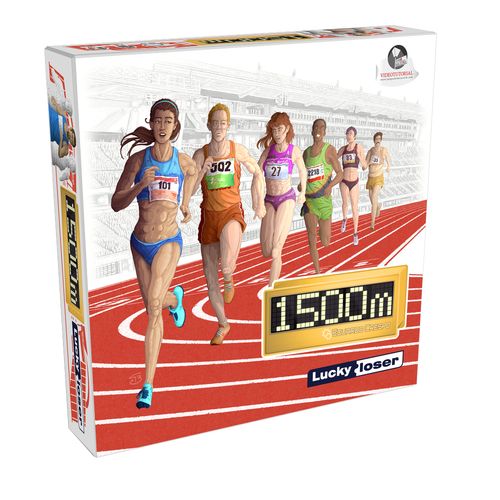
1500 m
1500 m Rulebook
Table of Contents
Table of Contents
Content
32 Movement cards with values from 8 to 11 in eight different colors 64 Extra action bid card with values from 1 to 8 in eight different colors 8 Runners in eight different colors 24 Wooden cubes in eight different colors 4 Movement cards for robot runners 1 Board 1 Finish line template 1 Wooden marker for lap track 1 Rulebook
Components
Field
Divided in spaces and where runners advance during the race.
Tracks
There are different tracks you have to take control all over the race, because levels will be changing as race goes on or players take decissions in different rounds.
1) Mental Strength Track
Mental strength is the runner skill to hold an effort. All runners start with 100 mental strength points. Throughout the race, this value will change, going up or down. Each runner will show his/her level with his own cube color. When runners reach certain levels of mental strength, some negative effects will take place.
2) Runners Pace Track
Rate is the number of movement points that a runner has in his pace phase. All runners have a starting level rate of 5. Each pace will force runners to spend mental strength points that will be subtracted from the mental strength track when they are in that level. You can change a runner's pace, increasing, keeping or decreasing it. Each runner will show his/her level with his own cube color.
3) Extra Actions Track
This track has the different extra actions runners can choose in the bid. Once actions has been chosen and the bid finishes, all actions can be chosen again in the next bid. Each runner will choose his/her action with his own cube color.
4) Laps Track
This track shows the number of laps left.
5) Movement Penalty Track
This track shows the number of movement penalty points a runner has in cards phase for reaching 0 mental strength points level.
Game Goal
As in any track competition, the goal of the game is to win the race. The winner will be the first runner who crosses first the finish line. If 2 or more runners do it in the same phase, the winner will be the runner who is better positioned (qualified) at the end of that last phase.
The race consists of 3 and ¾ laps. It begins at the start line and when runners arrive first time to the finish line (numbered spaces from 1 to 8), the ¾ are completed. After that, there will be 3 more laps, ending the game in the finish line.
We recommend to play the game until 3 runners crosses the finish line to award gold, silver and bronze medals as it happens in a real race.
Cards
Each runner has 2 kind of cards:
Movement cards. Players have 4 movement cards with values from 8 to 11. These values are the number of movement points a runner has when the card is played.
Extra action bid cards. Players have 8 extra action bid cards with values from 1 to 8. These values are the number of mental strength points that a runner will spend in order to get an extra action during the bid when the card is used.
Set Up
Players choose a color. They take the cards, cubes and the runner in such color. Each player puts a cube in 100 of mental strength track, another in 5 level pace track, and the other next to extra actions track.
Starting positions are randomly determined in the starting line.
Put the token on 3 level lap track.
Gameflow
The game is played in rounds. Each round consists of 3 phases that follows this order:
- Cards Phase
- Pace Phase
- Extra Mental Strenght Points Cost Phase
1. Cards Phase
Is divided in a) Extra actions bid b) Movement
a) Extra Actions Bid
All players choose at once and secretly a movement card and an extra action bid card that are kept away from the rest of the cards. All players reveal at the same time extra action bid cards and they are ordered from the highest to lowest value. All players subtract the value of their cards in mental strength track.
The player with the highest value chooses an action first, putting his/her cube in the actions track. Once an action is chosen it is blocked for the rest of players and cannot be chosen until next bid. This goes on until the rest of the players choose an action. The player with the lowest bid has no extra action.
In case of a tie between 2 or more card values, the worst positioned runner always chooses first. In case of a tie in classification the runner in the inner lane is considered better positioned.
Cards used during bid, return to player's hand and can be played in the next bid.
Extra actions bid:
Safe Mental Strength Points. The player who chooses this action, recovers that number of mental strength points from the track in the act. (Safe 3 and 4 mental strenght points actions.)
Movement +2 +3. The player who chooses this action, adds that number of extra movement points to his/her movement card when he moves.
Move First. The player who chooses this action, will move first (even before the runner who is leading the race) and can ignore all runners protection spaces during his/her movement. He will add an extra movement point to his/her movement card when he moves.
Increase Pace Levels For Free. The player who chooses this action, can increase in the act the number of pace levels indicated in the pace track for free. (Increase 1 and 2 pace levels actions.)
b) Movement
Once bid has been worked out and all players got their extra actions, movement cards are revealed and are used to perform their movements. They are made according to their positions (from first to last).
Exception: The player who picked MOVE FIRST will move before the first positioned runner.
Movement cards used don't return to players hands and form a common discard pile. When all 4 movement cards are used, all players will replenish their hands with all 4 cards again.
Once all runners have performed their movements, the cards phase ends.
2. Pace Phase
Each player chooses his/her pace level, subtracts mental strength points of that level and moves his/her runner. This is made according to their positions (from first to last).
Choosing pace level. A runner can choose between:
- Keep his/her current level.
- Increase only one level.
- Decrease as many levels as he/she wants. In this case, the runner will spend one less mental strength point than the number indicated in the picked level. If level 5 is chosen, no mental strength points are recovered.
Once all players have performed their movements, pace phase ends.
Pace track values (rate / mental strength point cost):
| Rate | 5 | 6 | 7 | 9 | 10 | 12 | 14 |
|---|---|---|---|---|---|---|---|
| Cost | 0 | 2 | 3 | 5 | 6 | 8 | 10 |
3. Extra Mental Strenght Points Cost Phase
In this phase, some runners will have additional mental strength points costs.
Qualifying Costs
The runner who is first placed loses 2 mental strength points because of the pressure of pulling the group.
Runners Movement
Moving forward one space costs 1 movement point. Lane change (inner or outer) is made diagonally. It cost one point to the inner lane and two points to the outer lane. In curves, the change is done diagonally to the most forward space of the two possible ones.
Each runner has a security zone that is the runner standing space. You can not go through those spaces to make a move and you can not end the movement on them. Only the runner who chooses MOVE FIRST can perform his/her movement through these spaces, but not finish his/her movement on them.
A runner is not forced to use all his movement points if he/she doesn't want to. When a player has to move his/her runner, is not allowed to count with the finger or to redo his movement when he is performing it or after it is done.
If a runner runs out of mental strength points and has to spend them, he/she will lose 1 movement point for each mental strength point he can't afford to pay. Use the movement penalty track to know it.
When players have no mental strength points left:
- In the cards phase, they will move using their movement cards but they can't bid for the rest of the race. And they are not considered the lowest value in the bid.
- In pace phase they will decrease immediately to level 5 (where there is no cost).
Each time the first runner crosses the finish line, the lap track goes to the lower number. When it gets 0 it will be the last lap.
Positions During the Race
Runners in both phases always move according to their positions (from first to last) when they have to perform it. Exception: the runner who choses MOVE FIRST action in the bid, always moves first in cards phase.
In case of a tie the runner in the inner lane is considered better positioned. At the start or when all runners are in a straight line zone is easy to check out if runners are at the same level.
In curves, to know which runner goes first, you have to count the number of spaces each runner has to move in his/her lane to the middle of the curve if he is in the first half of the curve. Or to the end of it if he is in the second half of the curve. The runner who had the least number of spaces to move to that point will be considered better positioned. In case of a tie, the runner who is in the inner lane goes first as normal.
Finish Line
During the last lap, when runners are going to cross the finish line, put the finish line template on the board following the finish line. Runners will end the race following the straight template instead of the normal curve printed on the board.
The winner will be the first runner who crosses first the finish line in any of the 2 phases. If 2 or more runners do it in the same phase, the winner will be the runner who is better positioned (qualified) at the end of that last phase.
Robot Runners
You can use robot runners to complete the number of players wanted.
1. Cards Round
a) Extra Action Bid
Robot runners don't bid for extra actions.
b) Movement
To know how many points robots have, shuffle robot movement cards and choose one randomly. All robots have the same movement points. Used cards go to the common discard pile and they will be recovered at the same time that players get theirs.
Robots always use all of their available movement points and choose the best path possible, that is the one that will put them better positioned. Robot runner movement can be redo if it doesn't end the best way positioned.
2. Pace Phase
Robots in pace phase will be considered at the same level as the highest runner level in the moment they have to move.
Robots always use all of his available movement points and choose the best path possible, that is the one that will put them better positioned.
3. Extra Mental Strenght Points Cost Phase
Robot runners neither use the mental strength track nor has extra mental strength points costs.
800 Meters
If you want, you can play an 800 m race instead of a 1500 m one, only with these simple changes:
Put the lap track on 1.
Runners start now with 50 points in mental strength track.
The start is compensated. All runners start in a lane and can't leave it until the end of the first curve. Once crossed this point, any runner can go to the inner lane as normal.
Advanced Rules
These rules make the game more real. But you'll have to manage more carefully your mental strenght because there will be additional mental strength points costs.
3. Extra Mental Strenght Points Cost Phase
Now there are more mental strength point costs. The spendings are made in this order.
1) Wear Costs
In 1500 m race. Runners between 49 and 25 mental strength points lose 1 mental strength point. Runners between 24 and 0 lose 2 additional points.
In 800 m race. Runners between 24 and 13 mental strength points lose 1 additional mental strength point. Runners between 12 and 0 lose another 2 points.
2) Qualifying Costs
Now when the bell rings announcing last lap (as soon as the first runner starts last lap), not only first positioned runner will have costs to pay but also the top three because of the pressure of getting medals. The first will lose 3 points, the second 2 points and the third 1 point.
Round Example
At the start of the round, runners are positioned in tracks and on the court as shown in the image.
1. Cards Phase
a) Extra Action Bid
- All runners choose secretly a movement card and an extra action bid card and separate them from the rest. After this, all runners reveal the extra action bid card at the same time.
- There's a tie between two runners (yellow and purple) for the highest bid (4). In this case the worst positioned runner will choose first. It is purple runner who goes in the outer lane.
- There's another tie between blue and white (3). White runner will choose first. And there's a third tie between green and red (2). Green will choose first. Red runner gets no action as he is considered the lowest bid.
- According to this order runners will choose actions and they subtract mental strength points of the card value used in the auction.
- The card used in the bid, comes back to player's hand and can be played in the next bid.
Let's see runners decisions:
- Purple runner chooses MOVE +3 action and he/she will add this to the movement card value used in this phase.
- Yellow runner chooses MOVE +2 action and he/she will add this to the movement card value used in this phase.
- White runner chooses MOVE FIRST. That means he/she will move before first positioned runner in this phase. He will have an extra movement point and he will be able to overtake other runners without going to the outer lane.
- Blue runner chooses SAFE +4 mental strength points. He/she recovers 4 points in the mental strength track.
- Green runner chooses INCREASE 1 EXTRA LEVEL in pace track and goes from 7 to 9 pace.
- Red runner gets no action, as he/she was the lowest bid. But subtracts mental strength points as well as the rest of runners did.
b) Movement
Once bid is over, all players reveal their movement cards chosen and they perform their movements. Movement is made according to their positions (from the first to the last).
Exception: white player who chose MOVE FIRST will move first.
Movement cards used don't return to player's hands and form a common discard pile. When all 4 movement cards are used, all players will replenish their hands with all 4 cards again.
Once all runners have performed their movements, cards phase is over.
2. Pace Phase
Each runner can choose between
- To keep current pace.
- To increase pace only one level.
- To decrease pace to the lowest level he chooses.
The choice is made according to their positions, performing movement and subtracting mental strength points in the act.
- Red runner increases 1 level. He/she will have 9 movement points and spends 5 mental strength points.
- Yellow runner increases 1 level. He/she will have 10 movement points and spends 6 mental strength points.
- Purple runner decreases 3 levels. He/she will have 7 movement points and spends 2 mental strenght points. (3-1).
- Blue runner decreases 1 level. He/she will have 9 movement points and spends 4 mental strength points. (5-1).
- Green runner increases 1 level. He/she will have 10 movement points and spends 6 mental strength points.
- White runner keeps his current 6 pace. He/she will have 6 movement points and spends 2 mental strength points.
Once all runners have performed their movements, pace phase ends.