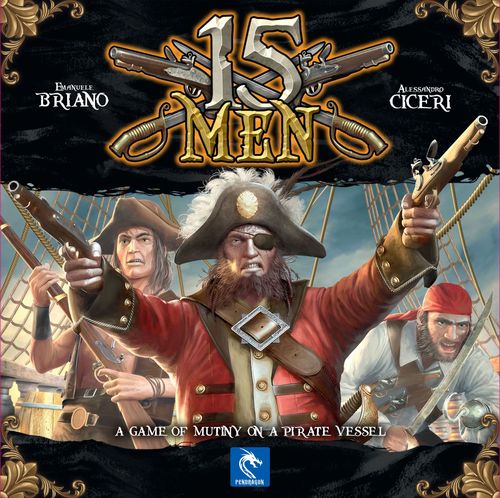
15 Men
15 Men Rulebook
Table of Contents
Table of Contents
- The Game
- Game Overview
- Game Components
- Setup
- Special Rules for 5 Players
- Rules for 2 Players
- Rules for 3 Players
- Playing the Game
- Notes on the Pirates
- Blackbeard (1680 - 1718)
- Augustin Blanco (1700 - 1725)
- Anne Bonny (1702 - 1782)
- Alonzo Bosco (unknown - unknown)
- Lope de Aguirre (1510 - 1561)
- Laurens de Graaf (1653 - 1704)
- Michel de Grammont (1645 - 1686)
- Raveneau de Lussan (1663 - unknown)
- Cabeza de Perro (1800 - unknown)
- Diabolito (unknown - 1823)
- Francis Drake (1540 - 1596)
- The Guards
- Scenarios
- Nationality
The Game
15 Men is a game of subterfuge, deception, and mutiny for 2-5 players, set on a pirate vessel. Each player will be called to play the role of the intrepid captain, his faithful loyalist, or one of the scoundrels who are preparing to mutiny. Recruit as many crewmembers to your side as you can by bribing them with doubloons, and take advantage of their unique skills to get the better of your opponents when the bullets start to fly.
Game Overview
During the game, each player plays a secret role: captain, loyalist, or mutineer. The captain tries to quell the mutiny with the help of his precious loyalist, who hides among the other players.
The rest are mutineers, who try to bribe enough crewmembers to their side and take control of the vessel. The crew is represented by 15 face-down cards, laid out in a circle around the board to form a ring called the "Round Robin," an ancient method used by sailors when they sign the act of mutiny so that it could not be used to trace back to who started the rebellion. By looking at the back of the pirate cards, you will know only their country of origin and their role on the ship.
Playing in turns, each player will offer doubloons to one of the 15 crewmembers to bring them over to their side and to obtain information about the other sailors. Their goal is to recruit the strongest crew, to take advantage of their special abilities, and to have the best position when the pirates pull out their guns and start shooting!
Game Components
1 game board. The board shows the deck of the ship where the mutiny takes place. The 15 pirates of the crew that will be controlled by the players are arranged around the outside.
The position of the pirates around the board is important: during the game every pirate can tell you the secrets of the pirates next to them, and eventually shoot one of them when the situation becomes difficult.
29 pirate cards. The front of each pirate card shows their name, a portrait, the flag that indicates the real nationality of the pirate, their role on board the ship, the Victory Points they will give their team at the end of the game, and their special skill.
On the back, only the symbol that represents their role and the flag that represents their presumed nationality are shown (Warning! Some pirates can make the other crewmembers believe that they have nationalities different than their real ones!).
The role of a pirate indicates their rank on the vessel and provides a clue about their abilities. Pirates who have the same role usually have similar effects. In particular:
- Buccaneers generally get to shoot earlier or at more distant targets than the other pirates;
- Cartographers generally allow you to secretly look at or reveal other pirate cards;
- Helmsmen generally allow you to move pirates or doubloons around the Round Robin;
- Phantoms are generally immune to the effects of shooting or they may give penalties to those trying to kill them;
- Bosuns generally award higher scores if certain conditions occur.
7 vessel cards. Each ship sails under a nation's flag and has a special effect on the game, which generally favors the pirates of the same nationality.
4 scenario cards. Each scenario changes the rules of the game, allowing for different game modes and making the experience different each time you play (see page 15 if you want to use scenario cards).
4 guard cards. These are pirates loyal to the captain. These cards are only used in games with 2 or 5 players.
5 sets of 7 doubloons, each set a different color, with: 2 of value 1, 3 of value 2, and 2 of value 3.
5 bullets, 1 for each player.
5 faction cards: 1 card for the Captain, 1 for the loyalist, 3 for the mutineers.
5 summary cards, 1 for each player color.
Expert Cards
Warning! Some cards show the "expert" label: we recommend that you only use these cards after playing a few games so you are familiar with all of the game mechanics.
Setup
These setup rules assume you are playing a 4-player game. If you are playing with a different number, see the special rules, on the next page.
Place the board in the middle of the table. Shuffle the pirate cards and randomly place 15 cards, without revealing them, around the game board so that each card is next to one of the numbers on the board. These are the pirates that will compose the ship's crew for this game. Put the remaining pirate cards in the box without looking at them.
Then, set aside The Revenge vessel card. Shuffle the rest of them, randomly select one card, and place it in the middle of the game board: it will determine which ship the game will take place on.
Each vessel card shows a minimum number of pirates of a nationality that you must have to use that ship. If there are not enough pirates of that nationality present, replace the vessel card with The Revenge.
Each player chooses a color and takes the bullet and doubloons of that color, depending on the number of players at the table:
| Players | Doubloons | Total |
|---|---|---|
| 2 or 3 | 2 of value 1, 3 of value 2, 2 of value 3 | 7 doubloons |
| 4 | 2 of value 1, 2 of value 2, 2 of value 3 | 6 doubloons |
| 5 | 2 of value 1, 1 of value 2, 2 of value 3 | 5 doubloons |
Put the unused doubloons and bullets in the box. Each player also receives a summary card showing the Jolly Roger of their color, that they place in front of them to show the other players their color.
Make sure that the faction cards include the captain and the loyalist card, recognizable by a black spot on the front, and enough mutineer cards to make the total faction cards equal the number of players (so, in a 4-player game, 1 captain, 1 loyalist, and 2 mutineers). Shuffle them and deal one card to each player. The player who has the captain reveals it. The other players must not reveal their own faction until the end of the game.
Special Rules for 5 Players
The captain takes the guard cards, shuffles them, then draws two at random and places them in front of their captain card face up. Guards are not part of the Round Robin and are immune to corruption and shooting (as long as they do not end up in the Round Robin). At the end of the game, they always count towards the captain's crew.
The captain can use the guards' abilities during his turn.
At the end of the game, the Victory Points and nationalities of the guards are counted like normal pirates in the Captain's crew.
Rules for 2 Players
Each player makes a team by himself. The captain card and a mutineer are dealt and revealed. The captain gets one randomly chosen guard card that he puts face up in front of him and plays first.
Rules for 3 Players
Each player makes a team by himself and there is no loyalist. Faction cards (the captain and 2 mutineers) are dealt (there must always be a captain at the table) and revealed immediately. At the beginning of the game, each mutineer may look at two pirates of his choice in the Round Robin before starting play.
Playing the Game
The game is divided into two phases: the Corruption Phase and the Showdown Phase.
Corruption Phase
Starting with the player to the left of the captain, the players take turns. On your turn, you must bribe one pirate by placing a single doubloon token (of any value you choose) on the board next to the pirate's card. Any other doubloons of your color previously played on this pirate are added to your total value there.
To bribe a pirate controlled by another player, the total value of your doubloons next to that pirate must be greater than the value of the current controller's doubloons.
It is the purple player's turn: he can bid a doubloon of any value on pirate 1 to bribe him and add him to his team. He can also take control of pirate 2 or pirate 3 by bidding a doubloon with a value equal to or greater than 2. He can't bid on pirate 4 because he can't bid enough to take control.
Important: You cannot add a doubloon to a pirate if it is not enough to take control of him. But, it is possible to add a doubloon to a pirate you already control to defend him. If you cannot take control of any pirate, you must discard one of your doubloons and play passes to the next player.
When you take control of a pirate, follow these steps:
- you may secretly look at that pirate. Then you must put it back in the same position in the Round Robin;
- you may secretly look at one of the pirates adjacent to that pirate (even if they are controlled by another player) and return them to the same position; and
- you get control of the pirate, who will—temporarily—join your team's crew, at least until another player corrupts them!
The Purple player has taken control of pirate 3. He can look at it and put it back in the same position, face down. Then he can look at pirate 2 or 4 and put it back in the same position, face down.
Before or after bribing a pirate, you may reveal one pirate you already control (normally, one you have bribed with a winning bid) who has a skill that begins with "Reveal..." to immediately resolve the effect described on that card.
After the effect is resolved, that pirate is returned to the same position in the Round Robin face up and his skill cannot be activated again during the game.
Obviously, this action cannot be taken during the first round, before you control any pirates. You can only use a pirate if you control it at the beginning of your turn.
Note: it is never possible to use the "Reveal..." skill of any pirates controlled by your teammates.
Showdown Phase
Keep taking turns until all players have used all of their doubloons. Now we arrive at the Showdown: it begins with a round of shots, starting with the player to the left of the captain.
In turn, any player who still holds their bullet can use it to make one pirate under his control shoot at an adjacent pirate in the Round Robin. The target of the shot is immediately discarded with all the doubloons on it. The target must be adjacent to the shooter ("distance 1").
If there is an empty space adjacent to a pirate, that pirate is not adjacent to the pirate in the next position (they are at "distance 2").
Remember: before or after you shoot, you still have the option to activate the skill of one of the pirates you control.
The purple player controls pirates 6, 7, and 8. He still has his bullet, but pirate 5 has already been eliminated by a shot from another player. So, purple can only fire at pirate 9 using his bullet.
If a player cannot or does not want to shoot, he keeps his bullet and passes his turn.
Note: Some pirates have special abilities that allow you to change the range of a shot or be immune to attack.
After a single round of shots, the loyalist reveals his role and puts all the pirates he controls together with those controlled by the captain, forming a common crew. Then they add up their Victory Points, taking into account any modifiers from the text on the cards and any bonuses conferred by the vessel card.
The captain and his faithful crew includes 5 pirates. Among these are two Hawkins brothers, who each get a bonus of +3, and Raveneau de Lussan, who does not get a bonus since the helmsman is missing from the crew. The two French pirates each have a bonus of 2 points awarded by the French vessel. The total number of points is therefore 23 (given by the sum of the individual scores of the pirates: 3+3, 2+3, 2+2, 2+2, and 4).
The mutineers do the same and calculate the Victory Points of their crew. The team that scores the highest total wins! In the event of a tie, the mutiny is unsuccessful and the captain's team wins.
Notes on the Pirates
Below you will find some historical notes on those pirates in the game that really existed or that are born from literary fiction. Each entry also has some clarifications of their special abilities.
Blackbeard (1680 - 1718)
Edward Teach, also known as Blackbeard, loved instilling fear in his enemies. He drank rum mixed with gunpowder. In battle, he wore a lit fuse under his hat, to be obscured by the cloud of smoke.
At the end of the Showdown, the player controlling Blackbeard must turn him face up, and must kill the closest pirate in clockwise order that he does not control. It may happen that, due to bad luck or the skill of your opponents, he shoots a pirate controlled by his teammate or a phantom. If no one controls Blackbeard, this effect does not apply.
Augustin Blanco (1700 - 1725)
A pirate from Cuba, he was known to be the leader of a crew composed of a variety of nationalities (Englishmen, Scotsmen, Spaniards, and Africans).
If you take control of a pirate using his ability, you do not get to look at the pirate or one of the two adjacent pirates. For control, you must count all of the doubloons on the pirate.
Anne Bonny (1702 - 1782)
She dressed like a man to hide her features. The lover of pirate Calico Jack, at the moment of his execution she told him: "Had you fought like a man, you need not have been hang'd like a dog."
Her ability changes the position of the target pirates without changing who controls them.
Alonzo Bosco (unknown - unknown)
Don Alonzo Bosco was a Spanish pirate known to have built a castle on the island he used as a base during the XVI Century, from which he launched his raids.
If you take control of a pirate using his skill, you do not get to look at the pirate or one of the two adjacent pirates. The other doubloons on the pirate remain where they are.
Lope de Aguirre (1510 - 1561)
A Conquistador sent to discover the mythical El Dorado, he instead led a rebellion against his homeland.
If you control him, you can turn him face up to look at a pirate of your choice as long as he has the English flag on the back. Then, put him back face down in the same position in the Round Robin.
Laurens de Graaf (1653 - 1704)
Among Spaniards, Laurencillo was considered the embodiment of the Devil himself, so much as to be nicknamed "Scourge of the West." He re-christened his first frigate Tiger.
He counts as English as long as he is face-down. From the moment he is revealed until the end of the game, he counts as a Spanish pirate for all effects. When you turn him face up to use his ability, choose the player who controls the most English pirates (your choice if tied), who must choose 1 of this English pirates to kill (beware of phantoms!).
Michel de Grammont (1645 - 1686)
A French nobleman, Grammont de la Motte was one of the leaders of the Brotherhood of the Coast. He became a pirate to escape a death sentence for having killed a man in a duel. He conquered Maracaibo, Trujillo, Gibraltar, and Campeche, and pillaged Vera Cruz.
He counts as French as long as he is face down. From the moment he is revealed until the end of the game he counts as an English pirate for all effects.
Raveneau de Lussan (1663 - unknown)
He took up buccaneering, distinguishing himself for his great audacity against the Spaniards. He wrote the Journal du voyage fait a la mer du Sud avec les flibustiers de l'Amérique.
If two or more pairs of Helmsmen and Cartographers are present, he still only gets +4 VP.
Cabeza de Perro (1800 - unknown)
His nickname of "Angel Garcia" comes from his physical appearance. He decided to leave piracy for the shame of having thrown a child and his mother into the sea (both were saved by the Italian ship Centauro), the only survivors of the slaughter on their ship.
If you take control of a pirate using his skill, you do not get to look at the pirate or one of the two adjacent pirates. For control, you must count all of the doubloons on the pirate.
Diabolito (unknown - 1823)
Also known as "Little Devil," he was one of the most violent pirates of his time, particularly skillful in escaping pursuit.
If you control him, you can turn him face up to look at one pirate of your choice, as long as he is controlled by the captain. Then, put him back face down in the same position in the Round Robin.
Francis Drake (1540 - 1596)
The first captain to circumnavigate the globe, on board the Pelican in 1577, and he was vice admiral of the English fleet that defeated the Spanish "Invincible Armada." Legend has it that, if England was once again in peril, it would suffice to play his drum to make the corsair come back from the realm of the dead to save his homeland.
After turning him face up, you keep control of Francis Drake, and the chosen pirate remains controlled by the same player (or by no one, if there were no bids on it).
Eustace the Monk (1170 - 1217)
The Black Monk lived his youth in a Benedictine monastery. He had to flee and take up piracy after he was accused of mishandling his duties as seneschal to the Count of Boulogne.
The guards count towards the total number of pirates in the team.
John Flint (from Treasure Island, by R.L. Stevenson)
"They was the roughest crew afloat, was Flint's; the devil himself would have been feared to go to sea with them." The ruthless pirate Flint hides his fabled treasure, the booty of his raids and pillaging, on a remote island, then returns alone to his ship, the Walrus, moored nearby, leaving his crew to their fate. The discovery of his map starts the events narrated in the book Treasure Island.
He does not count as a Buccaneer from the moment he is revealed until the end of the game. If he is hit by a bullet, he reveals himself, keeping his position in the Round Robin, and kills the pirate who shot him. If the killing of that pirate has an effect on the player who kills it, apply those effects to the player who controls Flint.
William Ghost
"Revenge on an enemy is to get a new lease on life."
He does not count as a helmsman from the moment he is revealed until the end of the game. Even if he is killed by the ability of Blackbeard or Flint, he still counts as a penalty to the player who controls the Ghost. In the rare case that the pirate who kills him is not controlled, remove Ghost from the game.
John Hawkins (1532 - 1595)
Also known as Juan Aquines, he had no rivals as a slaver. On his coat of arms stood an African in chains. Close relative of Richard and William Hawkins.
If, at the end of the game, you control two or three of the Hawkins brothers, each of them gains +3 VP.
William Hawkins (unknown - unknown)
He served under Francis Drake and fought the Spanish "Invincible Armada." He is mentioned in many pirate tales around 1600, but since his name is very common, it is not clear if it is always the same person. Close relative of John and Richard Hawkins.
If, at the end of the game, you control two or three of the Hawkins brothers, each of them gains +3 VP.
Richard Hawkins (1562 - 1622)
The name of the captain of the Dainty was among the most common in the trepid messages that the governors of the Antilles and the Spanish ambassador in London sent to Madrid. Close relative of John and William Hawkins.
If, at the end of the game, you control two or three of the Hawkins brothers, each of them gains +3 VP. Richard Hawkins does not count as a Bosun from the moment he is revealed until the end of the game.
Calico Jack (1682 - 1720)
Among the most famous pirates of his time, the pseudonym of John Rackham comes from the calicot, the Indian fabric which he used to wear. The two piratesses Anne Bonny and Mary Read were members of his crew. His Jolly Roger had a skull on top of two crossed sabers.
After using his ability, put Calico Jack with the killed pirates.
Jacquotte (1630 - 1663)
Jacquotte Delahaye was born in Haiti. She was nicknamed "back from the red dead." A knife-armed damsel was depicted on her Jolly Roger, dancing with Death around a red heart.
You can shoot any closest Buccaneer in the Round Robin, face up or face down.
Jean Lafitte (1776 - 1826)
With a safe haven in Barataria Bay, together with his brother Pierre, he was one of the greatest smugglers of his time. They became pirates to fight England alongside the American forces.
If you control him, you can turn him face up to turn another pirate face down, whose "Reveal..." ability can therefore be re-activated by his controller.
Pierre le Grand (unknown - unknown)
Nothing is known of his life prior to his arrival in Tortuga in mid-XVII Century. He managed to defeat a Spanish ship with a troop of only 28 men on a small boat, taking the Spaniards by surprise, who were not expecting an assault from a boat so small.
If, at the end of the game, your team has more French pirates than the opposing team, you gain a +4 VP bonus. French guards do count towards the total number of pirates
Francois l'Olonnais (1630 - 1669)
He did not kill his enemies right away, because he loved torturing them first. Such was the admiration of the Governor of Tortuga for Jean David Nau, that he nicknamed him "flail of the Spanish ships."
Your team gains +5 VP for each unused bullet they have at the end of the game. This counts even if the bullet remains because there was no valid target to shoot.
Daniel Montbars (1645 - 1707)
Hailing from Gascony, he, together with Grammont, conquered Maracaibo and Gibraltar. His nickname was "the Exterminator."
You can shoot any face-up pirate in the Round Robin.
Amaro Pargo (1678 - 1747)
A Corsair for the King of Spain, he was a fervent Catholic who donated substantial sums to charity. He plundered rich English and Dutch ships and traded in liquor. He was also an opponent of Blackbeard and one of the most famous pirates of his time.
If you control him, you can turn him face up to look at a pirate of your choice as long as it has either a French or Spanish flag on the back. Then, put him back in the same position in the Round Robin.
Mary Read (1685 - 1721)
She was very much favorable to the hanging of pirates, because she viewed it as a way to keep cowards away from piracy. Before her ship was captured, she fired upon her own fleeing crewmen, accusing them of cowardice.
She gains a bonus for each other Boatsman in your team.
Long John Silver (from Treasure Island, by R.L. Stevenson)
"All those I knew are dead. Some I sent them to the other world myself, if it exists. But why it should? In any case, I hope with all my soul that it does not exist, because in hell I would find them all, that idiot Morgan who dared to pass me the black stamp, and the others, including Flint, that God has it in glory, if a god exists. They would welcome me with open arms, bowing and scraping, claiming that everything is back like old times. But in the meantime, the terror would radiate from their faces like a burning sun on the calm sea. Terror of what? I ask. Of course, in hell they can not be afraid of death."
You can use his ability even during the Showdown, and even if you just used your bullet. If the scenario says that the players must buy their bullet, then the bullet cannot be bought using his ability.
"... the round robin - I explained - is nothing but a precautionary measure. On the one hand, everyone who wants to be with us will have to sign the declaration, so that they will not be able to quail when they smell a rat. On the other hand, that same sheet will lead us straight to the gallows, if it ends up in the wrong hands. But since the first ones are always considered to be the instigators, on the round robin the signatures form a ring, so that nobody could know who started."
(from Long John Silver, by Bjorn Larsson)
Jacques Tavernier (1625 - 1673)
The nickname of this French buccaneer was "le Lyonnais." His raids, which he carried out on Le Perle, stretched from Venezuela to Panama, and from Cuba to Mexico.
You can shoot up to a distance of 3 clockwise or counter-clockwise. Each position adds 1 to the distance even if the pirate in that position has been killed.
Charles Vane (1680 - 1721)
The captain of the Ranger never accepted the pardon that was offered to him in exchange for his promise to stop his raids. He also collaborated with the fabled Blackbeard.
If two or more pairs of Helmsmen and Cartographers are present, he still only gets +4 VP.
(As printed, the wording of this ability is identical to that of Raveneau de Lussan above.)
Emanuel Wynn (1650 - 1700)
He was the first pirate to use the Jolly Roger. Together with the mandatory skull, a sand timer was also present: "your time is running out."
If you control him, you can turn him face up to choose a face down pirate and turn him face up. Put that pirate back in his position, still face up, but do not activate his "Reveal..." skill, if he has one.
The Guards
Bamba (from Veracruz, by V. Evangelisti)
"Slave on the pirate ship of Lorencillo, he was forced to dance under the cage in which an unfortunate prisoner consumed his slow agony".
The captain may only exchange him during his turn, as an extra action. The chosen crewman must be placed face up in front of the captain and Bamba must be placed in the Round Robin in the chosen crewman's position. No player may raise his bid on Bamba. Bamba remains under the Captain's control and may be used to shoot during the Showdown.
The pirate notes below continue after The Guards section on the printed page 15; no heading is printed there.
William Gibbons (unknown - unknown)
A doctor and explorer of American waters around 1600, he was held in great respect for his ability to save lives following bloody clashes.
The rescue action is carried out in response to the killing or sacrifice of a pirate.
Henry Morgan (1635 - 1688)
He claimed that he had dropped out of school early, and that he was "much more used to the pike than the book." He was a bloodthirsty and astute pirate based in Port Royale who managed to conquer Portobello, a Spanish territory. Four years after Morgan's death, Port Royal was struck by a violent earthquake that caused it to sink below sea level, dragging with it the pirate's grave, which lies there still.
At the end of the Showdown, before pirates are revealed and points totaled, you may shoot 1 pirate of your choice without expending a bullet. If Blackbeard is present, Morgan shoots first.
Mr Parrot (unknown - unknown)
The most intelligent of the parrots coming from Veracruz, the Captain is teaching him to be an informer and to swear. When the captain tires of him, he will be sold for his weight in gold.
At the start of each of your turns, you may choose any face-down card in the Round Robin and look at it. During the game, Mr. Parrot counts as a pirate of any nationality for the effects of other pirates, scenarios, and vessels.
Scenarios
In your first game we suggest to use Treasure's island basic scenario.
Then in the following games, if you want to use the scenario cards, mix the cards and pull one at random before the game begins. The card will describe how the rules are changed for that scenario.
Tortuga
On the island of Tortuga there is peace among the pirates. All bullets are confiscated. But even those who watch the ammunition have a price...
At the start of the game the players place their bullets on the scenario card. Once per game, each player can reacquire his own bullet by paying a doubloon on the Tortuga card. This action counts as a corruption action and therefore the player will not be able to bribe a pirate during the same turn in which he acquires the bullet. The cost of the bullet decreases as more players acquire the bullet.
The Governor's Daughter
During a mutiny, things could go wrong for the mutineers. To save your own skin, you can try writing a letter to the Governor's daughter and ask for a safe conduct.
A small gift can help to plead the cause.
During his own turn, each player can bribe the Governor's daughter to earn the Loyalist role. The raise must be a winning bid, according to the normal corruption rules. However, at the beginning of the game the roles are assigned normally. If no player corrupts the governor's daughter, the player who received the card at the start of the game will keep the Loyalist role; otherwise, the Loyalist role will be held only by the player who corrupted last the Governor's daughter. This action counts as a corruption action and therefore the player will not be able to bribe a pirate during the same turn in which he corrupts the Governor's daughter.
Voodoo
On Caribbean nights, Voodoo sorcerers perform mysterious rituals. By paying the right price, you can use their services against your enemies.
During his turn, each player can buy a Voodoo ritual with one of his own doubloons instead of bribing a pirate. It is not necessary for the player to check or have previously read the ability of the pirate he wants to activate. Once the ritual is activated, the player must resolve the effect of the ability of the chosen pirate, if possible. This action counts as a corruption action and therefore the player will not be able to bribe a pirate during the same turn in which he acquired the ritual.
Nationality
The pirates' nationalities are shown by flags: English, French, and Spanish.