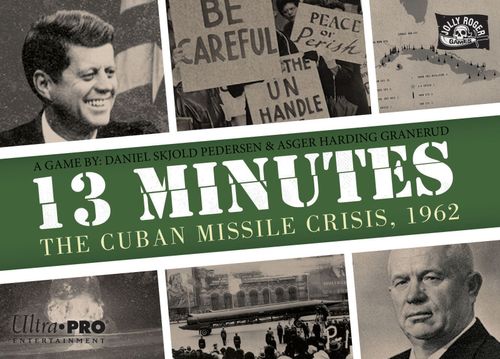
13 Minutes: The Cuban Missile Crisis, 1962
13 Minutes: The Cuban Missile Crisis, 1962 Rulebook
Table of Contents
Table of Contents
Components
- 13 Strategy cards
- 26 Influence cubes (13 blue and 13 red)
Setting Up the Game
- The US player takes the 13 blue cubes and the USSR player the 13 red cubes.
- Shuffle the deck of cards and deal 2 cards to each player.
- Draw one card without looking at it and place it facedown in the center of the table as the Cuba battleground.
The table is an imaginary world map divided into three zones. The center table is the neutral zone. The table space in front of you is your superpower's sphere of influence, and likewise for your opponent. This is important because having a card inside your sphere of influence will break ties if nobody dominates at the end of the game.
How to Play the Game
1) Bid for initiative
Both players take any number of Influence cubes in their hand and reveal their bid simultaneously. The highest bidder decides turn order (if tied, return cubes and bid again). Both the winning and losing bid's Influence cubes are removed from the game.
2) Play & draw a Strategy card
Players take turns playing one card from the two they hold in their hand. At the end of their turn they draw a replacement card. Once both players have had a turn where they can't draw a card (because none are left) the game ends.
When you play a card it instantly turns into a new battleground. Place it face up on the table either in the neutral zone (mid table) or in your own sphere of influence (in front of you). Then perform the chosen action.
Your action may either be for Command (all cards) or for the Event (only neutral UN cards and cards associated with your own superpower).
Command (available on all cards)
Place or remove your own Influence cubes on or from a single battleground. You may always use a card for less than the maximum allowed (number of cubes in the upper left corner). When you place Influence cubes you move the battleground one step towards your end of the table (your sphere of influence). When you remove Influence the Battleground moves one step towards your opponent's sphere of Influence. Regardless of how many cubes you place or remove, a card only moves one step in either direction.
Important! If you play a card associated with your opponent's superpower, they may decide to use the Event as if they had played it themself before you carry out your normal Command action.
Event (only available on your own and neutral cards)
Events are special actions that break some of the core rules of the game. Follow the instructions on the card.
Note: When you place/remove Influence cubes through the play of Events you still move battlegrounds between the two spheres of influence.
Draw a new Strategy card
If the deck is exhausted and both players hold one leftover card on hand the game is over. This card counts towards scoring AND may trigger nuclear war (see below).
3) End of the game
When the game is over follow the steps below.
Battleground Prestige
At the end of the game you score 1 Prestige for each battleground you dominate (2 Prestige for Cuba - the facedown card). You dominate by having more Influence cubes than your opponent. If tied on Influence cubes (also 0 cubes!) the tiebreaker is whichever sphere of influence the battleground is in.
Most military battlegrounds
Flip the Cuba battleground at this point. The player who dominates the most military battlegrounds scores 1 additional Prestige.
Aftermath Prestige
Reveal the two leftover cards in the players' hands. Then count the number of Influence cubes on US and USSR associated Events on these two cards only (It doesn't matter who holds which cards). The side with the highest total scores 1 additional Prestige.
Now, if the two cards match their colour DEFCON symbol, you immediately place your card in your own sphere of influence. It may trigger nuclear war!
Check for nuclear war
Battlegrounds have a DEFCON symbol in one of three colours (orange military, green political or purple world opinion). If you have three or more DEFCON symbols of the same colour in your own sphere of influence you have triggered nuclear war and lost the game. If both players trigger nuclear war, no one wins.
Campaign Game
Play a single game to find a winner, or keep tally of the score until one player reaches 13 Prestige. If you trigger nuclear war you lose the full campaign game immediately regardless of the score.