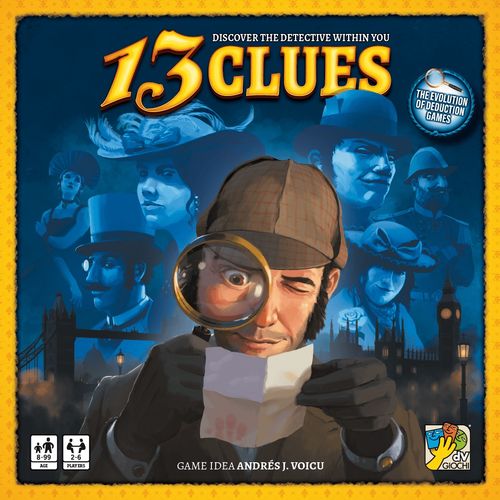
13 Clues
13 Clues Rulebook
Table of Contents
Table of Contents
Contents
- 30 Clue cards, distributed as follows:
- 10 Suspects (Man / Woman)
- 10 Locations (Indoor / Outdoor)
- 10 Weapons (Melee / Ranged)
- 6 pencils
- 8 Letter tiles (A to H)
- 6 screens with 5 transparent card-holders each (2 on the inside, 3 on the outside)
- 1 resolution notepad
- 8 Magnifying Glass tiles
- 6 Top Secret tiles (used only with the variant)
The number of Clue cards to remove and set back in the box, the number of Secret Informant cards (all cards of the indicated colors) and Letter tiles to use, depends on player count (see later in the rules):
| Number of players | Number of cards used | Number of cards to remove | Colors removed | Letter tiles used |
|---|---|---|---|---|
| 2 | 18 | 12 | gray, brown, white, orange | 8 (A–H) |
| 3 | 21 | 9 | gray, brown, white | 6 (A–F) |
| 4 | 24 | 6 | gray, brown | 4 (A–D) |
| 5 | 27 | 3 | gray | 2 (A–B) |
| 6 | 30 | 0 | none | 0 |
Objective
Be the first player to solve your case by identifying the culprit, the location, and the weapon of the crime.
Setup
Before your first game, carefully punch out the pieces from their frames.
Note: the rules below are for a game with 3 or more players. Special rules for a 2-player game are found at the end of the booklet. We recommend playing your first games with fewer than 6 players.
Each player takes 1 screen, 1 Magnifying Glass tile, 1 pencil, and one sheet from the resolution notepad. Place the remaining Magnifying Glass tiles in a reserve at the center of the table, then return any unused screens and pencils to the box.
Each player sets their screen in front of them so that the "13" points toward the center of the table. Players keep their resolution sheet behind their screen so other players cannot see it. The Magnifying Glass tile is placed in front of each player's screen — the number of Magnifying Glass tiles a player holds is always known to everyone.
Take the Clue cards. Depending on the number of players, remove all cards of one or more colors, following the table above.
Separate the cards in play into three piles: Suspects, Locations, and Weapons. Shuffle each pile separately, then deal one card from each pile to each player, face down. Then shuffle the rest of the cards together and deal 2 to each player, face down. Each player now has a total of 5 cards: one from each pile plus two random ones.
The remaining cards are placed face down in a row in the middle of the table: these form the "Secret Informant" cards. Assign a Letter tile to each of these cards, starting with A, as shown in the table above. Unused tiles go back in the box.
Each player looks at the 5 cards they received, then chooses 1 Suspect card, 1 Location card, and 1 Weapon card, which they place in front of themselves, face down.
Tip: it is possible to choose any combination, but it is advisable not to choose three cards of the same color.
Carefully slide the 2 remaining cards into the card-holders on the inside of the screen so they are not visible to other players. The cards slide in very easily — there's no need to pull on the card-holders.
Once all players have selected their cards, each player takes the three cards they chose earlier and places them on the outside of the screen belonging to the player on their left. Be careful that this player does not see the cards inserted into their own screen! Screens must be arranged so that everyone can see the 3 cards belonging to others, but not their own.
Note: each player now has 3 cards they cannot see, placed on the outside of their screen: 1 Suspect, 1 Location, and 1 Weapon. Their goal is to identify these 3 cards.
How the Game Unfolds
The first player is chosen at random, then play continues clockwise.
At the start of their turn, if a player has no Magnifying Glass tile, they take one from the reserve. If the reserve is empty, they take a Magnifying Glass tile from a player of their choice.
Next, the player must "spend" all of their Magnifying Glass tiles. Each one allows them to carry out one of the 3 actions described below. These actions can be carried out in any order, and the same action may be repeated several times (except for the Make an Accusation action, see below). Once a player has spent all their Magnifying Glass tiles, their turn ends and play passes to the next player.
Tip: the resolution sheet is used to remember the clues gathered as the game progresses. The screen keeps your information confidential.
The Actions
1. Question a Witness
Give a Magnifying Glass tile to the player of your choice, then ask them how many cards they see of a given color or category:
- The number of colors in play depends on the number of players (see "Setup").
- There are always 6 categories: Man or Woman (Suspects), Indoor or Outdoor (Locations), and Melee or Ranged (Weapons).
When a player questions a witness, they may ask only one of these questions. If they perform the action several times, they may question the same player multiple times or ask the same question of different players.
Examples of valid questions: "How many red cards do you see?" (color), "How many indoor Locations do you see?" (category).
Examples of questions that are not allowed: "How many cards with earrings do you see?", "How many weapons with a barrel do you see?", "How many chairs do you see?", "How many Suspects do you see?"
The questioned player must answer sincerely and exactly (bluffing is not allowed), based on everything they see: all the cards on the front of the other players' screens, as well as the 2 cards behind their own screen (important!).
2. Consult the "Secret Informant" Cards
Give a Magnifying Glass tile to the player who has none (if several players have no Magnifying Glass tile, give the tile to the eligible player closest clockwise; if all players have a Magnifying Glass tile, discard it to the reserve). Then choose one of the cards lined up in the center of the table, look at it secretly, and put it back in its place, face down.
Note: with 6 players, this action is not possible.
3. Make an Accusation
Give a Magnifying Glass tile to the player who has none (if several players have no Magnifying Glass tile, give the tile to the eligible player closest clockwise). If all players have a Magnifying Glass tile, discard it to the reserve. Then attempt to solve your case. Name 1 Suspect, 1 Location, and 1 Weapon. For example: "It was the Butcher, in the Park, with the Sword." A player is not allowed to make an accusation naming cards that they can see (whether behind their own screen or in front of another player's screen).
The other players compare the stated accusation to the three cards placed in front of the accusing player's screen.
- If the accusation is correct, the case is solved and that player wins the game!
- If the accusation is wrong, the other players inform the accuser. Their turn ends and any Magnifying Glass tiles they have left are placed in the general reserve.
Important: when a player's accusation is wrong, the others simply tell them they are wrong, without making any comment that could give them a clue.
Example: it's Marie's turn, she has 2 Magnifying Glass tiles and thinks she has found the 3 cards of her case. She spends her first Magnifying Glass and declares: "I'm making an accusation, it was the Officer, at the Market with the Revolver." The other players look at the cards on Marie's screen and tell her she is wrong. Marie's turn ends. She discards her 2 remaining Magnifying Glass tiles.
Later, on another turn, Marie spends a Magnifying Glass tile to attempt a new accusation: "So it must be the Officer, at the Market with the Rifle." The other players check and confirm she is right. Marie wins the game!
Additional Rule for 2 Players
- Magnifying Glass tiles are not used. Each player simply performs one action per turn.
- When a player asks their opponent how many cards they see, they must also specify: "including the card on your left inside your screen" or "including the card on your right inside your screen." In their answer, the questioned player must therefore take into account the left or right card inside their own screen, in addition to the cards they see on their opponent's screen.
Example: "How many Women do you see, including the card on the left behind your screen?"
Variant for 3 to 6 Experienced Players
Once players are familiar with the game, the following variant can be used: during setup, each player receives a Top Secret tile (unused tiles are returned to the box). Each player keeps their tile in front of their screen.
When a player questions a witness, they may use their Top Secret tile (and return it to the box) in addition to their Magnifying Glass tile so that the questioned player answers secretly. After asking their question out loud, the questioned player writes their answer on a piece of paper and passes it to the questioning player so that no one else knows the answer.
Tips to Get Started
If you eliminate all the cards removed during setup, in addition to the ones you can see, 13 possibilities remain. The solution to your case is among these 13 clues.
If a player answers "Zero" to a question, you can eliminate all the cards concerned by that question (no matter who asked it), since you know those cards cannot be on your screen.
A player who receives an extra Magnifying Glass tile theoretically gains no extra information, but they will benefit from more actions on their turn: think twice before giving too many Magnifying Glasses to an opponent.
Be careful when making an accusation, since every wrong accusation gives clues to the others.