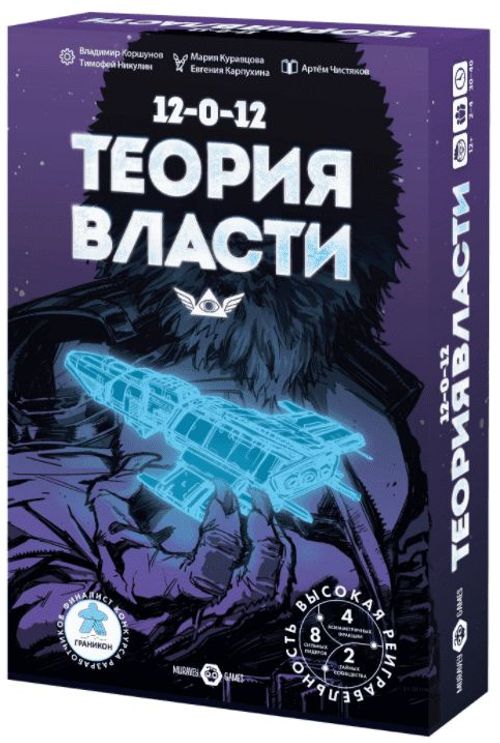
12-0-12: Теория Власти (Theory of Power)
12-0-12: Теория Власти (Theory of Power) Rulebook
Table of Contents
Table of Contents
Components
- 60 Animal cards (4 factions):
- 15 Herbivorous Mammal cards
- 15 Reptile cards
- 15 Bird cards
- 15 Carnivorous Mammal cards
- 8 Leader cards
- 40 Food tokens
- 20 Influence tokens
- 20 Compromat tokens (marked with the Compromat icon and the -1 VP symbol)
- 4 Player boards
- Rulebook
Objective
The winner is the first player to gain 8 victory points (VP).
Players earn VP for their supporters: 1 supporter = 1 VP.
If you are playing with Leader cards (see "Leaders"), you must also fulfil the victory condition printed on your Leader card in order to win.
Setup
Training variant: To make it easier to learn the basics:
- In setup step 5, deal each player 5 Food tokens instead of 3.
- Skip setup step 7 (play without Leader cards).
- Do not count the animals' membership in secret communities (see "Secret Communities").
Otherwise, the game follows the normal rules. The purple boxes throughout these rules give hints on how the game can be simplified.
-
Shuffle the Animal cards and place them face down in a pile in the centre of the table. This is the Animal deck. When a player needs to take a card, they take it from the Animal deck.
-
Place all the resource tokens next to the Animal deck. This is the resource supply (хранилище ресурсов).
-
Choose the first player. The first player is the player who last looked at the stars.
-
Deal each player a player board. The boards have zones where players must place their Food and Influence. These zones are each player's reserve (запас). A separate zone is marked where Compromat should be placed. The boards also contain basic information that players may need during the game.
-
Deal each player 3 Food tokens. Players place them in their reserve. In the training variant, deal each player 5 Food tokens instead of 3.
-
Deal Animal cards face down to each player in clockwise order: the first player receives 5 cards, the second 6, the third 7, and the fourth 8. Players look at their cards and then, in clockwise order starting with the first player, discard any of them of their choice so that each player has 5 cards in hand. The first player does not discard.
During the game, players do not show their cards in hand to other players. The number of cards in a player's hand is not limited.
Players always discard cards to a discard pile (сброс, "discard") next to the Animal deck. The player always decides for themselves which cards to discard and which to keep in hand.
If the Animal deck runs out of cards, shuffle the discard pile and place the cards face down in the centre of the table. This is the new Animal deck.
Resources
- Food. On an isolated ship, food is a valuable resource. For food, animals will gladly become your supporters.
- Influence. With Influence on the ship, you can get much more than with Food. For Influence, animals are ready to leave another player and become your supporters.
- Compromat. The more you are involved in attracting supporters, the more likely others are to collect negative information about you: Compromat. It will complicate your path to power.
If during the game the supply runs out of tokens of some resource, use any suitable substitute.
Example Game Layout
Captions from the example illustration in the rulebook: player 2's board, player 2's Compromat, player 2's reserve, player 2's Leader, player 2's supporters, and resources on player 2's supporters; the resource supply; the Animal deck; the discard pile; player 1's supporters (with a community symbol collected) and Leader; player 1's reserve; and player 1's board.
Golden Rule
If the text on a card contradicts the text of the rules, follow what the card says. If it is possible to do what the card says and what the rules say at the same time, do both.
Turn Structure
Gaining control of the ship is not easy. A skilled manager knows how to combine generosity with planning. For some supporters, however, they are merely consumables.
Players take turns clockwise, starting with the first player. On their turn, a player performs 1 of 4 actions, after which they immediately pass the turn to the next player.
The game ends when one of the players has fulfilled the victory conditions.
All actions consist of parts performed in sequence. Perform all parts in order.
You must perform all parts unless the text says that a part may be skipped.
If, while performing an action, a supporter's ability (see "Supporter Abilities") is triggered, the player may apply it before passing the turn.
Available Actions
Available player action options:
On their turn, a player chooses one of the following four actions.
Get Food
- Discard any number of cards from your hand to the discard pile.
- Take 1 Food token from the supply into your reserve for each discarded card. If you discarded 2 cards of one faction (see "Factions"), take 3 Food tokens for them instead of 2.
Example: By discarding 1 card of one faction and 2 cards of another faction, the player gets 4 Food: 1 for the card of the first faction and 3 for the 2 cards of the second faction.
Attract Supporter
- Choose an Animal card in your hand and place it in front of you, face up.
- Pay into the supply from your reserve Food and/or Influence tokens. Their number must equal the appetite of the Animal you placed. To pay for the attraction, you may use tokens of only one type, or any combination of Food and Influence tokens.
- The placed Animal becomes your supporter. Each supporter in front of you is worth 1 VP, unless its card says otherwise.
For cards of the Birds faction, special rules apply in addition to the ordinary attraction rules (see "Birds" in the section "Factions").
For all Animals with the Predator property, there are also special attraction rules (see "Predators" in the section "Card Properties").
Poach Supporter
- Choose a supporter of another player (an Animal card lying in front of that player).
- Pay into the supply from your reserve Influence tokens. Their number must equal the sum of the appetite of the chosen Animal and the number of any tokens (Food and Influence) lying on it.
- Take the chosen Animal from the other player (that player loses the supporter) and place it in front of yourself. It becomes your supporter. Any Food and Influence tokens lying on the card of the supporter you took (if any) are placed in your reserve.
A supporter can be poached only with Influence. It has already received the Food it needed when it became another player's supporter.
Seek Contacts
- Draw Animal cards from the Animal deck into your hand until you have 5 cards. If you already have 5 cards or more in hand, skip this part.
- Abilities of supporters marked with the magnifying-glass icon trigger (see "Supporter Abilities"). If there are none, skip this part.
- Take 1 Compromat token from the supply and place it on your board. Each Compromat token counts as minus one (-1) VP. If you already have 5 Compromat tokens, skip this part.
A player cannot have more than 5 Compromat tokens.
Players take turns, each performing one action, clockwise until one player fulfils the victory conditions (see "Victory Conditions"). When the victory conditions are fulfilled, the game ends immediately, and the player who fulfilled them is the winner.
Victory Conditions
The game is won by the player who first fulfils 2 victory conditions:
- Gathers 8 VP or more (taking into account minuses from Compromat).
- Gathers supporters that match the victory condition printed on their Leader card. If you are playing without Leaders, the player must fulfil only the first condition to win.
Rules for counting VP:
- Each supporter placed in front of a player is worth 1 VP, unless its card says otherwise.
- Each Compromat token on a player's board is worth minus 1 VP.
- If a player has collected 3 or more symbols of the secret community "Rulers" (Властители), they receive an additional 2 VP.
Victory conditions must be fulfilled simultaneously. A player cannot win if they gather the required VP but their supporters do not match the condition on their Leader card, and vice versa.
Victory conditions may be fulfilled at any moment in the game, even during another player's turn.
Animal and Leader Cards
There are two types of cards in the game: Animal cards and Leader cards.
Animal Cards
The ship is full of inhabitants, each performing their own task. By skilfully using their abilities and properties, you can achieve a great deal.
The Animal card diagram in the rulebook labels: Name, Appetite, Faction, Properties, Community, Ability, and Number of cards in the deck.
Leader Cards
Some passengers have always shown more appetite for power than others. It no longer matters which place on the ship the animals occupied before. Appearances are deceiving: a "simple rabbit" may turn out to be a calculating and cold-blooded manipulator.
The Leader card diagram in the rulebook labels: Name, Community, Victory condition, Ability, and icons marked "suitable for interactions" and "easy to learn". The example Leader shown is the Viper (Гадюка): its victory condition reads "At least 3 supporters with appetite 1", and its ability reads "During setup, take 1 additional Influence."
Animal-Leaders are player characters. Each Leader has an ability that helps its player. The Leader card also defines an additional condition that must be fulfilled to win (in addition to gathering 8 VP).
A Leader card does not bring VP.
A Leader cannot be poached or discarded: the card stays with its player until the end of the game.
Further in the rules you will find sections describing factions (p. 11), properties (p. 12), abilities (p. 14), and communities of animals (p. 15).
Factions
It has long been known that animals of different kinds are suited to different work. During the preparation for the flight, suitable tasks were determined for each kind of animal. The division by kind has grown into factions, each of which controls its own part of the work on the ship.
The ship's inhabitants are divided into several factions. A faction is shown by a special symbol in the upper right corner of an Animal card. It determines the direction in which the animals can help the players.
-
Herbivorous Mammals. They answer on the ship for supplies and service. They help get Food and attract new supporters.
-
Carnivorous Mammals. The most bloodthirsty inhabitants of the ship, as they were prepared for hunting and battle.
They can be fed to your other supporters, which they appreciate (see "Predators" in the section "Card Properties").
-
Reptiles. Enterprising and cunning scholars from the terrarium compartment. They will increase your Influence and help you poach other players' supporters.
-
Birds. Administrators who know how to get practical benefit out of nothing. They can take resources from your other supporters on their own.
When you attract a supporter of the Birds faction (see "Attract Supporter"), you may use Food and Influence tokens from your supporter cards to pay for the attraction. The tokens are paid into the supply. This rule works in addition to the ordinary attraction rule: you may combine resources to pay for attracting a Birds supporter, taking some from your reserve and some from your supporters.
Animal Properties
Animals may have useful properties that trigger when a player attracts them (see "Attract Supporter"). They are shown by icons in the upper right corner of the card.
Predators
Cruelty is the soil for the strength and respect of some animals. Using the chaos, they are not afraid to cross the line and will be glad of any chance to get "normal" food.
If an Animal card has the predator icon, it is called a predator. This property is possessed by all Animals of the Carnivorous Mammals faction (icon shown with the faction), as well as by some Animals of other factions (Eagle, Crocodile, and others). A predator can be an Animal of any faction.
Animals with the predator property can be attracted normally (see "Attract Supporter"), and you may also use their property to feed one of your supporters to them:
- Choose one of your supporters whose appetite is less than or equal to the appetite of the predator you are attracting.
- Discard the chosen supporter. If there were resources on it, return them to your reserve.
- Pay into the supply from your reserve as many resources (Food and/or Influence) as the appetite of the predator you are attracting exceeds the appetite of the supporter you fed to it.
- Place the predator in front of yourself. It becomes your supporter.
If the appetites of the predator and the eaten supporter are equal, you do not need to pay anything extra.
Example: To attract a Bear with appetite 2, the player decides to feed it a Gecko with appetite 1, on which lie 2 resources (1 Food and 1 Influence). The player discards the Gecko and takes 1 Food and 1 Influence into their reserve. Then they pay 1 Food into the supply, because the Bear's appetite is 1 more than the Gecko's. The Bear then becomes their supporter.
Suppliers
Working with resources is good, because you can always find additional food or improve living conditions. Having a reliable resource supplier as a supporter is always advantageous.
If an Animal card has the supplier icon, it is called a supplier.
When you attract a supporter with the Supplier property, take 1 Food token from the supply and place it on any other of your supporters. This is called feeding the supporter.
Each token of any type on a supporter increases the cost of poaching that supporter by 1.
If a supporter with tokens goes to the discard pile, all the tokens lying on it are sent to the owner's reserve.
A Supplier cannot feed itself.
Feeding supporters can also be done while using abilities (see "Supporter Abilities"). In that case the Animal may feed itself.
Supporter Abilities
Survival is easier if you can do something others cannot. Wishing to get closer to power, the animals are ready to use all their skills so that they draw attention.
Your supporters help you win with various useful abilities. An ability triggers at different moments of the game, depending on the icon shown before the ability's description:
- Arrow into the box (becomes a supporter): The Animal's ability triggers when it becomes your supporter, whether you attracted it from your hand or poached it from another player. It triggers immediately after the card is placed in front of the player.
- Arrow out of the box (stops being a supporter): The Animal's ability triggers when it stops being your supporter (you lose it). It does not matter why you lost the supporter (it was poached, you fed it to a predator, etc.). It triggers at the moment the card stops lying in front of you.
- Plus sign with a circle (fed): The supporter's ability triggers when it is fed (any resource is placed on it).
- Magnifying glass (Seek Contacts): The supporter's ability triggers when the player performs the "Seek Contacts" action.
- Binoculars (condition): The supporter's ability triggers when the condition described on the card occurs.
The player decides for themselves whether to use a supporter's ability, except for abilities whose text contains the word "mandatory" (обязательно). If a player uses an ability, they must carry out its description in full.
If several of a player's supporter abilities must trigger at the same time, the player decides the order in which they are resolved.
Triggering abilities sometimes affect the abilities of other supporters of the same player. If this happens, first all the affected abilities are resolved, and then the rest.
Example: The player has supporters Jackal, Owl, Hyena, and Monitor (Varan). The player loses the Jackal, and the abilities of the Owl and the Hyena trigger simultaneously. The player chooses to use the Owl's ability first, to feed the Monitor. After that, the player first uses the Monitor's ability, and only then the Hyena's ability.
Secret Communities
Animals are united not only by factions. The emergence of new alliances was only a matter of time. Mutual benefit is a reason to work together. The main thing is that this is not known too widely, otherwise everyone will want a "piece of the pie."
In the training variant, do not count the animals' membership in communities and do not collect their symbols.
Some animals belong to one of the secret communities.
If a player collects one or more community symbols, they immediately gain additional capabilities. These can be used at will at any moment, for as long as the symbols are collected.
Symbols are assembled from two cards. Place the cards side by side so that their sides form a complete symbol. The player must assemble a community symbol if they have the needed supporters.
Example: Two community symbols "Free" are assembled from three cards.
If a player loses the required number of assembled symbols (for example, a supporter with half of a symbol is poached), they also lose the additional capabilities.
Free (Свободные)
"The more acquaintances, the more opportunities." Their strength is in numbers; status is of no particular importance, since freedom and opportunity for everyone is their main goal. Support from this community will give greater scope for choice and action.
Free community bonuses:
- 1 symbol and more: when performing the "Get Food" action, for the discarded cards you may take 1 card from the deck into your hand instead of 1 Food token for each discarded card.
- 2 symbols: immediately after you assemble the second symbol of this community, take 3 cards from the deck into your hand. Take this bonus each time you assemble every second symbol.
- 3 symbols and more: on your turn you may perform 2 actions instead of 1.
Rulers (Властители)
"Status governs." Each of them knows it. Accumulating Influence and strengthening their status matter most to them. Support from this community will strengthen their position and speed up the seizure of power.
Rulers community bonuses:
- 1 symbol and more: when performing the "Get Food" action, you may take 1 Influence from the supply for 2 discarded cards of one faction (instead of 3 Food under the usual rules).
- 2 symbols: immediately after you assemble the second symbol of this community, take 2 Influence from the supply into your reserve. Take this bonus each time you assemble every second symbol.
- 3 symbols and more: immediately gain an additional 2 VP.
When performing the "Get Food" action, the player chooses which community's property to use when discarding 2 cards of one faction. The same pair of discarded cards of one faction cannot use the properties of different communities at the same time.
Example: The player has collected 3 symbols of the "Free" community and 1 symbol of the "Rulers" community. On their turn they decide to perform "Get Food". They discard:
- 2 cards of the Herbivorous Mammals faction. By the "Free" community property they take 1 Food and 2 cards from the deck.
- 2 cards of the Birds faction. By the "Rulers" community property they take 1 Influence.
- 1 card of the Reptiles faction. For this card they take 1 Food (community properties do not activate).
After this the player may perform a second action, since they have 3 "Free" symbols.
Additional Rules and Options
Rules for the first games with Leaders and for novice players, plus variants that change how much the players interact.
Leaders for First Games and Novice Players
The abilities of some Leaders are easier to learn than others. In the first games with Leaders you may use only the Rabbit, the Viper, the Sparrow and the Tiger. These Leaders carry the book icon. Deal them at random (ignore the usual rule for dealing Leaders).
You may also deal these Leaders to novices when the players have different experience. This makes it easier for novices to play against experienced players and to learn the basics of the game.
Rabbit (Кролик): victory condition "At least 4 Herbivorous Mammal supporters". Setup ability: take 2 additional Food.
Interaction Between Players
Leader abilities affect how much the players interact with each other. You can increase or decrease the interaction by removing some of the Leaders from the game.
After removing some Leaders, deal the remaining ones at random (ignore the usual rule for dealing Leaders).
If you want more interaction, take these Leaders for the game: Goat, Viper, Alligator, Raven. They carry the sword icon.
Goat (Козёл): victory condition "At least 3 supporters with appetite 4 or more". Ability (Seek Contacts): take 1 Food from the supply of any other player.
Conversely, take the Rabbit, Sparrow, Mongoose or Tiger if you want to reduce the interaction between players.
Game Without Compromat
If you want a faster game, do not use the Compromat tokens. Ignore card properties or rules that say to take or discard Compromat.
Frequently Asked Questions
Can I perform the "Seek Contacts" action when I already have 5 or more cards in hand, in order to use my supporters' abilities?
Yes. Compromat must be taken as well.
Can I play Animal cards when a card of the same Animal is already one of my supporters?
Yes. There is no restriction on identical supporters.
Can I discard my own supporter in order to use its ability once it is no longer your supporter?
No. A player cannot discard a supporter on their own. A supporter can be lost only by being poached, or when an ability or property of another Animal triggers on it (a "Predator" property, the Turtle's ability, etc.).
Do the abilities of different supporters combine with each other?
Yes. For example, a player has an Owl and a Hippo. When they lose a supporter, they feed another supporter 4 Food: twice by the Owl's ability, and 1+1 by the Hippo's ability.
Do the abilities, properties and special faction rules of a supporter combine with each other?
Yes. For example, you can attract an Eagle by eating your own supporter and paying the missing appetite with resources lying on other supporters.
Lynx, Eagle: do the cards themselves take part in their abilities that target their own faction?
Yes, they do. For example, the Eagle feeds itself if the player chooses the Birds faction for feeding. For the Lynx, the player draws an additional card, because the Lynx belongs to the Carnivorous Mammals faction.
Owl, Hyena: if a player loses a supporter with an ability that triggers when a supporter is lost, does that ability trigger?
No. The player first loses the card (it stops being a supporter), and only then the supporters' abilities are applied. For example, if the player loses the Owl, they do not feed another supporter by the Owl's ability.
Boar: does the Boar's ability trigger if a player who already has 5 Compromat tokens loses it?
The ability triggers, but the player does not take Compromat, because a player cannot have more than 5 Compromat tokens.
Penguin: if there are 3 or more resources on the Penguin, must its ability be activated immediately, or can it wait until the next turn?
The Penguin's ability must be activated immediately, right after it is fed and there are 3 or more resources on it as a result.
If the Penguin is fed and has 6 or more resources on it, can I attract two supporters with appetite 3?
No. The ability allows you to attract only one supporter after the Penguin is fed. To attract a second supporter, the Penguin must be fed again.
Camel: if the Camel is attracted as the player's first supporter, does it feed itself?
No, it does not feed itself, because Suppliers cannot feed themselves.
Gecko: if the Gecko is attracted as the player's first supporter, does the player take a card?
No, the player does not take a card. To receive a card for attracting a supporter, the Gecko must already be a supporter of the player when the player attracts a new Reptiles supporter.
Hippo: if the Elephant is attracted, does the Hippo's feeding ability work? If so, how much Food must be placed on the Elephant?
Yes, it works. When the Elephant becomes a supporter of the player, it must be fed 4 Food once. The Hippo's ability requires placing 1 more Food on the Elephant, since the player feeds the Elephant once. In total the Elephant receives 4+1=5 Food if it becomes a supporter of a player who has a Hippo.
Chameleon: can I attract the Chameleon as a Birds supporter, using resources lying on other supporters?
Yes, you can, because using resources from supporter cards is a special property of the Birds faction.
Chameleon: can I attract the Chameleon as a Carnivorous Mammals supporter by feeding one of my supporters to it?
No, you cannot, because the ability to eat a supporter is given by the "Predator" property of a card, not by the faction.
How is the faction of the Chameleon determined?
The faction of the Chameleon is determined when it is needed to check whether some abilities trigger.
The player whose supporter the Chameleon has become, or already is, determines its faction. If it has not yet become a supporter of a player, the faction is determined by the player who revealed the card (from the deck or the discard pile) or who has it in hand.
If several different abilities require the faction of the Chameleon to be determined at the same time, the faction is determined once for all of those abilities.
For example, a player attracts a Chameleon from their hand and states that it belongs to the Birds faction, to receive the bonus of the Peacock card. They cannot receive the attraction bonus of the Gecko as well, because they can choose only one faction. If another player later wants to poach the Chameleon, they cannot use the ability of their Rhino, because the player whose supporter the Chameleon is now states that it belongs to the Reptiles faction this time.
Turtle: what happens to the resources lying on cards that were involved in an exchange?
They stay on the cards and change owners together with the supporter.
Turtle: in what order do the players use the abilities of received supporters if they trigger after an exchange (for example, Iguana, Woodpecker, etc.)?
The ability of the received supporter is used first by the player who started the exchange. Then the ability of the received supporter is used by the other player.
After this, the player who started the exchange continues the turn as usual (using supporters' abilities if they triggered after the supporter was received, etc.).
Exception: the player who started the exchange uses the ability of the received supporter to take back the card exchanged. In that case the other player may use the ability of the received card before giving it back.
For example, a player received a Crocodile and wants to take back the Iguana they gave in exchange, using the Crocodile's ability. The other player may use the Iguana's ability before giving it back.