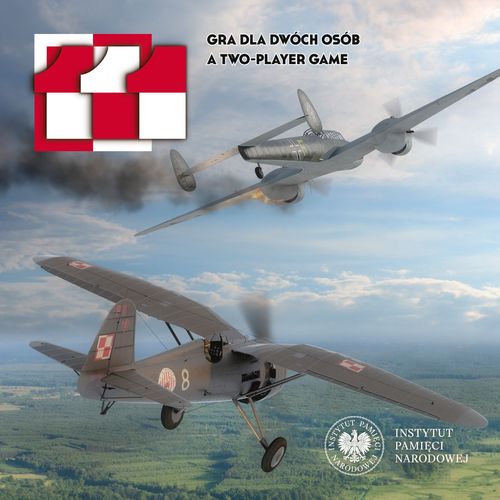
111: Alarm dla Warszawy
111: Alarm dla Warszawy Rulebook
Table of Contents
Table of Contents
Elements of the Game
- Playing board
- Tokens:
- 4 Polish fighters
- 1 Polish anti-aircraft artillery token
- 3 Luftwaffe fighters
- 2 Luftwaffe bombers
- 4 cloud tokens
- 3 camouflage tokens
- 3 shoot dice, the sides of which respectively stand for: 3 × Polish Air Force, 3 × Luftwaffe
- 10 shot markers
- Fuel consumption indicator with fastener
Preparing to Play the Game
- Place the board in the middle of the table.
- Choose who will be playing each side. The Polish player sits on the southern side of the map, the German player on its northern side.
- Assemble the planes according to the contours marked on the board.
- Place the Anti-aircraft Artillery token on the "Warszawa" (Warsaw) field.
- Place the fuel consumption indicator on mark "1" of the fuel gauge.
- Put shooting markers, camouflage tokens and the dice beside the board so that the players have easy access to them.
- Then, take two cloud tokens and place each of them alternately on the board, starting with the Polish player. You can place the cloud tokens anywhere on the board (marked on the setup diagram with blue tint), except other clouds, the airfields, and the anti-aircraft artillery defensive zone marked around Warsaw. Playing the rematch second round with the cloud setting identical to that in the first round is recommended.
The Aim of the Game
The aim of the game is different for each player. Luftwaffe's aim is to bomb Warsaw. To succeed, the German bomber must reach the field representing Warsaw. The Polish Air Force's aim is to prevent the raid by shooting down the bomber or delaying their flight towards Warsaw during 8 rounds of the game.
Game Parts
The game is divided into two parts, each consisting of eight rounds. Every round is marked off by means of the fuel consumption indicator on the fuel gauge in the corner of the board. Every round consists of six phases. Before the first air duel takes place, only phases 1, 3, 4, 6 are played.
- Luftwaffe fighters' move
- Luftwaffe fighters' and bombers' shots
- Bombers' move
- Polish fighters' move
- Polish fighters' and artillery shots
- Shifting the fuel gauge
The End of the Part
"111" has three possible endings:
a) Luftwaffe wins if the bomber pilot succeeds in bombing Warsaw, i.e. putting the bomber token on the field representing Warsaw. b) Poles win if the pilots manage to shoot down both bombers. c) Poles also win if, for eight rounds, its pilots manage to keep the bombers from reaching Warsaw.
Please note: at the end of the part, players must make a note of which round play ended at, and how many Polish planes remained on the game board. This can be done by placing two shooting markers on the black and white edge of the board on the numbers (6, 7, 8 and 1, 2, 3, 4, respectively). This information may be essential to establishing the winner of the entire game.
The End of the Game
After having played two parts, the winner of the game is determined in the following way:
a) If both parts were won by the Germans, the winner is the Polish player who did not let any German bomber reach Warsaw for the longest period of time. b) If both parts were won by the Poles, the winner is the Polish player who ended the game first. c) If one part was won once by the Poles and once by the Germans, the winner is the player who was victorious in both cases.
Example: Andrzej commanded Poles in first part and was defeated by Łukasz in 7th round. In second round, playing Luftwaffe, Andrzej won in 6th round. It means Andrzej wins the entire game, because, playing Poles, he lost in a later phase than Łukasz.
Please note: in the event of a draw in the number of rounds (e.g. the Poles lost twice in the 7th round) the winner is decided by the difference in the number of planes (not necessarily damaged) with which the Poles ended the last round. If this does not indicate the winner, a draw will be declared.
Fuel Gauge
Fuel consumption is marked off at the every round on the fuel gauge placed in the corner of the board. At the end of the round, the Polish player moves the fuel consumption indicator to the next mark. The gauge has double meaning. It may contribute to the Polish side winning the round "in time" and can decide on draws after both parts have been played.
Fighters
In '111', the visibly lower speed and weak firepower of the Polish PZL P.11/7 aircraft in comparison to the German fighters was taken into account. The assets which gave the Polish pilots advantages during aerial duels were their excellent training, the will to fight, and the maneuverability of the P.11s.
The move phase
During a single round German fighter may, but is not required to, move one, two, or three fields in any direction. The Polish fighter may, but is not required to, move one or two fields. Aircraft cannot fly over or stop on a field already occupied by another aircraft token. During the move phase, an unlimited number of aircraft can fly through an empty field.
The players decide on the order of moving the fighters, but they must remember that once all the aircraft have been moved and the shoot phase begins the tokens must remain in place.
Please note: According to the order from the General Headquarters forbidding flying over Warsaw, the Polish fighters are not allowed to enter the field with the anti-aircraft artillery. This field is considered by the Polish side as occupied.
The shot phase
During one round, one fighter may attack only one enemy aircraft. Conducting an attack on an enemy plane with two or more machines is allowed. The effectiveness of the attack is determined by a roll of the shoot dice. The farther the plane flies, the less time for shooting it has. This means that a German fighter which has flown over three fields is not allowed to shoot any more. If it has moved over two fields it can shoot with one die. After moving one field it can shoot with two dice. If it did not have to move at all because an opponent's token was on the neighboring field, it can make rolls with all three dice (see the table). Similarly, a Polish fighter is not allowed to shoot any more after having moved two fields, and after having moved one, it is allowed to shoot with one die. If it did not make a move as the opponent's token was located on the neighboring field, it may shoot with two dice.
| Fighter | Fields moved | Dice rolled |
|---|---|---|
| Luftwaffe | 0 | 3 |
| Luftwaffe | 1 | 2 |
| Luftwaffe | 2 | 1 |
| Luftwaffe | 3 | none |
| Polish | 0 | 2 |
| Polish | 1 | 1 |
| Polish | 2 | none |
Determining the outcome of a shot
Dice are thrown to determine the outcome of a shot. When you throw the symbol of your own air force on a die – the cross in the case of the Luftwaffe, or the chessboard in the case of Poles – you have a hit. The token of the fighter which has been hit should then be turned to the "damaged" side. Two hits mean that the plane has been shot down and is removed from the game. Extra shots do not count.
(Each die shows hit, damage or miss; only your own air force's symbol is a hit.)
As the dice are being rolled, and only after all the fighters have made their moves, remembering who is to shoot at whom and at what strength is sometimes difficult. Thus, 10 shooting markers are attached to the game to make it easier. During the move stage, you can place a shooting marker on the attacking plane, so you will know how many dice you have to roll during the "shot phase". Take the shooting markers off the attacking planes after deciding upon the successive shots in the sequence chosen. Using the shooting markers is not obligatory but it makes performing complex attacks much easier.
The end of the duel
Although this element of the game may create certain difficulties at the beginning, it clearly shows the specific features of fighting in the air and the differences in maneuverability between the German and Polish aircraft.
A German fighter misses the target and – irrespective of the outcome of the encounter it has to fly to the field located on its exact opposite side.
When there is another plane (diagram 1) or the edge of the board on the other side of the target, you must choose one of the two fields bordering both the target and the field on the opposite side of the target (field 2 or 3). If these fields are occupied, you must choose one of the two fields bordering both the target and the place where the shooting started (field 4 or 5). If all five fields bordering the target are occupied, the plane remains motionless after shooting (i.e. stays on the field 6).
Regardless of the outcome, a Polish fighter may choose any of the free fields bordering the target, apart from the field it started shooting from (fields 1, 2, 4 or 5). The plane remains motionless after shooting (i.e. stays on the field 6) only when all the five fields bordering the target are occupied. Field "Warsaw" (3) is considered by Polish planes as occupied.
If more than one plane declares shooting at the same target and the plane has been shot down after the first attack, the mandatory flight to the other side of the attacked target is performed by all the planes that cannot change the aim of attack.
Bombers
Bombers' shots
The bomber shoots by rolling only one shoot die, and, unlike the fighter, does not fly to the other side of the adversary after firing. The bomber shoots during the same phase as fighters, but it makes its move only after all the outcomes of all the shots have been determined, i.e. in the next phase.
The bombers' move
The bomber's move is the Luftwaffe player's last action in the round. It may move at the rate of one or two fields per round.
Shooting down the bomber
Since the bomber is a heavily armoured aircraft, to be shot down it must be hit at least twice in one round. It may be hit by more than one aircraft. If the bomber is only hit once during a round, nothing happens. If it is hit twice during a round, the part automatically ends. Hits from previous rounds do not count in subsequent rounds.
Damage and Repairs
When a fighter is hit during the battle, the plane token has to be turned to the side with smoke. The damaged fighter is not fit for fighting and cannot attack other planes. However, it can fly at its normal speed. The Polish side can repair its planes.
In order to repair a plane, a move has to end on one of the airfields. The damaged plane has to be covered with a camouflage token. This kind of place cannot be attacked by an enemy's aircraft. A field with a camouflage token is considered as occupied.
At the beginning of the Polish player's next move, the camouflage token has to be taken off and placed beside the board. The repaired plane has to be turned into the "undamaged" side and is ready to continue fighting at once. Only one plane at a time is allowed in the airfield.
Clouds
If a plane ends its move in a cloud it can neither attack nor be attacked. In order to be able to attack an enemy plane in the next round, it has to leave the cloud first and only then can it shoot. A plane can fly through a cloud without losing speed and enter the cloud when flying over after a shot (the end of the duel).
The Anti-Aircraft Artillery
In his round, the Polish player may declare a shot from the anti-aircraft artillery at a selected enemy aircraft which is located on the fields within artillery range marked on the board. A shot from a distance of one field from Warsaw (1) is determined by the roll of one die, onto the field bordering Warsaw (2) by the roll of two dice, and on a Warsaw field (3) the shot is made with three dice (this only applies to fighters, since a bomber token on the Warsaw field automatically ends the part).
An artillery shot is decided by the same principles as the plane shots.
Please note: When attacking a bomber, hits of the anti-aircraft artillery can be combined with hits made in the same round by fighters.
Sample Round of the Game
In phase 1, a Luftwaffe player decides to attack with all the fighters and bombers. Planes 1 and 2 are jointly attacking one target, and a fighter 3 is striking individually. The bomber 4 declares shot at a Polish fighter, but the bomber 5 cannot declare a shot at a plane hidden in the clouds.
In phase 2, plane 1 shot down the enemy. Plane 2 makes an obligatory flight to the field located on the other side of the declared target. After the attack, the plane 3 cannot fly to the field occupied by plane 1 and selects a field out of range of the anti-aircraft artillery. The bomber 4 misses and in phase 3, it hides in a cloud. Bomber 5 flies two fields towards Warsaw.
In phase 4, plane 1 blocks the bomber's way and fighters 2 and 3 attack the other one. The anti-aircraft artillery 4 opens fire at one of the Messerschmitts.
In phase 5, the Polish player gets lucky. Planes 2 and 3 manage to hit the bomber twice, which meant that it has been shot down, and the artillery damages a German fighter 4.
In phase 6, the Polish player moves the fuel consumption gauge onto the next field 5. The Germans will start round 5. Will the Poles be able to shoot down a bomber before it reaches Warsaw?