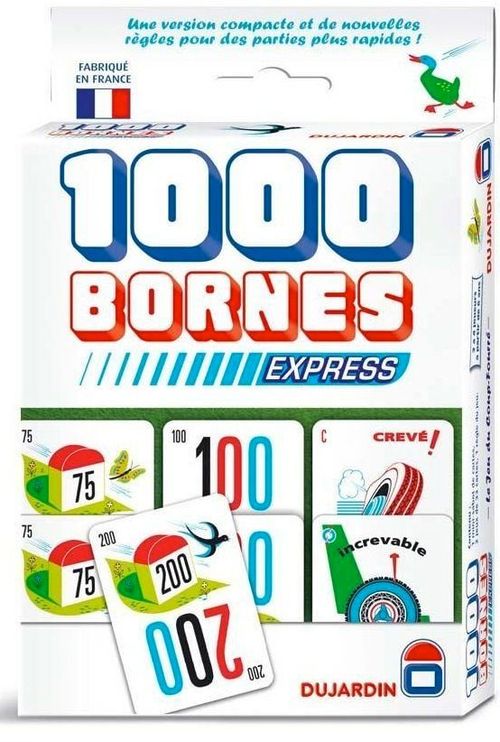
1000 Bornes Express
1000 Bornes Express Rulebook
Table of Contents
Table of Contents
What Is 1000 Bornes?
If you already know the rules of 1000 Bornes, you may read only this section.
The game proceeds, as in 1000 Bornes, by drawing and discarding cards, except that in 1000 Bornes Express everything goes faster:
- Each player has 4 cards in hand, instead of 6.
- On his or her turn, each player draws one card from the draw pile or from the discard pile.
- A player may set off again as soon as he or she has played the Parade card; there is no need to wait for a Green Light.
Object of the Game
A game ends when a player reaches exactly 1000 km, or "1000 Bornes"!
If nobody reaches that exact number, the game ends when all the distance cards have been played. The winner is then the player with the greatest number of Bornes.
- A Safety (Botte) lets you move your car faster: playing a Safety is worth 100 km.
- The Coup-fourré lets you move even faster: making a Coup-fourré is worth 300 km.
Note: with 4 players, you may decide to play only 700 km.
Contents
The 66 cards are divided into 4 families:
- Distance cards (Étapes), which represent the kilometres travelled;
- Attacks: Red Light (Feu rouge), Speed Limit (Limite de vitesse), Out of Gas (Panne d'essence), Flat Tire (Crevaison), Accident;
- Parades: Green Light (Feu vert), End of Speed Limit (Fin de limite de vitesse), Gasoline (Essence), Spare Tire (Roue de secours), Repairs (Réparations);
- Safeties (Bottes): Right of Way (Véhicule prioritaire), Tanker (Citerne d'essence), Puncture-Proof (Increvable), Driving Ace (As du volant).
The number to the left of each card shows how many copies of that card are in the game.
A memo card in the game summarises all the Attacks, Parades and Safeties.
Reminder of What the Cards Do
- Red Light (Feu rouge): placed on an opponent's Battle pile if that opponent can play distance cards. It stops the opponent from exposing new distance cards until the Red Light is covered by a Green Light.
- Out of Gas (Panne d'essence): placed on an opponent's Battle pile if that opponent can play distance cards. It stops the opponent from exposing new distance cards until the Out of Gas is covered by a Gasoline card.
- Flat Tire (Crevaison): placed on an opponent's Battle pile if that opponent can play distance cards. It stops the opponent from exposing new distance cards until the Flat Tire is covered by a Spare Tire card.
- Accident: placed on an opponent's Battle pile if that opponent can play distance cards. It stops the opponent from exposing new distance cards until the Accident is covered by a Repairs card.
- Speed Limit (Limite de vitesse): placed on an opponent's Speed pile. It stops the opponent from exposing new distance cards greater than 50 km until the Speed Limit is covered by an End of Speed Limit card.
- Attack: playing an Attack card delays another player.
- Parade: playing a Parade card lets a player set off again after an attack.
- Safety (Botte): playing a Safety makes the player invulnerable to certain attacks and gains 100 km.
- Coup-fourré: a Coup-fourré occurs when a player plays a Safety while being attacked, even if it is not his or her turn to play. See the Coup-fourré section below.
- Green Light (Feu vert): playing a Green Light starts the trip.
Card Actions
1. Distance Cards (Étapes)
Each card represents a distance of 25, 50, 75, 100 or 200 km. Once played, these cards add together to reach 1000 Bornes.
To play distance cards, a player must have a Green Light to start the game, must not be under attack, or must have the Right of Way (Véhicule prioritaire) Safety in play. Any distance card may be played when there is no Speed Limit attack on the player.
- Caution: each player may play no more than 2 cards of the 200 km distance card.
- To reach 1000 km, you must play exactly 1000 in total. For example, if you have reached 950 Bornes, the 75, 100 and 200 distance cards become useless and you may discard them.
2. Attacks and Parades
There are 10 attacks and 21 corresponding parades, as printed in the leaflet.
The Red Light, Out of Gas, Flat Tire and Accident attacks, and their corresponding parades, are placed on the Battle pile. The Speed Limit and End of Speed Limit cards are placed on the Speed pile.
Attacks on the Battle pile delay an opponent: the opponent may play a distance card only after covering the attack with its corresponding parade. For example, placing a Gasoline parade on an Out of Gas attack lets the player set off again.
As soon as an attack card is covered by its corresponding parade, both cards go to the discard pile, with the parade card on top.
Once the parade is placed, the Battle pile is then discarded entirely, with the parade card face up on top of the pile.
The Speed Limit card can be combined with each of the four other attacks.
3. Safeties (Bottes)
Each player may expose a Safety card at two moments:
- on his or her own turn (even if it is the very first card exposed by that player); or
- at the precise moment an opponent attacks and the Safety matches that attack. This is the Coup-fourré.
Either way, the player who played the Safety plays again. Playing a Safety gives the right to play again and advances the player by 100 km. The player draws another card from the draw pile and again has these four options.
Once exposed, a Safety makes the player immune for the rest of the game to the matching attacks.
The four Safeties are:
- Right of Way (Véhicule prioritaire): once exposed, it forbids opponents to attack with a Red Light or a Speed Limit.
- Tanker (Citerne d'essence): once exposed, it forbids opponents to attack with an Out of Gas card.
- Puncture-Proof (Increvable): once exposed, it forbids opponents to attack with a Flat Tire card.
- Driving Ace (As du volant): once exposed, it forbids opponents to attack with an Accident card.
If a Red Light is already on the Battle pile, or a Speed Limit is already on the Speed pile of the player concerned, at the moment the Right of Way Safety is exposed, those attack cards are discarded because the Right of Way Safety cancels them.
The Coup-fourré
The Coup-fourré consists of exposing a Safety as soon as an opponent places the matching attack on your game, even if it is not your turn.
Example: an opponent attacks you with a Flat Tire while you have the Puncture-Proof Safety in hand. You must immediately shout "Coup-fourré!" and place the card beside the Battle pile.
The Coup-fourré gives 4 advantages. It allows the player to:
- Discard the attack to the discard pile; the attack is cancelled in any case.
- Take a new card from the draw pile or from the discard pile to complete his or her hand.
- Play again immediately, that is, take another card from the draw pile or the discard pile and play as if it were his or her turn. Play then passes to the player on the left, and so on. Any players seated between the attacker and the attacked player therefore lose their turn.
- Advance 300 km more: the Coup-fourré card then counts as a distance card of 300 km.
By cancelling the attack, the Coup-fourré restores the situation to what it was before the attack.
In addition, the Safety in play makes the player immune to the matching attacks for the rest of the game.
The Coup-fourré also offers 3 further options, in addition to the ways of playing described above:
- If the 1st player has exposed a Green Light, the player may attack it with any attack card.
- If the 1st player attacked the player with a Speed Limit, the player may cover that card with an End of Speed Limit, which cancels it. The attack and the corresponding parade are then placed in the discard pile.
- If the 1st player has discarded a card that interests the player, the player may take it.
Note: "the 1st player" is kept as printed in the leaflet.
Remark: after playing, each player must always be left with 4 cards in hand.
Getting Started
Start of the Game
One player is designated as the first dealer. After shuffling the cards well, 4 cards are dealt, one at a time and face down, to each player. The dealer places the remaining cards face down in the small holder in the middle of the players to form the draw pile. Each player looks at his or her own cards but must not show them to the other players.
The player on the left of the dealer deals the cards at the next game, and so on.
Let's Play!
The 1000 Bornes Express game is played every player for himself or herself. Each player's game is laid out in front of him or her.
The first player draws the top card and adds it to the 4 cards already in hand, so he or she has 5 cards for the moment. The player then has 4 options:
- If he or she has a Green Light, he or she may place it in front of him or her and start his or her Battle pile.
- If he or she has a Safety, he or she may place it in front of him or her. Playing a Safety gives the right to play again and advances the player by 100 km. The player draws another card and has these four options again.
- If he or she has a Speed Limit, he or she may place it in front of an opponent, even if that opponent has not yet started playing.
- If he or she has none of these cards, he or she must discard one of his or her cards face up to the discard pile.
After playing, each player must always be left with 4 cards in hand. Then it is the next player's turn.
Note: a Safety may be exposed either on one's own turn as a precaution, or as a Coup-fourré during an attack. In either case, the player who played the Safety plays again.
Useful Tips
- At the start of the game, it is generally better to expose a Green Light on your Battle pile rather than attack an opponent.
- When starting is difficult for lack of a Green Light, it is better to expose one or more Safeties, if you have any, to increase your chances of getting the Green Light you want.
- In general, it is better to keep your Safeties for a Coup-fourré than to expose them simply for immunity.
- On the other hand, it can be worthwhile to expose the Right of Way Safety as soon as possible: it protects the player from 4 attacks.
Variant
You can add a little spice to the game: the player who has just covered his or her attack with a parade card chooses which card he or she places on top of the discard pile when discarding it (his or her parade card or his or her attack card, depending on what would bother the next player...).