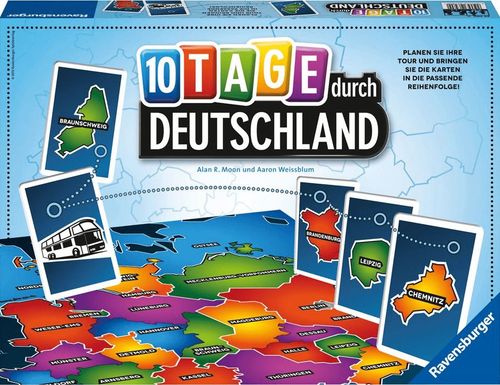
10 Tage durch Deutschland
10 Tage durch Deutschland Rulebook
Table of Contents
Table of Contents
Components
- 1 game board (map of Germany)
- 4 card holders (two-part); each player takes two
- 59 cards:
- 44 region cards
- 10 train cards, in 5 different colors
- 5 bus cards
Note: The map of Germany on the board has been slightly altered for gameplay reasons and only approximates the real geography. The regions are partly federal states (Bundesländer), partly government districts (Regierungsbezirke), and partly cities or counties (Kreise). Some bodies of water (the North Sea, the Baltic Sea, and Lake Constance) also count as regions for gameplay reasons.
Goal of the Game
The players try to put together a route through Germany on their card holders as quickly as possible. The route covers 10 days, and each day must connect correctly to the next.
Setup
The game board is placed in the middle of the table. Each player receives two card holders: one for days 1 to 5 and one for days 6 to 10.
All 59 cards are shuffled well and placed face down next to the board as the draw pile (Nachziehstapel). Each player takes 10 cards from this pile and places them face down in front of them as a stack, without looking at the cards.
Game Setup Phase (Spielregel)
At the start of the game, all players simultaneously take the top card of their 10 cards and place it on their own card holder in any position (= day). All players repeat this nine times, until each of the 10 days has a card standing on the card holder.
During this setup phase, note the following: once a card has been placed on the card holder, it may not be exchanged for another card or swapped places with another card during this phase.
Then three cards are taken from the draw pile and placed face up next to the board, side by side, as the bases of three discard piles (Ablagestapel). The youngest player begins. Play then continues clockwise.
Turn Structure
A turn always consists of the following three actions:
Draw a card — place a card if applicable — discard a card
Draw a Card
The player whose turn it is takes either the top card of the draw pile or one of the three face-up cards.
Place a Card, if it "fits"
The drawn card may either:
a. be exchanged for a card on the card holder, or
b. if it does not fit into the travel route, be placed on one of the three discard piles.
If the drawn card is exchanged for a card from the card holder, the exchanged card goes onto one of the discard piles. If at this point there are only two discard piles, the exchanged card must be placed face up as the base of the third discard pile. Otherwise, the discarded cards may be placed on any discard pile.
If all cards of the draw pile have been drawn during the game, all cards of the three discard piles, except for the three top cards, are shuffled and placed face down as a new draw pile.
Building the Route
The cards on the card holders should form a route through different regions of Germany from day 1 to day 10. The route can be built in several ways:
Visiting Neighbors
Here the player travels from one region to a directly neighboring region. The two regions must share a common border where they meet (see Example 1).
Example 1: Lüneburg and Mecklenburg-Vorpommern share a common border.
Train Journey
In a train journey, two regions at any distance from each other are connected by means of a train card. The two regions and the train card must have the same color.
The train card bridges any number of intervening regions of a different color.
At the end of the game, there may be only one connection between two regions on the card holder! (see Example 2)
Example 2: Mittelfranken (orange) – train card (orange) – Schleswig-Holstein (orange).
Special case: Since Berlin is enclosed by Brandenburg and has no other neighboring region, you may travel to and from Berlin with any train color!
Bus Journey
The buses act as a joker. They help to continue the route. With a bus, you can bridge a neighboring region without regard to color (see Examples 3 and 4).
Example 3: Berlin (special case, see above, black) – bus (for Brandenburg, red) – Magdeburg (orange).
Example 4: Oberpfalz (violet) – bus (for Oberfranken, blue) – Chemnitz (orange).
A journey through Germany may consist of any combination of the three types of travel shown. What matters is only the correct and unbroken sequence that must be formed over the 10 days.
Furthermore, train or bus cards may not be placed in the spaces for day 1 and day 10 on the card holder! The players therefore begin their journey in one region and end it on day 10 in another region.
End of the Game
As soon as a player has correctly assembled their 10-day route, they call out "Ich reise in 10 Tagen durch Deutschland!" ("I am travelling through Germany in 10 days!"). Then they show their fellow players that they have placed their 10 cards in the correct order and built a route through neighboring regions, which may be interrupted only by train or bus cards with a bridging function.
If the route is correct, the player wins, and the game ends immediately. If the player has made an error in their route, play continues until someone reaches the goal.