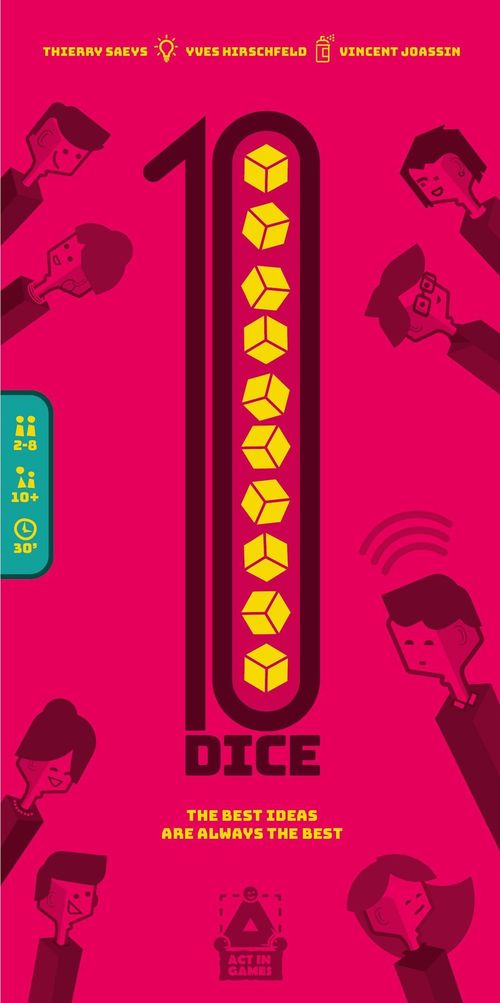
10 Dice
10 Dice Rulebook
Table of Contents
Table of Contents
The Concept
So, the concept is very simple; I will explain it to you in no time. If I tell you, "yellow – sky – hot," what are you thinking?
"Sun"? Bingo, you understand how 10 Dice works! Each round, you roll 10 dice. There are words on these dice. The goal is to find an idea born from association of several of these words. And that idea can be whatever you want: an object, a character, a location, a title… there's no limit! Anything is allowed — well, almost!
And the best thing is that you can have fun two different ways: by forming two teams for a supercharged competitive mode, or playing all together in a cooperative mode that offers a nice challenge.
Above all, never forget: The best ideas are always the best!!
An example… If I choose these dice, and tell you that my idea has 2 words, what does that bring to mind? The dice shown are STAR, BLACK and KING.
"Darth Vader"? Yes, bravo, well done!
Components
As for the components, we didn't mess around:
- 24 dice with words printed on them.
- 2 hexagonal pawns.
- 1 double-sided board: one side for each play mode.
- 1 very practical dice tray.
- The rule booklet you are holding in your adorable little fingers.
Competitive Mode
Want an epic yet friendly showdown, revolving around ideas both striking and far-fetched? Well, then round up at least 3 friends, and let's go! Your mission: Dash to victory by figuring out increasingly difficult word associations. It's fun, it's fast, it's showtime!
Setup
For setup, nothing could be easier:
- You and your friends should divvy up into two teams with at least 2 players on each. Ideally, the teams should face each other. Feel free to show your competitive spirit by adopting fierce poses, or glaring and sneering at your opponents.
- Place the dice tray in the middle of the table where everyone can reach it easily.
- Place the 24 dice and the gameboard (track side up, duh!) nearby. Each team places their pawn on their starting space.
- Find something to write on (1 sheet of paper per team is perfect).
- Using the 10D app? Well, fire it up and put it in the play area. (More info about the app on the next page.)
Note: The 10D app was created to set the tempo for your game! It's available on Apple's App Store and Google Play for free! Nice, right?
If you don't have a way to use the app, find some other method to track 30 seconds.
Moments in which you should employ the app are indicated with this logo: a phone icon.
Play a Round
And now, put down your phones, and let's play a round of the game!
- Someone (anyone) takes 10 random dice from the pool of dice, and rolls them into the dice tray. Poof! 10 words appear. They are the fertile soil in which ideas will sprout.
- Everyone wracks their brains to find an idea* from a certain number of the words. Precisely how many of the words should you associate? Well, that depends on the little number between your pawn's space and the next space on the track. For example, at the start of the game, you must associate two dice. The number of dice you need to associate is also a pictogram in the next space itself.
- Got an idea? Super! Quickly grab the dice you have in mind and place them in front of you, clearly visible. Since you are the one who came up with the idea, we will call you the ideafier (yeah, of course the word exists: I just invented it) for this round.
- No mercy: As soon as you grab the dice, start the app's timer.
- There's no time to lose: Secretly jot down your idea and announce in a clear voice the number of words you have written.
- Your teammates have 30 seconds to confer and to make one (and only one) guess.
* Remember, your idea can be anything you like: one or more words, an animal, a celebrity, a country… Go nuts!
-
Was it the right answer? Perfect! Mark it correct in the app, and advance your team's pawn to the next space. This round is complete!
Wrong answer? Yikes. Mark it incorrect in the app. Now the other team gets 30 seconds to agree on a guess.
-
If they get it right, they stole your idea, and the other team advances their pawn (even if that moves them into a space that requires more dice than the number you used!). Rough, eh? The round is complete.
-
If they get it wrong, press the corresponding button in the app. It's time for… a second chance. But before that, you are going to give a hint (see the golden rules on p. 12). This hint must be a single word, and as precise as possible to get your teammates on the right track.
Now there is a second round of answers just like the first: your team, then — if your team gets it wrong again — the other team.
-
-
If neither team has guessed your word, even with your clue and a second chance each, it's clearly because your idea… um… was a bit ahead of its time. Tough luck: You just gave the other team a time bonus for the next round. They will get 30 seconds during which your team cannot grab any dice. The app automatically grants the time bonus.
Following Rounds
For the following rounds, everything works pretty much the same way. Nevertheless, be aware that:
- Each round, you can feel free to replace some or all of the dice; a little variety can't hurt.
- The same person cannot be the ideafier for two consecutive rounds. Let someone else go, already!
- Remember that if nobody could figure out the the previous idea, the app will grant the time bonus.
Example of a Round
An example of a round — a little story to make everything clear:
- The game begins! On one side: Margaux, Diego, and Felix. On the other: Enola, Maeyva, and Amin.
- Amin grabs 10 dice from the pool and rolls them into the dice tray. Everyone looks for a way to combine the words on them to give birth to an idea.
- Margaux, quick as lightning, grabs the dice with the words boat and screen from the tray, and sets them in clear view on the table (thereby proclaiming herself the ideafier). She secretly jots down her idea, and announces that the idea has 1 word.
- Felix and Diego, her teammates, confer then propose Titanic as their answer. Unfortunately, they were wrong.
- Now the other team gets to make a guess. Maeyva, Enola, and Amin discuss it and agree on an answer: net. Also wrong.
- Margaux now must give a hint word. She says, "detection." This seems to have put her teammates, Felix and Diego, on the right track.
- After a brief discussion, they guess sonar. Super! Right answer! Margaux confirms this by revealing what she wrote, and her team advances their pawn along the track on the board. For the next round, Margaux cannot be the ideafier.
End of the Game
What signals the end of the game? You guessed it: As soon as a team reaches the space in the middle of the board, the game ends with that team victorious. This means that you will need to find a 5-word association (or steal an idea from the other team at the right moment to reach the final space). Yes… profanity is appropriate here.
For example, if I take these dice and tell you my idea is 1 word, what do you think I have in mind? The dice shown are SPORTS, GREEN QUEEN, CITY, BALL and QUEEN.
Did you come up with "Wimbledon"? If so, I'm really impressed!
Cooperative Mode
You say you want to feel the love, rather than buy into the antagonism of this brutal world? OK, no dueling then: We'll play together to achieve a common goal. If there are at least two of you, that's enough to play. Your objective: Fill the nine spaces of the 3×3 square AND one of the six spaces around the outside of the board before making 5 mistakes.
Easy…? We'll see once you try it!
Setup
The setup should take just a few seconds:
- Place the dice tray in the middle of the play area where everyone can reach it easily.
- Place the 24 dice and the board (yo, use the side with the square!) nearby. This side of the board comprises two areas: a 3×3 square of 9 spaces, which you will gradually fill with dice as they are validated, and the track of not-so-good ideas, along which you will advance the pawn when you make a mistake.
- Place a pawn on the starting space beside the track of not-so-good ideas.
- Grab something to write on.
- Roll a random die and place it on the central (yellow) space of the 3×3 square. This will be the first reference word.
First Round
In the first round, this is how it works:
-
Someone takes 10 random dice and rolls them into the tray.
-
Everyone works their gray matter: You must associate 1 of the 10 dice with the reference word that is in the middle of the 3×3 square.
-
You found an idea? Super, that makes you the ideafier (yes, this is a thing!) for this round. Pick up the die and place it in one of the four spaces orthogonally adjacent to the reference word (diagonals don't count). Secretly jot down your idea on a piece of paper, and announce the number of words you have written.
-
The other players confer and make one (and only one) guess.
-
Is it the right answer? Yeah! Your idea is validated; leave the die where it is, and move on to the next round.
Wrong answer? Crud. You must advance the pawn on the track of not-so-good ideas. Now give a one-word clue (and only one word) to the other players so they can agree on a new guess.
- Did they get it right? Phew! Your idea is validated; leave the die there, and start a new round.
- Did they get it wrong? Bummer. Your idea is not validated; remove the die and return it to the dice tray. The round is over.
The starting reference word is god. Diego grabs the word sun and places it adjacent to god. He announces that he has a 1-word idea. What do you think it is?
Following Turns
For the following turns, there are no major changes, but there are a few important details to note:
- The number of dice rolled each round is always 10. You can reroll the dice from previous rounds, or use different ones (for some or all of them). Whatever whimsy wills!
- The more dice there are on the 3×3 square, the more available reference words there are. You can place your die adjacent to any die, and use that die as your reference word.
- If the die you place is orthogonally adjacent to several reference words, your idea must come from associating all of those words. Note: You only have to include the words orthogonally adjacent to the one you place; diagonals don't count!
Margaux has placed the jungle die next to passion and movie. She says she has a 3-word idea. What do you think it is??
Super Hard Mode
Too easy for you? OK, then try Super Hard Mode! In this mode, there's no quitting if you can't guess the answer after one hint. Oh, no, you must see this through to the end! With each wrong answer, advance the pawn on the track of not-so-good ideas and get a new hint from the ideafier. You only continue to the next round once the idea has been validated. Be careful, because this game mode is ruthless: One foolish idea can quickly snatch victory from your grasp!
End of the Game
The end of the game can come about two ways:
- You lose as soon as the pawn lands on the 5th (and final) space on the track of not-so-good ideas. In other words, you can only make 4 mistakes!
- You win when you have completed two tasks. First, you must fill all 9 spaces of the 3×3 square. Then, once you have completed the 3×3 square, you must validate one final die on one of the six spaces around the outside of the board. I warn you, it won't be easy, because this last idea must use 4 words: the one you place, plus all three dice in the same row/column as your die.
Enola grabs the word plane and places it at the bottom of a column with pig, child, and screen. She says she has a 2-word idea. If they can figure out the 2-word idea, they'll win the game!
Golden Rules for Playing 10 Dice
Well, of course, because if literally anything is allowed, it wouldn't be much of a game, now would it?
- Your idea cannot include a variation on one of your reference words, nor a translation of one of them. For example, you can't use the word dance to get people to guess dance, dancer, etc. You can't use king to get people to guess King Kong; nor can you use feather to get people to guess nom de plume (translation).
- For clues, same deal: Inflections and translations, forget it; however, synonyms are quite welcome.
- On the other hand, when it comes to guessing, I'm a little nicer. I accept different terms for the exact same thing (punishment is OK for retribution); however, teacher is not an acceptable answer for professor, because the sense of them is not exactly the same.
- While people are searching for an idea, don't monkey with the dice in the tray: People can't see through your hands, no matter how adorable and little your fingers might be.
- Did several of you find an idea at the same time? Well, the fastest grabber gets to be the ideafier.
- The number of words the ideafier announces must correspond to the number of words they wrote. A hyphenated word counts as a single word.
- You can't reuse the same idea during the same game. Have a little imagination, people!
- The ideafier must remain silent and still, and keep a straight face during the discussions, so as not to give untimely hints.
- You can't be the ideafier twice in a row. I already said that? Right, 'cause it's important!
- The ideafier jots down their idea so they can prove their good faith after the idea was discovered.