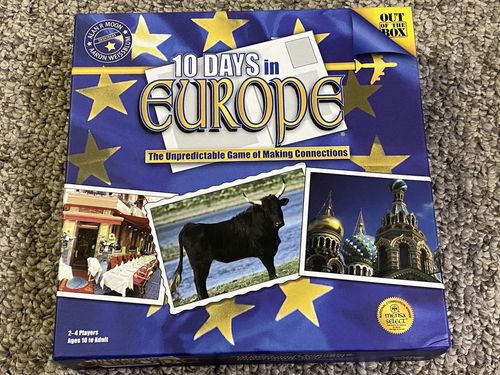
10 Days in Europe
10 Days in Europe Rulebook
Table of Contents
Table of Contents
What's in the Box
-
48 Country Tiles
Each country is displayed in one of five colors (blue, green, orange, pink, or yellow).
There is one tile per country, except for Denmark, France, Germany, Russia, Spain, and Sweden, for which there are two.
-
19 Transportation Tiles
There are ten Airplane Tiles: two per color.
There are nine Ship Tiles: four Atlantic, three Mediterranean, and two Baltic.
-
4 sets of Wooden Tile Holders
There are two holders per set. (Days 1-5 and days 6-10)
-
Game Board
-
Rules
German translation available at www.otb-games.com
The Object of 10 DAYS® IN EUROPE
In 10 Days in Europe, players use country and transportation tiles to chart a course across Europe. The first player to complete a ten day journey, where each day connects to the next day, is the winner!
Setting Up
- Open and place the game board in the center of the table.
- Place one set of tile holders in front of each player so that DAYS 1-10 are displayed in order, facing that player.
- Place all country and transportation tiles face down next to the board and mix thoroughly.
Getting Started
-
Players fill their tile holders without taking turns. Each player draws a tile, looks at it, and places it into any open location, DAYS 1-10. Players continue to draw, and place, one tile at a time, until all players have placed ten tiles in their tile holders.
Once placed, a tile may not be moved within the tile holder. However, a tile may be replaced or swapped with another tile during a player's turn. See A Player's Turn.
Tile holders should be positioned so that the placed tiles will not be in view of other players.
-
Stack the remaining tiles, face down, to form a draw pile. The three top tiles are then placed, face up, next to the draw pile to form three discard piles.
-
Select a player to take the first turn. Turns will continue clockwise.
A Player's Turn
A player may either draw a new tile or swap two tiles within his or her trip.
-
Draw a Tile—Select the top tile from one of the three discard piles or the top tile from the draw pile.
If the player depletes the draw pile, all tiles in the three discard piles, EXCEPT the top tile on each pile, are shuffled together to form a new draw pile.
Place the Tile—Replace any one of the ten tiles in the tile holder with the drawn tile, OR discard the tile, face up, onto one of the three discard piles. If the player replaced a tile in the tile holder, the replaced tile is discarded, face up, on one of the three discard piles.
If a player selects the last tile from a discard pile, the tile must be replaced with the newly discarded tile. As a result, players will always be able to select from three discard piles, as well as the draw pile.
-
Swap Two Tiles—Switch the position of any two tiles in the tile holder. No tiles are drawn or discarded on this turn.
Making Connections
Connecting by Foot: Players may travel by foot from one country to a bordering country. The bordering country tiles are connected to each other when they are positioned side-by-side in the tile holder. A solid black line across a body of water indicates a connection by bridge and a broken black line indicates a connection by ferry (therefore by foot). Two country tiles are considered connected if there is a black line, solid or broken, connecting the two countries on the map, or if they are located next to each other. See examples A, D, and F below.
Connecting by Ship: Players may travel by ship from one country to another country by sailing on the sea or ocean which borders both of the two countries being connected. When a ship tile is positioned between the two country tiles, these three tiles are connected to each other. Ship tiles may only be used for making connections on the sea or ocean designated on that tile. See examples B and E below.
Connecting by Airplane: Players may use an airplane to fly from one country to another country of the same color. When the airplane tile is positioned between the two country tiles, and is the same color as both country tiles, these three tiles are connected to each other. See example C below.
A Completed 10 Day Journey Where Each Day Connects to the Next Day
| DAY 1 | DAY 2 | DAY 3 | DAY 4 | DAY 5 | DAY 6 | DAY 7 | DAY 8 | DAY 9 | DAY 10 |
|---|---|---|---|---|---|---|---|---|---|
| Spain* | France* | Atlantic Ocean (ship) | Norway | Airplane | Albania | Greece | Mediterranean Sea (ship) | Turkey | Ukraine |
Examples: A (Spain–France, connected by foot/border), B (France–Atlantic Ocean–Norway, connected by ship), C (Norway–Airplane–Albania, connected by airplane), D (Albania–Greece, connected by foot/border), E (Greece–Mediterranean Sea–Turkey, connected by ship), F (Turkey–Ukraine, connected by foot/border).
Winning the Game
If at the end of a player's turn, that player has a completed ten day journey, he or she wins 10 Days® in Europe!
The winner must show that each day is connected to the next day in his or her tile holder.
Completing a 10 Day Journey
There are no restrictions as to where a tile may be placed in the tile holder during a player's turn. However, to win the game, a player must be the first to complete a ten day journey. A ten day journey is considered complete when, starting with DAY 1, each day is connected to the next day in the tile holder. The completed journey must also meet the following criteria:
- Completed journeys must start with a country tile and end with a country tile.
- Five countries have two tiles each, indicted by the * symbol. Two tiles from the same country may be included in a completed journey as long as the tiles are not placed next to each other.
- It is not necessary to include either an airplane or a ship tile to complete a ten day journey
- Transportation tiles placed next to each other, do not form a connection.
For Younger Players
10 Days® in Europe can be modified to make it easier for younger players. Here are two ways of adjusting the game to get younger players started.
- Open Hands—For the first few games, players lay their tiles face up on the table so that everyone can see which tiles the other players have and can discuss why people are making the decisions they make. Players may lay their tile holders behind their cards to keep track of which day is which.
- 5 Days in Europe—For a shorter and more simple game, only use one tile holder (Days 1-5) per player. When players have mastered five days, then move on to ten!
For Advanced Players
For players who want a bit more challenging game, try playing without the "swap rule." All other rules are the same, but on a player's turn, that player may only draw a tile (from a face up pile or the face down draw pile) and may not swap two tiles.
Notes
In the interest of map readability and game-play, several small countries are not labeled or included in the game, although they are outlined on the map. Ferries are shown connecting countries which might not actually be connected by ferry. These are elements of the game and should not be considered accurate representations of Europe at any given time.
Omitted Countries
There are no tiles for the following countries and they are not identified on the game board: Andorra, Gibraltar, Kosovo, Liechtenstein, Malta, Monaco, San Marino, and Vatican City.
Bridges / Ferries
Solid black lines indicate bridges and broken black lines indicate ferries. There is a bridge connection between Sweden and Denmark. There are ferry connections between France and England, England and Ireland, Northern Ireland and Scotland, the Ukraine and Turkey, the Ukraine and Bulgaria, and between Romania and Turkey. For the purpose of this game, these countries should be considered connected, similar to countries that border each other.
Map Information for the Purpose of this Game
- Germany, Denmark, Sweden, and Russia are on both the Baltic and Atlantic.
- Spain and France are on both the Mediterranean and Atlantic.
- Bosnia and Herzegovina does have a port so it is considered on the Mediterranean Sea.
- The Mediterranean Sea tile connects countries located on the water from Spain to Turkey and north to Slovenia.
- The Atlantic Ocean extends from the bridge between Sweden and Denmark, indicated by a solid black line, to the Strait of Gibraltar, indicated by a solid blue line. The Atlantic Ocean tile connects countries located on the water from Spain and Portugal, around Norway, to Russia.
- The Black Sea, the body of water between the Ukraine and Turkey, is not part of the game and cannot be used as a connection.
Population information is current as of 2009. Source: CIA World Factbook. Map not to scale.
20 Days Around the World
10 Days in the Europe can be combined with the other 10 Days games to travel around the entire world! Visit our website www.otb-games.com for rules for a 20, 30, or 40 day game!