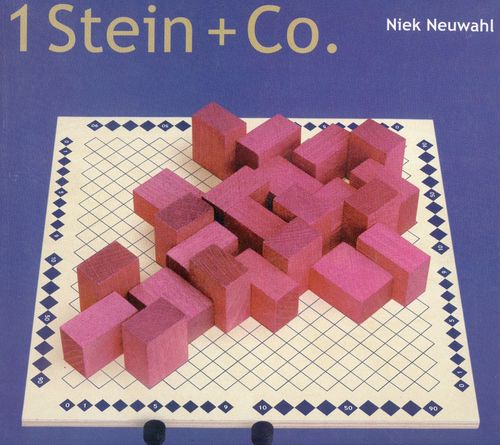
1 Stein + Co.
1 Stein + Co. Rulebook
Table of Contents
Table of Contents
Game Material
- One board with a grid making up many small boxes in a diagonal arrangement. On every outside border is a scale for players to record points.
- 41 game stones: Every stone is 2x3x4 grid-box size and can therefore be set up in three different ways - flat, high or lengthwise (see picture on page one of German rules). One of the stones is extra; only 40 are used in the game.
- 8 counting stones, two for each player
- 1 Set of Rules
Game Aim
The player with the highest score wins. Players score points by closing in spaces on the board. Points are scored after a stone is placed if it fully encloses a set of spaces on the board, as long as two conditions are met:
- The spaces must be completely enclosed by stones or by the edge of the game board.
- The closed-in surface cannot be able to hold a stone in any of its three orientations.
When closing in spaces that meet these conditions, the player scores points equal to the number of spaces enclosed.
[Example Two in the German rules show a player scoring three points by closing in spaces in the middle of the board (on the left), and then a player scoring three points by closing in spaces using the edge of the board (on the right).]
Game Preparation
Every player takes two counting stones. One is set on the "zero" of the first scale, and the other is set aside to use on the 10's scale when needed. [translator's note: I have found it easier to just record the scores on paper, especially since it becomes useful to rotate the board during play.]
The game stones are placed by the board so that all players can reach them.
Game Flow for Two, Three or Four Players
The youngest player begins. On a player's turn, they take a stone from beside the board and place it on the board. Players take turns in clockwise order. The following rules must be applied when placing the stones on the board:
- The stone may be set up in any of its three orientations so that it will cover 3x4, 2x3, or 2x4 spaces on the board.
- The first stone may not touch the border.
- Every other game stone must touch at least one other previously-placed stone by at least one board space.
- However, new stones may touch only stones which do not have same height.
[The drawing on the top of page three of the German rules shows that the identified piece cannot be placed since it is the same height as the piece it is touching.]
- Rule number four does not apply if the placed stone can cause a scoring to occur (if it closes in board spaces according to the rules). In this case, it is allowed for the newly placed stone to touch other stones of the same height.
- After each placement, any points are scored and tallied on the scales.
[The drawing in the middle of page three shows a scale with 35 points]
It is possible to isolate several sections with a single play. Of course, in these cases all isolated board spaces are scored.
Game End
The game is finished when no more stones can be added to the board. The player with the most points wins.
Variant for Three and Four Players
If playing with three or four, this interesting alternative can be also played:
When scoring, not only the player scores but also the player immediately preceding him. This makes it important to set up the next player for a big score.