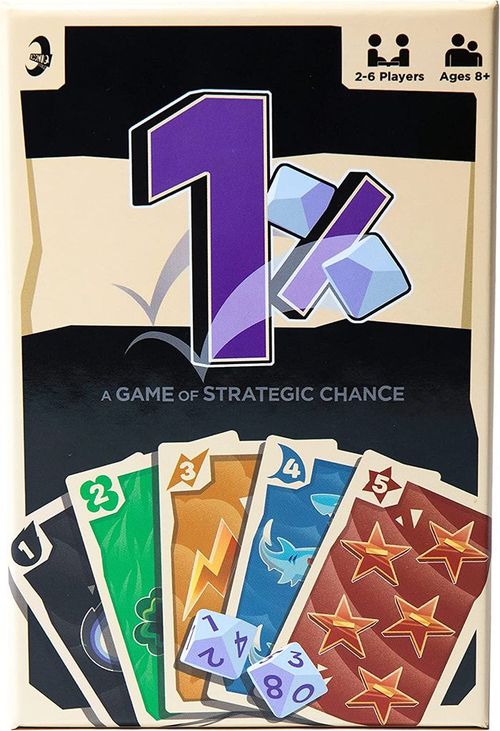
1%: A Game of Strategic Chance
1%: A Game of Strategic Chance Rulebook
Table of Contents
Table of Contents
Components
- 50 Bid cards
- 34 Reward cards
- 6 game aids
- 2 ten-sided dice
Card Families
The Bid and Reward cards belong to five families: Shark, Comet, Star, Lightning, and Clover. Each numbered card exists in two copies.
Overview and Goal
Use probability, bluff, and keep a close eye on your opponents' bids. When only one player is left in play, that player has a choice: roll the dice hoping for a double 0 to win, or collect cards that increase their odds of pulling it off on a future roll!
Setup
- Shuffle the two decks (Bid and Reward) separately and form two face-down draw piles on the table.
- Reveal 3 Reward cards and place them next to the Reward deck, visible to everyone.
- Deal 3 Bid cards to each player. Be careful: no one but you should see your cards!
- Before starting, everyone rolls the dice. Whoever gets the lowest total (adding the two dice together) goes first. In case of a tie, roll again. If any player rolls 0 and 0, they win the game immediately! Congratulations!
- Note: this step is only used to determine setup order.
You can now start playing!
Course of Play
A game is played over several rounds, each made up of a Bid phase and a Reward phase:
- During the Bid phase, you play against each other, turn after turn, until only one player is still in play.
- During the Reward phase, the last player in play receives a choice of 3 rewards (roll the dice to try to win, take cards to increase their dice odds, or a mix of both).
Bid Phase
Bid cards range from 1 to 5. They come in 5 families: Shark, Comet, Star, Lightning, and Clover. Each card exists in two copies.
Bids
The first player looks at their cards and makes a bid by naming a number and a family.
Example: "3 Sharks." This player thinks there are at least 3 Sharks total among the cards held by all the players.
Note: what counts is the total value of the named family (not the number of cards). For example, a 2-of-Sharks card and a 4-of-Sharks card together count as 6.
Then it's the next player's turn, in clockwise order: they must raise the bid by naming a number strictly higher than the previous bid. The named family may change or stay the same.
Continue in this way, each player taking their turn in order.
Example sequence of bids: 8 Clovers, 9 Clovers, 10 Stars, 12 Clovers.
"That's False!"
On their turn, if a player thinks the previous bid is wrong (i.e., that it overestimates the real value of the named family), they can say "THAT'S FALSE!"
Example: Player C says "That's false!" — they think there are not at least 12 Clovers among the players' hands, and they don't want to raise the bid.
The other players are then asked, in turn order, whether they agree with the challenged bid.
Everyone then reveals their hand: add up the values of the named family to find out who was right.
Example: 12 Clovers were bid, but there are actually only 5 Clovers in play.
In Play or Out of Play
Players who agreed with the correct side of the challenge remain IN PLAY. Players who were wrong are eliminated and are OUT OF PLAY until the end of the round.
Example: C and D were right: they both remain IN PLAY. A and B were wrong: they are both eliminated and are OUT OF PLAY until the end of the round. Note: if the challenged bid had actually been correct (12 or more Clovers in play), A and B would have remained IN PLAY and C and D would have been OUT OF PLAY.
New Bid Phase
Players still in play repeat the Bid phase until only one player remains.
For the new phase, the players who remain in play place all of the previous turn's cards into a discard pile, then draw 3 new cards.
Note: in the rare case where the Bid card draw pile runs out before the end of the round, reshuffle the discarded cards and resume the Bid phase.
Whoever challenged the bid by saying "THAT'S FALSE!" becomes the new first player. (If the bid had instead turned out to be correct, the player whose bid was challenged would become the new first player.)
Example: The players reveal their cards: there are 9 Sharks in total. C was wrong, so C is OUT OF PLAY. D is the only player still IN PLAY: she wins this round and moves on to the Reward phase.
Reward Phase
During the Reward phase, you get to choose 3 rewards. This is the phase where the Reward cards and the dice come into play. There are 2 types of Reward cards: winning numbers and single-use bonuses.
Take this opportunity to look at the 3 Reward cards revealed during setup!
3 Rewards of Your Choice
The player who won the Bid phase gets to choose 3 rewards:
- Roll the dice 3 times.
- Take 3 Reward cards (the ones revealed next to the deck).
- A bit of both: for example, take 2 Reward cards and roll the dice once, or roll the dice twice and take 1 Reward card.
Note: do not draw replacement Reward cards for the revealed cards you take. That will be done at the end of the round.
Rolling the Dice
If you choose 1 dice roll among your 3 rewards, you must always roll both dice. So if, among your 3 rewards, you choose several rolls in a row, reroll both dice each time.
Winning Numbers
Most Reward cards show a number between 1 and 9. This is a winning number.
If you choose Winning Number cards, place them on the table in front of you for the rest of the game (unless they are discarded or stolen).
The number shown on the card now counts as a "0" when its owner rolls the dice. So, the more winning numbers you have, the better your chances of winning.
Single-Use Bonuses
If you choose Single-Use Bonus cards, place them in front of you. You can use them immediately or during your future Reward phases. Discard them as soon as you use them.
Note: getting a Bonus card counts toward the 3 rewards earned at the end of the round, but using it does not.
Examples of Single-Use Bonus cards:
- Steal 1 Reward card from an opponent.
- Take the top 2 cards of the Reward deck.
- If you roll the dice and get exactly one winning number, you can play this card to reroll the other die and try to win!
8 Reward Cards Maximum
You cannot have more than 8 Reward cards. If you want to take more, you must first use or discard some.
Note: there is no benefit to owning a duplicate of the same winning number.
End of the Round
If no one has won by the end of the Reward phase, the round ends. A new round begins, and everyone returns to play:
- If Reward cards were taken during the previous round, reveal new ones so that there are always 3 face-up cards next to the deck at the start of the round.
- Note: if the Reward deck runs out, players will no longer have a choice and must roll the dice as their reward.
- Reshuffle the discarded Bid cards with the draw pile and begin a new Bid phase.
- Whoever won the previous round (and therefore just took their Reward phase) starts the next round.
End of the Game
The game ends immediately if any player makes a winning roll by getting a 0 and/or one of their winning numbers on both of their dice in a single roll. (0 is always a winning number!)
Example: D takes the Winning Number cards 6 and 3. From now on, she will win if both of her dice show 0, 6, or 3, in any combination. D rolls her two dice and gets 7 and 3. The 7 is not one of her winning numbers. She has spent her 3 rewards but has not managed to win. Note: she keeps her Winning Number cards and any unused Bonus cards.
Tips
- Listen carefully to your opponents' bids: they may reveal what they are holding (unless everyone is bluffing!).
- Your bids don't have to be tied to the cards you actually hold. You can name other families to throw people off — just make sure you name a family that actually exists in the game!
- It's all about your decisions: when to take Reward cards? When to roll the dice? The more cards you take, the better your chances of winning. Your odds of a winning roll with 1 Winning Number card are 4%. With 8 cards, they rise to 81%!
- If you think fortune favors you, you can always try rolling the dice during your Reward phase, even without a winning number.
Quick Reference
Setup: Shuffle the 2 decks separately. Reveal 3 Reward cards. Each player draws 3 Bid cards. Everyone rolls the 2 dice — whoever has the lowest total goes first.
Bid Phase: The first player makes a bid. Going clockwise, players raise the bid. On their turn, if a player thinks the previous bid is false, they can say "THAT'S FALSE!" Everyone else gives their opinion. Everyone reveals their cards. Add up the total for the named family. Players who were wrong are OUT OF PLAY. Players still IN PLAY play a new round. Repeat until only 1 player remains.
Reward Phase: The player who won the Bid phase chooses their 3 rewards — Reward cards, dice rolls, or both. To win, you must get a winning number on each of your dice in a single roll. 0 is always a winning number. If you don't win during your Reward phase, everyone returns to play and a new round begins.
The Families
The families are based on events even more improbable than rolling a double 0: they each have less than a 1% chance of happening! For your first games, we recommend giving each player a game aid so no one forgets the family names.
- Lightning — You have a 0.0065% chance of being struck by lightning in your lifetime.
- Clover — You have a 0.0001% chance of finding a four-leaf clover.
- Star — You have a 0.0086% chance of becoming a superstar.
- Shark — You have a 0.000026% chance of being killed by a shark.
- Comet — Each year, the Earth has a 0.00003% chance of being struck by a comet.