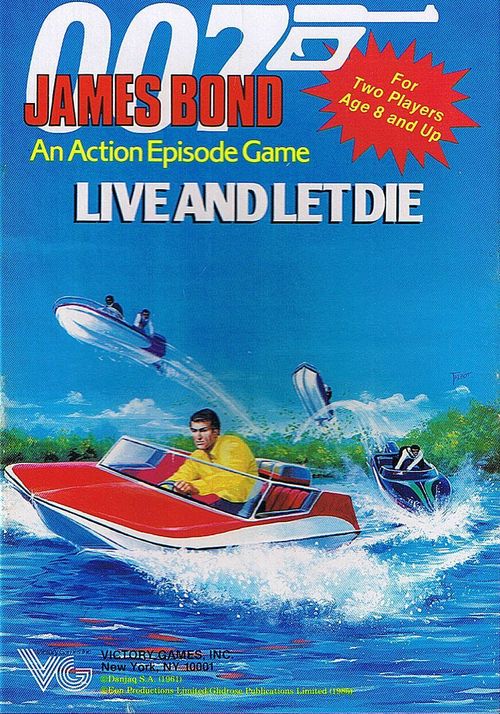
007 James Bond: Live and Let Die
007 James Bond: Live and Let Die Rulebook
Table of Contents
Table of Contents
Components
Each copy of Live and Let Die includes the following components:
- Rules folder
- Action and Card Summary Sheet
- 11" x 16" mapboard
- Playing pieces (4 Enemy boats, Bond's boat, number squares)
- Five playing piece stands
- 32 playing cards
- Two six-sided dice
Transcriber note: the printed page also carries a customer-service paragraph (missing parts, feedback card) and publisher address and copyright lines, which are omitted as non-rules text.
Pieces shown on the page: the Number Square (example shows the number 3), the Bond Piece (Bond's boat), and the Enemy Piece (an Enemy boat, marked with the letter A).
Set Up
To begin, unfold the game map and carefully punch out the playing pieces. Insert the boat pieces in their stands, and place them on the map in the Spaces marked (A, B, C, and D for the Enemy pieces, and the Space marked Bond for the Bond piece). Carefully separate the Playing Cards, shuffle team [sic], and deal four cards to each player. Place the rest of the deck face-down to one side of the map. Do not let your opponent see your cards.
How to Play
In each turn, the following things happen, in order:
- The James Bond player rolls two dice and looks at his James Bond Action Summary on the "Movement" line. This dice roll tells you how many Spaces the Bond piece must move in this turn (unless he loses his turn). Take the number square with the same number as the number of Spaces Bond must move and place it near the map to remind you, during Bond's turn, how many Spaces he will have to move.
Example: You are the James Bond player, and you roll two dice for movement. The dice roll is a 4 (a 1 and a 3); the number on the "Movement" line under a die roll of 4 is 6. James Bond will have to move 6 Spaces this turn; put the number square with a 6 on it near the map to remind you.
- The James Bond player can now move his piece, play cards, and perform Actions.
- After Bond has finished moving, playing cards, and performing Actions, the Bond player can draw one new card from the deck. If the Bond player already has 4 cards in his hand, he must discard one before drawing a new card, because neither player can ever have more than 4 cards at a time.
- The Enemy player rolls two dice for one of his boats and looks at his Enemy Action Summary on the "Movement" line. He finds how many Spaces the piece must move this turn, and puts the number square with that number on it near the map to remind him.
- The Enemy player can now move his piece, play cards, and perform Actions. The Enemy player does Steps 4 and 5 for each of his pieces, in any order of pieces he likes. Each piece must complete Steps 4 and 5 before another begins.
- After he has finished Steps 4 and 5 for all his pieces, the Enemy player can draw one new card from the deck. If he already has 4 cards in his hand, the Enemy player must discard one before drawing a new card. The 4 cards in the Enemy player's hand are all the cards he has for all his pieces; he cannot have 4 cards for each piece.
Losing a Turn. Sometimes a result on the Action Summaries says that a piece loses a turn. A piece that loses a turn cannot move or perform any Action; it must stay where it is until it has lost a full turn. A piece that loses a turn can still perform "Dodge Force" Actions during the opponent's turn.
Action Summaries. Each player has an Action Summary that lists all the Actions his pieces can perform, the requirements for each Action, and the results of success or failure. Whenever you perform an Action, roll two dice, add the results together, and refer to your Summary. If the dice result is in the white area, the Action succeeds and you read the message in the white area; if the dice result is in the gray area, the Action fails, and you read the message in the gray area. Note that playing a card to attempt most Actions increases your chance of succeeding with the Action.
How to Win
If the Bond piece reaches the Space marked "End," the Bond player wins. If the Bond piece crashes (due to gunfire from Enemy pieces) before reaching the "End" Space, the Enemy player wins.
Movement
After rolling to find how many Spaces you must move, pick a number square with that number on it and place it near the map (or in the Space you began the turn from, if you like). During your movement, you will probably want to perform Actions, and you might forget how many Spaces you were supposed to move; the number square is there to remind you how many Spaces to move.
Unless you enter a Space containing an opposing piece, you must always move your piece as far as your movement dice roll calls for; you can end your movement in a Space containing an opposing piece. When moving, your piece can only move forward — in the direction of the front of the boat — from Space to Space (unless it performs a Double Back). At the beginning of the game, you can point your pieces in any direction, as long as they are pointed toward another Space.
The Spaces on the map are connected by 3 types of lines: Normal, Quick Turn, and Jump lines. Normal (blue) lines are the lines your pieces normally move along from Space to Space. You cannot move or fire from one Space to another unless they are connected by one or more Normal lines. The canal (dotted blue) line in the lower right corner of the map is identical to a Normal line.
To move from one Space to another connected by a Quick Turn (blue with arrowhead) line in the direction of the arrowhead, you must perform a Quick Turn Action; you do not need a Quick Turn to go in the direction the arrow is not facing. You cannot fire along a Quick Turn line in the direction of the arrowhead (but you can fire in the other direction).
To move from one Space to another connected by a Jump (green) line, you must perform a Jump Action. You cannot fire along a Jump line.
Cards
At the beginning of the game, each player is dealt 4 cards. Some of these cards increase a piece's chance of performing an Action successfully when played at the moment the player attempts the Action (Quick Turn, Double Back, Fire Combat, Jump, Force); some increase a piece's speed when played at any time during the piece's turn (Pursue/Flee); and some are special cards. Notes on the special cards are on the Special Card Summary.
During your turn, while you move and perform Actions, you can play as many of the cards in your hand as you want, discarding them after you have played them. After each player has finished moving and performing Actions, he can draw one new card from the deck. If you have 4 cards in your hand and you want to draw another, you must discard one of the cards in your hand first, and then draw a new card; you can never draw more than one card in one turn. Once a card is used and discarded, it is placed face-up in a discard pile next to the card deck. If you use the entire deck and are still playing, shuffle the discard pile and use it as the new deck. Note that some cards can be used only by one player; the opposing player can still hold or discard these cards — he just cannot play them.
Actions
Actions are the heart of the game. The way that you perform Actions, combining them with movement and card play, is important to winning or losing. Experiment with the Actions, trying them in different combinations, and you will find that you can made [sic] your boat move, attack your opponent, and quickly move away so that your opponent cannot attack you.
During your movement, your pieces can perform Actions. All possible Actions are listed on your Action Summaries. You can use Quick Turn, Double Back, and Jump Actions to maneuver; you can use Fire Attack and Force Actions to damage or slow down your opponent; and you can use Force Dodge to avoid damage. Whenever you attempt an Action, roll two dice and refer to your Action Summary. Any number of different Actions can be attempted in a piece's turn, except that no piece can attempt the same Action more than once in a turn. Note that bond can still Force Dodge as often as he needs to.
Fire Attack
Only the Enemy player can use Fire Attack Actions, because only Enemy pieces have guns. Enemy pieces can only fire forward through Normal lines. Note that the farther away Bond is, the harder he is to hit.
Hits and Crashing. When Bond is hit, according to the Enemy Action Summary, a total of three times, Bond crashes, and the Enemy player wins the game (but see the Wedding card in the Special Card Summary). You must keep track of each time Bond is hit (use a pencil and paper or blank number squares to remember).
Transcriber note: the printed page ends with a "Game Design Credits" block (designer, artist, playtesting and production credits and the print code), which is attribution and is omitted. The Bond and Enemy Action Summary sheets and the Special Card Summary, which the rules text refers to for the dice-result tables and special card notes, are separate printed components not present in the scanned rules document, and their contents are not transcribed here.