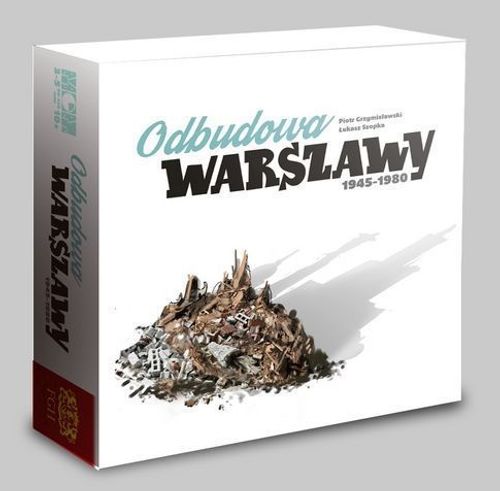
Warsaw Rising Up 1945-1980
Warsaw Rising Up 1945-1980: Advanced Variant
Table of Contents
Table of Contents
Goal of the Game
In "Warsaw Rising Up 1945-1980" the players' task is to rebuild the capital. To do so, participants will carry out building projects, create the metro or build bridges over the Vistula. For each completed object a player receives victory points. Players earn additional points at the end of the game depending on which other buildings neighbour the objects they built.
"Warsaw Rising Up 1945-1980" is a unique game designed for both beginners and advanced players. The box contains the rules in two variants: family and advanced. This rulebook is devoted to the advanced game. If you want to play the family variant, see the other part of the rulebook.
Components and Setup of the Advanced Variant
-
Place the board in the middle of the table. It shows a map of Warsaw divided into 37 hex spaces. The board is divided into an urban zone and a suburban zone. The suburban zone is the outermost ring of 18 hexes. The urban zone is formed by the remaining 19 hexes in the centre of the board. Around the board is a victory point track to mark each player's progress during the game. The board also has a round track that shows the passage of time during the game. The first four rounds are the first stage of the game (Reconstruction); rounds 5-8 belong to the second stage (Modernization). Place the round marker on the space marked with the numeral I. The board also has a legend reminding of the adjacency scoring rules. Adjacency points are awarded at the end of the game.
-
Next to the construction board, place the action board intended for the appropriate number of players.
-
(sic) In a 3-player game, randomly place 7 neutral building tokens on the spaces of right-bank Warsaw. In a 3-player game players may not build any buildings or metro on the right part of the board, but can still connect spaces on both sides of the Vistula with bridges.
-
Place 1 rubble marker (black wooden cube) on each empty hex of the board belonging to the urban zone. In a 3-player game place markers only on the hexes of left-bank Warsaw belonging to the urban zone (16 hexes); in a 4-5 player game place rubble markers (19 pieces) on all spaces of the urban zone (note in the source: not the outermost ring of hexes). Place the remaining rubble markers, as well as the concrete and funds markers, next to the board so that players have free access to them, forming the resource bank.
-
Each player receives 15 hexes of rebuilt Warsaw in their colour, 6 metro markers and engineer markers (of the same colour). In a 3- and 4-player game each player receives 4 engineers, in a 5-player game only 3 (in that case the fourth marker can be put back in the box). The player also receives a score marker in their colour, which is placed on the board's score track on the space with the number 0.
-
Divide the 60 building project cards into two parts according to the stage they belong to. Shuffle the Stage I cards (which we call the stage of reconstruction) and place them in a face-down pile next to the board. Place the Stage II cards aside; they will be needed later in the game.
Project Cards
Each project card has several pieces of information important for the game:
-
Name of the building.
-
Point value: the number of points the player scores immediately after building the building.
-
Colour of the card: determines the type of building.
-
Zone restrictions: some buildings can only be built in the appropriate zone, as marked on the card of that project.
-
Function: a special bonus the player can use during the game if they complete the project.
-
Stage number: the stage the card comes from.
-
Also divide the urban planning task cards into decks assigned to each stage. Shuffle the Stage I cards and place them next to the board, then reveal the top three cards and lay them out in a visible place. Set the Stage II cards aside; they will be needed later in the game.
Urban Planning Task Cards
Each urban planning task card shows the number of points that can be gained for completing the task and the condition that must be met to complete it. As a rule, it consists of placing a specific type of building next to a building of a given type that is already on the board. When completing urban planning tasks, pay attention to the order of buildings listed on the card. If a task says to build a Residential building next to a Cultural building, the player receives points only if they place the Residential building on a hex bordering the hex with a previously built Cultural building. The reverse situation, building a Cultural building next to an already existing Residential building, does not complete the task and does not bring the player additional points.
Some urban planning tasks may require the player to build a building in the Socialist Realist or Modernist style next to a specific type of already existing building. Information on which architectural style a building belongs to is on the card in the name of the function (the function text is not used in the family variant). If a player wants to complete a task consisting of building a Socialist Realist or Modernist building next to a specific type of building, they must build a building whose function is named Architecture of Socialist Realism / Architecture of Modernism next to an existing building of the type indicated by the urban planning task card.
- Shuffle the norm cards and deal two of them to each player. Each player secretly chooses one card, which determines the norm they will have to fulfil during the game. Discard the other card and put it in the box together with the unused cards.
Norm Cards
Each norm card specifies a set of objects the player must build during the game. In a 3- or 4-player game the set consists of 4 objects. In a 5-player game the last element of the set (marked on the card) is ignored; in that case players must try to complete sets of 3 elements. The norm is fulfilled if at the end of the game the player has at least one complete set of the required objects. In that case they receive an additional 3 points. If the player does not complete at least one set, they must subtract 3 points from those they scored during the game. A norm can be fulfilled several times, each time giving the player additional points. That is, if at the end of the game a player has 2 complete sets required by the norm card (but observing the rule that one object can be used in only one set), the player receives 6 points instead of 3.
-
Place all 60 wooden buildings, 4 bridge markers and the tunnel marker next to the board.
-
Put the remaining components (action boards, turn marker and first player marker) back in the box; they are not used in the family variant. (Transcribed as printed; in the advanced variant the action board and first player marker are used, see steps 2 and 10 and the Planning phase.)
-
Finally, randomly determine the player who will begin the game and give them the priority marker.
Course of the Game
The game is divided into two stages: Reconstruction (Stage I) and Modernization (Stage II) of Warsaw. Each stage is 4 game rounds, each of which consists of several successive phases:
1. Capital Reconstruction Office
In this phase, top up the number of urban planning tasks so that at the start of the round three of them are revealed. If Stage I has just ended and you are starting round 5, remove all Stage I urban planning task cards and lay out three completely new tasks from the previously shuffled Stage II urban planning task deck.
2. Planning
Each player has a set of engineers that they can use in the planning phase to perform individual actions. Players in turn (clockwise), starting with the one who has the priority marker, use 1 of their engineers each time, sending it on a delegation (placing it on a chosen space of the action board) or pouring foundations (placing it on a free, cleared space of the construction board).
Delegation
By choosing this action the player places their engineer on a chosen unoccupied space of the action board, and then performs the action assigned to that space. Most spaces on the action board can be occupied by only one engineer; if one is already there, the player cannot use that space in the given round. The exception is 3 unlimited spaces (see the space descriptions below): there is no limit to the number of engineers that can be on them (a player may send their engineer to such a space even if another engineer is there).
The boxes below describe all spaces for the individual variants in the game. (The boxes are not present in the source PDF.)
ATTENTION!!! At any moment of the game a player may hold no more than 3 markers of the same resource. This applies to rubble, concrete, funds and project cards.
Pouring Foundations
This is preparation for building a specific building. To perform this action the player must lay out in front of them a chosen project card from their hand, placing on that card a wooden building in the colour of the card laid out. Then the player must place their engineer on a chosen free, cleared space of the board. Additionally, this space must comply with the location restrictions for the given project. In the realization phase the player will be able to finish their projects on the spaces where they poured foundations.
ATTENTION!!! Some project cards have text restricting where the building may be built. It specifies whether the building is to be built in the urban or suburban zone. This means the player may build the building only in the zone written on the card. The game also contains 4 special buildings related to historical reconstruction. In their case the player may build them only in a specific place marked on the map. Additionally, in the first stage no player may build in these places any building other than the one indicated on the board. In the second stage these restrictions disappear: in the place of historical buildings any other building can be built, provided that no other building was previously built there.
Pass
When a player has no more engineers, or does not want to use them in this round, they must pass. A player who has passed cannot take any actions in the planning phase until the end of the round (a player cannot return to the planning phase after passing).
The planning phase ends when all players have passed. After this phase, all engineer markers on the action board (but not on the main board) return to their owners.
3. Realization of Projects
In this phase players (clockwise) build the projects begun earlier, as well as metro and bridges. On their turn a player may build any number of buildings that they laid out during the "pouring foundations" action (these are buildings under construction, that is, those lying in front of the player with a wooden building marker on them) and any number of metro sections or bridges. Each object has a cost that must be paid during construction. In the project realization phase a player may erect objects in any order within their own turn. This may matter for completing urban planning tasks (see below).
Building: cost 1 Fund and 1 Concrete marker, or 1 Fund and 2 Rubble markers.
When placing a building the player must return the required markers to the bank. Then they remove their engineer from the chosen space of the construction board and in its place put their hex, placing on it the wooden building marker from the appropriate card that was under construction. The project card is set aside with the buildings completed by that player. From this moment the player may use the function of the completed building.
Project Card Functions
Each project card has a function that can help the player during the game. After paying the cost (and thus building the building), the function on the project card is from then on available to the player. Some functions have permanent effect; others must be activated by the player and can be used only once during the game. A player may use a given function at any moment of their turn (whether in the planning phase or during project realization). Some functions must be used at a specific moment, in response to some action of another player.
After using a single-use function, rotate the project card 90 degrees clockwise to mark that the player has already used that function and will not be able to use it for the rest of the game.
Functions cannot be used if the project is still under construction.
After completing a project the player receives the victory points written on the card and any points resulting from completing urban planning tasks. If the player did not have enough resources to complete one of their buildings (or for some reason the player did not want to build a given building this turn), the engineer marker stays on the board until the next "realization of projects" phase.
INDUSTRIAL BUILDINGS. Most buildings in the game have a fixed number of victory points received by the player who completes the project. The exception is industrial buildings, which give a base of 2 victory points plus an additional 1 point for each unbuilt space that borders such a building at the moment it is built. Spaces with rubble are also treated as unbuilt and bring additional points if they border the industrial building just built.
COMPLETING URBAN PLANNING TASKS. During the game there are 3 revealed urban planning task cards on the table. A player who meets the condition written on an urban planning task card receives the indicated number of points. The urban planning task is then removed from the game. By building a single building a player may complete several urban planning tasks at once, receiving points for each completed task. At the start of each round, in the "Capital Reconstruction Office" phase, reveal new urban planning task cards, topping their number up to three.
Metro: cost 1 Fund.
A player may build any number of metro sections provided they still have the appropriate markers in their supply. When a player builds the metro, they take the appropriate marker in their colour and place it in the chosen place on the board (between two hexes). If the player has no more metro markers, they can no longer perform this action. If it is the first section of metro in the game, the player may place it anywhere; otherwise the built section must be a continuation of one of the previously built metro sections.
In the first stage players may build only 1 metro line (they cannot create branches). In the second stage they may continue building the Stage I metro line or begin building another by branching the already existing metro line. No third metro line may be created in the game.
For each metro section built, the player immediately receives 1 victory point.
ATTENTION!!! When building the metro, players must remember a few additional rules:
- The metro cannot be built along the perimeter of the board (the metro must always border at least two adjacent hexes). If a metro line reaches the edge, it is considered finished on that side.
- The metro cannot be looped: you cannot build a section of metro in such a way that previously built metro sections lie at both ends of the newly built section.
- The metro cannot be built along the river. When a metro line reaches the river, the player who placed that section takes the tunnel marker from the bank and places it on the river so that it connects the section just built with the other bank of the river (so that the next section can be built between two hexes).
- The player receives 1 point for each metro section built. No additional points are awarded for building the tunnel.
Bridges: cost 1 Fund + 1 Concrete marker + 1 Rubble marker, or 1 Fund + 3 Rubble markers, or 1 Fund + 2 Concrete markers.
As with the metro, a player may build any number of bridges as long as they can afford it and still have some metro markers. Bridges connect hexes on both sides of the Vistula. A bridge must be built so that it connects the edges of hexes adjacent to the river. When a player decides to build a bridge, they return one of their metro markers to the bank and take a bridge marker, placing it on the board in the chosen place. For each bridge built the player receives 4 victory points. During the game players may build a maximum of 4 bridges.
After the Realization phase ends, the round is over. Move the marker to the next space on the time track and begin the next round. All engineer markers should return to the players, except those marking the places of unfinished projects on the construction board.
End of Stage I
Stage I (Reconstruction of Warsaw) ends with the end of round 4. At that point put the Stage I project card deck back in the box and replace it with the shuffled Stage II project card deck. Players must also discard all project cards they hold in hand. Buildings under construction (lying in front of the player with the appropriate building marker on the card) are not discarded. They can be finished in the next stage.
Do likewise with the urban planning task deck, placing the shuffled Stage II cards in the place of the Stage I deck. At the same time, remove all revealed (uncompleted) urban planning tasks. At the start of the new, fifth round, 3 completely new tasks from Stage II appear.
Cards of buildings completed in the first stage remain on the table in front of the players, who can still use their functions.
Differences Between Stage I and Stage II
The second stage of the game is very similar to the first. Play follows the same rules in successive rounds. However, there are some modifications to the rules that must be introduced from the moment Stage II begins.
New Metro Line
Players may build a second metro line by branching an existing one. The player who first creates a metro branch by adding a new section to an already existing line begins construction of the second line. From that moment players may add new metro sections to either of the two existing lines.
Historical Zone
If by the start of Stage II any of the spaces of the historical zone remained unbuilt (nobody built the corresponding historical building there), players may place in these places any building that can be built in the urban zone.
End of the Game
The second stage, and thus the whole game, ends when:
- the last space on the construction board is built up; in that case the current round ends, after which the game ends.
- the last, eighth round of the game is finished.
Scoring and Determining the Winner
After the game ends, proceed to count points. The game is won by the player who has scored the most victory points at the end. They can be scored through:
Building Various Objects
Players receive points during the game at the moment of building a building (depending on the project card), a bridge (4 points) or a metro section (1 point).
Completing Urban Planning Tasks
Scored by players during the game when they manage to complete one of the urban planning tasks.
Adjacency
Adjacency points are calculated at the end of the game. Each building on the board can bring the player who built it (determined by the colour of the hex the building stands on) a specific number of points depending on which buildings it neighbours. We suggest calculating points for each player in turn. Below is a table describing which adjacencies give points. Points from the table below are cumulative. For example, a player whose Residential building borders 2 Service buildings and 1 Transport building receives 3 additional points for this building at the end of the game.
| Type of building | Adjacent to | Points |
|---|---|---|
| Industrial | Unbuilt space (at the end of the game) | +1 |
| Service | Residential | +1 |
| Residential | Service or Transport | +1 |
| Representative | Cultural | +1 |
| Cultural | Representative | +1 |
| Transport | Gives no adjacency points with other buildings | 0 |
Additionally, each building of a player that neighbours the metro (regardless of how many sections and by whom they were built) receives 1 additional point.
INDUSTRIAL AND TRANSPORT BUILDINGS. When counting adjacency points, industrial buildings receive points for bordering unbuilt spaces of the board (as at the moment they were built). Transport buildings bring no additional points for adjacency with other buildings. All buildings (including Transport and Industrial) are worth 1 additional point if they border at least one metro section.
Completing Norms
At the end of the game it remains to assess how well the players managed to fulfil the norms they chose at the beginning of the game. If a player fulfilled the Norm by collecting one full set of the required objects (100% of the norm), they receive 3 points. If they fulfilled the norm several times (built objects that allow assembling several complete sets required by the norm), they receive 3 victory points for each unique complete set of objects. If the player did not manage to fulfil the Norm, they lose 3 points.
Functions: Architecture of Socialist Realism and Architecture of Modernism
The game has two functions that can be a source of additional points for a player: the Architecture of Socialist Realism and Architecture of Modernism functions. At the end of the game the player who has the most buildings in a given architectural style receives an additional 5 points. Both kinds of function are resolved this way, and additional points are awarded to the appropriate player for each of them. In case of a tie in the number of cards held, all tied players receive 3 victory points each.
The player who scored the most victory points wins the game. In case of a tie, the player who built the most buildings wins. If there is still a tie, the players share the victory.