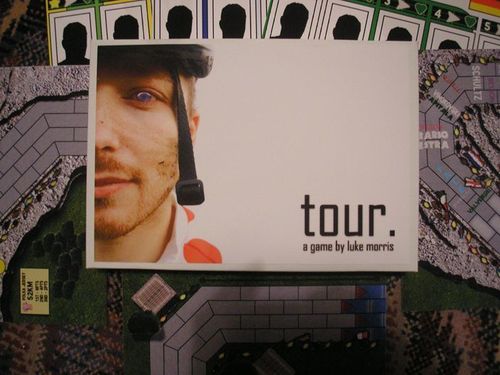
Tour
Tour Advanced Rulebook
Table of Contents
Table of Contents
Additional Stages
The stage boards are listed below with their distances. Each jersey symbol marks a checkpoint at that distance: green for a green jersey (sprint) checkpoint, red and white polka dot for a mountain checkpoint. The board art is not reproduced here.
- Montauban to Angouleme: green jersey 145km; polka dot 126km; polka dot 92km
- Dax to Cahors: green jersey 131km; polka dot 106km; green jersey 34km
- Perigueux to Angers: green jersey 141km; green jersey 120km; polka dot 86km; green jersey 30km (footnote 3, see the stage notes below)
- Team Time Trial: 82km
- Bourges to Troyes: green jersey 129km; polka dot 124km; polka dot 68km
- Troyes to Reims: green jersey 137km; green jersey 128km; green jersey 100km; green jersey 66km
Stage notes
The following notes are printed on the handbook page with the Team Time Trial board. The page does not label them, but the note box beginning "Race only to red flags" appears to be the footnote 3 marked on the Perigueux to Angers 30km entry (the printed marker is a superscript 3 and no other footnote 3 is printed).
- Footnote 3 (as printed): Race only to red flags. Green jersey checkpoint is ignored. For "Paris" add the final kilometre board and all cyclists race together. The green checkpoint is used.
- Team Time Trial: Team time trials are raced by a team working together. Each round of movement for a team counts as +1 time. The clock stops when the last cyclist in the team crosses the line. When one team crosses the green checkpoint the next team starts. The fastest team is scored as +0 with every other team calculating their times from this.
- Team Time Trial example: Casse Vasse start first. When their last cyclist crosses the green checkpoint Capitala start and so on. Each team must start in the furthest back starting spaces.
- Team Time Trial jerseys: No green jersey points are awarded at all in team time trial.
Scenario 1: Tour of France
Race the stages in order. This will take you a number of gaming sessions to complete, so perfect with a regular group!
The Tour of France is a large tour combining flat, mountainous and rolling stages to test a cyclist to his limit. Starting with a flat, long stage, the tour takes in a few days in the north of France before, via a team time trial, heading down to the south and massif central to test the mountain men before a short final parade through Paris for the sprinters to fight for the glory of crossing the line first.
Stage listing:
- Orleans to Poitiers
- Bourges to Troyes
- Troyes to Reims
- Team Time Trial
- Dax to Cahors
- Perigueux to Angers
- Montauban to Angouleme
- Angouleme to Gueret
- Paris (Time Trial track)
Predictions: Apart from stage 2, the first six stages favour the powerful sprinters and flat riders (five and six only have one short climb each). The mountain men have to wait until stage 7 to really put a dent in the lead of the flat riders and pull their way back up the rankings. The sprinters can really struggle over these two days and by the time the final stage begins, only the very strongest cyclists will have a chance of overall victory and the coveted yellow jersey!
Yellow Jersey: The yellow jersey goes to the cyclist with the lowest overall time. The yellow jersey is awarded after every stage to the overall time leader. The first cyclist to cross the finishing line in a stage scores +0 with a time bonus of -1. Any other cyclists that cross the line in that turn also score +0. Anyone who crosses a turn behind scores +1, a turn behind that is +2, +3, +4 and so on. Cyclists crossing the line on the same turn score the same time.
For example: On stage 1 Ramsay wins (-1), Schultz crosses on the same turn in second (+0), one turn later Steele finishes (+1) then Kawada two after that (+3) and Besson five turns after the leader (+5). Ramsay claims the yellow jersey and the yellow jersey card is placed under his cyclist card on the team board. In stage 2 Besson wins (-1), Schultz second again one turn behind (+1) then Kawada (+3), Ramsay (+6) and Steele (+7). Overall times after two stages are: Schultz (1), Besson (4), Ramsay (5), Kawada (6), Steele (8). Schultz would receive the yellow jersey before stage 3.
Whoever has the jersey after the final stage is the overall champion!
Green Jersey: The green jersey is awarded to the cyclist who is the quickest, most explosive sprinter over the course of the tour. The first three cyclists through the green checkpoints on a stage score 6, 4 and 2 points towards their total, while the top 6 cyclists to finish a stage score 10, 8, 6, 4, 2, 1 points.
Often a cyclist will race purely for the green jersey, knowing that they will not be able to keep up in the mountains due to specialising in flat sprinting.
In the Tour of France there are 140 points MAXIMUM for a green jersey contender to aim towards. Of course, the more points they win, the less likely opponents will be to let them break away for bonus points!
The green jersey card is placed under the cyclist card of the cyclist with the most points before each stage. Whoever has the green jersey after the final stage wins the points competition! If a cyclist holds yellow AND green jersey then the green jersey is worn by the second placed green jersey rider.
A cyclist can win more than one category.
King Of The Mountains: The polka dot jersey is awarded to the cyclist who has performed most successfully in the draining mountains of the tour.
Points for this competition are awarded for the first three cyclists to cross a red checkpoint. 6, 4 and 2 respectively. No points are awarded for finishing in the top 6 of a stage.
This is a real chance for the mountain men to show their mettle if they cannot win the overall standings, and often cyclists compete purely for the honour of wearing the polka dot jersey.
In the Tour of France there are 54 points MAXIMUM for a polka dot jersey contender to aim towards. Of course, the more points they win, the less likely opponents will be to let them break away for bonus points!
The polka dot jersey card is placed under the cyclist card of the cyclist with the most points before each stage. Whoever has the polka jersey after the final stage becomes King Of The Mountains! If a cyclist holds yellow AND polka jersey then the polka jersey is worn by the second placed polka jersey rider.
A cyclist can win more than one category.
Under 25s: The light blue Under 25s jersey is awarded to the cyclist, aged 24 or younger, who has the lowest overall time. It is awarded the same as the yellow jersey but can only be won by a cyclist aged 24 or below.
If the same cyclist holds the U25 and another jersey the U25 jersey is worn by the second placed eligible cyclist.
A cyclist can win more than one category.
Team Competition: Keep the sponsors happy! Decide before the tour how many cyclists are being counted for the overall team competition. The team who wins the competition is the team who have the lowest overall time score for the chosen number of cyclists.
For example, if each team has 5 cyclists and it is decided that the times of the best 3 from each team are chosen then the lowest 3 individual times from each team are added and the lowest team score wins!
Guidelines: Always score more than one cyclist per team. Never demand the score of EVERY cyclist in the team (this allows for a single poor performance or injury to not decide the results).
Score sheets: For the Tour of France each team will need two of the following score sheets (print double-sided for ease!)
- Yellow jersey sheet: After each stage write the cyclist's time for that stage. Then the overall time for the cyclist (this shows who is winning overall) and then how far back from the leader's time this cyclist is. Columns: Overall Classification; stage one, stage two, stage three, stage four, each with time, overall and diff. Cyclist names go in here in relevant numbered position.
- Points classification sheet (green jersey): Columns for each stage with points and overall. For each stage of the race enter the green jersey points scored and the new overall score. Race notes space for notes and plans.
- Mountain classification sheet (polka dot): Columns for each stage with points and overall. For each stage of the race enter the polka dot points scored and also the cyclist's new overall score.
Unfortunately for the Tour of France there is no space for the final stage. Write the final times and scores next to the cyclist's name!
Scenario 2: Tour du Nord
Race the stages in order. A shorter tour that can be played between 1 (LONG!) and 4 sessions. Ideal to get the feel of tours.
Stage listing:
- Bourges to Troyes
- Troyes to Reims
- Paris (Time Trial track)
- Orleans to Poitiers
The Tour du Nord is a fast, mainly flat race that encourages exciting sprints, breakaways and frantic racing that requires perfect timing to win.
Bourges to Troyes is the only trouble for the sprint specialists but even this stage has a flat start and a couple of flat kilometres before the final sprint. The rest of the tour is flat and fast as the cyclists take in the countryside of Northern France. The final stage is the massive Orleans to Poitiers that needs perfect timing to win.
Predictions: Teams are wise not to focus too heavily on the first stage. The polka dot jersey is only fought for on this stage and mountain riders may not fare so well in later stages. Placing all mountain hopes in one decent mountain climber may be wise tactics. On flat stages the (-1) first place finishing bonus could swing the tour. The green jersey is prestigious here.
Jerseys: Yellow Jersey; Green Jersey (82 points maximum); Polka Dot Jersey (12 points maximum); U25 Jersey; Team Competition.
Each team needs one tour. score sheet as shown on "Tour Of France".
When racing a tour, each team must choose their cyclists (as shown in the basic game handbook) and must use these cyclists for EVERY stage. Therefore it is important to pick the best line-up for the stage selection!
For the Tour du Nord the teams need to focus more on the powerful, sprinting cyclists, however, at least one cyclist who can climb well would massively help claim a jersey or two.
If a cyclist has to drop out due to injury or is retired by the manager then they drop out of the WHOLE tour. They must finish a stage in order to continue onto the next.
Scenario 3: Massif Tour
Race the stages in order. A shorter tour that can be played between 1 (LONG!) and 4 sessions. Intermediate difficulty.
Stage listing:
- Perigueux to Angers
- Montauban to Angouleme
- Angouleme to Gueret
- Dax to Cahors
The Massif Tour is all about mountains. One for the climbers - a short sharp tour that builds up to two miserable days before a relatively easy finish.
While the flatter cyclists may fancy their chances in the opening and final stages, stages 2 and 3 belong purely to the mountain men who will fight for the coveted King Of The Mountains across some large Massif Central mountains and hills. It's not unheard of for a mountain climber to win the green jersey!
Predictions: Teams have got to go with their climbers. No sprinter will win the tour, that's for sure. While they can perform on the flat run-ins of the first and final stages, many practically give up in the horrific mountains. The second stage features the longest, most gruelling climb of the season. If it's not a star all rounder who wins, it'll be a climber.
Jerseys: Yellow Jersey; Green Jersey (58 points maximum); Polka Dot Jersey (42 points maximum); U25 Jersey; Team Competition.
Each team needs one tour. score sheet as shown on "Tour Of France".
When racing a tour, each team must choose their cyclists (as shown in the basic game handbook) and must use these cyclists for EVERY stage. Therefore it is important to pick the best line-up for the stage selection!
For the Massif Tour the teams need to focus more on the resilient, mountain specialists, although the first and fourth stages are open for sprint finishes and with a good run from a flat specialist... Who knows...
If a cyclist has to drop out due to injury or is retired by the manager then they drop out of the WHOLE tour. They must finish a stage in order to continue onto the next.
Scenario 4: Paris Invitational
Race the stages in order. A short tour racing the same stage in three different ways! Can be played in a couple of sessions.
Stage listing:
- Team Time Trial
- Individual Time Trial
- Paris (Time Trial track)
The Paris Invitational is about short, sharp, explosive racing. There are NO green jersey points and NO polka dots in sight. The event was set up as a three day racing festival that would draw spectators, sponsors and a carnival atmosphere.
The first day is the team time trial - an exciting spectacle on the Parisian streets.
The second day is the solo time trial - raced on the same stage as the team event but one man against the clock. Starting order is drawn at random and finishing times are calculated in the same way as the team time trial.
Special Rule: In individual time trial when a cyclist's resilience reaches zero start it again ON FIVE and take away 1 from each movement roll. If it reaches zero again THEN maximum movement is 2.
The final day is the full stage with all racers. Remember no green jersey points are awarded but the winner of this stage receives a (-1) time bonus.
Predictions: The fast, powerful and resilient cyclists will win - but only if they have a good team to support them in the team time trial.
Jerseys: Yellow Jersey; U25 Jersey; Team Competition.
Each team needs one tour. score sheet as shown on "Tour Of France".
When racing a tour, each team must choose their cyclists (as shown in the basic game handbook) and must use these cyclists for EVERY stage. Therefore it is important to pick the best line-up for the stage selection!
For the Paris Invitational bring your fast, exciting cyclists. Make sure your team can work together for the team time trial and that your yellow jersey contender has the resilience to power around the individual time trial. The individual trial is a bit of a dice fest but the strongest will usually reign victorious.
If a cyclist has to drop out due to injury or is retired by the manager then they drop out of the WHOLE tour. They must finish a stage in order to continue onto the next.
Scenario 5: Le Petit Tour
Race the stages in order. A five stage tour that provides a mixture of racing styles. Can be played over a few sessions.
Stage listing:
- Troyes to Reims
- Perigueux to Angers
- Angouleme to Gueret
- Orleans to Poitiers
- Bourges to Troyes
- (optional) Individual Time Trial
Le Petit Tour gives a feeling of varied racing over a shorter period than the full Tour of France. Two big mountain stages, two flat stages and an intermediate hilly stage give everything a tour manager could want - but over a shorter amount of time! No time to play the full tour? Then fight through this. There's even an optional individual time trial to finish if the managers decide beforehand! Only the best all round cyclists and teams with the strongest strategies will claim victory in this tricky tour.
Predictions: Teams need to look for a mixture of sprinters, power men and mountain climbers to claim victory in each of the jersey competitions. Nearly any quality cyclist could win this event if they dig deep inside and give their all.
Jerseys: Yellow Jersey; Green Jersey (98 points maximum); Polka Dot Jersey (36 points maximum); U25 Jersey; Team Competition.
Each team needs two tour. score sheets as shown on "Tour Of France".
When racing a tour, each team must choose their cyclists (as shown in the basic game handbook) and must use these cyclists for EVERY stage. Therefore it is important to pick the best line-up for the stage selection!
For Le Petit Tour the teams need to focus on building a balanced team with a strong team leader, a sprinter, a mountain climber and a strong support to give them the edge in the team competition.
If a cyclist has to drop out due to injury or is retired by the manager then they drop out of the WHOLE tour. They must finish a stage in order to continue onto the next.
Scenario 6: Short Season
Complete the tours and races in the order that best suit your sessions. This short season is a good intro.
Season listing:
- Orleans to Poitiers Classic
- Massif Tour (4 stages)
- Angouleme to Gueret Classic
- Paris Invitational (3 stages)
The Short Season provides managers with the chance to play two single stage races (otherwise known as Classics) as well as a shorter tour and finish with the short crowd-favourite Paris Invitational.
At the start of the season each team should choose a squad for the season. Then the managers decide how many cyclists from each team can be entered for each classic or tour. This is up to the managers to decide between themselves. This allows managers to choose their best team for each race from their squad. So mountain men for the Massif Tour and power men for the Paris Invitational for example.
In classic races polka dot and green jerseys are not involved. Only the race winning yellow jersey, the under 25 and team competition takes place.
Prize Money:
- Orleans to Poitiers Classic: Race winner £10,000; Team winner £10,000; Under 25 winner £5,000
- Massif Tour: Stage wins £5,000 per stage; Yellow Jersey winner £20,000; Green Jersey winner £10,000; Polka Dot Jersey winner £10,000; Team winner £15,000; Under 25 winner £8,000
- Angouleme to Gueret Classic: Race winner £10,000; Team winner £10,000; Under 25 winner £5,000
- Paris Invitational: Team Time Trial winner £8,000; Individual Time Trial winner £8,000; Final Stage winner £10,000; Yellow Jersey winner £20,000; Team winner £15,000; Under 25 winner £8,000
- Total: £199,000
Money is earned by winning all the different categories. The team with the most money at the end of the season wins!
Playing more than one season: If the managers want to play more than one season then the money earned is added to a sponsorship income of £35,000 each team to give a budget for the next season.
In order to keep a star cyclist for the next season a team manager must pay £20,000. To keep another cyclist in their team they must pay £10,000.
A team manager can release a star cyclist back to the pool and receive £15,000 or another cyclist for £5,000. They then pay £1,000 per skill point for each cyclist they wish to purchase (they cannot buy back a cyclist they have sold that season).
For example, Clint Scott has 3 Sprints, 3 Mountains, 3 Power and 3 Resilience and therefore would cost £12,000.
Managers make one decision each clockwise until every manager is happy with their team for the new season.
Scenario 7: Long Season
Complete the tours and races in the order that best suit your sessions. This long season is getting serious!
Season listing:
- Orleans to Poitiers Classic
- Tour du Nord (4 stages)
- Angouleme to Gueret Classic
- Paris Invitational (3 stages)
- Le Petit Tour (5/6 stages)
- Bourges to Troyes Classic
The Long Season provides managers with the chance to play three single stage races as well as two varied tours and the Paris Invitational.
At the start of the season each team should choose a squad for the season. Then the managers decide how many cyclists from each team can be entered for each classic or tour. This is up to the managers to decide between themselves. This allows managers to choose their best team for each race from their squad. So strong all-rounders for Le Petit Tour and power men for the Paris Invitational for example.
In classic races polka dot and green jerseys are not involved. Only the race winning yellow jersey, the under 25 and team competition takes place.
Prize Money:
- Orleans to Poitiers Classic: Race winner £7,000; Team winner £7,000; Under 25 winner £3,000
- Tour du Nord: Stage wins £3,000 per stage; Yellow Jersey winner £15,000; Green Jersey winner £7,000; Polka Dot Jersey winner £7,000; Team winner £10,000; Under 25 winner £5,000
- Angouleme to Gueret Classic: Race winner £7,000; Team winner £7,000; Under 25 winner £3,000
- Paris Invitational: Team Time Trial winner £5,000; Individual Time Trial winner £5,000; Final Stage winner £7,000; Yellow Jersey winner £15,000; Team winner £10,000; Under 25 winner £5,000
- Le Petit Tour: Stage wins £3,000 per stage; Yellow Jersey winner £15,000; Green Jersey winner £7,000; Polka Dot Jersey winner £7,000; Team winner £10,000; Under 25 winner £5,000
- Bourges to Troyes Classic: Race winner £7,000; Team winner £7,000; Under 25 winner £3,000
- Total: £210,000/£213,000
Money is earned by winning all the different categories. The team with the most money at the end of the season wins!
Playing more than one season: See guidelines for Short Season.
Scenario 8: Uber Season
Complete the tours and races in the order that best suit your sessions. This Uber Season will keep you going for months!
Season listing:
- Orleans to Poitiers Classic
- Tour du Nord (4 stages)
- Angouleme to Gueret Classic
- Paris Invitational (3 stages)
- Massif Tour (4 stages)
- Troyes to Reims Classic
- Tour of France (9 stages)
- Bourges to Troyes Classic
The Uber Season provides managers with the chance to play the most varied season with four classic races interspersed between two short tours, the Paris Invitational and, as the highlight of the season, the Tour of France!
At the start of the season each team should choose a squad for the season. Then the managers decide how many cyclists from each team can be entered for each classic or tour. This is up to the managers to decide between themselves. This allows managers to choose their best team for each race from their squad. So strong all-rounders for the Tour of France and power men for the Paris Invitational for example.
In classic races polka dot and green jerseys are not involved. Only the race winning yellow jersey, the under 25 and team competition takes place.
Prize Money:
- Orleans to Poitiers Classic: Race winner £4,000; Team winner £4,000; Under 25 winner £2,000
- Tour du Nord: Stage wins £2,000 per stage; Yellow Jersey winner £10,000; Green Jersey winner £5,000; Polka Dot Jersey winner £5,000; Team winner £7,000; Under 25 winner £4,000
- Angouleme to Gueret Classic: Race winner £4,000; Team winner £4,000; Under 25 winner £2,000
- Paris Invitational: Team Time Trial winner £3,000; Individual Time Trial winner £3,000; Final Stage winner £4,000; Yellow Jersey winner £12,000; Team winner £8,000; Under 25 winner £4,000
- Massif Tour: Stage wins £2,000 per stage; Yellow Jersey winner £10,000; Green Jersey winner £5,000; Polka Dot Jersey winner £5,000; Team winner £7,000; Under 25 winner £4,000
- Troyes to Reims Classic: Race winner £4,000; Team winner £4,000; Under 25 winner £2,000
- Tour of France: Stage wins £3,000 per stage; Yellow Jersey winner £15,000; Green Jersey winner £7,000; Polka Dot Jersey winner £7,000; Team winner £10,000; Under 25 winner £5,000
- Bourges to Troyes Classic: Race winner £4,000; Team winner £4,000; Under 25 winner £2,000
- Total: £223,000
Money is earned by winning all the different categories. The team with the most money at the end of the season wins!
Playing more than one season: See guidelines for Short Season.
What You Need to Know
So how do I keep track of a season? There are score sheets provided (photocopy or download more copies from www.boardgamegeek.com/game/25105) for classics and tours. The classic race score sheets double as sheets for one off races. To keep track of season money earned and results keep a notebook or piece of paper to hand.
What's the difference between a squad and a team? A squad can contain more than five members. Squads are used for seasons and a manager can choose which cyclists to include in their team for each race or tour. Within a tour the same cyclists must be kept in the team. Managers keep squad members beside their team board.
If a cyclist gets injured in one race or tour is he out for the next race? No. He is out of the race or tour, but he is available for selection for the next event. Managers can choose to impose an injury period if they desire, but as far as the official rules go, this is not the case.
Can I make my own tours, stages and seasons? Please do. These scenarios are here to give you a good starting point!
How many cyclists do each team have for each race? It's up to the managers concerned to decide unanimously for each occasion. Use common sense though - if only two teams are competing then think about each entering at least four cyclists. With six teams having five cyclists each will be a lot more time consuming than three or four.
Team competition? What? In pro cycling, as well as individual victories, team victories are also decided by adding together the total times of the top three or four (or more!) cyclists from each team. When deciding on how many team members' times are added together, always allow for each team losing at least one cyclist to injury! So if each team enters five cyclists, the team competition should take the times of the best three from each team for example.
Using the CD for Weather Conditions
With your copy of tour. you should have received a CD which is jammed full of vocal tracks. These give possible weather conditions, special events and situations that add to the cycling world. After all, some cyclists thrive in certain conditions, and the French always fight to win a stage on Bastille Day!
If you decide you wish to use this in tour. then take the CD and place it in a player, setting the machine to random or jumble. Then randomly play one of the clips before each classic race or stage. After this you must obey the effects of the event (if there are any) for the rest of the stage (or race if you choose to play a one off classic race). In the event of a tour, a track is randomly played before each stage and only that one is obeyed.
If you wish to use this variation but do not have a CD player to hand then follow the following steps:
- Place 1 of each colour cyclist in two piles.
- Randomly and blindly take one cyclist from one pile (look at the appropriate column) then one cyclist from the other pile (look at the appropriate row).
- Obey the effects written in the chart.
Chart: the row is the first cyclist's colour, the column is the second cyclist's colour. Each cell gives the effect.
| Row \ Column | Red | Orange | Yellow | Green | Blue | Purple |
|---|---|---|---|---|---|---|
| Red | Bastille Day! All French cyclists can add 1 point | Perfect Conditions! All 3 & under rated power riders gain 1 power point | Huge Crowds! All 2 & under rated power gain 1 power point | 3 Scheil SFS cyclists gain 1 point to add as desired | Overconfidence led to night out! All team leaders must lose 2 resilience | Cool and breezy conditions |
| Orange | Independence Day! All US cyclists can add 1 point | Overcast & Heavy! All 4 and 5 rated power cyclists lose 1 power | Water Bottles plentiful on route! 2 resilience riders increase to 4 | 3 Casse Vasse cyclists gain 1 point to add as desired | Injury! Drop 2 points from one cyclist. Points must have effect * | Warm and pleasant conditions |
| Yellow | Wintery Conditions! All Russian, Latvian and Ukrainean cyclists add 1 point | Hot and Sticky! All 4 and 5 rated resilience cyclists lose 1 resilience | Morons with flags! All spaces with any flag cover cannot be moved into** | 3 Bario Estra cyclists gain 1 point to add as desired | Underdog gives an interview! One non-star cyclist per team gains 1 point | Early mist giving way to comfortable sunshine |
| Green | Cold & Raining! All German, British, Danish and Dutch cyclists add 1 point | Massive Headwinds All 4 and 5 rated mountain riders lose 1 mount point | Beautiful Podium Girls! All under 25 riders gain 1 skill point | 3 Capitala cyclists gain 1 point to add as desired | Team Spirit! All team leaders give 1 point to another team mate | Warm but with cool light winds |
| Blue | Hot & Humid! All Italian, Spanish and Australian cyclists add 1 point | Powerful Tailwinds! All 3 & under rated mountain riders gain 1 mount point | TV Expose on "old cyclists"! All 31+ age riders gain 1 skill point | 3 Team FATE cyclists gain 1 point to add as desired | EPO! All cyclists can choose to add 1 point for unfair advantage | Light cloud with sunny spells forecast all day |
| Purple | Strong Breezes! All Belgian, Swiss and Japanese cyclists add 1 point | High Crosswinds! All 4 and 5 rated sprinters lose 1 sprint point | Sponsorship! The stage winner will receive £3,000 extra | Regarde cyclists all gain 1 point to add as desired | Weight of expectations! 1 cyclist per team can lose 2 points* for £2,000 | A little chilly early on but with a warm breeze |
* For example, a manager cannot take off 2 mountain points on a flat stage.
** Except the English flag being waved on one of the boards otherwise there is no way through!