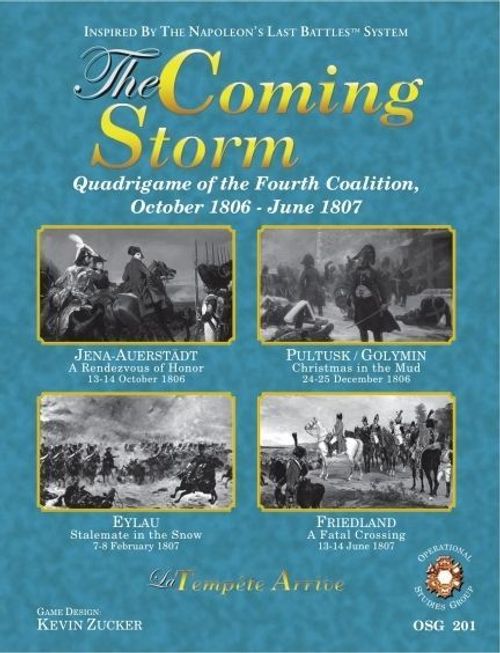
The Coming Storm: Quadrigame of the Fourth Coalition October 1806 - June 1807
The Coming Storm: Quadrigame of the Fourth Coalition October 1806 - June 1807 — Study Folder
Table of Contents
Table of Contents
- Game Components
- 25.0 Scenarios
- 26.0 Victory Conditions
- 27.0 The Battle of Jena-Auerstädt
- 28.0 The Battle of Pultusk-Golymin
- 29.0 The Battle of Eylau
- 30.0 The Battle of Friedland
- 31.0 The Campaign Game
- Historical Notes
- Jena-Auerstädt
- 13 October, Monday—Gera, 7 A.M.
- 8 A.M. Capellendorf. The Army Retreats
- Jena, 9 A.M.
- Gera, 9 A.M.
- 10 A.M. Fourth Bulletin of the Grande Armée
- Jena 2 P.M.
- Dornburger Schlöss 3 P.M.
- Lutzeroda
- Capellendorf
- Kösen, 6:30 P.M.
- Hassenhausen
- Orders for Davout, 10 P.M.
- Jena
- 12 Midnight, Apolda
- Jena
- 14 October, Tuesday—Jena
- 2 A.M. Reconnaissance
- 3 A.M. Naumburg
- 4 A.M. Landgrafenberg: Staff Meeting
- 5 A.M. Front Lines
- Pultusk-Golymin
- Eylau
- Friedland
- Jena-Auerstädt
- Design Notes
Game Components
- 4 Map Sheets, 22" x 34"
- 2 Counter Sheets: 560 die-cut playing pieces
- 2 Booklets: Series Rules, Study Folder
- 21 Player Aid Cards: Turn Record Cards x4, Initial Set-up x11 (5 French, 6 Coalition), Combined Casualty Record, Combat Results, Reorganization, Weather, Fog of War x2
- Adding the Cards Folder, 11" x 17"
- Combat Tables Folder, 11" x 17"
- Orders Slip Sheet/Sequence of Play
- Victory Worksheet
- Cards Removed from Deck/Scenario Parameters
- Game Box
NOT INCLUDED: An optional deck of 100 cards (the "Universal Deck") is not included; two 6-sided dice.
25.0 Scenarios
In 1806, Napoleon became the first general in history to march from the Rhine to the Vistula in one campaign. The Coming Storm documents the progression of battles that led the Grande Armée to the doorstep of Russia.
25.1 The Scenario Information
The Coming Storm includes four Battle Games, each with two scenarios, as well as a Campaign Game that links the battle games. Players select a scenario to play, and then refer to the Scenario Information. Sections 27.0 through 30.0 provide set-up and other scenario information for the four Battle Games:
- 27.0 Jena-Auerstädt, 13-14 October 1806
- 28.0 Pultusk-Golymin, 26 December 1806
- 29.0 Eylau, 7-8 February 1807
- 30.0 Friedland, 13-14 June 1807
(25.11) Turn Record Card (TRC): TRCs are provided for each battle. The Game-Turn marker is placed on the turn designated as the Game Start.
(25.12) One-Day Scenarios: Begin by playing any of the Day of Battle games (DoB): 14 October, 26 December, 8 February, 14 June. Move on to the Approach to Battle Scenarios.
(25.13) The Campaign Game: All four Approach to Battle games are played in chronological order. Depending upon the level of victory in the battles of Jena, Pultusk, and Golymin, one or both players may draw "Bonus Cards" on the second turn of Eylau and Friedland.
(25.14) French Player Nationalities: The French Player controls units of the French (blue), Guard (dark blue), 1807 Saxons (chamois), Polish (crimson), Württembergers (dark blue), Bavarians (green), Netherlands (white).
(25.15) Coalition Player Nationalities: The Coalition Player controls units of the Russians (brown), Prussians (Feldgrau), and 1806 Saxons (white).
(25.16) Vedettes: Vedettes can be used freely with any parent unit of the same nationality, disregarding unit I.D.
(25.17) Replacement Officers: Use replacement leaders ("Repl.") when an Officer is captured (see 5.52). To replace Commanders use any (4) Officer who is not in play. (Repl. brigades — see 25.76.)
(25.18) Prussian Army Commanders: Prussian Commanders including Scharnhorst (like all other commanders) may command any friendly officers or combat units, not limited to any particular army (see 27.36): the 1st Army fights at Auerstädt, the 2nd Army at Jena, and the 3rd Army arrives later.
(25.19) Distinguishing French Friedland counters: French Combat units and officers deployed only at Friedland — not available in the earlier battles — have a darker Initiative box (see Counter Sheet #2). The leaders Napoleon, Bessieres, Davout, and Ney; combat units Gde/Soules, Gde/Walther, and C/Wattier; vedettes of I/Beaumont, III/Geoffrey, VI/Colbert, and C/Wattier's 11th Chasseurs and Bavarian Kronprinz Chevauxlegers are used in both 1806 and 1807. C/Wattier gains a third vedette, the Württemburg Leib Chevauxlegers, at Friedland, hence his vedette number (2-3).
25.2 Setting Up the Scenarios
All units in play set up in supply as Hidden Forces. All reinforcements are in supply upon entry. Units may start in Road March at the owning player's option.
(25.21) Initial Set-up: The First Player sets up first. The units to set up are listed on the Initial Set-up Cards, specifying the location for each unit. Refer to the appropriate column by date for your battle. Units to set up at reduced strength show an ®. They are treated as having been eliminated and already reorganized. A BLANK indicates a unit not available in that battle.
(25.22) Hex Numbers: The hex numbers on the Initial Set-up cards show where units are located at the start of the scenario. (In the Friedland Scenario, hex numbers with an "E" prefix are set up on the Eylau map section that adjoins the Friedland map.) Place all combat units and leaders on the map in the hexes specified, or within 1 or 2 hexes as shown by a number in parenthesis. If there is no hex number listed, the unit is not placed in the PEU box, but is out of play; it may appear as an Alternate Reinforcement.
The second player may adjust the set-up of any one friendly unit by one hex prior to the first player turn (not in an EZOC). The set-up may include overstacked hexes. Make sure to observe stacking limits on your first move.
(25.23) Reinforcements: Reinforcement arrival is listed on the Turn Record Card (as modified by the play of Arrival Cards). If the formation designation follows an officer's name, all units of that formation arrive on the same turn unless otherwise specified; "div." indicates all units of that division arrive.
(25.24) Pontoon Trains: Availability of pontoon trains is specified in the scenario information. Available Pontoon Trains must be set up within [7] hexes of any friendly Commander unless otherwise specified.
(25.25) Baggage Trains: All Baggage Trains set up within [7] hexes of any unit in their respective formation or enter as reinforcements, unless otherwise specified. Each formation has its dedicated baggage train available if the formation has three or more units in play. Use the French 1806 baggage trains in all battles.
(25.26) Train Reinforcements:
- A train listed on the TRC arrives as specified.
- If the train's formation sets up, so does its train.
- If part of the formation sets up and part arrives later, trains appear with either group at owner's choice.
- If an entire formation is listed as a reinforcement, the baggage and pontoon trains arrive after all combat units.
- If a formation arrives over several turns, the trains arrive at owner's choice of time.
(25.27) Leaders: Leaders set up in the hex specified, or, at owning player's choice: Commanders may set up with any Friendly force — Officers in any hex containing units of their Formation — in supply and not in an EZOC. Leaders ignore Mode Cards unless specifically mentioned. Leader cards may be played as "inapplicable" prior to the named leader's arrival.
(25.28) Vedettes: Vedettes may be deployed at the beginning of a scenario at the owning player's choice, anywhere within three hexes of their parent unit (not in an EZOC). The second player deploys all available vedettes first, then the first player deploys.
25.3 Forces at a Glance
(25.31) French Grande Armée: The French Army was rebuilt after Eylau with the introduction of fresh corps and changes at brigade level. French Counters on Sheet #2 are for the Friedland battle (only) with a darker box around their Initiative ratings. Sheet #1 is for the 3 prior battles.
(25.32) French Army 1806 and 1807 — Corps availability by battle:
| Corps | Jena | Pultusk | Eylau | Friedland |
|---|---|---|---|---|
| I | in play | not available | not available | Alternate Reinforcement |
| III | in play | in play | in play | not available |
| IV | in play | not available | in play | Alternate Reinforcement |
| V | in play | in play | not available | in play |
| VI | in play | not available | in play | in play |
| VII | in play | in play | in play | not available |
| VIII | not available | not available | not available | in play |
| Reserve | not available | not available | not available | in play |
| Cavalry Reserve | in play | in play | in play | not available |
| Guard | in play | in play | in play | Alternate Reinforcement |
(25.33) Russian Army — Corps availability by battle (the Russian Army does not take part at Jena-Auerstädt):
| Corps/Formation | Pultusk | Eylau | Friedland |
|---|---|---|---|
| Guard (Constantine) | not available | not available | in play |
| 2nd (Ostermann) | in play | in play | in play |
| 3rd (Sacken) | in play | in play | in play |
| 4th (Somov) | in play | in play | not available |
| 5th (Tutchkov) | in play | not available | Alternate Reinforcement |
| 6th (Sedmoratsky) | not available | Alternate Reinforcement | Alternate Reinforcement |
| 7th (Dochturov) | in play | in play | in play |
| 8th (Essen III) | in play | in play | Alternate Reinforcement |
| 14th (Kamenski II) | in play | in play | Alternate Reinforcement |
| 17th (Lobanov) | not available | not available | Alternate Reinforcement |
| Cavalry (Golitzin V) | in play | in play | in play |
| Advance Guard (Barclay) | in play | in play | in play |
| Advance Guard (Markov) | in play | in play | not available |
| Advance Guard (Bagration) | in play | in play | in play |
| Cossacks (Platov) | in play | in play | in play |
(25.34) Prussian Army: The Prussian Army is deployed only at Jena-Auerstädt. EXCEPTION: L'Estocq's Prussian Corps (purple stripe) only appears at the Battle of Eylau. No Prussian forces may be deployed in the battles of Pultusk-Golymin or Friedland.
(25.35) Utility Markers: Burnt Bridge, Charge, Check, Construction, Control, Demoralized, Garde Recule, Improved Position, In Command, Late Start, 1 Hex, Out of Command, Out of Supply, Reinforcements Delayed, Reorganizing, Repaired Bridge, Overrun, Repulse, Road Block, Road March, Saxon Demoralization Marker, Square, Suppressed, Turn, and Weather. The use of markers is explained below or in the Series Rules. Players may not build I.P.s in excess of the number of markers provided.
- Casualty Level: Markers for the Demoralization Track (not included in this game: EXCEPTION: Saxon).
- Late Start: If Card No. 2, Late Start, is in effect, place the Late Start marker on all unawakened Commanders.
- Reorganizing denotes Leaders unable to provide command while Reorganizing.
- Reinforcements Delayed: applies to forces that are subject to Fog of War Card No. 23, Delay — March Confusion: 1, 2, or 3 turns delay.
- Square: Place on any infantry unit that was successfully charged to denote increased movement costs.
- Suppressed: see the Bombardment Table.
- Command Markers: During the Command Segment place In Command markers on officers and units placed in command by commanders. Then place In Command or Out of Command (OOC) markers on officers as they check initiative. As you go, place Check markers on units beyond command range (these will check initiative shortly). When checked and initiative is gained, place a red OOC marker to indicate the unit may move up to its MA, but may not advance after combat.
25.4 Scenario Information Detail
The following information is provided in 27.0-31.0.
(25.41) Duration: The game ends with the completion of the last turn specified under "Duration," or may end immediately when all the formations of one side are demoralized or have exited. The Level of Victory still has to be determined.
(25.42) Mode Cards at Start: The number of Mode Cards to draw on the first turn only.
(25.43) Remove Cards from Deck: Before play begins remove the specified number of cards from each Player's card deck. See the separate list per Battle. The Scenario Parameters sheet is a summary of all the information you need to play, for all the battles, in one place.
(25.44) Bonus Cards: On the second turn of each battle, each player draws a number of Bonus Cards specified for that battle. If playing the Campaign, at the end of each battle, each player draws a number of Bonus cards determined by victory level.
(25.45) Alternate Reinforcements (ALT): Formations of both sides that might arrive during play.
(25.46) Special Rules: Rules that apply to this battle; at-start conditions and map area in play. The Coming Storm-Specific Rules (25.7) apply to all battles.
(25.47) Victory Conditions: Victory Points are awarded for control of places on the map.
25.5 Reinforcements
Reinforcement units are placed on the Turn Record Cards, and enter at the map-edge hex specified there. All units and leaders are listed separately.
(25.51) Alternate Reinforcements (ALT): ALTs should be employed by mutual agreement of the players, considering their potential to impact play balance. These are listed in the Scenario Information. One numbered group of friendly ALT Reinforcements arrives for each Card No. 29 played. ALT groups must arrive in order of priority starting with #1. Each time an ALT group enters, the enabling card is removed from play after being scored. ALT reinforcements enter at a reinforcement entry hex of the same army.
If not using the cards — roll two d6 during the Command Movement Segment of every Player Turn: on a result of 2 or 3, you may enter the next group of Alternate Reinforcements listed; if you roll a 4-12, there is no result. DELAY: If you roll a 2 or 3, your opponent can roll 2d6 to delay the alternate reinforcements; the delay is for one turn if he also rolls a 2 or 3.
(25.52) Hidden Reinforcements: All Reinforcements enter the map as Hidden Forces. Vedettes may enter instead of their parent unit.
(25.53) Deploying Off-Map Reinforcements: For multi-hex forces, prior to entry, all additional stacks after the first are deployed off-map in a column, beginning with the leader at the front of the column, and ending with the baggage. Reinforcements can enter in Road March at the owning player's option.
25.6 March Orders
One March Order per player may be issued prior to the start of any scenario, to any friendly force in play on the map, if a Commander of the appropriate army is on-map at the start of the scenario.
(25.61) Pre-Programmed March Orders: The Special Rules specify mandatory "pre-programmed" March Orders. These orders represent historical conditions limiting the leaders' freedom of action. They can be removed according to 20.23. One March Order can be changed at night. If you wanted to change one of those pre-programmed March Orders, and you drew a Late Start Mode Card, you'd need to wake up first. A sleeping leader moves with his units. If players agree, they may ignore the Pre-Programmed Orders (not advised on first playing). They should all be used or not at all.
(25.62) Small Unit Road March: All units of 3 SPs or less may move adjacent to each other in Road March, even on the same road. They do not require the extra road space of larger units. (EXCEPTION to 7.53.)
25.7 The Coming Storm-Specific Rules
The following Special Rules apply to all four battles.
(25.71) Weather (WX): Roll one d6 to determine WX on the first turn of each day. Roll again to determine the next Recovery Turn. Check weather again each Recovery Turn. All listed weather conditions apply each turn until the next WX check. Weather effects do not apply at Night.
(25.72) Baggage Train Movement: All Formations must recover any units awaiting reorganization before their baggage trains move farther away from the current friendly supply source. Otherwise, if the Formation's Trunk Line is increased, roll for each unit of the Formation still on the Reorganization Display: on a die roll of 5 or 6 move the unit to the PEU. All units that are out of supply (or lack a baggage train) upon reorganization must also roll as above.
(25.73) The Emperor: Napoleon's capture will bring about the game's end in a Coalition victory.
(25.74) Russian Avant Garde and Cossacks: Russian Cossacks and units with the "AG" designation may be assigned to any friendly formation. They may be reassigned by the Coalition Player from one formation to another during the Command Phase. Except for "AG" officers and Platov, no officer may have more than 2 "AG" or Cossack units assigned to his formation.
(25.75) Twilight-Fog: Semi-darkness creates exceptions to the rules of Movement and Combat. All turns marked with the diagonal hatching on the TRC — and all other FOG turns — use the Day Sequence of Play with the following modifications:
- There is no Command Movement Segment: All Movement during shaded/fog turns is by Initiative. EXCEPTIONS: Units with a current March Order in effect; Commanders can move freely (individually).
- There is no LOS during fog turns. You must define attacks before revealing enemy units.
- All "Ar*" and "Dr*" results become "Shock."
- Artillery and Horse Artillery may not bombard or contribute their strength to an adjacent attack; they may defend against enemy attacks as they would during daylight hours.
- Cards are not drawn or played during fog turns. Movement Allowance is 2/3 MPs (infantry/cavalry).
(25.76) Russian Repl. (break-down) Brigades: Any Russian infantry or cavalry brigade in the PEU, that was already at reduced strength at start — can reorganize using one of the four Replacement brigades (gray stripe). (Exception to 12.52.) Confirm that a unit in the PEU started at reduced strength by referencing the Initial Set-up card.
(25.77) Select the Repl. Brigade: Select a strength at least one less than the strength of the unit in the PEU. Observe the combat arm (infantry or cavalry). If the correct Repl. brigade is not available, the unit stays in the PEU box.
(25.78) Repl. Brigades in Play: Once a Repl. brigade is placed on the map it may not be reorganized further. It may lose a step in combat, if not on its reduced side. A Repl. brigade in play may be assigned to any division for command purposes and can even change division from turn to turn.
(25.79) Russian AG Officers: Barclay was wounded in the hand during the Approach to Battle and he departed by sledge to Königsberg in the evening. On the following day the remnants of Barclay's AG were incorporated into Bagration's AG.
If any of the AG officers (or officer-commanders) are captured and removed from play, their remaining forces may be re-assigned to any AG with officers remaining in play. The units transferred are considered a part of the new formation for all purposes. This rule applies to all three battles with Russian forces.
25.8 Optional Rules
May be adopted by consensus of players.
(25.81) Artillery as Wheeled Units: Treat all artillery like trains, moving at cavalry costs. Artillery may not enter Slope hexes except by Road or Trail. Artillery may not cross Rivers (even if frozen), or streams, except via bridge, trestle, or Pontoon bridge. (Use with 25.82.)
(25.82) Out of Command: Use a gray Out of Command marker to mark a unit that is Out of Command due to failed initiative, because it is either: 1) within Command Range of its Officer who fails his initiative roll, or 2) beyond his Command Range and fails its own initiative roll. Such a unit remains Out of Command and cannot advance after Combat or move. Use a red marker to mark a unit that is beyond Range and passes its initiative roll. Such a unit remains Out of Command and cannot advance after combat but may move its full MA.
(25.83) Officer Initiative: If the Officer's Initiative die roll exceeds his Initiative Rating by one, the leader, plus all of his units in Command Range may move 1 (and only 1) hex. If the die roll exceeds the Initiative Rating by more than 1, the force may not move.
25.9 Optional Rule: Roadblocks
Roadblocks may be adopted by consensus of players.
(25.91) General Rule: A roadblock is several companies of infantry with an obstruction in the roadway. It cannot move, has a combat strength of 1 and Initiative of 3 for defense only. It may never attack and simply remains in contact when adjacent to the enemy during the friendly combat phase. Neither side's units may cross a roadblocked (red arrow) hexside (although leaders may). Until the roadblock is cleared a roadblocked hexside is impassable to French and Coalition movement, retreats, pursuits and supply lines (but not Command Radius). Enemy Units may not enter a hex containing a concealed roadblock marker. Roadblocks are always immobile and "unable to retreat fully/PEU."
(25.92) Roadblock Construction: Each side can construct up to 2 roadblocks at start (unless otherwise specified) and 2 each Night PM turn, at least 3 hexes from the nearest enemy unit, and within 2 hexes of a friendly infantry unit (tracing only through terrain passable to infantry). Roadblocks may only be placed on a road or trail at a "defile" — either end of a bridge, town, slope, or woods. Construction is automatic — simply place the roadblock marker with the red arrow pointed toward the blocked defile hexside, and conceal it with a friendly flag marker on top. You may build up to 2 roadblocks in a hex, each pointing to a different defile.
(25.93) Reconnaissance against Roadblocks: Roadblocks are hidden from the enemy until revealed by reconnaissance or Repulse. The roadblock is treated as "no cavalry" on the Reconnaissance Table. A repulse is resolved as a regular combat, with no column shift.
(25.94) Roadblock ZOCs: A hidden roadblock marker has a ZOC into all adjacent hexes. A revealed roadblock marker exerts a ZOC into the two hexes on either side of its red arrow hexside only. The 5 other adjacent hexes are revealed as non-controlled when the roadblock marker is revealed. Friendly units may stack with the roadblock — their ZOCs are unimpaired.
(25.95) Clearing Roadblocks: To clear an enemy roadblock, a friendly combat unit must attack it, using the Shock Combat table, through the defile hexside (in either direction). A retreat or 1R result for the roadblock means it is cleared (removed). Units cannot charge or bombard through the defile hexside. The initiative of roadblocks (needed for shock combat) is 3. A player may clear a friendly roadblock when occupied by a friendly combat unit during Movement, at a cost of 1 additional MP.
(25.96) Defending a Roadblock: There are no additional terrain effects on combat for units stacked with a roadblock. The defense strength of the roadblock is added to the total combat strength defending the hex.
26.0 Victory Conditions
Victory is awarded to the player or team with the most Victory Points at the end of the game. In the Campaign Game, the level of Victory is according to the ratio of each side's Victory Point total.
26.1 Victory Point Awards
Victory Points (VPs) are awarded for the conditions listed below. Calculate VP awards at the end of battle.
(26.11) Determine VP Totals: VPs are awarded for:
a) Enemy Combat SPs Eliminated b) Enemy Formations Demoralized c) Captured Enemy Baggage Trains d) Controlled Hexes e) Total VPs of cards you have played f) Leaders in a town through the Night g) Captured Commanders h) Units that have exited the map
(26.12) Total Combat SPs Eliminated: At the end of the battle, total the losses in SPs by both sides, including the total SPs in the PEU, Unrecovered and Recovered boxes. Don't count SPs in the Full Strength Holding Box. Subtract the smaller from the larger total. The side losing the least SPs receives VPs as follows: a difference of 0-4 is worth 0 VPs; 5-9 is worth 1 VP; 10-14 is worth 2 VPs; 15-19 is worth 3 VPs; 20-24 is worth 4 VPs; 25-29 is worth 5 VPs; 30-34 is worth 6 VPs; 35-39 is worth 7 VPs, and so on.
When calculating Total Combat Strength count the unit's Full Strength. EXCEPTION: For units starting the scenario at Reduced Strength, use reduced strength.
(26.13) Enemy Formations Demoralized: Each Player receives [4] VPs for each enemy Formation demoralized at the end of play. EXCEPTION: only [2] VP are awarded for demoralization when the demoralization level of the formation is 4 or less.
(26.14) Captured Baggage Trains: The Player receives [2] VPs per Enemy Baggage Train captured.
(26.15) Control: The Player receives [4] VPs for each Enemy Supply Source he controls. Each Player also receives the number of Victory Points printed on the map for each VP Hex he controls. EXCEPTION: The Scenario Victory Conditions may specify certain VP hexes that do not apply in that scenario.
To be considered in control of a hex, a friendly Combat Unit in Supply must physically occupy the hex, or be the last Combat Unit to have occupied or moved through it. An occupying unit that is Out of Supply at the moment it enters or moves through a hex does not control that hex. To indicate the control of a hex, place a control marker of the controlling side in the hex.
(26.16) Cards: Add or subtract the VP value of each card you have played during the game, if that card's instruction was actually used, as specified on the card. VPs printed on the cards are tallied at the end of the first (approach) day before the cards are reshuffled.
(26.17) Leader in a town throughout the Night: Each player receives one-half VP for every friendly Leader in a town or a Chateau who will remain there until 7 AM. (Round fractions down.)
(26.18) Capture of Commanders: A player receives a number of VPs for each captured Commander equal to that Commander's Command Rating.
26.2 Levels of Victory
At the end of the battle the total of Victory Points achieved by the two players is compared as a ratio (French: Coalition), which determines the level of victory — Marginal, Tactical, or Strategic. Divide the French by the Coalition VP total.
(26.21) Find VP Ratio: A ratio of 1 to 2 or less is a Coalition Strategic victory; 1 to 1.5 up to 1 to 1.99 is a Coalition Tactical victory; 1 to 1 up to 1 to 1.49 is a Coalition Marginal victory; 1.01 to 1 up to 1.5 to 1 is a French Marginal victory; 1.51 to 1 up to 2 to 1 is a French Tactical victory; more than 2 to 1 is a French Strategic victory.
(26.22) When Total of VPs is Zero: Convert scores of "0" to "1" in order to calculate the VP ratio.
(26.23) Levels of Victory in the Campaign Game: In the Campaign Game at the end of each battle, the winner, Level of Victory and total VPs for each side must be recorded.
26.3 Exiting the Map
Either Player may choose to exit his units by playing the "General Retreat" card once per game.
If not using the cards, the Phasing Player may declare one General Retreat per game. Exit hexes may not always be marked on the maps. Individual units in a General Retreat move to the closest Supply Source of the appropriate army. Special Rules may specify additional exit conditions. Friendly units may exit where an enemy unit previously exited. The exiting unit pays the Movement cost of the hex it is leaving once again. Exited leaders may not reorganize units. Units that exit the map cannot be returned to play. They are not considered eliminated for Victory Point purposes. (Units forced to retreat off the map are eliminated.)
(26.31) VP Award: If he makes a "General Retreat" the Exiting Player receives [4 VP] for exiting each friendly baggage train, and [1 VP] for every five combat units exited. EXCEPTION: The total number of VPs from exiting units may not exceed the total number of enemy combat units PEU and UAR. EXAMPLE: The Coalition player exits 25 units. The French lost at least 5 units, so all five VPs are counted.
(26.32) Exit by March Order: A force may be assigned a regular March Order to exit the map.
(26.33) No Award: Even if you do not declare "General Retreat," you may choose at any time to exit individual units to prevent their destruction, but unless they exit at their own Supply Source, you receive no VPs, and the exited units cannot be returned to play.
26.4 Zero Loss Award
The Player receives [2] VPs if the total of eliminated SPs in the Friendly PEU + Unrecovered + Recovered boxes at the end of the game is zero.
26.5 Bonus Cards in the Campaign Game
The Campaign includes all four battles (Approach to Battle) played day-by-day in date order. Score the Level of Victory at the end of each Day of Battle (only). Each victory will allow the winning player to draw "Bonus Cards" from his card deck at the next day of battle.
- Strategic Victory: 3 Bonus Cards per battle
- Tactical Victory: 2 Bonus Cards per battle
- Marginal Victory: 1 Bonus Card per battle
Each player receives a minimum of 2 Bonus Cards.
EXAMPLE: The French Player wins a Marginal Victory at Jena-Auerstädt. He would draw one "Bonus Card" (plus the regular cards) on turn two of Pultusk-Golymin. The Coalition Player would draw the minimum of 2 Bonus Cards each day.
26.7 First Player
The French Player is the First Player in all scenarios and sets up first.
27.0 The Battle of Jena-Auerstädt
A Rendezvous of Honor, 13-14 October 1806
27.1 Day of Battle Scenario
The Prussian Second Army was posted near Jena to protect the flank of the First Army on its march toward Auerstädt. This flank guard was attacked by Napoleon, who indeed saw the entire Prussian Army before him on the night of the 13th. Hohenlohe, the Army commander, believed he was facing only one corps of Frenchmen.
The First Army was not expecting to meet any opposition at Auerstädt. There, without hesitation, Davout attacked head-on, alone with his three divisions.
(27.11) Duration: 14 October, 6AM-8PM.
(27.12) Mode Cards at Start: French 1, Coalition 3, including Coalition "Late Start" in effect.
(27.13) Bonus Cards, Turn 2: French 4, Coalition 3.
(27.14) Pontoon Trains: French, None. Coalition, one within 7 hexes of Brunswick.
(27.15) Improved Positions: None. Neither side may construct I.P.s in the Jena-Auerstädt scenarios.
(27.16) First Player: French.
(27.17) Damaged Bridges at Start: None.
27.2 Alternate Reinforcements
FRENCH (Day of Battle and/or Approach to Battle):
- #1. Cavalry/Sahuc, hex 2101; Cavalry/Beaumont, hex 3201
- #2. I Corps/1st Div-Rouyer, Legendre, Reserve Horse Artillery, hex 3201
- #3. Lefebvre, Guard/Soules, Hulin, Horse Artillery (2-3-6). Regular reinforcement accelerated from 7PM on the 13th, hex 3049
- #4. Augereau, VII Corps/Durosnel, Lapisse, Conroux, 1-2 Artillery. Reinforcement accelerated from 8PM on the 13th, hex 3754
PRUSSIAN (Day of Battle and Approach to Battle; all the units of the indicated divisions are included):
- #1. Winning, 8th Division; 3rd Army/Wobeser (infantry & cavalry), hex 0653
- #2. Weimar, 16th Division, 17th Division, hex 0653
- #3. Rüchel, Alternate Larisch, 6th & 7th Divisions. Regular reinforcement accelerated from 2PM on the 14th, hex 1354
- #3. Württemberg, 18th, 19th and 20th Divisions, hex 0101
27.3 Special Rules
(27.31) Fog Turns: On 14 October, the 6AM-9AM turns are Twilight-Fog turns, as shown on the TRC. Roll for weather on the indicated turns. All units are in supply at start.
(27.32) Terrain Effect of Towns: Coalition units derive no combat strength increase from occupying town hexes.
(27.33) Prussian Guards: Units of the Prussian Reserve Corps (14th and 15th Divisions, with black stripe) are Guard units.
(27.34) Coalition Baggage Trains: The Coalition Player has five baggage trains that are assigned to Prussian and Saxon units as follows: the 2nd Army's trains support the 1st-5th Divisions and the Reserve's 14th-15th Divisions; the 3rd Army's trains support the 6th-10th Divisions (none for the 16th Division, see 17.41); the 1st Army's trains support the 11th-13th Divisions; the Saxon train supports the Saxon T and Z Corps. Independent HQ Guard units are not part of any formation.
(27.35) March Orders at Start: The French Player may issue March Orders for up to 2 on-map Friendly Forces, as well as a I Corps pre-programmed March Order to Apolda (hex 0935) by way of Dornburg (hex 3527), and a III Corps pre-programmed March Order to Apolda. The Prussian Player may issue one March Order, as well as a Reserve Corps pre-programmed March Order to Gernstedt (hex 0710).
(27.36) Brunswick and Scharnhorst: Brunswick and Scharnhorst are Commanders. However, if Brunswick is not stacked with Scharnhorst at the start of any Prussian Command Phase, Brunswick becomes an officer of (4) initiative — invert his counter to its (4) 6 side. As an officer Brunswick may command only the 1st Army. Upon Brunswick's capture, the Prussian 1st Army, Reserve and Advance Guard no longer benefit from Combined Arms.
(27.37) Prussian Late Start: Coalition Card No. 2 (Late Start) is in effect at 6 AM on 14 October (Day of Battle only). Place the card near the map face up, to denote its enduring effect. See Coalition Card No. 2 and follow instructions. Early Arrival cancels Late Start for the Coalition.
(27.38) Jena Map: Dragons Teeth (adjacent to hexes 1802 & 1902) are impassible hexsides; treat them like River hexsides with blocked LOS. No ZOCs cross them, no attacks or bombardment across. No command trace, no retreat through. The northern map edge: Coalition units are prohibited from entering hexrow xx01-xx02 prior to the 11AM October 14th Game-Turn.
(27.39) Prussian non-Cooperation Between Corps: Units from different Prussian corps cannot stack or combine together in an attack. If units from different Prussian Corps are adjacent to a single French unit (or stack) only one of them can be subject to 10.31. The other stack(s) remain "in contact." EXCEPTION: Units under the direct command of the same Commander (or under the Advance Guard Officer Blücher) may stack together and cooperate freely. Prussian artillery units from different corps cannot combine in a bombardment of the same target.
27.4 Victory Conditions
VPs are earned as per 26.1.
(27.41) Control: VP Locations that do not count — None.
27.5 Approach to Battle Scenario
(27.51) Duration: 13 Oct, 2PM-14 Oct, 8PM.
(27.52) Mode Cards at Start: French zero, Coalition 4. Late Start is not in effect.
(27.53) March Orders at Start: Each player has 1. In addition, the Prussian 1st Army has a pre-programmed March Order to Auerstädt (hex 0813); the Reserve to hex 0813; the Advance Guard to Rannstedt (hex 0322).
(27.54) All Other Scenario Info: Same as 27.1 to 27.4.
28.0 The Battle of Pultusk-Golymin
Christmas in the Mud, 26 December 1806
28.1 Day of Battle Scenario
Two indecisive meeting engagements took place when Napoleon ordered Lannes to take the bridge at Pultusk, unaware that his V Corps troops would be facing double their numbers in Bennigsen's four divisions. On the same day, Augereau, with the VII, and Davout, with the III Corps, fought the rearguard of Buxhowden's 2nd Army at Golymin. Cavalry was fairly useless and artillery could not deploy in the deep mud.
(28.11) Duration: 26 Dec, 12 Noon-8PM.
(28.12) Mode Cards at Start: French 2, Coalition 3.
(28.13) Bonus Cards, Turn 2: French 3, Coalition 3.
(28.14) Pontoon Trains: French: None. Russian: 1.
(28.15) Improved Positions: None.
(28.16) First Player: French.
(28.17) Damaged Bridges at Start: None.
28.2 Alternate Reinforcements
FRENCH:
- #1. IV Corps/3rd Division-Ledru, Levasseur, hex 2754
- #2. IV Corps-Soult (rest of corps less Light Cavalry Margaron, baggage, Lariboisière; Light Cavalry Guyot is reduced strength), hex 2754
- #3. Guard/Lefebvre, Napoleon (entire corps less baggage, Artillery), hex 3954
COALITION:
- #1. 7th Division-Markov, Yermolov (reduced strength), hex 0141
- #2. 5th Division-Tutchkov, Leontyev, Ogarev, Sievers (reduced strength), Sacken III, hex 0141 or 0128
28.3 Special Rules
(28.31) Fog Turns: The 4PM-8PM Game-Turns inclusive are Twilight-Fog turns.
(28.32) Pultusk Mud Effects for Cavalry: During Mud, all cavalry movement is reduced by one-third (rounding fractions up) in addition to the usual Mud effects.
(28.33) Captured Guns: During Mud, artillery that suffers a retreat or eliminated result remains in the hex and if the enemy advances into its hex, the capturing player places a friendly Hidden Force marker on it and may use it in combat henceforth. It may fire but the unit is immobilized and cannot move henceforth. If recaptured it remains immobilized; remove the Hidden Force Marker.
(28.34) March Orders at Start: Both Players may issue up to 2 March Orders to any on-map Friendly Forces, in effect at start. In addition, on the Day of Battle, Augereau's VII Corps and Davout's III Corps — except for the 3rd Division (Gautier, Petit and Pelegrin) — have pre-programmed March Orders for Golymin (hex 1343).
(28.35) Russian Advanced Guard: Advance Guard/Davydovsky (blue stripe) is considered part of Barclay's Advance Guard.
(28.36) Russian Baggage Trains: The Russian Army has four baggage trains for the entire Army. Two baggage trains set up in the Approach to Battle scenario, three in the Day of Battle scenario, with one entering as a reinforcement at 7AM.
28.4 Victory Conditions
VPs are earned as per 26.1.
(28.41) Control: VP Locations that do not count — None.
28.5 Approach to Battle Scenario
(28.51) Duration: 26 Dec, 6AM-26 Dec, 8PM.
(28.52) Mode Cards at Start: French 4, Coalition 4.
(28.53) March Orders at Start: Each player has 1. In addition, all Russian formations East of hex row xx30 have a March Order to Pultusk (hex 1104). Russian formations west of hex row xx30 have a March Order to Golymin (hex 1343).
(28.54) All Other Scenario Info: Same as 28.1 to 28.4.
29.0 The Battle of Eylau
Stalemate in the Snow, 7-8 February 1807
29.1 Day of Battle Scenario
After Pultusk the French rested in winter quarters. Bennigsen had no such intentions and marched through the remote forest of Johannisburg to attack Bernadotte's isolated corps near the Bay of Danzig. Alerted by Marshal Ney at the last minute, the Emperor set out from Warsaw in pursuit of Bennigsen, intending to trap him at Jonkovo, but his quarry slipped away. After a week-long delaying action, Bennigsen reached the road junction to Königsberg, and turned at bay.
(29.11) Duration: 8 Feb, 6AM-8PM.
(29.12) Mode Cards at Start: French 2, Coalition 2.
(29.13) Bonus Cards, Turn 2: French 3, Coalition 3.
(29.14) Pontoon Trains: None.
(29.15) Improved Positions: None.
(29.16) First Player: French.
(29.17) Damaged Bridges at Start: None.
29.2 Alternate Reinforcements
FRENCH:
- #1. Cavalry/Becker, hex 3944
- #2. Bernadotte, I Corps/1st Div-Rouyer, Legendre, Light Cavalry Tilly (reduced strength), Reserve Horse Artillery, hex 3944
- #3. I Corps/2nd Div-Pacthod (reduced strength), Maison, Reserve Artillery, hex 3944
- #4. I Corps/3rd Div-Frere, Werle; Cavalry/Sahuc (reduced strength), hex 3944
COALITION:
- #1. Light Cavalry/Klüchzner, Prittwitz Cavalry, hex 0140
- #2. (Campaign Game only): Prussian survivors from Jena-Auerstädt arriving in hex 1253.
29.3 Special Rules
(29.31) Sledge Unit: The Cossack "Sledge" unit (Don Horse Artillery unit, light guns on sleds) pays basic movement costs during Snowstorms (instead of double).
(29.32) Deep Snow: French troops were entirely unaware that they trod upon lakes underneath the deep snow.
- Infantry, cavalry and artillery ignore Lakes and Swamps. Treat Lakes and Swamps as clear terrain.
- Though frozen, streams cause a movement disruption due to soft snow in the stream cut. When crossing a stream the hexside costs +2 MPs during Snowstorm.
(29.33) "White-Out": Snow squalls may occur during any Snowstorm turn. A White-Out can blind the troops, potentially preventing a force from entering an EZOC. This rule only affects the French because of the prevailing northeasterly wind.
If the current weather is Snowstorm, the French Player (only) must roll one die for each French stack at the moment it attempts to enter an EZOC. On a 1 or 2 it may not enter the ZOC and must immediately end its move.
(29.34) March Orders at Start: Each player has 1. In addition, two pre-programmed March Orders are in effect at start on the Day of Battle: French Marshal Ney's March Order to hex 0339; Prussian General L'Estocq's March Order to Althof (hex 1224).
(29.35) Fog Turns: The 4PM-8PM Game-Turns inclusive are Twilight-Fog turns.
(29.36) Baggage Trains Setup:
- FRENCH: French baggage trains enter at the back of their respective Corps column. On February 8th, the French baggage sets up on the road west of hex 2324. EXCEPTION: III Corps baggage arrives behind III Corps/3rd Division.
- RUSSIAN: The Russian Army has three baggage trains for the entire Army. For the Approach to Battle scenario they may set up within [7] hexes of Eylau (hex 2222).
- PRUSSIAN: None. L'Estocq's Prussian baggage is considered off-map. One stack of Prussian units may trace to each Russian baggage train; any and all Prussian units within 10 hexes of Supply Source hex 0140 may trace a "Forward Line" of Supply direct to it.
29.4 Victory Conditions
VPs are earned as per 26.1.
(29.41) Control: VP Locations that do not count — None. At the end of the first day, total all VPs for both players.
29.5 Approach to Battle Scenario
(29.51) Duration: 7 Feb, 10AM-8 Feb, 8PM.
(29.52) Mode Cards at Start: French zero, Russian 1.
(29.53) March Orders at Start: The French Player has 1. The Coalition Player has 5 March Orders. In addition, Prussian General L'Estocq has a pre-programmed March Order for Lampasch (hex 2111).
(29.54) All Other Scenario Info: Same as 29.1 to 29.4.
30.0 The Battle of Friedland
A Fatal Crossing, 13-14 June 1807
30.1 Day of Battle Scenario
Bennigsen's Army set out for Friedland, while Napoleon marched on Königsberg, all-important supply base of the Prussian monarchy. Bennigsen sought to re-cross the Alle at Friedland, defeat Marshal Lannes there, and then race to the rescue of Königsberg. The resulting battle, a meeting engagement on June 14th, decided the campaign.
(30.11) Duration: 14 Jun, 6AM-8PM.
(30.12) Mode Cards at Start: French 1, Coalition 1.
(30.13) Bonus Cards, Turn 2: French 3, Coalition 3.
(30.14) Pontoon Trains: French: None, Russians: 3. For the Day of Battle these trains set up deployed at 2119/2219, 2118/2218, and 2117/2216.
(30.15) Improved Positions: None.
(30.16) First Player: French.
(30.17) Damaged Bridges at Start: None.
30.2 Alternate Reinforcements
FRENCH (Approach to Battle only):
- #1. Cavalry/Latour, Durosnel, Wattier; hex E3944
- #2. III Corps/Davout, Light Cavalry Marulaz, 3rd Division-Gautier, Petit, Thiebault, Pelegrin, hex E0113
- #3. III Corps/1st Division-Lacour, L'Hullier, Ricard, Vassaras; hex E0113
- #4. III Corps/2nd Division-Grandeau, Gilly, Geoffrey, hex E0113
COALITION:
- #1. Kamenski II, 5th Division-Leontiev, Mordvinov (reduced strength), Light/Kall, Kohler (reduced strength), Weitz, Hartmann (reduced strength), hex 0144
- #2. 17th Division-Lobanov, Tuchov III, Muchonov, 17, 18, Odoevsky, hex 2001
- #3. Day of Battle only: Cossack/Platov, Cossack Platov, Sledge Horse Artillery, 7th Division-Borosdin (reduced strength), Advance Guard/Davydovsky (reduced strength), Cavalry/Zakolmelsky, Kreuze, hex 2001 (not available 13 June)
- #4. Day of Battle only: Guard/Preobrazhenski, Kerstenetzky, hex 2001 (not available 13 June)
30.3 Special Rules
(30.31) Reserve/9th Hussars: This vedette has no parent unit and begins the game deployed on the map. It is a normal vedette and may be used to recombine into any friendly LC unit.
(30.32) March Orders at Start: Each player has 1. In addition, all French units west of hex 1833 have a pre-programmed March Order to Posthenen (hex 2126). In the Approach to Battle, this rule does not apply.
(30.33) Ford: Ford hexsides are treated as stream and share all the terrain effects of a stream.
(30.34) Russian Baggage Trains: The Russians have four baggage trains for the entire Army.
30.4 Victory Conditions
VPs are earned as per 26.1.
(30.41) Control: VP Locations that do not count — None.
(30.42) Map Exit to Königsberg: Russian Forces may exit at hex 0144.
30.5 Approach to Battle Scenario
(30.51) Duration: 13 Jun, 11AM-14 Jun, 8PM.
(30.52) Mode Cards at Start: French 1, Coalition 1.
(30.53) Map Area in Play: The Approach to Battle scenario requires both the Eylau and Friedland maps. Join the Eylau map to the Friedland map and use the entire playing surface. There is one hexrow of overlap. In the Approach to Battle the French Alternate Reinforcements enter on the Eylau map. The prefix "E" indicates a hex on the Eylau map section. (No prefix = Friedland map.)
(30.54) Map Exit to Königsberg: In addition to hex 0144, Russian forces may exit to Königsberg at any road (not trail) hex west of 0144, including roads on the Eylau north map edge.
(30.55) Reinforcement Takes Other Route: If the Russian Player plays Card No. 26, arrival for each group of Russian Reinforcements may be any road or trail on the south map edge of either map east of hex E3914, inclusive. Arrival time is the same as listed on the Turn Record.
(30.56) March Orders at Start: Each player has 1. In addition, Davout's III Corps has a pre-programmed March Order to exit at hex E0113. If Russian troops enter the Eylau map section, Davout's March Order is immediately cancelled.
(30.57) All Other Scenario Info: Same as 30.1 to 30.4.
31.0 The Campaign Game
31.1 Introduction
The Campaign Game is the "Link Game," consisting of all the Battle Games, played successively in order.
(31.11) Duration: The total number of turns in the four Approach to Battle Games. If the Coalition Player wins a Strategic or Tactical Victory in any battle the campaign ends immediately.
(31.12) Mode Cards at Start: Same as the battle games.
(31.13) Card Deck: Same as the battle games.
(31.14) Bonus Cards: Each victory in prior games will allow the winning player to draw "Bonus Cards" from his card deck at Eylau and Friedland.
- Each Strategic Victory: 3 Bonus Cards per battle
- Each Tactical Victory: 2 Bonus Cards per battle
- Each Marginal Victory: 1 Bonus Card per battle
Minimum Bonus Cards: 3 per player. EXAMPLE: The French Player wins a Marginal Victory at Jena, and a Tactical Victory at Pultusk. He would draw three "Bonus Cards" plus the regular cards, on turn two of Eylau. If in that situation the French Player goes on to win a Strategic Victory at Eylau he would draw 6 Bonus Cards on turn two of Friedland.
31.2 Initial Set Up
(31.21) The Prussian Army: HISTORICAL NOTE: Most of the Prussian Army was destroyed and so did not fight at Eylau. The forces disposable by the Prussians in 1807 were limited to the second-line troops already stationed in East Prussia under L'Estocq. If they had not been thoroughly routed at Jena and Auerstädt some of Brunswick's men might have survived to fight alongside them.
(31.22) Pursuit Table: In a campaign game, the Jena-Auerstädt level of victory will determine a number of units from the Prussian survivors of Jena and Auerstädt that may set up at Eylau. After determining the victory level, the Coalition Player will add the appropriate strength to arrive as Alternate Reinforcement group #2. The Jena Pursuit Table shows the number of Prussian strength points available. The actual units to set up at Eylau can be freely selected by the Coalition player from among the Prussian units that survive. Units may set up at full or reduced strength and may be of any type or division (with a maximum of one artillery unit). Include one officer per 10 SPs.
(31.23) Jena Pursuit Table: A Coalition Strategic or Tactical result ends the campaign. A Coalition Marginal result gives 40 SPs and four officers. A French Marginal result gives 20 SPs and two officers. A French Tactical result gives 10 SPs and one officer. A French Strategic result gives 0. In each case, roll one die and add the result to the SPs above.
(31.24) Eliminated Units: All units in the PEU box at the end of Pultusk-Golymin should be sequestered and kept out of play at Eylau.
(31.25) Reduced Strength Units: When playing the Campaign, adhere to the list of reduced-strength units on the Initial Setup. HISTORICAL NOTE: The French VII Corps was disbanded after Eylau and its weak regiments distributed to the I, III, IV, and VI Corps.
(31.26) Friedland: If the Coalition Player wins a Marginal Victory at Eylau he will derive up to 15 additional SPs to arrive with his army at the battle of Friedland. The actual units to set up can be freely selected by the Coalition player from among the units present at Eylau that survive the battle (being neither UAR nor PEU), and not already in the Friedland set-up. All units set up at full or reduced strength and may be of any type or division (limit: one artillery unit). Include one officer if available. Set up within 3 hexes of any Russian unit (not in an EZOC).
31.3 Special Rules
See 26.23, 29.32, 30.33, 30.34.
31.4 Campaign Victory Conditions
The running total of Victory Points in all four battles is tallied for each side, and the Grand Total is expressed as a Ratio. See the "Campaign Ratio" Section of the Victory Worksheet to determine the overall level of victory for the campaign.
Historical Notes
Jena-Auerstädt
The Fourth Coalition Against France
In the fall of 1806, Prussia stood alone against Napoleon. Already in a state of phony war with England, she nevertheless advanced into Thüringia to attack the French Army, with predictably disastrous results. Except for garrisons and a small corps in East Prussia, the Army of Frederick the Great was no more. The Russians, at war with France since 1805, halted their westward march upon word of Jena-Auerstädt. They did not have to wait two months to meet the Emperor, fighting him to a standstill at Pultusk-Golymin and again—bloodily and without result—at Eylau. The Austrian Empire maintained neutrality throughout the campaign of 1806-07. The consensus at the Tsar’s headquarters was that only a decisive victory against Napoleon would bring Austria into the Coalition, and hence, a sizeable victory at Jena, Pultusk, Eylau or Friedland spells victory for the Coalition in the Campaign Game.
13 October, Monday—Gera, 7 A.M.
The Emperor made his last moves before battle, telling Murat to rest his Dragoons. “I have no news from Jena and Naumberg; I will certainly hear within the hour. My intention is to march straight at the enemy. Send a Commissaire des guerres to Leipzig with an order for 30,000 rations of bread and have it delivered to Naumburg. I depart here at 9 and will be at Jena by noon or 1.”
8 A.M. Capellendorf. The Army Retreats
Brunswick was full of foreboding and could not commit to any single plan of action. Colonel Scharnhorst and his other advisors could not dispell the gloom that had immobilized his mind. Here, if ever, was an appropriate moment for boldness: a concentration of the entire army along the Saale River to dispute the crossing. But Brunswick continued to hold back. With a heavy heart, Scharnhorst dispatched his superior’s orders for the Principal Army over the next two days. ‘The Army marches off on the 13th, with intervals of two hours between successive Divisions, towards Auerstädt. On the 14th, after having cooked, one division will be advanced to cover the defile of Kösen, the remainder will file off left … to the bridge at Freiburg, where they will cross the Unstrut... General Rüchel moves from Erfurt by Weimar to the Lehnstedter heights and takes up the position evacuated by the Army.’ The lead division was the 3rd, commanded by General Schmettau. French scouts on the Windknolle immediately perceived the enemy troops getting underway at 9 A.M. Passing through Apolda during the afternoon, the Prussians made their regular 12 or 13 miles, arriving at 5 P.M. on the hills five miles from Kösen. The fire-eating hussar, von Blücher, was recalled from Rüchel’s division with his hussar regiment, to lead the avant garde of the principal army. Marshal Lannes, in his position about Jena, was isolated, his back to steep inaccessible cliffs. Hohenlohe’s Army was preparing to drive him into the Saale on the 13th. Hohenlohe was for seizing the chance to obtrude a major setback upon V Corps and give a boost to Prussian morale. Unfortunately, Colonel Massenbach appeared waving a dispatch from Brunswick. “This order prohibits any forward movement, General; you will be held responsible if the order is not obeyed.” Already smarting from previous censure for his aggressiveness, he had to comply. This fatal guidance cost the Prussians the campaign, allowing Napoleon to complete his massive deployment undisturbed.
Jena, 9 A.M.
The victors of Saalfeld, the 17th Light Infantry deployed as skirmishers and moved along the road into Jena. They drove the Prussian skirmishers out of town toward the Weimar road, capturing 30 men. The last Saxons and Prussians climbed to the plateau. The Regiment of Zweiffel, a half battalion of Herwarth Grenadiers, Werner and Valentini Jager companies, and two cannon moved to Closewitz. “The Rosen and Erichsen Fusilier battalions went to Lützeroda. This retreat was protected by the Rechten battalion (which had been set up on the slopes of the Landgrafenberg) and by the Bila Hussars, together with the Masars Light Cavalry and Colonel Boguslawski’s remaining forces.”
Gera, 9 A.M.
French scouting reports arriving at HQ revealed the Prussians retreating to the north. Augereau sent dispatches from VII Corps headquarters reporting that the Prussian Army was falling back on Weimar. Davout informed IHQ that the King had reached Weimar, retiring from Erfurt. The III Corps had found no trace of the enemy on the right bank of the Saale, and Prussian communications with the Elbe were severed. The day of rest was cancelled, and the Emperor delayed his departure. The Emperor sent messengers summoning Marshal Ney toward Roda, the heavy cavalry from Auma, and St. Hilaire’s infantry division (of Soult’s IV Corps) from Gera. Master of morale-management, he delayed his departure for Jena to compose and have printed a brief situation update for his troops.
10 A.M. Fourth Bulletin of the Grande Armée
Events are moving rapidly. The Prussian army is caught in flagrant délit, its magazines captured; it is turned. Marshal Davout arrived in Naumburg on the 12th at 9 P.M., and controls the magazines of the enemy, has taken many prisoners and captured a superb pontoon train with 18 copper-bottomed boats. It appears the Prussian Army intends to march on Magdeburg; however, the French Army has gained three marches on it.
Jena 2 P.M.
Lannes’ main body straggled through the town. The advanced guard was proceeding along the Mühltal en route to Weimar, when musketry from their right drove them scattering down the road, leaving a small crowd of wounded. The drummers of the light infantry regiment sent out the “generale” relayed in turn by following regiments. The message quickly reached the ears of Marshal Lannes, who despatched a courier to summon the Emperor. Marshal Lannes immediately pushed his advanced posts upon the heights; from there he perceived the enemy army encamped between Jena and Weimar. As he was nearing Jena, about 3 P.M., the Emperor received Lannes’s message. “I desire to know whether it is the intention of Your Majesty that I should advance my corps toward Weimar.” Sending directives to hasten the Imperial Guard, the cavalry, the IV and VI Corps, Napoleon spurred on into Jena, briefly attempting to restrain his unruly recruits looting the shops in town.
Dornburger Schlöss 3 P.M.
Hohenlohe believed that the enemy was advancing to the plateau from Camburg and Dornburg. Taking a brigade of 4 battalions, 21 squadrons, and 2 batteries, he marched for Dornburg, only to find that the chateau was as yet unoccupied; though large quantities of supplies had been ordered for Bernadotte. These he took and, leaving a cavalry outpost in Dornburg ordered the rest of the force under Holtzendorff to occupy the villages on the plateau above so as to be ready to meet the enemy, should he debouch from either Dornburg or Camburg.
Lutzeroda
Supported by troops in Closewitz and Lutzeroda, Tauenzien held the crest of the Dornberg with 13 battalions, 8 squadrons and 1-2 batteries Windknolle 4 P.M. Lannes pointed out to Napoleon the scene of the firefight, along the road called the “Schnecke,” (snail) snaking its way toward the left. The Mühltal is the passage traversed by the highroad from Jena to Weimar. This road first keeps along the bottom of the Mühltal, then rises in form of a spiral staircase, and opens upon the plateaux in rear. It would have required a fierce assault to force this pass. To the right, they could see the road running north from Jena to Apolda. From either side of it a valley runs down—on the left, just in front of the village of Cospeda, to the Mühltal, on the right to the Saale valley at Lobstadt. Beyond Cospeda is the village of Lutzeroda; and beyond that again is the great wood of Isserstedt. At the top of the gorge leading down to the Saale stands the village of Closewitz, about a mile from the Windknolle and right of the Apolda road. After passing near Closewitz, that road mounts the slope of the Dornberg, whose crown shuts out the view towards Apolda. “Beyond the Dornberg the ground is rolling as it descends to the Ilm, nothing but unfenced fields, bare except for potato and turnip sprouts.” The Prussian principal army encamped on the flat stubbly farm fields. The main Prussian Army had been marching north all day, passing through Apolda and heading for Auerstädt and Eckartsberg. Rüchel stayed put in Weimar, while the divisions of Arnim, Kunnheim, and Schmettau of Brunswick’s army marched in column on the road from Umpferstedt toward Auerstädt. They had accordingly commenced their march on the morning of the 13th, and now were settling down into bivouac; they were still but a short march from the decisive field. Beyond the Dornberg, the Prussians’ firelights illuminated the darkening sky. The fires Napoleon could see were only those of Hohenlohe’s command, namely General Holtzendorff’s 5,000 men camped toward Dornburg, Tauenzien’s 8,000 in the Closewitz-Lutzeroda area, and the remainder, about 25,000 men, encamped to the south and west of Vierzehnheiligen. Unknown to Napoleon the enemy had divided his force into two armies, and both were likely to be in contact with different parts of the French army. On the morrow, while Napoleon and the majority of the French fought here, Davout’s III Corps alone faced Brunswick’s Main Army at Auerstädt. Marshal Davout, approaching from the north, would have 3 superb divisions against 5. He had immediately dispatched a battalion to the bridge of Kösen, and enjoined these troops to be stirring by midnight, for the purpose of occupying the heights commanding the Saale.
Capellendorf
Hohenlohe’s force was drawn up facing the Weimar road between the Schnecke and Capellendorf, unaware of the storm about to burst on their left. Army Headquarters were in Capellendorf. On the right, the Prussian survivors of Saalfeld (Louis’s former brigade) and Boguslawski’s small mixed brigade were east of Capellendorf, with some hussars on the Weimar Road at Hohlstädt, Zezschwitz’s HQ. On the left were two infantry and one cavalry brigades under Zezschwitz and Kochtitzky: “The Saxon infantry were on the left between the Schnecke and Kotschau with the cavalry just west of Isserstedt.”
Kösen, 6:30 P.M.
General Charles Etienne Gudin de la Sablonnière, commanding Davout’s 3rd Division, crossed the Saale on the stone bridge of Kösen. His advanced guard, consisting of a squadron from the 1st Chasseurs and the 25th Line Regiment, passed through the switchback defile and arrived on the plateau, and moved toward Hassenhausen.
Hassenhausen
Several Prussian squadrons intercepted a French patrol of about 30 1st Chasseurs and chased them away. Davout then appeared leading another group of Chasseurs and gathered-in the first patrol.
Orders for Davout, 10 P.M.
The last communiqué sent by IHQ until after the day of battle, ordered Davout to fall upon the rear of the enemy army by Apolda. … to turn westward from Naumburg towards Kösen and to bring Bernadotte with him if the two were still together. The letter, however, ended with the words “but I hope he is already on his way to Dornburg.” Now Bernadotte had neglected to keep the Emperor informed as to his whereabouts. He was still with Davout; but, concluding that he had missed an order directing him to Dornburg, he thought to conceal his error by assuming the receipt of the order evidently alluded to in the last words, and as a result he marched towards Dornburg, and his whole corps was lost to the Emperor at the crisis of the next day’s battle.
Jena
Napoleon’s tactical problem was the road out of town— a steep and inaccessible slope surmounted only by the winding road through the Schnecke. Rejecting this route, he decided upon an attack on the left flank of Hohenlohe’s position. Under cover of darkness, his army would climb the steep trail, the Apoldaer Steiger, up to the Landgrafenberg—a path so confined that the axles of the gun-carriages jammed into its rocky sides. Arriving on the scene, the Emperor “urging on the gunners seized a torch and got the track widened, remaining on the spot until the first vehicle had passed through.” Each battalion of infantry, on passing toward the top, was given picks and shovels from the wagons of the engineers and required to work for one hour. As the French Army continued to concentrate at Jena, units of Marshal Ney’s corps and the heavy cavalry moved in column from Roda. St. Hilaire’s division had already passed through town, while the remainder of Soult’s IV Corps approached from Gera. By midnight, the entire V Corps of Lannes and the infantry of the Imperial Guard were massed on the stony plateau above Jena. Augereau’s first division reached the town square below and was forming-up for the march into the Schnecke.
12 Midnight, Apolda
Blücher had just made the turn at Umpferstadt, von Arnim bivouacked near Apolda, Kühnheim was just across the Ilm. The Reserve, composed of Arnim’s and Kühnheim’s Guards divisions, under the orders of Count Kalckreuth, only got underway at three that afternoon; they followed the same march route and arrived during the night, the 1st Reserve Div (Arnim) at Ranstädt; and Kühnheim (2nd Reserve) near Eberstädt. The 3rd Division (Schmettau) camped on the Volksberg hill between Auerstädt and Lissdorf, with its advanced posts facing Gernstadt reinforced by the Queen’s Dragoons and some cannon. Wartensleben’s and Orange’s divisions arrived some hours later and camped between Auerstädt and Sulza. The King and the Duke of Brunswick made their headquarters in Auerstädt. The troops were in good spirits and shouted “Long live the Queen” as Luise passed through their columns on her return to Weimar in the evening. Brunswick issued his orders for the following day: The army will march to the left. The 3rd Division will follow the road to Kösen and occupy the hills near that village. The 3rd division, the leading formation, was detailed to cover the defile of Kösen. Blücher’s 600 hussars reinforced its advanced guard, along with the Queen’s Dragoons, one horse battery, jaegers, and a battalion of grenadiers. The 2nd Division (Wartensleben) and Orange’s Division … will go towards Freiburg, to cross the Unstrutt. The entire Reserve will march through Eckartsberg and Aucha, where it will cross the Unstrutt. The baggage train will follow the Reserve, as well as the pontoons from Hohenlohe’s army, which are in Buttstadt.
Jena
At the horizon on the right, topped by the old castle of Eckartsberg, fires of the army of the Duke of Brunswick, had all at once become visible for Napoleon. He conceived that so far from retiring, the whole of the Prussian forces had come to take part in the battle.
14 October, Tuesday—Jena
The theater of battle is divided into the Jena Front and the Auerstädt Front. The Saale River, unfordable from Jena to Kösen, flows along the edge of the two battlefields. The Saale is flanked by several medieval castles; Roman ruins are scattered amongst the wheat, barley, and sugar beet fields. Prussian and Saxon troops held the vine-covered west bank that commands the east, whereby the French approached with the objective of pinning-down the enemy and seizing the plateau. Jena, Dornburg, Camburg and Kösen are the only crossings in this section. Napoleon and four divisions had crossed at Jena while Davout’s Corps was passing through the Kösen defile downstream. Murat, with the cavalry, and Bernadotte, with his I Corps, would in due course appear at the two intermediate crossings. At Jena the French were preparing to attack from the Landgrafenberg toward the villages of Closewitz, Cospeda and Vierzehnheiligen toward Kapellendorf, the location of Hohenlohe’s headquarters. On the French side, Lannes’ V Corps and the Imperial Guard were already on the plateau. Augereau’s VII Corps was forming-up in the streets and squares of Jena below. St. Hilaire’s division, of IV Corps, was preparing to ascend to the plateau. The remainder of Soult’s IV Corps and Ney’s VI Corps, plus Murat’s cavalry, were slated to appear in the afternoon. The Emperor issued his final instructions: 1 A.M. Order of the Day Marshal Augereau commands the left, placing his first division in column on the road to Weimar, while General Gazan mounts with his artillery to the plateau; he will keep such force as may be necessary on the left plateau, on a level with the head of his column; he will have skirmishers opposite the whole of the enemy’s line, at the several issues from the heights; he will debouch, with his whole corps, upon the plateau as soon as General Gazan advances, and will forthwith march, according to circumstances, to take the left of the army. At daybreak Marshal Lannes will have all his artillery in the intervals [between regiments], in the order of battle in which he passes the night. The Guard artillery is emplaced on the [Windknolle] heights, with the infantry at the back of the plateau ranked in five lines, the first composed of Chasseurs, crowning the plateau. The village on our right [Closewitz] will be bombarded by all the artillery of General Suchet and immediately attacked and carried. The Emperor will give the signal at the break of day. Marshal Ney will support the right of Marshal Lannes, at the moment that the village has been captured and there is room for his deployment.
2 A.M. Reconnaissance
Counting campfires cannot reveal enemy intentions. Attempting to size-up his adversary, the Emperor left his headquarters with General Suchet. The night was very dark, and the camp sentries could not see ten paces around them. The first of them, hearing someone advancing in the gloom, and approaching our line, shouted: “Who goes there?" and made ready to fire. The Emperor was so profoundly plunged in thought that he did not hear the voice, and it was a ball whistling at his ear which drew him out of his abstraction. His Majesty was still at this post when the soldier who had fired on him came in, having just been relieved of guard; it was a young grenadier of the line. The Emperor ordered him to approach, and pinching his cheek very hard, said to him: “How is this, you rascal, you must have taken me for a Prussian? This rogue doesn’t waste his powder; he fires at nothing but emperors…”
3 A.M. Naumburg
Marshal Davout distributed Napoleon’s orders to his division generals. His 2nd and 1st Divisions set out toward Kösen an hour later.
4 A.M. Landgrafenberg: Staff Meeting
“The Emperor gave his last instructions to his lieutenants, and ordered his soldiers to get under arms. The night was cold, the country covered to a distance with a thick fog, like that which for some hours enveloped the field of Austerlitz.”
5 A.M. Front Lines
Some 46,000 French troops and 70 guns were massed in position on the Landgrafenberg and in the neighboring valleys, ready to advance into action.” Twenty-eight cannon had made it to the top of the plateau. The V Corps and St. Hilaire would begin the attack all along the front to make room for the rest of the army. Hohenlohe was determined to drive the French off the plateau at daybreak, but had no idea of the numbers he would be facing. The Prussian estimated the most he’d have to deal with was 20,000 Frenchmen with his 38,000 Prussians and Saxons.
Pultusk-Golymin
Le moment des demi-succès était arrivé. ("The moment of our half-success had arrived." —Fézensac)
Napoleon had anticipated a major battle near Pultusk as early as December 15th. Had he not changed his army’s concentration point, toward Golymin and Ciechanow, without doubt Bennigsen would have been crushed at Pultusk. However, believing the two Russian armies under Bennigsen and Buxhöwden to have already united, he believed they would move at once to the support of the Prussian Corps near Soldau. Davout's III Corps marched north to Kaleczin, the cross-roads between Nowemiasto and Golymin. Finding the town occupied by many Russians (guarding the convoys returned from the Sonna), the French, of Buxhowden’s V and III Corps, stopped in the woods short of the town. From there they turned right toward Strzegoczin, taking it with little resistance from Ostermann’s beleaguered force. No one cared to celebrate Christmas. Davout’s men bivouacked in and around Strzegoczin, with dragoons from Beau-mont’s division on piquet duty. Beaumont’s main body was still south of Strzegocin, while Becker’s at Gonsiorowo watched the road to Pultusk. “A complete thaw, accompanied with melting snow and rain, had soaked the ground” to a depth of four feet, turning the abysmal roads into quagmires. A number of guns left behind by the Russians fell into French hands along with Russian stragglers and Polish deserters. On the other hand, the French also left their guns behind. Napoleon traveled via Sluskow and Nowe Miasto to Lopaczin. Mud had caused him to overestimate his troops’ abilities and much reduced his chances of success. The attacking columns started late, marching slowly and painfully. Horses too could not get forward, so the scouts learned nothing of the enemy. The artillery, especially the heavy metal, had to be left far behind. As Napoleon rode beside the marching columns to their angry jibes and hurled epithets, he realized that the rank and file had reached their limit of endurance. The Cossacks made good their superiority in screening, preventing the few French scouts who got forward from collecting information on enemy movements. Napoleon could only guess their intentions. He sent Lannes’ V Corps toward Pultusk, and to protect the rear of Lannes’ column he sent Gudin’s division as it arrived from Czarnowo. Lannes arrived at Zbrowski, five miles short of Pultusk, and camped there in the evening. Napoleon was unaware that this corps was heading into the jaws of Bennigsen’s main force. In the meanwhile Napoleon with the Guard hastened from Nasielsk toward Lopaczin, hoping to catch Sacken. Scouts reported Sacken already crossing at Lopaczin and making for Kaleczin. Sacken aware of Augereau’s approach from Nowemiasto, and already had his 3rd division well clear on its way east. At Kaleczin, Sacken diverted three batteries with an infantry escort on Golymin to avoid the encumbered route of the main body of his division, which got away safely toward Pultusk. The Emperor’s aide-decamp, de Ségur, and two squadrons of guard chasseurs rode up toward the crossing at Lopaczin. On the way they were joined by Nansouty, the dragoons of Klein and the Light Cavalry of Lasalle. Upon sighting the Lopaczin bridge, the chasseurs of the guard charged a Russian regiment of hussars guarding the bridge and threw them into the river. A small rearguard under Pahlen crossed further upstream. Colonel Dahlmann charged them at the head of the guard chasseurs and drove them northward, taking three guns. Klein followed up as far as Sonsk. Augereau occupied Nowemiasto and received the order to turn north along the Sonna, but his corps managed to advance only six miles. Heudelet encamped at Gostymin, and Dejardins at Gatkowo just short of Lopaczin. On the way north to Ciechanow, Durosnel and Wattier stopped in and beyond Bondkowo. On Augereau’s left rear, Soult’s Corps reached the broken bridge at Sochoczin; his Light Cavalry under Guyot, far ahead, reached Oirzen and proceeded on to Ciechanow were he had been warned to expect serious opposition. None of Buxhöwden’s four divisions were in position to engage. The 8th division and Anrepp’s 14th (less detachments), isolated on the far side of the Narew, moved directly on Rozan, by-passing Pultusk. Tutchkov’s 5th, marching south from Ostrolenka, stood at Makow. Dochturow’s 7th, moving up between Makow and Golymin, had been detected by Nansouty’s scouts the day before. Napoleon arrived in Lopaczin to receive Nansouty’s report of a large enemy formation near Golymin, and of 20,000 men—Barclay and Sacken—retiring from the Ukra toward Ciechanow and Golymin, whose rear guard his chasseurs had just despatched. The Emperor turned his attention toward Golymin. He ordered Davout’s two lead divisions, along with the cavalry reserve and the Guard, to intercept Sacken’s force at Golymin and cut the road to Pultusk. But it was all far too late. The Emperor had failed to trap the mass of the retiring Russians. Victory in the East With the failure of Bennigsen’s attempt to hold the Ukra, the Russian high command was divided on whether to continue the fight. Kamenskoi was now all for retiring to Ostrolenka and perhaps on into East Prussia. The astute Bennigsen judged a riskier, aggressive policy more likely to please the Tsar, even if it failed militarily.
Pultusk
Bennigsen, enroute to Pultusk with the 2nd division, under Ostermann-Tolstoi and the 6th, under Gortchakov, met men of Osten-Sacken’s 3rd division, and Barclay’s Avant Garde drawing back from Lopaczin and Nowemiasto. To avoid hampering the retreat, the colliding columns abandoned most of their baggage and a total of 60 guns in the mud. Fourteen guns had been lost on previous days in the battles at Kolozomb, Czarnowo, and Kowalovice. The remaining twelve battalions, mainly Gallitzin’s troops, plus cavalry and guns, were retiring on Golymin. Pahlen’s two cavalry regiments and three battalions of Sacken’s 3rd division set out from Ciechanow toward Golymin, a distance of 12 miles, with the baggage of their division and the horse battery of the 3rd division.
26 December, Friday
Narew Front—Pultusk
Several roads converge upon the town. The road to Golymin mounts the plateau to follow the ridge to the west. Bennigsen formed his army along this road as far as the large wood of Moszyn. In the first line stood 21 battalions of the 2nd and 3rd Divisions with five batteries of artillery in front and one in reserve. Three hundred yards back, in the second line, stood a further 18 battalions of the 5th and 6th Divisions. In the intervals between regiments and somewhat forward were 28 squadrons of regular cavalry. A long line of cossacks supported by ten squadrons of hussars comprised the forward screen. On the right, the Moszyn wood’s 250-acres crackled with sounds of breaking wood as three regiments of Barclay de Tolly’s Avant Garde took up their positions. From afar, the momentary stirring of a hundred Jägers created a telltale rippling in the shadows. The infiltrating sharpshooters spread along the tree line with reserves deeper in. Out in front of these light infantry, near a smaller wood, Barclay positioned a battery facing southwest toward Zbrowski on the Nasielsk road. Behind the Jägers, a regiment of Polish cavalry in the Russian service and two battalions of the Tenghinsk musketeers stood astride the Golymin road. Where the road leaves Moszyn to the northwest on its way to Golymin, about 4 miles out of Pultusk, Barclay posted a third musketeer battalion and a battery to guard against a flanking attempt. North of town, the road to Ostrolenka leads along the Narew; the road due north, to Makow. These two roads would ease the escape of Bennigsen’s forces should a retreat become necessary. Near the Makow road he stationed five reserve battalions and cavalry in the 3rd line. Bennigsen’s position was well protected against envelopment on its left by two outposts on the Warsaw road and the Narew bridge. Major General Charles Fedorovich Baggovut covered the approaches from Warsaw with an Advanced Guard of ten battalions and one battery of the 6th Division, about 4,000 men. Baggovut’s two squadrons of dragoons and 600 cossacks pushed forward along the Warsaw road as it follows the Narew due south. Across the river stood one battalion of Anrepp’s Division with 2 guns, guarding the bridge. The artillery deployed in front of the first line. Altogether the Russians may have fired as many as 156 guns—down from 228 three weeks earlier—in two and one-half horse and seven and one-half foot companies. At 6 a.m. Davout’s third division, commanded temporarily by his chief of staff, d’Aultanne, set out from Kowalovice in pursuit of a Russian column of guns and stores, escorted by cavalry, falling back on Pultusk. D’Aultanne was ordered to keep this column from interfering with Lannes’ left flank, and, without seriously engaging, he picked up 14 guns and scores of wagons. Lannes’ Corps marched forward from Zbrowski at 7 a.m. The bad weather continued—a thaw accompanied by intermittent showers of rain, sleet and snow, which melted upon reaching the ground and made for a miserable four-mile march. His two divisions, under Louis Gabriel Suchet and Honoré Théodore Gazan, his corps cavalry under Anne François Trelliard, and the new 5th Division of Dragoons under Becker, could not count more than 18,400 men that morning. Using all the teams of the artillery, Lannes’s men managed to drag along a few light guns. Lannes rode forward with his escort of two squadrons, who cleared some cossacks out of the thickets as they approached within sight of Pultusk. From the road he saw only Bennigsen’s cavalry and some of Baggovut’s men. General of Brigade Michel Claparède joined Lannes with the Avant Garde, the 17th light infantry, who drove in the cossack outposts and enabled Lannes to get a better view. When he caught sight of the Golymin road he glimpsed 40,000 Russians deployed in line of battle. If Lannes had any thoughts of falling back now, at 10 a.m., he was not the man to reveal them. There was no disguising the critical situation he faced. He had just received the Emperor’s order to take the bridge at Pultusk and construct a bridgehead.
Eylau
Stalemate In The Snow
7 February, Saturday—Heilsberg
Davout, ordered at first to Landsberg, was diverted toward Bartenstein, where he crossed the Alle.
Landsberg
Arriving at Landsberg, Ney received orders to march on Kreuzburg, to intercept the Prussians’ march on Eylau.
Eylau
Bennigsen’s army took the road northeast from Landsberg, and emerged from the forest into a clearing about a mile and a half in front of the large village of Preussische Eylau. Ahead to the north, east, and south, stretched an undulating plain with few hills of any military significance. The largely flat countryside offered few dramatic panoramas: rivers, lakes, and massive stands of oak, pine, spruce, beech, hornbeam and other species. On the left foreground a lake extends half a mile north-west to the village of Tenknitten; to the right lies Waschkeiten (Warszkajty) lake. All the ponds were frozen over, covered with snow. The ground between the two lakes is slightly elevated, and the road runs along the highest crest. The Russian defenses of Eylau Half a mile before Eylau, the road descends into the valley to approach the substantial village, stretching some three hundred yards “right and left of the road. Towards the right of it, church and cemetery stand on a wellmarked mound.” The Passmar stream curves around Eylau through the lakes toward Althof (Oriechowo) and Kreuzburg (Slawskoje), draining numerous smaller lakes and marshes which crater the valley. Bagration’s powerful rear-guard remained on the western hill, the Ziegelhof plateau. The rear guard comprised two musketeer, two grenadier and one jäger infantry regiments covered by artillery in front, and one regiment of dragoons. The 8th Division awaited Bagration’s orders a short distance up the road toward Eylau. Bennigsen despatched five regiments that had not yet deployed, along with some infantry to meet the rearguard at Grünhöfchen. The road from Landsberg begins to ascend the Ziegelhof just outside Grünhofchen. The horse artillery deployed on the slope across the road, in a defile between two woods. The jäger regiment skirmished in front of the guns on a curving line to screen the left as far as Waschkeiten lake (3327. 3427). To the right rear of the guns, a grenadier regiment stood on the frozen surface of Tenknitten Lake. Two musketeer regiments extended the line to the left of the lake, with another grenadier regiment behind them. The Petersburg dragoons stopped behind the village of Tenknitten. Bagration deployed for defense in depth, to allow the most advanced troops to withdraw through their comrades further back. The 8th Division arrayed behind Waschkeiten lake, with its left on the road to Heilsberg, and its right on the Landsberg road. Fourteen guns lined up on the edge of the lake to its left front. Behind the division, at the foot of the plateau, stood 25 squadrons in three lines, with 10 more across the road. Another Avant Garde force under Barclay de Tolly held the village of Eylau and the churchyard south of town and the saw mill to the north. Beyond the village the ground rises to a ridge paralleling Ziegelhof about 1000 yards east of Eylau. Bennigsen led the army across the valley, attaining the forward slope and crest of the opposite plateau, where he deployed. Near the village of Serpallen Bennigsen selected the high point to anchor his left. Behind his right, beyond the villages of Schloditten (Zagorodnoje) and Schmoditten (Riabinowka), forests of fir trees stretched to the horizon. Extensive birch woods spread through the valley behind Bennigsen’s center. A thicket of brambles covered the hills between Sausgarten (Oziornoje), Kutschitten (Znamienskoje) and Anklappen.
Preparations
2:00 p.m. Grünhofchen The French Light Cavalry arrived at the edge of the woods. The Avant Garde of Marshal Soult's IV Corps moved up in support, and Marulaz’s Light Cavalry departed to rejoin III Corps on the Bartenstein road. Soult was uncertain whether he attacked the whole Russian army or merely a rear-guard. He impatiently sent General Levasseur with the 18th and 46th Line up the road, preferring to skip the preliminary skirmishing and commence a massed charge with naked weapons. The 18th marched forward across Tenknitten lake, until an all-out Russian bombardment shook them. As they turned away to the right, the musketeers charged with the bayonet. The Petersburg dragoons then fell upon the 18th before they had time to form square, and threw them into such disorder that they lost one of their eagles. Only the arrival of Klein’s dragoons prevented their complete dissolution. The 46th reached the Russian front in turn, and received several charges but succeeded in maintaining an orderly retirement. Soult placed his corps artillery on a slight rise and began a bombardment. Two brigades, under Schinner and Vivièr, moved off-road through the woods on the right, while Marshal Augereau's VII Corps hustled out toward Tenknitten lake. Soult renewed his attack on the Russian center, while Legrand and Augereau turned up the pressure on their flanks. Bagration began falling back on Barclay. Vivièr’s brigade moved up along the far shore of Waschkeiten lake, thus outflanking Bagration’s men and compelling them to pass back through Barclay’s lines. Two Avant Gardes became flank guards on Bennigsen’s main line. Covered by Barclay’s men and guns in the gardens and houses of the village, Markow turned north to take post on Bennigsen’s extreme right, while Baggovut moved east and south to his post at Serpallen, on the extreme left.
Landsberg (Evening)
The Imperial Guard followed Augereau’s Corps along the road through Landsberg, and reached a bivouac a half league before Eylau.
The Capture of Eylau
Marshal Augereau’s column, coming up the road from Landsberg, approached Ziegelhof. Napoleon called for a halt. “I shall wait till tomorrow on this high ground, where our artillery can play. When Ney and Davout are in line we can advance simultaneously.” Napoleon gave orders to remain in order of battle on the plateau, and to arrange his bivouac below Ziegelhof, with his Guard encamped all around him. Some cavalry, however, followed the Russians into the town. At this moment the Imperial quartermasters, coming from Landsberg with their baggage and servants, passed Ziegelhof without anyone telling them to halt, and went through the advanced posts at the entrance to Eylau. They unpacked their apparatus, and set to work cooking and stabling their horses, when an enemy patrol discovered and nearly captured them. Fortunately their Guard escort arrived. At the sound of their fire the troops of Marshal Soult posted at the gates of the town ran up to rescue Napoleon’s baggage. Thinking the French wished to take possession of Eylau, Barclay sent up reinforcements on his side, so that a bloody engagement took place in the streets of the town. Legrand’s and Leval’s divisions of Soult’s corps, approaching by the Landsberg road, encountered strenuous resistance from Barclay’s infantry, supported by two guns on the outskirts of town. Driving the Russians back in bitter house-to-house fighting the French pushed into the village. Barclay reached the town’s central square, where a single French gun at the upper end of the Landsberg- Strasse swept the market-place. Fifty paces away a Russian gun was ensconced in a gateway, and cannon engaged cannon while Barclay’s men killed and wounded hundreds of soldiers of Soult’s corps, taking hundreds more prisoner. Meanwhile Vivier’s brigade, which had been sent around the lake to turn the enemy rear-guard, turned toward the Eylau cemetery, and found themselves staring into the muzzles of the Russian artillery in front of the church. Vainly endeavoring to get into the streets, the brigade pulled back to reform its columns on the ice-covered lake, protected from the guns by the bank along the Heilsberg road. At 4 p.m. Vivier advanced again, supported by the rest of St. Hilaire’s division, and succeeded in getting into the vital cemetery. Barclay led his cavalry in a bitter sanguinary counterattack and forced Vivier back. The French once again stormed the church and cemetery, driving out Barclay’s leaderless men. Bagration took command of the troops in the village, and was pulling his men out when Bennigsen suddenly appeared with Somow’s 4th division, which had marched over from the reserve in three columns to retake Eylau at any cost. In the face of the French artillery sweeping the streets with grape, they recaptured part of the village by 6 p.m., only to quietly withdraw at 6:30. The 4th division drew away first, covered by a line of skirmishers from the Archangel regiment and two battalions at the sawmill on its right. Scouts sent forward left no doubt of a major battle on the morrow. Napoleon sent messengers to Davout, who had continued along the Alle to Bartenstein, ordering him to unite forces on the battlefield itself. 7.00 p.m. Hussehnen Part of L’Estocq’s corps arrived nine miles north-east of Eylau after marching all day from Engelswalde over narrow lanes, between the villages of Kanditten and Orschen. The rear guard was behind, near Rossitten, cutting a road through the forest for the artillery. L’Estocq, determined to continue on via Bornehnen to Hussehnen. Night. The village of Eylau The French center in Eylau was dangerously exposed. Soult’s corps maintained the village, having finally thrown the Russians out. Claude Juste Alexandre Legrand’s division took post just beyond it. Ferey’s brigade held the north end of town, Schinner’s brigade occupied the houses near the cemetery. From the church hill toward Rothenen Louis Vincent Joseph le Blond St. Hilaire’s division bivouacked out in the open, with Milhaud’s cavalry on his right. Vivier’s brigade quartered in the church and cemetery, surrounded by the dead and dying. Grouchy’s and Klein’s dragoons halted short of Eylau, on either side of the Landsberg road. Lasalle’s Light Cavalry division occupied the lowland on the far left, and Durosnel’s brigade took post still further out. Augereau’s infantry remained on the plateau. Milhaud’s troops took quarters in the little hamlet of Zehsen. The Guard camped on the Ziegelhof, Deprived of their depots at Guttstadt and Leibstadt, and their magazines on the Alle River, the Russian commissariat before Eylau was hopelessly disorganized. Nor could the more elaborate French supply service keep up. Provision trains could never follow such a massive concentration of men. Even the store-wagons of the staff remained at Landsberg, and so on this occasion the headquarters too went completely hungry. Soult’s men, who had lived for several days only on potatoes and melted snow, had hoped for more. At his bivouac fire Napoleon met with his subordinates to discuss last-minute adjustments in their deployments. He then moved his headquarters to a merchant’s house in the Landsberg-Strasse. He conferred with Murat and Soult. The army was much reduced by dysentery, marching, rearguard actions, stragglers and marauders dispersed in search of provisions. The Guard, better treated and disciplined, had few losses, and mustered 5,663 infantry, cavalry and gunners. Murat had present, in reserve behind Eylau, Klein’s 1st dragoon division (less one brigade with Ney) with 1,252 men, while Grouchy’s 2nd mustered 1,890, and d’Hautpoul’s 2nd Cuirassier division had 1,391 present under arms. The VII Corps of Marshal Augereau, 12,534 strong, camped to the rear at Tenknitten. The Emperor lacked the infantry to fill out his position properly. On his left, he had only 3,229 light cavalrymen in four brigades. The two divisions of Generals Leval and Legrand, of Soult’s Corps, occupied the center of the French position about Eylau with 14,635. On the right stood the division of St. Hilaire with 7,193 men, and the 3rd Dragoon division commanded by Edouard Jean Baptiste Milhaud, with 2,400 troopers. The total of Napoleon’s force on the field numbered just over 50,000 men and 200 guns. Bennigsen with 67,000 men and 460 guns held the heights from Schloditten to Serpallen. On the extreme right, the Cossacks—inspired now by the presence of their “Ataman,” Matvei Platov, sought some sign of L’Estocq’s approach from Althof. Near Schloditten, Markow deployed 18 regiments of dragoons, cuirassiers and hussars, and four regiments of infantry. Bennigsen presently drew Markow in, so his right ranged no farther than Walkmühle, and brought other troops from the front to the reserve to shorten his line. Tutchkov’s 5th division, Essen III’s 8th, Sacken’s 3rd and Ostermann- Tolstoi’s 2nd divisions marshaled their infantry regiments in attack formation, with two battalions in front, and their 3rd, in column, behind. The divisions formed a single phalanx, very intermixed and indistinguishable. In second line, behind Essen, stood Dochturov’s 7th division. In front of the main line 400 guns and howitzers assembled in batteries along the line. The center battery of 72 heavy guns included 22 pieces of siege artillery brought from Königsberg by sledge, while 60 pieces faced the French left, and 40 faced their right. There were also three Prussian batteries under Major Huguenin, and later a fourth under Brockhausen. In Anklappen waited a 60-gun horse artillery reserve. Barclay, his arm dressed and in a sling, departed on his way by sledge to Königsberg.
From Heilsberg
to Friedland On June 10th, Bennigsen extracted a terrible toll from Marshal Soult’s IV Corps behind his fortified position at Heilsberg. But the road to Königsberg remained in Napoleon’s hands, and French reinforcements were sent north to capture the last Prussian bastion. There was to be no repeat of the Eylau campaign—Napoleon had the interior lines now. Bennigsen was constrained to retire upon his own communications toward the east, Bartenstein and Shippenbeil. Bennigsen directed his four columns toward Friedland. On 12 June, upon departing from Heilsberg, they marched on Bartenstein by three parallel routes as follows: 1. Reserve, Grand Duke Constantine Uhlan Regiment Guard Grenadier Regiment Garde du Corps Grenadier Regiment 1st Infantry Division (Guard) Route of March: Klaitz – Kerwienen – Springhorn – Polpen – Gallingen– Minten 2. Prince Gorchakov Gorchakov’s Corps (6th & 3rd Inf. Divs.) Right Wing Cavalry (Gallitzin) Route of March: Rehagen – Kleiditten – Krekollen – Kraftshagen – Schwarzaunen 3. General Ouvarov • Left Wing Cav • 7th Infantry Division • 8th Infantry Division Route of March: (direct road) Markheim – Rogausen – Lauterhagen – Hermanhagen – Plensen 4. General Sukin II • 2nd Infantry Division • 14th Infantry Division (at rear) Route of March: (behind Ouvarov) Knipstein – Napratten – Krekollen – Hermanhagen – Plensen 5. Cossacks • 3 regiments Route of March: (L-bank of the Alle, observing the French) 6. General Bagration (behind Sukin II) • Rear Guard • Platov’s Cossacks Route of March: (direct road) Markheim – Rogausen – Lauterhagen – Hermanhagen – Plensen Friday 12 June 3:30 a.m. Heilsberg At sunrise three Russian divisions still remained on the left bank, near the French. Had Napoleon continued the battle, these Russians might well have been crushed. However, Napoleon did not wish to draw the enemy upon Marshal Soult’s bloodied corps while his van, defiling in two columns, marched away for Eylau. Instead, Soult’s corps remained quietly in front of Heilsberg to cover the move, supported by the Guard at Langwiese. During the day Mortier’s VIII Corps arrived from Altkirch. The composition of the four Russian columns as they moved out from Heilsberg was as follows: I. Kollogribov’s Wohnsdorf detachment II. 1st ID (Guard) III. Three Infantry Divisions IV. Left-Wing Cavalry Two divisions followed at a distance, prepared to provide support to Bagration's Rear Guard, which comprised one division and the Right-Wing Cavalry. The last of the Russians crossed the bridges without incident, which they burned behind them along with their camp on the right bank to follow Bennigsen toward Bartenstein about 16 miles off.
Bagration’s Rear Guard departed Heilsberg at 6 a.m., leaving a Cossack detachment that withdrew before the occupying French cavalry at 11 a.m. The rearguard marched into Lauterhagen, on the direct road, pausing for two hours to await stragglers, and then continued its march on Bartenstein. Arriving at Bartenstein toward nightfall, Bennigsen’s main body took a few hours rest. At midnight they resumed their march for Schippenbeil in three columns: Kollogribov with the Guard on the right bank; three divisions and the left wing cavalry via the left bank; two divisions supported the rearguard; Bagration had one division and the right wing cavalry; swarms of cossacks protected the flanks. Latour-Maubourg’s division of French dragoons and the Light Cavalry brigades of Durosnel and Watier followed the Russians by both banks of the Alle—a single brigade on the left bank, Latour’s divison and one brigade on the right bank. They merely observed from a distance, and did not press the rearguard. The four columns marched by three parallel routes: I Column marched east and north to Lowenstern (east of Shippenbeil). II Column marched in the middle, and then behind I Col via Lowenstern. III and IV marched direct to Bartenstein and crossed the river to arrive in Shippenbeil by the left bank. 5 p.m. Domnau French Marshal Lannes, arriving at Domnau at the head of his Reserve Corps, sent the 9th Hussars on a reconnaissance of Friedland.
Upon reaching Shippenbeil, Russian scouts reported Napoleon’s troops marching north toward the beleaguered Prussian fortress. Bennigsen at once resolved upon the desperate measure of marching to the King’s defense. With luck, the direct route from Friedland might get him there in the nick of time. He certainly could beat the French to Friedland and seize the bridge there. Then, it would be only a long day’s march to the outskirts of Königsberg.
Eylau
Davout arrived in the familiar town. His Avant Garde rode over the winter battlefield toward Anklappen, where they encountered the Prussian hussars scouting ahead for Kamenski. Gudin’s division took post at Rothenen, where the French right stood on February 8th. Morand’s division found quarters near the Waschkeiten Lake. Friant’s delayed division only arrived at 8 p.m. In the evening Berthier arrived and established the Emperor’s headquarters in the town. No longer a dreary plain covered with blood-drenched snow, the staff officers found a cheerful and fertile landscape covered with verdant woods, beautiful lakes, and scattered villages. They would remain here through the following day.
Friedland
A Fatal Crossing
13 June, Saturday
4 a.m. Schippenbeil After an eight-mile march from Bartenstein, the head of Bennigsen’s column began passing through the streets of the town. They appeared to turn about and take positions in order of battle along the Alle and its tributary the Guber, as though expecting battle. Platov’s scouts reported a strong enemy column under Lannes moving on Domnau.
Eylau
In the morning Napoleon joined his headquarters. Meadows where once the dead blanketed the snow had grown over with lovely flower-studded green pastures. Brave men rested under those meadows. The cavalry and the artillery were astonished to discover that, in the great battle, they had galloped across frozen lakes. The Emperor studied his despatches, as uncertain of Bennigsen’s intentions as that general himself. Reconnaisance from the Light Cavalry on the right showed the main body of the Russians marching along the Alle from Bartenstein toward Schippenbeil. Other reports, from the direction of Lampasch, seemed to indicate detachments of the enemy intent upon joining L’Estocq in front of Königsberg. Grossly over-estimating the size of Kamenski’s force, Murat reported the bulk of the Russian army advancing on Mühlhausen. This induced Napoleon to detach more strength than necessary toward Königsberg. The Emperor pushed the corps of Marshal Soult, reduced to 16,000 men, up the road by Kreuzberg, while Murat took the direct road north, with the divisions of Count Raymond St. Sulpice (1900), Milhaud, and Lasalle. The two marshals were ordered to make a sudden attack on Königsberg. Davout followed, prepared to join in a few hours either Marshal Soult or the main body of the army according to circumstances, and to block the road between Domnau and Königsberg. 11 a.m. Eylau Napoleon wrote to Murat, to inform him of the position of all the corps d’armée: “Marshal Lannes and his army corps are advancing on Lampasch, his cavalry heads for Domnau; Marshal Davout marches on Wittenberg, Marshal Soult started at 10 a.m. for Kreuzburg. The First Corps have reached Landsberg; Ney and Mortier are just arriving at Eylau. If you find yourself able to enter Königsberg, you should allocate this task to Marshal Soult. Should the enemy army reach Domnau today, you will still push Marshal Soult toward Königsberg, placing Davout so as to block the enemy army between Domnau and Königsberg.” Davout was also charged with the task of turning Bennigsen’s right flank if the Russians should be forced to turn and give battle at Domnau. As Napoleon was now aiming at nothing less than a battle of annihilation, he also detached Lannes’s corps and sent it eastward to Friedland to hold the bridges over the Alle and deprive Bennigsen of an alternative line of retreat to the east.
12:00 Noon Schippenbeil
French cavalry were already in Domnau, blocking enemy communications with Königsberg. The Russians resumed their march toward Allenau and Friedland, while Bagration overtook the army and became the army’s strong Advanced Guard, carefully preceding the main body. The Russian army was reorganized into two columns: The original I and II Columns probably became the new II Column, since they were ordered east to Lowenstein. The new II Column marched via Losskeim to Friedland. The III and IV Columns had to wait at Shippenbeil, during which pause the troops marauded and set the town on fire. These troops became the new I Column and took the more direct road, marching along the Alle’s right bank to Friedland. As the rear-guard departed, the little village was almost completely incinerated, with many inhabitants burned alive. Latour-Maubourg’s division of French cavalry and the two cavalry brigades, which had followed Bennigsen to Schippenbeil, crossed the Alle upon the embers, and moved on Domnau. Bennigsen’s first column proceeded via Romsdorf, Honigbaum, Massaunen, Gross-Schönau, Kaidann, Heyde and Batkeim; the direct route along the Alle River. The second column was to march parallel to the first, a few miles eastward, via Löwenstein, Laggarben, Losskeim, Melehden, Keulenburg, Friedenberg and Böttchersdorf, via the Barthen-Friedland Road. 3 p.m. Gollau L’Estocq came upon the head of Kamenski’s column within sight of Königsberg. L’Estocq took command of the combined force, about 25,000-strong. As the evening wore on, Murat’s cavalry began to appear from the direction of Wittenberg, and several skirmishes broke out.
6 p.m. Friedland (Pravdinsk)
Still cantering as they approached, the 9th Hussars continued into Friedland, ejecting a few Russian troops guarding the magazines in the town. Vedettes following these troops onto the opposite bank suddenly encountered Prince Dimitri Gallitzin and 20 squadrons on the road from Schippenbeil. In the confusion a number of Frenchmen were taken prisoner. Their compatriots scampered back into Friedland and attempted to destroy the bridge. Sweeping back the French Hussars, Colonel Tchalikov and Prince Manvelov led a squadron of Grand Duke Constantine Uhlans into the town. Reinforced by two squadrons of the St. George Cuirassier Regiment and two more squadrons of lancers under Major Mesenow, they threw the enemy back into the woods beyond Heinrichsdorf, capturing 60 more horsemen and obliging the remainder to flee to Georgenau. Bennigsen himself arrived in Friedland at 8 p.m. and received the report of Lannes’ force at Domnau. As his troops marched into Friedland, Bennigsen sent several detachments beyond the town to hold the Alle bridges further upstream. Kollogribow sent five squadrons of the Guard and three guns to Wohnsdorf.
Russian arrivals at Friedland on 13 June, p.m., included the Chevalier-Garde Regiment (Depreradovich), 5 squadrons (465 men) with 3 Horse Artillery guns; Gallitzin's cavalry, arriving first with 20, and later 28, squadrons, including Colonels Tchalikov and Manvelov, the Grand Duke Constantine Uhlans, and the St. George Cuirassiers; and next to arrive, passing through, Kollogribov's detachment en route to Wohnsdorf. Some of Platov’s squadrons went to Allenburg and Wehlau to watch the bridges and gain communication with L’Estocq.
Gross-Wohnsdorf Detachment
• Malakov’s cossacks • 1st Jaeger (Eger) Regiment Gross-Wehlau Detachment Maj. Gen. Mühler-Sakomelski (13 June p.m.) • Kargopol Dragoon Regiment 5 escadrons (300) • Lithuanian Dragoon Regiment 5 escadrons (300) • St. Petersburg Dragoon Regiment 5 escadrons (300) • Ingermannland Dragoon Regiment 5 escadrons (300) Allenburg Detachment Maj. Gen. Borosdin (14 June a.m.) • Preobrazhenski Leib Garde Regiment (Kozlovsky) 3 battalions (1,557) • Oliviopol Hussar Regiment (Glebov) 10 escadrons (360) • Finland Dragoon Regiment (Borosdin) 5 escadrons (265) • Mitau Dragoon Regiment (Alexeiev) 5 escadrons (265) • A few Guard batteries Gallitzin with 28 squadrons and 17 horse artillery pieces remained in Friedland. The captured French hussars reported that Napoleon had taken the main body of his army on the road to Königsberg. This erroneous report corresponded with Bennigsen’s own expectations. He thereupon resolved to give battle, tempted to save a day’s march by following the direct road to Königsberg, crushing Lannes’ unsupported corps, and racing for the Prussian base. “The weakness of the French column suggested to Bennigsen the idea of fighting a fortunate battle en passant.” Here was an unexpected opportunity, a tempting favor of Fortune, a chance for another Pultusk against the same Marshal. Without giving much thought to their siting, other than to impede his forward momentum as little as possible, Bennigsen ordered three pontoon bridges deployed along the south side of the town. Convinced that Napoleon and the main body of the Grande Armée were marching toward Königsberg, he ovelooked the lack of depth in his position. Should he be forced onto the defensive, he would have nowhere to go with a river at his back. 10 p.m. Eylau The Emperor ordered Lannes to occupy Friedland and sieze the bridge, and giving command of the cavalry to Grouchy, ordered that general to follow Lannes toward Domnau. He ordered his guard into motion, and informed his staff to be prepared to start on horseback at daybreak, to be on the morrow at the head of his assembled troops. He sent a final missive to Soult before retiring for four hours’s rest.
Domnau
Latour-Maubourg’s division of dragoons and the Light Cavalry brigades of Durosnel and Wattier, which had followed Bennigsen as far as Schippenbeil, arrived near Domnau and camped for the night. 11 p.m. Georgenau Lannes met the 9th Hussars who had fallen back from Friedland. The Hussars’ Colonel, Gautherin, described in detail the encounter with the Russian cavalry.
Posthenen
Gallitzin, who with his cavalry had followed the 9th Hussars, established his command post outside the village. 11 p.m. Friedland Bennigsen ordered a battalion of Constantine’s Imperial Guard across the bridge to support the cavalry.
12:00 Midnight Friedland
Part of Bagration’s Avant Garde began crossing into Friedland. The men, exhausted after covering 34 miles of road from Heilsberg over two oppressively hot days, were still ready for a fight. They consumed provisions left around in the town. Gallitzin’s outposts held Heinrichsdorf and Posthenen beyond. By 3 AM there were 10,000 Russians across the river, including the main body of the Guard. By 5 AM the total had increased to 25-30,000. DEPLOYING NORTH OF FRIEDLAND BY 5:45 AM: 3 ID (except 2 & 3 bdes still crossing Alle R) STARTED CROSSING ALLE R. BY 6 AM: 6 ID STARTED CROSSING ALLE R. BY 7 AM: 2 ID STARTED CROSSING ALLE R. BY 8 AM: 7ID 14 June, Sunday 1 a.m. Posthenen Arriving at the head of Oudinot’s grenadiers, Lannes drove Gallitzin’s horsemen out of the village back toward Friedland. Lannes sent forward Ruffin’s brigade and the two battalions of Oudinot’s grenadiers already in Posthenen. Oudinot pushed the two battalions toward the Sortlack wood; the remainder of his division deployed near Posthenen, to the left of the Eylau road along a small brook in front of the Bothkeim wood. He placed two batteries in front and five or six battalions and one gun with their backs to the wood. 1:30 a.m. Posthenen Lannes received Napoleon’s despatch of 10 p.m.— promising to send Ney toward Posthenen at 1 a.m., and to have Victor at Domnau by 10 a.m. should he be required.
2:00 a.m. Sortlack Wood
Ruffin’s Brigade, the first of Oudinot’s column, debouched onto the Friedland plain to find Russian Guard skirmishers moving into the Sortlack wood. They were fatigued by a long march without respite, and were unfamiliar with the terrain. A desultory exchange of musketry and artillery fire broke out all along the line. Oudinot’s van began coming up in force behind him. Grouchy, in turn, reported at the head of the dragoons and Saxon cuirassiers, bringing Lannes’ strength to 8,800 infantry and 2,500 cavalry. The battlefield Flowing north toward the Pregel, the Alle River meanders through gently-rolling hills formed by ancient glaciers. Before Friedland, the Alle makes a fishhook bend; passing the town, it makes another sharp left turn. The right bank dominates the town. Woods are scattered about the gently undulating plain on the left bank. Several lakes pocketed between hills found their outlets into streams flowing in all directions. Many of these converge at Posthenen into the Millstream (Mühlen Fluss) bordering Friedland immediately to the north. On the south, by the Alle, lies Sortlack, and two miles north along the road to Königsberg, the village of Heinrichsdorf. Marshal Lannes, in his haste to march, had brought with him only Oudinot's voltigeurs and grenadiers, the 9th Hussars, Grouchy's dragoons, and two regiments of Saxon cavalry. He could not oppose more than 10,000 men to the enemy's Avant Garde. 3:00 a.m. Posthenen It was quite light by three o’clock. From the wood at Posthenen the ground slopes gradually down for two miles, affording a view into Friedland. The rising sun enabled Lannes’ staff to see a large part of the Russian army massed on the other side of the river, on the high table-land between Allenau and Friedland. The first three regiments of the Russian Imperial Guard were just beginning to cross the bridges into Friedland. Perhaps 10,000 Russians were on the left bank with many more hurrying toward the bridges. Marshal Lannes soon distinguished the nature of the ground, the troops which occupied it, and those which were crossing the bridges of the Alle, for the purpose of disputing the road to Königsberg. The course of the Alle, near the spot where the two armies were about to meet, exhibits numerous windings. The French arrived by woody hills, beyond which the ground gradually sinks to the bank of the Alle. The ground at this season is covered with rye of great height. The Alle was seen on the French right pursuing its way through the plain in many meanders, then turning round Friedland coming to the French left, and thus forming an elbow open on the French side, and the further end of which was occupied by the town of Friedland. It was by the bridges of Friedland, placed in this elbow of the Alle, that the Russians came to deploy in the plain opposite to the French. They were seen distinctly hurrying across the bridges, passing through the town, debouching from the suburbs, and drawing up in line of battle facing the heights. A rivulet called the Mill Stream, running towards Friedland there formed a small pond, then threw itself into the Alle, after dividing that plain into two unequal halves. The half situated on the French right was the less extensive of the two. It was that on which Friedland was seated, between the Mill Stream and the Alle, at the very corner of the elbow which we have just described. 5 5 a.m. Friedland The Russian main body poured across the bridges, raising their strength to 25,000 or 30,000. The artillery lined the right bank, with commanding fields of fire. From the wood of Sortlack, Oudinot threatened the Russian left. The fire from both sides suddenly intensified. The French batteries on the plateau of Posthenen took a toll among the Russian infantry attempting to move in their direction. French voltigeurs stationed along the edge of the Sortlack wood harried them with an incessant tirailleur fire, and the Russians drew back to await further reinforcements, which were arriving constantly, before a renewed assault. Marshal Lannes sent Marbot to warn the Emperor to hurry the two corps which he knew were on the march. Marbot passed the columns of Mortier’s Dutch cuirassiers, under Frésia, who reached Posthenen and stood to the right, to tackle any cavalry attempts against Oudinot’s flank.
MODULE 1: F. Loraine Petre
Bennigsen, finding his right more and more outflanked, halted at Bartenstein but a few hours, to rest his troops, before continuing his march to Schippenbeil at midnight of the 12th-13th. He marched in three columns. Kollogribow, with the Russian Guard, marched by the right bank. The second column, of three divisions, and the cavalry of the left wing, took the road along the left bank. The third, of two divisions, acted as support to the rear-guard, composed of one division and the cavalry of the right wing. The cossacks guarded the flanks. The head of the column reached Schippenbeil at 4 a.m. on the 13th. As the troops passed through the town, they took position, as if for battle, behind it, between the Alle and its tributary, the Guber. But there was no rest for Bennigsen's troops, wearied though they were with more than a week of constant marching and fighting, for he now learnt that the French were already about Domnau. Trembling for his communications with Lestocq and Koenigsberg, he resumed his march at noon. It was 6 p.m. on the 13th June when the head of Bennigsen's army, under Gallitzin, began to reach the neighbourhood of Friedland. Lannes' cavalry had already ejected from the town the few Russian troops guarding the magazines there. A French patrol was surrounded and captured on the right bank of the river. Passing into Fried- land, Gallitzin captured 60 cavalry in it; beyond the town, on the west, he found the French 9th Hussars, which he forced back on Lannes' corps at Domnau, taking post with his cavalry at Posthenen. Kologribow detached small bodies to Wohnsdorf, Allenburg, and Wehlau, to watch the lower passages of the Alle, and to gain communication with Lestocq. There then remained at Friedland, 28 squadrons, and 17 guns. Towards 8 p.m., Bennigsen himself reached Friedland. Informed of the proximity of Lannes' corps, he ordered the first troops which arrived to cross the river in support of the cavalry, and directed the construction of three pontoon bridges, one above and two below the permanent bridge. It was not till 11 p.m. that the head of the Guard infantry column arrived at Friedland. One battalion was sent over at once to the support of the cavalry, and three more regiments as day dawned (about 3.30), and the French began to appear. It was 5 a.m., before the first battalions of the main Russian body came up. By 9 o'clock, Bennigsen had passed across the river 46,000 men, a force amply sufficient to overwhelm Lannes, with whom alone he still believed he would have to deal. Six divisions of infantry, and most of the cavalry, had crossed. As his troops arrived, the Russian commander drew them up on the plain between Sortlack and the Damerau wood. On the northern half of this space, between Damerau and the Millstream, the 8th, 7th, 6th, and 3rd divisions, under Gortchakow, stood, whilst the smaller southern portion, from the Millstream to Sortlack, was occupied by the 1st and 2nd divisions, the advanced guard, and part of the cavalry under Kologribow. The greater part of the cavalry was in the northern portion, under Uvarov and Golitzin.
MODULE 2: Wilbur Gray
13 June 1807: Galitzen is reinforced with Bagration's Advance Guard as well as Docturov with the 7th and 8th Divisions so as to push back the French and allow the rest of the army to cross the Alle, bivouac and rest. Based on information gathered from French POWs taken by Galitzen, Bennigsen moves across the Alle. General Ouvarov with the cavalry of the Right Wing, the Gatchina 2nd and 3rd Divisions, General Gorchakov's corps and the Reserve of His Majesty. Bennigsen detaches the Chevalier Guards, Preobrazhenski Guards, the Finland and Mitau Dragoons, and some artillery to the town of Allenburg. Platov and his Cossacks occupy Wehlau while General Dolgorouky and the remainder of the Left Wing cavalry remain on the right bank of the Alle. 14 June 1807: The entire deployment was completed by 4:00 AM The army was deployed as follows from right to left as you are looking towards French line • Kologribow's and Ouvarov's cavalry • 3d Division under Titov • 7th and 8th Divisions under Soukin II • Gorchakov's Corps • Advanced Guard under Bagration forming the Left Wing • Galitzin's Cavalry to support the Center and Left Wings, behind which sat the Reserve in which stood the Semenovsky, Ismailovsky and Horse Guards.
Design Notes
Development Notes
We all agreed that the Russian leadership was overrated in the 2010 edition. For this edition, Russian command points were reduced by 36% while the average Russian officer’s initiative increased 8%. The divisional officers, with only regimental guns, no heavy batteries, and no jaeger regiments are generally rated (2) initiative. Sedmoratsky (6th Div.) had some battle experience but, "...belonged to a clique known as the Gatchina officers, men who could perfectly perform military minutia—'the science of rolling up one's coat' as a junior officer caustically noted—not much else." 6 General Andrei Andreievich Somov (4th Div.) was a good brigade commander who assumed temporary command of the division. General Zakar Olsufiev (14th Div.) lost the battle at Champaubert in 1814 after criticism of his conduct at Brienne a week earlier.
Prince Dmitry Ivanovich Lobanov-Rostovsky
(17th Div.) No battle experience. A political general, he signed the 1807 armistice on behalf of the Tsar. From January 1808 he was governor of various military districts, overseeing the work on the fortification of Riga. The Russian army in 1807 was still in the 18th century using the outdated lines, wings, and columns organization. If an individual unit advanced or maneuvered, it could expose its neighbor’s flanks. So stay in your lane to cover each other's flanks was the rule. There could be only one commander per army with a "single axis of operations." By 1812 this approach had evolved with the Russian adoption of corps and improved division level organization. This allowed someone below the level of commander to conduct combined arms and move on their own initiative—what Nosworthy calls "multiple axes of operations.” You can see this in Bennigsen's evolutions. At Pultusk he is deployed in two fighting lines. At Eylau and at Friedland he has his second line in column. This, according to Nosworthy, allows Bennigsen to delegate some initiative to his officers. They can locally counterattack in column without getting direct orders from Bennigsen. In the ancien regime the entire second line had to counterattack at once, because any break in the line exposed neighboring flanks. Therefore the senior commander had to give the order for this to happen. Lower-level generals under the ancien regime were not encouraged to use initiative.
Bennigsen's Deployment at Friedland
In the plain around Heinrichsdorf, on the right, stood four divisions of infantry, under Lieutenant-General Gortschakow. The better part of the cavalry under General Ouvarov flanked the infantry to the side and a little in advance. The infantry comprised the 3rd, 6th, 7th and 8th divisions; the cavalry belonged to Ouvarov, Kollogribov, and Gallitzin Prince Bagration commanded the Russian left, between the Mill Stream and the Alle (and in the town itself) with two divisions, the 2nd and the 14th.. Three guard regiments were with Bagration. Bagration and Ouvarov were added this time as Commanders. Ouvarov’s new initiative as Cavalry Officer is a (4). This is the first appearance of Ouvarov/Uvarov as officer in the series. In 1807, General Feodor Uvarov was a key commander in the June campaign, fighting at Heilsberg and Friedland. He led the Russian cavalry attack on Murat's corps at Heilsberg in June, and a cavalry charge at Friedland with sixty squadrons. He participated in the Russo-Swedish War (1788–1790), the Polish– Russian War of 1792, and the Kościuszko Uprising (1794). During the Napoleonic Wars he participated in the Battle of Austerlitz (1805). From 1807 he commanded the Guard Cavalry Brigade. In 1810, he commanded the vanguard of the Army of the Danube against the Turks. In the Patriotic War of 1812, he commanded the 1st Reserve Cavalry Corps. During 1813, he fought at Bautzen, Dresden, Kulm, and Leipzig. There are two brothers Gorchakov. The one included in the 2010 counter mix is Gorchakov II (18th Div.), an ALT Reinf. for Friedland. This division (which did not fight at Friedland) was removed from the counter mix (to make room for the four “Repl.” Brigades, see 25.76). His older brother Gorchakov I has been added as a [1] 10. He had served with Suvarov. The Russians divided the cavalry into 2 wings. Only one cavalry officer was included in the 2010 edition—Golitzin V, a [2] 10. Golitzin, Uvarov and Pahlen III each have combat unit counters. Golitzin V, the Left Wing Cavalry Officer, is in all three battles, downgraded to (3) 6. Uvarov (at Friedland) and Pahlen III (at Eylau and Golymin) were the Right Wing Cavalry commanders. We added a Pahlen III officer (3) 6 in addition to Uvarov. The Russian cavalry counters all retain their yellow stripes; no need to divide into separate stripe colors since the units often changed wings. OTHER CHANGES: Light cavalry units with only one vedette no longer exist. Their vedette number ① was removed. There are no duplicate baggage trains across the two counter sheets. The French I, III, VI and Cavalry baggage trains from the 1806 mix must be employed in the 1807 battles. We changed names, strengths and initiative ratings of many Coalition units. The Prussians got an additional 11 SPs at Jena. The Russian artillery got several more points. The French combat units are just about identical to the 2010 edition. Game design requires historical understanding and strategic knowledge—not just an accurate OrBat. There is a difference between merely achieving historical accuracy and creating an enjoyable and competitive game. Each rule has to have a dynamic tension and balance, and play a role in relation to the rest of the design. Enjoy the game!
Map Sources: Karte des Deutschen Reiches, 1:100,000 (1893) for Jena-Auerstädt, Eylau and Friedland; Schrötter, Karte von Alt Preussen enthaltend Ost-Preussen nebst Preussisch Litthauen und West-Preussen, 1:150,000 (1802) for Eylau and Friedland; Preußisches Urmeßtischblatt, 1:25,000 (1852-1857) for Jena-Auerstädt; Topograficzna Karta Królestwa Polskiego, 1:126,000 (1864); and D.F. Sotzmann, Topographisch-Militaerische-Karte vom vormaligen Neu Ostpreussen, oder dem jetzigen Nördlichen Theil des Herzogthums Warschau, 1:150,000 (1807) for Pultusk-Golymin.